
lovethailand home >Central Travel Attractions >Bangkok Travel Attractions >Phra Nakhon >Phra Borommaha Ratchawang > National Theatre
TL;DR: National Theatre, open Saturday – Sunday (the main performance season is often around December –, hours Based on performance rounds (please check the latest schedule before visiting).
National Theatre
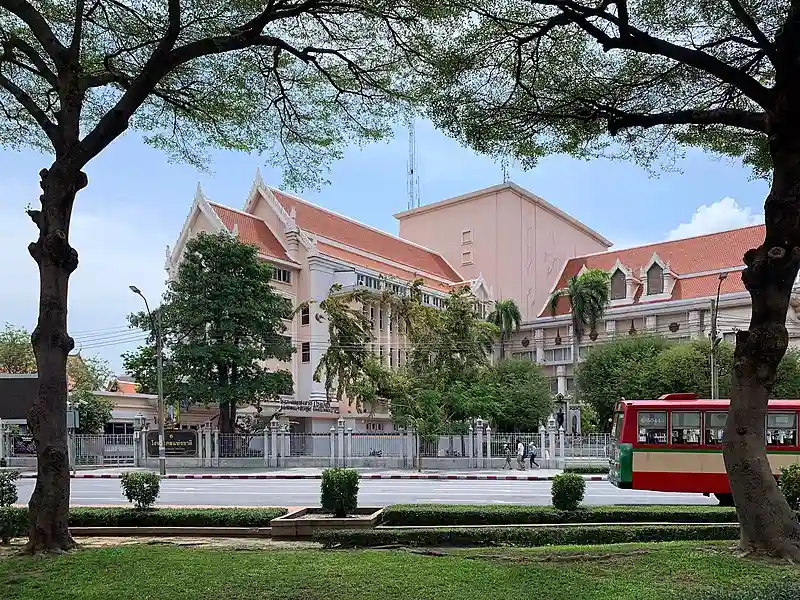
Open Days: Saturday – Sunday (the main performance season is often around December – April) and/or performance dates as announced by the Fine Arts Department
Opening Hours: Based on performance rounds (please check the latest schedule before visiting)
National Theatre is a Bangkok attraction and a major performing-arts venue under the Fine Arts Department. It presents performances and theatrical arts every Saturday–Sunday during December through April, and there are also Thai cultural performances such as khon and classical theatre staged on the lawn area in front of the National Museum Bangkok (Phra Nakhon).
The Fine Arts Department took over khon, theatre, and music activities from the Bureau of the Royal Household in 1932. At that time, there was not yet a National Theatre building; there was only the Fine Arts Department’s performance hall, an old auditorium constructed of wood with a corrugated metal roof.
It was located on the right side of Phra Thinang Siwamokkhaphiman, which is part of the library and the National Museum Bangkok (Phra Nakhon). His Royal Highness Prince Bhanubandhu Yugala renovated the auditorium, and later it was renamed from the Fine Arts Department Auditorium to the “Silpakorn Theatre.” A fire occurred on 9 November 1960.
The National Theatre was then constructed in the fiscal years 1961–1965 with a total budget of 56,484,465 baht. The architect was Mr. Itsara Wiwattananon, and the supervising engineer was Professor Dr. Rachot Kanchanawanich. Later, further modifications were made, with Mom Chao Samai Chaloem Kritdakorn serving as the revising architect, using an additional budget of 41 million baht.
When construction had progressed to a certain stage, the theatre construction committee respectfully invited His Majesty the King to visit the National Theatre under construction. His Majesty visited on 9 January 1964 and graciously provided recommendations and additional improvements. After that, the National Theatre was completed and officially opened on 23 December 1965, with Field Marshal Thanom Kittikachorn, the Prime Minister, presiding over the opening ceremony.
His Majesty the King and Her Majesty the Queen graciously attended a Thai classical performing-arts program on the opening night of the National Theatre, 23 December 1965. The program featured three sets: (1) the floral dance offering of “Silver Flowers and Golden Flowers” in tribute, (2) a classical drama, Sangkha Sinchai, episode “Chup Sangkha Sinchai,” and (3) a khon performance from the Ramakien, set “Ramavatar.” This was regarded as the auspicious beginning of the National Theatre’s operations from that time onward.
From a traveler’s point of view, the National Theatre feels like a “gateway to authentic Thai performing arts,” because its program calendar often includes khon, classical theatre, and Thai music depending on the season and special occasions. What makes the experience different from watching clips or typical tourist shows is the detail of the piphat ensemble, stage composition, codified movement language, and the formal atmosphere of a major theatre that is intentionally maintained to professional standards. Audiences can experience beauty, precision, and the “discipline of the arts” that defines Thai classical performance.
If you are planning a Rattanakosin Island itinerary, the National Theatre can easily become the anchor of your day: start the morning at the National Museum Bangkok (Phra Nakhon) or nearby historic sites, take a lunch break, then attend a performance round in the afternoon or evening. It is also a great indoor activity that helps you reset after Bangkok heat, and it turns a day of temples and photos into something more alive by adding cultural performance into the mix.
For admission, the National Theatre typically offers multiple price tiers depending on the performance and seating. Prices often seen in theatre announcements are around 200 / 150 / 100 / 60 baht, and some programs may have special conditions or limited free admission. For the most accurate plan, it is best to check the latest performance listing and current ticket prices in the official ticketing system before your visit, so you can choose a round and seats that fit your group.
Getting There The National Theatre is located in the Phra Nakhon area, near the National Museum Bangkok (Phra Nakhon) and the old-town zone. A straightforward approach for visitors who want to avoid heavy traffic is to take the MRT Blue Line and then transfer to a short taxi/ride-hail trip, or use buses that pass through the Sanam Luang–Phra Nakhon area. If you are driving, allow extra time and check nearby parking options in advance; you can also call the National Theatre to confirm details before you go.
In terms of experience, the National Theatre is not only a place to watch a show; it functions like a “living cultural classroom” for all audiences—students, teachers, and international visitors who want to understand the foundations of Thai performing arts in a clear, structured way. Watching khon or classical theatre in this auditorium highlights the difference between performances designed specifically for the stage and those presented at festivals or outdoor venues, because the theatre can precisely control lighting, sound, timing, and atmosphere. As a result, viewers can sense the “weight of the art” in each scene more distinctly.
Another dimension many people may not immediately notice is the National Theatre’s role as a space for cultivating and transmitting professional knowledge of Thai dance and Thai music. Many productions are not created for entertainment alone; they preserve rigorous standards of movement, piphat repertoire, and traditional staging formats passed down with strict discipline. This is why the National Theatre differs from typical theatres and why scholars, artists, and culture enthusiasts often regard it as a national “reference stage” for Thai performance.
During the peak tourism season from late year into early year (especially December through April), the National Theatre often schedules performances on Saturdays and Sundays alongside outdoor cultural performances on the lawn in front of the National Museum Bangkok (Phra Nakhon). This helps broaden access to Thai performing arts for the general public. Watching an outdoor performance amid historic architecture around Rattanakosin Island is a very different experience from sitting inside the hall, and it suits visitors who want to absorb Thai culture in the old-town context more fully.
If you want a “worth-the-whole-day” visit without running around too much, the easiest method is to treat the National Theatre as the centerpiece of an old-town trip and then place nearby sights around your chosen performance round. For example, start with the museum and Sanam Luang in the morning, attend the show in the afternoon, then end the day at Tha Tien or Tha Maharaj. This planning style gives you history, art, and the old-town atmosphere in one day without pushing the pace too hard.
A sample 1-day itinerary around the National Theatre: In the morning, begin at the National Museum Bangkok (Phra Nakhon) to understand history, fine arts, and the cultural context of Thai performance, then walk around Sanam Luang and photograph nearby architecture. Have lunch in the Samran Rat or Dinso area. In the afternoon, head to the National Theatre to collect tickets and attend your chosen round. An afternoon performance helps you avoid rushing, and you can still continue to nearby temples or museums afterward. In the evening, if you still have time, continue to Tha Tien, Wat Pho, or a Chao Phraya riverside walk to end the day with a relaxed atmosphere before returning.
| Place Summary | A Fine Arts Department venue for Thai performing arts (khon, classical theatre, Thai music) in Phra Nakhon, near the National Museum Bangkok (Phra Nakhon) |
| Highlights | Official-standard Thai classical performances, a theatre atmosphere that elevates the experience, and a strong fit for an old-town cultural itinerary |
| Ticket Price & Admission | Commonly seen price tiers in National Theatre announcements: 200 / 150 / 100 / 60 baht (depending on program and seating), and some programs may offer limited free admission For inquiries: 0 2224 1342, 0 2221 0171 |
| Zones | Front area / information point and entrance Ticket counter / ticket collection area (varies by show-day arrangements) Main auditorium / seating for performances Surrounding museum–Sanam Luang area (ideal for extending an old-town walk) |
| Nearby Accommodations | Riva Surya Bangkok (approx. 3 km) Tel. +66 2 633 5000 Navalai River Resort (approx. 3 km) Tel. 02-280-9955 sala rattanakosin bangkok (approx. 3 km) Tel. +66 2 622 1388 Riva Arun Bangkok (approx. 3 km) Tel. +66 (0)2 221 1188 Feung Nakorn Balcony (approx. 2 km) Tel. +66 92 269 8087 (or +66 2 622 1100) |
| Nearby Attractions | National Museum Bangkok (Phra Nakhon) (approx. 1 km) Tel. 02 224 1402, 02 224 1333 Museum Siam (approx. 3 km) Tel. 02-225 2777 Wat Phra Kaew (Temple of the Emerald Buddha) (approx. 3 km) Tel. 02 224 3290 Bangkok Metropolitan Administration (Giant Swing) (approx. 3 km) Tel. 0-2221-2141-69 Wat Pho (approx. 4 km) Tel. 083-057-7100 |
| Nearby Restaurants | Thip Samai (Pad Thai Pratu Phi) (approx. 3 km) Tel. 02-226-6666 Jay Fai (Pratu Phi) (approx. 3 km) Tel. 02 223 9384 Krua Apsorn (Dinso branch) (approx. 3 km) Tel. 02-685-4531 Methavalai Sorndaeng (approx. 3 km) Tel. 02-224-3088, 02-224-3178 The Sixth (Tha Tien) (approx. 4 km) Tel. 064-078-7278 |
Frequently Asked Questions (FAQ)
Q: During which months does the National Theatre usually have performances?
A: Commonly referenced information is that weekend rounds (Saturday–Sunday) often appear around December through April, and there are also special rounds/programs as announced. Please check the latest schedule before visiting.
Q: Where can I buy tickets?
A: Tickets are generally available through the National Theatre’s online system and at the ticket counter (depending on each show’s timing and conditions). If you want to confirm, call 0 2224 1342 or 0 2221 0171.
Q: If I have never watched khon or Thai classical theatre before, will I still understand it?
A: Yes. Much of the appeal comes from movement language, music, and stage storytelling. Even if you do not know every plot detail, you can still enjoy the beauty and grandeur.
Q: How early should I arrive before the performance?
A: It is recommended to arrive at least 20–30 minutes early to collect tickets, find your seat, and enter without rushing, especially on busy days or when tour groups are present.
Tel : 022241342, 022221092
 Tel : 022241342, 022221092
 Category: ●Entertainment and Agricultural
 Group: ●Theater
Last Update : 8 MonthAgo
 Last Update : 8 MonthAgo
 Click to Access the Navigation Map GPS
National Theatre Map
Recommend

 Art, Culture and Heritage
 Historical Sites and Monuments(3)
 Landmarks and Memorials(23)
 Royal Palace(13)
 Art, Craft Centres, Tradition(35)
 Museums(59)
 Historic Homes and Cities(3)
 Art Gallery(16)
 Educational Places
 Museum for Study(6)
 Library(4)
 Places of Worship
 Temple(72)
 Church(2)
 Mosque(67)
 Other Sacred Sites(8)
 Research and Development
 Royal Project(1)
 Suburban Living
 Village, Community(5)
 Local Market(9)
 Floating Market(2)
 Nature and Wildlife
 River, Canal(3)
 Bays and Beaches(1)
 Other natural attractions(1)
 Zoos and Aquariums(4)
 Animal camps and shows(5)
 Stadium(9)
 Farms, Parks and Ecotourism(20)
 Amusement Park(1)
 Waterpark(1)
Theater(7)
Waterpark(1)
Theater(7)
 Cinema(1)
 Shopping
 Shopping and Night Market(20)
 Department Store(7)
 Spas and Wellness
 Spas and Wellness(1)
 Restaurant
 Michelin Star(5)
 Accommodation
 Hotel(3)
 Call Customer Service in Tourism
 Call Customer Service in Tourism(1)
 Travel Articles, Recipes
 Travel Review, Food Review(21)
 Royal Thai Desserts and Recipes(56)


