
lovethailand home >North Travel Attractions
> Chiang Rai Travel Attractions
TL;DR: A quick overview of attractions in Chiang Rai, plus planning details, access, and key travel highlights.
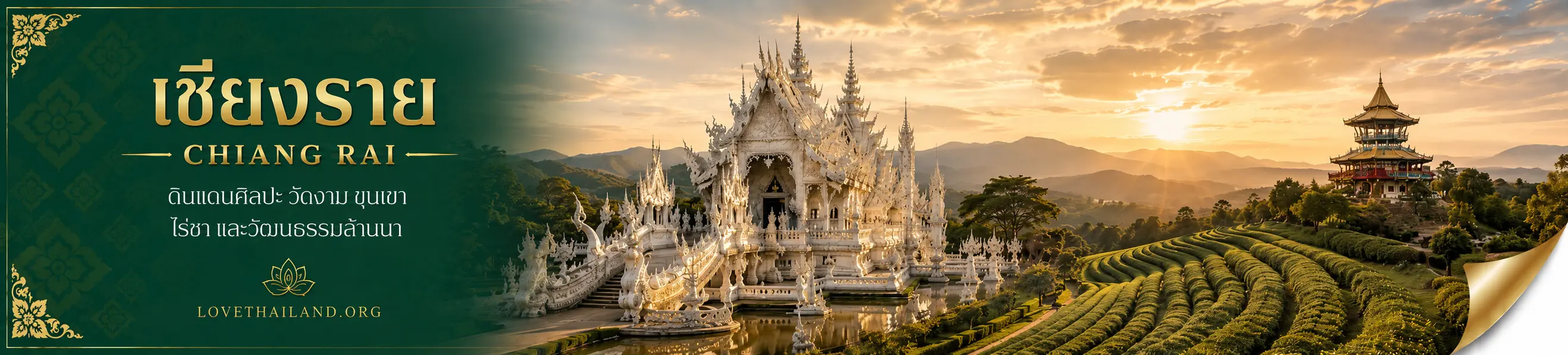
Chiang Rai
Slogan : The northernmost of Siam, the frontiere of three lands, the home to the culture of Lanna and Doi Tung Temple.
Chiang Rai is the northernmost province of Thailand and one of the most distinctive destinations in the country, known for its unique combination of geography, history, culture, and way of life. This province is not only a popular travel destination but also widely recognized as the “origin of the Lanna Kingdom,” where traditional culture still thrives in architecture, customs, language, and local lifestyles.
Chiang Rai was founded in 1262 (B.E. 1805) by King Mangrai the Great, who unified the Lanna Kingdom and established the city as its first capital. He chose the Kok River basin as the center of the city due to its fertile land and strategic advantages. Although the capital was later moved to Chiang Mai, Chiang Rai has remained a fundamental cultural and spiritual center of Lanna heritage.
Geographically, Chiang Rai is characterized by complex mountain ranges, with the Phi Pan Nam Range forming the backbone of the region. This terrain results in a cool climate throughout the year, especially during winter. The province is also the source of several important rivers, including the Kok River, Lao River, and Mekong River, which plays a vital role in connecting Thailand with neighboring countries.
One of the most internationally significant areas in Chiang Rai is the “Golden Triangle,” where Thailand, Myanmar, and Laos meet. This area, located along the Mekong River, was historically known as a major opium trading hub but has since transformed into a cultural and historical tourism destination with panoramic views of three countries.
Chiang Rai is home to numerous natural attractions with unique identities, such as Phu Chi Fa, Pha Tang, Doi Mae Salong, Doi Tung, and Phu Chi Dao. These locations are famous for their spectacular sea of mist and sunrise viewpoints, especially during the winter season when temperatures drop and the landscapes become exceptionally scenic.
The best time to visit Chiang Rai is between November and February, when the weather is cool and comfortable. During this period, travelers can enjoy misty mountain views almost every morning. It is also the season when wild Himalayan cherry blossoms bloom, turning entire mountainsides pink, particularly around Doi Mae Salong.
Culturally, Chiang Rai is one of the most ethnically diverse provinces in Thailand. It is home to various hill tribes such as the Hmong, Akha, Lahu, Lisu, and Yao, as well as Chinese communities on Doi Mae Salong. Each group has its own language, clothing, and traditions, creating a vibrant cultural landscape that is rarely found elsewhere.
Traditional festivals in Chiang Rai reflect the lifestyle and beliefs of local communities. Events such as the Hmong New Year, Akha Swing Festival, and Loy Krathong along the Kok River combine ancient traditions with modern tourism experiences.
Economically, Chiang Rai plays a significant role as a producer of high-quality tea and coffee. Oolong tea from Doi Mae Salong and Arabica coffee from Doi Chang have gained international recognition. The province also benefits from cross-border trade with Laos and Myanmar.
Chiang Rai is also considered a hub of contemporary art in Thailand, featuring world-renowned landmarks such as the White Temple (Wat Rong Khun), the Black House (Baan Dam Museum), and the Blue Temple (Wat Rong Suea Ten). These sites represent a fusion of traditional Lanna art and modern creativity, giving Chiang Rai a distinctive artistic identity.
For travelers, Chiang Rai offers flexible itinerary options. A 3-day trip typically covers the city’s main attractions, while a 4–5 day journey allows visitors to explore mountain destinations in greater depth. Most trips begin in the city with visits to iconic sites such as the White Temple, Blue Temple, and Black House, followed by excursions to Doi Mae Salong, Doi Tung, and scenic viewpoints like Phu Chi Fa.
Traveling in Chiang Rai can also be organized by zones, including the city center, Mae Sai, Mae Fah Luang, and Wiang Kaen areas. Each zone offers different experiences, allowing visitors to tailor their journey according to their interests.
In terms of experience, Chiang Rai is ideal for relaxation, photography, and cultural exploration. The province retains its natural beauty and authentic lifestyle, making it a perfect destination for those seeking a deeper connection with Northern Thailand.
Getting There Chiang Rai can be reached by air via Mae Fah Luang Chiang Rai International Airport, with a flight time of approximately 1 hour and 20 minutes from Bangkok. Alternatively, it is about a 3-hour drive from Chiang Mai via Highway 1. For local travel, renting a car is highly recommended due to the mountainous terrain and distances between attractions.
Chiang Rai offers a complete travel experience, combining nature, culture, art, and authentic local life, making it one of the most rewarding destinations in Northern Thailand.
Chiang Rai Festivals 2026
| Period | Festival | Location | Details |
| January | Hmong New Year | Santikhiri Village, Doi Mae Salong | Traditional games and cultural dress |
| February | Cherry Blossom Festival | Doi Mae Salong | ชมดอกนางพญาเสือโคร่ง |
| March | Akha Swing Festival | Akha Villages | Hill tribe traditions |
| April | Songkran Festival | Thanon Thanalai, City Center | Water festival and traditions |
| November | Loy Krathong | Kok River / Suan Tung | Floating lanterns and lights |
3–5 Day Chiang Rai Travel Itinerary
| Day | Route | Attractions | Highlights |
| Day 1 | City Center | White Temple, Blue Temple, Black House, Clock Tower | Iconic landmarks and world-class art |
| Day 2 | Mae Sai & Golden Triangle | Doi Tung, Mae Sai, Golden Triangle | Border views and history |
| Day 3 | Doi Mae Salong | Tea plantations, Chinese village | Mountain scenery and tea culture |
| Day 4 | Wiang Kaen | Phu Chi Fa, Pha Tang | Sea of mist and sunrise |
| Day 5 | Optional | Singha Park, Khun Korn Waterfall, Doi Chang | Nature and outdoor activities |
Must Visit Attractions in Chiang Rai (Top 15)
| No. | Place | Zone | Highlight |
| 1 | White Temple | City | World-famous art temple |
| 2 | Blue Temple | City | Unique blue architecture |
| 3 | Black House | City | Contemporary Lanna art |
| 4 | Doi Tung | Mae Fah Luang | Royal project and gardens |
| 5 | Phu Chi Fa | Wiang Kaen | Sea of mist viewpoint |
| 6 | Pha Tang | Wiang Kaen | Mekong River view |
| 7 | Doi Mae Salong | Mae Fah Luang | Tea plantations |
| 8 | Golden Triangle | Chiang Saen | Three-country landmark |
| 9 | Doi Chang | Mae Suai | World-class coffee |
| 10 | Khun Korn Waterfall | City | Tallest waterfall |
| 11 | Singha Park | City | Outdoor activities |
| 12 | Tham Luang Cave | Mae Sai | Famous rescue site |
| 13 | Clock Tower | City | City landmark |
| 14 | Mae Sai | Border | Northernmost point |
| 15 | Tea Plantation 101 | Mae Salong | Scenic tea fields |
Frequently Asked Questions (FAQ)
Q: How many days should I spend in Chiang Rai?
A: 3–4 days is ideal to explore both the city and mountain areas.
Q: Is Chiang Rai worth visiting?
A: Yes, it offers unique culture, nature, and iconic landmarks.
Q: Can I travel Chiang Rai without a car?
A: Yes, but renting a car or joining a tour is recommended.
Q: What is the best time to visit Chiang Rai?
A: November to February for cool weather and misty views.
Q: What are the must-see places in Chiang Rai?
A: White Temple, Doi Tung, Phu Chi Fa, and Golden Triangle.
Q: Is Chiang Rai better than Chiang Mai?
A: Chiang Rai is quieter and more nature-focused.
Q: How much budget is needed for Chiang Rai?
A: Around 100–250 USD depending on travel style.
Chiang Rai Map

 Art, Culture and Heritage
 Historical Sites and Monuments(3)
 Landmarks and Memorials(7)
 Art, Craft Centres, Tradition(6)
 Museums(8)
 Historic Homes and Cities(1)
 Educational Places
 Museum for Study(1)
 Library(1)
 Educational Gardens, Farm(3)
 Places of Worship
 Temple(38)
 Other Sacred Sites(5)
 Research and Development
 Royal Project(9)
 Suburban Living
 Village, Community(16)
 Local Market(5)
 Nature and Wildlife
 National Parks and Marine Reserves(18)
 Mountain (Doi)(20)
 Dam, Reservoir, Lake(8)
 Waterfalls(16)
 Hot Springs(6)
 Caves(8)
 River, Canal(10)
 Sea, Beach(1)
 Other natural attractions(3)
 Entertainment and Agricultural
 Animal camps and shows(1)
 Farms, Parks and Ecotourism(9)
 Shopping
 Shopping and Night Market(2)
 Call Customer Service in Tourism
 Call Customer Service in Tourism(1)
 Travel Articles, Recipes
 Travel Review, Food Review(1)
 Food Menu, North Recipes(1)


