
lovethailand home >Northeastern Travel Attractions
> Roi Et Travel Attractions
TL;DR: A quick overview of attractions in Roi Et, plus planning details, access, and key travel highlights.
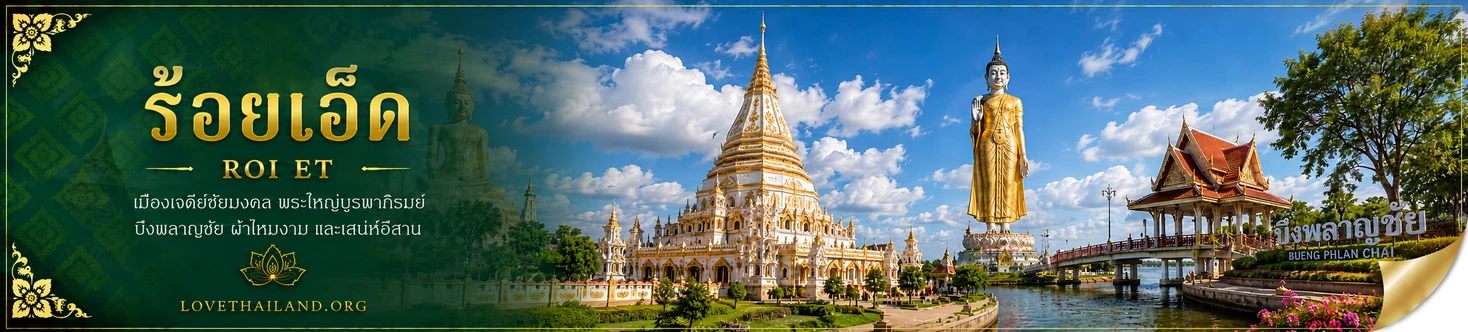
Roi Et
Slogan : Dimond of north-east, Pra chai nice lake, famous hight-grade monk, the best of silk, beautiful girl, nice Thung kula.
Roi Et Province is one of the key provinces in northeastern Thailand, or the Isan region. It is well known for its distinctive identity in history, culture, traditions, and a way of life that continues to preserve authentic northeastern heritage. This identity is reflected in the provincial motto: “Eleven beautiful city gates, renowned for the tall Buddha image, exquisite Saket silk, Bun Phawet festival tradition, the magnificent Chai Mongkol Chedi, the scenic Bueng Phlan Chai, the vast Thung Kula fields, and world-famous jasmine rice.” This motto encapsulates the province’s historical prosperity, religious devotion, agricultural richness, and natural beauty.
Roi Et Province is located in the central part of northeastern Thailand, within the Chi River basin, an area of significant geographical and cultural importance since ancient times. This region was once a center of early civilization influenced by both the Khmer Empire and Dvaravati culture, as evidenced by numerous archaeological remains such as ancient monuments, stone sanctuaries, and sema stones that hold artistic and religious significance.
In the past, this area was known as “Saket Nakhon” or “Kuluntha Nakhon,” a prosperous city that governed 11 satellite towns. This is the origin of the name “Roi Et,” which does not literally mean “101,” but symbolically represents greatness and abundance. These 11 satellite towns included Chiang Hian, Fa Daet, Si Kaew, Pueai, Thong, Hong, Bua, Khong, Chiang Khwang, Chiang Di, and Phai, all of which still contain historical traces today.
Archaeological evidence indicates that human settlement in Roi Et dates back to the prehistoric era, particularly in Ban Mueang Bua, where remains are estimated to be around 1,800 to 2,500 years old. Later, during the historical period, Buddhism spread into the region through Dvaravati culture between the 7th and 10th centuries CE, leading to the creation of numerous sema stones and Buddha images that can still be found throughout the province.
By the 11th century CE, the influence of the Khmer Empire became prominent in the region, resulting in the construction of Khmer-style religious structures such as Ku Ka Sing, Ku in Thawat Buri district, and Ku Phra Kona. These sites reflect the artistic sophistication and religious beliefs of that era.
Following this period, there is a gap of approximately 400 years in the historical record of Roi Et. The history becomes clearer again during the late Ayutthaya period, when unrest in Vientiane led Phra Khru Phon Samet to migrate people into the area and establish new settlements, restoring prosperity to the region.
During the Rattanakosin period, Roi Et was formally established as an important administrative center and continued to develop steadily. Significant reforms took place during the reign of King Rama VI, when the Monthon Roi Et administrative system was introduced, positioning the province as a regional governance hub.
One of the most notable development projects in the province’s history is the excavation of “Bueng Phlan Chai,” located in the city center. This project mobilized more than 40,000 people and took over two years to complete, transforming it into a vital water source and a symbolic landmark that remains important to this day.
Today, Roi Et Province is divided into 20 districts and remains a major agricultural center, particularly known for producing high-quality jasmine rice that is recognized worldwide. The Thung Kula Ronghai area is especially regarded as one of the best jasmine rice cultivation regions in Thailand.
In addition to its historical significance, Roi Et Province is also known as a city of religion and deep faith. One of its most important landmarks is Phra Maha Chedi Chai Mongkol, a magnificent and large-scale pagoda that serves as a spiritual center for Buddhists. The province is also home to many significant temples that reflect the artistic styles and religious beliefs of different historical periods.
The cultural traditions of Roi Et remain vibrant and are actively preserved by local communities. One of the most prominent traditions is Bun Phawet, a major merit-making festival associated with the Vessantara Jataka. The event features grand processions and the recitation of the Mahachat sermon, symbolizing strong faith and unity within the community.
Other important traditions include the Rocket Festival (Bun Bang Fai), the Songkran Festival, and various merit-making ceremonies held throughout the year. These traditions are deeply connected to religion, seasonal cycles, and the agricultural lifestyle of the Isan people.
In terms of cuisine, Roi Et is a true destination for authentic northeastern Thai food, known for its bold and distinctive flavors. Popular dishes include som tam (papaya salad), larb, koi, nam tok, and kaeng om, along with a wide variety of local dishes made from natural ingredients. The province also offers local products such as Saket silk, handicrafts, and traditional souvenirs that reflect the wisdom and creativity of the local community.
Getting There Traveling to Roi Et is convenient and accessible via multiple modes of transportation, including private car, interprovincial buses, and domestic flights. Roi Et Airport provides direct flights from Bangkok, with a travel time of approximately 1 hour. Alternatively, traveling by car from Bangkok covers a distance of around 512 kilometers.
With its rich combination of history, culture, traditions, cuisine, and attractions, Roi Et Province is an ideal destination for travelers seeking an authentic Isan experience. Visitors can enjoy peaceful surroundings, spiritual depth, and a simple yet meaningful way of life that continues to thrive in this region.
Roi Et Province Festival Calendar 2026
| Festival | Date | Time | Location | Highlights |
| Bun Phawet (Mahachat Sermon Festival) | February 2026 | All Day | Bueng Phlan Chai, Mueang Roi Et District | Grand Vessantara Jataka procession and 13-chapter Mahachat sermon, one of the largest in Isan |
| Phra Maha Chedi Chai Mongkol Festival | January 2026 | Morning – Evening | Wat Pha Nam Yoi, Nong Phok District | Religious ceremonies, candlelight processions, and large merit-making events |
| Rocket Festival (Bun Bang Fai) | May – June 2026 | Daytime | Various districts such as Kaset Wisai and Suwannaphum | Traditional rocket launching to ask for rain, folk performances, and colorful parades |
| Songkran Festival Roi Et | April 13 – 15, 2026 | All Day | Roi Et City Center | Water celebrations, merit-making, Buddha bathing rituals, and cultural activities |
| Loy Krathong at Bueng Phlan Chai | November 2026 | 18:00 – 22:00 | Bueng Phlan Chai | Krathong floating ceremony, light shows, and cultural performances |
3–5 Day Roi Et Travel Itinerary
| Day | Place | Location | Highlights |
| Day 1 | Bueng Phlan Chai | Nai Mueang Subdistrict, Mueang Roi Et District | City landmark with scenic lake views, ideal for walking and photography |
| Day 1 | Wat Buraphaphiram | Mueang Roi Et District | Home to Thailand’s tallest standing Buddha image |
| Day 2 | Phra Maha Chedi Chai Mongkol | Wat Pha Nam Yoi, Nong Phok District | Magnificent pagoda with panoramic mountain views |
| Day 2 | Pha Nam Yoi | Nong Phok District | Natural viewpoint with scenic landscapes and misty mornings |
| Day 3 | Ku Ka Sing | Kaset Wisai District | Ancient Khmer sanctuary over several hundred years old |
| Day 4 | Thung Kula Ronghai | Multiple districts in Roi Et | World-famous jasmine rice cultivation area |
| Day 5 | Local Market | Roi Et City | Local food, traditional snacks, and souvenirs |
Top 10 Must-Visit Attractions in Roi Et
| Attraction | Full Address | Highlights |
| Bueng Phlan Chai | Ploenchit Road, Nai Mueang Subdistrict, Mueang Roi Et District, Roi Et 45000 | Central city landmark with scenic views |
| Wat Buraphaphiram | Chaeng Sanit Road, Nai Mueang Subdistrict, Mueang Roi Et District, Roi Et 45000 | Tallest standing Buddha image in Thailand |
| Phra Maha Chedi Chai Mongkol | Wat Pha Nam Yoi, Ban Khok Klang, Pha Nam Yoi Subdistrict, Nong Phok District, Roi Et 45210 | Grand national-level pagoda |
| Ku Ka Sing | Ku Ka Sing Subdistrict, Kaset Wisai District, Roi Et 45150 | Ancient Khmer ruins |
| Wat Klang Ming Mueang | Sunthon Thep Road, Nai Mueang Subdistrict, Mueang Roi Et District, Roi Et 45000 | Beautiful architecture |
| Pha Nam Yoi | Pha Nam Yoi Subdistrict, Nong Phok District, Roi Et 45210 | Scenic natural viewpoint |
| Thung Kula Ronghai | Across Kaset Wisai and Suwannaphum Districts, Roi Et | World-class jasmine rice fields |
| Wat Ban Mueang Bua | Mueang Bua Subdistrict, Kaset Wisai District, Roi Et 45150 | Important archaeological site |
| Bueng Kluea | Ko Kaeo Subdistrict, Selaphum District, Roi Et 45120 | Peaceful natural scenery |
| Roi Et Municipal Market | Ronchai Chan Yut Road, Nai Mueang Subdistrict, Mueang Roi Et District, Roi Et 45000 | Local food and traditional products |
Frequently Asked Questions (FAQ)
Q: What are the must-visit attractions in Roi Et Province?
A: The top attractions include Bueng Phlan Chai, the central landmark of the city; Wat Buraphaphiram, home to Thailand’s tallest standing Buddha image; Phra Maha Chedi Chai Mongkol, one of the most magnificent pagodas in the country; and Ku Ka Sing, an ancient Khmer sanctuary with significant historical value.
Q: When is the best time to visit Roi Et?
A: The best time to visit is between November and February when the weather is cool and comfortable. This period also features important festivals such as Bun Phawet and Loy Krathong, enhancing the overall travel experience.
Q: What are the most famous festivals in Roi Et?
A: Major festivals include Bun Phawet (Mahachat Sermon Festival), the Rocket Festival (Bun Bang Fai), and the Phra Maha Chedi Chai Mongkol celebration, all of which reflect the strong religious faith and cultural identity of the local community.
Q: How many days should I spend in Roi Et?
A: A 3–5 day trip is recommended to fully explore the province’s temples, historical sites, natural attractions, and local lifestyle.
Q: How can I travel to Roi Et?
A: Roi Et is accessible by air, bus, and private car. The province has an airport with direct flights from Bangkok, taking approximately 1 hour. Traveling by car from Bangkok covers a distance of around 512 kilometers.
Q: What type of travel experience does Roi Et offer?
A: Roi Et is ideal for cultural, religious, and local lifestyle tourism. It is especially suitable for travelers seeking a peaceful atmosphere, authentic Isan culture, and meaningful travel experiences.
Roi Et Map

 Art, Culture and Heritage
 Historical Sites and Monuments(3)
 Landmarks and Memorials(5)
 Art, Craft Centres, Tradition(2)
 Museums(1)
 Educational Places
 Educational Gardens, Farm(3)
 Places of Worship
 Temple(35)
 Other Sacred Sites(6)
 Suburban Living
 Village, Community(1)
 Local Market(1)
 Nature and Wildlife
 National Parks and Marine Reserves(1)
 Mountain (Doi)(2)
 Dam, Reservoir, Lake(8)
 Waterfalls(1)
 Flower Field(1)
 River, Canal(4)
 Entertainment and Agricultural
 Zoos and Aquariums(1)
 Stadium(1)
 Farms, Parks and Ecotourism(5)
 Shopping
 Shopping and Night Market(1)


