
lovethailand home >Northeastern Travel Attractions
> Surin Travel Attractions
TL;DR: A quick overview of attractions in Surin, plus planning details, access, and key travel highlights.
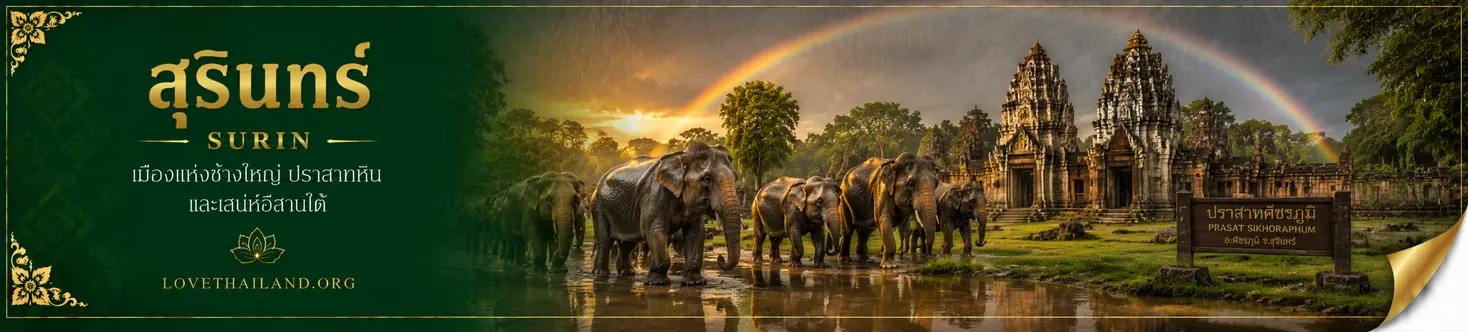
Surin
Slogan : Surin the city of big elephent, beautiful silk, many castle, sweet lettuce ,smell rice so good, nice culture.
Surin Province is one of the key provinces in northeastern Thailand, commonly known as “Isan.” It is located in the lower northeastern region, often referred to as “Southern Isan,” an area distinguished by its unique cultural identity, language, and way of life that differ from other parts of the region. Surin is widely recognized both nationally and internationally as the “Land of Elephants” or “Surin, the Great Elephant Land,” reflecting a deep-rooted relationship between humans and elephants that has been passed down through generations.
The province covers an area of approximately 8,124 square kilometers, or around 5 million rai, ranking as the 24th largest province in Thailand. Its geography can be divided into three main zones: mountainous terrain in the south along the Phanom Dong Rak mountain range, which forms a natural border with Cambodia; undulating plains in the central region; and fertile lowlands in the north suitable for agriculture. Important water sources include the Mun River, Chi River, and Huai Saneng, all of which have sustained local communities for centuries.
Surin experiences a tropical monsoon climate with three distinct seasons: summer, rainy season, and winter. The rainy season plays a crucial role in rice cultivation, particularly jasmine rice, which is the province’s primary economic crop. The richness of the soil and water resources makes Surin an important agricultural hub in Thailand.
Historically, Surin has been a significant settlement since the era of the ancient Khmer civilization more than 2,000 years ago. Evidence of this can be seen in stone sanctuaries such as Sikhoraphum Castle and Ban Phluang Castle, along with numerous archaeological sites scattered across the province. These structures reflect the strong influence of the Khmer Empire, which once flourished in this region. After the decline of Khmer power, many settlements were abandoned for a period before being reestablished during the late Ayutthaya period.
The true identity of Surin began to emerge with the arrival of an indigenous ethnic group known as the “Kui” (also called Suay). Around 1717, this group migrated into the area and established communities. The Kui people are particularly renowned for their exceptional skill in capturing and training wild elephants for use in agriculture, transportation, and warfare. This expertise led to Surin becoming a major center for elephant domestication in Thailand and the origin of its reputation as the “Elephant City.”
In 1763, Luang Surin Phakdi (Chiang Pum) relocated the community to Ban Ku Prathai, an area with strategic advantages, abundant water resources, and strong defensive potential. The settlement was later elevated to city status. In 1786, King Rama I officially renamed the city “Surin,” a name that has remained ever since. It was later designated as Surin Province in 1908 during the administrative reforms under the monthon system.
Surin stands out for its rich ethnic diversity, with three main population groups: Khmer-Thai, Kui, and Lao-Isan communities. Each group maintains its own language, cultural practices, and beliefs, yet they coexist harmoniously. This diversity is clearly reflected in daily communication, traditional attire, rituals, and local cuisine.
One of the most defining characteristics of Surin Province is its deeply rooted cultural diversity, which has evolved from the coexistence of multiple ethnic groups, particularly the Khmer-Thai, Kui, and Lao-Isan communities. Each group contributes its own linguistic patterns, rituals, belief systems, and artistic expressions, forming a unique cultural landscape that is rarely found elsewhere in Thailand. This blend is not superficial but embedded in everyday life, from spoken language to ceremonial practices and traditional craftsmanship.
Among these groups, the Kui people hold a particularly significant role in shaping Surin’s identity. Historically known for their expertise in elephant capture and training, the Kui have maintained a profound spiritual and practical relationship with elephants. This connection is not merely occupational but deeply cultural, involving rituals, respect, and symbolic meanings that reinforce the bond between humans and animals. The continuation of this tradition has positioned Surin as Thailand’s most prominent elephant province.
Surin’s cultural heritage is strongly reflected in its annual festivals and traditional ceremonies. One of the most internationally recognized events is the Surin Elephant Round-Up Festival, held every November. This large-scale event showcases elephant performances, historical reenactments, and cultural displays, attracting both domestic and international visitors. Beyond entertainment, the festival serves as a cultural preservation platform, highlighting the historical significance of elephants in Thai society.
Another important tradition is the “San Don Ta” festival, a ritual practiced among the Khmer-Thai community to honor ancestral spirits. This ceremony typically takes place around September or October and involves offerings, prayers, and communal gatherings. It reflects a belief system centered on gratitude, respect for lineage, and spiritual continuity. The festival demonstrates how ancient beliefs continue to influence modern community life in Surin.
In addition to festivals, traditional crafts form a vital part of Surin’s cultural identity. The province is particularly famous for its silk weaving, especially high-quality mudmee silk, which features intricate patterns and vibrant natural dyes. These textiles are not only economically valuable but also represent inherited knowledge passed down through generations. The silk industry supports many local households and contributes significantly to the province’s cultural economy.
Surin’s culinary landscape is equally distinctive, reflecting the fusion of Khmer and Isan influences. Local dishes often emphasize bold flavors, fresh herbs, and locally sourced ingredients. Popular foods include spicy minced meat salads, grilled meats, fermented dishes, and traditional soups. Ingredients such as freshwater fish, forest vegetables, bamboo shoots, and wild mushrooms are commonly used, illustrating a strong connection between local cuisine and natural resources.
Beyond cultural richness, Surin’s economy is primarily driven by agriculture. The province is well known for producing high-quality jasmine rice, which is cultivated extensively across its fertile plains. Livestock farming, particularly cattle and buffalo, also plays a role in the rural economy. Additionally, silk production and handicrafts provide supplementary income and promote local entrepreneurship.
Another important economic factor is cross-border trade with Cambodia. Surin’s geographical location allows it to function as a gateway for commerce and cultural exchange. Border markets and trade routes contribute to regional economic activity, supporting both formal and informal sectors. This cross-border interaction enhances the province’s strategic importance in the lower northeastern region.
In terms of tourism, Surin offers a wide range of attractions that appeal to different types of travelers. Cultural tourism is particularly prominent, with visitors seeking authentic experiences such as elephant villages, traditional weaving communities, and historical Khmer ruins. Natural attractions, including reservoirs, forests, and scenic rural landscapes, provide additional opportunities for relaxation and exploration.
The province’s infrastructure supports accessibility, with road networks connecting Surin to major cities in northeastern Thailand and Bangkok. Public transportation options, including buses and trains, make it convenient for both domestic and international travelers. This accessibility enhances Surin’s potential as a growing tourism destination.
Overall, Surin Province represents a harmonious integration of history, culture, economy, and natural environment. Its unique identity, shaped by centuries of cultural interaction and adaptation, continues to attract visitors who are interested in exploring Thailand beyond mainstream destinations. The province’s strengths lie not only in its well-known elephant heritage but also in its ability to preserve and showcase a multifaceted cultural legacy.
Surin Province represents one of the most culturally rich and historically layered destinations in northeastern Thailand. Unlike more commercialized provinces, Surin offers a deeper and more authentic experience rooted in heritage, identity, and long-standing traditions. Its positioning as part of “Southern Isan” gives it a distinctive character shaped by Khmer influence, Kui heritage, and Lao-Isan culture, all of which coexist and continue to evolve in modern society.
From a strategic tourism perspective, Surin is best understood as a “cultural depth destination.” Travelers visiting the province are not only exploring places but engaging with living traditions, including elephant culture, ancestral rituals, textile craftsmanship, and local agricultural practices. This makes Surin particularly appealing to cultural tourists, experiential travelers, and those seeking meaningful travel beyond surface-level attractions.
One of the province’s strongest differentiators is its identity as Thailand’s elephant capital. The relationship between humans and elephants in Surin is not constructed for tourism alone but is deeply embedded in local history and daily life. Visitors can observe and learn about elephant care, training practices, and community-based conservation efforts, particularly in elephant villages such as Ban Ta Klang. This creates a unique value proposition that cannot be easily replicated in other destinations.
Another key strength lies in Surin’s preserved Khmer heritage. The presence of ancient stone sanctuaries, traditional ceremonies, and Khmer linguistic influence provides a rare opportunity to experience a cultural continuum that spans centuries. These elements contribute to Surin’s strong positioning in heritage tourism and archaeological interest within Thailand.
For travelers planning an itinerary, Surin is ideally explored over a period of 3 to 5 days. This allows sufficient time to experience its major highlights, including historical sites, elephant-related attractions, local markets, and cultural villages. The pace of travel in Surin is generally relaxed, making it suitable for those who prefer immersive and unhurried exploration.
Accessibility is another advantage. Surin can be reached from Bangkok by road or rail within approximately 6 to 8 hours. Once in the province, transportation between districts is manageable, although private vehicles or guided tours may offer greater flexibility for exploring rural areas and cultural sites.
In terms of future potential, Surin is well-positioned for sustainable tourism development. Its strong cultural assets, combined with community-based tourism initiatives, create opportunities for growth without compromising authenticity. This aligns with global travel trends that emphasize responsible tourism, cultural preservation, and local engagement.
Ultimately, Surin Province is not just a destination but a cultural narrative. It tells the story of human-animal relationships, ethnic diversity, historical transformation, and resilience. For those seeking to understand Thailand beyond its major cities and beaches, Surin offers a compelling and deeply enriching journey.
Annual Tourism Festivals in Surin Province 2026
| Festival Name | Date | Period | Location | Highlights |
| Surin Elephant Round-Up Festival | November 2026 | 3 Days | Si Narong Stadium, Mueang Surin District | Elephant shows, historical reenactments, cultural performances |
| San Don Ta Festival | September – October 2026 | 3–5 Days | Communities across Surin Province | Ancestor worship rituals, Khmer cultural ceremonies |
| Surin Silk Festival | December 2026 | 5–7 Days | Surin City Hall Area | Silk exhibitions, fashion shows, local handicrafts |
| Bun Bang Fai Festival (Rocket Festival) | May – June 2026 | 2–3 Days | Various Districts in Surin | Traditional rocket launching, rain-calling ritual |
| Songkran Festival Surin | April 13–15, 2026 | 3 Days | Downtown Surin | Water festival, traditional ceremonies, merit-making |
3–5 Days Travel Plan in Surin Province (Detailed Itinerary)
| Day | Destination | Location | Highlights |
| Day 1 | Surin City Exploration | Mueang Surin District | City landmarks, local markets, cultural overview, Surin National Museum |
| Day 2 | Ban Ta Klang Elephant Village | Tha Tum District | Elephant interaction, traditional Kui culture, elephant lifestyle learning |
| Day 3 | Sikhoraphum Castle & Silk Village | Sikhoraphum District | Khmer architecture, historical ruins, silk weaving communities |
| Day 4 | Phanom Dong Rak Mountain Range | Border Area with Cambodia | Scenic nature, viewpoints, cultural border exploration |
| Day 5 | Local Markets & Cultural Wrap-Up | Surin City & Nearby Areas | Souvenir shopping, silk products, local food tasting |
Top 10 MUST VISIT Places in Surin Province
| Place | Location | Highlights |
| Ban Ta Klang Elephant Village | Krapho Subdistrict, Tha Tum District, Surin Province | The most famous elephant village in Thailand, showcasing Kui elephant culture |
| Sikhoraphum Castle | Ra Ngaeng Subdistrict, Sikhoraphum District, Surin Province | Magnificent Khmer sanctuary with refined stone carvings |
| Ban Phluang Castle | Ban Phluang Subdistrict, Prasat District, Surin Province | Small but historically important Khmer stone temple |
| Surin National Museum | Chaniang Subdistrict, Mueang Surin District, Surin Province | Comprehensive insight into Surin’s history, archaeology, and ethnic heritage |
| Huai Saneng Reservoir | Chaniang Subdistrict, Mueang Surin District, Surin Province | Relaxing lakeside atmosphere, sunset views, and local recreation area |
| Surin City Pillar Shrine | Nai Mueang Subdistrict, Mueang Surin District, Surin Province | Sacred spiritual landmark in the heart of Surin city |
| Phanom Sawai Forest Park | Na Bua Subdistrict, Mueang Surin District, Surin Province | Hilltop viewpoint, Buddha images, and panoramic scenery over Surin |
| Chong Chom Border Market | Dan Subdistrict, Kap Choeng District, Surin Province | Thailand–Cambodia border trade area with local products and cross-border atmosphere |
| Wat Burapharam | Nai Mueang Subdistrict, Mueang Surin District, Surin Province | Important temple associated with Surin’s local faith and history |
| Surin Silk Weaving Communities | Various districts including Khwao Sinarin and nearby weaving villages, Surin Province | Traditional silk craftsmanship, local wisdom, and cultural shopping experience |
Frequently Asked Questions (FAQ)
Q: What is Surin Province best known for?
A: Surin Province is best known for its deep connection with elephants, earning the nickname “The Land of Elephants.” It is also famous for its Khmer-influenced culture, traditional silk weaving, and diverse ethnic heritage.
Q: When is the best time to visit Surin?
A: The best time to visit Surin is between November and February when the weather is cooler and more comfortable. November is especially recommended because of the Surin Elephant Round-Up Festival.
Q: What are the must-visit historical sites in Surin?
A: Key historical sites include Sikhoraphum Castle and Ban Phluang Castle, both of which showcase the influence of ancient Khmer civilization in the region.
Q: What cultural experiences can travelers expect in Surin?
A: Travelers can experience elephant culture in Kui communities, traditional Khmer ceremonies such as San Don Ta, silk weaving villages, and authentic Isan lifestyle practices.
Q: What local foods should I try in Surin?
A: Popular dishes include Isan-style spicy salads, grilled meats, fermented foods, soups, and dishes made from local ingredients such as fish, bamboo shoots, and wild mushrooms.
Q: What is the main economy of Surin Province?
A: Surin’s economy is mainly based on agriculture, especially jasmine rice farming. Other important sectors include silk production, livestock farming, and cross-border trade with Cambodia.
Q: How can I travel to Surin?
A: Surin can be reached by car, bus, or train from Bangkok, with travel time ranging from approximately 6 to 8 hours.
Q: How many days are recommended for visiting Surin?
A: A 3–5 day trip is ideal to fully explore Surin’s cultural sites, elephant villages, historical landmarks, and local markets.
Q: Is Surin suitable for international tourists?
A: Yes, Surin is suitable for international travelers who are interested in cultural tourism, history, and authentic local experiences beyond typical tourist destinations.
Q: Where should first-time visitors start in Surin?
A: First-time visitors should start in Surin city, exploring landmarks such as the City Pillar Shrine and Surin National Museum, before heading to elephant villages and historical sites.
Surin Map

 Art, Culture and Heritage
 Historical Sites and Monuments(11)
 Landmarks and Memorials(2)
 Art, Craft Centres, Tradition(5)
 Museums(1)
 Places of Worship
 Temple(15)
 Other Sacred Sites(1)
 Suburban Living
 Village, Community(9)
 Local Market(1)
 Nature and Wildlife
 National Parks and Marine Reserves(2)
 Mountain (Doi)(2)
 Dam, Reservoir, Lake(6)
 Waterfalls(1)
 River, Canal(2)
 Other natural attractions(4)
 Entertainment and Agricultural
 Animal camps and shows(1)
 Farms, Parks and Ecotourism(2)
 Travel Articles, Recipes
 Travel Review, Food Review(1)


