
lovethailand home >Northeastern Travel Attractions
> Ubon Ratchathani Travel Attractions
TL;DR: A quick overview of attractions in Ubon Ratchathani, plus planning details, access, and key travel highlights.
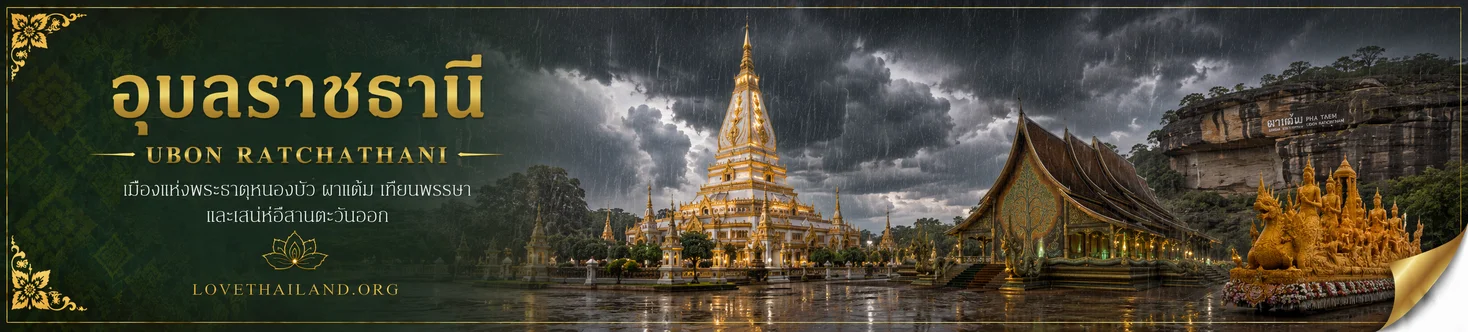
Ubon Ratchathani
Slogan : The city of beauty lotus, two color of river, yummy fish, rock sand, city of clever people, good people, beautiful candles, Pha Team is history.
Ubon Ratchathani is a province located in the northeastern region of Thailand, commonly known as Isan. It is situated in the lower northeastern part of the country and holds a unique geographical distinction as the easternmost province of Thailand, making it one of the first places in the country to witness the sunrise each day. The province is also aligned with Thailand’s standard time zone at 105 degrees east longitude. Today, Ubon Ratchathani stands as a major cultural and tourism hub rich in history, traditions, and heritage that date back to the ancient Khmer civilization, later blending seamlessly with Isan culture to create a distinctive and compelling identity.
Beyond its cultural significance, Ubon Ratchathani is abundant in natural resources, including forests, wildlife, diverse plant species, and numerous water sources. The province features striking landscapes that range from vast plateaus to dramatic rock formations shaped by natural forces over thousands of years. Combined with well-developed infrastructure, accommodations, and the presence of an airport, Ubon Ratchathani has become one of the most accessible and attractive destinations in northeastern Thailand for both domestic and international travelers.
The province covers an area of approximately 16,113 square kilometers, making it the fifth largest province in Thailand. It is located within the Khorat Plateau, characterized by gently sloping terrain that inclines eastward. The Mun River flows across the province from west to east before merging with the Chi River and eventually joining the Mekong River at Khong Chiam District. The southern part of the province is dominated by mountainous terrain, including the Bantad Mountain Range and the Phanom Dong Rak Range, which form natural borders and contribute to the region’s ecological diversity.
Ubon Ratchathani has a history spanning more than 200 years. In earlier periods, this area was under the influence of the ancient Khmer Empire. As Khmer power declined, the region later came under the control of the Ayutthaya Kingdom. However, due to political fragmentation, local communities became divided for several decades. Stability was eventually restored during the reign of King Taksin the Great, who unified the region under the Thonburi Kingdom.
During this time, Thao Kham Phong, later granted the title Phra Pathum Wongsa, migrated from Vientiane and established a settlement in the Dong U Phueng forest area near the Mun River, in what is now Don Mot Daeng District. Following severe flooding, the community relocated to the present-day city area. King Taksin officially named the new settlement “Ubon Ratchathani” and appointed Thao Kham Phong as the first governor of the city.
In 1792, the area was reorganized as “Monthon Ubon Ratchathani,” serving as an administrative center for the northeastern region. Later, in 1925, the administrative system was restructured and the monthon was dissolved, placing the area under Nakhon Ratchasima. By 1933, the monthon system was completely abolished, and Ubon Ratchathani became a province in its own right. Over time, parts of the province were separated to form new provinces, including Yasothon in 1972 and Amnat Charoen in 1993.
Today, Ubon Ratchathani is divided into 20 districts and 5 minor districts, including Mueang Ubon Ratchathani, Warin Chamrap, Det Udom, Buntharik, Na Chaluai, Nam Yuen, Phibun Mangsahan, Khong Chiam, Si Mueang Mai, Trakan Phuet Phon, Khemarat, Muang Sam Sip, Khueang Nai, Kut Khaopun, Tan Sum, Pho Sai, Samrong, Sirindhorn, Don Mot Daeng, Thung Si Udom, Na Yia, Na Tan, Lao Suea Kok, Sawang Wirawong, and Nam Khun.
One of the most important travel tips for visitors is to plan a trip to Sam Phan Bok and Kaeng Song Khon during the dry season between January and April. During this period, the Mekong River level drops significantly, revealing thousands of sandstone formations and natural rock pools that resemble a vast underwater canyon emerging above the surface.
The cultural identity of Ubon Ratchathani is deeply rooted in Buddhism and traditional Isan beliefs. The province is widely known for the Candle Festival, held during the Buddhist Lent period. This event showcases elaborately carved wax sculptures displayed in grand parades, reflecting both religious devotion and exceptional craftsmanship passed down through generations.
Local traditions also include merit-making ceremonies, temple fairs, and seasonal rituals that align with agricultural cycles. These traditions are not merely symbolic but remain an active part of daily life, particularly in rural communities where cultural preservation is still strongly maintained.
In terms of cuisine, Ubon Ratchathani offers a wide variety of authentic Isan dishes, characterized by bold flavors and the use of fresh local ingredients. Popular dishes include papaya salad, larb, grilled meats, spicy soups, and fermented fish-based sauces. Local ingredients such as river fish, bamboo shoots, mushrooms, and wild herbs play a crucial role in defining the region’s culinary identity.
Economically, Ubon Ratchathani relies heavily on agriculture, particularly the cultivation of jasmine rice, cassava, rubber, and sugarcane. Additionally, cross-border trade with Laos contributes significantly to the local economy, supported by transportation routes and trade checkpoints along the Mekong River.
Getting There Traveling to Ubon Ratchathani is convenient, with multiple transportation options available. The province is accessible by air via Ubon Ratchathani International Airport, by train from Bangkok, and by long-distance buses. Road networks are well-developed, allowing for easy travel within the province and connections to neighboring regions.
Annual Festivals in Ubon Ratchathani (2026)
| Festival Name | Date | Location | Highlights |
| Ubon Ratchathani Candle Festival | July 2026 (Buddhist Lent Period) | Thung Si Mueang, Mueang Ubon Ratchathani District | Elaborately carved candle parades, traditional dance, and cultural performances |
| Songkran Festival | April 13–15, 2026 | City area and major temples | Water celebrations, merit-making, and cultural rituals |
| Makha Bucha Day | February 2026 | Major temples across the province | Candlelit processions and Buddhist ceremonies |
| Rocket Festival (Bun Bang Fai) | May–June 2026 | Rural districts in Ubon Ratchathani | Traditional rocket launching ceremony to pray for rain |
| End of Buddhist Lent Festival | October 2026 | Temples throughout the province | Merit-making ceremonies and illuminated boat processions |
3–5 Day Travel Itinerary in Ubon Ratchathani
| Day | Destination | Location | Highlights |
| Day 1 | City Tour | Mueang District | Visit temples, museums, and local markets |
| Day 2 | Sam Phan Bok | Pho Sai District | Explore sandstone formations along the Mekong River |
| Day 3 | Pha Taem National Park | Khong Chiam District | Sunrise viewpoint and prehistoric rock paintings |
| Day 4 | Wat Phra That Nong Bua | Mueang District | Golden pagoda and spiritual atmosphere |
| Day 5 | Local Lifestyle Experience | Local communities | Experience Isan culture and traditional living |
Top 10 Must-Visit Attractions in Ubon Ratchathani
| Attraction | Location | Highlights |
| Sam Phan Bok | Pho Sai District | Grand Canyon of Thailand with thousands of rock holes |
| Pha Taem National Park | Khong Chiam District | Sunrise point and ancient rock art |
| Wat Phra That Nong Bua | Mueang District | Beautiful golden chedi inspired by Bodh Gaya |
| Wat Thung Si Mueang | Mueang District | Traditional wooden scripture hall in a pond |
| Wat Nong Pah Pong | Warin Chamrap District | Famous forest monastery of Ajahn Chah |
| Kaeng Saphue | Phibun Mangsahan District | Rocky rapids and Mekong scenery |
| Huai Luang Waterfall | Na Chaluai District | Large waterfall surrounded by forest |
| Sirindhorn Dam | Sirindhorn District | Scenic reservoir and floating solar farm |
| Two-Colored River (Mae Nam Song Si) | Khong Chiam District | Confluence of Mun and Mekong rivers |
| Wat Sirindhorn Wararam (Glow-in-the-Dark Temple) | Sirindhorn District | Luminous temple art visible at night |
Frequently Asked Questions (FAQ)
Q: What is Ubon Ratchathani best known for?
A: Ubon Ratchathani is best known for being Thailand’s easternmost province, where sunrise can be seen earlier than in other parts of the country. It is also famous for the Ubon Candle Festival, the natural wonder of Sam Phan Bok, Pha Taem National Park, and its long-standing cultural heritage rooted in Isan, Lao, and ancient Khmer influences.
Q: When is the best time to visit Ubon Ratchathani?
A: The best time depends on the travel experience you want. If you want to visit natural attractions such as Sam Phan Bok and Kaeng Song Khon, the ideal period is from January to April, when the Mekong River level is low and the rock formations are clearly visible. If you want to experience local culture, the Buddhist Lent period in July is the best time to see the famous Candle Festival.
Q: What natural attractions should not be missed in Ubon Ratchathani?
A: The top natural attractions include Sam Phan Bok, Pha Taem, the Two-Colored River, Saeng Chan Waterfall, and Kaeng Song Khon. Each of these places offers a distinctive landscape and represents the beauty of the lower northeastern region of Thailand.
Q: What local food is Ubon Ratchathani known for?
A: Ubon Ratchathani is known for both Isan and Lao-influenced cuisine, including som tam, larb, koi, kaeng om, jaew, and dishes made from freshwater fish, mushrooms, bamboo shoots, and local vegetables. These ingredients are essential to the province’s culinary identity.
Q: Why is the Ubon Candle Festival important?
A: The Ubon Candle Festival is one of the province’s most important religious and cultural events. It reflects Buddhist faith and local craftsmanship through the creation of large, intricately carved wax candles that are displayed in grand parades. The festival has become a symbolic landmark event of Ubon Ratchathani.
Q: What is the economic importance of Ubon Ratchathani?
A: Ubon Ratchathani plays an important economic role in northeastern Thailand. Its economy is based mainly on agriculture, especially jasmine rice, cassava, rubber, and sugarcane. In addition, cross-border trade with Laos and tourism-related services contribute significantly to the province’s economic activity.
Q: Is it easy to travel to Ubon Ratchathani?
A: Yes. Ubon Ratchathani is easy to reach because it has an airport, railway access, interprovincial bus services, and major road connections linking it with Bangkok and other important provinces in northeastern Thailand.
Q: How many days should I spend in Ubon Ratchathani?
A: A 3–5 day trip is recommended if you want to explore the city, important temples, natural attractions, and local communities without rushing.
Q: Where should first-time visitors start in Ubon Ratchathani?
A: First-time visitors should begin in Ubon Ratchathani city by visiting Wat Phra That Nong Bua, Wat Thung Si Mueang, and the old town area or local museums. After that, they can continue to Khong Chiam, Sam Phan Bok, and Pha Taem, which are among the province’s major highlights.
Q: What type of travelers is Ubon Ratchathani suitable for?
A: Ubon Ratchathani is suitable for a wide range of travelers, including nature lovers, cultural travelers, history enthusiasts, spiritual travelers, and those who enjoy deeper travel experiences. The province offers large-scale natural attractions, major traditions, important temples, and communities that still preserve their traditional way of life.
Ubon Ratchathani Map

 Art, Culture and Heritage
 Historical Sites and Monuments(5)
 Landmarks and Memorials(2)
 Royal Palace(1)
 Art, Craft Centres, Tradition(7)
 Museums(3)
 Places of Worship
 Temple(37)
 Other Sacred Sites(4)
 Research and Development
 Royal Project(2)
 Suburban Living
 Village, Community(2)
 Local Market(4)
 Nature and Wildlife
 National Parks and Marine Reserves(5)
 Mountain (Doi)(6)
 Dam, Reservoir, Lake(8)
 Waterfalls(12)
 Hot Springs(1)
 Caves(2)
 River, Canal(11)
 Bays and Beaches(8)
 Islands(2)
 Other natural attractions(6)
 Entertainment and Agricultural
 Zoos and Aquariums(2)
 Animal camps and shows(1)
 Farms, Parks and Ecotourism(1)
 Waterpark(1)
 Travel Articles, Recipes
 Travel Review, Food Review(1)


