
lovethailand home >Central Travel Attractions
> Pathum Thani Travel Attractions
TL;DR: A quick overview of attractions in Pathum Thani, plus planning details, access, and key travel highlights.
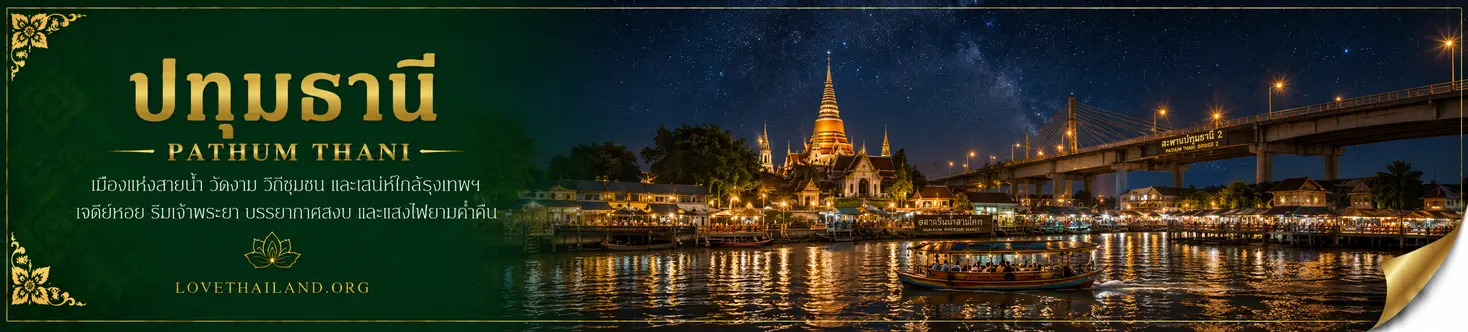
Pathum Thani
Slogan : Hindu Lotus Area, Ear of Rice Town, Descendants of the Mons, Dharma City, Palace of Solidarity, the Clear Chao Phraya River, Industrial Progress.
Pathum Thani Province is one of the important provinces of Thailand, located in the Bangkok Metropolitan Region. It plays a prominent role in various aspects, including the economy, education, science, and technology. It is considered a major center for research and development in the country, with a large number of leading universities, research institutions, and major industrial estates. This has led to continuous growth and development, making Pathum Thani a strategic area in central Thailand. :contentReference[oaicite:0]{index=0}
In addition to its economic and technological advancement, Pathum Thani is also rich in valuable cultural heritage. In particular, the culture of the Mon people is a key identity of the province. This culture has been passed down through generations over many centuries, including traditions, ways of life, language, clothing, and cuisine. All of these clearly reflect the historical roots and continue to thrive within the community today.
With its location close to Bangkok and convenient transportation systems, including roads, expressways, and public transit, Pathum Thani has become a popular destination for one-day trips and short-term travel. Visitors can easily explore temples, local markets, cultural attractions, as well as natural and community-based tourism sites.
The area that is now Pathum Thani Province has historical evidence of settlement for more than 300 years, dating back to the Ayutthaya period during the reign of King Narai the Great. This was a time of migration and expansion of communities along the Chao Phraya River.
In 1659 (B.E. 2202), a significant event marked the beginning of community development in this area. Mon families from Martaban fled war with Burma and sought refuge under the royal patronage of King Narai the Great. The King graciously allowed them to settle in Ban Sam Khok, which later developed into an important and continuously growing community.
The Sam Khok community gradually expanded in both population and strength. Mon culture became the core of daily life, including religious practices, local traditions, and distinctive settlement patterns. These elements formed the foundation of Pathum Thani’s identity as it is known today.
Later, during the Thonburi period under the reign of King Taksin the Great, another wave of Mon migrants fleeing Burma arrived. The King allowed them to settle together with the existing Mon community in Sam Khok, resulting in a larger and stronger Mon community in terms of society, culture, and local economy.
During the reign of King Buddha Loetla Nabhalai (Rama II) of the Rattanakosin period, a large number of Mon people migrated from Martaban into Thailand once again. The King permitted some of them to settle in Sam Khok, leading to rapid expansion in population and economic growth. Eventually, the area developed into Sam Khok town.
An important historical event occurred in 1815 (B.E. 2358), when King Rama II visited Sam Khok and stayed at a pavilion on the west bank of the Chao Phraya River, opposite the town. On that occasion, many Mon people, deeply grateful for his royal kindness, presented lotus flowers to pay their respects.
As a result, the King bestowed a new name upon Sam Khok, calling it “Prathum Thani,” meaning “City of Lotus.” This name symbolizes faith, purity, and prosperity, and later became the origin of the province’s current name, Pathum Thani.
In 1918 (B.E. 2461), during the reign of King Vajiravudh (Rama VI), administrative reforms were implemented, changing the term “Mueang” to “Province,” and the spelling was adjusted from “Prathum Thani” to “Pathum Thani” according to modern Thai usage.
In 1932 (B.E. 2475), during the reign of King Prajadhipok (Rama VII), further administrative restructuring took place. Thanyaburi Province was dissolved and became a district under Pathum Thani Province, forming the administrative structure that continues to the present day.
Today, Pathum Thani Province is divided into seven districts: Mueang Pathum Thani, Khlong Luang, Thanyaburi, Lat Lum Kaeo, Lam Luk Ka, Sam Khok, and Nong Suea. Each district has its own unique characteristics and strengths in terms of economy, tourism, and local lifestyle.
Pathum Thani is also one of the country’s key economic centers, with major industrial estates such as Navanakorn Industrial Estate and Bangkadi Industrial Park. These areas host numerous factories, technology firms, and multinational corporations, contributing to employment and continuous economic growth.
In terms of education and research, Pathum Thani is home to leading universities and institutions such as Thammasat University (Rangsit Campus), Bangkok University, Rangsit University, and Thailand Science Park, which serves as a major hub for technological innovation and development in Thailand.
In addition to its strengths in economy and education, Pathum Thani has a distinct cultural identity, particularly rooted in Mon heritage. The Mon communities in Sam Khok District continue to preserve traditional customs, including religious ceremonies, merit-making traditions, traditional attire, and even language used in daily life.
One of the important Mon traditions in Pathum Thani is the “Honey Offering Ceremony,” held during the end of Buddhist Lent. Locals offer pure honey to monks as a merit-making ritual believed to bring good fortune and prosperity. This tradition clearly reflects the strong bond between the community and Buddhism.
Another well-known tradition is the “Hongsa Flag and Takrab Parade,” an ancient Mon ceremony performed as a Buddhist offering and to demonstrate unity within the community. The procession is beautifully decorated and accompanied by traditional dance and music, creating a vibrant and memorable atmosphere.
In terms of cuisine, Pathum Thani offers diverse cultural flavors, especially Mon dishes such as Khao Chae Mon, Mon-style curry, and traditional Thai desserts that are still produced and sold within local communities. Local markets and floating markets also serve as major hubs for food and local products.
The province is characterized by fertile lowlands along the Chao Phraya River, making it highly suitable for agriculture, particularly rice farming and horticulture. Numerous irrigation canals support agricultural activities and sustain the local way of life.
In terms of tourism, Pathum Thani offers a wide range of attractions, including historically significant temples such as Wat Chedi Hoi, Wat Bot, and Wat Phai Lom, as well as eco-tourism and agricultural destinations like farms and learning centers that allow visitors to experience hands-on activities.
Getting There Traveling to Pathum Thani is convenient from Bangkok, taking approximately 30–60 minutes depending on the destination. Visitors can travel by private car via expressways and major roads such as Phahonyothin Road, Rangsit-Nakhon Nayok Road, and Tiwanon Road. Public transportation options, including buses, vans, and trains, are also available.
With its complete combination of history, culture, economy, and accessibility, Pathum Thani Province has strong potential as a high-quality travel destination for both Thai and international visitors seeking to explore a diverse and vibrant area near Bangkok.
Annual Festivals in Pathum Thani 2026
| Festival Name | Date | Time | Location |
| Honey Offering Ceremony | October 2026 (End of Buddhist Lent) | 06:00–10:00 | Temples in Sam Khok District |
| Hongsa Flag and Takrab Parade | October 2026 | 08:00–17:00 | Sam Khok District |
| Loy Krathong Festival | November 2026 | 18:00–22:00 | Chao Phraya River |
| Songkran Festival | 13–15 April 2026 | 09:00–18:00 | Province-wide |
| Sam Khok Retro Market | Every Saturday–Sunday | 09:00–16:00 | Sam Khok Community |
3–5 Days Travel Plan in Pathum Thani
| Day | Place | Location | Highlight |
| Day 1 | Wat Chedi Hoi | Lat Lum Kaeo District | Ancient shell fossil pagoda |
| Day 1 | Sam Khok Market | Sam Khok District | Mon cuisine and local lifestyle |
| Day 2 | National Science Museum | Khlong Luang District | Modern learning center |
| Day 2 | Wat Bot | Mueang District | Historic riverside temple |
| Day 3 | Dream World | Thanyaburi District | Large amusement park |
| Day 4 | Talad Thai Market | Khlong Luang District | Thailand’s largest wholesale market |
| Day 5 | Wat Phai Lom | Mueang District | Peaceful riverside atmosphere |
10 MUST VISIT Attractions in Pathum Thani
| Place | Location | Highlight |
| Wat Chedi Hoi | Lat Lum Kaeo | Ancient shell fossils |
| Wat Bot | Mueang | Historic temple |
| Wat Phai Lom | Mueang | Peaceful atmosphere |
| Dream World | Thanyaburi | Amusement park |
| Talad Thai | Khlong Luang | Largest market |
| Sam Khok Market | Sam Khok | Mon culture |
| Science Museum | Khlong Luang | Educational attraction |
| Wat Bang Luang | Mueang | Ancient art |
| Agricultural Farm | Nong Suea | Agro-tourism |
| Family Park | Lam Luk Ka | Family activities |
Frequently Asked Questions (FAQ)
Q: When is the best time to visit Pathum Thani?
A: The best time is from November to February when the weather is cooler and suitable for outdoor travel.
Q: What are the must-visit attractions in Pathum Thani?
A: Key attractions include Wat Chedi Hoi, Dream World, Talad Thai, and the National Science Museum.
Q: How can I travel to Pathum Thani?
A: You can travel by private car, bus, or van from Bangkok. It takes approximately 30–60 minutes depending on traffic.
Q: Is Pathum Thani suitable for a one-day trip?
A: Yes, it is very suitable due to its proximity to Bangkok and variety of attractions.
Q: What local food should I try?
A: You should try Mon-style cuisine such as fermented rice noodles, traditional desserts, and local river fish dishes.
Pathum Thani Map

 Art, Culture and Heritage
 Historical Sites and Monuments(2)
 Landmarks and Memorials(1)
 Art, Craft Centres, Tradition(2)
 Museums(11)
 Art Gallery(1)
 Educational Places
 Museum for Study(1)
 Library(1)
 Training Center(1)
 Places of Worship
 Temple(44)
 Mosque(1)
 Other Sacred Sites(1)
 Research and Development
 Royal Project(1)
 Suburban Living
 Local Market(2)
 Floating Market(3)
 Nature and Wildlife
 River, Canal(1)
 Entertainment and Agricultural
 Animal camps and shows(1)
 Stadium(2)
 Amusement Park(1)
 Waterpark(1)


