
lovethailand home >Northeastern Travel Attractions
> Sakon Nakhon Travel Attractions
TL;DR: A quick overview of attractions in Sakon Nakhon, plus planning details, access, and key travel highlights.
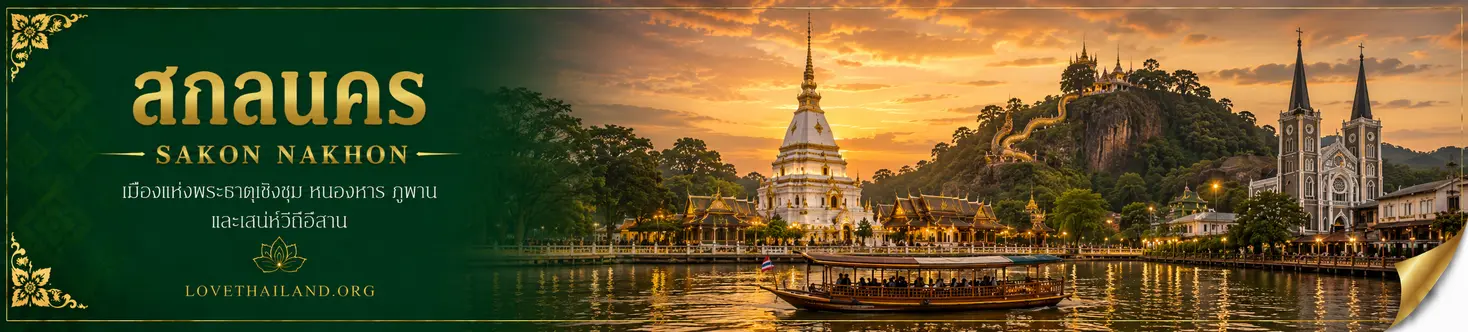
Sakon Nakhon
Slogan : Phra That Choeng Chum and Phu Phan palace with the city, fomous of Nong Han, beautiful Phu thai girl.
Sakon Nakhon Province is one of the key provinces in Northeastern Thailand, also known as the Isan region. It stands out with profound significance in history, religion, culture, and local way of life. The province is often referred to as the “City of Buddhism, Home of Five Sacred Stupas, and Land of 3,000-Year Civilization,” reflecting its long-standing Buddhist heritage and continuous human settlement over thousands of years.
Sakon Nakhon is located on the Khorat Plateau, characterized by alternating lowlands and rolling hills. The Phu Phan mountain range stretches across the southern part of the province, serving as an important watershed and ecological system. In addition, the province is home to “Nong Han,” the third-largest freshwater lake in Thailand, which functions as a vital water resource and has long been the center of local community life from the past to the present.
Historically, Sakon Nakhon was originally known as “Nong Han Luang City,” established around the 16th Buddhist century by Khun Khom Ratchabutr under the influence of the Khotabun Kingdom. As Khmer influence declined, the city came under the rule of the Lan Xang Kingdom and was renamed “Chiang Mai Nong Han.” Later, it became part of Siam and was renamed “Sakon Thawapi,” before eventually adopting its present name, “Sakon Nakhon”.
Sakon Nakhon is considered one of the most important centers of Buddhism in Northeastern Thailand, particularly for the forest monk tradition. It was home to many revered monks such as Phra Ajahn Mun Bhuridatto, Phra Ajahn Fan Acharo, and Luang Pu Thes Thesarangsi. As a result, the province contains numerous forest monasteries and meditation centers, making it a significant destination for those seeking spiritual tranquility.
Beyond its religious significance, Sakon Nakhon is also rich in archaeological sites that demonstrate continuous human settlement for over 3,000 years. These include sites such as Ban Chiang Khrua, ancient boundary stones (bai sema), and various ruins that reflect the influence of Dvaravati and ancient Khmer civilizations.
In terms of culture, Sakon Nakhon has preserved traditional Isan customs remarkably well. One of the most important festivals is the “Wax Castle Procession Festival,” held during the end of Buddhist Lent. Locals collaboratively create intricate wax structures and parade them to temples, expressing deep faith and strong community unity.
Another significant tradition is the “Bun Bang Fai” (rocket festival), where rockets are launched to pray for rain according to local beliefs. The Songkran festival is also widely celebrated, featuring water pouring over Buddha images, paying respect to elders, and various traditional community activities that strengthen family and social bonds.
Regarding cuisine, Sakon Nakhon is a hub of authentic Isan food known for its bold and distinctive flavors. Popular dishes include larb, koi, bamboo shoot soup, kaeng om, and som tam. There are also local dishes made from natural ingredients such as fish from Nong Han, wild mushrooms, and native vegetables, reflecting the wisdom of utilizing local resources sustainably.
Local products from Sakon Nakhon are equally notable, especially “indigo-dyed fabric,” a traditional craft passed down through generations. It is recognized for its unique colors and patterns and has gained popularity both domestically and internationally.
Getting There Traveling to Sakon Nakhon is convenient via private car, public buses, or air travel. Sakon Nakhon Airport offers direct flights from Bangkok, taking approximately 1 hour and 15 minutes. Alternatively, traveling by car from Bangkok covers a distance of around 650 kilometers.
Today, Sakon Nakhon is divided into 18 districts and continues to play an important role in agriculture, economy, and tourism. Cultural and religious tourism, in particular, has seen steady growth, attracting visitors who seek peace, spirituality, and authentic Isan experiences.
With its rich combination of history, religion, culture, natural resources, and local lifestyle, Sakon Nakhon stands out as a compelling destination for travelers who wish to explore the deeper and more authentic side of Northeastern Thailand.
Sakon Nakhon Annual Festivals 2026
| Festival Name | Date | Time | Location (Full Address) | Highlights |
| Wax Castle Procession Festival | October 2026 (End of Buddhist Lent) | 09:00 – 21:00 | Suk Kasem Road, Nong Han Area, Mueang Sakon Nakhon District, Sakon Nakhon 47000 | Large-scale wax sculptures paraded with intricate craftsmanship |
| Phra That Choeng Chum Worship Festival | February 2026 | 06:00 – 22:00 | Wat Phra That Choeng Chum Worawihan, Charoen Mueang Road, Mueang Sakon Nakhon, Sakon Nakhon 47000 | Major annual merit-making event with rituals and cultural market |
| Bun Bang Fai Rocket Festival | May 2026 | 08:00 – 18:00 | Wanon Niwat District, Sakon Nakhon 47120 | Traditional rocket launching ceremony to pray for rain |
| Songkran Festival Sakon Nakhon | 13 – 15 April 2026 | 08:00 – 20:00 | Nong Han Area, Mueang Sakon Nakhon District, Sakon Nakhon 47000 | Water pouring rituals, cultural activities, and local celebrations |
Sakon Nakhon 3–5 Day Travel Itinerary (Detailed Plan)
| Day | Place | Full Address | Highlights |
| Day 1 | Wat Phra That Choeng Chum | Charoen Mueang Road, That Choeng Chum Subdistrict, Mueang Sakon Nakhon District, Sakon Nakhon 47000 | Sacred stupa and provincial landmark |
| Day 2 | Nong Han Lake | That Choeng Chum Subdistrict, Mueang Sakon Nakhon District, Sakon Nakhon | Large freshwater lake with scenic sunrise views |
| Day 3 | Wat Pa Sutthawat | That Na Weng Subdistrict, Mueang Sakon Nakhon District, Sakon Nakhon 47000 | Forest monastery for meditation practice |
| Day 4 | Phra That Narai Cheng Weng | That Na Weng Subdistrict, Mueang Sakon Nakhon District, Sakon Nakhon 47000 | Ancient Khmer-style sanctuary |
| Day 5 | Phu Phan National Park | Phu Phan District, Sakon Nakhon | Mountains, waterfalls, and nature trails |
Top 10 MUST VISIT Attractions in Sakon Nakhon
| Attraction | Full Address | Highlights |
| Wat Phra That Choeng Chum | Charoen Mueang Road, Mueang Sakon Nakhon District, Sakon Nakhon 47000 | Iconic provincial landmark |
| Nong Han Lake | Mueang Sakon Nakhon District, Sakon Nakhon | One of Thailand’s largest freshwater lakes |
| Wat Pa Sutthawat | Mueang Sakon Nakhon District, Sakon Nakhon | Renowned meditation center |
| Phra That Narai Cheng Weng | Mueang Sakon Nakhon District, Sakon Nakhon | Ancient Khmer architecture |
| Ajahn Mun Museum | Wat Pa Sutthawat, Mueang Sakon Nakhon District, Sakon Nakhon | History of a revered monk |
| Phu Phan National Park | Phu Phan District, Sakon Nakhon | Forests, waterfalls, and scenic trails |
| Phu Phan Royal Palace | Mueang Sakon Nakhon District, Sakon Nakhon | Royal residence surrounded by nature |
| Indigo Dyeing Village | Phanna Nikhom District, Sakon Nakhon | Famous traditional indigo textiles |
| White Bridge Nong Han | Mueang Sakon Nakhon District, Sakon Nakhon | Popular photography spot |
| Wat Tham Pha Daen | Tao Ngoi District, Sakon Nakhon | Mountain views and giant Naga sculpture |
Frequently Asked Questions (FAQ)
Q: What makes Sakon Nakhon a unique travel destination?
A: Sakon Nakhon is unique for its deep-rooted Buddhist heritage, rich cultural traditions, and natural attractions. It is a major center of forest monk Buddhism, home to sacred sites such as Wat Phra That Choeng Chum, as well as natural landmarks like Nong Han Lake and the Phu Phan mountain range.
Q: When is the best time to visit Sakon Nakhon?
A: The best time to visit is in October during the end of Buddhist Lent, when the Wax Castle Procession Festival takes place. The cool season from November to February is also ideal due to pleasant weather conditions.
Q: What are the most important religious sites in Sakon Nakhon?
A: Key religious sites include Wat Phra That Choeng Chum, Wat Pa Sutthawat, Wat Tham Pha Daen, and Phra That Narai Cheng Weng, all of which hold significant spiritual importance for locals and visitors.
Q: What local food should travelers try in Sakon Nakhon?
A: Visitors should try authentic Isan dishes such as larb, koi, bamboo shoot soup, kaeng om, and som tam. Local specialties also include freshwater fish from Nong Han and seasonal wild vegetables.
Q: How can I travel to Sakon Nakhon?
A: Sakon Nakhon is accessible by air, bus, and private car. Flights from Bangkok take approximately 1 hour and 15 minutes, while road travel covers about 650 kilometers.
Q: What type of travel is Sakon Nakhon best suited for?
A: Sakon Nakhon is ideal for cultural, religious, and nature-based tourism. It is especially suitable for travelers seeking peaceful experiences, meditation, and authentic Isan lifestyle exploration.
Sakon Nakhon Map

 Art, Culture and Heritage
 Historical Sites and Monuments(9)
 Landmarks and Memorials(2)
 Royal Palace(1)
 Art, Craft Centres, Tradition(8)
 Museums(3)
 Educational Places
 Educational Gardens, Farm(2)
 Places of Worship
 Temple(18)
 Church(2)
 Other Sacred Sites(4)
 Research and Development
 Royal Project(3)
 Suburban Living
 Village, Community(7)
 Nature and Wildlife
 National Parks and Marine Reserves(4)
 Mountain (Doi)(3)
 Dam, Reservoir, Lake(14)
 Waterfalls(4)
 Caves(4)
 River, Canal(9)
 Bays and Beaches(1)
 Islands(1)
 Other natural attractions(5)
 Entertainment and Agricultural
 Zoos and Aquariums(1)
 Farms, Parks and Ecotourism(4)
 Outdoor and Adventure Activities(1)
 Travel Articles, Recipes
 Travel Review, Food Review(1)


