
lovethailand home >Central Travel Attractions
> Ratchaburi Travel Attractions
TL;DR: A quick overview of attractions in Ratchaburi, plus planning details, access, and key travel highlights.
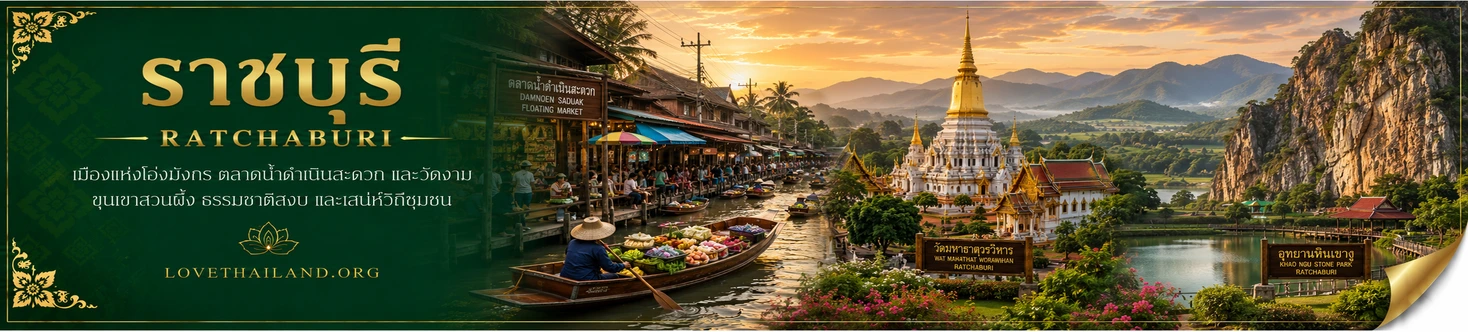
Ratchaburi
Slogan : Beautiful women of Photharam, beautiful women of Baan Pong, the city of earthen jars, shadow plays at Wat Khanon, magnificent caves, floating market at Damnoen, bats, delicious Yii Sok fish.
Ratchaburi Province is an important province in the western part of central Thailand, distinguished by its unique geography, history, and culture. It serves as a transitional area between the central plains and the Tenasserim mountain range along the western border adjacent to Myanmar. This geographical position has made Ratchaburi a land of diverse natural environments and ways of life. In addition, its proximity to Bangkok—approximately 1.5–2 hours of travel—has established it as one of the consistently popular tourist destinations in Thailand.
The name “Ratchaburi” means “City of the King,” reflecting the historical significance of this area since ancient times. It was particularly important as a frontier city for defending against invasions from the west and as a central hub for trade routes connecting inland regions with border areas. As a result, Ratchaburi has played a long-standing role in military, economic, and cultural aspects.
Geographically, Ratchaburi covers an area of approximately 5,196 square kilometers and can be divided into four main zones: the mountainous region in the west along the Tenasserim range; the plateau and rolling hills in the central area; the fertile plains along the Mae Klong River, which are important agricultural zones; and the low-lying plains in the east that connect to Samut Songkhram Province. The Mae Klong River is the province’s lifeline, flowing through the area for more than 67 kilometers and playing a crucial role in agriculture, transportation, and local livelihoods.
Archaeological evidence indicates that Ratchaburi has been inhabited since prehistoric times, particularly during the Middle Stone Age around 10,000 years ago. Later, it developed into an ancient community during the Dvaravati period, with significant evidence found in Khu Bua Subdistrict, Mueang Ratchaburi District. Numerous archaeological sites and artifacts discovered there reflect the prosperity of Buddhism and culture during the 7th–8th centuries.
Between the 10th–12th centuries, Ratchaburi became an important trade center with international connections via the Mae Klong River. A city was established on the right bank of the river, with the prang of Wat Mahathat Worawihan as its central landmark. This site remains a significant historical monument that clearly represents Ayutthaya-era art.
During the Thonburi and early Rattanakosin periods, Ratchaburi played a key military role as a frontline defense against Burmese invasions, particularly during the Nine Armies War, one of Thailand’s most important historical events. Later, in the reign of King Rama II, new city walls were constructed and the administrative center was relocated to strengthen strategic defenses.
In the reign of King Rama V, administrative reforms led to the establishment of “Monthon Ratchaburi,” which incorporated several important western cities. This elevated Ratchaburi as a regional administrative and economic center. The monthon system was abolished in 1933, after which Ratchaburi continued as a province to the present day.
Ratchaburi is notable for its ethnic diversity, including native Thai communities, Thai-Chinese, Mon, and Karen populations. In particular, areas such as Suan Phueng and Ban Kha districts still preserve traditional ways of life, cultural practices, and local traditions, giving the province a distinct identity compared to others.
The culture and traditions of Ratchaburi are diverse and reflect the foundations of its communities. These include traditional Songkran celebrations, temple merit-making festivals, Mon cultural traditions, and religious activities associated with important temples such as Wat Mahathat Worawihan and Wat Nong Hoi, which serve as spiritual centers for local people.
In terms of cuisine, Ratchaburi is well known for its authentic Thai dishes and local specialties, especially those using ingredients from the Mae Klong River such as freshwater fish, prawns, and shellfish. The province is also famous for its iconic dragon jars, as well as traditional desserts and snacks that reflect local culture.
The economy of Ratchaburi is diverse, consisting of agriculture, industry, and tourism. Key agricultural products include sugarcane, coconuts, and various fruits. The province is also renowned for its ceramic and pottery industries, particularly the iconic dragon jars, which are important cultural products that generate continuous income.
Tourism in Ratchaburi stands out for its combination of nature, culture, and local lifestyle. Popular attractions include Damnoen Saduak Floating Market, which reflects riverside life; Khao Bin Cave with its beautiful stalactites and stalagmites; Khao Ngu Stone Park, which blends nature with art; Wat Nong Hoi with panoramic views; and the bat colony at Wat Khao Chong Phran, where millions of bats emerge at dusk.
Additionally, Suan Phueng District is a highly popular destination known for its scenic mountain landscapes and natural beauty, making it ideal for relaxation. Key attractions include Kao Chon Waterfall, Bo Khlung Hot Spring, and internationally styled farms such as Coro Field, which are popular among both Thai and international tourists.
Ratchaburi is therefore a province that offers a complete blend of history, culture, nature, and economy. It is an ideal destination for all types of travelers—whether nature lovers, cultural explorers, or lifestyle tourists—and continues to show strong potential for sustainable tourism growth in the future.
Getting There Ratchaburi can be conveniently reached from Bangkok via Phetkasem Road (Highway No. 4), taking approximately 1.5–2 hours. Alternatively, visitors can travel by southern railway line or by bus services that operate throughout the day.
Annual Tourism Festivals in Ratchaburi (2026)
| Festival Name | Date | Time | Location | Main Activities | Best For | Highlights |
|---|---|---|---|---|---|---|
| Damnoen Saduak Floating Market | January – December 2026 | 07:00 – 15:00 | Damnoen Saduak Canal, Damnoen Saduak District | Boat rides, local food tasting, riverside lifestyle experience | Families, general tourists, international visitors | World-famous floating market |
| Khao Chong Phran Bat Festival | February – April 2026 | 17:30 – 18:30 | Wat Khao Chong Phran, Photharam District | Watching millions of bats emerge at dusk | Nature lovers, photographers | Millions of bats in a continuous stream |
| Ratchaburi Dragon Jar Festival | April 2026 | 10:00 – 21:00 | Ratchaburi Provincial Hall | Ceramic exhibitions, handicrafts, local products | Art lovers, collectors | Iconic dragon jar craftsmanship |
| Songkran Festival in Ratchaburi | 13–15 April 2026 | All Day | Province-wide | Water celebrations, merit-making, traditional rituals | All travelers | Authentic Thai New Year traditions |
3–5 Day Ratchaburi Travel Itinerary (Detailed & Practical)
| Day | Destination | Location | Activities | Highlights | Category |
|---|---|---|---|---|---|
| Day 1 | Damnoen Saduak Floating Market | Damnoen Saduak District | Boat ride, local food tasting | Traditional Thai lifestyle | Cultural |
| Day 2 | Khao Bin Cave & Khao Ngu Stone Park | Mueang District | Nature exploration, photography | Iconic landmarks | Nature |
| Day 3 | Suan Phueng & Coro Field | Suan Phueng District | Farm visit, photography | Mountain scenery & Japanese-style farm | Lifestyle |
| Day 4 | Kao Chon Waterfall | Suan Phueng District | Hiking, waterfall activities | 9-tier waterfall | Nature |
| Day 5 | Wat Mahathat Worawihan | Mueang District | Temple visit, merit-making | Historical significance | Cultural |
Top 10 Must-Visit Attractions in Ratchaburi
| Attraction | Location | Category | Highlights | Best For |
|---|---|---|---|---|
| Damnoen Saduak Floating Market | Damnoen Saduak | Cultural | World-famous floating market | Everyone |
| Khao Bin Cave | Mueang | Nature | Stalactites & stalagmites | Travelers |
| Khao Ngu Stone Park | Mueang | Landmark | Mountain & Buddha sculpture | Photography |
| Wat Nong Hoi | Mueang | Temple | Panoramic views | Spiritual travelers |
| Suan Phueng | Suan Phueng | Nature | Mountains & mist | Relaxation |
| Coro Field | Suan Phueng | Farm | Japanese-style experience | Families |
| Kao Chon Waterfall | Suan Phueng | Nature | 9-tier waterfall | Adventure |
| Wat Khao Chong Phran | Photharam | Nature | Bat phenomenon | Photographers |
| Oh Poi Market | Suan Phueng | Cultural | Karen community lifestyle | Slow travel |
| Wat Mahathat Worawihan | Mueang | Historical | Ancient prang | History lovers |
Frequently Asked Questions (FAQ)
Q: What is Ratchaburi Province known for?
A: Ratchaburi is known for its diverse attractions, including natural landscapes, cultural heritage, floating markets, mountain destinations like Suan Phueng, and its famous dragon jar ceramics.
Q: How far is Ratchaburi from Bangkok?
A: Ratchaburi is approximately 80–100 kilometers from Bangkok and takes around 1.5–2 hours to travel by car.
Q: What are the best places to visit in Ratchaburi?
A: Top attractions include Damnoen Saduak Floating Market, Khao Bin Cave, Khao Ngu Stone Park, Wat Nong Hoi, Suan Phueng, and Wat Khao Chong Phran.
Q: When is the best time to visit Ratchaburi?
A: The best time to visit is between November and February when the weather is cool and pleasant, especially in mountainous areas like Suan Phueng.
Q: Is Ratchaburi suitable for a weekend trip?
A: Yes, Ratchaburi is ideal for a short trip due to its proximity to Bangkok. A 2–3 day trip is sufficient to explore major attractions.
Q: What local food should I try in Ratchaburi?
A: Visitors should try freshwater fish dishes, river prawns, traditional Thai cuisine, and local desserts. The province is also famous for its agricultural products.
Q: What makes Suan Phueng popular?
A: Suan Phueng is popular for its mountain scenery, cool climate, resorts, waterfalls, hot springs, and European-style cafes and farms.
Q: Are there cultural experiences in Ratchaburi?
A: Yes, Ratchaburi offers cultural experiences such as Mon traditions, temple festivals, local markets, and traditional crafts like pottery and ceramics.
Q: What is the highlight of Wat Khao Chong Phran?
A: The highlight is the evening spectacle of millions of bats flying out of the cave in a continuous stream at sunset.
Q: What type of travelers is Ratchaburi suitable for?
A: Ratchaburi is suitable for all types of travelers, including nature lovers, cultural explorers, photographers, families, and lifestyle travelers.
Q: What are the main economic activities in Ratchaburi?
A: The province’s economy is driven by agriculture, ceramics and pottery industries, tourism, and local trade.
Q: Can I travel to Ratchaburi without a car?
A: Yes, you can travel by train, bus, or van from Bangkok, but having a car provides more flexibility for exploring attractions.
Q: Is Ratchaburi safe for tourists?
A: Ratchaburi is generally safe, with good infrastructure and facilities for both Thai and international tourists.
Q: What are unique cultural products from Ratchaburi?
A: The most iconic product is the dragon jar (Ong Mangkon), along with ceramics, handicrafts, and locally made goods.
Q: What natural attractions are available in Ratchaburi?
A: Natural attractions include waterfalls, caves, mountains, hot springs, and scenic countryside areas, especially in Suan Phueng.
Ratchaburi Map

 Art, Culture and Heritage
 Historical Sites and Monuments(2)
 Landmarks and Memorials(1)
 Art, Craft Centres, Tradition(5)
 Museums(7)
 Art Gallery(1)
 Educational Places
 Educational Gardens, Farm(2)
 Places of Worship
 Temple(18)
 Other Sacred Sites(3)
 Research and Development
 Royal Project(1)
 Suburban Living
 Village, Community(4)
 Local Market(1)
 Floating Market(3)
 Nature and Wildlife
 National Parks and Marine Reserves(2)
 Mountain (Doi)(5)
 Dam, Reservoir, Lake(1)
 Waterfalls(4)
 Hot Springs(2)
 Caves(4)
 Flower Field(2)
 River, Canal(1)
 Other natural attractions(3)
 Entertainment and Agricultural
 Zoos and Aquariums(2)
 Animal camps and shows(1)
 Farms, Parks and Ecotourism(3)
 Waterpark(1)
 Outdoor and Adventure Activities(4)
 Shopping
 Shopping and Night Market(2)
 Spas and Wellness
 Spas and Wellness(1)
 Travel Articles, Recipes
 Travel Review, Food Review(1)


