
lovethailand home >South Travel Attractions
> Narathiwat Travel Attractions
TL;DR: A quick overview of attractions in Narathiwat, plus planning details, access, and key travel highlights.
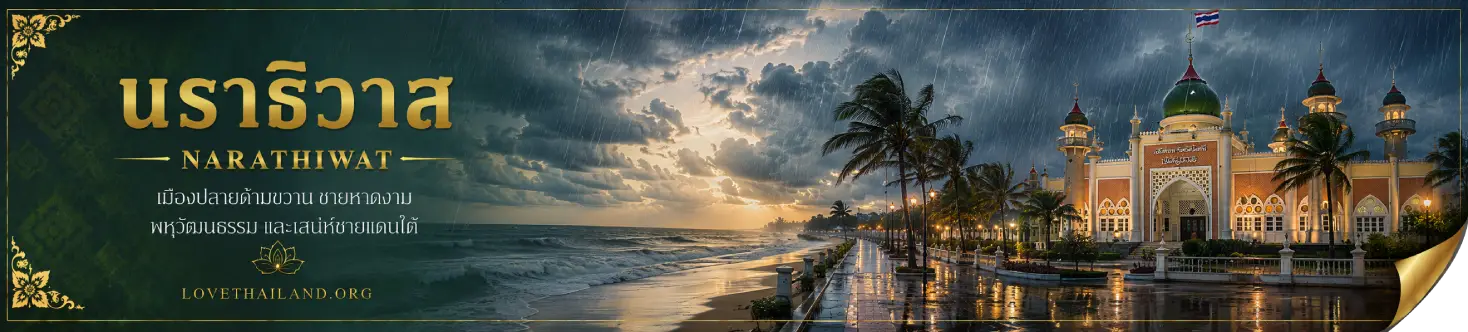
Narathiwat
Slogan : The royal Taksin palace, people love religion, landscape so beautiful, Pajo is great, source of gold, sweet fruit.
Narathiwat Province is a province located in southern Thailand, known for its peaceful atmosphere and distinctive Muslim cultural heritage. Historically, it has served as an important economic and trading hub, and today it is one of the five southern border provinces included in the IMT-GT Growth Triangle Development Project, which promotes cross-border economic cooperation between Thailand, Malaysia, and Indonesia.
Narathiwat’s economic and tourism center is concentrated in Su-ngai Kolok District, a major border town that attracts visitors from Malaysia and Singapore. This area has long been a hub of trade, cultural exchange, and tourism, offering a unique blend of Thai and Malay influences that continue to shape the region’s identity.
The province covers an area of approximately 4,475 square kilometers, or around 2,797,143.75 rai. About two-thirds of the land consists of forests and mountainous terrain. The southwestern part of the province is dominated by dense mountain ranges connected to the Sankalakhiri Range, which forms a natural boundary between Thailand and Malaysia. The landscape gradually slopes from west to east, with fertile plains extending toward the Gulf of Thailand. Important river basins include four major rivers: the Sai Buri River, Bang Nara River, Tak Bai River, and Kolok River, all of which play a crucial role in the province’s agriculture and settlement patterns.
Historically, the area known as Ban Bang Nara, or Manalo, was originally a small village situated along the Bang Nara River near the sea. During the reign of King Rama I, this settlement was under the administration of Sai Buri. Later, when Pattani was elevated to a monthon (administrative region), Bang Nara became part of Ra-ngae, which was under Pattani’s jurisdiction.
In 1906, during the reign of King Rama V, Bang Nara developed into a significant commercial community with active trade by both land and sea. As a result, the administrative center was relocated from Ra-ngae to Manalo in Bang Nara District. The former Ra-ngae area was reorganized as Tanyong Mat District, and Bang Nara was elevated to city status. At that time, the administrative region included Bang Nara, Tanyong Mat, Su-ngai Padi, Yaba (minor district), and Toma (minor district). In 1909, Bang Nara received Tak Bai District following the Anglo-Siamese Treaty, and Yi-ngo District was also transferred from Sai Buri into its jurisdiction.
During a royal visit to the southern region, King Rama VI granted a royal sword to the city and recognized that “Bang Nara” was merely a local subdistrict name. To establish a more formal and enduring identity, the king renamed the city “Narathiwat,” meaning “the residence of good people” or “the abode of the noble,” effective from June 10, 1915.
Today, Narathiwat Province is divided into 13 districts: Mueang Narathiwat, Tak Bai, Waeng, Yi-ngo, Su-ngai Kolok, Su-ngai Padi, Bacho, Ra-ngae, Sukhirin, Rueso, Si Sakhon, Chanae, and Cho-airong. Each district reflects a unique combination of natural landscapes, cultural diversity, and historical significance.
The province stands out for its rich cultural identity rooted in Islamic traditions, reflected in architecture, daily life, cuisine, and festivals. Mosques serve not only as religious centers but also as community hubs. Local traditions, attire, and food strongly reflect Malay influences, creating a distinctive cultural landscape unlike other regions of Thailand.
Economically, Narathiwat plays a strategic role as a border province. Trade with Malaysia is a key driver of the local economy, especially in Su-ngai Kolok, where cross-border commerce, tourism, and services are highly active. The IMT-GT framework further strengthens economic connectivity, infrastructure development, and regional cooperation.
In terms of tourism, Narathiwat offers a diverse range of attractions, including beaches such as Narathat Beach, lush forests like the Hala-Bala Wildlife Sanctuary, waterfalls such as Pa Cho and Si Po, and unique wetland ecosystems like To Daeng Peat Swamp Forest. These natural resources provide opportunities for eco-tourism, wildlife observation, and cultural exploration.
Food culture in Narathiwat is another highlight, combining southern Thai and Malay culinary traditions. Signature dishes include Khao Yam, Budu sauce, Roti, Mataba, beef soup, and a variety of fresh seafood. The flavors are rich, aromatic, and deeply connected to local traditions.
Getting There Narathiwat can be accessed by multiple modes of transportation. The most convenient option is by air via Narathiwat Airport, with regular domestic flights. Travelers can also reach the province by train to Su-ngai Kolok Railway Station or by road from neighboring provinces such as Pattani and Yala. Cross-border travel from Malaysia is also possible via the Kolok checkpoint.
Annual Festivals and Events in Narathiwat (2026)
| No. | Festival Name | Date | Location | Highlights |
| 1 | Narathiwat Food Festival | February 2026 | Narathat Beach, Mueang Narathiwat District, Narathiwat, Thailand | Local cuisine, seafood, cultural shows |
| 2 | Long Boat Racing Festival | September 2026 | Bang Nara River, Narathiwat, Thailand | Traditional racing, community celebration |
| 3 | Hari Raya Festival | April 2026 | Throughout Narathiwat Province | Islamic celebration, traditional food, family gatherings |
| 4 | Tak Bai Cultural Festival | August 2026 | Tak Bai District, Narathiwat, Thailand | Local traditions, cultural exhibitions |
| 5 | Su-ngai Kolok Border Festival | December 2026 | Su-ngai Kolok District, Narathiwat, Thailand | Cross-border trade fair, entertainment |
3–5 Day Travel Plan (Detailed Itinerary)
| Day | Plan | Location | Highlights |
| Day 1 | Arrival and city exploration | Mueang Narathiwat District | Narathat Beach, Central Mosque |
| Day 2 | Nature exploration | Hala-Bala Forest, Sukhirin District | Rainforest, wildlife observation |
| Day 3 | Waterfalls and relaxation | Pa Cho Waterfall | Natural scenery, relaxation |
| Day 4 | Cultural and border tourism | Su-ngai Kolok | Shopping, cross-border culture |
| Day 5 | Local lifestyle experience | Tak Bai District | Fishing village, local food |
10 MUST VISIT Attractions in Narathiwat
| No. | Attraction | Location | Highlights |
| 1 | Narathat Beach | Mueang Narathiwat District | Scenic beach, peaceful atmosphere |
| 2 | Central Mosque Narathiwat | Mueang Narathiwat | Islamic architecture |
| 3 | Hala-Bala Wildlife Sanctuary | Sukhirin District | Rainforest, biodiversity |
| 4 | To Daeng Peat Swamp Forest | Tak Bai District | Wetland ecosystem |
| 5 | Pa Cho Waterfall | Bacho District | Large waterfall |
| 6 | Si Po Waterfall | Su-ngai Padi District | Forest waterfall |
| 7 | Su-ngai Kolok Town | Su-ngai Kolok District | Border trade, nightlife |
| 8 | Tak Bai Beach | Tak Bai District | Fishing lifestyle |
| 9 | Bang Nara River | Mueang Narathiwat | River scenery |
| 10 | Yi-ngo District | Yi-ngo | Local culture |
Frequently Asked Questions (FAQ)
Q: What makes Narathiwat Province unique?
A: Narathiwat stands out for its strong Islamic cultural identity, peaceful atmosphere, rich natural landscapes, and its role as a key border province connecting Thailand with Malaysia.
Q: What type of travel is Narathiwat suitable for?
A: It is ideal for cultural tourism, eco-tourism, and travelers seeking a quiet and authentic local experience away from crowded destinations.
Q: When is the best time to visit Narathiwat?
A: Narathiwat can be visited year-round, but the cooler months from late year to early year offer more comfortable weather for outdoor activities.
Q: What are the main attractions in Narathiwat?
A: Key attractions include Narathat Beach, Central Mosque Narathiwat, Hala-Bala Wildlife Sanctuary, To Daeng Peat Swamp Forest, Pa Cho Waterfall, and Su-ngai Kolok.
Q: What local food should not be missed?
A: Signature dishes include Khao Yam, Budu sauce, Roti, Mataba, beef soup, and fresh seafood influenced by Malay cuisine.
Q: How can I travel to Narathiwat?
A: You can travel by air via Narathiwat Airport, by train to Su-ngai Kolok Station, or by road from nearby provinces. Cross-border access from Malaysia is also available.
Q: Why is Narathiwat important economically?
A: It is a strategic border province with active cross-border trade with Malaysia and part of the IMT-GT economic cooperation framework.
Q: Which area is most popular among foreign tourists?
A: Su-ngai Kolok is the most popular area due to its border trade, shopping, and vibrant cultural mix.
Q: Does Narathiwat only have beaches?
A: No, it offers mountains, forests, waterfalls, wetlands, and cultural sites, providing diverse travel experiences.
Q: Who should visit Narathiwat?
A: It is perfect for travelers seeking unique cultural immersion, natural beauty, and a peaceful travel environment.
Narathiwat Map

 Art, Culture and Heritage
 Landmarks and Memorials(8)
 Royal Palace(1)
 Art, Craft Centres, Tradition(7)
 Museums(4)
 Art Gallery(1)
 Places of Worship
 Temple(16)
 Mosque(23)
 Other Sacred Sites(5)
 Research and Development
 Royal Project(1)
 Suburban Living
 Village, Community(9)
 Local Market(1)
 Nature and Wildlife
 National Parks and Marine Reserves(5)
 Mountain (Doi)(2)
 Dam, Reservoir, Lake(2)
 Waterfalls(16)
 River, Canal(3)
 Bays and Beaches(5)
 Islands(1)
 Other natural attractions(4)
 Entertainment and Agricultural
 Stadium(1)
 Farms, Parks and Ecotourism(7)
 Shopping
 Shopping and Night Market(1)
 Travel Articles, Recipes
 Travel Review, Food Review(1)


