
lovethailand home >Northeastern Travel Attractions
> Yasothon Travel Attractions
TL;DR: A quick overview of attractions in Yasothon, plus planning details, access, and key travel highlights.
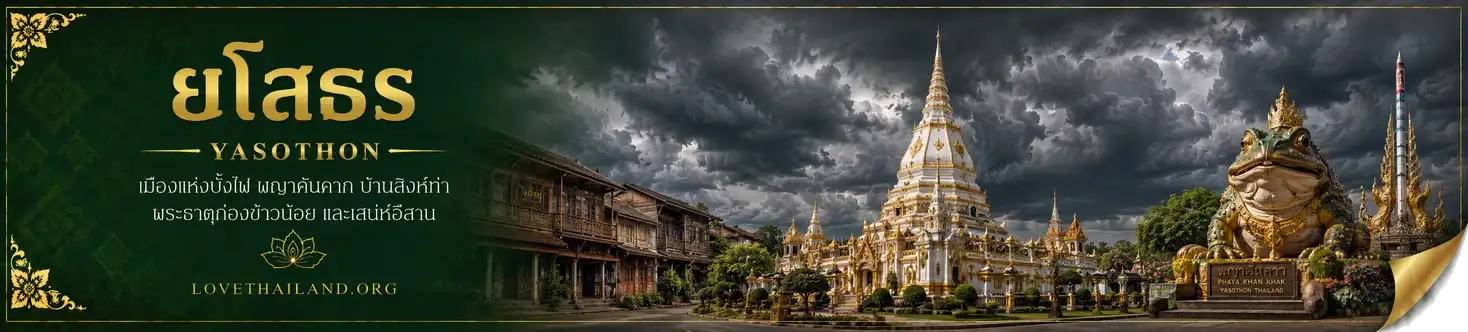
Yasothon
Slogan : The city of democracy, cool rocket, sweet watermalon, pillow, Khit Farbric, land of Jusmin rice.
Yasothon Province is located in Northeastern Thailand, commonly known as the Isan region. It is a fertile land along the Chi River and is recognized as one of the smallest provinces in the lower northeastern region. Despite its modest size, Yasothon has gained nationwide recognition for its vibrant rocket festival, earning the nickname “Rocket City”. Today, the province plays an important role as an agricultural hub, particularly as one of Thailand’s key producers of premium jasmine rice.
Yasothon offers a distinctive blend of tourism resources, including history, culture, traditions, and local ways of life. The province retains a peaceful and simple atmosphere characteristic of traditional Isan communities, where modernization has not yet fully transformed the landscape. Visitors to Yasothon can therefore experience authentic rural lifestyles and well-preserved cultural heritage, which are increasingly rare in today’s urbanized society.
Covering an area of approximately 4,161 square kilometers (about 2.6 million rai), Yasothon ranks as the 54th largest province in Thailand. The northern part of the province consists mainly of highlands interspersed with rolling plains, while the southern area features complex lowlands. The Chi River flows through the province, accompanied by numerous swamps and wetlands that support agricultural activities, especially rice cultivation. Major waterways include the Chi River, Thuan River, Phong River, and Yang River.
The historical roots of Yasothon are closely linked with Nong Bua Lamphu and Ubon Ratchathani. The area was initially established around 1771 during the migration of Chao Phraya Wo, a former noble of Vientiane, who relocated with his family and followers to establish a new settlement called “Nong Bua Lum Phu”.
After the death of Chao Phraya Wo, his younger brother Chao Kham Phong led another group of settlers along the Mun River to Huai Cha Ra Mae and later founded a new settlement in Dong U Phueng. He then formally pledged allegiance to King Taksin of Thonburi. In response, the king granted royal recognition and named the city “Ubon”, appointing Chao Kham Phong as its first ruler.
Meanwhile, another group led by Chao Faai Na, the younger brother of Chao Kham Phong, separated and settled in Ban Singh Tha under the leadership of Chao Kham Su. This settlement gradually developed and prospered into an important community.
In 1814, during the reign of King Rama II, Ban Singh Tha was elevated to city status and placed directly under Bangkok’s administration. The city was named “Yotsunthon”, and Chao Ratchawong Singh was appointed as the first governor, bearing the title “Phra Sunthon Ratchawongsa”. The name later evolved into “Yasothon”, which means “one who upholds honor or prestige”, and it has been used ever since.
During the reign of King Rama V, Yasothon became part of the northeastern administrative region. Later, when the Monthon system was abolished, Yasothon was merged with Ubon Ratchathani. It was not until February 6, 1972, that a revolutionary decree officially established Yasothon as a province by separating several districts from Ubon Ratchathani, including Mueang Yasothon, Kham Khuean Kaeo, Maha Chana Chai, Pa Tio, Loeng Nok Tha, and Kut Chum. The province officially came into effect on March 1, 1972, becoming the 71st province of Thailand.
Today, Yasothon is administratively divided into 9 districts: Mueang Yasothon, Kham Khuean Kaeo, Maha Chana Chai, Pa Tio, Loeng Nok Tha, Kut Chum, Kho Wang, Sai Mun, and Thai Charoen.
Getting There Traveling to Yasothon is relatively convenient. Visitors can drive from nearby provinces such as Ubon Ratchathani, Roi Et, and Amnat Charoen. For air travel, the nearest airports are located in Ubon Ratchathani and Roi Et, from which travelers can continue by road to Yasothon. The province is also accessible by interprovincial bus services connecting major cities in the northeastern region.
One of the highlights for visitors interested in cultural tourism is Ban Singh Tha, an old community known for its preserved wooden houses and historic shophouses. Walking through this area offers a nostalgic glimpse into the architectural and cultural past of Yasothon, making it a memorable experience for those who appreciate heritage and traditional lifestyles.
Beyond its historical background, Yasothon stands out prominently for its rich cultural identity and deeply rooted traditions. The most iconic event is the “Bun Bang Fai” or Rocket Festival, which takes place annually before the rice-planting season, typically in May. This festival reflects the community’s belief in requesting rain from the sky to ensure a successful agricultural season. Handmade rockets are launched high into the sky in a festive atmosphere filled with parades, traditional dances, music, and community celebrations. The event is not only a form of spiritual expression but also a significant cultural attraction that draws visitors from across Thailand and abroad.
In addition to the Rocket Festival, Yasothon maintains a wide range of traditional Isan ceremonies throughout the year. These include merit-making events aligned with the Buddhist calendar, such as Bun Khao Sak, Bun Khao Pradap Din, and Bun Kathin. Each ceremony reflects the close relationship between religion, agriculture, and community life. The continuation of these traditions demonstrates the strong cultural continuity and communal unity that define Yasothon society.
The local way of life in Yasothon remains closely tied to agriculture, particularly rice farming. Villagers typically follow seasonal cycles, with planting, harvesting, and post-harvest activities shaping daily routines. Traditional farming knowledge has been passed down through generations, and in recent years, Yasothon has become widely recognized for its commitment to organic agriculture. The province is considered one of Thailand’s leading areas for organic jasmine rice production, emphasizing sustainability and environmentally friendly practices.
Food culture in Yasothon reflects the bold and distinctive flavors of Isan cuisine. Meals often feature sticky rice as a staple, accompanied by dishes such as som tam (papaya salad), larb (spicy minced meat salad), nam tok (grilled meat salad), and grilled chicken. Fermented fish (pla ra) is a key ingredient that gives many dishes their signature depth of flavor. Local ingredients are typically sourced from nearby farms, rivers, and forests, reinforcing the strong connection between food and the natural environment.
Another notable aspect of Yasothon is its local markets and community-based economy. Traditional markets serve as centers of trade and social interaction, where villagers exchange goods such as fresh produce, handmade crafts, and local delicacies. These markets reflect a localized economic system that prioritizes self-sufficiency and community resilience rather than large-scale industrialization.
Geographically, Yasothon presents a diverse natural landscape that supports its agricultural identity. The combination of rivers, wetlands, and fertile plains creates ideal conditions for rice cultivation. Seasonal flooding from the Chi River contributes to soil fertility, while smaller waterways and ponds provide additional irrigation sources. The natural environment not only supports agriculture but also shapes the rhythm of life in the province.
Despite its relatively low level of urban development, this characteristic is precisely what makes Yasothon appealing to certain types of travelers. Those seeking tranquility, authenticity, and a slower pace of life will find the province particularly rewarding. Rather than large-scale attractions, Yasothon offers experiential tourism, where visitors can engage with local communities, observe traditional practices, and gain insight into rural Thai life.
Key highlights of Yasothon include its cultural festivals, organic farming communities, historic districts such as Ban Singh Tha, and scenic rural landscapes along the Chi River. These elements collectively create a destination that is not driven by modern entertainment but by cultural depth and authenticity.
From a tourism development perspective, Yasothon represents a model of cultural sustainability. Unlike major tourist cities that rely heavily on infrastructure and commercial attractions, Yasothon’s appeal lies in its ability to preserve its identity while gradually integrating tourism. This approach allows visitors to experience a more genuine connection with local communities, rather than a curated or commercialized version of culture.
Community-based tourism plays an increasingly important role in the province. Visitors have opportunities to participate in activities such as rice farming, organic agriculture workshops, traditional cooking, and local handicraft production. These experiences not only provide deeper engagement but also generate income directly for local residents, supporting a more inclusive economic model.
Another dimension that enhances Yasothon’s tourism value is its educational potential. The province serves as a living classroom for those interested in sustainable agriculture, rural development, and cultural preservation. Students, researchers, and eco-tourists often visit Yasothon to study its organic farming systems and community-based initiatives, which have been recognized at both national and international levels.
Transportation infrastructure in Yasothon remains relatively simple compared to larger provinces, but this simplicity contributes to its charm. Roads connect all major districts, and travel between locations is generally straightforward. The absence of heavy traffic and large-scale urban congestion allows visitors to move around comfortably while enjoying scenic countryside views.
Accommodation options in Yasothon range from small local guesthouses to modest hotels. While the province does not offer luxury resorts on a large scale, it provides comfortable and affordable lodging that aligns with its overall character. Many accommodations emphasize hospitality and local experience rather than luxury, offering a more personal and authentic stay.
In terms of regional connectivity, Yasothon benefits from its proximity to neighboring provinces such as Ubon Ratchathani and Roi Et. This makes it suitable for inclusion in multi-destination travel routes across the northeastern region. Travelers can combine visits to Yasothon with other cultural and natural attractions, creating a more comprehensive exploration of Isan.
Overall, Yasothon Province is best understood not as a destination defined by landmarks alone, but as a place defined by experience. Its strengths lie in culture, tradition, agriculture, and authenticity. For travelers seeking depth rather than spectacle, Yasothon offers a rare opportunity to engage with Thailand in a way that remains largely unchanged by modern pressures.
Annual Festivals in Yasothon 2026
| Festival Name | Date | Time | Location | Highlights |
| Bun Bang Fai Rocket Festival | May 15–17, 2026 | All Day | Mueang Yasothon District | Rocket launching, parades, traditional performances |
| Bun Khao Sak Festival | September 2026 | Morning | Local temples across Yasothon | Merit-making for ancestors |
| Bun Khao Pradap Din | August 2026 | Early Morning | Community temples | Offerings to spirits and ancestors |
| Kathin Ceremony | October–November 2026 | Daytime | Temples province-wide | Offering Kathina robes and participating in religious activities |
3–5 Day Travel Itinerary in Yasothon
| Day | Location | Address | Highlights |
| Day 1 | Ban Singh Tha Old Town | Mueang Yasothon | Historic buildings, local lifestyle |
| Day 2 | Phaya Tan Public Park | Mueang Yasothon | Giant toad sculpture, relaxing park |
| Day 3 | Organic Farming Community | Kut Chum District | Learn organic rice farming |
| Day 4 | Chi River Area | Various locations | Scenic views, rural life |
| Day 5 | Local Market Tour | City center | Street food, local products |
Top 10 Must-Visit Attractions in Yasothon
| No. | Place | Address | Highlights |
| 1 | Ban Singh Tha | Mueang Yasothon | Historic community |
| 2 | Phaya Tan Park | Mueang Yasothon | Iconic giant toad landmark |
| 3 | Wat Maha That | Mueang Yasothon | Historic temple |
| 4 | Kut Chum Organic Village | Kut Chum | Organic agriculture |
| 5 | Chi River Scenic Area | Province-wide | Nature and riverside views |
| 6 | Yasothon Museum | Mueang Yasothon | Local history exhibits |
| 7 | Local Markets | City center | Food and culture |
| 8 | Phu Thai Cultural Sites | Nearby areas | Ethnic traditions |
| 9 | Rice Fields Landscape | Province-wide | Rural scenery |
| 10 | Community Craft Villages | Various districts | Handmade products |
Frequently Asked Questions (FAQ)
Q: What is Yasothon Province best known for?
A: Yasothon is best known for the Bun Bang Fai Rocket Festival, a traditional event held before the rice planting season. It is also recognized for its strong cultural identity, organic agriculture, and high-quality jasmine rice production.
Q: When is the best time to visit Yasothon?
A: The best time to visit is in May during the Rocket Festival. Alternatively, the cool season from November to February offers pleasant weather suitable for exploring the province.
Q: What type of tourism is Yasothon suitable for?
A: Yasothon is ideal for cultural tourism, rural tourism, and eco-tourism. Visitors can experience traditional Isan lifestyles, participate in local festivals, and learn about organic farming.
Q: What are the must-try foods in Yasothon?
A: Must-try foods include som tam (papaya salad), larb, nam tok, grilled chicken, sticky rice, and dishes made with fermented fish (pla ra), which is a key ingredient in Isan cuisine.
Q: How important is agriculture to Yasothon’s economy?
A: Agriculture is the backbone of Yasothon’s economy, especially the production of jasmine rice. The province is also known for organic farming, which has gained recognition for its sustainability.
Q: How can travelers get to Yasothon?
A: Travelers can reach Yasothon by road from nearby provinces such as Ubon Ratchathani, Roi Et, and Amnat Charoen. The nearest airports are in Ubon Ratchathani and Roi Et, followed by a road transfer.
Q: What is Ban Singh Tha and why is it significant?
A: Ban Singh Tha is a historic community in Yasothon known for its preserved wooden houses and old shophouses, offering a glimpse into the province’s architectural and cultural heritage.
Q: Is Yasothon suitable for international travelers?
A: Yes, Yasothon is suitable for international travelers seeking authentic Thai culture, traditional lifestyles, and a peaceful rural environment that differs from major tourist cities.
Yasothon Map

 Art, Culture and Heritage
 Historical Sites and Monuments(6)
 Landmarks and Memorials(1)
 Art, Craft Centres, Tradition(4)
 Museums(1)
 Historic Homes and Cities(1)
 Places of Worship
 Temple(22)
 Church(1)
 Other Sacred Sites(10)
 Research and Development
 Royal Project(2)
 Suburban Living
 Village, Community(3)
 Local Market(1)
 Nature and Wildlife
 National Parks and Marine Reserves(2)
 Mountain (Doi)(2)
 Dam, Reservoir, Lake(7)
 River, Canal(2)
 Bays and Beaches(1)
 Other natural attractions(2)
 Entertainment and Agricultural
 Farms, Parks and Ecotourism(1)
 Travel Articles, Recipes
 Travel Review, Food Review(2)


