
lovethailand home >Central Travel Attractions
> Nakhon Pathom Travel Attractions
TL;DR: A quick overview of attractions in Nakhon Pathom, plus planning details, access, and key travel highlights.
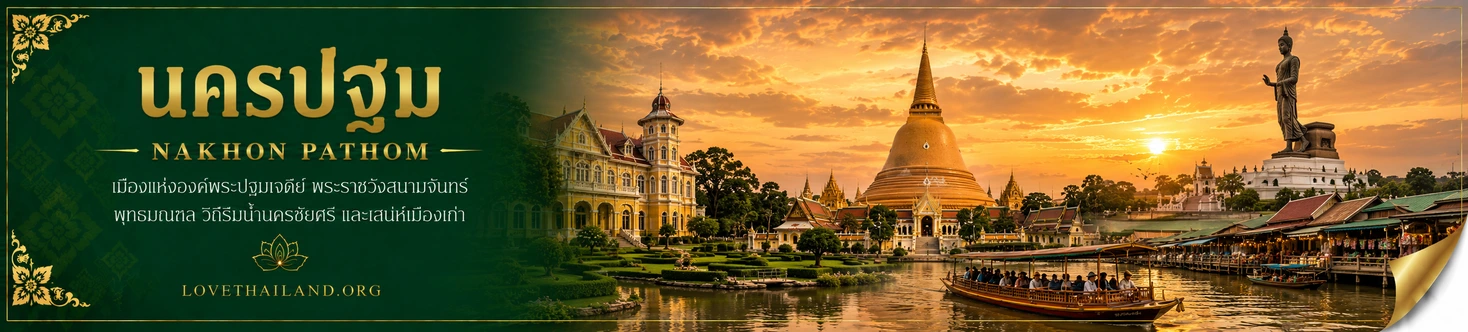
Nakhon Pathom
Slogan : Sweet pomelos, delicious rice, beautiful young ladies.
Nakhon Pathom is a relatively small province located on the outskirts of Bangkok. Despite its size, it holds significant importance in terms of history, culture, and economy. The province is highly fertile and well-suited for agriculture, especially pomelo cultivation, which has earned it the nickname “City of Sweet Pomelo.” This abundance is not limited to agricultural produce but also extends to a wide variety of well-known local foods, making it a popular destination for food lovers.
Nakhon Pathom has a long history of over 1,000 years. Numerous archaeological discoveries indicate that this area was once a major center during the Dvaravati period. One of the most important historical landmarks is Phra Pathom Chedi, the largest stupa in Thailand and a symbol of the early spread of Buddhism and Indian civilization into Southeast Asia. Its presence reflects the former prosperity of Nakhon Pathom in terms of religion, trade, and cultural exchange.
In the past, Nakhon Pathom was located along the coastline and served as a thriving center of trade and transportation. People from various ethnic backgrounds migrated to settle here, resulting in a rich blend of cultures. However, over time, changes in water flow led to drought conditions, forcing residents to relocate closer to river areas and establish a new settlement called “Nakhon Chai Si.” As a result, the original city of Nakhon Pathom was abandoned for several centuries.
The revival of Nakhon Pathom began during the reign of King Rama IV (King Mongkut), who discovered Phra Pathom Chedi while he was still a monk. After ascending the throne, he ordered the restoration of the site by constructing a Sri Lankan-style stupa to cover the original structure. He also developed infrastructure, including the excavation of Chedi Bucha Canal, to support transportation and urban revitalization.
Later, during the reign of King Rama V (King Chulalongkorn), further development took place, particularly the construction of the Southern Railway line, which re-established Nakhon Pathom as an important city. The administrative center was relocated back to the area around Phra Pathom Chedi, as it had been in ancient times. Continued development in the reign of King Rama VI included the construction of Sanam Chandra Palace, roads, and Charoen Sattha Bridge, all of which remain significant infrastructure today.
Geographically, Nakhon Pathom covers an area of approximately 2,168 square kilometers. It is located within the Tha Chin River basin and consists entirely of flat plains, with no mountains. This makes it ideal for agriculture, particularly fruit orchards such as pomelo, orchids, and various vegetables. The northwestern part of the province has slightly elevated land, while most areas are lowland plains supported by a well-developed irrigation system.
The economy of Nakhon Pathom has traditionally been based on agriculture, but it has expanded rapidly into industry and services. Areas such as Sam Phran and Phutthamonthon districts have seen significant growth due to the presence of industrial estates and educational institutions, including Mahidol University (Salaya campus). This has contributed to urban economic expansion and continuous real estate development.
Culturally, Nakhon Pathom stands out for its blend of Thai, Chinese, and Mon influences. This diversity is reflected in local traditions such as the annual Phra Pathom Chedi Fair, which attracts a large number of visitors each year. Traditional floating markets and riverside communities continue to preserve authentic ways of life, offering visitors a glimpse into local heritage.
Food is one of the province’s strongest attractions. Signature dishes include braised duck, red pork rice, crispy roasted pork, and Thai-Chinese desserts such as ginger syrup dumplings and mooncake-style pastries. In addition, modern cafés and restaurants have emerged, combining traditional flavors with contemporary dining experiences.
In terms of tourism, Nakhon Pathom offers a wide range of attractions, including cultural sites, natural settings, and local lifestyle experiences. Popular destinations include Phra Pathom Chedi, Sanam Chandra Palace, Don Wai Floating Market, and Khlong Mahasawat. Visitors can enjoy boat tours to explore traditional riverside life. The province is easily accessible from Bangkok, taking only about one hour, making it an ideal destination for day trips or weekend getaways.
Getting There Travelers can reach Nakhon Pathom from Bangkok via private car, Southern Railway trains, or public buses. The journey typically takes around 1–1.5 hours, depending on traffic conditions. The province is also well connected to nearby areas such as Ratchaburi, Suphan Buri, and Nonthaburi, allowing for convenient multi-destination travel planning.
Nakhon Pathom represents a perfect balance between modern development and traditional lifestyle. It reflects the historical roots of Thailand while also meeting the needs of contemporary tourism, offering a complete experience in terms of food, culture, nature, and accessibility.
Nakhon Pathom Annual Festivals 2026
| Festival | Date | Time | Location / Address | Highlights |
| Phra Pathom Chedi Fair | November 2026 (Loy Krathong period) | 08:00 – 22:00 | Phra Pathom Chedi, Mueang District | Major annual event with food, markets, and temple activities |
| Pomelo Festival | August 2026 | 09:00 – 18:00 | Nakhon Chai Si / Sam Phran | Taste GI-certified pomelo and local products |
| Don Wai Floating Market | Daily (Peak: weekends) | 07:00 – 17:00 | Bang Krathuek, Sam Phran | Famous local food and riverside atmosphere |
| Khlong Mahasawat Boat Tour | All year round | 08:30 – 16:00 | Phutthamonthon District | Local lifestyle + organic farming experience |
3–5 Day Travel Itinerary in Nakhon Pathom
| Day | Place | Location | Highlights |
| Day 1 | Phra Pathom Chedi | Mueang District | Largest stupa in Thailand |
| Day 1 | Sanam Chandra Palace | Mueang District | Royal architecture blending Thai and European styles |
| Day 2 | Don Wai Floating Market | Sam Phran | Famous street food and riverside dining |
| Day 3 | Khlong Mahasawat | Phutthamonthon | Boat tour through local farming communities |
| Day 4 | Phutthamonthon | Phutthamonthon District | Important Buddhist landmark in Thailand |
| Day 5 | Pomelo Orchard | Nakhon Chai Si | Agricultural tourism + GI pomelo tasting |
Top 10 MUST VISIT Attractions in Nakhon Pathom
| Place | Location | Highlights |
| Phra Pathom Chedi | Mueang District | Largest stupa in Thailand |
| Sanam Chandra Palace | Mueang District | Royal residence with unique architecture |
| Don Wai Floating Market | Sam Phran | Authentic Thai food destination |
| Phutthamonthon | Phutthamonthon District | Major Buddhist park |
| Wat Rai Khing | Sam Phran | Famous sacred Buddha image |
| Sampran Riverside | Sam Phran | Cultural and eco-tourism destination |
| Khlong Mahasawat | Phutthamonthon | Traditional canal lifestyle |
| Sam Phran Garden | Sam Phran | Organic farming experience |
| Lam Phaya Floating Market | Bang Len | Authentic local community market |
| Wat Bang Phra | Nakhon Chai Si | Traditional Sak Yant temple |
Frequently Asked Questions (FAQ)
Q: What are the must-visit attractions in Nakhon Pathom?
A: The top attractions include Phra Pathom Chedi, Sanam Chandra Palace, Don Wai Floating Market, Phutthamonthon, and Khlong Mahasawat. These destinations offer a mix of culture, history, food, and local lifestyle experiences.
Q: When is the best time to visit Nakhon Pathom?
A: Nakhon Pathom can be visited all year round, but the best time is from October to February when the weather is cooler and more comfortable for outdoor activities.
Q: How far is Nakhon Pathom from Bangkok?
A: Nakhon Pathom is approximately 50–60 kilometers from Bangkok and takes about 1 hour by car, making it perfect for a day trip or weekend getaway.
Q: Is Nakhon Pathom suitable for family travel?
A: Yes, it is very family-friendly. The province offers easy-access attractions such as temples, floating markets, parks, and cafés suitable for all ages.
Q: What local food should I try in Nakhon Pathom?
A: Popular dishes include braised duck, red pork rice, crispy pork, and Thai-Chinese desserts like ginger dumplings and pastries. Pomelo is also a must-try local fruit.
Q: How many days should I spend in Nakhon Pathom?
A: A 1-day trip is enough for a quick visit, but for a more complete experience including food, culture, and activities, 2–3 days or even 3–5 days is recommended.
Q: Are there any floating markets in Nakhon Pathom?
A: Yes, popular floating markets include Don Wai Floating Market and Lam Phaya Floating Market, both known for authentic local food and traditional atmosphere.
Q: What makes Nakhon Pathom unique?
A: Its uniqueness lies in its historical significance as a Dvaravati center, the presence of Thailand’s largest stupa, rich food culture, and its convenient location near Bangkok.
Q: What transportation options are available to Nakhon Pathom?
A: Travelers can reach the province by private car, train (Southern Line), or public buses. The journey is short and convenient from Bangkok.
Q: Can I visit Nakhon Pathom as a day trip?
A: Yes, it is one of the best day-trip destinations from Bangkok. However, staying overnight allows for a more relaxed and complete travel experience.
Nakhon Pathom Map

 Art, Culture and Heritage
 Historical Sites and Monuments(6)
 Landmarks and Memorials(4)
 Royal Palace(3)
 Art, Craft Centres, Tradition(5)
 Museums(13)
 Art Gallery(1)
 Educational Places
 Educational Gardens, Farm(2)
 Places of Worship
 Temple(77)
 Other Sacred Sites(4)
 Research and Development
 Royal Project(1)
 Suburban Living
 Village, Community(3)
 Local Market(3)
 Floating Market(8)
 Nature and Wildlife
 River, Canal(4)
 Other natural attractions(3)
 Entertainment and Agricultural
 Animal camps and shows(1)
 Stadium(1)
 Farms, Parks and Ecotourism(5)
 Theater(1)
 Outdoor and Adventure Activities(2)
 Spas and Wellness
 Spas and Wellness(1)


