
lovethailand home >Northeastern Travel Attractions
> Si Sa Ket Travel Attractions
TL;DR: A quick overview of attractions in Si Sa Ket, plus planning details, access, and key travel highlights.
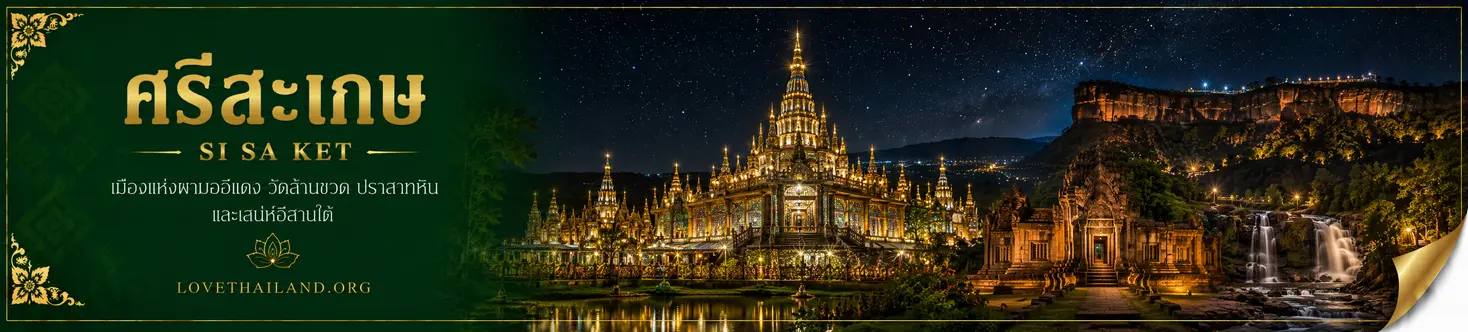
Si Sa Ket
Slogan : Si Sa Ket land of castle cambodia style, grate garlic and onions, have garden of king, many Lamdouan flowers, many different cultures, the best of harmonious.
Sisaket Province is located in the northeastern region of Thailand, commonly known as Isan, specifically in the lower northeastern area. As a border province adjacent to Cambodia, Sisaket has long served as a significant crossroads of culture, history, and trade. This unique geographical position has shaped the province into more than just an agricultural area; it stands as one of the most distinctive representations of Southern Isan identity in Thailand.
The province is particularly notable for its harmonious blend of ancient Khmer civilization, Lao cultural influences, and traditional Isan ways of life. This cultural fusion has created a unique identity that cannot be found elsewhere. Numerous historical sites across Sisaket, especially the ancient Khmer stone sanctuaries along the Phanom Dong Rak mountain range, provide clear evidence of the region’s prosperity during the Khmer Empire and continue to serve as important archaeological and historical learning sites today.
Geographically, Sisaket features a diverse landscape. Most of the province consists of gently undulating plains, making it highly suitable for agriculture, particularly rice cultivation and other economic crops. The northern part of the province lies within the Mun River basin, which has long supported local livelihoods. In contrast, the southern region is dominated by the Phanom Dong Rak mountain range, which stretches along the Thai-Cambodian border and serves as both a natural boundary and a vital source of natural resources.
The Phanom Dong Rak range is also home to several natural attractions and scenic viewpoints, including Pha Mo E Daeng, where visitors can enjoy panoramic views extending into Cambodia. This area is located near Preah Vihear, a world-renowned historical site that reflects the grandeur of the ancient Khmer civilization.
In terms of ethnicity, Sisaket is one of Thailand’s most culturally diverse provinces. The population includes several ethnic groups such as the Kuy (Suay), Lao, Khmer, and Yer communities. Each group maintains its own language, traditions, and belief systems. The coexistence of these diverse groups has resulted in a rich cultural landscape that is both complex and fascinating.
One of the defining characteristics of Sisaket is its linguistic diversity. Multiple languages are commonly spoken in daily life, including the Isan dialect, Khmer, and Kuy languages. This reflects the harmonious coexistence of different ethnic groups and represents a living cultural heritage that continues to thrive in modern society.
Historically, Sisaket has roots that date back thousands of years. The area was once part of the Khmer Empire before evolving into an important settlement during the Ayutthaya period. In 1759 (B.E. 2302), the city of “Nakhon Lamduan” was established, later renamed “Khukhan.” During the reign of King Rama I, “Sisaket” was officially established, and in 1938 (B.E. 2481), it was designated as Sisaket Province, the name it retains today.
This historical evolution highlights Sisaket’s role as a regional administrative center and a key settlement area in Southern Isan, as well as its importance in connecting border regions with central Thailand.
Culturally, Sisaket has preserved its traditional customs remarkably well. One of the most significant traditions is “Saen Don Ta,” an ancestral worship ceremony practiced by Thai people of Khmer descent. Held annually during the tenth lunar month, this ritual reflects deep-rooted beliefs about ancestry, spirituality, and the afterlife.
In addition, the province continues to celebrate traditional Isan festivals following the “Heet 12, Kong 14” calendar, including Bun Bang Fai (rocket festival), Bun Khao Jee, Buddhist Lent, and the End of Lent ceremonies. These traditions are closely tied to agricultural cycles and Buddhist beliefs.
Another major highlight is the “Volcanic Durian Festival,” which has gained national recognition. Durians grown in Sisaket are cultivated on ancient volcanic soil, resulting in a unique flavor profile characterized by sweetness, creamy texture, and a mild aroma. This premium agricultural product has become an important economic driver for the province.
Sisaket’s local cuisine is equally distinctive, offering a wide variety of traditional dishes that reflect the region’s cultural diversity. Most dishes feature bold flavors and natural ingredients such as herbs, bamboo shoots, freshwater fish, and locally sourced meats. Popular dishes include larb, koi, bamboo shoot soup, and spicy herbal soups, alongside unique ethnic recipes from Khmer and Kuy communities.
Local ingredients, especially volcanic durian, are also used to create processed products such as snacks, desserts, and OTOP goods, helping to increase product value and support community income.
Economically, Sisaket is primarily an agricultural province, with rice, rubber, cassava, and durian as key products. Cross-border trade with Cambodia also plays a significant role in boosting the local economy.
Border checkpoints such as Chong Sa-ngam serve as important trade gateways and also function as travel routes connecting Thailand and Cambodia, further enhancing the province’s economic and tourism potential.
In terms of tourism, Sisaket offers strong potential in cultural, historical, and natural travel experiences. Visitors can explore ancient Khmer temples, important Buddhist sites, natural attractions, and authentic local communities within a single province.
Key attractions include Prasat Sa Kamphaeng Yai, Wat Lan Khuad (Temple of a Million Bottles), Pha Mo E Daeng, Samrong Kiat Waterfall, and the Queen Mother Park. Each of these destinations reflects the province’s unique identity and attracts both domestic and international visitors.
Community-based tourism is also growing in Sisaket, allowing visitors to experience local lifestyles, traditional weaving, regional cuisine, and cultural activities firsthand.
Getting There Sisaket is accessible via multiple transportation options. Travelers can drive from Bangkok via Nakhon Ratchasima, Buriram, and Surin, covering approximately 550 kilometers in about 7–8 hours.
Alternatively, visitors can take the northeastern railway line directly to Sisaket Station, with daily train services available. Interprovincial buses from Bangkok’s Mo Chit Terminal also provide direct routes to Sisaket.
The province’s transportation infrastructure is well developed, making it easy to travel between attractions by private car, rental services, or local transport.
With its rich combination of history, culture, traditions, cuisine, economy, and natural resources, Sisaket stands out as a well-rounded destination suitable for both short trips and extended travel experiences.
Sisaket is not only a destination for general tourists but also an important location for those interested in history, archaeology, anthropology, and cultural studies, offering a deep and authentic experience of Southern Isan.
Annual Festivals in Sisaket Province 2026
| Festival Name | Date | Time | Location (Full Address) | Highlights |
| Volcanic Durian Festival | June–July 2026 | 09:00–20:00 | Front yard of Sisaket Provincial Hall, Thepha Road, Mueang Nuea Subdistrict, Mueang Sisaket District, Sisaket 33000 | Premium GI durian tasting and local agricultural products |
| Saen Don Ta Festival | September 2026 | All Day | Khukhan District, Sisaket Province | Ancestral worship ceremony of Khmer descendants |
| Bun Bang Fai Rocket Festival | May 2026 | 08:00–18:00 | Kanthararom District, Sisaket Province | Traditional rocket launching ceremony for rain blessing |
| Silk and Local Products Fair | December 2026 | 10:00–21:00 | Sisaket Provincial Hall | Silk products, OTOP goods, and local food |
| New Year & Red Cross Fair | January 2026 | 17:00–22:00 | Sisaket Provincial Hall | Entertainment, shopping, and charity activities |
3–5 Day Travel Itinerary in Sisaket (Detailed Plan)
| Day | Location (Full Address) | Highlights |
| Day 1 | Wat Maha Phuttharam (Wat Phra To), Khukhan Road, Mueang Tai Subdistrict, Mueang Sisaket District, Sisaket | Sacred giant Buddha statue, city landmark |
| Day 2 | Prasat Sa Kamphaeng Yai, Sa Kamphaeng Yai Subdistrict, Uthumphon Phisai District, Sisaket | Largest Khmer sanctuary in the province |
| Day 3 | Pha Mo E Daeng, Khao Phra Wihan National Park, Sao Thong Chai Subdistrict, Kantharalak District, Sisaket | Cliff viewpoint overlooking Thailand–Cambodia border |
| Day 4 | Samrong Kiat Waterfall, Bak Dong Subdistrict, Khun Han District, Sisaket | Large waterfall in lush forest |
| Day 5 | Queen Sirikit Park (Suan Somdet Phra Srinagarindra), Nong Khrok Subdistrict, Mueang Sisaket District, Sisaket | Large public park for relaxation |
Top 10 MUST VISIT Attractions in Sisaket
| Attraction | Full Address | Highlights |
| Pha Mo E Daeng | Khao Phra Wihan National Park, Sao Thong Chai, Kantharalak, Sisaket | Cliff viewpoint and sea of mist |
| Prasat Sa Kamphaeng Yai | Sa Kamphaeng Yai, Uthumphon Phisai, Sisaket | Ancient Khmer stone sanctuary |
| Wat Lan Khuad (Million Bottle Temple) | Si Kaeo Subdistrict, Si Rattana District, Sisaket | Temple built from over one million glass bottles |
| Samrong Kiat Waterfall | Bak Dong, Khun Han, Sisaket | Scenic waterfall surrounded by forest |
| Wat Maha Phuttharam | Mueang Tai, Mueang Sisaket, Sisaket | Sacred giant Buddha statue |
| Queen Mother Park | Nong Khrok, Mueang Sisaket, Sisaket | Peaceful large park |
| Huai Chan Waterfall | Huai Chan, Khun Han, Sisaket | Famous swimming waterfall |
| Chong Sa-ngam Border | Phrai Phatthana, Phu Sing, Sisaket | Thailand–Cambodia border crossing |
| Prasat Ban Prasat | Huai Thap Than District, Sisaket | Ancient Khmer ruins |
| Huai Nam Kham Reservoir | Mueang Sisaket District, Sisaket | Relaxing natural scenery |
Frequently Asked Questions (FAQ)
Q: Where is Sisaket located in Thailand?
A: Sisaket is located in the northeastern region of Thailand (Isan), bordering Cambodia. It lies approximately 515 kilometers from Bangkok and is part of the lower northeastern cultural and historical zone.
Q: What is Sisaket famous for?
A: Sisaket is well known for its volcanic durian (a GI-certified fruit), ancient Khmer ruins such as Prasat Sa Kamphaeng Yai, scenic viewpoints like Pha Mo E Daeng, and unique temples including Wat Lan Khuad, also known as the Million Bottle Temple.
Q: When is the best time to visit Sisaket?
A: The best time to visit Sisaket is between November and February when the weather is cooler and more comfortable. Travelers who want to experience local culture should also consider visiting during major festivals such as the Volcanic Durian Festival (June–July) or the Saen Don Ta Festival (September).
Q: How do I get to Sisaket?
A: You can travel to Sisaket by train from Bangkok (Hua Lamphong or Krung Thep Aphiwat Central Terminal), by intercity bus from Mo Chit Bus Terminal, or by private car via Highway 1 and Highway 24. The journey typically takes 7–9 hours depending on the mode of transportation.
Q: What are the must-visit attractions in Sisaket?
A: Key attractions include Pha Mo E Daeng, Prasat Sa Kamphaeng Yai, Wat Lan Khuad (Million Bottle Temple), Samrong Kiat Waterfall, and Wat Maha Phuttharam. These places highlight both natural beauty and cultural heritage.
Q: Is Sisaket suitable for international tourists?
A: Yes, Sisaket is suitable for international travelers who are interested in authentic Thai culture, Khmer heritage, and nature tourism. While English may not be widely spoken in rural areas, major attractions are accessible and welcoming.
Q: How many days should I spend in Sisaket?
A: A 3–5 day trip is ideal to explore Sisaket. This allows time to visit temples, historical sites, waterfalls, viewpoints, and experience local culture without rushing.
Q: Are there accommodations available in Sisaket?
A: Yes, Sisaket offers a range of accommodations including hotels, resorts, and guesthouses, especially in Mueang Sisaket District and near major attractions.
Q: What local food should I try in Sisaket?
A: Visitors should try local Isan cuisine such as som tam (papaya salad), larb (spicy minced meat salad), grilled chicken, sticky rice, and especially volcanic durian, which is a signature product of the province.
Q: Is Sisaket safe for travel?
A: Sisaket is generally safe for travel. However, travelers visiting border areas should follow local guidelines and check current conditions before traveling.
Si Sa Ket Map

 Art, Culture and Heritage
 Historical Sites and Monuments(12)
 Landmarks and Memorials(1)
 Art, Craft Centres, Tradition(8)
 Places of Worship
 Temple(13)
 Other Sacred Sites(3)
 Suburban Living
 Village, Community(2)
 Nature and Wildlife
 National Parks and Marine Reserves(2)
 Dam, Reservoir, Lake(7)
 Waterfalls(5)
 River, Canal(5)
 Bays and Beaches(2)
 Entertainment and Agricultural
 Zoos and Aquariums(1)
 Farms, Parks and Ecotourism(3)
 Travel Articles, Recipes
 Travel Review, Food Review(1)


