
lovethailand home >South Travel Attractions
> Ranong Travel Attractions
TL;DR: A quick overview of attractions in Ranong, plus planning details, access, and key travel highlights.
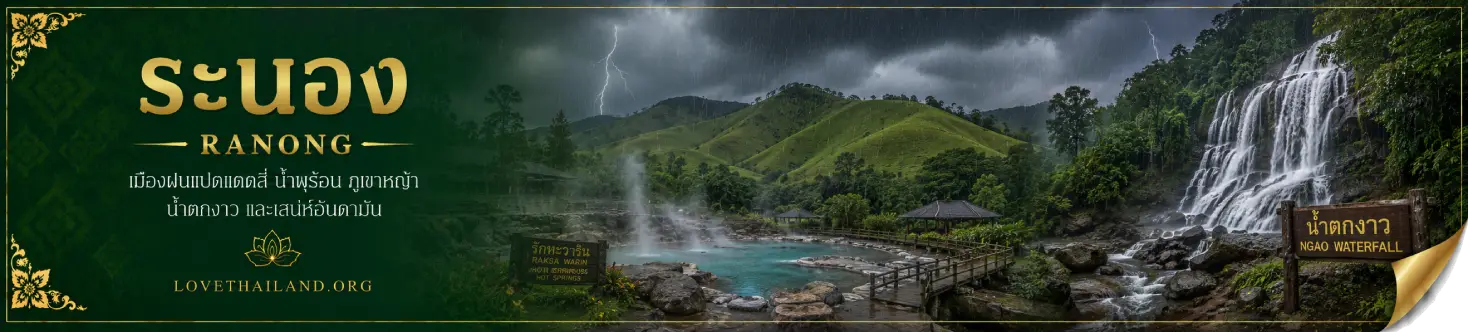
Ranong
Slogan : Kor Kod Ka, mountains and grass, Ka U sweet, rivers and mineral water, pearl.
Ranong Province is a coastal province located on the western side of Thailand in the upper southern region. It is distinguished by its rich natural environment, cultural diversity, and deep historical background. The province remains highly abundant in natural resources, including mountains, forests, waterfalls, natural hot springs, and the clear waters of the Andaman Sea, along with numerous small islands that retain their peaceful and unspoiled atmosphere. These characteristics make Ranong an ideal destination for eco-tourism and true relaxation.
Ranong is also known as the province with the highest rainfall in Thailand, which keeps its forests lush and green throughout the year. It is an important source of natural water resources and has a unique cultural identity shaped by a harmonious blend of Thai, Chinese, and Myanmar influences, creating a distinctive charm that sets it apart from other southern provinces.
Ranong Province covers an area of approximately 3,298 square kilometers, or about 2,141,250 rai, making it a medium-sized province in Thailand. Its geography is characterized by a long and narrow shape stretching from north to south, with a length of approximately 169 kilometers and a maximum width of only 44 kilometers. This makes Ranong one of the narrowest provinces in Thailand, especially in Kraburi District, where the width is only about 9 kilometers.
The terrain of Ranong consists mainly of complex mountain ranges in the eastern part, gradually descending toward the Andaman Sea in the west. This creates a diverse landscape that includes tropical rainforests, waterfalls, streams, and beautiful coastlines. Although there is limited flat land for agriculture, the province remains exceptionally rich in natural resources.
Ranong is located at the “Isthmus of Kra,” the narrowest part of the Malay Peninsula, where the distance between the Andaman Sea and the Gulf of Thailand is only about 50 kilometers. This location has made Ranong a strategically important area both historically and in modern times.
Historically, Ranong was once part of the Srivijaya Kingdom, a major maritime trading center in the region. During the Ayutthaya period, Ranong was a small town under the administration of Chumphon and played an important role as a border town and mining center, particularly for tin, which was a key natural resource of the area.
During the reign of King Rama IV, Ranong was elevated to the status of a fourth-class city, marking an important step in its administrative and economic development.
Later, during the reign of King Rama V, Ranong underwent further development in administration, economy, and infrastructure. The expansion of tin mining and maritime trade significantly contributed to the province’s prosperity and importance as a gateway to the Andaman coast.
In the present day, Ranong’s economy is supported by several key sectors, including tourism, agriculture such as rubber and oil palm cultivation, fisheries, and cross-border trade with Myanmar, particularly through the Kawthaung border area.
One of the most well-known attractions in Ranong is Raksawarin Hot Springs, a natural mineral hot spring that is rich in beneficial minerals. It has become a popular destination for both Thai and international visitors seeking relaxation and health benefits.
Another highlight of Ranong is its islands, especially Koh Phayam and Koh Kam, which are renowned for their tranquil atmosphere, crystal-clear waters, and relatively untouched natural surroundings. These islands offer a perfect escape from crowded tourist destinations and are ideal for travelers looking for peace and simplicity.
The lifestyle of people in Ranong reflects a multicultural heritage. The local population consists of Thai Buddhists, Thai-Chinese communities, and people of Myanmar origin, all of whom coexist harmoniously. This diversity is clearly reflected in local traditions, festivals, architecture, and especially cuisine.
Important local traditions include the Vegetarian Festival, which is strongly influenced by Chinese culture and features elaborate rituals and processions, as well as the Sart Festival, a Buddhist merit-making tradition dedicated to honoring ancestors.
Ranong’s cuisine is another distinctive aspect of the province. Visitors can enjoy a wide range of food, from fresh seafood sourced directly from the Andaman Sea to southern Thai dishes known for their bold and spicy flavors, as well as Chinese-influenced meals such as Hainanese-style chicken rice and fish porridge.
Getting There Traveling to Ranong is convenient and can be done in several ways. Visitors can drive via Highway No. 4 (Phetkasem Road), fly directly to Ranong Airport, or take interprovincial buses from Bangkok and other southern regions.
The most suitable time to visit Ranong is between December and April, when rainfall is lower and sea conditions are favorable for traveling to the islands and exploring outdoor attractions comfortably.
With its combination of natural beauty, cultural richness, and peaceful atmosphere, Ranong remains one of Thailand’s hidden gems. It offers a unique travel experience that appeals to those seeking authenticity, relaxation, and a deeper connection with nature.
Ranong Tourism Festivals 2026
| No. | Festival | Period | Location | Highlights |
| 1 | Ranong Vegetarian Festival | October 2026 | Guan Yu Shrine and Ranong Town | Processions, traditional Chinese rituals, various vegetarian food |
| 2 | Sart Festival | September 2026 | Temples throughout the province | Merit-making for ancestors, traditional desserts |
| 3 | Ranong Onsen Tourism Festival | March – April 2026 | Raksawarin Hot Springs | Hot spring bathing, wellness tourism activities |
| 4 | La-un River Rafting Festival | November – December 2026 | La-un District | Nature rafting, mangrove forest experience |
| 5 | Ranong Seafood Festival | April 2026 | Ranong Coastline | Fresh seafood, community activities |
Ranong Travel Itinerary (3–5 Days)
| Day | Destination | Location | Highlights |
| Day 1 | Ranong Town / Raksawarin Hot Springs | Mueang Ranong District | Hot spring bathing, old town exploration |
| Day 2 | Koh Phayam | Mueang Ranong District | Clear sea, peaceful beaches, slow life experience |
| Day 3 | Koh Kam / Kam Islands | Suk Samran District | Snorkeling, crystal-clear water, coral reefs |
| Day 4 | Ngao Waterfall | Ngao Waterfall National Park | Large waterfall, scenic natural views |
| Day 5 | La-un Canal / Mangrove Forest | La-un District | Rafting, nature exploration |
Must-Visit Attractions in Ranong (Top 10)
| No. | Attraction | Location | Highlights |
| 1 | Koh Phayam | Mueang Ranong District | Beautiful, peaceful beaches |
| 2 | Raksawarin Hot Springs | Ranong Town | Health hot spring bathing |
| 3 | Ngao Waterfall | National Park Area | Tall and impressive waterfall |
| 4 | Koh Kam | Suk Samran District | Snorkeling, coral reefs |
| 5 | Phu Khao Ya (Grass Hill) | Mueang District | Open grassland, scenic views |
| 6 | La-un Mangrove Forest | La-un District | Rich ecosystem |
| 7 | Wat Suwan Khiri | Ranong Town | Historic temple |
| 8 | Ranong Pier | Mueang Ranong | Gateway to islands |
| 9 | Koh Chang (Ranong) | Mueang District | Pristine nature |
| 10 | Khlong Naka Wildlife Sanctuary | Protected Forest Area | Rich biodiversity |
Frequently Asked Questions (FAQ)
Q: What makes Ranong Province different from other provinces?
A: Ranong stands out for its pristine natural environment, including islands, waterfalls, and natural hot springs. It also has a high level of rainfall, keeping the forests lush year-round, along with a unique cultural blend of Thai, Chinese, and Myanmar influences.
Q: When is the best time to visit Ranong?
A: The best time to visit is from December to April, when rainfall is lower, the sea is clearer, and conditions are ideal for island trips and outdoor activities.
Q: What type of travel is Ranong suitable for?
A: Ranong is ideal for nature-based tourism, eco-tourism, and relaxing travel styles. It is also suitable for wellness travelers, such as those interested in hot spring bathing and slow life experiences.
Q: How many days are recommended for a trip to Ranong?
A: A 3–5 day trip is recommended to fully explore the city, Koh Phayam, waterfalls, and other natural attractions.
Q: How can I travel to Koh Phayam?
A: You can take a speedboat from Ranong Pier, which takes approximately 40–60 minutes. Boats operate daily with multiple departure times.
Q: What food is Ranong famous for?
A: Ranong is known for fresh seafood, spicy southern Thai cuisine, fish porridge, Hainanese-style chicken rice, and local dishes influenced by multicultural heritage.
Q: What wellness activities are available in Ranong?
A: Visitors can relax at Raksawarin Hot Springs, a natural mineral spring known for its health benefits and peaceful environment.
Ranong Map

 Art, Culture and Heritage
 Historical Sites and Monuments(4)
 Landmarks and Memorials(1)
 Royal Palace(1)
 Art, Craft Centres, Tradition(4)
 Educational Places
 Educational Gardens, Farm(1)
 Places of Worship
 Temple(12)
 Other Sacred Sites(2)
 Suburban Living
 Village, Community(2)
 Nature and Wildlife
 National Parks and Marine Reserves(6)
 Mountain (Doi)(4)
 Waterfalls(15)
 Hot Springs(3)
 Caves(4)
 River, Canal(2)
 Bays and Beaches(10)
 Islands(8)
 Other natural attractions(3)


