
lovethailand home >Central Travel Attractions
> Saraburi Travel Attractions
TL;DR: A quick overview of attractions in Saraburi, plus planning details, access, and key travel highlights.
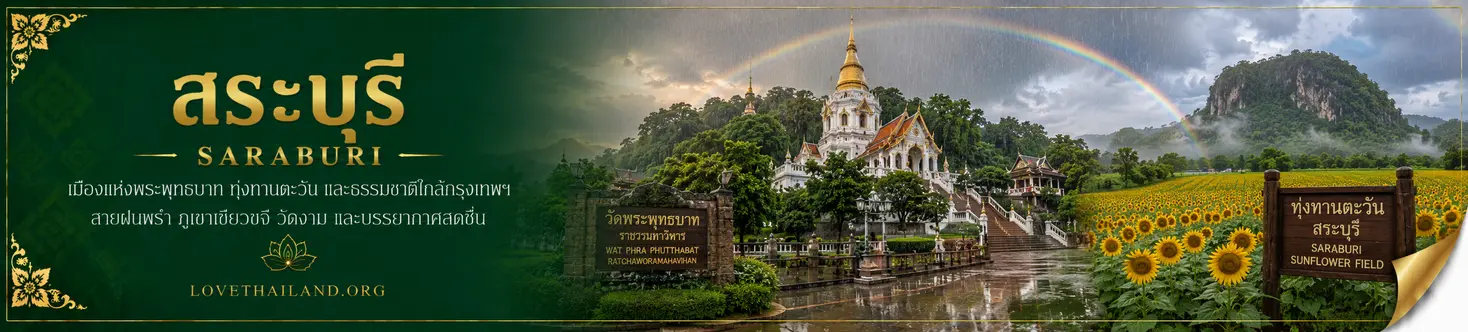
Saraburi
Slogan : Trail of buddha, Pha Sak Chollasit dam, base of industry, the best of agriculture, many attraction to travel, the best of curry puff, good milk, make a merit flower festival, glowing sunflower fields.
Saraburi Province is a familiar name to many Thai people, yet it is still overlooked by a fair number of travelers who tend to think of it merely as a stopover between Bangkok and the Northeast. In reality, when viewed more closely, this province offers an impressively complete travel profile: landscapes that shift from fertile plains to mountain ridges, historical connections to the Ayutthaya period, nationally important religious landmarks, a distinctive local tradition known as the floral alms offering during Buddhist Lent, waterfalls and forest areas suited to both relaxed sightseeing and outdoor adventure, and a culinary identity shaped by Saraburi curry puffs and Muak Lek dairy products. All of this makes Saraburi far more than just a nearby province; it is a destination with a clear identity and year-round appeal.
If Saraburi had to be summed up as briefly as possible, it would be described as the gateway between Central Thailand and the Northeast. It is a province where transportation, industry, agriculture, and tourism come together in one place. Nature lovers will find waterfalls, forests, reservoirs, and flower fields. Pilgrimage travelers will discover Wat Phra Phutthabat, Wat Tham Krabok, Wat Pa Sawang Bun, and Phra Phutthachai. Families can comfortably plan a 3–5 day trip because the distances between attractions are manageable. Those who prefer a slow travel style centered around food will also find plenty to enjoy, from long-established eateries in the city to farm cafés around Muak Lek and worthwhile local products to take home.
Saraburi covers approximately 3,576.5 square kilometers, or about 2.23 million rai, and lies along the transition zone between Central Thailand and the Northeast. As a result, its physical geography is more varied than many people expect. The northern area, parts of the center, and the eastern side consist of rolling hills, forests, and elevated terrain interspersed with plains, making them suitable for field crops, livestock, and nature-based tourism. The southern and western parts are flatter lowlands, better suited to rice farming, settlement, and transportation networks. This combination of two major landscape types within a single province is what gives Saraburi its dual image as both an industrial province and a green destination where mountains, waterfalls, and fresh air can be reached not far beyond the urban zone.
The province’s main lifeline is the Pa Sak River, which flows through several key districts of Saraburi before continuing toward Phra Nakhon Si Ayutthaya. The river is not only an important water source for agriculture and local communities, but also a defining part of the province’s landscape, history, and economic development. Saraburi also has several important canals, including Khlong Rapeepat, Khlong Roeng Rang, Khlong Wihan Daeng, and Khlong Phriiao, all of which have long been tied to agricultural livelihoods and settlement patterns. Together with the nearby Pa Sak Jolasid Dam, these waterways make Saraburi especially significant in terms of water management, while also enhancing its appeal as a place for leisure, photography, and scenic travel.
Historically, Saraburi did not become important only after emerging as a strategic town during the Ayutthaya period. The area contains traces of human presence dating back to prehistory, including ancient tools and rock paintings found at several locations, as well as Dvaravati-period artistic remains that indicate a long and continuous development of communities and culture. Later, during the reign of King Maha Chakkraphat of Ayutthaya, Saraburi was formally established as a center for troop mobilization and a key route linking the kingdom to eastern and northeastern frontier towns. What may look today like a mere transit location once represented a major strategic advantage in the past.
The name “Saraburi” is directly linked to the landscape. The word “sa” means a pond or water basin, while “buri” means city. Combined together, the name refers to a city tied to water, in line with the belief that the town was established near Nong Ngong marsh. The provincial name is therefore more than just a label; it is a geographic and historical code that reflects how the area was formed, grew, and settled around water and routes of movement from the very beginning. Interestingly, the name still mirrors the province’s modern character as well. Although Saraburi has grown into a major industrial base, its foundations remain rooted in natural resources, water systems, and agriculture.
Another major turning point came when the Northeastern railway line passed through Saraburi during the reign of King Chulalongkorn. The province’s transportation role then evolved from that of a strategic military town into a true transport hub. Saraburi became a gateway to the Northeast not only in military terms, but also in terms of economy and travel. Major highways such as Phahonyothin Road and Mittraphap Road further accelerated its growth. Travelers from Bangkok can reach the province very easily, whether by private car, train, or bus. This transportation advantage is precisely what makes Saraburi suitable for travelers seeking a short 1-night escape, a 3-day 2-night trip, or even a longer journey using the province as a base for onward travel to Khao Yai, Lopburi, or Phra Nakhon Si Ayutthaya.
At present, Saraburi is divided into 13 districts: Mueang Saraburi, Kaeng Khoi, Nong Khae, Wihan Daeng, Nong Saeng, Muak Lek, Ban Mo, Phra Phutthabat, Sao Hai, Nong Don, Don Phut, Wang Muang, and Chaloem Phra Kiat. Each district has a distinct personality. Mueang Saraburi is ideal for beginning an introduction to the province through old communities, local dining, and city access. Phra Phutthabat stands out for religion and tradition. Kaeng Khoi and Muak Lek are well known for natural scenery and farm cafés. Wang Muang and Chaloem Phra Kiat are associated with mountains, flower fields, and wide open views. Areas such as Sao Hai, Ban Mo, and Nong Khae still preserve the feel of traditional communities and agricultural life, helping travelers experience Saraburi as a real province rather than just a tourism label.
From an economic perspective, Saraburi is especially interesting because it has a clearly mixed economic structure. On one side, it is one of Thailand’s major industrial provinces, particularly in cement, quarrying, construction materials, and manufacturing that rely on limestone resources and highly convenient logistics. On the other side, Saraburi also has a strong agricultural base, including rice, sugarcane, corn, field crops, and dairy farming. The Muak Lek and Phra Phutthabat areas in particular are widely associated with farms, dairy products, and broad grassland scenery. This coexistence between heavy industry, agriculture, and tourism gives Saraburi its own rhythm, setting it apart from destinations that depend almost entirely on the service sector.
Saraburi’s industrial character should not automatically be seen as the opposite of tourism. In another sense, it gives the province a strong infrastructure base, with roads, businesses, people, and year-round economic movement. At the same time, the province has managed to retain the appeal of its natural attractions and religious sites. Travelers can therefore enjoy multiple styles of travel within a single trip: visiting temples in the morning, eating well in town at midday, driving out to a waterfall in the afternoon, enjoying a mountain-view café in the evening, or staying overnight at a resort in the Muak Lek area without having to cover long distances. This is a tourism advantage that many other provinces near Bangkok do not offer in the same way.
If one were to identify the symbolic highlight of Saraburi, the first place that must be mentioned is Wat Phra Phutthabat Ratchaworamahawihan. It is both the province’s spiritual center and one of its defining landmarks. The sacred Buddha’s footprint enshrined there has made Saraburi a deeply respected pilgrimage city for generations of Thai people. A journey here is not simply a religious activity; it is also connected to the province’s major annual traditions, including the Phra Phutthabat worship fair and the floral alms-offering ceremony during Buddhist Lent. Wat Phra Phutthabat is therefore not just an old temple, but a living cultural space woven into the identity of Saraburi and contemporary Thai religious life.
The province’s most distinctive tradition is the Tak Bat Dok Khao Phansa Festival, often referred to simply as the floral alms offering. Held in the Phra Phutthabat district, the ceremony is unique in its use of seasonal flowers, especially the Khao Phansa flower, to offer alms to monks during Buddhist Lent. The visual impression is both beautiful and gentle, while its roots are firmly grounded in local belief and practice. This has made it one of the province’s most recognizable traditions at the national level. The charm of the event lies not only in the ritual itself, but also in the atmosphere of the town, the gathering of local people, and the clear sense that Saraburi continues to preserve cultural heritage that remains real and lived, rather than turning it into a performance purely for tourism.
From a broader cultural tourism perspective, Saraburi is interesting because it does not rely solely on major temples or scenic landscapes. It also contains layers of stories and shared experiences spread throughout the province. Phra Phutthachai connects sacred belief with mountain scenery. Tham Krabok is widely known as a place of personal recovery and transformation. Wat Pa Sawang Bun is visually striking for its large number of golden pagodas. Pha Sadet carries associations with royal journeys in the past. This diversity makes Saraburi a province that cannot be exhausted in a single visit. Each site offers a clearly different atmosphere. Some are ideal for merit-making, some for nature lovers, some for families seeking a relaxed trip, and others for hikers who come specifically for outdoor challenges.
One of Saraburi’s most powerful visual identities is its sunflower fields in the late and early part of the year. Many travelers think of Lopburi first, but in fact Saraburi also has sunflower fields scattered across several districts, especially Muak Lek, Kaeng Khoi, Chaloem Phra Kiat, Phra Phutthabat, Wihan Daeng, Nong Don, and Mueang Saraburi. The beauty of Saraburi’s sunflower landscapes lies in the way the yellow blooms are framed by mountain backdrops and country roads, creating a softer and more layered visual experience. When visited at the right time, travelers enjoy bright flowers, cool weather, and the opportunity to combine the outing with cafés, farms, or nearby viewpoints in the same day. It is no surprise, then, that sunflower season remains one of the strongest tourism periods for the province.
Nature lovers who want to experience Saraburi in its freshest mood should devote time to its waterfall and forest zones. Namtok Chet Sao Noi National Park is one of the most accessible and family-friendly destinations, thanks to its multi-tiered waterfall, shady atmosphere, and easy walking conditions. Those seeking something more adventurous can head toward Namtok Krok E-Dok or the Chet Kot–Pong Kon Sao area, where the environment is greener, wetter, and more immersive, with forest trails and a true sense of leaving the city behind. Saraburi’s waterfalls and forests are not merely photo spots; they are central to the province’s role as a place for recovery and escape, especially for Bangkok residents who want a noticeably different atmosphere within a relatively short travel time.
Dams and reservoirs are another important part of Saraburi’s charm, though they are often mentioned less than they deserve. Whether it is Pa Sak Jolasid Dam, which carries nostalgic associations for many generations of Thai travelers, or the Muak Lek Reservoir, which offers a calm and open atmosphere suitable for driving, relaxing, taking photographs, and slowing the pace of a trip, water-based landscapes play a significant role in the province’s tourism character. One of their strengths is that they are close to mountains and communities rather than standing in isolation, making it easy to continue the journey in different directions within the same day, such as starting with a temple visit in the morning, moving to the reservoir in the afternoon, and ending with a restaurant or café without needing to cross into another province.
When it comes to food, Saraburi has a stronger culinary identity than many people realize. The province’s most famous souvenir is the Saraburi curry puff, available from both long-established shops and newer stores that continue to expand their flavors and styles, turning the snack into a recognizable provincial icon. Yet Saraburi’s food culture goes far beyond curry puffs. The province is also known for dairy products, especially in the Muak Lek area, where dairy farms, fresh milk, baked goods, desserts, and farm-style cafés form part of the local identity. In addition, there are traditional Thai dishes, bold everyday cooking, long-running noodle shops in the city, fish and ingredients connected to the Pa Sak river basin, and a growing number of contemporary restaurants that have emerged alongside tourism development. This means that visiting Saraburi is not just about stopping to eat on the way; it is a province where food can be a reason to come in its own right.
What is particularly interesting is the way Saraburi’s food reflects the structure of its economy and geography. The flatter zones and old communities offer grounded, home-style flavors that are direct and satisfying, while the Muak Lek and Kaeng Khoi areas, shaped by tourism and farming, are full of scenic restaurants, garden cafés, and menus built around fresh dairy and agricultural ingredients. Within a single province, travelers can therefore experience the atmosphere of old market eateries, community-based food, and aesthetically designed modern restaurants that appeal to newer generations of visitors. Anyone who wants to understand Saraburi through food will find that the province tells its story remarkably well through flavor.
In terms of community life, Saraburi has a valuable advantage in that it has not been pushed so far into tourism development that it loses its original rhythm. Many areas still retain the everyday scenes of fresh markets, local temples, community roads, roadside souvenir shops, and agriculture existing side by side with urban growth. Travelers can still easily experience the feel of a real province, especially if they choose to venture slightly beyond the most popular routes, perhaps by visiting an older community, stopping at a local market, or driving through fields and farms in the early morning. This understated quality is an important strength for contemporary travel content, because many travelers today are not looking only for landmarks; they are looking for places that feel alive and not interchangeable with every other province.
From a tourism strategy perspective, Saraburi has strong potential because it can present itself through multiple identities at once. First, it is a nearby province ideal for day trips. Second, it is a city of merit-making with nationally important temples. Third, it is a nature destination with accessible forests and waterfalls. Fourth, it is a province associated with food and souvenirs. Fifth, it is a convenient transit point that can be extended into routes toward Khao Yai, Lopburi, or Ayutthaya. Having all of these roles at once means that Saraburi does not need to depend on only one form of tourism marketing. Instead, it can be shaped around the real interests of different kinds of travelers.
For those who have never visited Saraburi before, the best approach is not to try to do everything in one day. The province contains far more depth than the typical online list of attractions suggests. If you are interested in religion and history, start with the Phra Phutthabat district and Mueang Saraburi. If you prefer natural scenery, focus on Kaeng Khoi, Muak Lek, and Wang Muang. If you want a light trip with attractive photo spots, good food, and rest, pair Muak Lek with seasonal flower areas or farm visits, then add one or two major temples into the route. Thinking in this way allows you to travel through Saraburi without rushing and gives you a much fuller sense of the province than simply running from one check-in point to another.
The seasons also play an important role in Saraburi’s appeal. For many travelers, the most beautiful period is from late rainy season into early winter, when waterfalls still have good water flow, forests remain lush, temperatures begin to soften, and the province gradually transitions into sunflower and flower season toward the end of the year. Even in the hot season, many places, especially waterfalls and farm café areas, are still enjoyable if the day is planned properly and started early. During Buddhist Lent, meanwhile, the province enters an important period for local traditions and faith-based travel. This makes Saraburi a province with different high points across different months, rather than a destination defined by only one season.
In terms of contemporary culture, Saraburi is also notable for the way older urban structures, long-standing communities, and newer travel lifestyles now mix together. Muak Lek has seen continued growth in cafés, resorts, and leisure-oriented spaces, yet it still retains its rural and mountainous atmosphere. Mueang Saraburi itself still feels like a real provincial city rather than a heavily stylized tourism center. Travelers therefore experience both convenience and a lack of over-curation, a balance that is not easy to find in many provinces close to Bangkok.
If one were to explain why Saraburi is becoming an increasingly attractive province to watch as a travel destination, the answer is simple: it already holds the real essentials. It has natural resources, strong religious heritage, distinctive traditions, memorable food, easy access, and a tourism profile that can branch into many directions. Today’s travelers are looking for provinces where several kinds of experiences can happen within the same trip, and Saraburi answers that need well. You can visit temples in the morning, enjoy waterfalls in the afternoon, eat well in the evening, stay overnight with mountain views, and continue the next morning with farms or flower fields without having to change provinces.
In terms of practical itinerary planning, Saraburi is especially well suited to 3–5 day travel, particularly for families, groups of friends, or couples who want a well-paced trip that does not feel exhausting. The first day may be spent getting to know the city and Phra Phutthabat. The second can be dedicated to natural attractions around Kaeng Khoi. The third can focus on Muak Lek and Wang Muang. The fourth can be used to collect key temples or seasonal photo spots. The fifth can be left for souvenir shopping or attractions missed earlier. Because the distances between major places are generally manageable, Saraburi is easier to plan than many people assume, especially for travelers with private transportation.
Getting There Saraburi is very easy to reach from Bangkok. By car, travelers can use Highway No. 1, Phahonyothin Road, or connect via Highway No. 2, Mittraphap Road, depending on the destination within the province. Reaching the city itself does not take long. Those who do not drive can travel by train on the Northeastern line and get off at Saraburi Station or nearby stations. There are also buses running throughout the day from Bangkok Bus Terminal (Mo Chit) to Saraburi. Once in the province, getting around the city area can be done by local songthaews, hired transport, or ride-hailing apps in some zones. However, if the plan includes visiting multiple districts, especially Muak Lek, Kaeng Khoi, Wang Muang, and Chaloem Phra Kiat, having a private car will be the most flexible and convenient option.
Travelers visiting Saraburi for the first time should begin with a simple question: what kind of Saraburi do you want to experience? If you want a faith-and-history version of the province, start with Wat Phra Phutthabat, Phra Phutthachai, Wat Pa Sawang Bun, and Tham Krabok. If you want a nature-centered Saraburi, pair Chet Sao Noi, Chet Kot–Pong Kon Sao, Namtok Krok E-Dok, and Muak Lek Reservoir. If you want a relaxing version centered on good food and comfortable stays, head to the Muak Lek zone for farms, cafés, and mountain-view restaurants. If you want the fullest overall picture of the province, plan a multi-day trip and combine all of these zones together. That is when it becomes clear that Saraburi is much more than simply a province near Bangkok.
Another reason why articles about Saraburi should go beyond basic listicles is that the province contains layers of useful information that genuinely help travelers. People want answers to questions such as which month is best, where to stay, how to get around, which places work best for children, which temples pair well together, when to come for photography, or how much time to set aside for food in the city and Muak Lek. A province with as many dimensions as Saraburi requires writing that goes beyond “what is there” and moves into “how should it be planned well.” This is exactly what makes a detailed Saraburi travel article more valuable than a simple attractions list.
In the end, the charm of Saraburi lies in the fact that it does not need to force an image in order to attract travelers. The province already has strong foundations: a long history, important religious sites, accessible natural attractions, memorable food, and a distance from Bangkok that makes spontaneous travel decisions easy. Saraburi is therefore suitable both for those just starting to explore nearby provinces and for experienced travelers who want a destination with more layers to discover. The more familiar one becomes with Saraburi, the clearer it is that this is not merely a transit province, but a high-quality destination with a full range of experiences and every reason to return more than once.
Saraburi Province Annual Tourism Festivals 2026
| No. | Festival Name | Date / Period | Address / Event Area | Highlights |
| 1 | Khao Phansa Flower Alms Offering Tradition and Royal Candleถวาย Ceremony | 29–30 July 2026 | Wat Phra Phutthabat Ratchaworamahawihan and the Phra Phutthabat Municipality area, Khun Khlon Subdistrict, Phra Phutthabat District, Saraburi Province | A one-of-a-kind provincial tradition where Khao Phansa flowers are offered to monks, linking faith with local identity |
| 2 | Festival of Candlelight Devotion and Cloth Offering to Phra Phutthachai | Around February 2026 (official dates pending announcement) | Wat Phra Phutthachai, Nong Pla Lai Subdistrict, Mueang Saraburi District, Saraburi Province | A candlelit ritual around the mountain and faith-based activities set against a dramatic rocky landscape and the sacred Buddha image shadow site |
| 3 | Saraburi Sunflower Blooming Season | December 2026 – January 2027 (each field opens on a different schedule; check before visiting) | Sunflower fields across Muak Lek, Kaeng Khoi, Chaloem Phra Kiat, Phra Phutthabat, Wihan Daeng, Nong Don, and Mueang Saraburi districts | One of the province’s winter highlights, ideal for photography and easy to combine with cafés, farms, and nearby temples in a single day |
| 4 | Waterfall and Forest Travel Season | June – October 2026 | Namtok Chet Sao Noi National Park in Muak Lek District and Chet Kot–Pong Kon Sao Nature Study and Ecotourism Center in Kaeng Khoi District, Saraburi Province | The best season for full waterfalls and lush forests, ideal for nature travel, hiking, water activities, and mountain-area stays |
5-Day Saraburi Travel Plan
| Day | Time | Place | Address | Highlights |
| 1 | Morning | Wat Phra Phutthabat Ratchaworamahawihan | Khun Khlon Subdistrict, Phra Phutthabat District, Saraburi Province | Begin the trip at the province’s spiritual center and learn about the sacred Buddha’s footprint and the region’s most important traditions |
| 1 | Afternoon | Wat Pa Sawang Bun | Cha-om Subdistrict, Kaeng Khoi District, Saraburi Province | Admire the many golden pagodas and striking architecture, ideal for merit-making and photography |
| 1 | Evening | Markets and local restaurants in Saraburi city | Saraburi Municipality area, Mueang Saraburi District, Saraburi Province | Try curry puffs, buy local souvenirs, and enjoy local food before staying overnight in the city |
| 2 | Morning | Phra Phutthachai and Khao Sam Lan National Park | Nong Pla Lai Subdistrict, Mueang Saraburi District, Saraburi Province | A combination of faith and nature in one zone, with the sacred Buddha image shadow, rocky hills, and forest scenery |
| 2 | Afternoon | Pha Sadet | Thap Kwang Subdistrict, Kaeng Khoi District, Saraburi Province | A scenic historical site linked to royal journeys and beautiful riverside surroundings |
| 2 | Evening | Stay in the Kaeng Khoi–Muak Lek zone | Kaeng Khoi District or Muak Lek District, Saraburi Province | Reduce driving time for the next day and enjoy a more relaxed nature-focused route |
| 3 | Morning | Namtok Chet Sao Noi National Park | Muak Lek Subdistrict, Muak Lek District, Saraburi Province | A multi-tiered waterfall area that is easy to explore, family-friendly, and ideal for swimming and relaxing in the forest |
| 3 | Afternoon | Muak Lek Reservoir and nearby cafés/farms | Muak Lek District, Saraburi Province | Water-and-mountain scenery perfect for resting, sightseeing, and enjoying meals in a natural setting |
| 3 | Evening | Stop for Muak Lek dairy products | Muak Lek area, Saraburi Province | Connect the travel experience with the area’s agricultural and dairy identity |
| 4 | Morning | Chet Kot–Pong Kon Sao Nature Study and Ecotourism Center | Tha Maprang Subdistrict, Kaeng Khoi District, Saraburi Province | Ideal for nature lovers, with trails, camping opportunities, and a rich forest ecosystem |
| 4 | Afternoon | Namtok Krok E-Dok | Forest area in Kaeng Khoi District, Saraburi Province | A destination for adventure travelers that requires preparation and extra time, perfect for serious nature enthusiasts |
| 4 | Evening | Stay in Wang Muang or Muak Lek | Wang Muang District or Muak Lek District, Saraburi Province | A good choice for ending the nature portion of the trip with a mountain-view stay |
| 5 | Morning | Wat Tham Krabok | Khun Khlon Subdistrict, Phra Phutthabat District, Saraburi Province | A nationally known temple with religious significance and a strong social role |
| 5 | Afternoon | Talat Hua Plee or a local souvenir stop | Chaloem Phra Kiat District, Saraburi Province | End the trip with food, souvenirs, community products, and the atmosphere of a travel-friendly market near Bangkok |
| 5 | Evening | Return to Bangkok | Travel via Phahonyothin Road or Mittraphap Road depending on the most convenient route | A well-paced ending to a trip that covers faith, nature, and food without feeling rushed |
10 MUST VISIT Places in Saraburi Province
| No. | Place | Address | Highlights |
| 1. | Wat Phra Phutthabat Ratchaworamahawihan | Khun Khlon Subdistrict, Phra Phutthabat District, Saraburi Province | The province’s spiritual landmark and the center of the Khao Phansa flower alms-offering tradition |
| 2. | Namtok Chet Sao Noi National Park | Muak Lek Subdistrict, Muak Lek District, Saraburi Province | A beautiful waterfall park with easy access, swimming areas, and strong appeal for families and nearby getaways |
| 3. | Chet Kot–Pong Kon Sao Nature Study and Ecotourism Center | Tha Maprang Subdistrict, Kaeng Khoi District, Saraburi Province | A destination for forest walks, camping, and nature-based travel linked to nearby waterfall routes |
| 4. | Namtok Krok E-Dok | Forest area in Kaeng Khoi District, Saraburi Province | A favorite route for adventure travelers, known for its tall waterfall and immersive forest atmosphere |
| 5. | Wat Pa Sawang Bun | Cha-om Subdistrict, Kaeng Khoi District, Saraburi Province | Known for its many golden pagodas, strong spiritual atmosphere, and photogenic architecture |
| 6. | Wat Tham Krabok | Khun Khlon Subdistrict, Phra Phutthabat District, Saraburi Province | A nationally recognized temple with religious significance and an important social role |
| 7. | Phra Phutthachai | Nong Pla Lai Subdistrict, Mueang Saraburi District, Saraburi Province | A sacred site at the foot of a mountain, blending spiritual meaning with natural scenery |
| 8. | Pha Sadet | Thap Kwang Subdistrict, Kaeng Khoi District, Saraburi Province | A historical and scenic site associated with royal journeys and a memorable natural setting |
| 9. | Muak Lek Reservoir | Muak Lek District, Saraburi Province | A scenic place to relax, enjoy the view, drive around, and pair with cafés and nature-focused dining |
| 10. | Saraburi Sunflower Fields | Found across Muak Lek, Kaeng Khoi, Chaloem Phra Kiat, Phra Phutthabat, Wihan Daeng, Nong Don, and Mueang Saraburi districts | A winter highlight of the province, ideal for photography and easy to combine with farm and café visits |
Frequently Asked Questions (FAQ)
Q: What is the best time to visit Saraburi Province?
A: If you enjoy nature and comfortable weather, late rainy season through early winter is the best time, because the waterfalls still have water and the forests remain lush. If you want to see sunflower fields, December to January is the ideal period. If you would like to experience one of the province’s most distinctive traditions, follow the Buddhist Lent season and attend the Khao Phansa flower alms-offering event in Phra Phutthabat District.
Q: Can Saraburi be visited as a day trip?
A: Absolutely, especially if you are traveling from Bangkok. However, if you want to cover major temples, waterfalls, cafés, and several photography spots, it is better to stay at least 1–2 nights, because the attractions are spread across multiple districts and the province has more depth than a simple list of places might suggest.
Q: Where should first-time visitors start in Saraburi?
A: If you want a strong first impression of the province’s identity, begin with Wat Phra Phutthabat Ratchaworamahawihan, because it represents Saraburi’s faith, history, and traditions in one place. From there, continue to Wat Pa Sawang Bun, Phra Phutthachai, or natural attractions such as Namtok Chet Sao Noi and Chet Kot–Pong Kon Sao.
Q: What makes Saraburi stand out compared with other provinces near Bangkok?
A: Saraburi stands out because it offers a complete mix within one province: nationally important temples, a unique floral alms-offering tradition, waterfalls and forest scenery, sunflower fields, famous local food such as curry puffs, and the Muak Lek identity centered on fresh milk, farms, and cafés.
Q: Is Saraburi suitable for families traveling with children?
A: Very much so. Places such as Namtok Chet Sao Noi National Park, Muak Lek Reservoir, farm zones, cafés, and seasonal photo spots are especially suitable because they are easy to reach and do not make the trip too tiring. If you are traveling with small children, it is best to choose attractions with convenient access and avoid longer forest trekking routes.
Q: How should spiritual travelers plan a Saraburi route?
A: A strong basic route would include Wat Phra Phutthabat Ratchaworamahawihan, Wat Tham Krabok, Wat Pa Sawang Bun, and Phra Phutthachai. Together, these places reflect the province’s religious identity and spiritual atmosphere clearly, and they can also be combined easily with restaurants or cafés in Kaeng Khoi and Muak Lek.
Q: What food should not be missed in Saraburi?
A: The must-try item is Saraburi curry puffs, which are among the province’s best-known local products. Visitors should also try fresh dairy products and milk-based menus in the Muak Lek area, as well as traditional Thai food, long-established restaurants in the city, and scenic restaurants that have become increasingly popular in Saraburi’s travel zones.
Q: Is Saraburi still worth visiting without a private car?
A: Yes. You can travel by train or bus and start in central Saraburi. However, if you want to explore multiple districts such as Muak Lek, Kaeng Khoi, Wang Muang, or Chaloem Phra Kiat, renting a car or using private transport will be far more convenient, since it saves time and gives you much more flexibility in planning the route.
Saraburi Map

 Art, Culture and Heritage
 Historical Sites and Monuments(2)
 Landmarks and Memorials(2)
 Royal Palace(4)
 Art, Craft Centres, Tradition(4)
 Museums(1)
 Educational Places
 Museum for Study(1)
 Educational Gardens, Farm(2)
 Places of Worship
 Temple(8)
 Other Sacred Sites(5)
 Research and Development
 Royal Project(1)
 Suburban Living
 Village, Community(3)
 Nature and Wildlife
 National Parks and Marine Reserves(3)
 Mountain (Doi)(3)
 Waterfalls(5)
 Caves(6)
 Flower Field(1)
 River, Canal(1)
 Bays and Beaches(1)
 Other natural attractions(2)
 Entertainment and Agricultural
 Zoos and Aquariums(1)
 Animal camps and shows(1)
 Farms, Parks and Ecotourism(8)
 Outdoor and Adventure Activities(1)
 Travel Articles, Recipes
 Travel Review, Food Review(1)


