
lovethailand home >Central Travel Attractions
> Samut Songkhram Travel Attractions
TL;DR: A quick overview of attractions in Samut Songkhram, plus planning details, access, and key travel highlights.
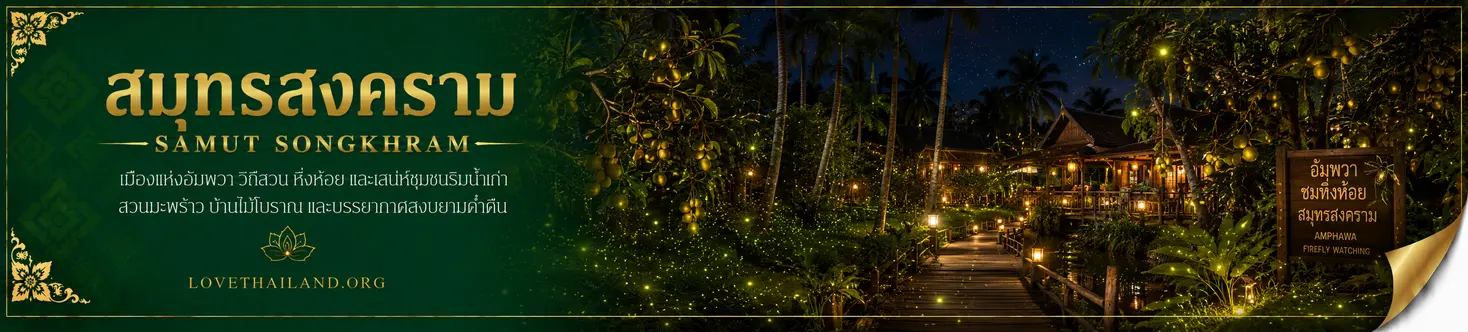
Samut Songkhram
Slogan : City of Hoi Lot, Top Lychee, King Rama II Memorial Park, the Mae Klong River, and Luangpho Ban Laem.
Samut Songkhram Province is one of the provinces in Thailand, located in the lower central region along the Gulf of Thailand. It is the smallest province in the country and has the second-lowest population after Ranong. Despite its size, it holds significant importance in terms of history, arts and culture, natural tourism resources, and is especially known for preserving traditional Thai ways of life.
Samut Songkhram offers a wide variety of unique tourism resources that continuously attract both Thai and international visitors. Its convenient location near Bangkok, along with accessible transportation, makes it one of the increasingly popular travel destinations in the region.
This small province can be reached from Bangkok in just over 1 hour, making it ideal for travelers who enjoy cultural and community-based tourism. Visitors can experience traditional lifestyles such as fruit and vegetable farming, coconut sugar production, and exploring Tha Kha Floating Market, which still preserves its authentic canal-side atmosphere. It is therefore an excellent destination for those seeking genuine local experiences.
The exact founding of Samut Songkhram is unclear. It was originally believed to be part of Ratchaburi Province and was known as “Suan Nok.”
During the Ayutthaya period through the Thonburi era, it was separated from Ratchaburi and became known as “Mae Klong.” The province played an important historical role when King Taksin the Great established Thonburi as the capital. When Burmese forces advanced to Bang Kung, the King gathered troops and built Bang Kung Camp to defend against the invasion, successfully defeating the enemy. This event marked a significant moment in Thailand’s history.
Samut Songkhram is located approximately 72 kilometers from Bangkok, covering an area of about 416 square kilometers. It is divided into 3 districts: Mueang Samut Songkhram, Amphawa, and Bang Khonthi.
Boundaries North: Ratchaburi Province. South: Phetchaburi Province and the Gulf of Thailand. West: Phetchaburi and Ratchaburi Provinces. East: Samut Sakhon Province.
Travel Tips
- During weekends such as Saturday and Sunday, there are large numbers of tourists, which may result in limited boat availability. It is recommended to check and reserve boats in advance.
- When taking a boat trip, prepare a hat and comfortable footwear. For night trips such as firefly watching, bring mosquito repellent.
- Avoid drinking alcohol during boat trips as it may be dangerous. When observing fireflies, do not make loud noises or disturb nature, and strictly avoid touching them.
- Sit in the center of the boat, avoid leaning to one side, and always wear a life jacket for safety.
- Choose experienced boat operators and check distances before using services.
- When visiting Amphawa Floating Market on weekends, be cautious with valuables due to crowds and limited space.
- When visiting the Khlong Khon mangrove forest, prepare a hat, outerwear, and clothing suitable for getting wet or muddy, as activities such as mangrove planting involve direct contact with mud.
Geography and Environment Samut Songkhram features low-lying coastal plains with an average elevation of only 1–2 meters above sea level. Most areas are influenced by tidal changes from the Gulf of Thailand and the Mae Klong River, which flows through the province into the sea. This water system creates fertile conditions suitable for agriculture and coastal fisheries, especially aquaculture and fruit farming.
The province is largely composed of wetlands with dense networks of natural and man-made canals, forming a unique ecosystem. Coconut plantations, lychee orchards, pomelo farms, and mangrove forests—particularly in Khlong Khon—serve as breeding grounds for marine life and help prevent coastal erosion.
Economy and Lifestyle The economy of Samut Songkhram is primarily based on agriculture and fisheries, especially coconut farming and coconut sugar production, which are signature products of the province. Coastal aquaculture such as shrimp, shellfish, crabs, and fish is also common, alongside traditional fishing practices combined with modern technology.
Another key economic activity is the processing of coconut products, including authentic coconut sugar and palm sugar, as well as traditional foods. These not only generate income for local communities but also represent cultural heritage passed down through generations.
Culture and Traditions Samut Songkhram is culturally diverse, influenced by Thai-Chinese communities and the Mae Klong River basin. These influences are reflected in local lifestyles, traditions, and beliefs that continue to be practiced, such as Loy Krathong along the Mae Klong River, Chinese worship festivals, and community activities related to agriculture and fishing.
There are also many important temples that serve as cultural and religious centers, including Wat Bang Kung, Wat Chulamanee, and Wat Amphawan Chetiyaram, all of which have long histories and connections to significant national events.
Local Food and Specialties The cuisine of Samut Songkhram is distinguished by local ingredients, particularly coconut and seafood. This results in unique traditional dishes such as spicy curry with river snails, shrimp paste chili dip with Mae Klong mackerel, sweet braised mackerel, and Thai desserts made from coconut sugar.
Amphawa Floating Market and Tha Kha Floating Market are key culinary destinations where visitors can enjoy traditional boat-based food, reflecting the authentic canal-side lifestyle.
Highlights of Samut Songkhram Province
1. It is the smallest province in Thailand, yet offers a wide range of tourism resources.
2. Outstanding for cultural and community-based tourism.
3. Home to well-preserved traditional floating markets such as Amphawa Floating Market and Tha Kha Floating Market.
4. A major producer of high-quality coconut sugar in Thailand.
5. Rich in natural attractions such as Khlong Khon mangrove forests and wetland ecosystems.
Getting There Traveling to Samut Songkhram is convenient. Visitors can drive via Rama II Road (Highway No. 35), which takes approximately 1–1.5 hours from Bangkok. There are also regular van services and public transportation options available, making it ideal for short trips.
Tourism Trends Samut Songkhram has become increasingly popular among travelers seeking to escape the hustle and bustle of big cities. It is especially favored for One Day Trips and eco-tourism experiences that focus on learning about local ways of life.
With its strengths in culture, cuisine, and nature, Samut Songkhram has strong potential to develop into a high-quality and sustainable tourism destination in the future.
Samut Songkhram Tourism Festival Calendar 2026
| No. | Event Name | Date | Location | Highlights |
| 1 | Amphawa Floating Market (Evening Market) | Every Friday–Sunday throughout 2026 | Amphawa District, Samut Songkhram | Local canal-side food and traditional community atmosphere |
| 2 | Amphawa Firefly Boat Tour | May–October 2026 | Mae Klong River, Amphawa District | Nighttime firefly watching in natural surroundings |
| 3 | Mae Klong Lychee Festival | March–April 2026 | Bang Khonthi District | Famous local fruit and community activities |
3–5 Day Travel Itinerary in Samut Songkhram
| Day | Place | Location | Highlights |
| 1 | Amphawa Floating Market | Amphawa District | Popular floating market with diverse food options |
| 2 | Wat Bang Kung | Bang Kung Subdistrict | Temple covered by banyan roots with historical significance |
| 3 | Tha Kha Floating Market | Amphawa District | Authentic local lifestyle market |
| 4 | Khlong Khon | Khlong Khon Subdistrict | Mangrove planting and boat tours |
| 5 | King Rama II Memorial Park | Amphawa District | Cultural and historical learning center |
Top 10 Must-Visit Attractions in Samut Songkhram
| No. | Attraction | Location | Highlights |
| 1 | Amphawa Floating Market | Amphawa | Famous floating market |
| 2 | Wat Bang Kung | Bang Kung | Banyan-covered temple |
| 3 | Tha Kha Floating Market | Amphawa | Traditional floating market |
| 4 | Khlong Khon | Khlong Khon | Mangrove forest |
| 5 | King Rama II Memorial Park | Amphawa | Cultural site |
| 6 | Wat Chulamanee | Amphawa | Famous spiritual temple |
| 7 | Ban Bang Phlap | Amphawa | Community-based tourism |
| 8 | Don Hoi Lot | Bang Chakreng | Famous razor clam area |
| 9 | Bang Kung Camp | Bang Kung | Historical site |
| 10 | Mae Klong Railway Market | Mueang District | Famous railway market |
Frequently Asked Questions (FAQ)
Q: How many days are enough to visit Samut Songkhram?
A: A 2–3 day trip is ideal. It allows you to explore floating markets, temples, and natural attractions such as firefly boat tours and mangrove forests at a relaxed pace.
Q: When is the best time to visit Amphawa Floating Market?
A: The best time to visit is from Friday to Sunday in the late afternoon and evening, when most shops are open and the atmosphere is lively.
Q: What is the best season to see fireflies in Amphawa?
A: The best time is between May and October, when humidity levels are high and fireflies are most abundant.
Q: Are there natural attractions in Samut Songkhram?
A: Yes, popular natural attractions include Khlong Khon mangrove forests, Don Hoi Lot, and various wetland ecosystems suitable for eco-tourism activities.
Q: How can I travel from Bangkok to Samut Songkhram?
A: You can travel by private car via Rama II Road (Highway 35), which takes about 1–1.5 hours. Alternatively, vans and local trains to Mae Klong are also available.
Q: What type of travel is Samut Songkhram suitable for?
A: It is ideal for cultural tourism, community-based travel, and nature exploration. The destination suits families, couples, and photographers.
Samut Songkhram Map

 Art, Culture and Heritage
 Historical Sites and Monuments(2)
 Art, Craft Centres, Tradition(1)
 Museums(6)
 Historic Homes and Cities(1)
 Places of Worship
 Temple(34)
 Church(1)
 Research and Development
 Royal Project(2)
 Suburban Living
 Village, Community(6)
 Local Market(2)
 Floating Market(5)
 Nature and Wildlife
 River, Canal(1)
 Bays and Beaches(1)
 Other natural attractions(1)
 Entertainment and Agricultural
 Farms, Parks and Ecotourism(1)


