
lovethailand home >South Travel Attractions
> Pattani Travel Attractions
TL;DR: A quick overview of attractions in Pattani, plus planning details, access, and key travel highlights.
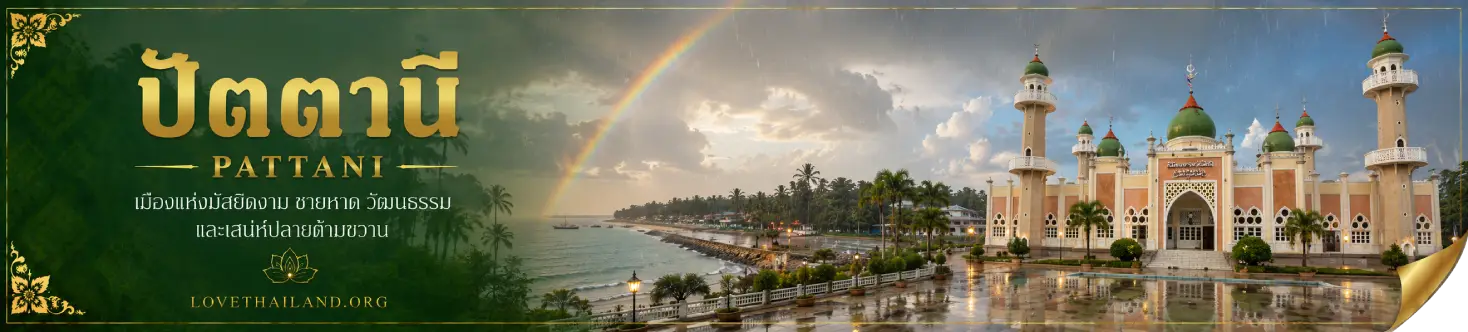
Pattani
Slogan : Bodo is clean, beautiful sandy beach, many waterfalls, good bird, Lookyee so delicious, fresh cockles.
Pattani Province is one of Thailand’s southern border provinces with a highly distinctive identity shaped by a long and layered history. The region offers a wide range of attractions, including historical landmarks, cultural heritage sites, and natural landscapes. Notable places include Krue Se Mosque, Lim Ko Niao Shrine, and the ancient city of Yarang. In addition to its historical depth, Pattani is also rich in natural resources, featuring forests, rivers, and coastal areas that reflect the diversity of its geography. The province stands out as a destination where culture, lifestyle, and environment remain deeply interconnected, reflecting its legacy as the former center of the Langkasuka Kingdom—one of the oldest civilizations in Southeast Asia.
Pattani covers an area of approximately 2,052 square kilometers, making it the second smallest province in Southern Thailand after Phuket. Most of the terrain consists of lowland plains, which are highly suitable for agriculture. The province is also home to important natural features, including Khao Sai Khao, part of the Sankalakhiri mountain range. Two major rivers, the Pattani River and the Sai Buri River, play a crucial role in sustaining local communities and ecosystems.
The province has a long-standing historical presence, with its name appearing in various ancient records under different spellings such as Tani, Patani, Fathoni, Fotani, and Tani. Its strategic coastal location, combined with sheltered bays and access to both land and river routes connecting to the Indian Ocean, contributed to its early development as a thriving trade center. The abundance of natural resources further strengthened its economic significance.
As a result, Pattani became an important port city on the Malay Peninsula, attracting traders from diverse regions. This long history of trade and interaction led to the integration of multiple cultural influences, which blended with local traditions to form the unique cultural identity that defines Pattani today.
Historians and archaeologists widely believe that present-day Pattani was once the location of the Langkasuka Kingdom, which flourished as early as the 7th century Buddhist Era. Its central hub was located in what is now known as the ancient city of Yarang. By the 19th century Buddhist Era, the kingdom began to decline due to environmental changes such as coastal sedimentation and shifting river routes, as well as repeated invasions from the Malacca Sultanate. Eventually, by the 21st century Buddhist Era, Langkasuka collapsed, giving way to the rise of a new port city known as Patani, which became a major center for Islamic education and dissemination in the region.
In 1808 (B.E. 2351), Pattani was administratively divided into seven principal towns: Tani, Yaring, Nong Chik, Sai Buri, Ra-ngae, Raman, and Yala. Later, in 1906 (B.E. 2449), Pattani was reorganized as a provincial administrative region. By 1932, the Pattani Monthon was dissolved and merged with Nakhon Si Thammarat. In 1933, Pattani was officially established as a province, a status it maintains to this day.
Today, Pattani Province is divided into 12 districts: Mueang Pattani, Khok Pho, Mayo, Nong Chik, Panare, Sai Buri, Yarang, Yaring, Thung Yang Daeng, Mai Kaen, Kapho, and Mae Lan. Each district contributes to the province’s cultural diversity and socio-economic landscape.
Pattani’s cultural landscape is deeply influenced by Malay-Muslim traditions, which have been preserved and practiced continuously over generations. The province is widely recognized as one of the most culturally distinct regions in Thailand, where Islamic faith plays a central role in daily life. Mosques are not only places of worship but also serve as community centers for education and social activities. Traditional attire, local customs, and religious practices remain visible and vibrant, reflecting a strong sense of identity and continuity.
One of the most significant cultural expressions in Pattani is the annual Lim Ko Niao Festival, which takes place at the Lim Ko Niao Shrine. This event blends Chinese spiritual beliefs with local traditions and has become an important cultural symbol of the province. The festival features processions, rituals, and performances that attract both local residents and visitors from neighboring regions. It represents the historical coexistence of different ethnic groups and belief systems within Pattani.
In addition to religious and cultural festivals, Pattani also preserves traditional performing arts such as Mak Yong, a classical dance-drama with roots in the Malay world. This art form combines storytelling, music, and ritual elements, and has been recognized as an important intangible cultural heritage. Despite modernization, efforts continue to sustain and promote Mak Yong as part of Pattani’s cultural identity.
Pattani’s culinary scene is another defining characteristic of the province. The local cuisine is heavily influenced by Malay flavors, featuring a rich use of spices, herbs, and fermented ingredients. Signature dishes include Khao Yam, a mixed rice salad served with fresh herbs and Budu sauce; Roti and Mataba, which are popular street foods; and various beef and seafood dishes prepared with aromatic spices. The province’s proximity to the sea also ensures a steady supply of fresh seafood, contributing to the diversity of local food offerings.
Economically, Pattani relies on a combination of agriculture, fisheries, and small-scale industries. The fertile plains support rice cultivation and fruit farming, while coastal communities engage in fishing and aquaculture. In recent years, there has been a growing interest in community-based tourism, which allows visitors to experience local lifestyles, traditional crafts, and cultural practices in an authentic setting. This approach not only generates income but also helps preserve cultural heritage.
The province’s natural environment further enhances its appeal as a travel destination. Pattani features a mix of coastal landscapes, river systems, and forested areas. Beaches such as Talo Kapo offer peaceful settings with fewer crowds compared to more commercialized destinations. Rivers like the Pattani River provide scenic views and opportunities for local transportation and recreation. Inland areas, including parts of the Sankalakhiri range, contribute to the ecological diversity of the region.
Transportation to Pattani is relatively accessible through nearby provinces such as Hat Yai, Yala, and Narathiwat. Visitors can travel by road via Highway 42, which connects Pattani to major cities in Southern Thailand. Public transportation options include buses and vans from Hat Yai, which serves as a regional transportation hub. For those traveling by air, Hat Yai International Airport is the nearest major airport, located approximately 150 kilometers from Pattani, with onward travel available by road.
Getting There Traveling to Pattani is most convenient via Hat Yai, which is well-connected by domestic flights from Bangkok. From Hat Yai, visitors can continue their journey by bus, minivan, or private car. The route offers a gradual transition from urban centers to more rural and culturally rich landscapes, providing an introduction to the unique character of the southern border provinces.
What makes Pattani particularly compelling is its authenticity. Unlike mainstream tourist destinations, the province offers a more intimate and grounded travel experience. Visitors have the opportunity to engage directly with local communities, observe traditional ways of life, and gain insights into a region that has maintained its cultural identity despite external influences. This authenticity positions Pattani as an emerging destination for travelers seeking meaningful and culturally immersive experiences.
From a historical perspective, Pattani continues to hold significant academic and archaeological interest. The ancient city of Yarang remains a key site for understanding early Southeast Asian civilizations. Excavations have revealed evidence of urban planning, religious structures, and trade networks that highlight the sophistication of the Langkasuka Kingdom. These findings contribute to a broader understanding of regional history and Pattani’s role within it.
Overall, Pattani Province represents a unique convergence of history, culture, and nature. Its legacy as a former kingdom, its role as a cultural crossroads, and its present-day community life all combine to create a destination that is both historically significant and culturally rich. For travelers, researchers, and cultural enthusiasts, Pattani offers a perspective on Thailand that is both distinct and deeply rooted in its past.
Annual Festivals and Events in Pattani 2026
| No. | Festival Name | Date | Location | Highlights |
| 1 | Lim Ko Niao Festival | March – April 2026 | Lim Ko Niao Shrine, Ano Ru Subdistrict, Mueang Pattani District, Pattani 94000 | Traditional Chinese rituals, cultural performances, sacred procession |
| 2 | Pattani Cultural Festival | August 2026 | Pattani City Hall Area, Sabarang Subdistrict, Pattani | Local crafts, food fairs, cultural exhibitions |
| 3 | Islamic New Year Celebration | Based on Islamic Calendar | Mosques throughout Pattani Province | Religious ceremonies, community gatherings |
3–5 Day Travel Itinerary in Pattani (Detailed Plan)
| Day | Destination | Location | Highlights |
| Day 1 | Krue Se Mosque + Pattani Central Mosque | Mueang Pattani District | Historical mosques, Islamic architecture |
| Day 2 | Yarang Ancient City | Yarang District, Pattani | Archaeological site of Langkasuka Kingdom |
| Day 3 | Talo Kapo Beach | Panare District, Pattani | Quiet beach, natural scenery |
| Day 4 | Sai Buri River Community | Sai Buri District | Local lifestyle, river culture |
| Day 5 | Local Markets & Food Tour | Mueang Pattani | Street food, Malay cuisine |
Top 10 MUST VISIT Attractions in Pattani
| No. | Attraction | Location | Highlights |
| 1 | Krue Se Mosque | Mueang Pattani | Historic mosque over 400 years old |
| 2 | Pattani Central Mosque | Mueang Pattani | Iconic Islamic architecture |
| 3 | Lim Ko Niao Shrine | Ano Ru Subdistrict | Cultural and spiritual landmark |
| 4 | Yarang Ancient City | Yarang District | Archaeological remains of Langkasuka |
| 5 | Talo Kapo Beach | Panare District | Peaceful coastal scenery |
| 6 | Sai Buri River | Sai Buri District | Scenic river and local life |
| 7 | Pattani Bay | Coastal Pattani | Fishing communities and sea views |
| 8 | Local Markets | Mueang Pattani | Authentic local food experience |
| 9 | Khao Sai Khao | Sankalakhiri Range | Mountain landscape |
| 10 | Panare Coastal Area | Panare District | Fishing villages and coastline |
Frequently Asked Questions (FAQ)
Q: What is Pattani Province known for?
A: Pattani is known for its rich history as part of the ancient Langkasuka Kingdom, its unique Malay-Muslim culture, historical landmarks, and diverse natural landscapes including rivers and coastal areas.
Q: What are the top attractions in Pattani?
A: Key attractions include Krue Se Mosque, Pattani Central Mosque, Lim Ko Niao Shrine, Yarang Ancient City, and Talo Kapo Beach.
Q: What type of travel experience does Pattani offer?
A: Pattani offers cultural, historical, and nature-based travel experiences, ideal for visitors seeking authentic local lifestyles and less commercialized destinations.
Q: What food is Pattani famous for?
A: Pattani is famous for Malay-influenced cuisine such as Khao Yam, Budu sauce dishes, Roti, Mataba, beef soup, and fresh seafood.
Q: When is the best time to visit Pattani?
A: Pattani can be visited year-round, but the cooler months from late year to early year offer more comfortable weather for travel.
Q: Why is Pattani historically important?
A: Pattani was the center of the Langkasuka Kingdom and later became a major trading port and an important hub for Islamic education in the region.
Q: How many districts are in Pattani Province?
A: Pattani Province has 12 districts: Mueang Pattani, Khok Pho, Mayo, Nong Chik, Panare, Sai Buri, Yarang, Yaring, Thung Yang Daeng, Mai Kaen, Kapho, and Mae Lan.
Q: How can I travel to Pattani?
A: Travelers typically reach Pattani via Hat Yai by air, then continue by road using buses, vans, or private vehicles along Highway 42.
Q: Does Pattani only offer beach attractions?
A: No, Pattani offers a wide range of attractions including historical sites, cultural landmarks, rivers, and community-based tourism experiences.
Q: Who should visit Pattani?
A: Pattani is ideal for travelers interested in culture, history, and authentic local experiences, as well as those seeking destinations beyond mainstream tourism routes.
Pattani Map

 Art, Culture and Heritage
 Historical Sites and Monuments(3)
 Landmarks and Memorials(7)
 Royal Palace(2)
 Art, Craft Centres, Tradition(7)
 Historic Homes and Cities(1)
 Educational Places
 Museum for Study(1)
 Training Center(1)
 Places of Worship
 Temple(13)
 Mosque(5)
 Other Sacred Sites(4)
 Research and Development
 Royal Project(2)
 Suburban Living
 Village, Community(5)
 Local Market(2)
 Nature and Wildlife
 National Parks and Marine Reserves(2)
 Mountain (Doi)(3)
 Waterfalls(3)
 River, Canal(2)
 Bays and Beaches(13)
 Islands(2)
 Other natural attractions(1)
 Entertainment and Agricultural
 Farms, Parks and Ecotourism(1)
 Travel Articles, Recipes
 Travel Review, Food Review(1)
 Southern Food Menu, Southern Food Recipes(3)


