
lovethailand home >Central Travel Attractions
> Samut Prakan Travel Attractions
TL;DR: A quick overview of attractions in Samut Prakan, plus planning details, access, and key travel highlights.
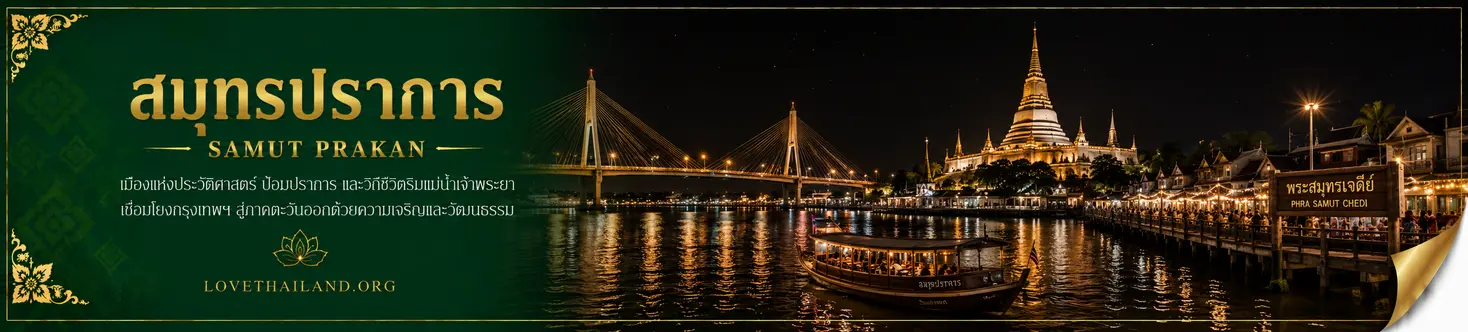
Samut Prakan
Slogan : Marine Battle Fortresses, Chedi in the Water, Crocodile Farm, Exquisite Ancient City, Phra Pradaeng Songkran Festival, Tasty Dried Snakeskin Gourami, Rap Bua Festival, Industrial Estate.
Samut Prakan Province is located in central Thailand at the mouth of the Chao Phraya River, along the northern coast of the Gulf of Thailand. It is a relatively small province situated on the outskirts of Bangkok and is commonly known by alternative names such as “Pak Nam” and “Phra Pradaeng.”
Today, Samut Prakan plays a significant role in Thailand’s economy as one of the country’s major industrial hubs. The province is home to large industrial estates that attract substantial foreign investment, making it an important contributor to national economic growth and international business activity.
Covering an area of approximately 1,004 square kilometers (around 627,557 rai), Samut Prakan ranks as the 70th largest province in Thailand. The Chao Phraya River serves as its main waterway, branching into numerous canals that shape the province’s landscape. The general topography is predominantly low-lying plains, which can be divided into three main zones.
The first zone lies along both sides of the Chao Phraya River, where fertile land supports rice farming and orchard cultivation. The second zone, located in the southern coastal area, is influenced by seawater intrusion. During the dry season, both soil and freshwater sources become highly saline, and the area is characterized by mangrove forests, making it suitable for charcoal production and coastal resource use. The third zone covers the northern and eastern plains, which are wide and suitable for agriculture and urban development.
Historically, Samut Prakan was established during the Ayutthaya period, with the original city located in what is now Phra Pradaeng District. It served as a crucial naval outpost and a strategic checkpoint for maritime trade. Foreign merchant ships traveling to Siam would stop here before continuing inland, and the coastal area was fortified with strong defensive structures, including city walls and fortifications.
During the Thonburi period, King Taksin the Great ordered the dismantling of the old city walls of Phra Pradaeng. Later, in the reign of King Rama II, the king recognized the vulnerability of the area to potential invasions and commanded the construction of a new fortified city at Pak Nam in 1819. The construction took three years to complete and included the establishment of six major forts on both sides of the river: Phi Sua Samut Fort, Phra Chulachomklao Fort (later period), Prakarn Fort, Narai Prab Suek Fort, Prakan Chai Fort, and Nakhonrach Fort.
During the construction, King Rama II personally visited the site several times and ordered the building of a grand chedi on an island in the river, later named “Phra Samut Chedi.” However, the king passed away before its completion.
In the reign of King Rama III, the construction of Phra Samut Chedi was completed, and three additional forts were built: Tri Phet Fort, Khongkraphan Fort, and Suea Son Lep Fort.
In 1859, during the reign of King Rama V, Phra Samut Chedi was renovated and elevated. Additionally, a new coastal fort was constructed and named “Phra Chulachomklao Fort.” Today, many of these historic forts have deteriorated over time, with only Phi Sua Samut Fort and Phra Chulachomklao Fort remaining in relatively preserved condition.
At present, Samut Prakan Province is administratively divided into five districts and one subdistrict-level administrative area: Mueang Samut Prakan District, Phra Pradaeng District, Bang Phli District, Bang Bo District, Phra Samut Chedi District, and Bang Sao Thong District.
Travel Tips When taking a boat trip, it is advisable to prepare a hat and wear comfortable shoes. For evening boat trips, such as firefly watching tours, bringing mosquito repellent lotion is highly recommended.
During boat trips, visitors should avoid consuming alcohol or intoxicating substances, as these may increase the risk of accidents. When observing fireflies, it is important not to make loud noises, as this can disturb both the fireflies and local residents. Visitors should also avoid touching or interfering with the fireflies under any circumstances.
For safety, passengers should sit in the center of the boat, avoid leaning to one side, and wear life jackets at all times.
When choosing a firefly boat tour service, it is recommended to select experienced operators who are familiar with the routes and habitats of fireflies. Visitors should also confirm the distance and duration of the trip with the service provider in advance.
Annual Festivals in Samut Prakan Province (2026)
| Festival Name | Date | Period | Location | Highlights |
| Rap Bua Festival (Bang Phli) | October 2026 | 1 Day | Bang Phli District, Samut Prakan | Lotus throwing ceremony to receive Luang Pho To Buddha image along the canal |
| Phra Samut Chedi Fair | November 2026 | 7–10 Days | Phra Samut Chedi District | Traditional fair, temple worship, cultural performances, local markets |
| Phra Pradaeng Songkran Festival | April 2026 | 3–5 Days | Phra Pradaeng District | Mon cultural parade, traditional costumes, local rituals |
| Bang Pu Seagull Festival | November – February 2026 | Seasonal | Bang Pu Recreation Center | Seagull feeding, sunset photography, coastal tourism |
3–5 Day Travel Itinerary in Samut Prakan
| Day | Places to Visit | Location | Highlights |
| Day 1 | Ancient City (Muang Boran), Erawan Museum | Mueang Samut Prakan | Explore Thailand in miniature, giant three-headed elephant museum |
| Day 2 | Bang Pu, Phi Sua Samut Fort | Mueang District | Seaside atmosphere, bird watching, historical fort |
| Day 3 | Phra Samut Chedi, Local Markets | Phra Samut Chedi District | Sacred pagoda, riverside lifestyle |
| Day 4 | Bang Nam Phueng Floating Market | Phra Pradaeng | Local food, cycling routes, eco tourism |
| Day 5 | Phra Chulachomklao Fort | Phra Samut Chedi | Historic naval defense site, sea views |
Top 10 MUST VISIT Attractions in Samut Prakan
| No. | Attraction | Location | Highlights |
| 1 | Ancient City (Muang Boran) | Mueang District | Thailand landmarks in one place |
| 2 | Erawan Museum | Mueang District | Three-headed elephant landmark |
| 3 | Bang Pu Recreation Center | Mueang District | Seagull feeding and sunset |
| 4 | Phra Samut Chedi | Phra Samut Chedi | Sacred riverside pagoda |
| 5 | Bang Nam Phueng Floating Market | Phra Pradaeng | Local lifestyle and food |
| 6 | Phi Sua Samut Fort | Mueang District | Historic defensive fort |
| 7 | Phra Pradaeng Market | Phra Pradaeng | Traditional community market |
| 8 | Phra Chulachomklao Fort | Phra Samut Chedi | Naval defense history |
| 9 | Sri Nakhon Khuean Khan Park | Phra Pradaeng | Green lung of Bangkok |
| 10 | Wat Asokaram | Mueang District | Beautiful white pagodas |
Frequently Asked Questions (FAQ)
Q: What is Samut Prakan Province known for?
A: Samut Prakan is known as a historic coastal gateway of Thailand, located at the mouth of the Chao Phraya River. It is famous for its cultural heritage, traditional Mon communities, industrial importance, and popular attractions such as Ancient City, Erawan Museum, and Bang Pu.
Q: Is Samut Prakan worth visiting for a day trip?
A: Yes, Samut Prakan is one of the best day-trip destinations from Bangkok. It offers a mix of cultural sites, temples, local markets, coastal views, and museums, all within a short travel distance.
Q: What are the top attractions in Samut Prakan?
A: The must-visit attractions include Ancient City (Muang Boran), Erawan Museum, Bang Pu Recreation Center, Phra Samut Chedi, Bang Nam Phueng Floating Market, and Phra Chulachomklao Fort.
Q: What is the best time to visit Samut Prakan?
A: The best time to visit is from November to February when the weather is cooler and suitable for outdoor activities. This is also the season to see seagulls at Bang Pu and enjoy coastal tourism.
Q: What local festivals can travelers experience in Samut Prakan?
A: Travelers can experience unique festivals such as the Rap Bua Festival in Bang Phli, Phra Pradaeng Songkran Festival, and the Phra Samut Chedi Fair, which reflect local traditions and cultural identity.
Q: What kind of food is popular in Samut Prakan?
A: The province is known for fresh seafood, riverside cuisine, Mon-style dishes, traditional Thai desserts, and local specialties influenced by coastal and community lifestyles.
Q: How do you get to Samut Prakan from Bangkok?
A: Samut Prakan is easily accessible from Bangkok by BTS Skytrain (Sukhumvit Line), private car, bus, or taxi. Travel time typically ranges from 30 minutes to 1 hour depending on traffic.
Q: Are there eco-tourism activities in Samut Prakan?
A: Yes, eco-tourism activities include cycling in Bang Kachao (the green lung of Bangkok), visiting mangrove forests, exploring floating markets, and taking boat tours to observe fireflies and local ecosystems.
Samut Prakan Map

 Art, Culture and Heritage
 Historical Sites and Monuments(2)
 Landmarks and Memorials(1)
 Art, Craft Centres, Tradition(9)
 Museums(5)
 Historic Homes and Cities(1)
 Places of Worship
 Temple(30)
 Mosque(1)
 Other Sacred Sites(9)
 Suburban Living
 Local Market(1)
 Floating Market(3)
 Nature and Wildlife
 River, Canal(1)
 Bays and Beaches(2)
 Entertainment and Agricultural
 Zoos and Aquariums(1)
 Animal camps and shows(1)
 Farms, Parks and Ecotourism(1)
 Outdoor and Adventure Activities(1)


