
lovethailand home >Central Travel Attractions
> Samut Sakhon Travel Attractions
TL;DR: A quick overview of attractions in Samut Sakhon, plus planning details, access, and key travel highlights.
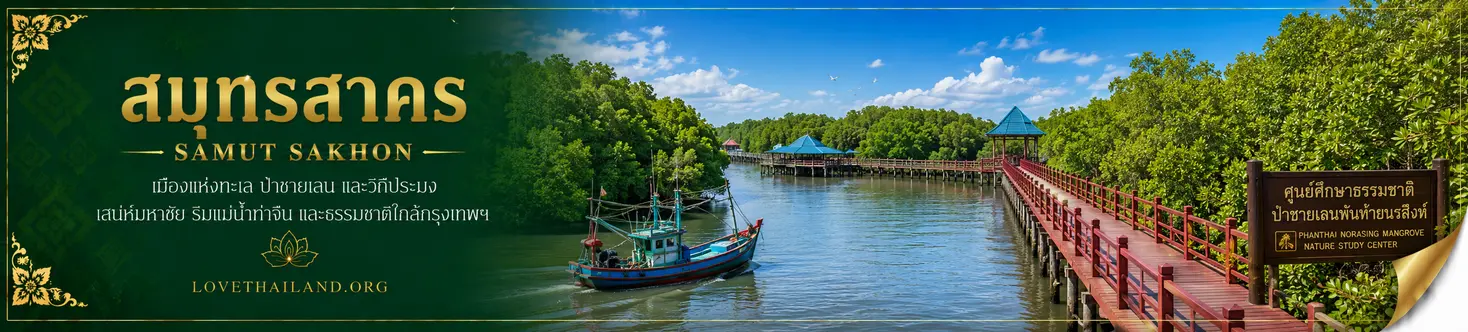
Samut Sakhon
Slogan : Fishing City, Factory Town, Agricultural Ground, Historic Site.
Samut Sakhon Province is a province in Thailand. It is a relatively small province located in the lower central region, at the mouth of the Tha Chin River, only about 2 kilometers from the Gulf of Thailand. The area is rich in aquatic resources, especially marine life, which has led to a strong and widespread fishing industry. The province is home to thousands of modern fishing vessels and is capable of producing the highest volume of seafood in the country. In addition, it is also the province with the largest area of salt farms in Thailand. :contentReference[oaicite:0]{index=0}
In terms of history, Samut Sakhon is recorded in the chronicles of the Ayutthaya Kingdom. During a royal water journey of King Suea, the story of Phanthai Norasingh emerged—a loyal and devoted figure who upheld discipline even at the cost of his life. Today, he remains one of the most important symbols of the province.
Samut Sakhon covers an area of approximately 872.34 square kilometers, or about 545,216 rai, ranking as the 72nd largest province in Thailand. It is located in the lower central region at the mouth of the Tha Chin River, just 2 kilometers from the Gulf of Thailand. The terrain is a coastal lowland plain, approximately 1–2 meters above sea level. The Tha Chin River flows through the center of the province from north to south and empties into the Gulf of Thailand in Mueang Samut Sakhon District. The river runs approximately 70 kilometers through the province.
The upper part of the province, in Ban Phaeo District and Krathum Baen District, has fertile soil and a network of more than 170 interconnected canals spread throughout the area. It is therefore suitable for growing a wide variety of crops, and parts of it have also developed into business, industrial, and residential zones. Meanwhile, the lower part of the province, in Mueang Samut Sakhon District, lies along a coastline stretching 41.8 kilometers, making it ideal for marine fishing, coastal aquaculture, and salt farming.
Samut Sakhon was formerly called “Tha Chin” because it was a large settlement on the Gulf of Thailand where many foreign traders, especially Chinese merchants, brought their junks to dock and trade. As a result, the area came to be commonly known as “Tha Chin.” Later, in 1548 during the reign of King Maha Chakkraphat of Ayutthaya, Ban Tha Chin was elevated to the status of a city and named “Sakhon Buri,” serving as a strategic coastal outpost for mobilizing troops during war with Burma and for defending against maritime invaders.
Later, during the Rattanakosin period, King Mongkut (Rama IV) renamed Sakhon Buri as “Samut Sakhon”. In 1913, King Vajiravudh (Rama VI) issued a royal command changing the term “mueang” to “changwat” (province) throughout the country. As a result, Mueang Samut Sakhon became officially known as “Samut Sakhon Province,” which remains its official name today.
As for the name “Mahachai,” which people commonly use, it comes from Khlong Mahachai. This canal was ordered to be dug by King Sanphet VIII of Ayutthaya to cut through the winding course of the old Khlong Khok Kham, creating a more direct route from Thonburi to the river mouth. However, the canal was not completed before the king passed away. King Sanphet IX (Khun Luang Thai Sa) later ordered the work to be completed and bestowed the name “Khlong Mahachai.” Over time, a large community grew on the left bank at the mouth of the canal, and it became known as “Mahachai,” a name that has remained widely used ever since.
Samut Sakhon is administratively divided into 3 districts: Mueang Samut Sakhon District, Krathum Baen District, and Ban Phaeo District.
Culture and Traditions Samut Sakhon has a culture that reflects the way of life of communities living along rivers and the coast. In particular, Thai Chinese and Mon communities have preserved their traditional customs very strongly, including the Vegetarian Festival, Chinese worship ceremonies, and local traditions related to fishing and riverside life.
Another important identity is the lifestyle of the fishing communities, which continues to combine modern technology with traditional wisdom in fishing, seafood processing, and trade. This has created vibrant communities that clearly reflect the character of a coastal town.
Food The cuisine of Samut Sakhon stands out for the freshness of its seafood ingredients, including shrimp, crab, fish, and shellfish, as well as processed seafood products such as dried squid, dried shrimp, and frozen seafood. In addition, there are local foods influenced by Chinese and Mon cultures, such as seafood rice porridge, dim sum, steamed buns, and distinctive street food.
Getting There Traveling to Samut Sakhon from Bangkok is very convenient via Rama II Road, the main route, and usually takes about 30–60 minutes depending on traffic conditions. In addition, visitors can also use buses, vans, or the Mahachai railway line, which is another popular option and offers a local travel experience.
Economy and Strategic Role Samut Sakhon plays a highly important role in Thailand’s economic system, especially in the seafood industry, fisheries, and logistics. Because it is located close to Bangkok and has transportation networks connected both by land and water, it has become a major center for distributing goods and raw materials.
The province’s main industries include seafood processing factories, consumer goods manufacturing, and many medium and large industrial operations. These industries play a major role in generating income for the country, especially through the export of processed seafood products to international markets such as Japan, the United States, and the European Union.
In addition, Samut Sakhon has a large labor force from both within Thailand and abroad, contributing to economic growth in multiple sectors, including industry, trade, and services. As a result, the province remains economically active throughout the year.
Geography and Coastal Environment The coastal area of Samut Sakhon stretches approximately 41.8 kilometers and contains important coastal ecosystems such as mangrove forests, aquatic breeding grounds, and coastal aquaculture zones, all of which play an important role in maintaining environmental balance and supporting the local economy.
The mangrove forests of Samut Sakhon serve as natural nurseries for aquatic life and help prevent coastal erosion. They are also important ecotourism destinations where visitors can closely experience coastal community life and learn about the local ecosystem.
Highlights of Samut Sakhon Province
1. It is one of the most important marine fishing centers in Thailand, with the highest volume of seafood catch in the country.
2. It has the largest area of salt farms in Thailand and is a major source of quality sea salt.
3. It is a major center for large-scale seafood processing industries.
4. It has a clear blend of Thai, Chinese, and Mon cultural influences.
5. It is located close to Bangkok, making it ideal for short trips.
Major Tourist Attractions Samut Sakhon has a variety of attractions, including cultural, natural, and community-based sites. Popular attractions include Mahachai Market, the Kok Kham Mangrove Forest Learning Center, Wat Krok Krak, and the Phanthai Norasingh Shrine, all of which are historically linked to stories from the Ayutthaya period.
Visitors can also enjoy the lively atmosphere of fresh seafood markets, which truly reflect the way of life of local fishermen and vendors, and they can buy fresh seafood directly from the source at affordable prices.
Hidden Gems Not to Be Missed Although Samut Sakhon is a small province, it has several lesser-known attractions, such as the Kok Kham mangrove nature trail, Ban Bang Ya Phraek community tourism area, and salt farm learning sites where visitors can closely observe traditional salt-making processes.
These places are ideal for travelers seeking a deeper experience and wishing to escape the bustle of the big city in order to enjoy nature and traditional local lifestyles more authentically.
Tourism Trends and Future Opportunities At present, Samut Sakhon is gaining increasing attention as a travel destination near Bangkok, especially among travelers looking for convenient one-day trips or weekend escapes.
Ecotourism, cultural tourism, and food tourism are all growing steadily, and Samut Sakhon has strong potential to develop in these areas because it already possesses outstanding natural resources, culture, and food.
With all of these elements combined, Samut Sakhon is not merely an industrial city. It is also a destination with a distinctive charm and strong potential for sustainable tourism growth in the future.
Annual Festivals and Tourism Events 2026
| No. | Event Name | Date | Location | Highlights |
| 1 | Vegetarian Festival (Tesagan Kin Je) | September–October 2026 | Shrines and Chinese communities across Samut Sakhon | Ritual ceremonies, vegetarian food markets, cultural processions |
| 2 | Phanthai Norasingh Memorial Fair | March 2026 | Phanthai Norasingh Shrine, Mueang District | Historical reenactments, cultural shows, local food stalls |
| 3 | Seafood Festival | December 2026 | Mahachai Market Area | Fresh seafood, cooking demonstrations, local performances |
3–5 Day Travel Itinerary (Detailed Plan)
| Day | Location | Highlights |
| 1 | Mahachai Market | Explore fresh seafood market, local lifestyle |
| 2 | Phanthai Norasingh Shrine | Historical site, cultural significance |
| 3 | Kok Kham Mangrove Forest | Nature walk, ecological learning |
| 4 | Salt Farms | Observe traditional salt production |
| 5 | Local Communities | Experience local culture and food |
Top 10 Must-Visit Attractions
| No. | Place | Location | Highlights |
| 1 | Mahachai Market | Mueang District | Fresh seafood hub |
| 2 | Phanthai Norasingh Shrine | Mueang District | Historic loyalty story |
| 3 | Wat Krok Krak | Mueang District | Unique Buddha statue with sunglasses |
| 4 | Kok Kham Mangrove Forest | Mueang District | Mangrove ecosystem |
| 5 | Red Bridge | Khok Kham | Scenic coastal views |
| 6 | Salt Farms | Coastal Area | Traditional salt production |
| 7 | Wat Chong Lom | Mueang District | Historic temple |
| 8 | Local Fishing Villages | Coastal Area | Authentic lifestyle |
| 9 | Bang Ya Phraek Community | Mueang District | Community tourism |
| 10 | Seafood Markets | Across Province | Fresh seafood shopping |
Frequently Asked Questions (FAQ)
Q: What is Samut Sakhon Province known for?
A: Samut Sakhon is widely known as Thailand’s seafood hub, with abundant marine resources, large-scale fisheries, and the largest salt farming area in the country.
Q: Where is Samut Sakhon located?
A: Samut Sakhon is located in the lower central region of Thailand, at the mouth of the Tha Chin River, approximately 2 kilometers from the Gulf of Thailand and about 30–60 minutes from Bangkok.
Q: What are the main economic activities in Samut Sakhon?
A: The main economic activities include marine fishing, seafood processing industries, salt farming, logistics, and manufacturing.
Q: What cultural influences are found in Samut Sakhon?
A: The province reflects a blend of Thai, Chinese, and Mon cultural influences, especially visible in local traditions, festivals, and cuisine.
Q: Is Samut Sakhon suitable for tourism?
A: Yes, Samut Sakhon is ideal for short trips and cultural tourism, offering seafood markets, coastal attractions, mangrove forests, and community-based tourism experiences.
Q: How can visitors travel to Samut Sakhon?
A: Visitors can travel by car via Rama II Road, by bus or van, or by train using the Mahachai railway line.
Samut Sakhon Map

 Art, Culture and Heritage
 Historical Sites and Monuments(3)
 Landmarks and Memorials(4)
 Art, Craft Centres, Tradition(2)
 Museums(1)
 Historic Homes and Cities(1)
 Educational Places
 Museum for Study(1)
 Places of Worship
 Temple(31)
 Other Sacred Sites(12)
 Research and Development
 Royal Project(1)
 Suburban Living
 Village, Community(4)
 Local Market(2)
 Floating Market(2)
 Nature and Wildlife
 National Parks and Marine Reserves(1)
 River, Canal(4)
 Bays and Beaches(1)
 Other natural attractions(3)
 Entertainment and Agricultural
 Zoos and Aquariums(1)
 Shopping
 Shopping and Night Market(1)


