
lovethailand home >North Travel Attractions
> Phitsanulok Travel Attractions
TL;DR: A quick overview of attractions in Phitsanulok, plus planning details, access, and key travel highlights.
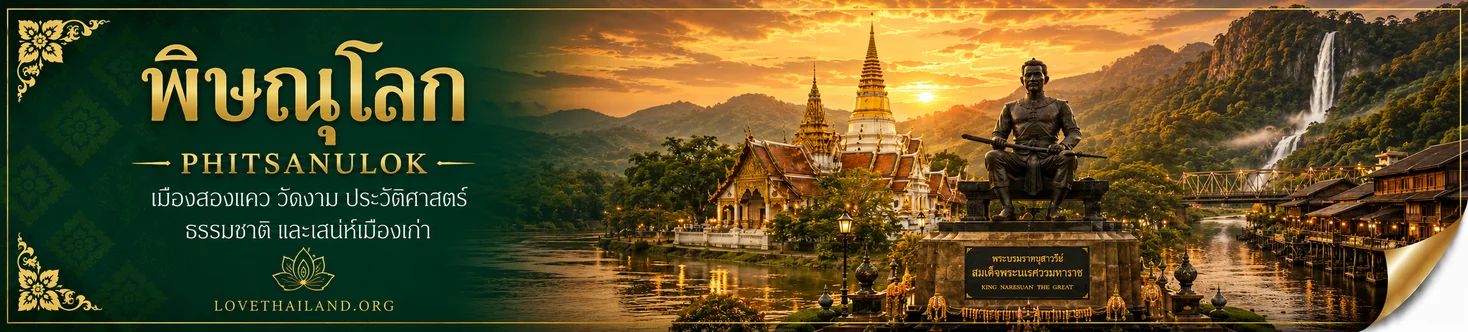
Phitsanulok
Slogan : The marvelous Buddha Chinnarat, the birthplace of King Naresuan the Great , houseboats on the two banks of the Nan, delicious dried bananas, enchanting caves and waterfalls.
Phitsanulok Province is a large province in the lower northern region of Thailand, historically significant in terms of politics, economy, and tourism. The city has flourished since before the Sukhothai period and even served as a temporary capital of the Ayutthaya Kingdom for 25 years. It is therefore considered one of the most strategically important cities in Thai history. The distinctiveness of Phitsanulok is not only rooted in its past but also reflected through its culture, traditions, lifestyle, and deeply embedded Buddhist faith, making it a key destination for travelers seeking tranquility, spirituality, and diverse experiences.
In the past, Phitsanulok was known as “Song Khwae City” because it is intersected by two major rivers: the Nan River and the Khwae Noi River. These rivers contributed to the fertility of the land, making it ideal for settlement and agriculture. They also served as important transportation routes in the past. Beyond economic benefits, the rivers have influenced the local culture, traditions, and way of life, which continue to be passed down to this day.
Phitsanulok is also a key center for education and transportation. It is home to leading institutions such as Naresuan University and Pibulsongkram Rajabhat University. The province also has Phitsanulok Airport, which connects to Bangkok and other major cities, as well as the northern railway line, where almost all trains pass through. This makes Phitsanulok a major transportation and trade hub in the lower northern region. Tourists can conveniently reach the province by car, train, or airplane.
In addition to its infrastructure, Phitsanulok is distinguished by its cultural and religious identity, particularly as the home of Phra Buddha Chinnarat, one of the most beautiful Buddha images in Thailand. It is enshrined in Wat Phra Si Rattana Mahathat Woramahawihan (Wat Yai), which serves as the spiritual center of both locals and visitors. The sacredness and beauty of this Buddha image make Phitsanulok a major pilgrimage destination.
In terms of tourism, Phitsanulok offers a complete experience, covering history, culture, lifestyle, and nature. Visitors can explore Phu Hin Rong Kla National Park, known for its mountain landscapes and unique geological formations, or enjoy rafting along the Khek River, one of Thailand’s most popular rafting routes, especially during the rainy season when water levels are ideal.
The province is also known for its local cuisine, which blends northern and central Thai flavors. From main dishes to street food, the unique taste and fresh ingredients leave a lasting impression on visitors.
Phitsanulok has strong tourism infrastructure, including accommodations, restaurants, and various activities. It is also conveniently located near major provinces such as Sukhothai, Phetchabun, and Loei, making it suitable for multi-province travel itineraries.
Transportation within the province is also convenient. Visitors can travel easily by private car, rental car, or public transport. Major tourist attractions are well-developed with clear signage, ensuring a smooth travel experience.
Getting There From Bangkok, travelers can take Highway 32 (Asian Highway) and connect to Highway 117, taking approximately 4–5 hours. Alternatively, northern railway trains frequently pass through Phitsanulok. Flights to Phitsanulok Airport are also available, making travel fast and convenient.
Adventure tourism is another highlight, especially rafting along the Khek River. However, water levels should be checked beforehand, as conditions may vary. Safety regulations are strictly enforced, including restrictions such as no participation for children under 12 years old.
Visitors who wish to pay respect to Phra Buddha Chinnarat should dress modestly. Photography inside the ordination hall is allowed, but visitors must sit while taking photos to maintain respect.
With its combination of history, religion, natural attractions, and accessibility, Phitsanulok is a well-rounded destination suitable for all types of travelers.
From a natural tourism perspective, Phitsanulok is rich in diverse ecosystems. Phu Hin Rong Kla National Park features cool weather year-round and unique landscapes such as Lan Hin Pum, Lan Hin Taek, and Pha Chu Thong, formed by natural erosion over millions of years. During winter, blooming fields of paper flowers attract photographers.
The park also holds historical significance as a former stronghold of the Communist Party of Thailand, with remnants such as field hospitals and villages still visible.
The Khek River is a top rafting destination, especially between July and October. The route spans approximately 8–10 kilometers with more than 10 rapids of varying difficulty levels, offering an exciting experience under professional supervision.
During summer, freshwater jellyfish appear in the river—an extremely rare natural phenomenon, making it a unique attraction for eco-tourists.
Phitsanulok also preserves its local lifestyle, particularly in rural communities where agriculture, fishing, and handicrafts remain part of daily life. Community-based tourism allows visitors to experience these traditions firsthand.
Cultural events are held throughout the year, including boat races and religious festivals, reflecting the lifestyle of riverside communities. These events are vibrant and welcoming for visitors.
For religious tourism, Phitsanulok offers many historic temples such as Wat Ratchaburana, Wat Chan Tawan Tok, and Wat Nang Phaya, each showcasing unique Thai architectural styles.
The province maintains a balance between development and tranquility. Despite being an economic hub, it retains a peaceful atmosphere, making it ideal for slow travel.
The best time to visit is from November to February when the weather is cool. The rainy season is ideal for rafting, while summer offers unique ecological experiences.
Phitsanulok also serves as a gateway to nearby provinces, allowing visitors to easily travel to Sukhothai or Phetchabun.
With its strong potential in all aspects—history, culture, nature, and infrastructure—Phitsanulok continues to grow as a top tourism destination in Thailand.
Today, the province continues to develop while preserving its identity. The combination of past and present creates a unique charm that appeals to all types of travelers.
Visitors can enjoy walking through the old town, experiencing riverside life, and tasting local cuisine to fully appreciate the essence of Phitsanulok.
Overall, Phitsanulok is not just a transit city but a destination worth exploring in depth, whether for a short 2–3 day trip or a longer 4–5 day journey.
Annual Festivals in Phitsanulok Province 2026
| Festival Name | Period | Location | Description |
| Phra Buddha Chinnarat Worship Festival | January | Wat Phra Si Rattana Mahathat | Major annual event with religious ceremonies, cultural shows, and traditional markets |
| Khek River Rafting Festival | July – October | Wang Thong District | Popular adventure tourism event featuring rafting activities |
| Long Boat Racing Festival | September – October | Nan River | Traditional boat races reflecting riverside culture |
| King Naresuan Commemoration Fair | January | Chan Royal Palace | Historical reenactments and light & sound shows |
| Song Khwae Loy Krathong Festival | November | Nan River | Loy Krathong celebration with cultural performances |
3–5 Day Travel Plan in Phitsanulok
| Day | Itinerary |
| Day 1 | Wat Phra Si Rattana Mahathat → Chan Palace → Wat Nang Phaya → Night Bazaar |
| Day 2 | Phu Hin Rong Kla → Lan Hin Pum → Pha Chu Thong → Sunset View |
| Day 3 | Khek River Rafting → Kaeng Song Waterfall → Local Restaurant |
| Day 4 | Wat Ratchaburana → Wat Chan Tawan Tok → Community Tourism |
| Day 5 | Souvenir Shopping → Morning Market → Return |
15 MUST VISIT Attractions in Phitsanulok Province
| Attraction | Location | Description | Contact |
| 1. Wat Phra Si Rattana Mahathat | Nai Mueang Subdistrict, Mueang District, Phitsanulok | The province’s most important landmark, enshrining Phra Buddha Chinnarat, a highly sacred and revered Buddha image | 055-258-966 |
| 2. Chan Royal Palace | Nai Mueang Subdistrict, Mueang District, Phitsanulok | Birthplace of King Naresuan the Great, featuring historical exhibitions | |
| 3. Wat Nang Phaya | Nai Mueang Subdistrict, Mueang District, Phitsanulok | Origin of Phra Nang Phaya amulet, one of Thailand’s famous Benjapakee amulets | |
| 4. Wat Ratchaburana | Nai Mueang Subdistrict, Mueang District, Phitsanulok | Ancient Ayutthaya-era temple known for its prang and historical structures | |
| 5. Wat Chan Tawan Tok | Nai Mueang Subdistrict, Mueang District, Phitsanulok | A peaceful riverside temple along the Nan River, ideal for merit-making and relaxation | |
| 6. Phu Hin Rong Kla National Park | Noen Phoem Subdistrict, Nakhon Thai District, Phitsanulok | A natural and historical attraction featuring Lan Hin Pum and Lan Hin Taek | 055-233-527 |
| 7. Lan Hin Pum | Phu Hin Rong Kla National Park | Unique mushroom-shaped rock formations, popular for photography | |
| 8. Lan Hin Taek | Phu Hin Rong Kla National Park | A large stone field split into dramatic cracks, creating a unique landscape | |
| 9. Pha Chu Thong | Phu Hin Rong Kla National Park | A scenic viewpoint for sunrise and sea of mist | |
| 10. Khek River | Wang Thong District, Phitsanulok | Famous rafting destination suitable for adventure travelers | |
| 11. Kaeng Song Waterfall | Wang Thong District, Phitsanulok | A large waterfall with strong year-round flow, perfect for relaxation | |
| 12. Talat Tai (Local Morning Market) | Nai Mueang Subdistrict, Mueang District, Phitsanulok | Traditional morning market offering authentic local food | |
| 13. Night Bazaar | Mueang District, Phitsanulok | Popular night market for food and shopping | |
| 14. Nan River | Across Phitsanulok City | Scenic river offering views, lifestyle experiences, and Loy Krathong activities | |
| 15. Wat Aranyik | Aranyik Subdistrict, Mueang District, Phitsanulok | A peaceful ancient temple ideal for meditation and spiritual retreats |
Frequently Asked Questions (FAQ)
Q: What is the best time to visit Phitsanulok?
A: The best time is from November to February when the weather is cool and comfortable. The rainy season is ideal for rafting, while summer offers unique natural experiences.
Q: What is Phitsanulok most famous for?
A: It is best known for Phra Buddha Chinnarat, one of Thailand’s most beautiful Buddha images, as well as its historical importance and natural attractions.
Q: How many days should I spend in Phitsanulok?
A: 2–3 days are enough for the city highlights, but 4–5 days are recommended for a full experience including nature and adventure activities.
Q: Is Phitsanulok easy to travel to?
A: Yes, it is very accessible by car, train, and airplane, making it a transportation hub in northern Thailand.
Q: Can children join Khek River rafting?
A: No, children under 12 years old are not allowed due to safety regulations.
Q: What type of travelers is Phitsanulok suitable for?
A: It is suitable for all types including cultural, religious, nature, and adventure travelers.
Q: What should I wear when visiting temples?
A: Visitors should dress modestly. Shorts and short skirts are not recommended.
Phitsanulok Map

 Art, Culture and Heritage
 Historical Sites and Monuments(1)
 Landmarks and Memorials(2)
 Art, Craft Centres, Tradition(3)
 Museums(3)
 Educational Places
 Educational Gardens, Farm(1)
 Places of Worship
 Temple(29)
 Mosque(1)
 Other Sacred Sites(3)
 Research and Development
 Royal Project(1)
 Suburban Living
 Village, Community(1)
 Nature and Wildlife
 National Parks and Marine Reserves(7)
 Mountain (Doi)(4)
 Dam, Reservoir, Lake(5)
 Waterfalls(19)
 Caves(3)
 River, Canal(9)
 Other natural attractions(1)
 Entertainment and Agricultural
 Farms, Parks and Ecotourism(2)
 Outdoor and Adventure Activities(1)
 Travel Articles, Recipes
 Travel Review, Food Review(1)


