
lovethailand home >Northeastern Travel Attractions
> Bueng Kan Travel Attractions
TL;DR: A quick overview of attractions in Bueng Kan, plus planning details, access, and key travel highlights.
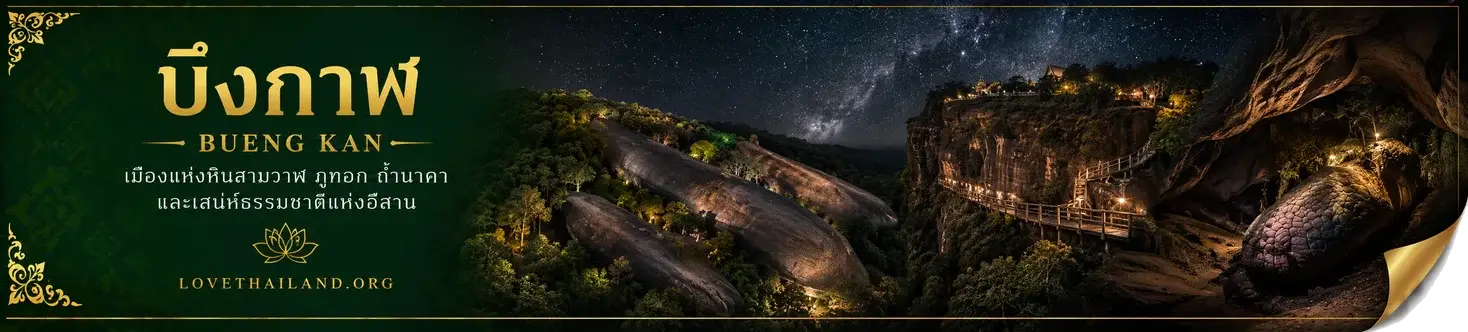
Bueng Kan
Slogan : Two girl Holy, Luang Por Yai have a power, Nong kud Ting water clean, unceen long boat racing, white sand beach, beauty Gang Ahon and Namkhong.
Bueng Kan Province is located in the northeastern region of Thailand (Isan). It was officially established under the Bueng Kan Province Establishment Act B.E. 2554 (2011), which came into effect on March 23, 2011. It is recognized as the 77th province of Thailand, formed by separating administrative areas from Nong Khai Province, consisting of 8 districts: Bueng Kan, Seka, So Phisai, Bueng Khla, Bueng Khong Long, Pak Khat, Phon Charoen, and Si Wilai.
The concept of establishing Bueng Kan Province dates back to 1994 when Sumet Promphanhao, a Member of Parliament from Nong Khai Province, proposed separating these districts into a new province. The proposed area covered approximately 4,305 square kilometers, with a population of around 390,000 people.
At that time, however, the Ministry of Interior determined that establishing a new province was not necessary, citing concerns over increased government budget burdens and the need for additional public sector personnel, which could conflict with existing cabinet resolutions.
The project remained inactive for nearly 20 years until 2010, when the Ministry of Interior revisited the proposal and submitted it to the Cabinet for reconsideration. A public opinion survey conducted in Nong Khai Province revealed that 98.83% of residents supported the establishment of Bueng Kan Province.
On August 3, 2010, the Cabinet approved the establishment of Bueng Kan Province, concluding that it met the criteria regarding the number of districts, population size, and unique geographical characteristics. The decision was also expected to enhance administrative efficiency and public service delivery.
Nong Khai Province, the original administrative area, stretches along the Mekong River, making travel between distant districts and the provincial center difficult and time-consuming. The creation of Bueng Kan Province was therefore essential for improving governance, strengthening border security, and facilitating better access for residents.
The establishment of Bueng Kan Province did not result in duplication of public services with local administrative organizations. A total of 439 government personnel positions were allocated and distributed appropriately among various agencies, causing minimal impact on the overall administrative system.
The National Assembly approved the Bueng Kan Province Establishment Act on February 7, 2011. The Prime Minister at the time presented the bill for royal endorsement, which was granted on March 11, 2011, by His Majesty King Bhumibol Adulyadej. The act was subsequently published in the Royal Gazette on March 22 and came into effect the following day.
In addition to establishing the province, the law also mandated renaming Bueng Kan District to “Mueang Bueng Kan District” as the administrative center. Between March 22–25, 2011, a grand celebration was held to mark the founding of the province, with Chavarat Charnvirakul presiding over the ceremony.
Beyond its historical background, Bueng Kan Province possesses a distinct cultural identity rooted in the Mekong River basin. Influenced by Thai, Lao, and indigenous traditions, the region reflects a unique blend of beliefs, customs, and ways of life that have been preserved and passed down through generations.
Key traditions in Bueng Kan are closely tied to Buddhism and local beliefs, including Bun Bang Fai (Rocket Festival), Buddhist Lent (Khao Phansa), End of Buddhist Lent (Ok Phansa), and the illuminated boat procession along the Mekong River. These traditions highlight the deep connection between people, nature, and spiritual beliefs, particularly the Mekong River, which serves as the lifeline of the community.
One of the most renowned phenomena associated with the region is the “Naga”, a mythical serpent believed to inhabit the Mekong River. Especially in Bueng Khong Long District and surrounding areas, the Naga is revered as a guardian of the river and a symbol of abundance, inspiring stories and faith that have endured for generations.
The lifestyle of Bueng Kan residents remains closely tied to nature and agriculture, with rubber plantations being the province’s primary economic activity. In addition, farming, horticulture, and freshwater fishing along the Mekong River and other natural water sources play important roles in local livelihoods.
The provincial economy is largely based on agriculture, particularly rubber production, which is a major export commodity. Cross-border trade with Laos along the Mekong River further stimulates economic activity, while tourism has increasingly contributed to the province’s development in recent years.
Local cuisine in Bueng Kan reflects the broader Isan culinary tradition but features unique characteristics derived from local ingredients such as Mekong fish, fermented fish (pla ra), wild vegetables, and regional herbs. Popular dishes include som tam (papaya salad), larb, koi pla (spicy raw fish salad), jaew bong (chili paste), and grilled fish, all known for their bold flavors and simplicity.
Geographically, Bueng Kan is distinguished by its location along the Mekong River and its sandstone mountain landscapes. Notable attractions include “Phu Thok”, famous for its wooden stairways winding around the mountain, and “Bueng Khong Long”, a large wetland and significant bird-watching site in Thailand.
Another defining feature of Bueng Kan is its tranquility and well-preserved natural environment. The province is ideal for travelers seeking to escape urban life and experience authentic rural living, as well as eco-tourism and cultural tourism experiences that are steadily gaining popularity.
From a tourism development perspective, Bueng Kan is considered a high-potential destination that remains relatively undeveloped commercially. This serves as a major advantage, allowing visitors to experience nature and culture in their original, unaltered forms.
Tourism in Bueng Kan focuses primarily on nature and community-based experiences, such as trekking on Phu Thok, witnessing morning sea mist, exploring Bueng Khong Long wetlands, and learning about traditional lifestyles that remain deeply connected to the environment.
Community-based tourism has gained increasing importance in the province, with routes developed to connect various villages. Visitors can participate in activities such as cooking local dishes, tapping rubber trees, traditional fishing, and learning local wisdom, providing both meaningful experiences and income opportunities for local communities.
In terms of infrastructure, Bueng Kan remains relatively simple but accessible via major roads connecting nearby provinces such as Nong Khai, Udon Thani, and Nakhon Phanom. Although the province does not have its own airport, travelers can fly to nearby provinces and continue by road without difficulty.
Accommodation options in Bueng Kan include small hotels, resorts, and homestays, most of which emphasize simplicity, cleanliness, and a friendly atmosphere. These are ideal for travelers seeking relaxation in a peaceful natural setting rather than luxury accommodations.
Another key strength of Bueng Kan is its potential for cross-border tourism, particularly with Laos. The Mekong River serves as a natural boundary, creating opportunities for international tourism routes and long-term economic growth.
Overall, Bueng Kan Province is a destination for those seeking tranquility, authenticity, and cultural depth. It offers a genuine reflection of northeastern Thailand’s charm, where traditions, nature, and local lifestyles remain intact and unhurried.
Annual Festivals in Bueng Kan Province 2026
| Event Name | Date | Time | Location | Highlights |
| Bun Bang Fai Rocket Festival | May 2026 | All Day | Mueang Bueng Kan District | Rocket launching ceremonies, parades, and traditional performances |
| Illuminated Boat Festival | October 2026 | Evening – Night | Mekong Riverfront | Beautiful illuminated boats honoring Buddha |
| End of Buddhist Lent Festival | October 2026 | Morning – Evening | Temples Province-wide | Merit-making, almsgiving, and Naga fireball phenomenon |
| Phu Thok Climbing Festival | December 2026 | Morning | Phu Thok, Si Wilai District | Sea of mist views and iconic wooden stairway climbing |
3–5 Day Travel Itinerary in Bueng Kan (Detailed Plan)
| Day | Destination | Location | Highlights |
| Day 1 | Phu Thok | Si Wilai District | Wooden stairway around the mountain, panoramic views |
| Day 2 | Bueng Khong Long | Bueng Khong Long District | Wetland ecosystem, bird watching, natural scenery |
| Day 3 | Wat Chetiyakhiri Wihan (Phu Thok Temple) | Si Wilai District | Famous meditation site |
| Day 4 | Mekong River | Mueang Bueng Kan District | River views and border lifestyle experience |
| Day 5 | Local Markets | City Center | Local food and souvenirs |
Top 10 MUST VISIT Attractions in Bueng Kan
| No. | Attraction | Location | Highlights |
| 1 | Phu Thok | Si Wilai District | Iconic wooden stairway around the mountain |
| 2 | Bueng Khong Long | Bueng Khong Long District | Large freshwater lake |
| 3 | Hin Sam Wan (Three Whale Rock) | Mueang District | Famous panoramic viewpoint |
| 4 | Tham Phra Waterfall | Seka District | Waterfall in forest setting |
| 5 | Wat Ahong Silawas | Mueang District | Deepest point of Mekong (“navel of Mekong”) |
| 6 | Kaeng Ahong | Mueang District | Deepest Mekong river point |
| 7 | Phu Sing Forest Park | Mueang District | Natural forest landscape |
| 8 | Chet Si Waterfall | Seka District | Multi-layer waterfall |
| 9 | Indochina Market | Mueang District | Border trade products |
| 10 | Mekong Riverside Communities | Multiple Districts | Authentic local lifestyle |
Frequently Asked Questions (FAQ)
Q: What makes Bueng Kan Province unique?
A: Bueng Kan stands out for its natural landscapes and Mekong River culture, including Phu Thok, Hin Sam Wan (Three Whale Rock), Bueng Khong Long, and strong beliefs surrounding the Naga. The province also preserves a simple and authentic local lifestyle.
Q: When is the best time to visit Bueng Kan?
A: The best time to visit is during the cool season from November to February, when the weather is pleasant and ideal for viewing sea mist at Phu Thok and exploring nature.
Q: What type of tourism is Bueng Kan suitable for?
A: Bueng Kan is ideal for nature tourism, cultural tourism, and community-based tourism. Activities include hiking, scenic viewpoints, visiting wetlands, and experiencing local village life.
Q: What are the famous local foods in Bueng Kan?
A: Local cuisine includes classic Isan dishes such as som tam (papaya salad), larb, koi pla (spicy raw fish salad), jaew bong (chili paste), and grilled fish. Many dishes feature Mekong fish, fermented fish, and local herbs.
Q: What is the main economic driver of Bueng Kan?
A: The economy is primarily based on agriculture, especially rubber plantations. Cross-border trade with Laos and growing tourism also contribute significantly to the province’s economy.
Q: How can I travel to Bueng Kan?
A: You can travel by road from nearby provinces such as Nong Khai, Udon Thani, and Nakhon Phanom. The nearest airports are in Udon Thani or Sakon Nakhon, from which you can continue by car.
Q: What is Phu Thok and why is it famous?
A: Phu Thok is a sandstone mountain featuring a unique wooden staircase that spirals around it across 7 levels. It is a popular viewpoint offering 360-degree panoramic views and also serves as a well-known meditation site.
Q: Is Bueng Kan suitable for international tourists?
A: Yes, Bueng Kan is highly suitable for travelers seeking authentic nature, local culture, and rural Thai experiences. It remains relatively undeveloped commercially, offering a more natural and genuine travel experience.
Bueng Kan Map

 Art, Culture and Heritage
 Landmarks and Memorials(1)
 Museums(1)
 Places of Worship
 Temple(12)
 Other Sacred Sites(4)
 Suburban Living
 Local Market(1)
 Nature and Wildlife
 National Parks and Marine Reserves(1)
 Mountain (Doi)(3)
 Waterfalls(5)
 Caves(1)
 River, Canal(4)
 Bays and Beaches(1)
 Islands(1)
 Entertainment and Agricultural
 Waterpark(1)
 Shopping
 Shopping and Night Market(1)
 Travel Articles, Recipes
 Travel Review, Food Review(1)


