
lovethailand home >Northeastern Travel Attractions
> Buri Ram Travel Attractions
TL;DR: A quick overview of attractions in Buri Ram, plus planning details, access, and key travel highlights.
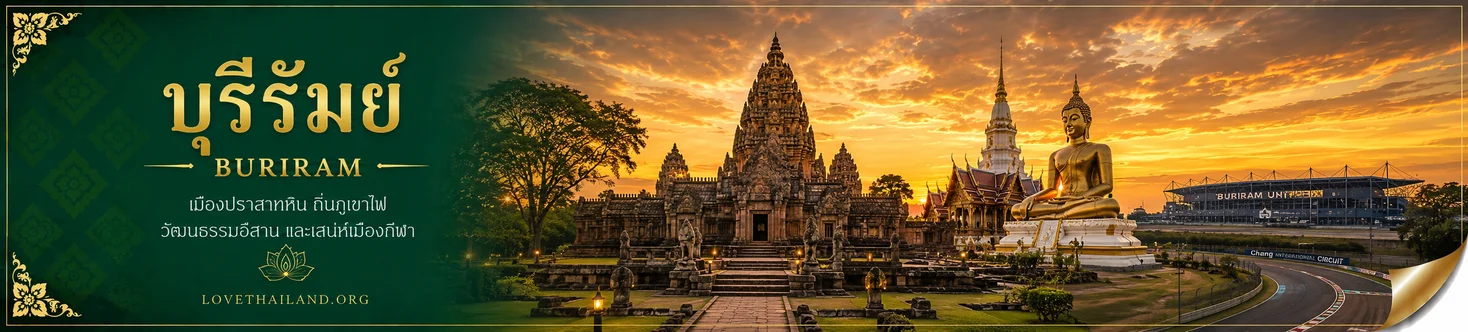
Buri Ram
Slogan : The city of sandstone sanctuaries, the land of volcanoes, beautiful silk and rich culture.
Buriram Province is an important province in Northeastern Thailand, distinguished by its history, culture, and modern tourism. It is especially known for the traces of ancient Khmer civilization reflected through numerous stone sanctuaries, earning it the titles “Land of Stone Castles” and “Land of Volcanoes in Thailand.”
Buriram covers an area of approximately 10,321 square kilometers and is located in the lower Northeastern region. Its terrain consists of undulating plateaus and remnants of several ancient volcanoes, which have now become major tourist attractions such as Khao Kradong. At the same time, the province serves as a center of Khmer archaeological sites, particularly Phanom Rung Historical Park and Muang Tam Sanctuary, both of which are key destinations for Thai and international visitors.
In addition to its historical heritage, Buriram is also famous for its silk and Na Pho mudmee textiles, as well as its local cuisine influenced by both Isan and Khmer cultures. Important traditions such as the Phanom Rung Festival and the Rocket Festival (Bun Bang Fai) clearly reflect the local way of life and identity.
In the present day, Buriram has developed significantly in sports and lifestyle tourism, featuring Chang Arena, Chang International Circuit, and various international events held continuously. This makes the province a destination that offers diverse experiences, including history, nature, culture, food, and sports.
Getting There Traveling to Buriram is convenient by car, train, bus, or airplane. From Bangkok, it takes approximately 5–6 hours by road, or you can take a direct flight to Buriram Airport to save time. It is suitable for both short trips and 3–5 day travel plans.
With a unique blend of a glorious past and modern development, Buriram is a province that offers a complete travel experience and is ideal for those who want to explore Northeastern Thailand in a deeper and more diverse way.
Buriram has a long history dating back to prehistoric times, continuing through the Dvaravati period and flourishing during the ancient Khmer civilization. Evidence of this can be seen in more than 60 archaeological sites, including brick and stone sanctuaries, kilns, and Khmer ceramics dating back to the 15th–18th Buddhist centuries.
After the Khmer period, historical records of Buriram became clear again during the late Ayutthaya period, when it was a dependency of Nakhon Ratchasima. It continued to play a role during the Thonburi and Rattanakosin periods until it was officially established as a province in 1933 and gradually developed into one of the key provinces in the Northeast today.
The province’s landscape, shaped by ancient volcanoes, gives Buriram a unique identity in both scenery and natural resources. Volcanic soil is suitable for agriculture, while natural attractions such as Khao Kradong, an extinct volcano, offer panoramic views of the city.
Culturally, Buriram is a blend of Thai and Khmer identities, resulting in diverse language, food, and traditions. Local dishes such as larb, nam tok, and som tam, along with Khmer-influenced cuisine, offer distinctive flavors unique to the area.
Handicrafts such as silk and Na Pho mudmee textiles represent long-standing local wisdom, featuring unique patterns recognized nationwide. These products serve both as cultural goods and valuable souvenirs.
Buriram hosts important festivals throughout the year, including the Phanom Rung Festival aligned with the sunrise phenomenon through the sanctuary gates, the Rocket Festival, and other local events that deeply reflect community beliefs and traditions.
Today, Buriram has evolved into a comprehensive tourism city, especially in sports tourism, with world-class venues such as Chang Arena and Chang International Circuit hosting global events. This development positions Buriram as a modern destination that seamlessly blends traditional culture with contemporary attractions.
Currently, Buriram is divided into 23 districts, covering urban areas, agricultural communities, and major tourist attractions, allowing for flexible travel planning, whether for short visits or multi-day trips.
With its combination of history, nature, culture, food, and modern activities, Buriram caters to all types of travelers and stands as a must-visit destination in Thailand.
With its diverse attractions, Buriram is ideal for well-planned trips, whether following the path of Khmer civilization, exploring volcanic landscapes, enjoying local cuisine, or participating in annual festivals.
The following sections provide practical travel information, including festivals, 3–5 day itineraries, and must-visit attractions, organized in a way that can be directly applied for both first-time visitors and experienced travelers.
Each table is designed to include key details such as timing, highlights, locations, and characteristics, making it easier to plan routes without searching multiple sources.
Whether planning a short 3-day trip or a detailed 5-day itinerary, this information ensures a complete and efficient travel experience in Buriram.
Buriram Tourism Festival Calendar 2026
| Festival | Period | Venue | Address | Highlights |
| Sarus Crane Festival 2026 | 2 February 2026 | Wetland and Sarus Crane Learning Center | Buriram Province | Nature and eco-tourism activities focusing on wetlands and the Sarus crane, one of the province’s early-year highlights |
| PT Grand Prix of Thailand 2026 | 27 February – 1 March 2026 | Chang International Circuit | Isan Subdistrict, Mueang Buriram District | World-class MotoGP event attracting large numbers of tourists, with hotels, restaurants, and city areas becoming especially lively |
| Colors of Buriram 2026 | 22 March – 14 April 2026 | Mueang Buriram District | Buriram Province | Tourism promotion activities adding vibrancy to the city during peak travel season, ideal for travelers seeking lively urban experiences |
| Phanom Rung Festival 2026 | 3 – 5 April 2026 | Phanom Rung Historical Park | Ta Pek Subdistrict, Chaloem Phra Kiat District | The province’s most important festival, featuring the sunrise alignment through 15 doorways, cultural parades, light and sound shows, and strong Khmer heritage atmosphere |
| Buriram Countdown 2026 | 30 – 31 December 2025 | Buriram City Area | Mueang Buriram District | Year-end celebration with festive atmosphere, ideal for travelers continuing into early 2026 trips |
Buriram 3–5 Day Travel Itinerary (Detailed Plan)
| Day | Zone | Plan | Highlights |
| Day 1 | Buriram City | Start at Chang International Circuit and Chang Arena, then visit Buriram Castle. In the evening, explore the city and try local food such as “standing meatballs” and Isan-Khmer cuisine | A relaxed introduction combining sports, lifestyle, and food |
| Day 2 | Chaloem Phra Kiat – Prakhon Chai | Visit Phanom Rung Historical Park in the morning, then continue to Muang Tam Sanctuary. Stop for local meals in nearby districts | Trip highlight, ideal for history and photography |
| Day 3 | Khao Kradong | Explore the extinct volcano crater, visit Phra Suphattharabophit, and enjoy city views, followed by cafés and relaxing spots | Nature, viewpoints, and relaxing atmosphere |
| Day 4 | Na Pho | Visit silk villages, learn about weaving, and shop for souvenirs | Cultural immersion and local craftsmanship |
| Day 5 | Flexible | Visit markets, cafés, or temples before departure | Relaxed ending to the trip |
Buriram MUST VISIT 15 Places
| No. | Place | Address | Highlights |
| 1 | Phanom Rung Historical Park | Ta Pek, Chaloem Phra Kiat | Iconic Khmer sanctuary on a volcano with sunrise alignment |
| 2 | Muang Tam Sanctuary | Chorakhe Mak Subdistrict, Prakhon Chai District, Buriram Province | A Khmer archaeological site surrounded by moats and ponds, peaceful in atmosphere, and ideal to visit together with Phanom Rung |
| 3 | Khao Kradong | Isan Subdistrict, Mueang Buriram District, Buriram Province | An easily accessible extinct volcano where visitors can see the crater, city views, and the giant Phra Suphattharabophit Buddha statue |
| 4 | Phra Suphattharabophit | Khao Kradong area, Isan Subdistrict, Mueang Buriram District, Buriram Province | A large Buddha image that is one of Buriram’s symbolic landmarks, ideal for worship and panoramic views |
| 5 | Chang International Circuit | Isan Subdistrict, Mueang Buriram District, Buriram Province | A world-class motorsport circuit, host of Thailand’s MotoGP, and a landmark of sports tourism in the province |
| 6 | Chang Arena | Isan Subdistrict, Mueang Buriram District, Buriram Province | A major football stadium of Buriram United and one of the key landmarks of modern Buriram |
| 7 | Buriram Castle | Isan Subdistrict, Mueang Buriram District, Buriram Province | A lifestyle attraction zone with shops, restaurants, and check-in spots near the sports complex |
| 8 | Rom Buri 200 Years Park | Mueang Buriram District, Buriram Province | A public park in the city center, suitable for relaxation, walking, and enjoying the local atmosphere |
| 9 | Food Streets / Dining Areas in Buriram City | Mueang Buriram District, Buriram Province | Ideal for tasting local specialties, standing meatballs, Isan food, and evening street food |
| 10 | Na Pho District | Na Pho District, Buriram Province | A famous center of silk and mudmee weaving in Buriram, perfect for buying souvenirs and learning local wisdom |
| 11 | Ban Kruat District | Ban Kruat District, Buriram Province | An area associated with archaeological sites and handicrafts, suitable for travelers interested in deeper local stories |
| 12 | Nang Rong District | Nang Rong District, Buriram Province | An important base for travelers heading to Phanom Rung and Muang Tam, with many restaurants and accommodations available |
| 13 | Prakhon Chai District | Prakhon Chai District, Buriram Province | An area linked to Muang Tam Sanctuary and the Khmer civilization route, ideal for a history-focused trip |
| 14 | Phutthaisong District | Phutthaisong District, Buriram Province | Suitable for experiencing local communities and traditional ways of life outside the main tourist routes of Buriram |
| 15 | Lahan Sai District and the Border Zone | Lahan Sai District, Buriram Province | An area with a different atmosphere from the city and temple zones, suitable for travelers who want to see Buriram from a broader perspective |
From all this information, it is clear that Buriram is a well-rounded destination with strengths in history, culture, nature, and modern tourism. Whether exploring ancient Khmer temples, visiting extinct volcanoes, or attending international sports events, the province offers experiences rarely found elsewhere.
Its rich local cuisine, handicrafts, and traditions further enhance the depth of travel, making a visit to Buriram not just a trip but a meaningful cultural experience.
With continuous development in infrastructure and tourism systems, Buriram can accommodate all types of travelers, from families to cultural explorers and sports enthusiasts.
With proper planning based on this information, visitors can maximize their time and experience the province fully without missing key highlights.
Ultimately, Buriram is not just a transit city but a destination full of stories and experiences waiting to be discovered in every dimension.
Frequently Asked Questions (FAQ)
Q: What is Buriram best known for?
A: Buriram is known for Khmer stone castles, extinct volcanoes, local culture, cuisine, and sports tourism.
Q: Where should first-time visitors go?
A: Phanom Rung, Muang Tam, Khao Kradong, Chang Arena, and Chang Circuit.
Q: How many days are ideal?
A: 3 days for highlights, 4–5 days for deeper exploration.
Q: When is the best time to visit?
A: Late year to early year, or during major festivals.
Q: What food is famous?
A: Isan and Khmer-influenced dishes such as larb, grilled meats, and local specialties.
Q: Is Buriram only about stone castles?
A: No, it also offers volcanoes, sports, culture, and lifestyle tourism.
Q: Can you travel without a car?
A: Yes, but renting a car is more convenient for multiple locations.
Q: What are good souvenirs?
A: Na Pho silk, mudmee textiles, handicrafts, and local food products.
Buri Ram Map

 Art, Culture and Heritage
 Historical Sites and Monuments(14)
 Landmarks and Memorials(2)
 Art, Craft Centres, Tradition(6)
 Museums(3)
 Educational Places
 Museum for Study(1)
 Places of Worship
 Temple(74)
 Other Sacred Sites(5)
 Suburban Living
 Village, Community(3)
 Nature and Wildlife
 National Parks and Marine Reserves(2)
 Mountain (Doi)(1)
 Dam, Reservoir, Lake(14)
 River, Canal(1)
 Bays and Beaches(1)
 Other natural attractions(2)
 Entertainment and Agricultural
 Animal camps and shows(1)
 Stadium(2)
 Farms, Parks and Ecotourism(2)
 Waterpark(1)


