
lovethailand home >Central Travel Attractions >Bangkok Travel Attractions > 50 Best Day Trips from Bangkok
TL;DR: 50 Best Day Trips from Bangkok, open Daily Opening Hours: 09:00 – 19:00 (Ticket Counter Closes at 18:00), hours 08:30 – 17:00.
50 Best Day Trips from Bangkok
50 Best Day Trips from Bangkok: No Overnight Stay Required is a comprehensive travel guide for visitors who want to explore Thailand beyond the capital without booking accommodation. From magnificent Buddhist temples and ancient royal palaces to floating markets, riverside communities, scenic waterfalls, and coastal attractions, the provinces surrounding Bangkok offer a remarkable variety of experiences. Whether you are interested in history, traditional architecture, local food, cultural heritage, or natural landscapes, there are numerous destinations that can be explored in a single day.
One of the greatest advantages of taking a day trip from Bangkok is the opportunity to experience a different side of Thailand without spending several days away from the city. With an early start and a carefully planned route, travelers can discover historic communities, enjoy traditional Thai cuisine, visit important religious landmarks, and return to Bangkok in the evening. Day trips are particularly suitable for families, couples, groups of friends, and international visitors who have limited time but want meaningful experiences outside the capital.
The diversity of destinations near Bangkok is closely connected to the geography and history of central Thailand. Major rivers such as the Chao Phraya, Tha Chin, Mae Klong, and Bang Pakong have supported settlements, agriculture, commerce, and transportation for centuries. Many historic temples, traditional markets, and riverside communities developed along these waterways. Today, travelers can still explore neighborhoods where wooden houses, local craftsmanship, Buddhist traditions, and canal-based lifestyles preserve important aspects of Thailand's cultural identity.
For travelers interested in history, Phra Nakhon Si Ayutthaya is one of the most rewarding destinations near Bangkok. The former capital of the Ayutthaya Kingdom was established in 1350 and remained a major political, cultural, and commercial center until 1767. Its historic city was inscribed on the UNESCO World Heritage List in 1991. Ancient temples, ruined palaces, monumental stupas, and archaeological sites offer valuable insights into the architectural achievements and international connections of one of Southeast Asia's most influential kingdoms.
Nakhon Pathom is another destination with exceptional historical significance. The province is associated with Dvaravati civilization and the early development of Buddhism in central Thailand. Its most recognizable landmark, Phra Pathom Chedi, is an enormous Buddhist stupa that dominates the surrounding cityscape. Travelers can combine a visit to this sacred monument with traditional markets, local restaurants, and cultural attractions along the Tha Chin River, creating a varied itinerary that blends religious heritage with everyday community life.
Samut Prakan is especially attractive to visitors who want to discover Thailand's artistic and architectural heritage. Ancient Siam, also known as Muang Boran, is an extensive open-air museum featuring reproductions and interpretations of major monuments from different regions of Thailand. Nearby, the Erawan Museum is distinguished by its enormous three-headed elephant sculpture and extraordinary interior decorations. Bang Pu Recreation Center offers a contrasting experience, with coastal views, migratory seabirds, and a classic seaside atmosphere along the Gulf of Thailand.
Nonthaburi provides an opportunity to explore traditional communities without traveling far from Bangkok. Koh Kret, an island in the Chao Phraya River, is particularly well known for its Thai-Mon cultural heritage, pottery workshops, Buddhist temples, and local food. Visitors can walk through the community, observe traditional craftsmanship, and experience the distinctive atmosphere of a settlement shaped by centuries of river transportation and cultural exchange.
Samut Songkhram is another excellent destination for cultural day trips. The province is famous for its agricultural communities, coconut plantations, canals, and traditional markets. Mae Klong Railway Market attracts visitors with its extraordinary arrangement of stalls beside active railway tracks, while Amphawa Floating Market is known for its historic wooden buildings, local food, and lively canal-side atmosphere during the weekend. These two markets can be combined into a memorable day trip when their operating schedules are taken into account.
Food is an essential part of exploring the regions surrounding Bangkok. Each province offers specialties influenced by its natural resources, history, and local communities. Travelers can sample Mon-inspired dishes and traditional sweets on Koh Kret, regional delicacies at Don Wai Market, seafood and Mae Klong mackerel in Samut Songkhram, and a wide variety of Thai desserts in historic markets throughout central Thailand. Visiting local food markets is not simply about eating; it also offers an introduction to traditional ingredients, cooking methods, and community livelihoods.
Local festivals and religious traditions add another dimension to these journeys. The annual Phra Pathom Chedi Worship Fair in Nakhon Pathom is an important Buddhist celebration, while the Rap Bua or Lotus Receiving Festival in Bang Phli, Samut Prakan, reflects the region's longstanding relationship between faith and waterways. Historic temple festivals and community celebrations in Ayutthaya and other provinces provide opportunities to experience cultural traditions that remain meaningful to local residents. Visitors interested in attending a festival should check the official dates for the relevant year.
Day-trip destinations can also be organized according to geography. Routes east and southeast of Bangkok, including Samut Prakan and Chachoengsao, are suitable for temple visits, museums, historic markets, and coastal attractions. Northern routes through Nonthaburi, Pathum Thani, and Ayutthaya offer riverside communities and important historical landmarks. Western and southwestern routes through Nakhon Pathom, Ratchaburi, and Samut Songkhram are particularly rewarding for traditional markets, agricultural landscapes, and regional cuisine.
Nature lovers have equally appealing options. Nakhon Nayok features waterfalls, forested hills, reservoirs, and outdoor learning centers, while Saraburi has important Buddhist sites surrounded by limestone hills and scenic countryside. Farther away, Kanchanaburi offers waterfalls, national parks, and historic railway landscapes. Phetchaburi and Prachuap Khiri Khan provide coastal scenery, mountain environments, and nature reserves. These longer journeys require an earlier departure and more careful planning, but many can still be completed in one day.
Transportation is an important consideration when planning a day trip. Depending on the destination, travelers can use private cars, rental vehicles, trains, buses, the BTS Skytrain, ferries, and local taxis. Some attractions, such as the Erawan Museum, are relatively easy to reach by public transportation. Others, especially waterfalls and national parks, may require a private vehicle or additional local transportation. Checking schedules and arranging the return journey in advance is particularly important for travelers who do not plan to stay overnight.
Families traveling with young children may prefer attractions with accessible walkways, rest areas, food services, and educational activities. Ancient Siam and the Erawan Museum provide cultural learning experiences, while Bang Pu offers an opportunity to enjoy nature without demanding physical activity. Older visitors may find temples, museums, and traditional markets more comfortable than steep hiking trails. Couples and groups of friends can design flexible itineraries around local food, photography, riverside walks, and historic architecture.
Seasonal conditions can significantly influence the experience. The cooler months are generally more comfortable for visiting outdoor monuments and walking through traditional markets. Migratory seagulls are a seasonal attraction at Bang Pu, while waterfalls and forested landscapes often appear especially lush during the rainy season. However, heavy rainfall can also create safety concerns, particularly in mountainous areas and near rivers. Travelers should check current weather conditions and official access restrictions before entering natural attractions.
A well-planned day trip usually focuses on two or three attractions within the same area rather than attempting to visit too many distant destinations. In Samut Prakan, for example, travelers may combine the Erawan Museum and Ancient Siam before visiting Bang Pu later in the day. Those who want to explore Ancient Siam thoroughly, however, should consider spending most of their day there. In Samut Songkhram, a visit to Mae Klong Railway Market can be followed by an afternoon or evening at Amphawa Floating Market on a day when the market is operating.
Ayutthaya offers another practical itinerary. Visitors can explore Wat Mahathat, Wat Phra Si Sanphet, and other monuments within the historic city before continuing to Wat Chaiwatthanaram. In Nakhon Pathom, travelers can focus on Phra Pathom Chedi and the surrounding town or explore the riverside communities of Sam Phran and Don Wai Market. Choosing attractions within a compact geographical area helps reduce travel time and allows visitors to enjoy each location without unnecessary rushing.
It is important to distinguish between a destination's official opening hours and the time when it is most enjoyable to visit. Some traditional markets technically operate every day but have more vendors on weekends. Other markets are primarily active on particular days. Museums and archaeological sites may have separate ticket-office hours and final admission times. Visitors should therefore check the latest information from the relevant attraction or managing authority before departure.
Responsible tourism is equally important. When visiting temples and historic monuments, dress respectfully and avoid touching fragile structures or cultural objects. In residential communities, respect local privacy and avoid blocking narrow walkways. Do not throw litter into rivers, canals, or coastal areas, and observe wildlife without disturbing its natural behavior. Supporting local businesses and traditional crafts can also contribute to the long-term preservation of community heritage.
These 50 day trips from Bangkok demonstrate that a rewarding travel experience does not always require an overnight stay. Some destinations offer nationally significant history, others preserve traditional crafts and local lifestyles, while still others provide memorable natural scenery. The following attractions have been selected to help visitors discover the cultural, historical, and environmental diversity of the regions surrounding Bangkok, with practical travel information and GPS directions to support independent trip planning.

1. Ancient Siam, Samut Prakan is one of the most impressive cultural attractions near Bangkok. Located in Bang Pu Mai Subdistrict, Mueang Samut Prakan District, this vast open-air museum brings together architectural landmarks, historical interpretations, reconstructed buildings, and artistic traditions from different regions of Thailand. One of its most distinctive features is the site's overall layout, which roughly follows the geographical shape of the country. This allows visitors to experience a remarkable range of Thai cultural heritage within a single destination.
Highlights: Sanphet Prasat Palace, the symbolic Mount Sumeru, regional Thai architecture, reconstructed religious monuments, traditional artistic details, landscaped gardens, cultural learning opportunities, and photography locations throughout the museum.
Ancient Siam was developed through the vision of Lek Viriyaphan, a Thai entrepreneur and cultural heritage enthusiast who wanted to preserve and communicate the artistic achievements of Thailand. His concept went beyond creating a conventional sightseeing attraction. The project was intended to demonstrate the historical significance of traditional buildings and artistic styles, including architectural forms that had been damaged, transformed, or lost over time. Its displays therefore combine historical references, artistic interpretation, and educational experiences designed to encourage a deeper appreciation of Thai culture.
The museum contains numerous remarkable architectural structures. Sanphet Prasat Palace is among its best-known landmarks, presenting an interpretation of the grandeur of the Ayutthaya royal court through elaborate roofs, ornamental details, and traditional palace architecture. Other buildings reflect the artistic character of different Thai regions, allowing visitors to compare the relationship between geography, local beliefs, construction techniques, and cultural identity. For architecture enthusiasts, even a single building can provide enough details for an extended period of observation.
Another fascinating aspect of Ancient Siam is the incorporation of religious symbolism and traditional cosmology into its architectural displays. Certain structures represent ideas associated with Mount Sumeru, Buddhist cosmology, mythology, and classical Thai literature. Their designs reveal how historical communities understood the relationship between human life, the natural world, and spiritual beliefs. Exploring these structures offers an opportunity to appreciate Thai architecture not only as a visual art form but also as a language of cultural meaning.
The landscaped environment also contributes significantly to the experience. Traditional pavilions, waterways, ponds, gardens, bridges, and ornamental sculptures surround the architectural displays, creating numerous viewpoints for photography. Visitors can capture sweeping images of major monuments or focus on delicate carvings, roof decorations, and individual artistic details. Morning visits are generally more comfortable for exploring the grounds, while afternoon light can bring out the shapes and textures of the buildings in particularly attractive ways.
Because Ancient Siam covers such an extensive area, time management is important. Visitors who want to explore the museum thoroughly should reserve much of the day rather than treating it as a brief stop. Internal transportation options may be available under the attraction's operating conditions, helping guests move between distant sections. Comfortable walking shoes, drinking water, sun protection, and a basic route plan are useful, particularly for families with children or older travelers.
Ancient Siam is suitable for families, students, architecture enthusiasts, photographers, and international visitors seeking an introduction to Thailand's cultural diversity. It can also be combined with the Erawan Museum or Bang Pu Recreation Center on a Samut Prakan day trip, although attempting to visit all three attractions in detail may leave too little time at each location. For travelers primarily interested in Thai history and architecture, making Ancient Siam the main destination offers the richest experience.
Open Days: Daily Opening Hours: 09:00 – 19:00 (Ticket Counter Closes at 18:00)
Getting There: From Bangkok, drive along Sukhumvit Road toward Samut Prakan and continue through Pak Nam toward Bang Pu. Follow the signs to Ancient Siam in Bang Pu Mai. Visitors using public transportation can take the BTS Sukhumvit Line to Kheha Station and continue by taxi or available local transportation to the museum entrance. Check the latest admission conditions and internal transportation arrangements before visiting.
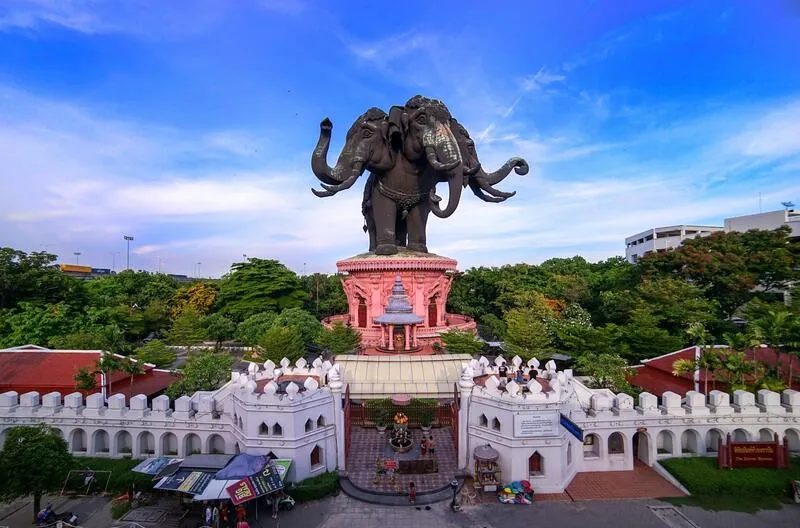
2. The Erawan Museum, Samut Prakan is an extraordinary cultural destination distinguished by its enormous three-headed elephant sculpture rising above an elaborate museum building. Located along Sukhumvit Road in Mueang Samut Prakan District, it combines monumental sculpture, religious symbolism, decorative arts, and architectural craftsmanship. Its appeal extends far beyond the size of the elephant itself, as the building incorporates a richly symbolic interior inspired by traditional cosmology and spiritual beliefs. The museum is particularly rewarding for travelers interested in Thai art, architecture, cultural history, and photography.
Highlights: The monumental three-headed Erawan elephant, the museum's cosmological design, elaborate staircases, stained-glass ceiling, ceramic decorations, ornamental plasterwork, sacred objects, Buddha images, and landscaped gardens.
The Erawan Museum was developed from the cultural vision of Lek Viriyaphan, who was also responsible for Ancient Siam in Samut Prakan and the Sanctuary of Truth in Chonburi. His projects share a commitment to preserving traditional craftsmanship and expressing philosophical and spiritual ideas through architecture. At the Erawan Museum, the building itself forms an essential part of the artistic experience. Visitors encounter not just a collection of objects but an environment in which sculpture, spatial design, mythology, and symbolism are closely connected.
The three-headed elephant represents Erawan, a mythical elephant traditionally associated with Indra in Hindu cosmology and Thai artistic traditions. The sculpture's monumental proportions create an imposing silhouette above the surrounding landscape. From the gardens and entrance areas, visitors can appreciate its scale and the detailed treatment of the elephant's heads, trunks, and body. The unusual relationship between sculpture and architecture gives the museum a character unlike most conventional cultural institutions.
Inside the building, the exhibition areas are organized around a symbolic cosmological framework associated with the underworld, the human world, and the celestial realm. Different levels use distinctive materials and decorative techniques to express these concepts. Ornamental staircases, ceramic surfaces, finely modeled plasterwork, and colorful stained glass contribute to an atmosphere that combines visual spectacle with religious meaning. Exploring these levels offers a deeper understanding of how spiritual concepts can influence architectural design.
The interior craftsmanship is particularly impressive. Visitors can observe intricate traditional patterns, sculptural details, carefully composed decorative surfaces, and the interaction of natural and artificial light. The stained-glass ceiling is among the most memorable interior features, creating a colorful focal point above the central space. Rather than moving quickly through the building, visitors are encouraged to appreciate how individual artistic elements work together to create an integrated symbolic environment.
The surrounding gardens provide a quieter setting in which to view the elephant sculpture from different angles. Landscaped pathways and ornamental features help visitors appreciate the scale of the architecture while offering opportunities for photography. The outdoor environment is also a pleasant place to rest before or after exploring the museum. Photography and access to sacred spaces should always follow the attraction's posted rules.
The Erawan Museum is suitable for art lovers, international tourists, families, and visitors interested in mythology and Thai religious culture. Its accessibility makes it especially convenient for travelers without private transportation. A visit can be combined with Ancient Siam, although sufficient time should be allocated to appreciate the museum's intricate interior rather than treating it only as a quick photography stop.
Open Days: Daily Opening Hours: 09:00 – 18:00 (Ticket Sales End at 17:00)
Getting There: Take the BTS Sukhumvit Line to Chang Erawan Station (E17), use Exit 2, and continue on foot toward the museum entrance. Visitors traveling by car can follow Sukhumvit Road from Bangkok into Samut Prakan. The enormous three-headed elephant is a prominent landmark visible from the surrounding area. Check admission conditions and appropriate dress requirements before visiting.

3. Bang Pu Recreation Center, Samut Prakan is a long-established seaside destination on the Gulf of Thailand, located in Bang Pu Mai Subdistrict, Mueang Samut Prakan District. It is one of the most accessible places to experience a coastal atmosphere near Bangkok without traveling to a distant beach resort. Its main attractions include Sukta Bridge, Sukjai Pavilion, expansive sea views, and migratory seagulls that gather along the coast during certain seasons. Unlike a typical sandy beach destination, Bang Pu is primarily known for its scenic walkway, coastal wetlands, birdwatching opportunities, and relaxed atmosphere.
Highlights: Sukta Bridge, Sukjai Pavilion, sunset views over the Gulf of Thailand, seasonal migratory seagulls, coastal wetlands, mangrove habitats, and opportunities for seaside photography and relaxation.
Bang Pu Recreation Center has a long history as a coastal leisure area and has been managed in connection with the Royal Thai Army. Its enduring popularity comes from the combination of easy access from Bangkok and the opportunity to enjoy an open seaside landscape. Over the years, the site has become associated with family outings, coastal dining, birdwatching, and relaxing walks along the sea. It remains one of the most recognizable destinations in Samut Prakan for visitors seeking a simple day trip.
Sukta Bridge is the centerpiece of the visitor experience. Extending from the shoreline toward Sukjai Pavilion, the bridge provides an elevated walkway overlooking the Gulf of Thailand and the surrounding coastal environment. Visitors can enjoy panoramic sea views, observe the changing sky, and photograph the natural landscape. The late afternoon is particularly attractive because the light becomes softer and the colors of the sky and water shift as sunset approaches.
Bang Pu is especially famous for migratory seagulls that arrive during the cooler months and remain in the coastal area for part of the year. Watching these birds circle above the bridge and shoreline is one of the area's signature experiences. The number of birds visible depends on seasonal migration, weather conditions, tides, and natural behavior, so visitors should not expect equally large flocks throughout the year. Wildlife should be observed responsibly without chasing, touching, or disturbing the birds.
The coastal wetlands and mangrove environment are another important part of Bang Pu's appeal. These habitats support birds, fish, invertebrates, and plant species adapted to salty or brackish conditions. They also provide an opportunity to learn how coastal ecosystems function and why their conservation matters. Families with children can use a visit to discuss migratory wildlife, the relationship between land and sea, and the role of wetlands in supporting biodiversity.
Photography enthusiasts will find different subjects throughout the day. Morning conditions can be suitable for observing the coastline in a quieter atmosphere, while the late afternoon is popular for photographing the bridge, the sea, and the changing light. Visitors interested in photographing birds should use an appropriate viewing distance and avoid actions that could disrupt their feeding or resting behavior.
Bang Pu is particularly suitable for families, couples, older travelers, and visitors who prefer an accessible outdoor attraction. It can be combined with the Erawan Museum and Ancient Siam on a Samut Prakan itinerary. Travelers with limited time may prefer to spend the earlier part of the day exploring museums and cultural sites before ending their trip with a relaxed seaside walk at Bang Pu.
Open Days: Daily Opening Hours: 10:00 – 20:00
Getting There: From Bangkok, follow Sukhumvit Road toward Samut Prakan, continue through Pak Nam, and travel toward the Bang Pu area. The recreation center is located near kilometer 37 of Sukhumvit Road. Public transportation users can take the BTS toward Samut Prakan and continue by local bus, songthaew, or taxi to the entrance. Allow additional travel time during busy weekend evenings.

4. Koh Kret, Nonthaburi is a remarkable cultural destination on an island in the Chao Phraya River, located in Pak Kret District, Nonthaburi Province. It is especially well known for its Thai-Mon community, traditional pottery, Buddhist temples, historic riverside atmosphere, and distinctive local cuisine. Despite being relatively close to Bangkok, Koh Kret offers a slower and more traditional environment than the surrounding urban districts. Visitors can explore the island on foot or by bicycle and discover a community whose history has been closely connected to river transportation and cultural exchange for centuries.
Highlights: Thai-Mon cultural heritage, traditional pottery workshops, Wat Poramai Yikawat, the leaning riverside pagoda, local food and desserts, handicraft shops, traditional houses, and walking or cycling routes through the island community.
Koh Kret's history is closely connected to the changing course of the Chao Phraya River. During the Ayutthaya period, a shortcut canal was excavated to make river transportation more convenient. As water continued to flow through the new channel, the surrounding land gradually became separated from the riverbank, creating the island that exists today. The area subsequently developed into an important community, particularly associated with Mon settlers whose descendants have preserved many distinctive cultural traditions.
Wat Poramai Yikawat is one of the island's most significant religious landmarks. The temple plays an important role in the cultural and spiritual life of the local Mon community. Its leaning pagoda beside the Chao Phraya River is among Koh Kret's most recognizable symbols. Visitors can explore the temple's architecture and artistic details while learning about the relationship between Mon heritage and Thai Buddhism. The riverside setting also illustrates the close historical connection between religious communities and waterways.
Traditional pottery is another defining feature of Koh Kret. Local artisans are known for producing unglazed earthenware and intricately decorated ceramic objects that reflect Mon craftsmanship. Visitors may encounter pottery workshops and shops selling both practical household items and decorative pieces. Observing the different shapes, textures, and carved patterns offers insight into the skills required to form, decorate, and produce traditional ceramics. These crafts represent an important part of the island's cultural identity and local economy.
Food is an essential part of the Koh Kret experience. The island is known for Mon-influenced dishes, traditional Thai desserts, snacks, and locally produced refreshments. Visitors can walk between food stalls and small shops while observing the architecture and everyday activities of the surrounding community. On weekends and public holidays, more shops tend to open and the market atmosphere becomes livelier. Purchases from local craftspeople and food vendors also help support traditional livelihoods.
Walking through the island reveals how its architecture and settlement patterns developed in relation to the river. Traditional houses, narrow paths, temples, and small businesses exist alongside newer structures, illustrating how the community has adapted to economic and social changes while maintaining a strong cultural identity. Visitors should be mindful that Koh Kret is a residential community rather than a purpose-built tourist park. Respecting private homes and keeping pathways clear are important parts of responsible travel.
Koh Kret is suitable for families, couples, cultural travelers, photographers, and visitors who enjoy walking through local markets. A relaxed visit can take half a day or longer, especially if you want to explore temples, pottery workshops, food stalls, and quieter residential areas. Cyclists should exercise caution on narrow routes shared with pedestrians. Visitors traveling with young children or older family members should also consider the practical requirements of boarding the ferry and walking on the island.
Open Days: The island can be visited daily. Most tourist-oriented shops and markets are livelier on weekends and public holidays.
Getting There: From Bangkok, travel toward Pak Kret District via Chaeng Watthana Road or another suitable route. Continue to the ferry pier near Wat Sanam Nuea and take the cross-river ferry to Koh Kret. Travelers using public transportation can reach the Pak Kret area by bus or rail connections and continue to the pier by local transport. Check the ferry operating schedule, particularly if you plan to return in the evening.
Map (GPS):Open Google Maps Directions to Koh Kret

5. Wat Phra Pathom Chedi Ratchaworamahawihan, Nakhon Pathom is one of Thailand's most important Buddhist temples and a major historical landmark in central Thailand. Located in Phra Pathom Chedi Subdistrict, Mueang Nakhon Pathom District, the temple is dominated by the immense bell-shaped Phra Pathom Chedi, which forms the visual and spiritual center of the city. The temple is closely connected to the history of Buddhism in the region and the archaeological heritage of ancient Nakhon Pathom. It is an excellent destination for travelers interested in religious history, architecture, traditional Buddhist practices, and cultural landmarks.
Highlights: The monumental Phra Pathom Chedi, Phra Ruang Rojanarit Buddha image, surrounding galleries and prayer halls, traditional Thai religious architecture, the history of Buddhism in central Thailand, and the annual Phra Pathom Chedi Worship Fair.
The historical significance of Phra Pathom Chedi is closely connected to ancient settlements in the Nakhon Pathom region and archaeological evidence associated with Dvaravati civilization. Numerous discoveries from the area demonstrate the importance of Buddhism and cultural exchange in central Thailand during the early historic period. Although the monumental stupa visible today was extensively rebuilt in the Rattanakosin era, the site preserves a much longer religious and historical tradition that continues to shape the identity of Nakhon Pathom.
During the reign of King Mongkut, Rama IV, an important restoration project was undertaken to construct a new monumental stupa enclosing the earlier structure. The work continued through subsequent reigns and eventually produced the immense bell-shaped monument that visitors see today. This development reflects the role of Thai monarchs in supporting Buddhism and conserving important religious sites. It also demonstrates how historic monuments can accumulate architectural layers and meanings over time.
Phra Pathom Chedi is remarkable for its enormous scale and elegant architectural proportions. Rising above a broad surrounding platform, the stupa is visible from many parts of Nakhon Pathom. Its golden-toned exterior becomes particularly striking in natural sunlight, while the surrounding galleries, shrines, and religious buildings create an atmosphere appropriate for worship and reflection. Visitors can explore the accessible areas around the monument and appreciate the details of its architectural composition.
Phra Ruang Rojanarit is another important sacred image associated with the temple. This revered standing Buddha image is housed in a shrine on the northern side of the main stupa. Visitors frequently pay their respects to Phra Ruang Rojanarit as part of their journey around the temple grounds. The image holds great religious significance for the local community and contributes to the site's role as a center of Buddhist devotion.
The temple is also associated with the annual Phra Pathom Chedi Worship Fair, an important religious and community tradition. During the festival, worshippers visit the temple to make merit, pay respect to the stupa, and participate in Buddhist activities. The event creates a lively atmosphere in the surrounding city and demonstrates how religious traditions remain closely connected to the daily lives of local people. Festival dates vary by year and should be checked through official announcements before planning a visit.
The area around the stupa provides a valuable opportunity to observe the relationship between a major religious monument and urban development. Shops, roads, transportation connections, and residential communities surround the temple, illustrating how Phra Pathom Chedi has remained an important element of the city's identity. A visit therefore offers insight not only into religious architecture but also into the way a historical landmark continues to influence the character of a modern Thai city.
For travelers planning a day trip from Bangkok, Wat Phra Pathom Chedi is a convenient starting point for exploring Nakhon Pathom. After visiting the temple, you can discover local restaurants, traditional desserts, and shopping areas in the town center. Travelers interested in history may also explore archaeological heritage associated with Dvaravati civilization. Visitors traveling with older family members should choose a comfortable time of day and allow breaks when walking around the extensive temple grounds.
Open Days: Daily Opening Hours: 05:00 – 20:00
Getting There: From Bangkok, follow Phetkasem Road toward Nakhon Pathom and continue into the city center, following signs to Phra Pathom Chedi. Travelers using public transportation can take a train to Nakhon Pathom Railway Station, which is conveniently located near the temple area. Check the latest train timetable if you plan to return to Bangkok on the same day.

6. Don Wai Market, Nakhon Pathom is a historic riverside market famous for traditional Thai food, local desserts, and an authentic community atmosphere along the Tha Chin River. Located in Bang Krathuek Subdistrict, Sam Phran District, Nakhon Pathom Province, near Wat Don Wai, the market is a popular destination for travelers seeking local culinary experiences within easy reach of Bangkok. Beyond its reputation for food, Don Wai Market offers an opportunity to explore traditional riverside commerce, historic shops, and the relationship between local communities and the waterways that once served as central Thailand's principal transportation network.
Highlights: Historic Tha Chin River market, traditional Thai food, Chinese-style braised duck, Thai desserts, seasonal agricultural products, established family-run shops, riverside community life, and boat excursions when available.
Don Wai Market developed alongside agricultural communities on the banks of the Tha Chin River, one of the most important waterways in central Thailand. Before modern roads transformed transportation and commerce, rivers were essential routes for moving agricultural produce, prepared food, and everyday goods between villages and regional markets. Communities established trading areas at convenient points along the river, allowing farmers, merchants, and residents to exchange products. Don Wai gradually became an important commercial center, and its continuing popularity reflects the enduring connection between traditional markets and riverside settlements.
Walking through the market reveals rows of shops selling freshly prepared dishes, Thai desserts, seasonal fruit, local snacks, and specialty products. The atmosphere is lively, with aromas from cooking stalls and conversations between vendors and customers filling the narrow walkways. Unlike modern shopping centers, the market retains a strong sense of connection between food producers, shop owners, and the surrounding community. Many visitors come not only to purchase ingredients or meals but also to enjoy the experience of traditional market culture.
Food is undoubtedly one of Don Wai Market's greatest attractions. Chinese-style braised duck is particularly well known, alongside a wide selection of other Thai dishes and traditional sweets. Visitors can discover desserts made with coconut milk, grated coconut, rice flour, palm sugar, and other ingredients characteristic of central Thai cuisine. Some vendors also sell fresh produce sourced from agricultural areas nearby. The range of products provides an introduction to regional ingredients and traditional cooking techniques that remain an important part of community identity.
The Tha Chin River adds a distinctive setting to the market. Visitors can observe the waterway, surrounding houses, and everyday activities along both riverbanks. When local boat operators are providing services, a river excursion can offer a different perspective on the landscape and provide insight into how waterways supported transportation and trade before the expansion of modern roads. The riverside setting also makes Don Wai an appealing destination for visitors who enjoy photography and traditional community environments.
The nearby Wat Don Wai illustrates another important aspect of historic settlements in central Thailand: the close relationship between temples and markets. Buddhist temples often served as religious and social centers, while markets provided places for trade and community interaction. Both were frequently established near waterways because rivers offered convenient transportation. Exploring the market and temple together therefore helps visitors understand the traditional organization of Thai riverside communities.
Don Wai Market is particularly suitable for families, food enthusiasts, and travelers who enjoy exploring local culture at a relaxed pace. Visitors can combine a market visit with nearby attractions in Sam Phran District or other destinations in western Bangkok's surrounding provinces. Morning and midday are convenient periods for discovering the selection of freshly prepared dishes and local products, although the number of operating stalls may vary between weekdays and weekends.
When purchasing food to take home, travelers should consider storage conditions and travel time, especially for dishes containing fresh seafood, coconut milk, or other perishable ingredients. Weekends can be busy, so allowing additional time for walking, shopping, and parking is advisable. Despite its popularity, Don Wai remains a working community market, and visitors should respect local businesses and residents while exploring.
Open Days: Daily Opening Hours: 06:00 – 18:00
Getting There: From Bangkok, travel along Borommaratchachonnani Road or connecting routes toward Sam Phran District in Nakhon Pathom. Continue toward Bang Krathuek Subdistrict and follow the signs for Wat Don Wai and the riverside market. Travelers without a private car can reach the Salaya or Sam Phran area by public transportation and continue by local bus or taxi. Weekend visitors should allow extra travel time due to increased traffic near the market.
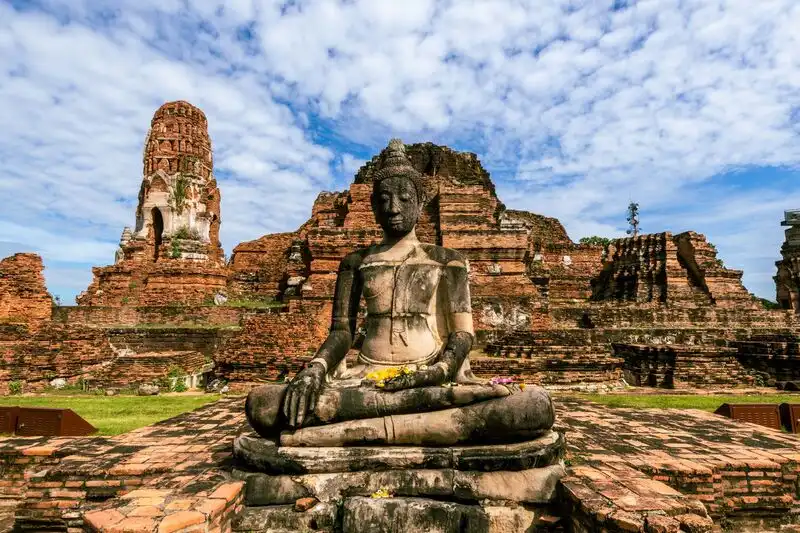
7. Wat Mahathat, Phra Nakhon Si Ayutthaya is one of the most historically significant archaeological sites within Ayutthaya Historical Park. Located near Naresuan Road on the historic city island of Phra Nakhon Si Ayutthaya Province, the temple is especially famous for the sandstone Buddha head surrounded by the roots of a large tree. This extraordinary image has become an internationally recognized symbol of Ayutthaya's ancient ruins. Beyond this iconic attraction, Wat Mahathat contains the remains of stupas, religious halls, Buddha images, and other structures that reveal the architectural achievements and spiritual importance of the former Siamese capital.
Highlights: The Buddha head entwined in tree roots, ruins of the central prang, ancient stupas and viharns, sandstone Buddha sculptures, Ayutthaya-period architecture, and the historic atmosphere of the UNESCO World Heritage Site.
Wat Mahathat occupied an important position in the religious and political life of the Ayutthaya Kingdom. In traditional Southeast Asian capitals, major Buddhist temples were not merely places of worship. They also served as prominent sacred landmarks associated with royal authority, religious ceremonies, and the spiritual identity of the kingdom. The name Mahathat refers to a great relic, reflecting the importance of Buddhist relics in the religious landscape of historic Thai cities. The temple's location and architectural composition demonstrate its standing within the former royal capital.
The central prang once formed the dominant architectural feature of Wat Mahathat. Its design reflected the architectural traditions of early Ayutthaya and the continuing influence of earlier Khmer-style religious structures in central Thailand. Although much of the original tower has collapsed, its remaining foundations and surrounding structures provide valuable evidence of the temple's former scale. Visitors can examine the layout of the ruins and imagine how the religious complex appeared during the kingdom's period of prosperity.
The most famous feature of Wat Mahathat is the sandstone Buddha head embraced by the roots of a large tree. Over time, the growing roots have formed a natural frame around the sculpture, creating a remarkable visual relationship between ancient religious art and the surrounding environment. This image is among the most photographed landmarks in Ayutthaya. However, it remains a sacred Buddhist object and an important historical artifact. Visitors should follow the site's guidelines and behave respectfully when taking photographs, including observing appropriate positioning near the Buddha image.
Throughout the archaeological complex, visitors can discover the remains of stupas, religious halls, boundary walls, and other architectural elements. These structures provide insight into the organization of Buddhist monasteries during the Ayutthaya period. Details such as brick foundations, traces of old passageways, and surviving fragments of sculptures reveal how the temple complex was arranged and used. Exploring slowly allows travelers to appreciate features that may be overlooked during a brief visit.
Wat Mahathat forms part of the Historic City of Ayutthaya, which was inscribed on the UNESCO World Heritage List in 1991. This recognition reflects the outstanding cultural and historical significance of the former capital. The surviving monuments illustrate the achievements of Ayutthaya in architecture, urban planning, religion, and international cultural exchange. As a protected archaeological site, Wat Mahathat requires careful preservation. Visitors should never climb restricted structures, touch fragile surfaces, or remove materials from the ruins.
For travelers planning a day trip from Bangkok, Wat Mahathat is conveniently located near other important historical attractions, including Wat Ratchaburana, Wat Phra Si Sanphet, and several monuments on Ayutthaya's city island. Wat Chaiwatthanaram can also be included in a broader itinerary, although additional travel time is required to reach the western side of the Chao Phraya River. Early morning or late afternoon visits are often more comfortable because the archaeological site has extensive outdoor areas with limited shade.
Visiting Wat Mahathat provides a direct encounter with Thailand's historical heritage. The surviving structures reflect the former kingdom's prosperity, the changes brought by centuries of history, and the continuing importance of cultural conservation. Understanding the site in the wider context of Ayutthaya's history makes the experience much more rewarding than simply stopping to photograph the famous Buddha head. Comfortable shoes, drinking water, and sun protection are particularly useful for families and travelers exploring several ruins in one day.
Open Days: Daily Opening Hours: Ticket Sales 08:00 – 17:00 (Visiting Permitted Until 18:00 According to the Listed Site Information)
Getting There: From Bangkok, take the Asian Highway or another major route toward Phra Nakhon Si Ayutthaya. Continue onto the historic city island and follow directions to Wat Mahathat near Naresuan Road. Travelers can also take a train to Ayutthaya Railway Station and continue by local taxi, tuk-tuk, or other available transportation to the historical park. Allow sufficient time for moving between monuments and check current admission requirements before visiting.
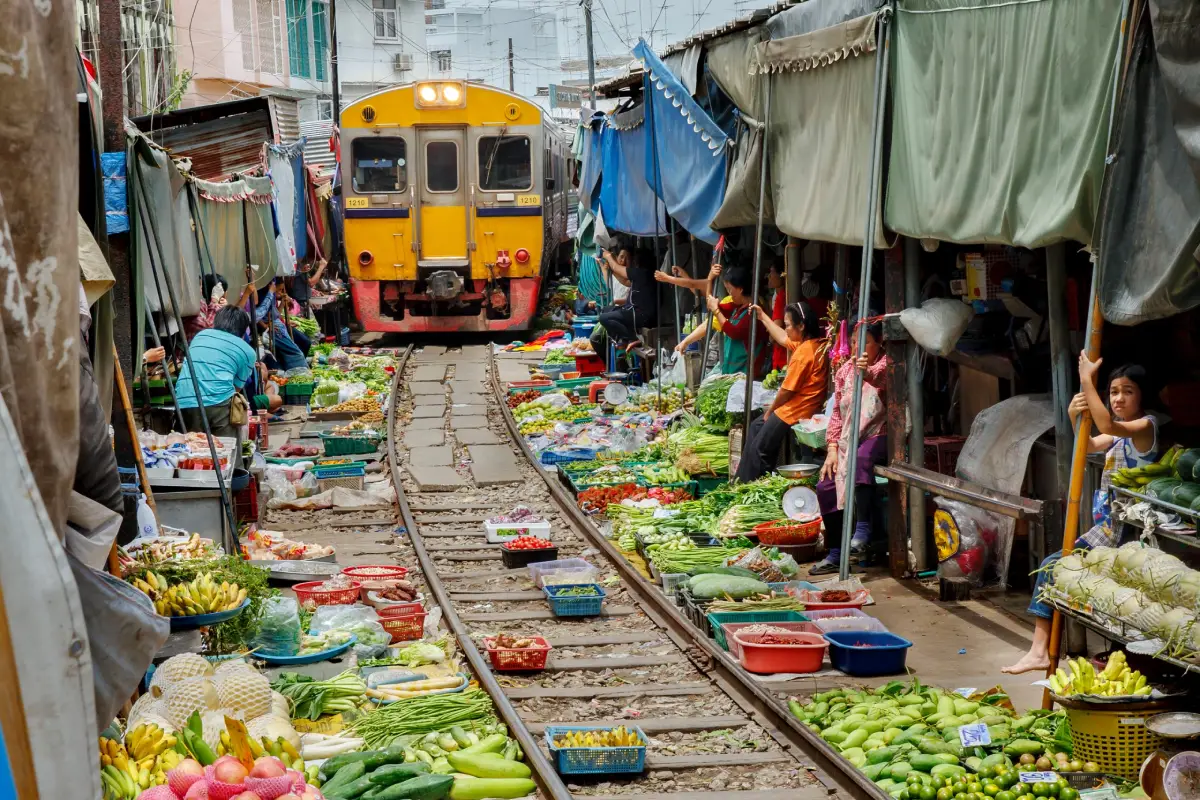
8. Mae Klong Railway Market (Rom Hoop Market), Samut Songkhram is one of Thailand's most unusual traditional markets, internationally recognized for its location directly alongside an active railway track. Situated near Mae Klong Railway Station in Mueang Samut Songkhram District, this working fresh-food market offers a memorable display of how local commerce has adapted to the railway environment. When a train approaches, vendors fold their umbrellas and move merchandise away from the track, allowing the train to pass through the market before reopening their stalls. The resulting scene has become a famous attraction for visitors interested in Thai community life, railway travel, and distinctive local experiences.
Highlights: Fresh-food stalls beside an active railway line, umbrellas folding as trains approach, Mae Klong Railway Station, seafood and agricultural produce, traditional market culture, everyday vendor activities, and memorable railway photography.
Mae Klong Railway Market developed as part of an established commercial community closely connected to the local railway system. The railway station became an important transportation point in Samut Songkhram, supporting the movement of people and commercial activities within the town. Over time, market stalls occupied spaces near the tracks, creating a distinctive arrangement in which local trading activities and railway operations exist in unusually close proximity. The market's present appearance reflects the ability of local vendors to adapt their businesses to limited space and an active transport corridor.
The market's best-known activity occurs when a train approaches or leaves Mae Klong Station. Vendors begin folding their awnings, moving portable displays, and ensuring their products remain outside the train's clearance area. As the train slowly passes, the narrow track corridor becomes temporarily free of umbrellas and other obstructions. Once it has departed, the vendors return their stalls to normal and trading continues. This process is an established part of the market's working routine rather than a performance staged solely for tourists.
Although the passing train attracts considerable attention, Mae Klong Railway Market remains an active local fresh-food market. Visitors can find seafood from the Gulf of Thailand, vegetables, fruit, herbs, seasonings, and everyday household ingredients. The variety of goods reflects Samut Songkhram's economy, which is closely associated with coastal fishing and agricultural communities along the Mae Klong River. Walking through the market offers an opportunity to observe the daily routines of local merchants and the food culture of the surrounding region.
Travelers who want to witness a train passing through the market should check the current timetable issued by the State Railway of Thailand. Trains do not arrive continuously, and schedules may change because of operational conditions. Planning around confirmed arrival or departure times helps visitors avoid unnecessary waiting and makes it easier to combine the experience with other attractions. Even when no train is present, the market is interesting for its food stalls, railway setting, and local atmosphere.
Safety is especially important at Mae Klong Railway Market. The tracks form part of an operating railway, and visitors should never stand too close to an approaching train or enter restricted areas for photography. When vendors or railway personnel signal that the train is coming, move promptly to an appropriate viewing position and keep all belongings clear of the track. Avoid extending cameras, phones, or other equipment toward the train. Respecting the vendors' work is also important, as they must concentrate on moving their displays safely.
The market is a particularly good destination for travelers interested in community culture, transportation, photography, and traditional commerce. It can be combined with Amphawa Floating Market on a day trip from Bangkok, particularly on Friday, Saturday, or Sunday when the floating market operates. Visitors may explore Mae Klong Railway Market in the morning or around a suitable train arrival, then continue to Amphawa later in the day.
What makes Mae Klong Railway Market exceptional is not simply the sight of a train moving past food stalls, but the way transportation infrastructure and everyday livelihoods have become interwoven. The market demonstrates how local communities can adapt established trading practices to unusual physical conditions while retaining a recognizable cultural identity. For international travelers, this combination of authenticity, railway history, and community life creates an experience unlike a conventional tourist market.
Open Days: Daily Opening Hours: 06:00 – 18:00
Getting There: From Bangkok, drive along Rama II Road toward Samut Songkhram and continue into Mae Klong town, following signs to the railway station. Travelers who prefer public transportation can use the Mae Klong Railway route, which involves traveling from the Bangkok area through Mahachai, crossing between the Mahachai and Ban Laem sections by local transport or ferry connections, and continuing by train toward Mae Klong. Check the latest railway schedules and connection arrangements before departure.

9. Amphawa Floating Market, Samut Songkhram is one of central Thailand's best-known cultural markets, celebrated for its traditional wooden buildings, canal-side atmosphere, regional food, and lively evening setting. Located in Amphawa Subdistrict, Amphawa District, Samut Songkhram Province, the market allows visitors to experience a historic community built around the waterways of the Mae Klong River basin. Its appeal comes from the combination of traditional architecture, local cuisine, waterside activities, and an environment that preserves the distinctive character of an old Thai canal town.
Highlights: Evening floating market, historic wooden shophouses, canal-side restaurants, seafood and traditional Thai dishes, local desserts, souvenir shops, riverside community life, boat excursions, and seasonal firefly-watching activities when available.
Amphawa developed as an established riverside community within the Mae Klong River basin, an area historically important for settlement, agriculture, and commerce in central Thailand. Waterways once served as the principal routes for transporting goods and connecting households with temples and markets. Many traditional homes were therefore built facing the canals, with landing points that supported boats and commercial activities. These architectural arrangements reveal how closely the community's daily life depended on its network of waterways.
One of Amphawa's most appealing qualities is the preservation of its traditional canal-side atmosphere. Old wooden shophouses, narrow walkways, waterside restaurants, and small local businesses create a distinctive sense of place. Although tourism has influenced commercial activities and the use of some buildings, the community continues to reflect the character of a historic canal settlement. Walking through the market offers opportunities to observe how traditional buildings were adapted for living, trading, and interacting with the water.
Food is central to the Amphawa experience. Visitors can discover a wide selection of seafood and traditional dishes using ingredients associated with Samut Songkhram, including Mae Klong mackerel, prawns, squid, shellfish, and coconut-based products. Local desserts and drinks also showcase ingredients produced in nearby orchards and agricultural communities. Some food vendors operate near the canal, allowing visitors to enjoy meals while observing the waterways and the surrounding historic buildings.
Amphawa is also historically significant because of its connections to individuals and royal family history during the Thonburi and early Rattanakosin periods. In particular, the area is associated with King Phutthaloetla Naphalai, Rama II. Visitors interested in Thai history and classical arts can combine a market visit with King Rama II Memorial Park to learn about the cultural achievements, literature, and historical background of the period. This creates a richer itinerary than visiting the floating market solely for shopping and food.
Boat excursions offer another way to appreciate the landscape of Amphawa. Depending on available services, visitors may travel along canals and waterways passing temples, local homes, and orchard communities. These journeys provide a different perspective on the traditional relationship between residents and the river. Firefly-watching trips are another activity associated with the area, although sightings depend on natural conditions, seasonality, and the activities of licensed or operating boat providers. Responsible visitors should avoid disturbing firefly habitats or using bright lights near sensitive natural areas.
Amphawa Floating Market is suitable for families, couples, friends, photographers, and travelers who enjoy food and community heritage. A practical day-trip itinerary from Bangkok involves visiting Mae Klong Railway Market earlier in the day before continuing to Amphawa in the afternoon or evening. This allows visitors to experience two different types of traditional markets within Samut Songkhram, provided that the journey takes place on a day when Amphawa's weekend market is open.
Because Amphawa is popular on weekends, visitors should allow additional time for traffic, parking, and walking through the market. Some lanes and canal-side walkways are narrow and may become crowded. Respecting residents' privacy, avoiding unnecessary noise, and disposing of rubbish appropriately help maintain the character of the historic community. Visitors planning to return to Bangkok on the same evening should arrange their departure time carefully, especially if they intend to remain at the market after sunset.
Open Days: Friday – Sunday Opening Hours: 10:00 – 20:30
Getting There: From Bangkok, drive along Rama II Road toward Samut Songkhram, then continue toward Amphawa District via the connecting roads from Mae Klong town. Travelers without a private vehicle can take public transportation to Samut Songkhram and continue by local transport or taxi to the floating market. If you plan to visit the market in the evening, check the availability of return transportation before arriving.

10. Wat Yai Chaimongkon, Phra Nakhon Si Ayutthaya is one of Ayutthaya's most important historic Buddhist temples, located in Khlong Suan Phlu Subdistrict, Phra Nakhon Si Ayutthaya District. The temple is distinguished by its monumental Chai Mongkhon Chedi, surrounding rows of Buddha images, and a revered reclining Buddha. Its history is closely associated with the Ayutthaya Kingdom and traditional accounts relating to King Naresuan the Great. The combination of religious devotion, historical architecture, and royal heritage makes Wat Yai Chaimongkon an essential destination for travelers exploring Ayutthaya on a day trip from Bangkok.
Highlights: The monumental Chai Mongkhon Chedi, rows of Buddha images around the cloister, the reclining Buddha, historic prayer halls and religious structures, connections with King Naresuan the Great, and the atmosphere of an active Buddhist temple within ancient Ayutthaya.
Wat Yai Chaimongkon has a long history associated with the establishment and religious development of the Ayutthaya Kingdom. The temple is traditionally connected to Buddhist monastic communities and the practice of meditation during the early period of the kingdom. Over time, it became one of Ayutthaya's most recognizable religious landmarks. Its present name is closely associated with the great victory chedi that dominates the site and reflects the temple's place in the historical memory of the former capital.
The Chai Mongkhon Chedi is the temple's most prominent architectural structure. This enormous bell-shaped stupa stands on an elevated base and can be seen from several locations within the grounds. Its historical associations include traditional accounts of the military victories and royal achievements of King Naresuan the Great. The structure is therefore significant not only as an expression of Buddhist faith but also as an enduring symbol connected to the political and military history of the Ayutthaya Kingdom.
Surrounding the main chedi are rows of Buddha images arranged along the cloister, creating one of the temple's most memorable visual scenes. The repeated forms of the seated Buddhas produce a sense of rhythm and balance within the architectural complex. Visitors can observe differences in the sculptures and appreciate the relationship between religious imagery and architectural space. These areas also reveal the importance of Buddhist artistic traditions in shaping the appearance of major temples during the Ayutthaya period.
The reclining Buddha is another important devotional feature of Wat Yai Chaimongkon. Reclining Buddha images have a significant place within Buddhist visual culture and can be found in numerous important temples throughout Thailand. Visitors often pay their respects to the image and make offerings according to local Buddhist practices. The surrounding area provides a quieter setting for worship and reflection, and respectful clothing and behavior are expected when entering sacred spaces.
Beyond its religious importance, Wat Yai Chaimongkon offers insight into the historical relationship between Buddhist institutions and royal authority in the Ayutthaya Kingdom. The temple's association with King Naresuan reflects the role of religious monuments in preserving accounts of important historical events and figures. Exploring the temple while learning about the wider history of Ayutthaya helps visitors understand how architecture, Buddhism, and collective historical memory are closely connected in Thailand.
Wat Yai Chaimongkon remains an active place of worship, with Buddhist ceremonies and merit-making activities taking place throughout the year. Religious holidays such as Makha Bucha, Visakha Bucha, and Asalha Bucha are especially important in the Thai Buddhist calendar. Visitors may encounter worshippers attending ceremonies or making offerings during these periods. Travelers wishing to participate in specific events should consult current temple announcements, as annual schedules can vary.
The temple is conveniently located for travelers planning an Ayutthaya day trip. Visitors can begin with Wat Yai Chaimongkon before continuing to Wat Mahathat, Wat Ratchaburana, or other archaeological sites on the historic city island. Because the temple is situated outside the central island area, planning the route in advance helps reduce unnecessary travel. Morning visits can be more comfortable for exploring the grounds, particularly during Thailand's warmer months.
Wat Yai Chaimongkon combines monumental architecture, important Buddha images, religious traditions, and historical significance within one accessible destination. Travelers can appreciate the scale of the great chedi, explore the cloister, pay their respects at the reclining Buddha, and deepen their understanding of the Ayutthaya Kingdom. For international visitors interested in Thailand's Buddhist heritage, the temple is one of the most rewarding stops on a day trip from Bangkok.
Open Days: Daily Opening Hours: 08:00 – 17:00
Getting There: From Bangkok, follow the Asian Highway or another suitable route toward Phra Nakhon Si Ayutthaya. Continue toward Khlong Suan Phlu Subdistrict, where Wat Yai Chaimongkon is located outside the historic city island. Visitors traveling by train can disembark at Ayutthaya Railway Station and continue by taxi, tuk-tuk, or local transportation. If you intend to visit several temples in one day, organize the route according to their locations to minimize travel time.
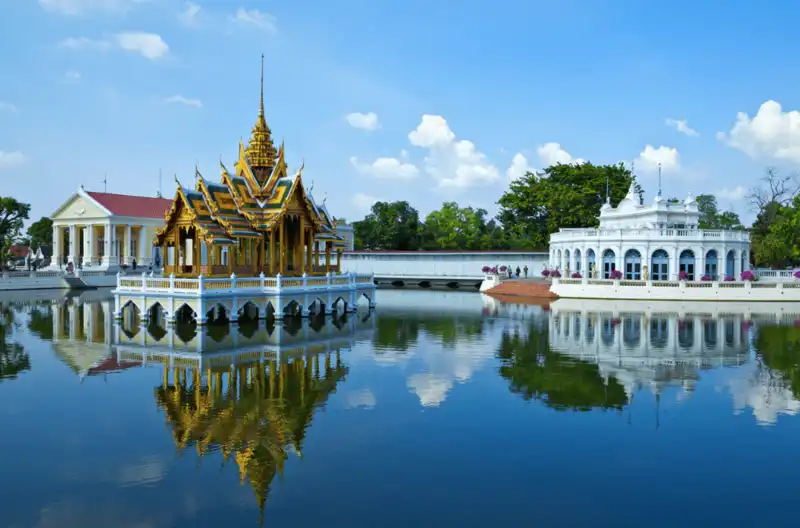
11. Bang Pa-In Palace, Phra Nakhon Si Ayutthaya is one of central Thailand's most remarkable royal heritage attractions, celebrated for its beautiful architecture, carefully landscaped gardens, and historical connections to both the Ayutthaya and Rattanakosin periods. Located in Ban Len Subdistrict, Bang Pa-In District, Phra Nakhon Si Ayutthaya Province, the palace brings together Thai, Chinese, and European architectural traditions in an unusually harmonious setting. It is an excellent destination for visitors interested in royal history, architecture, photography, and cultural exploration within a manageable distance of Bangkok.
Highlights: Aisawan Thiphya-Art Royal Pavilion, Warophat Phiman Royal Hall, Wehat Chamrun Royal Residence, Withun Thatsana Tower, landscaped gardens, ornamental ponds, bridges, and the palace's distinctive combination of Thai, Chinese, and Western architectural styles.
The origins of Bang Pa-In Palace are associated with the reign of King Prasat Thong during the Ayutthaya Kingdom. The area was historically connected with royal travel and leisure, reflecting the importance of rivers and waterways in the movement of the royal court. Following the decline of Ayutthaya, the palace underwent periods of change before being revived during the Rattanakosin era. Major restoration and construction projects took place during the reigns of King Mongkut, Rama IV, and King Chulalongkorn, Rama V, resulting in the architectural landscape that visitors can appreciate today.
Aisawan Thiphya-Art Royal Pavilion is among the most recognizable landmarks within the palace grounds. Standing gracefully in the middle of an ornamental pond, the traditional Thai-style pavilion is distinguished by its elaborate tiered roof and finely proportioned architectural details. Its reflection on the water creates one of the palace's most memorable views. The pavilion demonstrates the elegance of royal Thai architecture while providing a striking contrast to the other buildings inspired by different artistic traditions.
Wehat Chamrun Royal Residence is especially notable for its Chinese architectural character and elaborate decorative workmanship. The building reflects the importance of Chinese artistic influences within the Thai royal court. Warophat Phiman Royal Hall, by contrast, displays architectural features influenced by European palace design. Together, these structures illustrate Thailand's growing international connections during the nineteenth century, a period when the kingdom was engaging with foreign political, cultural, and technological developments.
Another important feature of Bang Pa-In Palace is its carefully organized landscape. Gardens, lawns, ponds, walkways, and bridges create visual relationships between buildings and their natural surroundings. The composition of the palace grounds encourages visitors to explore different viewpoints and observe the contrasting architectural styles from several angles. Morning visits are generally more comfortable, allowing travelers to appreciate the grounds before the strongest midday heat.
Bang Pa-In Palace offers valuable insight into the changing character of Thai royal architecture. Traditional Thai structures stand alongside buildings influenced by Chinese craftsmanship and European design, demonstrating how international styles were adopted and adapted within a Thai cultural setting. Visitors interested in architecture can compare roof forms, materials, decorative details, building proportions, and the relationship between formal royal buildings and their surrounding gardens.
For travelers planning an Ayutthaya day trip, Bang Pa-In Palace can serve as an attractive first stop before continuing to the historic city. However, the extensive grounds and numerous buildings deserve sufficient time, especially for visitors interested in photography or architectural history. As the property is associated with the Thai monarchy, respectful clothing and compliance with all visitor regulations are essential. Access to individual buildings may also be restricted according to official arrangements.
Open Days: Daily
Opening Hours: 08:30 – 17:00
Getting There: From Bangkok, travel north via Phahonyothin Road or the Asian Highway toward Bang Pa-In District in Ayutthaya. Follow signs to Bang Pa-In Palace in Ban Len Subdistrict. Travelers using public transportation can take a train that stops at Bang Pa-In Railway Station and continue by local taxi or other available transport. Check the latest railway schedule, admission requirements, and dress code before departing.
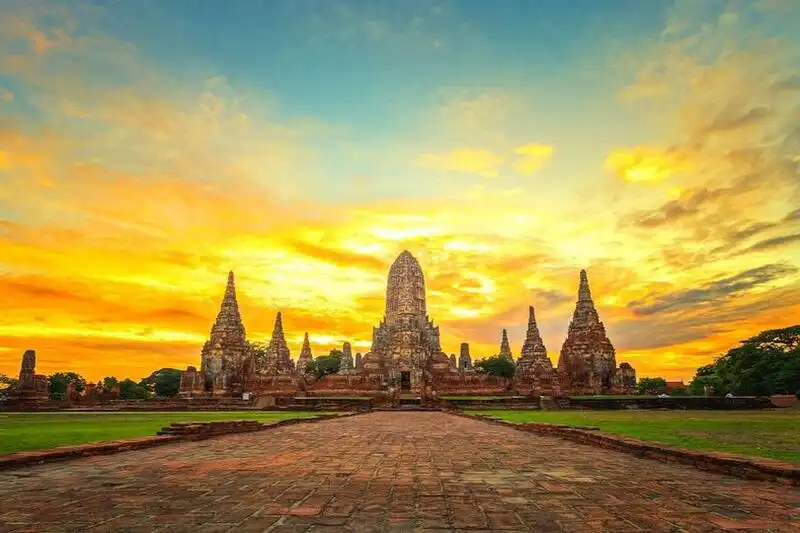
12. Wat Chaiwatthanaram, Phra Nakhon Si Ayutthaya is one of the most visually impressive archaeological sites in the historic city of Ayutthaya. Located in Ban Pom Subdistrict on the western bank of the Chao Phraya River, the temple is famous for its towering central prang, surrounding structures, and elegant riverside setting. Built during the reign of King Prasat Thong in the seventeenth century, it represents an important achievement of Ayutthaya-period architecture and Buddhist religious design. Its monumental appearance and scenic location make it a particularly rewarding destination for history enthusiasts, photographers, and visitors exploring Thailand's former royal capital.
Highlights: Monumental central prang, surrounding prangs and directional structures, ancient Buddha images, religious architecture inspired by Buddhist cosmology, the Chao Phraya River landscape, and beautiful photographic views in the late afternoon.
Wat Chaiwatthanaram was established in 1630 during the reign of King Prasat Thong. Its construction was associated with royal patronage and the development of major religious monuments during the middle Ayutthaya period. The temple's architecture demonstrates the influence of Khmer-inspired forms while incorporating characteristics distinctive to Ayutthaya. As a result, the site provides important evidence of artistic development and the relationship between religious architecture and royal authority in the former kingdom.
The central prang is the focal point of the entire temple complex. Rising above an elevated platform, it is surrounded by smaller structures arranged according to a carefully organized architectural plan. This arrangement has strong connections to traditional Buddhist cosmology, in which Mount Sumeru represents the center of the universe. The balanced relationship between the main prang and the surrounding structures creates a powerful sense of order and symbolism. Visitors approaching the temple can appreciate the impressive symmetry of its original design.
Within the archaeological complex are numerous traces of religious buildings and Buddhist sculptures. Although the temple has suffered damage over the centuries, its surviving structures provide insight into the craftsmanship of Ayutthaya builders. Visitors can observe the outlines of ancient halls, architectural bases, decorative features, and the spatial arrangement of the religious complex. These remains reveal how the temple functioned as both a sacred place and a monumental expression of royal Buddhist patronage.
Wat Chaiwatthanaram is particularly memorable because of its position beside the Chao Phraya River. The changing light throughout the day creates different visual effects on the brick structures and their surrounding landscape. Late-afternoon visits are especially popular, as the softer sunlight highlights the architectural forms and provides attractive conditions for photography. The temple is also a well-known destination for visitors wearing traditional Thai clothing, although respectful behavior and appropriate dress remain essential within the archaeological grounds.
Exploring Wat Chaiwatthanaram offers an opportunity to understand the importance of religious architecture in the Ayutthaya Kingdom. The temple's layout and monumental scale demonstrate how artistic design was used to convey Buddhist cosmology, royal authority, and religious devotion. Its surviving structures are also reminders of the historical changes that affected Ayutthaya over several centuries. As part of the historical heritage of the former capital, the site requires careful conservation and responsible tourism.
Visitors should avoid climbing restricted structures, touching fragile architectural surfaces, or entering areas closed for conservation. Comfortable shoes and sun protection are recommended because much of the site is exposed to the elements. Travelers interested in architecture will benefit from allowing enough time to examine the arrangement of the central prang, smaller buildings, and surviving details rather than limiting their visit to the main photography viewpoints.
Wat Chaiwatthanaram can be combined with Wat Mahathat, Wat Phra Si Sanphet, and other monuments within Ayutthaya Historical Park. A practical itinerary is to explore the central historical area earlier in the day before visiting Wat Chaiwatthanaram later in the afternoon. This arrangement allows travelers to experience different styles of Ayutthaya architecture while enjoying the changing natural light along the river.
Open Days: Daily
Opening Hours: 08:00 – 18:00
Getting There: From Bangkok, travel toward Phra Nakhon Si Ayutthaya and continue to Ban Pom Subdistrict on the western side of the Chao Phraya River. Follow signs toward Wat Chaiwatthanaram. Travelers arriving by train can disembark at Ayutthaya Railway Station and continue by taxi or local transport. Allow additional time when traveling between the historic city island and the western riverside area.
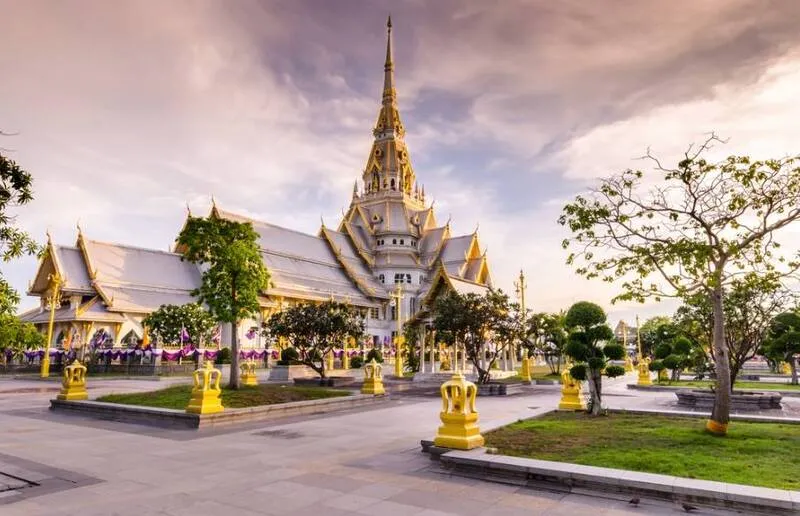
13. Wat Sothonwararam Worawihan, Chachoengsao is one of the most important Buddhist temples in eastern central Thailand, situated along the Bang Pakong River on Thep Khunakon Road in Na Mueang Subdistrict, Mueang Chachoengsao District. The temple is widely known for housing Luang Pho Phuttha Sothon, a highly revered Buddha image that attracts worshippers from across Thailand. Beyond its religious significance, the temple is distinguished by a monumental ordination hall with elaborate Thai architectural details. Its combination of spiritual heritage, local history, and impressive design makes it a major destination for a Buddhist pilgrimage or cultural day trip from Bangkok.
Highlights: Luang Pho Phuttha Sothon Buddha image, monumental Thai-style ordination hall, intricate decorative artwork, Bang Pakong River setting, religious ceremonies, and the annual celebrations honoring Luang Pho Sothon.
Luang Pho Phuttha Sothon has been closely associated with the spiritual identity of Chachoengsao for generations. Traditional local accounts describe the Buddha image's connection with the Bang Pakong River and the community's efforts to enshrine and worship it. Such stories form an important part of the province's cultural heritage, reflecting the deep relationship between Buddhism and riverside settlements. The temple continues to function as a major center of faith, drawing visitors who come to pay their respects and participate in Buddhist merit-making activities.
The temple's large ordination hall is an outstanding example of elaborate Thai religious architecture. Its tiered roof, decorative elements, carefully proportioned structure, and monumental scale create a particularly impressive appearance. Inside, the sacred image is enshrined within a setting designed to express respect and devotion. Visitors can appreciate the craftsmanship of the building while observing the religious practices that remain central to the temple's daily activities.
Artistic details throughout the temple help communicate Buddhist concepts and traditional Thai values. Decorative forms, architectural symbolism, and the arrangement of sacred spaces contribute to the experience of visiting an active religious institution. For travelers interested in Thai craftsmanship, the temple offers an opportunity to examine how traditional artistic principles have been incorporated into a major modern religious building while maintaining recognizable elements of historical Thai architecture.
Wat Sothonwararam Worawihan is particularly important during religious celebrations honoring Luang Pho Sothon. The annual worship festival brings together local residents and pilgrims from different provinces for merit-making and devotional activities. These events demonstrate the continuing significance of the Buddha image to the people of Chachoengsao. Travelers who wish to experience a festival should consult current announcements from the temple or provincial authorities, as exact schedules and arrangements may change from year to year.
The temple's location near the Bang Pakong River also reflects the historical importance of waterways in the development of Chachoengsao. The river supported settlement, transportation, trade, and agriculture long before the region's modern road system expanded. A visit to the temple can therefore be combined with an exploration of the city's riverside environment and traditional local cuisine, providing a broader understanding of the relationship between faith and community life.
Wat Sothonwararam Worawihan is suitable for families, older visitors, Buddhist pilgrims, and international tourists interested in religious architecture. Travelers planning a day trip from Bangkok can visit the temple in the morning before continuing to Wat Saman Rattanaram or another attraction in Chachoengsao. Starting early is advisable, especially on weekends and important Buddhist holidays when the temple may receive large numbers of worshippers.
Visitors should dress modestly, observe signs and visitor guidance, and avoid interrupting religious activities. The temple remains a place of worship rather than simply a sightseeing destination. Respectful behavior helps ensure that visitors can appreciate the architectural and cultural heritage while allowing worshippers to practice their faith without disturbance.
Open Days: Daily
Opening Hours: 07:00 – 16:30
Getting There: From Bangkok, travel toward Chachoengsao via Highway 304 or connecting expressway routes, then continue into the city center and along Thep Khunakon Road. Travelers without a private car can take a train or bus to Chachoengsao and continue by local taxi or other transport to the temple. Check transportation schedules and allow additional time during major religious celebrations.
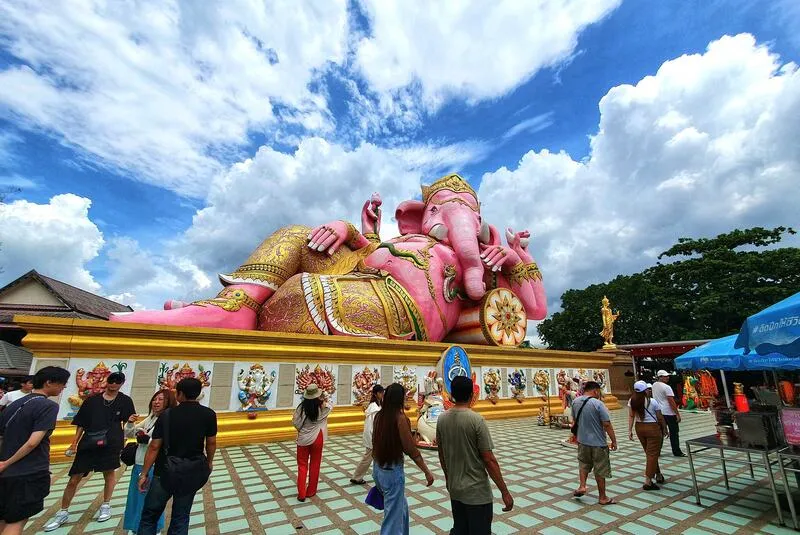
14. Wat Saman Rattanaram, Chachoengsao is a distinctive religious and cultural attraction located beside the Bang Pakong River in Bang Kaeo Subdistrict, Mueang Chachoengsao District. The temple is best known for its enormous reclining Ganesha statue, which has become one of the most recognizable landmarks in the province. The brightly colored sculpture attracts visitors interested in religious beliefs, monumental art, and cultural photography. The temple also contains other sacred monuments and decorative features, making it a popular destination for families and travelers exploring Chachoengsao on a day trip from Bangkok.
Highlights: Giant reclining Ganesha statue, religious sculptures and shrines, colorful decorative artwork, Bang Pakong River views, areas for making offerings, and visitor facilities within the temple grounds.
Ganesha is a major deity in Hindu tradition and has long influenced religious and cultural beliefs in Thailand. Widely associated with wisdom, knowledge, artistic pursuits, and new beginnings, Ganesha is respected by many people across different social and cultural backgrounds. The reclining Ganesha at Wat Saman Rattanaram represents a modern expression of this longstanding religious influence. Its impressive size and distinctive appearance make it both a devotional landmark and a prominent example of contemporary religious sculpture.
The reclining statue is designed with elaborate ornaments, bright colors, and recognizable symbolic details. Its monumental proportions are particularly striking when viewed from the open areas surrounding the sculpture. Visitors can observe the artistic treatment of Ganesha's form and accessories while learning about their cultural significance. The statue's reclining position gives it a distinctive character compared with the standing or seated representations often found at other religious sites.
Additional shrines and sacred images throughout the grounds reflect the diversity of religious traditions and devotional practices within Thai society. The temple provides an opportunity to observe how Hindu-influenced imagery and Buddhist religious culture may coexist within the same community environment. Visitors should respect worshippers, avoid obstructing ceremonies, and follow any posted guidance concerning offerings, photography, or access to sacred spaces.
The Bang Pakong River contributes to the atmosphere of Wat Saman Rattanaram. This important eastern Thai waterway has supported agriculture, fishing, transportation, and communities for generations. The riverside setting creates opportunities to appreciate local scenery while visiting the religious attractions. Travelers interested in regional culture can use the temple visit as part of a broader exploration of Chachoengsao's relationship with the river and surrounding agricultural communities.
For travelers spending one day in Chachoengsao, Wat Saman Rattanaram can be combined with Wat Sothonwararam Worawihan in the provincial capital. A practical itinerary is to visit the major Buddhist temple in the morning before traveling to the reclining Ganesha shrine later in the day. Additional stops at local markets or riverside restaurants may be possible depending on the time available and local transportation arrangements.
Wat Saman Rattanaram is suitable for families, older travelers, photography enthusiasts, and visitors who want to explore the diverse expressions of religious faith in Thailand. As the temple lies outside the central urban area, those traveling without a private vehicle should arrange their onward and return transportation carefully. Allow sufficient time for walking around the grounds and appreciating the large-scale sculpture and surrounding features.
Open Days: Daily
Opening Hours: 08:00 – 17:00
Getting There: From Bangkok, travel toward Chachoengsao and continue from the provincial capital toward Bang Kaeo Subdistrict and the Bang Pakong riverside area. Follow signs to Wat Saman Rattanaram. Visitors using public transportation can reach Chachoengsao by train or bus and continue by local taxi. Because the temple is outside the city center, arrange the return journey in advance if you do not have a private vehicle.

15. Khlong Suan 100-Year-Old Market, Samut Prakan and Chachoengsao is a historic canal-side market situated near the boundary between two provinces: Khlong Suan Subdistrict in Bang Bo District, Samut Prakan, and Theppharat Subdistrict in Ban Pho District, Chachoengsao. The market is distinguished by old wooden buildings, traditional shops, narrow walkways, and a community atmosphere that recalls the importance of canal-based trade in central Thailand. It is an appealing destination for travelers interested in historic architecture, local food, traditional markets, and cultural experiences close to Bangkok.
Highlights: Traditional wooden shophouses, historic canal-side trading areas, bridges connecting communities across provincial boundaries, Thai food and desserts, established local shops, and the atmosphere of a living heritage market.
Khlong Suan Market developed along waterways that once formed an important transportation network east of Bangkok. Before roads became the dominant method of travel, canals carried agricultural products, household goods, and passengers between farming settlements and larger commercial centers. Markets emerged at convenient points along these routes, where merchants and local residents exchanged products. Khlong Suan became a central trading area that supported surrounding communities and helped connect settlements across what are now provincial administrative boundaries.
The market's surviving wooden buildings are among its most attractive features. Walking through the narrow lanes, visitors can observe shopfronts, old wooden doors, traditional building materials, and architectural details associated with historic trading communities. Some businesses retain the atmosphere of traditional grocery shops and eateries, while others have adapted to serve visitors. Despite these changes, the market preserves much of its original relationship with the canal and surrounding residential neighborhoods.
Food and local products form an important part of the visitor experience. The market offers opportunities to sample traditional snacks, Thai desserts, and dishes associated with the surrounding communities. Historical canal settlements in central Thailand often brought together people from different cultural backgrounds, including Thai and Chinese merchant families. This diversity influenced local food, trading practices, and social traditions, some of which remain visible in the market's atmosphere today.
One of Khlong Suan Market's most unusual characteristics is its location across the boundary between Samut Prakan and Chachoengsao. Visitors can move through a community whose everyday social and commercial relationships developed along the canal rather than according to modern provincial borders. This setting provides an opportunity to consider how historic settlements were shaped by practical transportation routes and trading networks long before contemporary administrative divisions became part of everyday life.
Exploring the market can be especially rewarding for travelers interested in traditional Thai architecture and local history. Rather than rushing from shop to shop, visitors can appreciate the details of old buildings, observe community life, and speak with local merchants when appropriate. The market also offers a chance to support small businesses whose continued operation contributes to the preservation of the area's historic character.
Khlong Suan 100-Year-Old Market makes a convenient stop on a journey from Bangkok toward Chachoengsao. It can be combined with a visit to Wat Sothonwararam Worawihan or other regional attractions, depending on the chosen route. Morning and early afternoon visits are generally suitable for exploring the market, while weekends may bring a livelier atmosphere. Visitors should allow extra time for parking and remember that the market remains a residential and commercial community.
Open Days: Daily
Opening Hours: 08:00 – 16:00
Getting There: From Bangkok, travel along Bang Na–Trat Road toward Bang Bo District in Samut Prakan. Continue toward Khlong Suan Subdistrict and follow local signs to the historic market near the Chachoengsao provincial boundary. Travelers using public transportation should check available connections to Bang Bo and arrange a local taxi or other transport for the final section. GPS navigation is recommended because the market spans communities in two provinces.

16. Wat Chedi Hoi, Pathum Thani is an unusual Buddhist temple and cultural attraction located in Ban Khlong Bang Luang, Moo 4, Bo Ngoen Subdistrict, Lat Lum Kaeo District, Pathum Thani Province. It is best known for its distinctive stupas decorated with ancient shells, which create an unexpected connection between religious architecture and geological history. The temple is an interesting destination for families and travelers who enjoy discovering unusual attractions near Bangkok, as it combines Buddhist heritage, natural history, and the quiet atmosphere of a rural Thai community.
Highlights: Buddhist stupas decorated with ancient shells, shells discovered in local soil deposits, religious architecture, geological learning opportunities, and the peaceful countryside of Lat Lum Kaeo District.
Wat Chedi Hoi is closely associated with the discovery of large quantities of shells within the surrounding soil. These finds provide an opportunity to consider the geological history of central Thailand, where coastlines, sedimentary environments, and waterways have changed over long periods. The presence of shells in an area now situated inland demonstrates that present-day landscapes do not necessarily reflect the environmental conditions of the distant past. Geological processes continuously reshape the relationship between land and sea.
The temple's shell-covered stupas are its most recognizable architectural features. By incorporating shells into the construction and decoration of religious monuments, the site creates a connection between natural materials and Buddhist artistic expression. Visitors can observe variations in shell shapes and patterns, appreciating how natural objects have been incorporated into architectural surfaces. This unusual design makes Wat Chedi Hoi particularly memorable compared with more conventional temples.
The shells also encourage visitors to think about the relationship between geological evidence and environmental change. Sediments preserve information about earlier conditions, and the discovery of marine shells can provide clues about the natural history of a region. Families traveling with children can use the temple visit as an opportunity to discuss fossils, sedimentary deposits, and the ways in which landscapes evolve. Such topics can make the experience educational without requiring specialized geological knowledge.
Wat Chedi Hoi remains an active Buddhist religious site, with areas used for worship and merit-making. Visitors can pay their respects, walk around the grounds, and observe the relationship between the temple's architecture and its natural surroundings. The peaceful atmosphere of the surrounding countryside offers a contrast to the urban environment of Bangkok and nearby developed areas of Pathum Thani.
Lat Lum Kaeo District is also part of a region where agricultural landscapes, canals, and traditional communities remain visible alongside modern development. Traveling to Wat Chedi Hoi allows visitors to experience this rural character while exploring a destination with an unusual geological theme. Those planning a broader Pathum Thani itinerary can combine the temple with other nearby cultural sites or traditional markets.
Wat Chedi Hoi is suitable for families, students, cultural travelers, and anyone interested in unusual Buddhist architecture. Visitors should dress respectfully, avoid damaging the shell-decorated structures, and follow the temple's instructions. Comfortable shoes and sun protection are useful because some areas are outdoors. Allowing sufficient time to observe the details of the stupas makes the experience more rewarding than a brief photography stop.
Open Days: Daily
Opening Hours: 08:00 – 16:30
Getting There: From Bangkok, drive toward Lat Lum Kaeo District in Pathum Thani, using Kanchanaphisek Road or connecting provincial routes. Continue into Bo Ngoen Subdistrict and Ban Khlong Bang Luang, following signs to Wat Chedi Hoi. Visitors without a car should arrange local transportation in advance because the temple is not directly connected to Bangkok's main urban rail network.
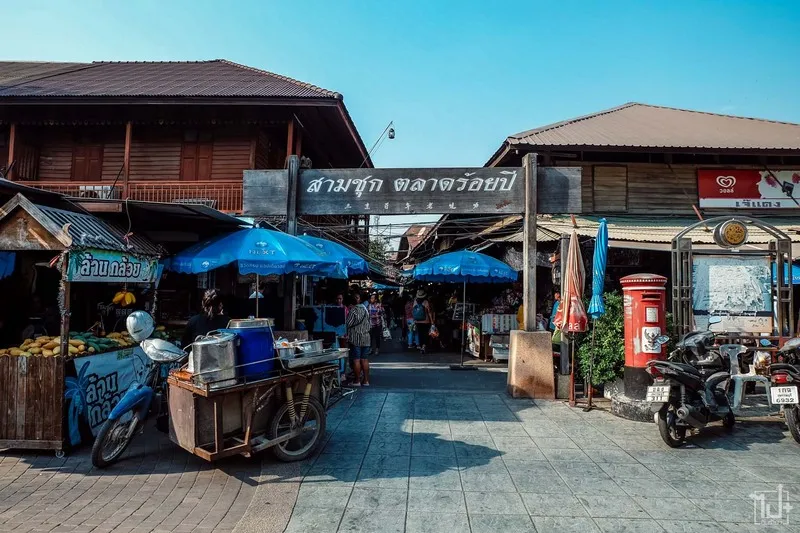
17. Sam Chuk 100-Year-Old Market, Suphan Buri is one of Thailand's most celebrated historic community markets, located beside the Tha Chin River in Sam Chuk Subdistrict, Sam Chuk District, Suphan Buri Province. Known for its wooden shophouses, narrow market lanes, traditional food, and community-based conservation efforts, the market offers a fascinating glimpse into the commercial history of central Thailand. Rather than functioning solely as a tourist attraction, Sam Chuk preserves the character of a living community where historic architecture and local businesses continue to shape everyday life.
Highlights: Historic wooden shophouses, traditional market lanes, Khun Chamnong Chinrak House Museum, long-established shops, local Thai food and desserts, riverside scenery, and the atmosphere of a living heritage community.
The history of Sam Chuk Market is closely connected to the Tha Chin River, which once served as a major transportation and commercial route through central Thailand. Agricultural products and everyday goods were transported by boat between rural settlements and larger market towns. Sam Chuk developed into an important trading center, with merchants establishing wooden shops and houses near the river. As road transportation expanded, the economic role of traditional riverside markets gradually changed, leading many communities to adapt their commercial activities.
Sam Chuk became especially notable for the efforts of its residents to preserve the historical character of the community. Rather than replacing old buildings with completely modern commercial structures, community initiatives helped encourage the conservation of traditional architecture and local cultural heritage. This approach allowed the market to remain an active commercial environment while gaining recognition as a destination for visitors interested in Thailand's historic towns.
The market's wooden buildings are among its greatest attractions. Visitors can walk through narrow lanes lined with traditional shophouses, observing wooden doors, old signs, architectural details, and shop layouts that reflect earlier forms of commerce. Some establishments continue to sell traditional products, while others offer regional food, desserts, souvenirs, and locally produced goods. The combination of active businesses and preserved buildings creates an atmosphere unlike that of a reconstructed heritage attraction.
Khun Chamnong Chinrak House Museum is an important cultural landmark within the market area. The historic building provides insight into the lives of influential community figures and the development of local commerce. Visitors interested in history can learn how transportation, economic conditions, and community leadership shaped the evolution of Sam Chuk. Exploring the museum adds an educational dimension to a market visit and helps explain why the preservation of old buildings is closely connected to the preservation of community memories.
Traditional food is another major reason to visit Sam Chuk. Market vendors offer a variety of Thai dishes, snacks, and sweets associated with the region. The culinary experience is closely connected to central Thailand's agricultural resources and longstanding food traditions. Visitors can sample local specialties while observing the atmosphere of old shops and family-run businesses, creating opportunities to appreciate both traditional flavors and local entrepreneurship.
Sam Chuk Market demonstrates that cultural conservation extends beyond preserving physical structures. A historic community also depends on maintaining social relationships, traditional knowledge, and commercial activities that give buildings their original purpose. The continued operation of shops and small businesses contributes to the market's authenticity and provides economic support for residents. For travelers interested in sustainable cultural tourism, Sam Chuk offers an informative example of community participation in heritage preservation.
Sam Chuk is suitable for families, photographers, food enthusiasts, and travelers interested in historical communities. Visitors traveling from Bangkok should depart early enough to allow time for walking through the market, visiting the museum, and enjoying lunch before returning. Those wishing to explore other attractions in Suphan Buri should consider the additional travel distances involved, as the province extends considerably farther from Bangkok than the immediate metropolitan region.
Open Days: Daily
Opening Hours: 08:00 – 17:00
Getting There: From Bangkok, drive toward Suphan Buri Province and continue north to Sam Chuk District, following signs into the town center near the Tha Chin River. Public transportation users should check bus connections to Suphan Buri or Sam Chuk and arrange local transport if required. Starting early is recommended because the market is farther from Bangkok than the nearby metropolitan provinces.
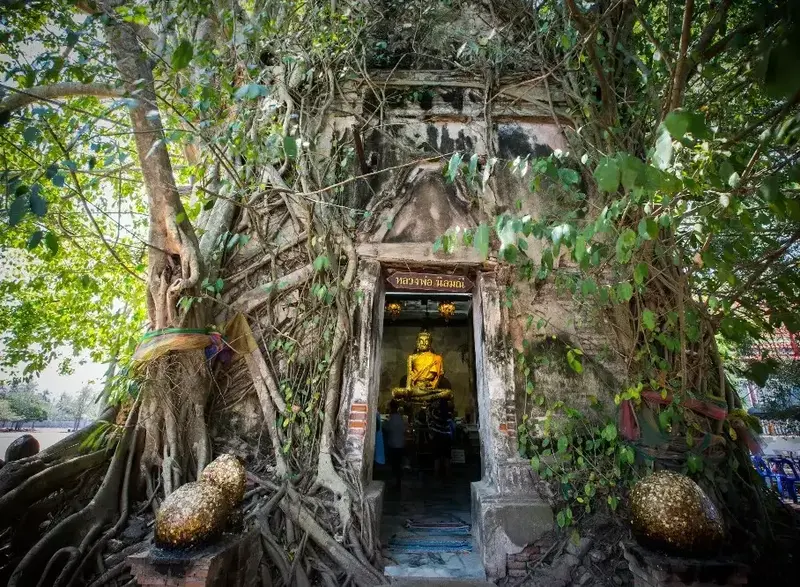
18. Wat Bang Kung, Samut Songkhram is a remarkable Buddhist temple and historical attraction located in Bang Kung Subdistrict, Bang Khonthi District, Samut Songkhram Province. The temple is famous for its ancient chapel almost completely enclosed by the roots and trunks of large trees, creating an extraordinary architectural scene where nature and religious heritage appear intertwined. Wat Bang Kung is also associated with the history of the Bang Kung military camp during the Thonburi period. These connections make it an appealing destination for travelers interested in Buddhist traditions, historic architecture, natural landscapes, and the military history of Thailand.
Highlights: Bot Prok Pho, the ancient chapel surrounded by large tree roots, revered Luang Pho Nil Mani Buddha image, historical connections to Bang Kung Camp, religious heritage, and the cultural landscape of the Mae Klong River basin.
Wat Bang Kung is historically associated with events around the end of the Ayutthaya Kingdom and the establishment of the Thonburi Kingdom. The Bang Kung area occupied an important strategic position within the Mae Klong River basin, where waterways played essential roles in transportation, communication, and military movements. The history of Bang Kung Camp is connected to efforts to defend and stabilize the region during a period of political and military change. Visiting the temple provides an opportunity to understand these events through a place that remains closely linked to local historical memory.
The temple's most recognizable feature is Bot Prok Pho, an old Buddhist chapel surrounded by the roots and trunks of several large trees. Over many years, the trees gradually grew around the building, creating a striking appearance in which architecture seems to be embraced by the natural environment. The roots cover large portions of the exterior walls, forming an organic framework around the historic structure. This unusual combination of nature and religious architecture makes Wat Bang Kung one of the most distinctive temple attractions in central Thailand.
Inside the chapel is Luang Pho Nil Mani, a revered Buddha image that attracts worshippers throughout the year. The enclosed space and surrounding tree roots create an atmosphere unlike that of a typical Buddhist ordination hall. Visitors can enter to pay their respects when permitted, but should move carefully through the historic structure and respect the religious activities taking place inside. The chapel's limited space makes considerate behavior particularly important during busy visiting periods.
The nearby historical associations of Bang Kung Camp add another dimension to the experience. During the Thonburi period, the Mae Klong River basin was important for transportation and defense, and the history of the area reflects the relationship between regional communities and military strategy. Exploring Wat Bang Kung alongside relevant historical information helps visitors understand how waterways influenced the movement of people, trade, and military forces in premodern Thailand.
Wat Bang Kung is also an interesting site for photographers and architecture enthusiasts. The relationship between tree roots, old masonry, and sacred imagery creates a remarkable composition. However, the building is a valuable religious and historical structure, not merely a photography location. Visitors should avoid touching or damaging the roots and walls, refrain from obstructing worshippers, and follow the instructions of the temple's caretakers.
For a day trip from Bangkok, Wat Bang Kung can be combined with Amphawa Floating Market and other attractions in Samut Songkhram. A practical itinerary is to visit the temple earlier in the day and continue to Amphawa in the afternoon when the weekend market is operating. This combination introduces travelers to both the region's historical heritage and its distinctive canal-side commercial culture.
Wat Bang Kung is suitable for families, history enthusiasts, Buddhist pilgrims, and travelers who enjoy unusual cultural sites. Visitors should dress respectfully and allow enough time to appreciate both the sacred chapel and the historical surroundings. As the temple remains a place of worship, maintaining a quiet and considerate attitude helps protect its religious atmosphere.
Open Days: Daily
Opening Hours: 08:00 – 16:30
Getting There: From Bangkok, follow Rama II Road toward Samut Songkhram. Continue through Amphawa District toward Bang Khonthi District and Bang Kung Subdistrict, following signs to Wat Bang Kung. Public transportation users can travel to Mae Klong town and arrange a local taxi or other available transport. Combining the visit with Amphawa can reduce unnecessary travel between attractions.

19. Don Hoi Lot, Samut Songkhram is a well-known natural attraction and coastal wetland near the mouth of the Mae Klong River in Bang Cha Kreng Subdistrict, Mueang Samut Songkhram District. The area is distinguished by extensive mudflats and sandy sediments formed through the interaction of river currents, coastal tides, and sediment deposition. Its name is associated with razor clams that inhabit the coastal substrate. Don Hoi Lot is an appealing destination for travelers interested in coastal ecology, traditional fishing communities, seafood, and the natural landscapes of the Gulf of Thailand.
Highlights: Coastal mudflats and sandy banks, habitats of razor clams, estuarine ecosystems, Gulf of Thailand scenery, local seafood, and opportunities to learn about the relationship between coastal environments and traditional livelihoods.
Don Hoi Lot was formed through natural sedimentary processes at the mouth of the Mae Klong River. As the river carries soil and other sediments downstream, the material interacts with tidal currents and seawater near the coast. Changes in water movement allow some sediments to settle, gradually creating the mudflats and sandy deposits visible today. These landforms are not fixed structures. Their appearance changes according to currents, tides, seasonal conditions, and longer-term coastal processes.
Razor clams are closely associated with the area's particular sediment conditions. These shellfish live within burrows beneath the surface of sandy or muddy coastal deposits. The presence of razor clams has long contributed to Don Hoi Lot's identity and its importance to local fishing communities. Because such species depend on suitable environmental conditions, the conservation of coastal habitats is essential for maintaining their populations and the wider ecological balance of the estuary.
The coastal environment also provides habitat for many other organisms, including small aquatic animals and species associated with tidal wetlands. Estuarine areas are particularly valuable because freshwater from rivers meets saltwater from the sea, creating ecological conditions that support a variety of life forms. Visitors interested in environmental education can learn how sediment, tides, salinity, and seasonal changes influence the organisms found along the coast.
Low tide is generally the most suitable period for observing exposed mudflats, but actual conditions vary throughout the day. Travelers should check tide information and local weather before planning activities near the shoreline. Walking onto unfamiliar mudflats can be hazardous because some areas are slippery or unstable and water levels may rise unexpectedly. Visitors should avoid entering distant or unsafe sections of the coastal flats without appropriate local guidance.
Don Hoi Lot is also associated with the culinary traditions of Samut Songkhram. The surrounding communities have longstanding relationships with fishing and the use of coastal resources. Visitors can explore the local seafood culture and enjoy regional dishes sold by businesses in the area. Food traditions provide an accessible way to understand how natural environments influence the economy and daily life of coastal settlements.
Beyond its ecological value, the area offers a relaxed seaside atmosphere with views toward the Gulf of Thailand. Families, photographers, and nature enthusiasts can enjoy the coastal scenery without undertaking strenuous activities. Don Hoi Lot can also be combined with Mae Klong Railway Market or other destinations near Samut Songkhram town, depending on travel time and tidal conditions.
Responsible tourism is particularly important in sensitive coastal environments. Visitors should avoid leaving litter, disturbing shellfish habitats, or entering protected areas. Those interested in the mudflats should prioritize safety and environmental conservation over collecting wildlife or exploring hazardous terrain. A carefully planned visit can provide an informative introduction to the relationship between estuarine ecosystems and traditional coastal livelihoods.
Open Days: The general visitor area is accessible daily, subject to local conditions and restrictions. The best time to observe exposed mudflats depends on the tides.
Getting There: From Bangkok, take Rama II Road toward Samut Songkhram and continue into Bang Cha Kreng Subdistrict near the mouth of the Mae Klong River. Travelers using public transport can reach Mae Klong town and continue to Don Hoi Lot by taxi or local transportation. Check the tide schedule and weather conditions before visiting if you intend to observe the coastal flats.

20. Sarika Waterfall, Nakhon Nayok is one of Nakhon Nayok Province's best-known natural attractions, located in Sarika Subdistrict, Mueang Nakhon Nayok District, within the broader forest environment of Khao Yai National Park. The waterfall descends over multiple levels of rocky terrain, surrounded by tropical vegetation and mountainous scenery. Its beautiful natural setting makes it an attractive destination for travelers who want to escape Bangkok's urban environment and experience forests, flowing water, and mountain landscapes during a day trip.
Highlights: Multi-tiered waterfall, dramatic rock formations, forested surroundings, natural pools in permitted areas, walking routes, and seasonal changes in water flow and landscape appearance.
Sarika Waterfall is part of the mountainous natural environment of Nakhon Nayok, where forested watersheds support streams and rivers flowing toward the surrounding lowlands. Its landscape consists of rocky slopes, steep terrain, and watercourses shaped by long-term geological processes. As streams descend through areas of different elevations, they create cascades and pools that contribute to the waterfall's distinctive appearance. The surrounding forest plays an important role in preserving moisture, stabilizing soil, and supporting the ecosystem.
The waterfall is known for the way its water descends across several rocky levels. Its appearance changes considerably according to seasonal rainfall and the amount of water flowing from the upper watershed. During periods of substantial rainfall, the waterfall may appear particularly impressive, with larger volumes of water descending over the rocks. However, heavy rain can also create dangerous conditions, including strong currents, slippery surfaces, and the possibility of sudden rises in water levels. Visitors should always consult official safety announcements before entering the area.
Walking through the waterfall surroundings offers an opportunity to observe a tropical forest environment at close range. The sounds of flowing water, shaded vegetation, and rock formations create a peaceful atmosphere that contrasts with Bangkok's busy streets. Photographers can capture the waterfalls, surrounding greenery, and natural textures of the landscape. Visitors should remain on designated routes and avoid restricted areas, particularly near steep or wet rock surfaces.
The surrounding forest has ecological importance beyond its visual appeal. Vegetation helps protect watersheds, maintain soil stability, and provide habitat for numerous species. Forest conservation supports the health of rivers and streams extending beyond the national park. Travelers can contribute to this protection by avoiding litter, leaving plants and rocks undisturbed, and respecting rules designed to safeguard wildlife and natural habitats.
Sarika Waterfall is suitable for families, friends, couples, and nature enthusiasts who want a day trip focused on forest scenery and flowing water. Travelers accompanied by young children or older family members should assess the walking conditions carefully, as some sections may include uneven ground, steep paths, or wet surfaces. Comfortable footwear with good grip is particularly important.
Depending on the time available, a visit to Sarika Waterfall can be combined with other attractions in Nakhon Nayok, such as scenic reservoirs, local restaurants, or nature learning centers. However, travelers should avoid creating an itinerary that involves too many distant stops. Allowing enough time to appreciate the waterfall and return safely to Bangkok is more practical than rushing through several outdoor destinations in a single day.
Preparation is essential for a safe and enjoyable visit. Bring drinking water, suitable walking shoes, comfortable clothing, and protection against rain or sunshine. Swimming should take place only in areas where it is expressly permitted, and visitors should avoid entering the water during heavy rainfall or when authorities warn of strong currents. Respecting official guidance helps ensure that the experience remains enjoyable while protecting the natural environment.
Open Days: According to the current opening announcements for the relevant national park area.
Opening Hours: 08:00 – 17:00 according to the listed attraction information, subject to temporary restrictions.
Getting There: From Bangkok, follow Rangsit–Nakhon Nayok Road toward Nakhon Nayok town. Continue along Highway 3049 for approximately 12 kilometers before connecting to Highway 3050 toward Sarika Waterfall for approximately another 3 kilometers. Travelers using public transportation can reach Nakhon Nayok town and continue by taxi or other available local transport. Check weather conditions and the latest national park announcements before departure.
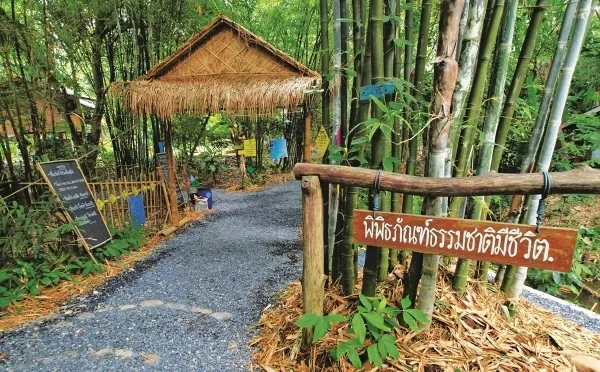
21. Bhumirak Dhamachart Centre, Nakhon Nayok is an educational and nature-based attraction located in Ban Tha Dan, Hin Tang Subdistrict, Mueang Nakhon Nayok District, near Khun Dan Prakan Chon Dam. The center focuses on sustainable living, environmental conservation, agricultural development, and practical applications of Thailand's Sufficiency Economy Philosophy. Unlike conventional sightseeing attractions, it offers opportunities to understand the relationship between natural resources and community livelihoods, making it particularly valuable for families, students, educators, and visitors interested in sustainability.
Highlights: Sufficiency Economy Philosophy, sustainable agriculture, soil and water management, natural resource conservation, educational demonstration areas, environmental learning activities, and green landscapes near Khun Dan Prakan Chon Dam.
The Bhumirak Dhamachart Centre is associated with efforts to communicate and apply the principles of sustainable development inspired by Thailand's royal development initiatives. The Sufficiency Economy Philosophy emphasizes moderation, reasonableness, and resilience, supported by knowledge and ethical considerations. Rather than focusing exclusively on economic growth or agricultural productivity, the approach encourages a balanced relationship between human needs, natural resources, and long-term community well-being.
One of the center's most important educational themes is the interconnected relationship between soil, water, forests, and human settlements. Healthy watersheds support agriculture and daily life, while the degradation of forests or soil can create environmental problems that extend beyond individual farms. By exploring practical approaches to soil conservation, water management, and sustainable cultivation, visitors can gain an understanding of how environmental protection supports long-term economic and social stability.
The center's learning environment is designed to make these concepts easier to understand through examples and demonstrations. Depending on the activities available during a visit, educational programs may introduce techniques for efficient water use, land management, agricultural diversification, and environmental restoration. These topics are relevant not only to farmers but also to urban residents interested in responsible resource consumption and sustainable everyday practices.
Nakhon Nayok provides an especially suitable setting for this type of learning because the province contains both agricultural lowlands and forested mountain watersheds. Water flowing from higher elevations supports rivers, irrigation systems, and farming communities downstream. The nearby Khun Dan Prakan Chon Dam illustrates the importance of managing seasonal rainfall and water resources in this region. Visiting both the center and surrounding landscape can therefore help travelers connect educational concepts with the actual geography of the province.
For students and families, the center offers an opportunity to explore environmental topics outside a traditional classroom. Children can learn about the importance of soil, water, and vegetation through observations of real landscapes, while adults may find practical ideas related to sustainable agriculture and household resource management. Group visits and organized educational activities can provide a more structured learning experience, depending on the center's current arrangements.
The Bhumirak Dhamachart Centre can be combined with Khun Dan Prakan Chon Dam or other natural attractions in the Tha Dan area during a day trip from Bangkok. Travelers should allow sufficient time for any planned activities rather than treating the site as a brief photography stop. Comfortable footwear, drinking water, and protection from the sun are useful when exploring outdoor educational areas.
Visitors who want to participate in specific training activities or guided learning sessions should check the latest arrangements in advance. General sightseeing access and participation in organized educational programs may involve different requirements. Planning ahead makes it easier to appreciate the center's role in promoting sustainable resource management and environmentally responsible development.
Open Days: Daily
Opening Hours: 08:00 – 17:00
Getting There: From Bangkok, follow Rangsit–Nakhon Nayok Road toward Nakhon Nayok Province. Continue toward Khun Dan Prakan Chon Dam and Ban Tha Dan in Hin Tang Subdistrict. The center is located within the wider tourism area near the dam. Travelers using public transportation can reach Nakhon Nayok town and continue by taxi or other available local transport. Visitors interested in organized learning activities should confirm access arrangements before departure.

22. Wat Phra Phutthachai, Saraburi is an important Buddhist pilgrimage destination located at the foot of Khao Pathawi in Nong Pla Lai Subdistrict, Mueang Saraburi District, Saraburi Province. The temple is celebrated for the sacred Buddha impression on a rock face, which has attracted worshippers for generations. Its distinctive relationship with the surrounding limestone landscape makes it an appealing destination for travelers interested in religious history, Buddhist beliefs, sacred art, and natural scenery. Wat Phra Phutthachai can be visited on a day trip from Bangkok, particularly as part of a broader journey exploring Saraburi's religious landmarks.
Highlights: Sacred Buddha impression on a rock cliff, historic Buddhist pilgrimage traditions, hillside religious structures, limestone scenery, sacred shrines, and the peaceful atmosphere of an established temple.
The temple takes its name from the sacred impression traditionally revered as Phra Phutthachai, often understood in local Buddhist belief as an image or shadow of the Buddha. Over time, the impression became an important object of devotion, attracting pilgrims who traveled to the hillside to pay their respects. The traditions associated with the site demonstrate how natural features can acquire religious significance through faith, storytelling, and community practices.
Wat Phra Phutthachai reflects a broader tradition found throughout Thailand and Southeast Asia in which mountains, caves, cliffs, and other natural formations become sacred places. These landscapes often serve as settings for religious practice because of their distinctive appearance, relative isolation, and association with spiritual traditions. The rocky environment around the temple therefore contributes directly to its religious identity rather than serving merely as a scenic background.
The sacred impression is located within the hillside religious area, where visitors follow designated routes to reach important worship points. Depending on the route and the areas open to visitors, access may involve stairs and sloping surfaces. Travelers should assess their physical ability before attempting sections that require climbing, particularly when visiting with older family members or individuals who have mobility limitations.
The temple also offers opportunities to observe Buddhist architectural features and the relationship between religious buildings and natural terrain. Shrines, worship areas, and pathways have been arranged to accommodate visitors while maintaining the significance of the hillside setting. Those interested in traditional religious landscapes may find the interaction between human-made structures and the surrounding limestone particularly fascinating.
Beyond its spiritual importance, Wat Phra Phutthachai provides insight into the geography of Saraburi. The province is known for its limestone hills and natural formations, which contribute to a landscape different from the flat agricultural plains surrounding Bangkok. Exploring the temple can therefore combine religious learning with an appreciation of local geology and the ways natural environments have influenced settlement and cultural traditions.
Wat Phra Phutthachai is suitable for Buddhist pilgrims, families, history enthusiasts, and travelers seeking a cultural destination away from Bangkok's urban environment. It may be combined with Wat Phra Phutthabat Ratchaworamahawihan or other important Saraburi sites, although visitors should plan their route carefully to allow sufficient travel time. Morning visits can be more comfortable when walking in outdoor hillside areas.
Visitors should dress respectfully, remain on designated routes, and observe religious etiquette when approaching sacred areas. Comfortable shoes with good grip and drinking water are useful because some sections may involve climbing or walking on uneven surfaces. A carefully planned visit provides an opportunity to appreciate the connections between Buddhist faith, local history, and the natural landscape.
Open Days: Daily
Opening Hours: 08:00 – 17:00
Getting There: From Bangkok, drive north along Phahonyothin Road toward Saraburi Province. Continue toward Nong Pla Lai Subdistrict in Mueang Saraburi District and follow signs to Khao Pathawi and Wat Phra Phutthachai. Public transportation users can travel to Saraburi town and continue to the temple by local taxi or other transport. Travelers with mobility concerns should check the conditions of the hillside access route before visiting.

23. Damnoen Saduak Floating Market, Ratchaburi is one of Thailand's most internationally recognized floating markets, located in Damnoen Saduak District, Ratchaburi Province. The market is famous for colorful boats carrying tropical fruit, freshly prepared Thai food, and traditional products along the canal. Its distinctive appearance reflects the historical importance of waterways in central Thailand, where communities relied on boats for transportation and commercial activities. The market is especially popular with travelers interested in Thai food culture, traditional markets, photography, and experiences connected to the country's canal-based heritage.
Highlights: Traditional vendor boats, tropical fruit and local agricultural products, Thai food prepared beside the canal, Damnoen Saduak Canal, riverside community life, market photography, and optional boat excursions through the surrounding waterways.
The history of Damnoen Saduak is closely connected to the construction of Damnoen Saduak Canal during the reign of King Mongkut, Rama IV. The waterway was developed to improve transportation between the Tha Chin and Mae Klong river systems, making it easier for residents and merchants to travel and transport agricultural products. The canal also encouraged settlement and cultivation in surrounding areas, contributing to the development of communities whose economic activities depended heavily on water transportation.
As settlements expanded along the canal, trading areas emerged where farmers could sell fruit, vegetables, and everyday goods directly from boats. Waterways functioned as commercial routes and public spaces, allowing sellers and buyers to meet without the need for extensive road infrastructure. This form of trade became an important characteristic of the region's economy and remains central to the cultural identity associated with Damnoen Saduak Floating Market.
Today, the market is particularly famous for the vibrant appearance of boats loaded with fresh produce and prepared meals. Visitors may see vendors arranging tropical fruit, cooking food, or serving customers from narrow wooden boats. These activities demonstrate the specialized techniques required to operate businesses in limited spaces on the water. Even as tourism has become a major part of the market's economy, the visual connection between food, boats, and traditional canals remains the defining feature of the destination.
Food is a major attraction at Damnoen Saduak. Travelers can explore a range of Thai dishes, snacks, traditional desserts, and seasonal fruit. The surrounding agricultural landscape supports orchards and farming communities, which historically supplied produce to the canal markets. Sampling local products offers an introduction to the culinary traditions of central Thailand and the importance of fresh ingredients in everyday Thai cooking.
Boat excursions provide another way to experience the area. Depending on available services, visitors may travel along canals lined with traditional houses, small businesses, and agricultural landscapes. These journeys offer insight into how canal-side settlements developed and how waterways remain part of community life. Before using a boat service, travelers should confirm the route, duration, total price, and any additional charges. Choosing a clearly explained service helps avoid confusion and makes the experience more enjoyable.
The most rewarding time to visit is generally early in the morning, when the market is more active and temperatures are relatively comfortable. Arriving early also provides more time for photography, shopping, and food experiences before the busiest part of the day. As one of Thailand's best-known tourism markets, Damnoen Saduak can become crowded, so visitors should move carefully along narrow canal-side paths and respect vendors conducting their normal business.
Damnoen Saduak Floating Market can be combined with other attractions in Ratchaburi or nearby Samut Songkhram. Travelers who want to experience both Damnoen Saduak and Amphawa Floating Market may begin with Damnoen Saduak in the morning before visiting Amphawa later on a Friday, Saturday, or Sunday. The two markets offer different atmospheres and operating patterns, allowing visitors to compare traditional morning canal trade with a lively weekend evening market.
Open Days: Daily
Opening Hours: Approximately 06:00 – 12:00
Getting There: From Bangkok, follow Rama II Road toward Samut Songkhram and continue to Damnoen Saduak District in Ratchaburi. Follow signs to the floating market and the relevant visitor access point. Public transportation users can take a bus or other service toward Damnoen Saduak and continue by local transport. Because there are multiple tourist boat piers, confirm your intended arrival point and any boat-service arrangements in advance.
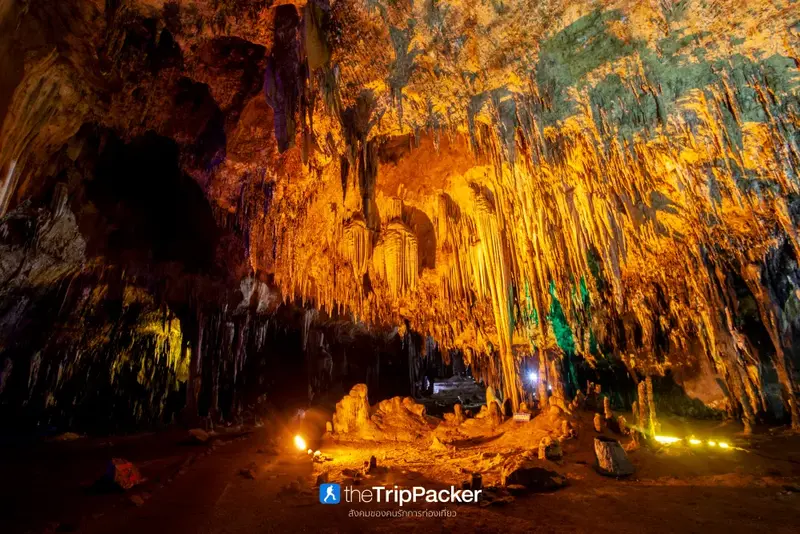
24. Khao Bin Cave, Ratchaburi is a well-known limestone cave attraction located in Hin Kong Subdistrict, Mueang Ratchaburi District, Ratchaburi Province. The cave is distinguished by numerous stalactites, stalagmites, and naturally formed mineral structures that have developed over long geological periods. Visitors can explore the accessible sections of the cave and observe a remarkable underground environment shaped by water, limestone, and mineral deposition. It is a rewarding destination for travelers interested in geology, natural history, photography, and educational day trips from Bangkok.
Highlights: Limestone cave chambers, stalactites and stalagmites, naturally formed mineral curtains and columns, underground geological formations, visitor walkways, and opportunities to learn about the development of limestone caves.
Khao Bin Cave developed through geological processes involving limestone and groundwater. Rainwater absorbs carbon dioxide as it moves through the atmosphere and soil, becoming capable of dissolving small amounts of calcium carbonate from limestone rock. Over long periods, this process can gradually enlarge cracks and openings within the rock, producing underground passages and cavities. As mineral-rich water later enters these spaces and releases dissolved materials, calcium carbonate may accumulate to form stalactites, stalagmites, and other cave deposits.
Stalactites grow downward from cave ceilings as mineral-bearing water drips and deposits calcium carbonate. Stalagmites develop upward from the cave floor where droplets land and release their dissolved minerals. Over considerable periods, the two formations may eventually connect and create columns. Differences in water flow, mineral concentration, humidity, and local cave conditions produce a wide variety of shapes and textures. Observing these structures provides a fascinating introduction to processes that operate over timescales far longer than a human lifetime.
The interior of Khao Bin Cave contains formations that visitors often compare with familiar objects because of their unusual shapes. Some mineral deposits resemble curtains hanging from the ceiling, while others appear as rounded columns or irregular sculptural forms. The cave environment creates a striking contrast with the outdoor landscape, emphasizing the distinctive character of underground geological processes.
Careful conservation is essential because cave formations may take extremely long periods to develop. Touching stalactites or stalagmites can introduce oils and contaminants that interfere with natural mineral deposition, while breaking a formation may cause damage that cannot realistically be repaired. Visitors should remain on designated routes, avoid touching the rock structures, and follow all guidance provided by the site operator.
The cave's environment also differs from conditions outside. Underground areas may have higher humidity, limited natural light, and wet or uneven walking surfaces. Comfortable shoes with good grip are therefore important. Travelers should move carefully along walkways and assess their physical ability before exploring, particularly if accompanying older visitors or children. Any visitor who experiences discomfort in enclosed spaces should consider the cave environment before entering.
Khao Bin Cave is suitable for nature enthusiasts, families, students, and visitors interested in earth science. It can be incorporated into a Ratchaburi day trip with selected cultural attractions or local food stops, although the travel time from Bangkok should be considered. Allowing sufficient time inside the cave makes it possible to appreciate the different formations and learn about their origins rather than simply walking through the site quickly.
Travelers should check current access arrangements before departure, since access to caves can be affected by maintenance, safety requirements, or environmental conditions. Respecting visitor rules helps protect the cave's geological heritage and ensures that future generations can continue to appreciate its remarkable natural formations.
Getting There: From Bangkok, travel toward Ratchaburi Province and continue from the city center to Hin Kong Subdistrict, following signs to Khao Bin Cave. The attraction is outside the main urban transportation network, so travelers without private vehicles should arrange local transportation in advance. Confirm that the cave is open to visitors and check any entrance procedures before setting out.

25. Phanthai Norasing Historical Park, Samut Sakhon is an important cultural and historical attraction located in Phanthai Norasing Subdistrict, Mueang Samut Sakhon District, Samut Sakhon Province. The park is associated with the story of Phanthai Norasing, a historical figure traditionally remembered for his loyalty, honesty, and commitment to duty during the Ayutthaya period. It provides an opportunity to explore Thai historical memory, cultural values, and the relationship between inland waterways and coastal communities. The surrounding environment also offers insight into the significance of mangrove habitats in Samut Sakhon.
Highlights: Phanthai Norasing Shrine, memorial structures associated with Ayutthaya history, traditional accounts of loyalty and responsibility, historical learning opportunities, and nearby mangrove environments.
The story of Phanthai Norasing is associated with the reign of King Sanphet VIII, commonly known as King Suea, during the Ayutthaya Kingdom. Traditional accounts describe an incident in which a royal boat was damaged near Khlong Khok Kham, leading to a conflict between the legal consequences prescribed by royal regulations and the king's willingness to show mercy. Phanthai Norasing is remembered for insisting that the established law be respected, despite the personal consequences.
Over time, the story became an important part of Thailand's cultural understanding of loyalty, integrity, and responsibility. It has been retold through historical writing, literature, and local traditions. The significance of the narrative lies not only in the events described but also in how later generations have interpreted it as an example of adherence to duty and moral principles. Visitors can use the site as a starting point for considering the relationship between history, storytelling, and social values.
The park's memorial features provide a physical setting for learning about this historical narrative. The shrine dedicated to Phanthai Norasing is an important place where visitors may pay their respects and reflect on the significance of the story. The surrounding grounds provide opportunities to explore historical displays or other features associated with the memorial, according to the arrangements maintained by the site.
Understanding the wider geography of the area adds depth to the visit. During the Ayutthaya period, waterways were essential for travel, transportation, trade, and political administration. Canals and rivers linked inland settlements to coastal areas, making their navigation important for both royal journeys and everyday economic activities. The landscape around Phanthai Norasing therefore provides context for understanding why waterways played such an important role in traditional accounts of the incident.
Mangrove environments in Samut Sakhon represent another important part of the region's natural heritage. Mangrove forests serve as habitats and nursery grounds for aquatic species, support coastal biodiversity, and contribute to shoreline protection. Where suitable visitor areas are accessible, travelers can explore the relationship between mangrove ecosystems and the livelihoods of coastal communities. The combination of historical learning and environmental awareness makes the area suitable for educational outings.
Phanthai Norasing Historical Park is particularly suitable for families, students, teachers, and history enthusiasts. The story associated with the park can encourage discussions about ethics, civic responsibility, and the interpretation of historical events. For visitors interested in Thai cultural heritage, the site offers an alternative to conventional temples and palaces by focusing on an individual whose story has become part of the nation's historical consciousness.
The park can be visited during a day trip from Bangkok and combined with selected attractions in Samut Sakhon. Morning or late-afternoon visits are more comfortable for exploring outdoor areas, especially during warmer months. Visitors should respect the memorial's religious and cultural significance, follow posted instructions, and avoid entering areas restricted for conservation or safety reasons.
Open Days: Daily
Opening Hours: 08:00 – 18:00
Getting There: From Bangkok, take Rama II Road toward Samut Sakhon and continue into Phanthai Norasing Subdistrict using the local roads connected to the main highway. Follow signs to Phanthai Norasing Historical Park. Travelers using public transportation should arrange local taxi or other transportation from the Samut Sakhon area, as the attraction is not directly served by Bangkok's urban rail network.
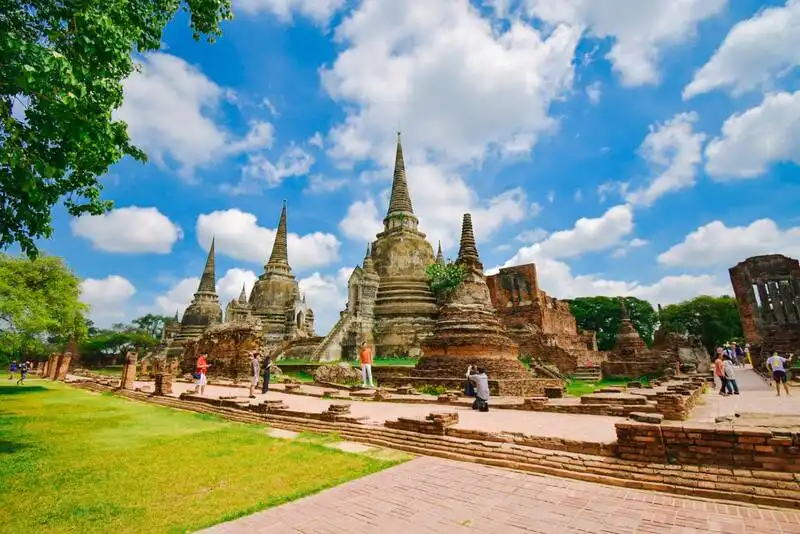
26. Wat Phra Si Sanphet, Phra Nakhon Si Ayutthaya is one of the most historically significant temple complexes in the former capital of the Ayutthaya Kingdom. Located within the area of Ayutthaya Historical Park near the former Royal Palace, it is best known for three monumental bell-shaped stupas standing in an elegant row. The temple once served as an important royal religious complex closely associated with ceremonies and the spiritual life of the Ayutthaya court. Today, its surviving ruins offer exceptional insight into the relationship between Buddhism, royal authority, and monumental architecture in one of Southeast Asia's most influential historical kingdoms.
Highlights: Three monumental bell-shaped stupas, historic royal temple grounds, ruins of the principal viharn, architectural remains of the Ayutthaya period, connections to the Phra Si Sanphet Buddha image, and the surrounding UNESCO World Heritage landscape.
Wat Phra Si Sanphet developed within an area associated with the royal palace of Ayutthaya. During the reign of King Borommatrailokkanat, part of the former palace area was designated for use as a royal Buddhist temple. This arrangement gave Wat Phra Si Sanphet a distinctive role, as it functioned as a religious institution associated with the royal court rather than a conventional residential monastery. Its history reflects the close relationship between the monarchy and Buddhism during the Ayutthaya period.
The three monumental stupas are the temple's most recognizable architectural features. Their graceful bell-shaped forms rise from elevated bases and create a remarkable sense of balance when viewed together. The stupas are historically associated with the enshrinement of royal ashes, giving them both religious and dynastic significance. Their surviving structure demonstrates the sophistication of Ayutthaya-period architecture and the importance of monumental religious construction to the royal court.
Wat Phra Si Sanphet was also associated with the great Phra Si Sanphet Buddha image, which once stood within the principal religious hall. The image was an important sacred object of the Ayutthaya royal court but suffered damage during the destruction of the city in 1767. Today, the foundations and surviving architectural remains provide evidence of the temple's former scale and importance. Visitors can use these ruins to understand the religious and ceremonial functions of the site during the kingdom's period of prosperity.
The archaeological remains include temple foundations, architectural bases, brick structures, and traces of the former viharn. These elements provide valuable information about the organization of the royal religious complex. Exploring the site offers opportunities to consider how the original structures related to one another and how the temple functioned within the larger palace precinct. Visitors interested in archaeology will find the surviving layout particularly informative.
Wat Phra Si Sanphet is located near other important Ayutthaya attractions, including Wihan Phra Mongkhon Bophit and the remains of the former Royal Palace. This concentration of monuments allows travelers to explore the political and religious history of Ayutthaya within a relatively compact area. Walking between the sites creates a broader understanding of how the ancient capital was organized and how royal and religious institutions occupied prominent positions in its urban landscape.
The temple forms part of the Historic City of Ayutthaya, recognized as a UNESCO World Heritage Site. Its cultural significance extends beyond the architectural beauty of the surviving stupas, encompassing the history of royal Buddhism, artistic traditions, and the political development of the kingdom. Visitors should remain on designated paths, avoid climbing restricted structures, and help protect fragile archaeological remains from unnecessary damage.
For a day trip from Bangkok, Wat Phra Si Sanphet can be combined with Wat Mahathat, Wat Ratchaburana, and Wat Chaiwatthanaram. Travelers interested in a more comprehensive understanding of Ayutthaya may also visit Chao Sam Phraya National Museum, where archaeological objects offer additional historical context. Comfortable shoes and adequate sun protection are recommended because the archaeological grounds include extensive outdoor areas.
Open Days: Daily
Opening Hours: 08:00 – 18:30
Getting There: From Bangkok, travel north along the Asian Highway or another suitable route into Phra Nakhon Si Ayutthaya. Continue to the historic city island and the former Royal Palace area. Visitors arriving by train can disembark at Ayutthaya Railway Station and continue by taxi, tuk-tuk, or other local transportation. The temple is conveniently situated near several major monuments, making it suitable for a historical walking itinerary.
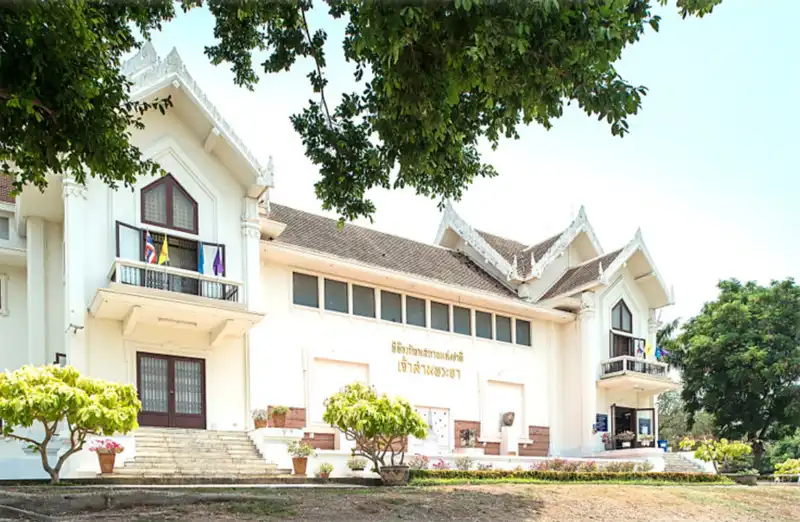
27. Chao Sam Phraya National Museum, Phra Nakhon Si Ayutthaya is an essential destination for travelers interested in the history, archaeology, and artistic achievements of the Ayutthaya Kingdom. Located near Rojana Road in Pratu Chai Subdistrict, Phra Nakhon Si Ayutthaya District, the museum preserves and exhibits important archaeological objects associated with the former royal capital. Its collections include Buddhist sculptures, decorative arts, gold artifacts, and objects discovered during archaeological excavations. Visiting the museum provides valuable context for understanding the ancient temples and ruined palaces found throughout Ayutthaya Historical Park.
Highlights: Ayutthaya-period archaeological objects, gold artifacts discovered in ancient temple crypts, Buddhist sculptures, historical decorative arts, religious objects, and exhibitions explaining the development of the former capital.
Chao Sam Phraya National Museum plays an important role in preserving evidence from the Ayutthaya Kingdom, which served as a major political and commercial center for more than four centuries. Archaeological excavations throughout the historic city have revealed objects associated with royal ceremonies, Buddhist institutions, artistic craftsmanship, and everyday life. These discoveries provide insight into the complexity of Ayutthaya society and the relationships between its religious, political, and economic institutions.
The museum's gold artifacts are among its most significant collections. Objects discovered in the crypts of historic temples demonstrate the technical abilities and artistic sophistication of Ayutthaya craftsmen. Intricate metalworking techniques, delicate ornamental designs, and carefully constructed religious objects illustrate the importance of precious materials in royal and Buddhist artistic traditions. These artifacts also provide evidence of the resources and specialized skills available within the kingdom.
Buddhist sculptures and religious objects form another important part of the museum's displays. Visitors can observe differences in artistic style, facial features, body proportions, and decorative details that developed across different periods. These comparisons help illustrate how religious art changed as the kingdom evolved and interacted with neighboring cultures. The museum therefore offers a particularly rewarding experience for visitors interested in the history of Thai sculpture and Buddhist iconography.
Exploring a museum provides a different experience from walking through ancient ruins. While archaeological sites reveal the physical remains of buildings and urban spaces, museum collections preserve movable objects that once formed part of those environments. Studying both types of evidence allows visitors to develop a more complete understanding of the past. A Buddha image or ceremonial object may help explain the function of an ancient hall, while the surviving foundations of a temple provide context for where the object was originally used.
Chao Sam Phraya National Museum is especially valuable when combined with visits to Wat Mahathat, Wat Ratchaburana, and Wat Phra Si Sanphet. These sites share historical connections with the artistic and religious traditions represented in the museum's collections. Travelers can choose to visit the museum first to understand the broader history of Ayutthaya, or explore the archaeological monuments before viewing related objects afterward.
The museum is suitable for students, families, historians, art enthusiasts, and international travelers who want more than a general sightseeing experience. Reading exhibition descriptions carefully and examining individual artifacts provides insight into the craftsmanship, religious beliefs, and cultural connections of the former kingdom. Visitors should follow all regulations concerning photography and the protection of museum objects.
As part of a day trip from Bangkok, the museum also provides a useful indoor activity between outdoor archaeological visits. Travelers should allow enough time for the exhibitions rather than treating the museum as a brief stop. It is particularly important to check the weekly closing day and any changes to exhibition access before arranging an itinerary.
Open Days: Tuesday – Sunday (Closed on Mondays)
Opening Hours: 09:00 – 16:00
Getting There: From Bangkok, follow the main roads toward Phra Nakhon Si Ayutthaya and continue into the historic city island near Rojana Road. The museum is located in Pratu Chai Subdistrict. Travelers arriving by train can use a taxi or local transportation from Ayutthaya Railway Station. Confirm the museum's opening schedule and visitor requirements before departure.
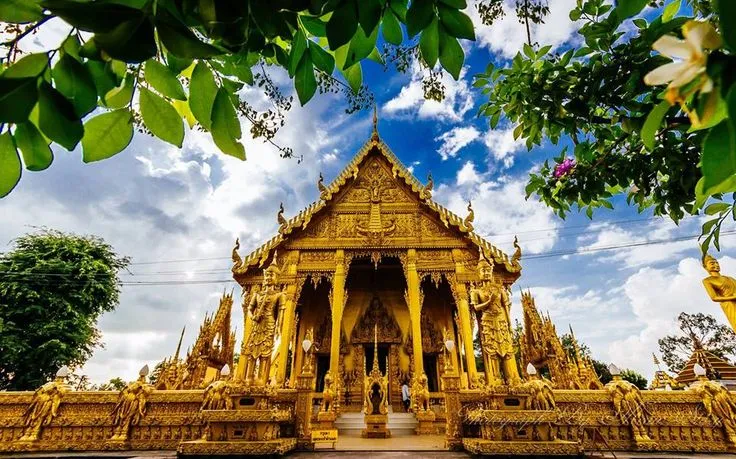
28. Wat Pak Nam Cholo, Chachoengsao is a distinctive Buddhist temple located in Pak Nam Subdistrict, Bang Khla District, Chachoengsao Province. It is especially famous for its striking golden ordination hall, whose decorative surfaces and traditional Thai architectural details make it one of the area's most recognizable religious landmarks. The temple is also associated with the history of riverside communities along the Bang Pakong River. Its combination of colorful religious architecture, local heritage, and scenic surroundings makes it a rewarding destination for travelers exploring Chachoengsao on a day trip from Bangkok.
Highlights: Golden ordination hall, elaborate Thai architectural decorations, Buddhist religious art, local history of Bang Khla, Bang Pakong River surroundings, and cultural attractions within the riverside district.
Wat Pak Nam Cholo developed within a region historically shaped by the Bang Pakong River. The river supported transportation, trade, fishing, and agricultural settlements, connecting inland communities with coastal areas of eastern Thailand. Buddhist temples often became important centers of village life in these environments, serving both spiritual and social functions. The history of Wat Pak Nam Cholo therefore reflects the wider relationship between waterways, local settlements, and the development of religious institutions.
The temple's golden ordination hall is its most remarkable visual feature. Traditional Thai architectural forms are combined with a distinctive decorative treatment dominated by golden surfaces. The roof, ornamental elements, and carefully composed structure demonstrate the artistic attention given to Buddhist religious buildings. When sunlight falls across the exterior, the reflective surfaces create a striking appearance that makes the hall particularly attractive for photography and architectural observation.
Visitors interested in Thai craftsmanship can examine the decorative components of the building, including traditional roof ornaments, architectural proportions, and detailed surface treatments. These elements reflect the continuing importance of Buddhist art within Thai culture. The ordination hall is more than a decorative landmark; it is part of an active religious environment where architectural beauty expresses respect for Buddhist teachings and sacred traditions.
Wat Pak Nam Cholo is also associated with local historical accounts connected to events around the transition from the Ayutthaya Kingdom to the Thonburi period. These stories form part of the cultural memory of Bang Khla and surrounding communities. Visitors interested in regional history can explore the relationship between the temple and the broader development of the Bang Pakong River basin, where waterways played important roles in transportation and political movements.
The surrounding area offers a quieter atmosphere than the larger urban center of Chachoengsao. Bang Khla remains closely associated with agricultural landscapes and riverside communities, allowing travelers to experience another aspect of the province's identity. A temple visit can be combined with a local market or riverside excursion, depending on available time and operating conditions.
For a day trip from Bangkok, Wat Pak Nam Cholo can be included in a route that begins at Wat Sothonwararam Worawihan in Chachoengsao town before continuing toward Bang Khla. This itinerary combines two religious attractions with different architectural characteristics. Visitors should allow adequate travel time between districts and consider stopping for local food or other nearby cultural experiences.
Wat Pak Nam Cholo is suitable for families, Buddhist pilgrims, architecture enthusiasts, and travelers interested in photography. Visitors should wear modest clothing and respect religious activities. Photographing the exterior in natural light is a popular activity, but care should be taken not to disturb worshippers or enter areas that are not open to the public.
Open Days: Daily
Opening Hours: 08:00 – 17:00
Getting There: From Bangkok, travel toward Chachoengsao and continue from the provincial capital toward Bang Khla District and Pak Nam Subdistrict. Follow the local road network toward the Bang Pakong riverside area and the temple. Public transportation users can reach Chachoengsao by train or bus and continue by local taxi or other available transport. Arrange the return journey in advance if traveling without a private car.

29. Bueng Chawak Chaloem Phrakiat, Suphan Buri is a major nature and educational attraction located in Doem Bang Nang Buat District, Suphan Buri Province, near the boundary with Hankha District in Chai Nat. The area is centered on a large natural freshwater wetland that has been developed for conservation, recreation, and public education. Its attractions include aquatic life exhibitions, lakeside scenery, and facilities for visitors interested in wildlife and environmental learning. Bueng Chawak is particularly suitable for families with children because it combines natural surroundings with educational activities that can be explored in a single visit.
Highlights: Large natural lake, aquatic life exhibitions, wetland ecosystems, nature education, landscaped recreation areas, family-friendly attractions, and conservation-focused development.
Bueng Chawak is an important wetland environment within the wider lowlands of central Thailand. Freshwater wetlands provide habitats for fish, aquatic plants, birds, and other organisms while helping maintain local ecological balance. They also play roles in water storage and the broader functioning of agricultural landscapes. The natural characteristics of Bueng Chawak make it an important location for environmental education and help explain why conserving wetlands is essential for biodiversity.
The development of Bueng Chawak Chaloem Phrakiat as a public attraction has increased opportunities for visitors to explore aquatic biodiversity and understand conservation issues. Aquatic exhibitions provide opportunities to observe different species and learn about their habitats, physical characteristics, and ecological roles. For children, seeing aquatic animals in carefully managed displays can make scientific concepts more accessible and encourage curiosity about the natural world.
The surrounding lake and landscaped environment create a setting suitable for relaxation and outdoor activities. Visitors can enjoy views across the water and observe the relationship between natural wetlands and the facilities developed around them. The scenery changes with seasonal water conditions, vegetation, and weather, making the area appealing for casual photography and nature appreciation.
Bueng Chawak is valuable not only as a recreational destination but also as a place for communicating the importance of natural resource conservation. Wetlands support complex food webs and provide essential habitat for numerous species. Changes to water quality, land use, and surrounding environmental conditions can affect these ecosystems. Learning about these relationships can encourage visitors to consider the importance of responsible water management and habitat protection.
Families and school groups can use the attraction as an educational outing that introduces children to aquatic life and ecological principles. Parents and teachers may connect observations from the exhibits with wider discussions about freshwater habitats, biodiversity, and human impacts on the environment. The combination of outdoor scenery and structured learning opportunities helps make the visit engaging for different age groups.
Because the attraction covers a substantial area and includes several activity zones, visitors should identify their preferred exhibits and plan an appropriate route. Different sections may operate according to separate schedules or admission arrangements. Travelers interested in specific displays should verify which areas are open before departure, especially when traveling a considerable distance from Bangkok.
Bueng Chawak can be combined with Sam Chuk Market or other attractions in Suphan Buri if sufficient time is available. However, the distance from Bangkok means that an early departure is advisable. Families traveling with young children or older visitors should allow breaks between activities and avoid an overly ambitious itinerary. Comfortable shoes, drinking water, and protection from the sun are useful for exploring the outdoor environment.
Getting There: From Bangkok, travel toward Suphan Buri Province and continue north toward Doem Bang Nang Buat District. Follow signs to Bueng Chawak Chaloem Phrakiat. Public transportation users should arrange their onward journey from the nearest available transport hub in advance, as the attraction is located outside the main urban area. Check current operating hours for the individual exhibition zones before visiting.
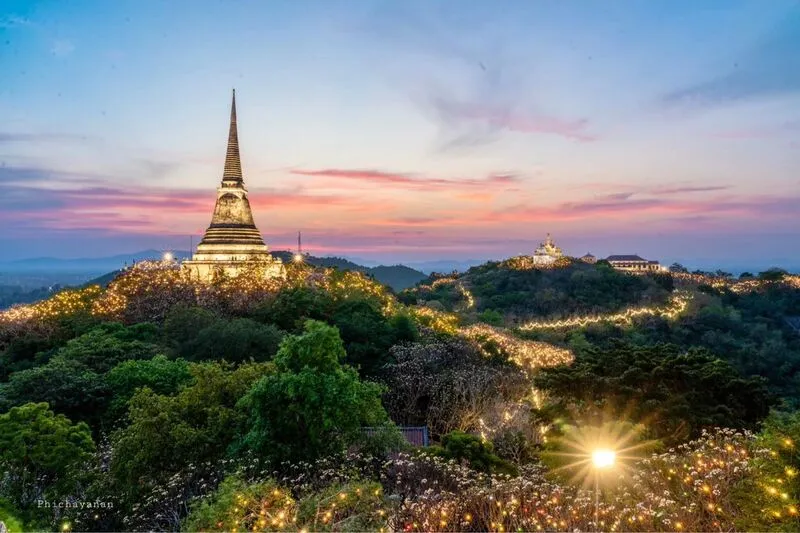
30. Phra Nakhon Khiri Historical Park, Phetchaburi is a historically significant royal palace complex located on Khao Maha Sawan, commonly known as Khao Wang or Palace Hill, in Mueang Phetchaburi District. The complex was developed during the reign of King Mongkut, Rama IV, and is distinguished by its hilltop royal buildings, religious monuments, architectural details, and panoramic views over Phetchaburi town. The historical park combines Thai, Chinese, and European artistic influences, making it one of the most rewarding cultural destinations in the province for travelers interested in royal history, architecture, and photography.
Highlights: Historic hilltop royal palace, Phet Phum Phairot Royal Hall, Phra That Chom Phet, Wat Phra Kaeo Noi, Thai and Western architectural influences, panoramic views over Phetchaburi, and historical connections to King Mongkut, Rama IV.
Phra Nakhon Khiri was developed during the reign of King Mongkut as a royal residence in Phetchaburi. The decision to establish a palace on the hill reflected both the scenic advantages of the location and the importance of the town as a regional center. From the elevated grounds, the surrounding landscape can be observed across a wide area, creating an impressive setting for royal architecture. The palace complex also reflects the artistic and cultural developments of the mid-nineteenth century, when Thailand was increasingly engaging with international influences.
The buildings of Phra Nakhon Khiri display a distinctive combination of architectural styles. Traditional Thai forms appear alongside decorative elements influenced by Chinese craftsmanship and European design. This blending of styles reveals the changing aesthetic preferences of the royal court during the reign of Rama IV. Visitors interested in architectural history can observe the forms of roofs, windows, columns, decorative patterns, and building proportions to understand how different artistic traditions were incorporated into a unified royal complex.
Phet Phum Phairot Royal Hall is one of the important buildings associated with the royal palace. Its architecture reflects the functions and character of the royal residence, while the surrounding structures reveal how different areas of the complex were used. Exploring these buildings provides insight into the organization of a nineteenth-century Thai royal retreat and the differences between a hilltop palace and formal royal buildings in the capital.
Phra That Chom Phet is another major landmark within the historical park. The stupa stands on one of the hilltop areas and contributes to the distinctive skyline of Phra Nakhon Khiri. Wat Phra Kaeo Noi, another significant religious site, demonstrates the close relationship between Buddhist institutions and royal architecture. Together, the palace and religious structures show how spiritual and political functions were integrated within the wider hilltop environment.
The panoramic views from Khao Wang are among the most memorable aspects of a visit. From suitable viewpoints, travelers can see Phetchaburi's urban landscape, religious buildings, surrounding hills, and wider countryside. The elevated terrain creates varied photographic perspectives, with historic architectural structures appearing against the town below. Morning visits can provide more comfortable walking conditions and sufficient time to explore the main sections of the complex.
The hill also has natural characteristics that contribute to its atmosphere, including vegetation and wildlife. Monkeys may be encountered around the historical park, and visitors should exercise caution. Do not feed or attempt to touch the animals, and keep food and personal belongings securely stored. Maintaining an appropriate distance helps reduce potential conflicts and supports safer interactions between visitors and wildlife.
Phra Nakhon Khiri Historical Park is suitable for families, history enthusiasts, architecture lovers, and photographers. The site can be combined with a visit to central Phetchaburi, where travelers may explore additional temples, traditional neighborhoods, and the province's well-known Thai desserts. Because the historical park occupies elevated terrain, visitors with mobility concerns should check the available transport services and walking conditions before arriving.
For a day trip from Bangkok, an early departure provides enough time to explore the hilltop palace complex and enjoy a meal in Phetchaburi before returning. Visitors should also check the operating schedule of the hill access transport and the final admission arrangements, as these may differ from the general opening hours of the historical park. Planning ahead will make the visit more comfortable and allow time to appreciate the architectural and historical significance of the site.
Open Days: Daily
Opening Hours: 08:30 – 16:00
Getting There: From Bangkok, travel along Rama II Road toward Phetchaburi and continue into the town center toward Khiri Ratthaya Road and Phra Nakhon Khiri Historical Park. Travelers using public transportation can take a train to Phetchaburi Railway Station and continue by local taxi to the entrance. Check the current operation of the hill access transport and the final visiting time before departure.
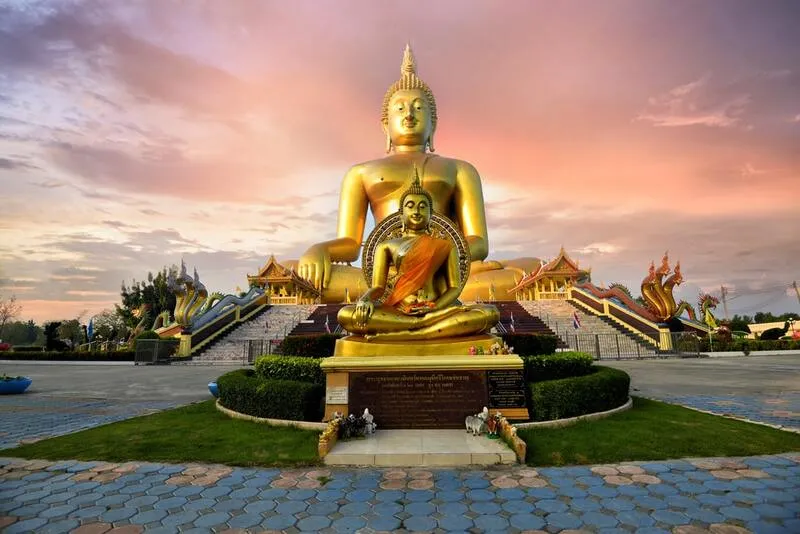
31. Wat Muang, Ang Thong is one of the most remarkable Buddhist attractions in central Thailand, famous for its enormous golden Buddha image, officially named Phra Phuttha Maha Nawamin Sakayamuni Si Wiset Chai Chan and commonly known as Luang Pho Yai. Located in Hua Taphan Subdistrict, Wiset Chai Chan District, Ang Thong Province, the temple stands amid the agricultural landscape of central Thailand. The monumental seated Buddha is visible from a considerable distance, creating a striking impression against the surrounding countryside. Wat Muang is an important destination for Buddhist pilgrims, architecture enthusiasts, and travelers seeking a memorable cultural day trip from Bangkok.
Highlights: The monumental golden Luang Pho Yai Buddha image, traditional Buddhist religious architecture, ceremonial areas, opportunities to observe large-scale religious sculpture, and the rural landscape of Wiset Chai Chan District.
The principal attraction at Wat Muang is the extraordinary seated Buddha image depicted in the Maravijaya posture, also known as the earth-touching gesture. This position is closely associated with an important episode in the life of the Buddha, when he overcame Mara's challenges before attaining enlightenment. In Buddhist artistic tradition, the gesture symbolizes spiritual determination, wisdom, and the triumph over obstacles. The impressive scale of the image makes Wat Muang an especially powerful expression of Buddhist devotion.
The Buddha image was created as a monumental religious sculpture reflecting the faith and contributions of those involved in its construction. Large Buddha images have long played important roles in Thai Buddhist culture, serving as centers of worship and symbols of religious commitment. At Wat Muang, the immense proportions of Luang Pho Yai distinguish the temple from many other religious sites and demonstrate the continuing significance of monumental Buddhist art in contemporary Thailand.
As visitors approach the temple, the golden Buddha appears above the surrounding buildings and agricultural fields. The difference in scale between the figure and the landscape emphasizes the monument's exceptional size. From the grounds near the base, travelers can observe the proportions of the seated figure and the artistic details of the Buddha's face, hands, and robes. Stepping farther away provides a different perspective, allowing the complete form to be appreciated within the wider rural environment.
Wat Muang also functions as an active religious center for the surrounding community. In addition to the giant Buddha, visitors can explore areas used for worship, merit-making, and Buddhist activities. These spaces demonstrate the relationship between monumental religious art and the daily practice of Buddhism. For travelers interested in local culture, the temple offers an opportunity to observe how religious institutions continue to serve as important social and spiritual centers outside Thailand's major cities.
The grounds also include religious artwork and decorative elements associated with Buddhist teachings and traditional beliefs. Visitors may explore these features while considering how sculpture and visual imagery communicate moral and spiritual ideas. The temple is particularly suitable for photography because its open surroundings offer different perspectives of the large Buddha image throughout the day. Morning and late-afternoon visits can be more comfortable than walking in the strongest midday sunlight.
Wat Muang can be included in an Ang Thong pilgrimage itinerary with Wat Khun Inthapramun and Wat Pa Mok Worawihan. These temples are notable for their different forms of monumental Buddhist sculpture, allowing visitors to compare a seated Buddha with important reclining Buddha images. Exploring several religious sites in the same province provides insight into the diversity of Thai Buddhist artistic expression and the long history of religious patronage in central Thailand.
Visitors should dress modestly, respect worshippers, and follow the temple's guidelines. During major Buddhist holidays, the temple may become particularly busy with devotees and families. Travelers planning a day trip from Bangkok should depart early and allow enough time to enjoy the main Buddha image and other selected attractions without rushing the return journey.
Open Days: Daily
Opening Hours: 06:00 – 18:00
Getting There: From Bangkok, follow the Asian Highway or another suitable northern route through Ayutthaya toward Ang Thong. Continue to Wiset Chai Chan District and Hua Taphan Subdistrict, following signs to Wat Muang. Travelers using public transportation can reach Ang Thong or Wiset Chai Chan and continue by local taxi or other available transport. Allow additional time for the return journey, especially on weekends.
Map (GPS):Open Google Maps Directions to Wat Muang

32. Wat Khun Inthapramun, Ang Thong is a historic Buddhist temple renowned for its enormous outdoor reclining Buddha image. Located in Inthapramun Subdistrict, Pho Thong District, Ang Thong Province, the temple combines monumental religious sculpture with traces of historic architecture associated with the Ayutthaya period. Its most recognizable feature is the elegant reclining Buddha lying in an open-air setting, allowing visitors to appreciate the full scale and refined artistic proportions of the image. Wat Khun Inthapramun is an excellent destination for travelers interested in Thai Buddhist history, ancient sculpture, and cultural day trips from Bangkok.
Highlights: Monumental outdoor reclining Buddha, graceful facial features and sculptural proportions, surviving traces of historic religious buildings, Ayutthaya-period heritage, and the peaceful atmosphere of a traditional Ang Thong temple.
Wat Khun Inthapramun is closely associated with the development of Buddhism in the central Thai lowlands during the Ayutthaya period. Ang Thong formed part of the wider network of agricultural settlements and religious communities connected to the former royal capital. Temples served as places of worship, education, and community gatherings, while major religious monuments reflected the devotion and resources of their patrons. The surviving reclining Buddha is an important reminder of these historical traditions.
The temple's enormous reclining Buddha is remarkable for both its scale and artistic character. The figure is depicted lying on its side in a peaceful posture, with carefully modeled facial features and elegantly arranged bodily proportions. Because the image stands in an outdoor environment, visitors can appreciate its complete length from different viewpoints. This arrangement differs from reclining Buddha images housed inside large halls and creates a powerful visual relationship between the sculpture and its surroundings.
Reclining Buddha images occupy an important place in Buddhist art and devotional practice. Their form is associated with significant episodes in Buddhist teachings and the life of the Buddha. The construction of monumental reclining images also reflects the importance of religious patronage in Thai history. Visitors to Wat Khun Inthapramun can consider the spiritual meanings of the sculpture while observing the technical achievements required to create a figure of such considerable size.
Traces of older religious buildings within the temple grounds provide additional historical interest. Foundations and surviving architectural remains help visitors imagine the appearance of the original temple complex and understand how its structures changed over time. The deterioration of ancient buildings demonstrates the effects of weather, historical events, and long-term environmental exposure. These remains should be treated as valuable archaeological evidence, and visitors should avoid climbing or touching fragile structures.
The open setting also creates attractive conditions for photography. Different viewing angles reveal the proportions of the reclining Buddha and its relationship to the surrounding landscape. Morning visits are particularly comfortable for exploring the area, while softer afternoon light can emphasize the sculpture's form and surface details. Visitors should remain respectful of religious activities and avoid disturbing people who have come to worship.
Wat Khun Inthapramun can be combined with Wat Muang and Wat Pa Mok Worawihan on a day trip around Ang Thong Province. Comparing the different religious monuments provides an opportunity to appreciate the diversity of Buddhist sculpture and the historical significance of major temples in the region. Travelers interested in art history can also observe differences in the architectural settings and devotional practices associated with each Buddha image.
For families and older travelers, the temple offers a relatively straightforward cultural experience centered on a major landmark. Comfortable shoes, drinking water, and sun protection are recommended because the reclining Buddha is exposed to the elements. Travelers should plan enough time for transportation between districts if visiting multiple temples in one day.
Open Days: Daily
Opening Hours: 06:00 – 18:00
Getting There: From Bangkok, travel north through Ayutthaya toward Ang Thong. Continue from Ang Thong town toward Pho Thong District and Inthapramun Subdistrict, following signs to Wat Khun Inthapramun. Visitors without a private car can arrange local transportation from Ang Thong town. Combining the temple with nearby cultural attractions is practical when the travel route is planned in advance.
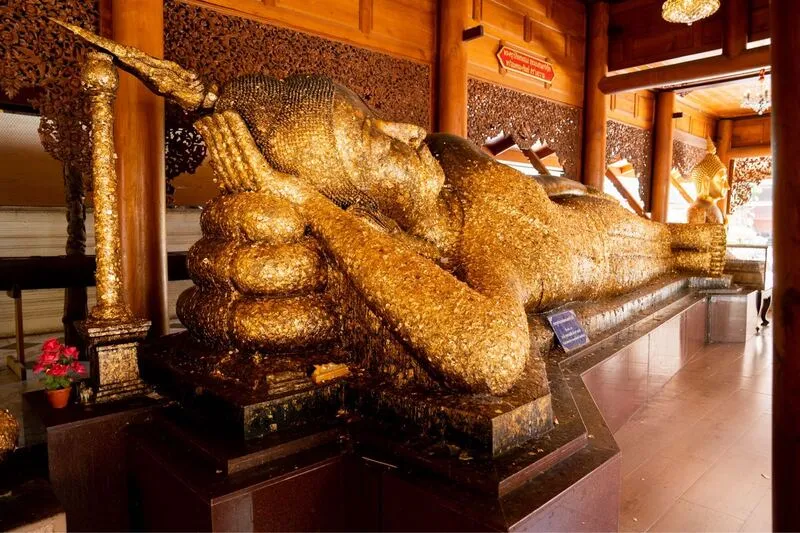
33. Wat Phra Non Chakkrasi Worawihan, Sing Buri is one of the most important Buddhist temples in Sing Buri Province, located in Chakkrasi Subdistrict, Mueang Sing Buri District. The temple is widely known for its monumental reclining Buddha image, which has been revered by local communities and pilgrims for generations. The impressive sculpture is housed within a large religious hall, creating a setting that emphasizes both the scale of the Buddha image and the spiritual atmosphere of the temple. Wat Phra Non Chakkrasi is an excellent destination for visitors interested in Buddhist art, historic royal temples, and cultural heritage in central Thailand.
Highlights: Monumental reclining Buddha inside the principal hall, traditional Buddhist architecture, historic royal temple setting, important religious sculptures, and the devotional atmosphere of one of Sing Buri's best-known temples.
Wat Phra Non Chakkrasi has a long history associated with Buddhist communities in the upper Chao Phraya River basin. Sing Buri has been inhabited for centuries and maintained close connections with the Ayutthaya Kingdom and surrounding settlements. Temples were essential institutions in these communities, supporting religious ceremonies, education, and cultural traditions. The continued importance of Wat Phra Non Chakkrasi reflects the enduring role of Buddhism in the region.
The reclining Buddha is the temple's principal attraction. Its elongated form and carefully modeled facial features create an impression of tranquility and spiritual dignity. The sculpture is housed within a large hall that protects the image and provides space for worshippers. Visitors can observe the Buddha from different positions while appreciating the relationship between monumental sculpture and traditional religious architecture.
Reclining Buddha images hold an important place in Buddhist visual traditions. They are often associated with key teachings and events in the life of the Buddha, while their construction reflects the devotion of religious patrons and communities. Visitors interested in Buddhist iconography can compare the image at Wat Phra Non Chakkrasi with other major reclining Buddhas in central Thailand, including the outdoor sculpture at Wat Khun Inthapramun in neighboring Ang Thong Province.
The surrounding architecture adds further interest to the temple experience. Religious halls and decorative features reveal aspects of Thai Buddhist design, while the arrangement of sacred spaces demonstrates the practical needs of an active monastery. The temple remains a place where visitors can observe merit-making traditions and the continuing relationship between religious heritage and everyday community life.
During major Buddhist holidays, worshippers may visit the temple to make offerings and participate in ceremonies. These events reflect the important place of the reclining Buddha in the spiritual identity of the province. Visitors should observe appropriate religious etiquette, especially when entering worship areas or photographing the sacred image. Specific ceremonies and annual activities should be confirmed through the temple's current announcements.
Wat Phra Non Chakkrasi can also serve as a starting point for exploring Sing Buri's wider history. The province is associated with important events during the late Ayutthaya period, including the traditional accounts of the Bang Rachan villagers. Travelers can combine the temple with historical memorials and other local landmarks to develop a broader understanding of the province's cultural identity.
For a day trip from Bangkok, an early departure is advisable because Sing Buri is farther from the capital than the immediate metropolitan provinces. Families and older travelers may prefer to focus on a limited number of attractions rather than visiting several distant districts. The temple provides a rewarding experience for those interested in Buddhist heritage and the history of Thailand's central plains.
Open Days: Daily
Opening Hours: 06:00 – 17:00
Getting There: From Bangkok, follow the Asian Highway north toward Sing Buri. Continue into Mueang Sing Buri District and follow signs to Chakkrasi Subdistrict and Wat Phra Non Chakkrasi Worawihan. Visitors traveling by public transportation can reach Sing Buri town by bus and continue by taxi or local transport. Allow sufficient time for the return journey to Bangkok.
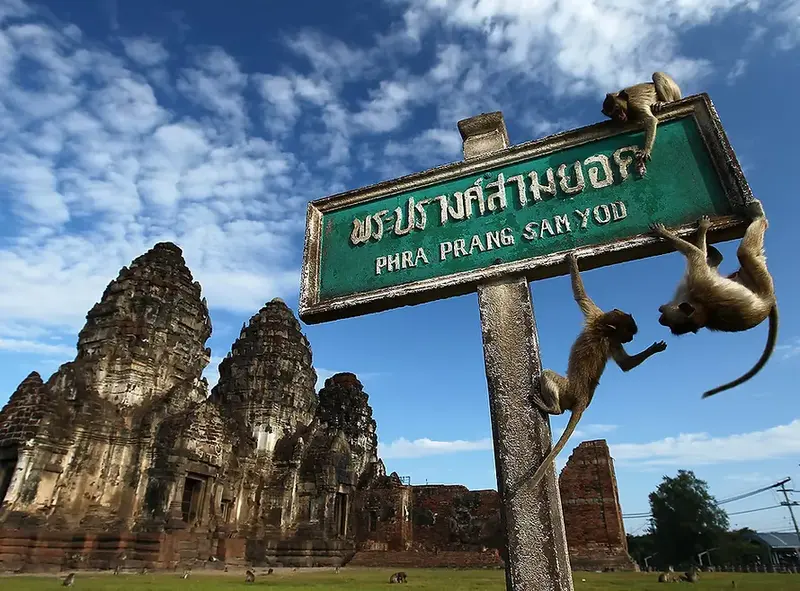
34. Phra Prang Sam Yot, Lop Buri is one of the most recognizable historical monuments in Lop Buri Province, located in Tha Hin Subdistrict, Mueang Lop Buri District. The site is famous for three connected prangs, or sanctuary towers, whose architectural design reflects the influence of ancient Khmer artistic traditions. The monument is an important reminder of Lop Buri's historical significance as the center of the ancient city of Lavo. It is also associated with the monkeys that inhabit parts of the surrounding old town, creating a distinctive relationship between archaeological heritage and urban wildlife.
Highlights: Three connected Khmer-style sanctuary towers, ancient religious architecture, surviving carved details, historical connections to Lavo civilization, Lop Buri's old town atmosphere, and the monkeys associated with the surrounding area.
Phra Prang Sam Yot is closely connected to the history of Lavo, an important regional center in central Thailand before and during the early development of the Ayutthaya Kingdom. The city maintained cultural relationships with neighboring regions and was influenced by Khmer artistic and religious traditions. The architecture of Phra Prang Sam Yot reflects these connections, particularly in its use of towers inspired by ancient sanctuary structures common in mainland Southeast Asia.
The monument consists of three towers arranged in a connected composition. Their placement creates a recognizable architectural silhouette and a sense of balance when viewed from different directions. Visitors can observe the surviving masonry, tower forms, and architectural details to understand the construction techniques and artistic principles used by ancient builders. The monument is particularly valuable as evidence of the cultural and religious exchanges that shaped central Thailand during the pre-Ayutthaya period.
Phra Prang Sam Yot also reflects changes in the religious landscape of Lop Buri. Ancient sanctuary architecture in the region was influenced by Brahmanical and Buddhist traditions at different times, and religious buildings were sometimes adapted to changing beliefs and political circumstances. Studying the monument helps visitors understand how architectural spaces can acquire new meanings as societies and religious practices evolve.
The three towers provide interesting opportunities for architectural photography. Different angles reveal the relationships between the towers and their surviving details, while the open setting allows visitors to appreciate the overall form of the monument. Morning and late-afternoon light can be particularly attractive for capturing the texture of the ancient masonry. Visitors should stay within permitted areas and avoid climbing or touching fragile structures.
Monkeys are another well-known feature of Lop Buri's historic district. Although they attract considerable interest, they are wild animals and can behave unpredictably. Visitors should not feed, touch, or approach them, and should keep bags, food, cameras, and other belongings securely stored. Maintaining a safe distance reduces the risk of bites, scratches, or conflicts and supports safer interactions between wildlife and visitors.
Phra Prang Sam Yot is conveniently located near other important historical attractions in Lop Buri, including the Phra Kan Shrine, Wat Phra Si Rattana Mahathat, and Phra Narai Ratchaniwet. Exploring these places together provides an overview of the city's history across several periods, from ancient Khmer-influenced traditions to the Ayutthaya royal court. The compact historical district makes it possible to design an efficient day trip, although adequate time should be allowed for outdoor walking.
For travelers interested in archaeology and ancient architecture, Phra Prang Sam Yot is an essential stop in Lop Buri. The monument's significance lies in its surviving architectural form and its role in explaining the history of Lavo. Visitors should approach it as a protected cultural landmark and follow all instructions concerning safety, wildlife, and conservation.
Open Days: Daily
Opening Hours: 06:00 – 18:00
Getting There: From Bangkok, drive north along Phahonyothin Road or other major routes toward Lop Buri. Continue into the historic center of Mueang Lop Buri District and follow signs to Phra Prang Sam Yot. Travelers using public transportation can take a train to Lop Buri Railway Station and continue to the monument within the old town area. Plan additional time if you intend to explore nearby historical landmarks.
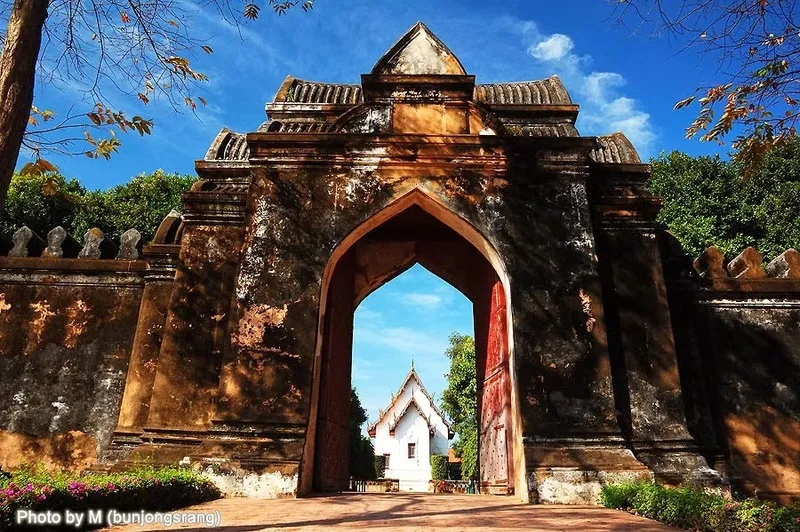
35. Phra Narai Ratchaniwet, Lop Buri is an important historic royal palace located on Sorasak Road in Tha Hin Subdistrict, Mueang Lop Buri District. The palace was constructed during the reign of King Narai the Great of Ayutthaya and is closely associated with the political and diplomatic history of seventeenth-century Siam. Lop Buri served as an important royal center during this period, and the surviving palace buildings demonstrate the architectural and cultural exchanges that accompanied the kingdom's growing international relations. Today, the site is a major destination for travelers interested in Thai royal history, archaeology, architecture, and museum collections.
Highlights: Historic royal palace of King Narai the Great, surviving royal halls and architectural ruins, Dusit Sawan Thanya Maha Prasat Throne Hall, Thai and European architectural influences, King Narai National Museum, and the diplomatic history of the Ayutthaya Kingdom.
Phra Narai Ratchaniwet was developed when Lop Buri became an important royal residence and administrative center during the reign of King Narai. The decision to establish a major palace in Lop Buri reflected the city's historical significance, strategic location, and established urban environment. The royal court used the palace for various functions, and its architecture reveals the scale of Lop Buri's importance during the later Ayutthaya period.
King Narai's reign was notable for extensive diplomatic and commercial contacts with foreign powers, including European nations and Asian trading partners. These relationships influenced the exchange of ideas, technology, artistic styles, and architectural practices. Elements of the palace demonstrate the interaction between traditional Thai building forms and foreign architectural influences, making the site particularly valuable for understanding Thailand's international connections during the seventeenth century.
The palace complex contains surviving structures and archaeological remains that reveal the organization of the former royal residence. Dusit Sawan Thanya Maha Prasat Throne Hall is particularly significant because of its association with royal audiences and diplomatic receptions. Although parts of the original structures have been damaged over time, the remaining architecture provides insight into the ceremonial and political functions of the palace.
Exploring the palace grounds allows visitors to examine architectural foundations, surviving walls, and historic building arrangements. The layout demonstrates how different spaces were organized within the royal compound. Observing these structures alongside historical explanations helps visitors understand the relationship between architecture and court life in the Ayutthaya Kingdom. The palace also provides a contrast to the Khmer-influenced monuments elsewhere in Lop Buri, illustrating the city's changing architectural history.
King Narai National Museum, located within the palace area, preserves and exhibits archaeological objects associated with different stages of Lop Buri's history. The museum offers opportunities to study the development of Lavo, later Ayutthaya-period culture, and the artistic traditions of the region. Viewing the museum collections alongside the architectural remains creates a more complete understanding of the site and its importance within Thai history.
The palace is particularly rewarding for visitors interested in the history of diplomacy. King Narai's reign is remembered for important international missions and contacts that connected Siam with political and commercial developments beyond Southeast Asia. Phra Narai Ratchaniwet provides a physical setting for exploring these events and considering how foreign relations influenced court culture and royal architecture.
Phra Narai Ratchaniwet can be combined with Phra Prang Sam Yot and other historic sites in Lop Buri during a day trip from Bangkok. A practical itinerary is to explore the ancient monuments in the morning and continue to the palace and museum later in the day. Visitors should check the museum's specific opening schedule, as it may differ from the access arrangements for outdoor palace areas.
Travelers should allow enough time to read the historical explanations and examine the surviving buildings carefully. Comfortable shoes and sun protection are useful for walking around the archaeological grounds. All visitors should observe conservation rules and avoid touching protected structures or museum objects.
Open Days: Daily according to the listed attraction information. Museum access may follow a separate schedule.
Opening Hours: 09:00 – 16:30 according to the listed attraction information.
Getting There: From Bangkok, travel north toward Lop Buri and continue into the historic town center along Sorasak Road in Tha Hin Subdistrict. Travelers using the railway can disembark at Lop Buri Railway Station and continue by local transportation or on foot where appropriate. The palace lies within the old town area and can be combined with nearby historical monuments.
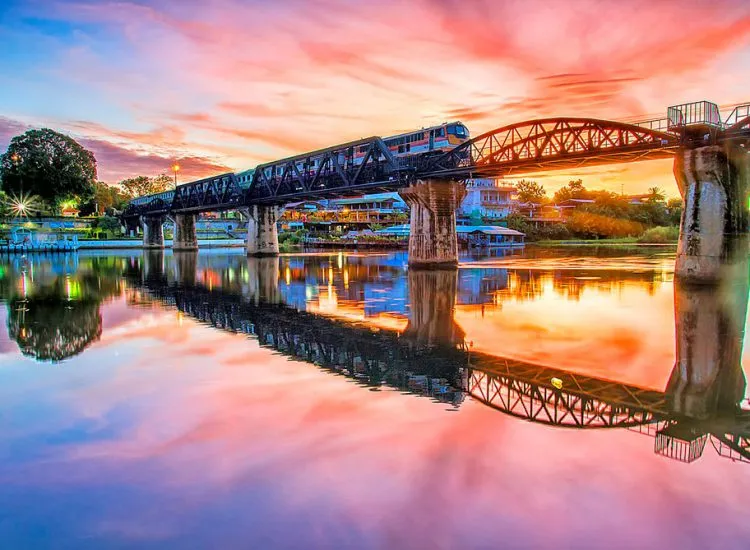
36. Bridge Over the River Kwai, Kanchanaburi is one of Thailand's most internationally recognized historical landmarks, located in Tha Makham Subdistrict, Mueang Kanchanaburi District. The railway bridge forms part of the Thai–Burma Railway, which was constructed during the Second World War under Japanese military control. The history of the project is closely connected to prisoners of war and civilian laborers who endured extreme hardship during its construction. Today, the bridge serves as an important memorial landscape where visitors can learn about wartime history while observing the River Kwai Yai and the surrounding scenery.
Highlights: Historic railway bridge over the River Kwai Yai, Second World War heritage, Thai–Burma Railway history, scenic river views, nearby war museums and memorials, and the atmosphere of Kanchanaburi's historic railway district.
The history of the Bridge Over the River Kwai is inseparable from the construction of the Thai–Burma Railway during the Second World War. Japanese military planners sought to establish a transport route between Thailand and Burma to support the movement of troops and supplies. The railway crossed extremely difficult terrain, including mountains, rivers, and forests. The project relied on prisoners of war and civilian laborers from different parts of Asia, many of whom faced inadequate food, disease, harsh treatment, and dangerous working conditions.
The railway's construction caused enormous human suffering and loss of life. The bridge became one of the most recognizable structures associated with this history and now serves as a reminder of the consequences of war. Understanding the experiences of the people who built the railway is essential to appreciating the site's significance. Rather than viewing the bridge solely as an engineering landmark or picturesque attraction, travelers are encouraged to consider the broader human history it represents.
The original wartime bridge structures suffered damage during aerial attacks in the later stages of the conflict. Following the war, repairs and reconstruction allowed the railway infrastructure to continue operating. As a result, the structure visible today reflects several stages of construction, destruction, and restoration. Observing the bridge's design can provide insight into the engineering and transportation challenges associated with railway operations during and after the war.
Visitors can admire the bridge from designated viewing areas along the river and nearby approaches. The combination of steel structure, water, and surrounding landscape creates attractive opportunities for photography, particularly in the morning and late afternoon. However, the bridge remains connected to an operating railway, and trains may pass through the area. Visitors must follow warning signals, remain clear of moving trains, and comply with instructions from railway personnel.
Several nearby attractions provide opportunities to explore the history of the railway in greater depth. The Kanchanaburi War Cemetery and historical museums in the city preserve information about prisoners of war and the human cost of railway construction. Visiting these sites alongside the bridge helps travelers understand the historical events from different perspectives and reinforces the importance of remembrance, peace, and historical education.
The surrounding district contains restaurants, shops, and tourism services that make the bridge a convenient destination for day visitors. Travelers can enjoy a meal overlooking the river or explore nearby attractions in Kanchanaburi town. Some visitors may also choose to travel on a railway service associated with the historic route, depending on the current schedule and available connections. Advance timetable checks are essential when planning a return journey.
The Bridge Over the River Kwai is suitable for history enthusiasts, railway travelers, students, and international visitors interested in understanding Thailand's role in the Second World War. Because the province contains many attractions spread across a large area, a day trip from Bangkok is most practical when focused on the bridge and nearby memorial sites rather than attempting to visit several distant waterfalls or national parks in the same day.
Open Days: The general bridge area is accessible daily, subject to railway operations and safety restrictions.
Getting There: From Bangkok, travel west toward Kanchanaburi Province via Phetkasem Road or connecting highways, then follow Highway 323 toward Tha Makham Subdistrict and the bridge. Visitors using public transportation can travel by train or bus to Kanchanaburi and continue to the bridge area. Check the current railway timetable and observe all railway safety regulations.
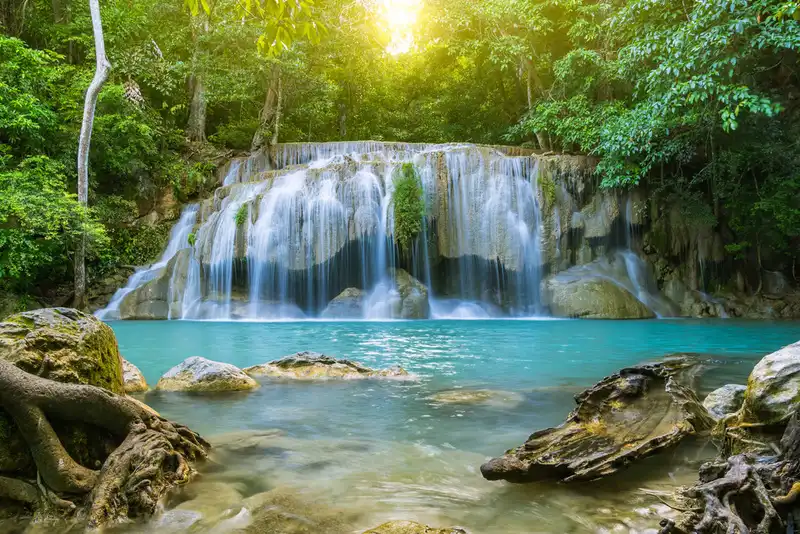
37. Erawan Waterfall, Kanchanaburi is one of Thailand's most celebrated natural attractions, located within Erawan National Park in Si Sawat District, Kanchanaburi Province. The waterfall is famous for its seven tiers, limestone formations, and beautiful natural pools that can appear turquoise or emerald green depending on lighting and water conditions. Surrounded by tropical forest, Erawan offers an outstanding environment for nature appreciation, hiking, photography, and outdoor recreation. For travelers planning a day trip from Bangkok, the waterfall is a more distant destination that requires an early departure and careful time management.
Highlights: Seven waterfall tiers, turquoise natural pools, limestone cascades, tropical forest scenery, designated nature trails, wildlife habitats, and recreational areas managed by Erawan National Park.
Erawan Waterfall is located within a forested landscape that forms part of Kanchanaburi's important watershed system. Streams descending through limestone terrain create cascades, pools, and natural rock formations. The appearance of the water is influenced by minerals, sediment, light, and seasonal conditions, giving some pools their distinctive blue-green coloration. These features demonstrate the relationship between geological processes and freshwater ecosystems in tropical mountain environments.
The waterfall has seven main tiers, each offering a different arrangement of flowing water, rocky terrain, and natural surroundings. Visitors who wish to explore all seven levels must be prepared for a longer walk with increasing changes in elevation. Some sections involve natural paths, tree roots, steps, and uneven surfaces, while the lower tiers are generally easier to reach. Travelers should assess their physical fitness and available time before choosing how far to continue along the route.
The natural pools are among the waterfall's most memorable features. In some places, water flows gently over limestone edges, while other sections feature more dramatic cascades and wider pools. The interplay between green forest vegetation, pale limestone, and clear water creates attractive opportunities for photography. Visitors should take care not to damage fragile rock formations or enter environmentally sensitive areas.
Swimming is a popular activity at Erawan Waterfall, but it is permitted only in areas and under conditions specified by national park authorities. Heavy rainfall can cause sudden changes in water levels and currents, creating significant risks near waterfalls and rocky slopes. Visitors should follow all safety warnings, avoid swimming in restricted areas, and never approach dangerous cliff edges. Seasonal closures or limitations may apply when conditions are unsuitable.
The surrounding forest is an important part of the waterfall experience. Trees and other vegetation help maintain the watershed, protect soil from erosion, and provide habitats for wildlife. Walking along designated trails allows visitors to observe the forest environment while enjoying the sounds of flowing water and the changing character of the terrain. Responsible visitors should avoid feeding wildlife, disturbing plants, or leaving rubbish along the trails.
Erawan National Park also offers an opportunity to learn about the importance of protected natural areas. The conservation of forests and freshwater systems supports biodiversity and helps maintain ecological processes extending beyond the park boundaries. Visitors can contribute to this effort by complying with park rules, limiting their environmental impact, and using only designated recreational areas.
For a day trip from Bangkok, Erawan Waterfall should generally be treated as the main destination rather than one stop among several distant attractions. The journey includes travel to Kanchanaburi and onward to Si Sawat District, which requires substantial time. Departing very early helps provide enough daylight for walking the trails and returning safely. Visitors with young children or older family members may prefer exploring the lower tiers rather than attempting the full route.
Open Days: According to the current announcements of Erawan National Park.
Opening Hours: 08:00 – 16:00 according to the listed attraction information. Individual waterfall levels may have earlier access restrictions.
Getting There: From Bangkok, travel toward Kanchanaburi Province and continue toward Si Sawat District, following signs to Erawan National Park. Travelers using public transportation can reach Kanchanaburi Bus Terminal and check available bus services toward the national park. Confirm park opening conditions, trail access restrictions, and weather warnings before departure.
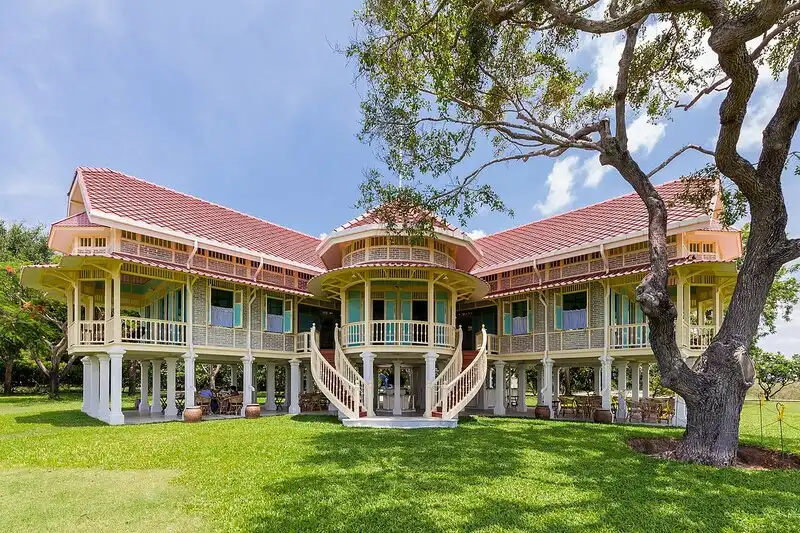
38. Mrigadayavan Palace, Phetchaburi is an elegant historic royal seaside residence located within the Rama VI military camp area in Huai Sai Nuea Subdistrict, Cha-Am District, Phetchaburi Province. Built during the reign of King Vajiravudh, Rama VI, the palace is celebrated for its extensive wooden architecture, elevated walkways, and carefully designed ventilation suited to Thailand's tropical coastal climate. Its distinctive combination of traditional Thai building techniques and modern architectural influences makes it an outstanding destination for travelers interested in royal history, sustainable architectural design, and heritage conservation.
Highlights: Historic teakwood royal buildings, elevated architectural structures, interconnected covered walkways, tropical climate-sensitive design, seaside landscape, and the royal history of King Vajiravudh, Rama VI.
Mrigadayavan Palace was developed during the reign of King Rama VI as a royal seaside residence. Its location near the Gulf of Thailand offered an environment suitable for relaxation, with coastal breezes and a relatively open natural landscape. Unlike formal royal buildings in the capital, the palace was designed specifically to accommodate leisure and residence in a tropical coastal setting. The resulting architecture reflects both the practical requirements of the environment and the changing artistic influences of the early twentieth century.
The palace is particularly distinguished by its extensive use of wooden construction. Many buildings are raised above the ground to improve ventilation and reduce heat accumulation beneath the floors. Windows, openings, and covered walkways are arranged to encourage airflow throughout the complex. These features demonstrate a sophisticated understanding of passive cooling techniques that remain relevant to discussions of environmentally responsive architecture.
Interconnected walkways are one of the palace's most memorable features. Long covered corridors link different groups of royal buildings, creating a continuous architectural composition across the grounds. This arrangement allowed movement between areas while providing shade and protection from the weather. The overall design emphasizes openness, balance, and a close relationship with the surrounding coastal environment.
The royal buildings were organized to support different aspects of court life, including residential functions, relaxation, and official activities. Studying the arrangement of rooms and connections between buildings helps visitors understand how the palace operated as a royal retreat. Architectural details such as timber columns, floorboards, shutters, and roof structures also demonstrate the craftsmanship involved in constructing and maintaining a complex of wooden buildings.
The surrounding grounds contribute greatly to the palace's atmosphere. Open spaces, greenery, and the nearby sea create a peaceful environment that complements the elegant architecture. Visitors can appreciate the relationship between the buildings and coastal landscape while walking along designated routes. Photography opportunities are numerous, particularly where long corridors, wooden structures, and the surrounding gardens create balanced architectural compositions.
Because the palace is constructed largely from timber, conservation is an ongoing responsibility. Historical wooden buildings are sensitive to moisture, weather, insects, and physical wear, making careful maintenance essential. Some areas may be temporarily closed or subject to limited access during conservation work. Visitors should respect all restrictions, avoid touching fragile surfaces unnecessarily, and follow the instructions of the palace's caretakers.
Mrigadayavan Palace can be included in a day trip from Bangkok to Cha-Am or Phetchaburi. Travelers may explore the palace earlier in the day before visiting nearby coastal areas or local restaurants. The extensive grounds and walking routes require sufficient time, particularly for visitors interested in architectural photography. Older visitors should check the walking conditions and current access arrangements before arrival.
Open Days: Friday – Sunday according to the listed attraction information. Thursday visits for organized groups or educational institutions may require advance arrangements.
Opening Hours: 09:00 – 17:00, subject to current access conditions and final admission rules.
Getting There: From Bangkok, follow Rama II Road or another major route toward Phetchaburi and continue to Cha-Am District. Follow signs toward Rama VI Camp and Mrigadayavan Palace. Travelers using public transportation can reach Cha-Am by bus or train and continue by local taxi. Check the current opening schedule, dress requirements, and access restrictions before departure because the palace is not necessarily open to general visitors every day.
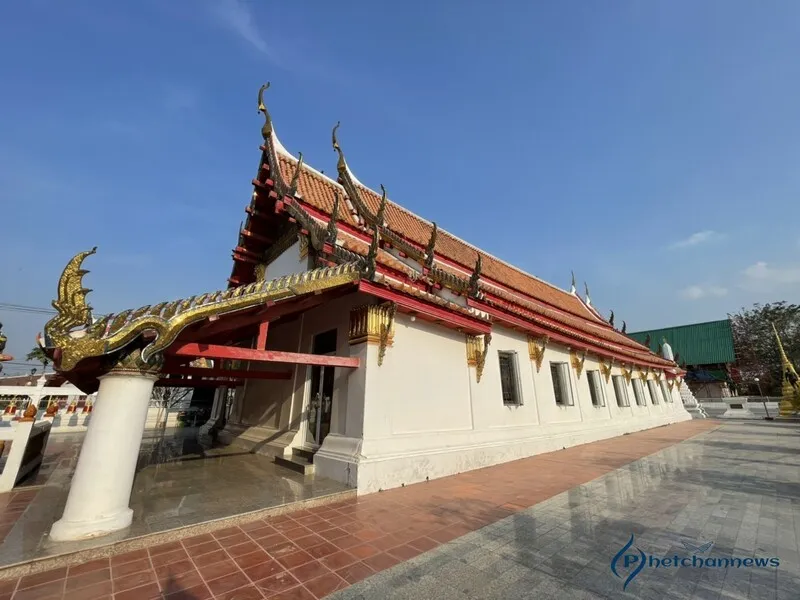
39. Wat Pa Mok Worawihan, Ang Thong is a historically important royal Buddhist temple located beside the Chao Phraya River in Pa Mok District, Ang Thong Province. The temple is best known for its revered reclining Buddha, housed within an elegant religious hall, and for historical accounts associated with the relocation of the Buddha image during the Ayutthaya period. Its combination of religious devotion, architectural heritage, and riverside history makes it a rewarding destination for travelers exploring the Buddhist landmarks of central Thailand.
Highlights: Revered reclining Buddha, historic Buddhist hall, accounts of moving the Buddha image during the Ayutthaya period, traditional royal temple architecture, Chao Phraya riverside setting, and continuing religious traditions.
Wat Pa Mok Worawihan has longstanding historical connections to the Ayutthaya Kingdom and the settlements along the Chao Phraya River. During the premodern period, waterways were essential routes for transportation, agriculture, and religious activities. Temples established along the river often served as important community centers, where residents gathered to make merit, participate in ceremonies, and maintain religious traditions. Wat Pa Mok reflects this relationship between Buddhist institutions and the geography of central Thailand.
The temple's reclining Buddha is the principal devotional landmark. The image is housed within a large viharn, allowing visitors to admire the peaceful facial expression, elongated proportions, and carefully modeled features of the sculpture. The protected setting emphasizes the spiritual character of the image and provides space for worshippers. Visitors can appreciate the relationship between the Buddha sculpture and its architectural surroundings while observing appropriate Buddhist etiquette.
One of the most important historical accounts associated with Wat Pa Mok concerns the relocation of the reclining Buddha during the reign of King Thai Sa of Ayutthaya. The original position of the image was threatened by erosion along the riverbank, prompting an ambitious effort to move the large sculpture to a safer location and construct an appropriate hall. This undertaking reflects the determination to preserve an important religious monument and demonstrates the capabilities of historical craftsmen and organizers who undertook the difficult operation.
The story of the Buddha image's relocation adds an engineering dimension to the temple's history. Moving a monumental sculpture without modern mechanical equipment would have required careful preparation, specialized techniques, and the coordinated efforts of many workers. The event therefore represents an important example of historical heritage conservation as well as an expression of Buddhist devotion.
Wat Pa Mok also offers an opportunity to appreciate the relationship between traditional religious architecture and the riverside landscape. The surrounding community developed within the broader agricultural region of the Chao Phraya basin, where water transportation shaped settlement and economic activity. Exploring the temple encourages visitors to consider how natural processes, including riverbank erosion, affected religious buildings and community infrastructure in the past.
The temple continues to serve as a place of Buddhist worship and community ceremonies. Residents and pilgrims visit to pay their respects to the reclining Buddha and participate in merit-making activities. Major Buddhist holidays may bring additional visitors and ceremonies, while other religious events may follow schedules announced by the temple. Travelers should respect worshippers and observe the appropriate customs when entering sacred spaces.
Wat Pa Mok Worawihan can be combined with Wat Muang and Wat Khun Inthapramun during a day trip around Ang Thong Province. The three temples provide an opportunity to observe monumental Buddhist sculptures in different forms and architectural settings. A carefully planned route can help reduce travel time between districts while allowing sufficient time for worship, photography, and historical exploration.
Open Days: Daily
Opening Hours: 08:00 – 17:00
Getting There: From Bangkok, travel north toward Ayutthaya and continue to Pa Mok District in Ang Thong. Highway 309 and connecting roads provide access to the riverside temple area. Travelers using public transportation can reach Ang Thong or Pa Mok and continue by local taxi. The temple is located along the western bank of the Chao Phraya River.

40. Hat Puek Tian Beach, Phetchaburi is a coastal attraction located in Puek Tian Subdistrict, Tha Yang District, Phetchaburi Province. The beach is known for its relaxed Gulf of Thailand atmosphere and distinctive sculptures inspired by characters from Phra Aphai Mani, the celebrated Thai literary work composed by Sunthorn Phu. This combination of seaside scenery and literary-inspired artwork gives Hat Puek Tian a character different from many conventional beach destinations. It is suitable for travelers who want to enjoy a day by the sea while discovering elements of Thai literature and cultural imagination.
Highlights: Gulf of Thailand beach scenery, sculptures representing characters from Phra Aphai Mani, seaside walks, coastal photography, local seafood, and opportunities to explore other attractions in Phetchaburi.
Hat Puek Tian forms part of Phetchaburi's coastal landscape, where communities have historically depended on fishing, agriculture, and access to the Gulf of Thailand. The coastline is influenced by waves, tides, winds, and sediment movement, which can change the appearance of the beach over time. Visitors should therefore expect natural variations in beach conditions throughout the year and check current weather and sea conditions before entering the water.
The literary sculptures are the beach's most recognizable cultural feature. They draw inspiration from Phra Aphai Mani, a major work of Thai literature written by Sunthorn Phu. The story combines adventure, romance, mythology, and sea journeys, making its characters especially suitable for a coastal artistic setting. By presenting these figures in a public seaside landscape, the attraction creates a visual connection between a real location and the imaginative world of classical Thai literature.
For visitors unfamiliar with Thai literary history, the sculptures provide an accessible introduction to Phra Aphai Mani and its cultural significance. The story remains widely recognized in Thailand and forms an important part of the country's literary heritage. Families can use the sculptures to introduce children to famous characters and themes, while international travelers may find the connection between mythology, sculpture, and the surrounding sea particularly interesting.
Hat Puek Tian also offers opportunities to enjoy the natural coastal landscape. Visitors can walk along accessible sections of the beach, relax in the sea breeze, and observe changes in light and water conditions throughout the day. The sculptures create distinctive photographic subjects, particularly when framed against the beach and the Gulf of Thailand. Morning and late-afternoon visits are generally more comfortable for outdoor activities than the hottest part of the day.
Local food contributes to the seaside experience. Visitors can look for Thai dishes and seafood served by businesses operating in the surrounding area. Choosing local establishments provides an opportunity to sample regional cuisine while supporting coastal communities. Travelers should confirm prices before ordering and consider the available time for dining and the return journey to Bangkok.
Hat Puek Tian is suitable for families, couples, and groups of friends who want a relaxed coastal outing. It can also be combined with Phra Nakhon Khiri Historical Park in Phetchaburi if the itinerary is carefully planned. A practical option is to visit the historical park in the morning before continuing to the beach in the afternoon. Travelers should avoid including too many distant coastal stops when planning to return to Bangkok the same evening.
Responsible beach tourism is important for maintaining the natural environment. Visitors should dispose of rubbish appropriately, avoid disturbing wildlife, and exercise caution near the water. Children should always be supervised, and swimming should be limited to areas and conditions considered safe. The beach's atmosphere and literary artwork make it an interesting cultural seaside destination even for visitors who prefer not to swim.
Open Days: The public beach area is generally accessible daily. Shops and visitor services follow their own operating schedules.
Getting There: From Bangkok, follow Rama II Road toward Phetchaburi and continue into Tha Yang District. Follow local road signs toward Puek Tian Subdistrict and the coastline. Travelers without private vehicles can reach Phetchaburi town or Tha Yang and arrange local transport to the beach. Check the weather and allow sufficient time for the journey back to Bangkok.
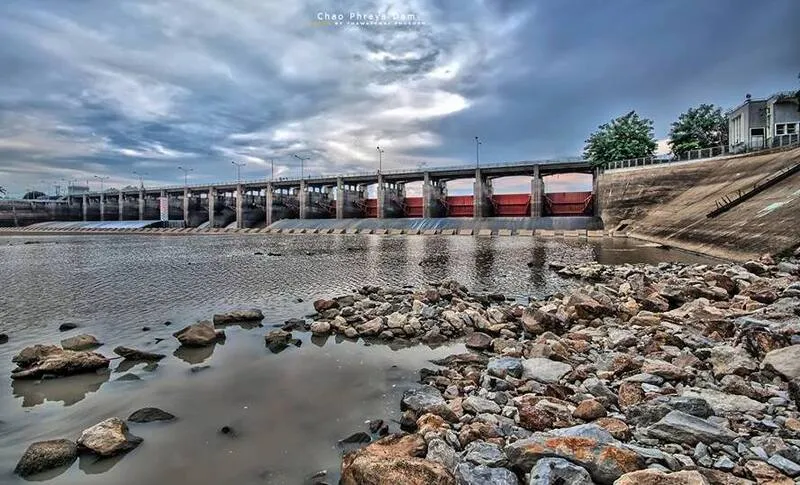
41. Chao Phraya Dam, Chai Nat is one of Thailand's most important irrigation structures, situated along the Chao Phraya River in Bang Luang Subdistrict, Sapphaya District, Chai Nat Province. The dam plays a major role in controlling river water levels and distributing water into central Thailand's extensive irrigation network. In addition to its engineering importance, the surrounding area offers broad river views and opportunities to understand the relationship between water management, agriculture, and the development of communities along the Chao Phraya River. It is a rewarding destination for travelers interested in engineering, geography, and the landscapes of central Thailand.
Highlights: Large river barrage and sluice gates, panoramic Chao Phraya River views, Thailand's central irrigation network, water-management engineering, riverside scenery, and opportunities to learn about the relationship between agriculture and natural resources.
The Chao Phraya River has shaped the history, settlement patterns, and agricultural economy of central Thailand for centuries. Its waters support extensive areas of rice cultivation and provide resources for cities and rural communities throughout the lower river basin. Managing the river's flow is therefore essential for irrigation and seasonal water distribution. Chao Phraya Dam forms an important component of this system, helping direct water into irrigation canals that serve agricultural areas downstream.
Chao Phraya Dam is technically a diversion barrage rather than a large mountain reservoir. Its principal purpose is to control upstream water levels and regulate the flow of water through gates, allowing water to be distributed to irrigation canals when conditions require it. This distinguishes the structure from major storage dams that retain large volumes of water within reservoirs surrounded by mountains. Visitors interested in civil engineering can appreciate these functional differences while observing the physical relationship between the barrage, river currents, and surrounding landscape.
The dam's structure demonstrates the complexity of managing water resources within a major river basin. Seasonal rainfall varies considerably, creating periods when agricultural communities require additional irrigation and other periods when large volumes of water must move downstream. Water management must therefore balance agricultural demand, river conditions, and the wider needs of communities. Chao Phraya Dam offers a practical example of the infrastructure required to support these activities in Thailand's central plains.
The landscape around the dam changes according to seasonal water conditions. During periods of higher river flow, visitors may observe substantial volumes of water passing through the control structures. At other times, differences in upstream and downstream water levels may be more apparent. These changing conditions reveal how water infrastructure interacts with a living river system. However, strong currents near the gates can be dangerous, and visitors should remain within public viewing areas.
Beyond its technical function, the dam provides an opportunity to learn about the historical importance of the Chao Phraya River. For generations, the river supported transportation, commerce, agriculture, and the growth of settlements. Its management continues to affect communities over a wide geographical area, extending far beyond Chai Nat Province. Visiting the dam therefore helps travelers connect the physical landscape with the economic and social development of central Thailand.
Chao Phraya Dam can be included in a day trip around Chai Nat together with selected temples and cultural landmarks, including Wat Pak Khlong Makham Thao. Travelers should consider the significant distance from Bangkok and begin their journey early. Choosing a limited number of destinations is more practical than attempting to explore several distant districts in one day.
Morning and late afternoon are generally more comfortable for observing the dam and surrounding river scenery. Visitors should follow all signs, avoid restricted operational areas, and respect any temporary access limitations issued by the authorities responsible for the structure. Photography should take place only from permitted and safe positions.
Open Days: The general visitor area is accessible according to the regulations of the responsible authority. Access to operational sections may be restricted.
Getting There: From Bangkok, follow the Asian Highway north toward Chai Nat Province, then continue to Sapphaya District and Bang Luang Subdistrict. Follow signs toward Chao Phraya Dam. Travelers using public transportation can reach Chai Nat or Sapphaya and continue by local taxi. Allow additional time for the return journey and do not enter restricted sections of the dam.
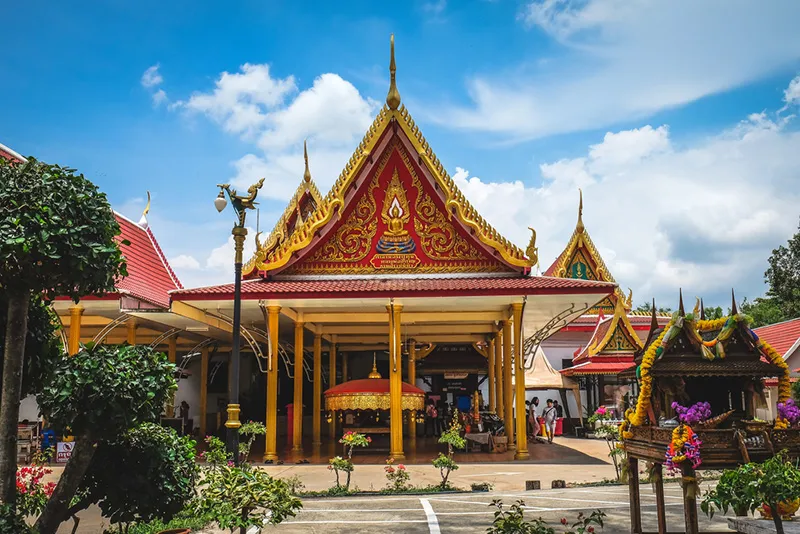
42. Wat Pak Khlong Makham Thao, Chai Nat is a historically significant Buddhist temple located in Makham Thao Subdistrict, Wat Sing District, Chai Nat Province. The temple is particularly well known for its association with Luang Pu Suk Kesaro, a revered Thai monk whose reputation and teachings have remained influential among Buddhist devotees. The temple combines religious heritage, local history, and the cultural traditions surrounding respected Buddhist teachers. Its riverside location also reflects the importance of waterways in the historical development of communities in the upper central plains.
Highlights: Historical connections to Luang Pu Suk Kesaro, Buddhist architecture and shrines, devotional traditions, local religious art, the history of revered Thai monks, and the atmosphere of a traditional riverside temple.
Wat Pak Khlong Makham Thao has become an important destination for visitors interested in the life and religious legacy of Luang Pu Suk Kesaro, a monk widely respected in Thai Buddhist culture. He is associated with religious practice, traditional knowledge, and the cultural history of prominent Thai spiritual teachers. His reputation has continued through the stories, objects, and traditions preserved by devotees and local communities.
Luang Pu Suk is also historically associated with Prince Abhakara Kiartivongse, Prince of Chumphon, an important figure in the history of the Royal Thai Navy. This connection adds another dimension to the temple's significance by linking the life of a respected Buddhist monk with the biography of an influential member of the Thai royal family. Visitors interested in Thai history can explore the relationship between religious teachers and prominent historical figures while distinguishing documented biographical information from beliefs passed down through local tradition.
The temple's name reflects its location near a canal junction in Makham Thao, where waterways historically supported transportation and settlement. Before the expansion of modern roads, rivers and canals played major roles in enabling residents to travel between communities, conduct trade, and visit religious institutions. Temples established along these routes often became important gathering places and spiritual centers. Wat Pak Khlong Makham Thao therefore reflects a wider pattern of religious community development in central Thailand.
Within the temple grounds, visitors can observe religious buildings, shrines, and areas dedicated to Buddhist worship. Architectural details and sacred objects provide insight into local craftsmanship and religious traditions. The temple remains especially meaningful to people who respect Luang Pu Suk and wish to learn about his life. For international visitors, the site offers an introduction to the cultural significance of revered Buddhist monks within Thai society.
The traditions associated with Luang Pu Suk also demonstrate the role of amulets and sacred objects in Thai religious culture. Such objects are often connected with devotional practices and beliefs that have been transmitted across generations. Their significance can be studied in the context of social history, religious practice, and cultural identity. Visitors interested in these traditions may find the temple particularly informative when approached with respect for the beliefs of worshippers.
Wat Pak Khlong Makham Thao can be combined with Chao Phraya Dam and other attractions in Chai Nat Province. The itinerary offers two contrasting perspectives on the importance of waterways: their historical relationship with religious communities and their modern role in irrigation and agriculture. An early departure from Bangkok allows travelers to explore both sites without rushing.
The temple is suitable for families, Buddhist pilgrims, religious history enthusiasts, and visitors interested in traditional Thai culture. Appropriate clothing and respectful behavior are expected within sacred areas. Visitors wishing to attend particular ceremonies should check the temple's announcements because scheduled activities may vary according to religious holidays and community events.
Open Days: Daily
Opening Hours: 08:00 – 18:00
Getting There: From Bangkok, drive north along the Asian Highway toward Chai Nat and continue to Wat Sing District and Makham Thao Subdistrict. Follow signs toward Wat Pak Khlong Makham Thao. Travelers arriving by public transportation can reach Chai Nat town and arrange local transport to the temple. Plan your return time carefully when combining the visit with other attractions.

43. Wat Pho Kao Ton (Wat Mai Daeng), Sing Buri is an important historical and Buddhist attraction located in Bang Rachan Subdistrict, Khai Bang Rachan District, Sing Buri Province. The temple is closely connected to the historical memory of the Bang Rachan villagers, who are remembered for their resistance during the final years of the Ayutthaya Kingdom. Its significance extends beyond religious architecture, as the site is associated with stories of collective courage, community organization, and sacrifice. Wat Pho Kao Ton is particularly suitable for visitors interested in Thai history, local heritage, and educational day trips from Bangkok.
Highlights: Historical associations with the Bang Rachan villagers, Buddhist temple heritage, community memorial traditions, connections to the final years of Ayutthaya, and nearby historical attractions within Khai Bang Rachan District.
The history of Wat Pho Kao Ton is associated with the events that occurred before the fall of Ayutthaya in 1767. Traditional accounts describe groups of villagers in the Bang Rachan area who organized resistance against Burmese military forces during a period of warfare and political instability. Their courage and determination became important elements of Thai historical memory. Over time, the Bang Rachan story has been interpreted as a symbol of unity, sacrifice, and the defense of local communities.
The temple's importance lies partly in its relationship with the surrounding historical landscape. Rural settlements, waterways, temples, and community gathering places formed the physical environment in which the remembered events took place. Exploring Wat Pho Kao Ton allows visitors to consider how places of worship also served as important centers for communication and collective activity during periods of crisis.
Wat Pho Kao Ton continues to function as a religious and community site. Visitors can explore the temple grounds, pay their respects, and observe the relationship between Buddhist traditions and historical commemoration. The site's meaning is maintained not simply by surviving buildings but also by the stories and cultural practices that local residents have passed down over generations.
The Bang Rachan narrative is especially valuable for understanding how local events become part of broader national history. Much of Thailand's historical writing focuses on royal capitals and political leaders, while community histories reveal the experiences and perspectives of people living outside major administrative centers. Visiting Wat Pho Kao Ton offers an opportunity to consider how warfare affected ordinary communities and how historical memory has been preserved through literature, commemorative sites, and education.
Travelers interested in the broader history of Bang Rachan can combine a visit to the temple with the Bang Rachan Heroes Monument and other nearby historical landmarks. Exploring these locations together provides a more complete geographical context for the accounts associated with the villagers. It also allows visitors to examine how temples, monuments, and community narratives contribute to the preservation of historical identity.
Wat Pho Kao Ton is suitable for students, teachers, families, and travelers interested in cultural heritage. The temple provides an opportunity to reflect on historical values such as cooperation and responsibility while learning about the conditions of central Thailand during the late Ayutthaya period. Visitors should distinguish between historical evidence and later literary or commemorative interpretations when studying the events in detail.
A day trip from Bangkok can include Wat Pho Kao Ton and Wat Phra Non Chakkrasi Worawihan, although the distance between districts and the journey back to the capital should be considered. Starting early and limiting the number of attractions helps create a more relaxed itinerary. Respectful clothing and appropriate behavior are expected when visiting the active temple.
Open Days: Daily, with general visits best planned during daylight hours.
Getting There: From Bangkok, follow the Asian Highway toward Sing Buri and continue to Khai Bang Rachan District and Bang Rachan Subdistrict. Follow local signs to Wat Pho Kao Ton. Visitors traveling by public transport can reach Sing Buri town and continue by taxi or other local services. Plan the route in advance if you intend to visit the nearby Bang Rachan memorial attractions.

44. Hua Hin Beach, Prachuap Khiri Khan is one of Thailand's most established seaside destinations, located in Hua Hin Subdistrict, Hua Hin District, Prachuap Khiri Khan Province. The beach is famous for its long sandy coastline, relaxed resort-town atmosphere, and convenient access from Bangkok. Hua Hin has attracted Thai and international visitors for generations, developing from a coastal settlement into an important leisure destination closely connected with the history of modern tourism in Thailand. It is suitable for travelers who want to enjoy sea views, coastal walks, regional food, and the atmosphere of a historic seaside town without necessarily staying overnight.
Highlights: Long sandy beach, Gulf of Thailand views, historic seaside resort atmosphere, coastal photography, restaurants and cafés, beach walks, and cultural attractions within Hua Hin town.
Hua Hin became an important seaside destination during a period when improvements in transportation made coastal travel more accessible from Bangkok. The development of the Southern Railway was especially significant, connecting the capital with towns along the Gulf of Thailand. Railway travel helped support the growth of Hua Hin as a leisure destination, and its association with royal visits contributed to its reputation as one of Thailand's early resort towns.
The beach itself stretches along the Gulf of Thailand and offers an attractive environment for walking, relaxing, and appreciating coastal scenery. Conditions change with tides, winds, and seasonal weather, so the width of exposed sand and the character of the shoreline may vary. Visitors can enjoy views of the sea and surrounding coastal landscape while choosing a suitable place to rest or take photographs.
Hua Hin's appeal extends beyond the beach. The town retains elements of its historical resort identity, including railway heritage, older buildings, and traditional commercial areas. Visitors interested in local culture can combine a beach walk with selected attractions in town, providing a broader understanding of how Hua Hin developed over time. This combination of coastal recreation and historic urban character distinguishes Hua Hin from many other seaside destinations.
Food is another important part of the Hua Hin experience. The town offers seafood, Thai cuisine, local desserts, and a wide variety of dining establishments. Travelers can enjoy a meal after exploring the beach or visit traditional markets when they are open. Those planning a day trip should consider both dining time and the substantial journey back to Bangkok, particularly during weekends when traffic may become heavy.
Photography enthusiasts will find attractive subjects along the shoreline throughout the day. Early morning offers relatively comfortable temperatures and changing light across the sea, while late afternoon is suitable for relaxing walks and coastal views. Visitors interested in local architecture may also explore the railway station area and nearby historic streets, provided that the itinerary allows sufficient time.
Hua Hin Beach is suitable for families, couples, and groups of friends. A day trip can include a beach walk, lunch, and one or two additional attractions within the town. However, attempting to explore several distant destinations in Prachuap Khiri Khan during the same day is usually impractical. Choosing a compact route helps travelers make the most of their time while avoiding an unnecessarily tiring return journey.
Beach safety should always be considered, particularly when traveling with children. Visitors should check sea conditions and pay attention to any warnings or local restrictions before swimming. Responsible behavior includes disposing of rubbish properly, respecting other beach users, and avoiding activities that disturb animals or damage coastal habitats.
Open Days: The public beach area is generally accessible daily. Restaurants and tourism services follow their own operating schedules.
Getting There: From Bangkok, travel south via Rama II Road and Phetkasem Road toward Hua Hin in Prachuap Khiri Khan Province. Visitors can also use train or bus services to Hua Hin and continue to the beach from the town center. Check return transportation schedules in advance if you intend to complete the trip in one day.

45. Rahaeng 100-Year Market, Pathum Thani is a historic canal-side market located in Rahaeng Subdistrict, Lat Lum Kaeo District, Pathum Thani Province. The market is distinguished by traditional wooden shophouses, long-established local businesses, and a community atmosphere associated with the canal trading networks of central Thailand. Unlike large modern shopping centers, Rahaeng Market offers a quieter environment in which visitors can explore historic architecture, local food, and the traditional character of a settlement that developed along a waterway.
Highlights: Historic wooden shophouses, Rahaeng Canal, traditional local shops, Thai food, old community architecture, cultural heritage, and the nearby Wat Bua Kaeo Kasorn.
Rahaeng 100-Year Market developed within the canal-based transportation network of Pathum Thani. Before modern roads became widespread, waterways were essential for transporting agricultural produce and everyday goods between villages and urban trading centers. Local markets emerged where residents and merchants could exchange products conveniently along these routes. Rahaeng became one such commercial settlement, supporting surrounding farming communities and connecting them with the wider regional economy.
The market's historic wooden buildings provide valuable evidence of earlier commercial lifestyles. Traditional shophouses were designed to combine business activities with residential functions, often placing retail space at the front while other areas supported family life. Their proximity to the canal reflects the importance of water transport for trade and daily movement. Visitors can observe wooden doors, shop signs, and architectural details that preserve elements of the old market's character.
Local food and traditional businesses contribute to the market's appeal. Visitors may find Thai dishes, snacks, and products associated with the surrounding community, depending on which shops are operating. Exploring these businesses provides an opportunity to support local livelihoods while experiencing a form of commerce that has evolved gradually over generations. Market activity may be more lively on weekends than on ordinary weekdays.
Wat Bua Kaeo Kasorn is part of the wider cultural environment surrounding Rahaeng Market. The relationship between temples, markets, and canals reflects a common pattern in traditional Thai settlements. Temples served as religious and social centers, markets provided opportunities for economic exchange, and waterways connected communities with one another. Understanding these relationships adds depth to the experience of exploring a historic canal-side neighborhood.
Rahaeng Market is particularly interesting for visitors who enjoy vernacular architecture and community history. The environment differs from a museum because the buildings remain part of an active settlement. Travelers can observe how historic structures continue to be used and adapted, while recognizing that the preservation of a community's identity depends on its residents as much as on its physical architecture.
The market is suitable for families, photographers, food enthusiasts, and travelers looking for a relaxed day trip close to Bangkok. It can be combined with Wat Chedi Hoi or other attractions in Lat Lum Kaeo District. Visitors should allow time to wander through the market without rushing and should respect the privacy of residents living within the historic community.
For those traveling without a car, advance planning is advisable because the market is not directly served by Bangkok's main urban railway network. Weekend visits may offer a more active market atmosphere, but individual businesses operate according to their own schedules. Checking the availability of shops you particularly want to visit can help avoid disappointment.
Open Days: The historic community is generally accessible daily. Individual shops follow their own schedules, with more activity often occurring on weekends.
Getting There: From Bangkok, travel into Pathum Thani Province and follow Highway 346 toward Lat Lum Kaeo District. Continue to Rahaeng Subdistrict and the canal-side market area. Public transportation users can reach Pathum Thani and continue by local taxi or other available transport. Check current shop opening arrangements if your visit is focused on particular food stalls or businesses.

46. Kaeng Krachan National Park, Phetchaburi is one of Thailand's most important protected natural areas, encompassing extensive forests and mountains across parts of Phetchaburi and Prachuap Khiri Khan provinces. The park is celebrated for its exceptional biodiversity, forested watersheds, wildlife habitats, and spectacular natural landscapes. For travelers planning a day trip from Bangkok, the reservoir and accessible areas around the park headquarters in Kaeng Krachan District, Phetchaburi, are more practical destinations than the remote mountain trails. The park is particularly rewarding for visitors interested in tropical ecology, forest conservation, scenic photography, and the natural heritage of western Thailand.
Highlights: Extensive tropical forests, Kaeng Krachan Reservoir, mountain scenery, biodiversity and wildlife habitats, watershed ecosystems, accessible lakeside landscapes, and opportunities for environmental education.
Kaeng Krachan National Park forms part of the extensive forest landscapes of western Thailand, an area of exceptional ecological importance. Its terrain includes mountainous forests, valleys, streams, and watersheds that support natural ecosystems across a large geographical region. Differences in elevation, rainfall, and vegetation create varied habitats for plants and animals. Maintaining the continuity of these forests is especially important because many wildlife species require extensive, connected habitats to survive.
The park is part of the Kaeng Krachan Forest Complex, which was inscribed on the UNESCO World Heritage List in 2021. The designation recognizes the area's outstanding importance for biodiversity conservation and its remarkable ecological characteristics. The forest complex supports numerous species of plants and animals, including wildlife associated with tropical forests and mountain ecosystems. Its international recognition highlights the need to protect natural habitats and maintain effective long-term conservation measures.
For day visitors, the landscape around Kaeng Krachan Reservoir provides an accessible introduction to the region's natural beauty. The broad expanse of water is surrounded by forested hills, creating attractive scenery that changes with the seasons, water levels, and weather. Visitors can appreciate the relationship between the reservoir and surrounding watershed without undertaking a demanding journey into remote forest areas. Photography enthusiasts may find the combination of water, mountains, and changing light particularly appealing.
The reservoir also illustrates how water infrastructure interacts with the natural landscape. Forested watersheds help regulate the movement of water and protect soil from erosion, while reservoirs support water management in downstream areas. Observing the surrounding terrain allows travelers to consider the importance of balancing water use, agricultural needs, tourism, and environmental conservation. This relationship is especially relevant in regions where seasonal rainfall influences both natural ecosystems and community livelihoods.
Some of Kaeng Krachan's best-known natural attractions are located deeper inside the forest, including mountain viewpoints, wildlife observation areas, and routes through remote landscapes. These destinations may require specialized vehicles, seasonal access permits, or considerably more travel time. Roads and visitor routes can also be closed because of heavy rain, maintenance, or environmental protection measures. Travelers should therefore distinguish between the easily accessible reservoir area and more demanding interior destinations when planning their visit.
Wildlife conservation is an essential aspect of the park's identity. Visitors should never feed wild animals, approach them for photographs, or make unnecessary noise in sensitive habitats. Staying on authorized routes and observing wildlife from a safe distance helps reduce disturbance. The park's value extends beyond its visual appeal; it is an important refuge for biodiversity and a vital component of Thailand's natural heritage.
Kaeng Krachan National Park is suitable for nature lovers, families, photographers, and travelers interested in environmental education. A day trip from Bangkok should focus on accessible locations near the reservoir or park entrance rather than attempting to visit multiple remote areas. An early departure provides more daylight for sightseeing and the return journey. Travelers should also account for possible weather changes, particularly during the rainy season.
Before traveling, check the latest announcements from the Department of National Parks, Wildlife and Plant Conservation concerning access, fees, seasonal closures, and permitted activities. Appropriate clothing, comfortable footwear, drinking water, and rain protection will improve the experience. Responsible travel helps preserve the natural environment while allowing visitors to appreciate the exceptional landscapes of the Kaeng Krachan region.
Open Days: According to current national park announcements. Some visitor routes and forest areas may close seasonally.
Getting There: From Bangkok, follow Rama II Road or Phetkasem Road toward Phetchaburi, then continue to Kaeng Krachan District and the reservoir area. Follow signs to the national park headquarters or your selected visitor location. Public transportation connections into the park are limited, so travelers without a private vehicle should arrange onward transportation in advance. Confirm that your chosen area is open before departure.

47. Phra Pathom Chedi National Museum, Nakhon Pathom is a culturally significant museum associated with the archaeological heritage of Nakhon Pathom Province. Located in the area of Wat Phra Pathom Chedi Ratchaworamahawihan in Mueang Nakhon Pathom District, the museum is known for collections related to the development of ancient communities in central Thailand, particularly the Dvaravati cultural period. Its historical significance lies in the preservation and interpretation of Buddhist sculptures, archaeological evidence, and artistic traditions that help explain the early history of Nakhon Pathom. Travelers interested in Thai archaeology can combine the museum with the monumental Phra Pathom Chedi on a day trip from Bangkok, provided the museum is currently open to visitors.
Highlights: Dvaravati-period archaeological heritage, Buddhist sculptures, ancient religious art, historical evidence related to early Nakhon Pathom, and opportunities to connect museum collections with the history of Phra Pathom Chedi.
Nakhon Pathom is one of Thailand's most important areas for the study of early historic settlements in the central plains. Archaeological discoveries from the province provide evidence of communities associated with Dvaravati culture, which flourished before the establishment of the later major Thai kingdoms. These communities participated in regional religious, artistic, and commercial networks, and their surviving material culture demonstrates the importance of Buddhism in early central Thailand.
Dvaravati-period Buddhist art is particularly significant for understanding the history of religious sculpture in mainland Southeast Asia. Buddha images and decorative objects display artistic characteristics that reflect both local craftsmanship and cultural influences transmitted through regional connections. By examining such objects, historians and archaeologists can study developments in religious beliefs, artistic traditions, and the organization of ancient communities.
The archaeological heritage associated with Phra Pathom Chedi also provides important context for understanding the wider history of the monument. Although the great stupa visible today was extensively reconstructed in the Rattanakosin era, the location is associated with a much longer religious tradition. Objects discovered from the wider Nakhon Pathom area help illustrate how Buddhist institutions and settlements developed over centuries. The relationship between archaeological finds and surviving religious landmarks is an essential part of the region's historical importance.
Museum collections can provide information that is not always visible when visiting ancient monuments. Portable sculptures, inscriptions, and other archaeological objects may preserve evidence of artistic techniques, religious practices, and historical communities. Studying individual objects alongside their archaeological context helps visitors appreciate how knowledge of the past is developed through material evidence rather than relying solely on legends or later accounts.
For travelers exploring Nakhon Pathom, combining historical learning with a visit to Phra Pathom Chedi provides a meaningful way to understand the area's cultural identity. The stupa remains an important living Buddhist monument, while archaeological collections and historical interpretation explain aspects of earlier religious activity. The combination of worship, architecture, and historical evidence reflects the continuity and transformation of Buddhism within the region.
The museum's subject matter is particularly valuable for students, teachers, art historians, and travelers interested in Thailand's early history. Carefully studying historical objects can reveal details of sculpture, craftsmanship, and cultural exchange that are easily overlooked during conventional sightseeing. Visitors should respect preservation requirements and follow any restrictions regarding photography or access to exhibition areas.
Getting There: From Bangkok, travel along Phetkasem Road or another suitable route to central Nakhon Pathom and continue toward Phra Pathom Chedi. Travelers using public transportation can take a train to Nakhon Pathom Railway Station. The museum's historical location is close to the main stupa area; however, confirm the current exhibition location and whether the museum is accepting visitors before traveling specifically for the collection.
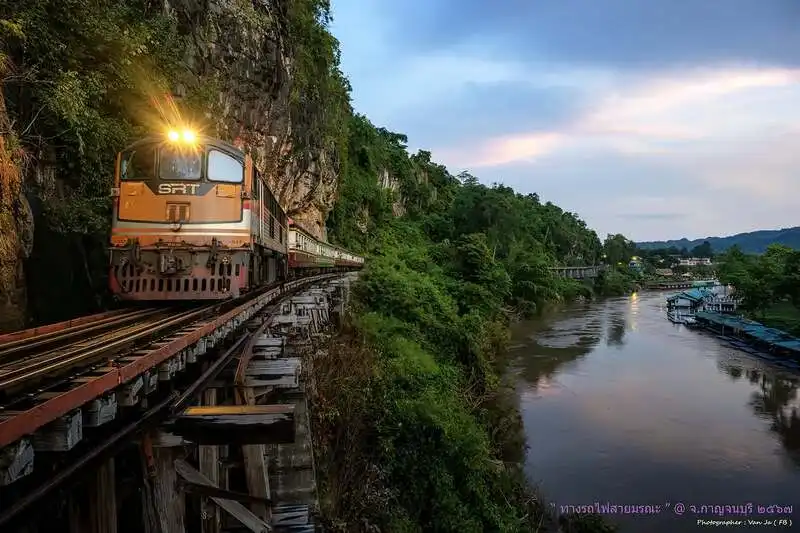
48. Death Railway, Kanchanaburi is a historically significant railway route associated with the construction of the Thai–Burma Railway during the Second World War. Running through parts of Kanchanaburi Province, the railway is remembered for the immense suffering of prisoners of war and civilian laborers who were compelled to work under extremely difficult conditions. Certain surviving sections remain in use for passenger services, allowing visitors to experience a railway landscape that combines wartime history with views of rivers, cliffs, and mountains. Particularly well-known scenic sections can be found around Tham Krasae, where the railway follows the hillside above the River Kwai Noi.
Highlights: Thai–Burma Railway history, Second World War memorial heritage, surviving historic railway sections, the cliffside railway near Tham Krasae, River Kwai Noi scenery, and opportunities to learn about the experiences of prisoners of war and civilian laborers.
The railway was constructed during the Second World War as part of a Japanese military project intended to establish a transportation connection between Thailand and Burma. The route crossed mountainous terrain, dense forests, rivers, and difficult slopes. Construction involved prisoners of war from Allied countries and a large number of civilian laborers recruited or coerced from different parts of Asia. Many workers faced inadequate food, disease, exhaustion, dangerous conditions, and harsh treatment, leading to an enormous loss of life.
The name Death Railway reflects the human cost of the construction project. Its historical significance extends far beyond the surviving tracks and bridges, encompassing the experiences of the people whose labor made the route possible. Visitors should approach the railway as a place of remembrance and historical education. Learning about the lives of prisoners of war and civilian laborers provides an essential context for understanding the railway and the wider consequences of the conflict.
One of the most dramatic remaining railway landscapes is the section near Tham Krasae. Here, the railway runs along a steep hillside above the River Kwai Noi, creating spectacular views of the surrounding natural environment. The narrow relationship between railway infrastructure and rocky terrain illustrates the engineering challenges involved in constructing the route. Travelers passing through this area by train can appreciate the difficult geography that shaped the wartime project.
The railway's surviving sections represent different phases of wartime construction and later operation. While some structures were damaged or replaced, parts of the route continue to serve passenger transportation and tourism. Observing the route provides insight into the complex history of railway engineering and the ways transportation infrastructure can remain in use long after the circumstances of its original construction have changed.
Travelers interested in studying the railway's history should consider visiting the Kanchanaburi War Cemetery and relevant historical museums in the provincial capital. These institutions help explain the experiences of prisoners of war and provide additional context through documentary material and historical interpretation. Exploring several related sites can offer a more complete understanding of the railway's construction and the international significance of the events associated with it.
Passenger rail services operating along parts of the historic route provide an opportunity to experience the landscape from a train rather than solely from roadside viewpoints. However, train departures are limited compared with urban transport services, and schedules may change. Visitors should confirm current train operations, station stops, and return arrangements before departure, particularly if they intend to travel from Bangkok and return on the same day.
Railway safety is essential at all locations along the route. Visitors should never stand on active tracks for photographs, approach moving trains, or enter restricted railway areas. The cliffside sections deserve particular caution because of their narrow layout and exposed terrain. Follow all warnings and instructions provided by railway staff or local authorities.
For a day trip from Bangkok, visitors should select a manageable section of the Death Railway to explore. The Bridge Over the River Kwai is convenient for travelers concentrating on central Kanchanaburi, while the Tham Krasae area requires additional travel. Attempting to visit several widely separated railway locations in one day may leave insufficient time for historical learning and a safe return journey.
Open Days: Railway operations follow the current timetable of the State Railway of Thailand. Access to individual viewpoints is subject to local restrictions and safety requirements.
Getting There: From Bangkok, travel toward Kanchanaburi using road or rail services. To visit the historic cliffside railway around Tham Krasae, continue along Highway 323 toward the appropriate access point. Visitors traveling by train should confirm services toward Nam Tok and the station where they intend to disembark. The GPS link below identifies the location supplied by the original attraction page near the Bridge Over the River Kwai, rather than the Tham Krasae cliffside section.
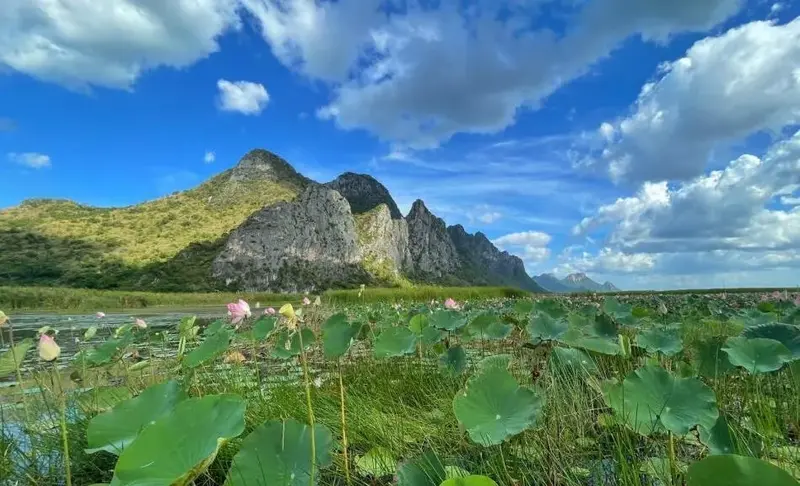
49. Sam Roi Yot National Park, Prachuap Khiri Khan is an exceptional protected landscape known for dramatic limestone mountains, freshwater wetlands, caves, and coastal habitats along the Gulf of Thailand. The park extends across areas of Sam Roi Yot and Kui Buri districts in Prachuap Khiri Khan Province. Its extraordinary range of natural environments makes it particularly valuable for biodiversity conservation and environmental education. Although the park can be visited on a long day trip from Bangkok, travelers should select a limited number of accessible attractions because its various sites are spread across a substantial area.
Highlights: Dramatic limestone mountain formations, Thung Sam Roi Yot wetlands, Phraya Nakhon Cave, the Kuha Kharuehat Royal Pavilion, coastal viewpoints, birdwatching habitats, and the park's diverse natural ecosystems.
Sam Roi Yot National Park is characterized by limestone mountains that rise steeply above surrounding lowlands and coastal environments. These formations developed through geological processes over immense periods, creating rugged cliffs, caves, and other distinctive landforms. The surrounding plains include freshwater wetlands and coastal ecosystems that provide habitats for many species. This combination of mountains, water, and lowland vegetation makes Sam Roi Yot one of the most visually distinctive natural landscapes in Thailand.
Thung Sam Roi Yot is a significant wetland environment supporting aquatic plants, birds, and other wildlife. Seasonal changes in water levels influence the appearance of the landscape and the species that can be observed. Wetland ecosystems are especially valuable because they provide feeding and breeding habitats while supporting natural water-related processes. Visitors interested in birdwatching should observe animals from designated locations and avoid disturbing sensitive habitats.
Phraya Nakhon Cave is one of the park's best-known landmarks. It contains the Kuha Kharuehat Royal Pavilion, a historic architectural structure situated within a cavern illuminated by natural light from an opening above. The appearance of the pavilion in the cave creates one of Thailand's most recognizable natural and cultural scenes. However, reaching the cave requires a physically demanding journey involving steep paths and uneven terrain, making it unsuitable for some visitors and especially challenging during hot or wet conditions.
The relationship between natural formations and cultural heritage adds a distinctive dimension to Phraya Nakhon Cave. The royal pavilion represents a human-made architectural element within an extraordinary geological setting. Visitors can consider how natural places acquire historical and symbolic importance through their association with royal visits and national heritage. Those intending to reach the cave should confirm the route, weather conditions, and current park requirements before beginning the walk.
Beyond its famous cave, Sam Roi Yot offers coastal landscapes, mountain viewpoints, and areas associated with wetland and mangrove ecosystems. Visitors can choose locations according to their interests and physical abilities. Some travelers may prefer relatively accessible nature-viewing areas, while others may undertake more challenging hiking routes. Activities and access arrangements can change according to the season, weather, and conservation requirements.
The park's ecological significance lies in the variety of habitats concentrated within one protected area. Limestone hills, wetlands, coastal environments, and forested areas each support different communities of organisms. Maintaining the integrity of these habitats is essential for biodiversity conservation. Visitors can contribute by remaining on designated trails, not removing natural materials, and avoiding actions that disturb wildlife or fragile ecosystems.
For a day trip from Bangkok, Sam Roi Yot requires substantial travel time. An early departure is essential, and travelers should focus on one or two nearby attractions rather than attempting to explore the entire park. Those intending to visit Phraya Nakhon Cave should allow additional time for hiking, rest, and the return journey. Families with children or older travelers may prefer accessible wetland or coastal locations instead.
Before visiting, check the current announcements of the Department of National Parks, Wildlife and Plant Conservation. Changes in weather, seasonal conditions, and trail maintenance can affect access to individual attractions. Appropriate footwear, drinking water, sun protection, and careful planning will help travelers explore the park safely while respecting its natural heritage.
Open Days: According to current national park announcements.
Opening Hours: 08:00 – 16:30 according to the listed attraction information. Individual locations may have different access times or restrictions.
Getting There: From Bangkok, follow Rama II Road and Phetkasem Road south through the Hua Hin and Pran Buri areas toward Sam Roi Yot District. Continue to the specific national park attraction you intend to visit. Because visitor locations are geographically dispersed, confirm your destination before departure. Public transportation within the park is limited, and onward travel should be arranged in advance.

50. Khun Dan Prakan Chon Dam, Nakhon Nayok is an important water-management project and scenic attraction located in Ban Tha Dan, Hin Tang Subdistrict, Mueang Nakhon Nayok District, Nakhon Nayok Province. Also known as Khlong Tha Dan Dam, it is distinguished by its substantial roller-compacted concrete structure and beautiful location among forested mountains. The dam plays an important role in irrigation and flood management while offering visitors impressive views across the reservoir and surrounding highlands. Its combination of engineering, natural scenery, and local history makes it a particularly rewarding destination for a day trip from Bangkok.
Highlights: Large roller-compacted concrete dam, expansive reservoir and mountain views, water-management development associated with royal initiatives, scenic viewing areas, accessible natural surroundings, and opportunities to combine the visit with other attractions in Nakhon Nayok.
Khun Dan Prakan Chon Dam was developed to improve water management in Nakhon Nayok and surrounding lowland areas. Seasonal rainfall creates considerable differences between wet and dry periods, affecting agriculture, communities, and flood conditions. The dam helps store water during periods of substantial rainfall and supports the regulated use of water for agriculture and other purposes. Its development reflects the importance of long-term resource planning in regions where water availability significantly influences local livelihoods.
The dam is especially notable for its roller-compacted concrete construction, often abbreviated as RCC. This engineering method involves placing and compacting relatively dry concrete mixtures using specialized equipment, making it suitable for building large and stable structures. The extensive dam crest provides a clear visual impression of the scale of the project. For visitors interested in engineering, the structure offers an opportunity to examine how modern construction techniques are used to manage important natural resources.
The name Khun Dan Prakan Chon is associated with Khun Dan, a figure remembered in the local historical traditions of Nakhon Nayok. The naming of the dam reflects the connection between major modern infrastructure projects and the historical memory of surrounding communities. As a result, the site has significance not only for engineering and water management but also for its relationship with the cultural identity of the province.
The reservoir creates one of Nakhon Nayok's most attractive landscapes. Broad stretches of water extend toward forested hills and mountains, with the scenery changing according to sunlight, weather, and seasonal water levels. The views can be especially beautiful during the morning and late afternoon, when the light becomes softer and the mountainous landscape appears more distinct. Visitors can appreciate the scenery from authorized public areas while observing all restrictions around operational structures.
The surrounding watershed provides an important ecological context for the dam. Forested mountain areas help regulate runoff, protect soil, and maintain the health of streams that feed the reservoir. Understanding this relationship helps explain why water infrastructure and forest conservation are closely connected. Protecting upstream ecosystems supports both the natural environment and the long-term effectiveness of water-management projects.
Khun Dan Prakan Chon Dam is situated near other attractions in Nakhon Nayok, including natural streams, waterfalls, and environmental learning centers. Travelers can combine a visit to the dam with the Bhumirak Dhamachart Centre or selected nearby attractions, provided that travel time is managed carefully. Organizing these stops within the same area allows visitors to experience both scenic landscapes and educational activities without unnecessary driving.
For families and older travelers, the dam offers an accessible way to enjoy mountain and reservoir scenery without undertaking a demanding forest hike. Some services or visitor activities may involve additional arrangements, and the availability of transport or boat excursions can change according to operating conditions. Travelers should confirm current options with authorized operators and prioritize safety around the water.
Visitors interested in reservoir activities should follow all instructions from the responsible authorities. Boat passengers should use appropriate safety equipment, including life jackets, while water-related activities may be suspended during heavy rain, strong winds, or unsuitable water conditions. The dam is an active infrastructure facility, and certain operational areas may be closed to public access.
Khun Dan Prakan Chon Dam is a fitting final destination in this collection of 50 day trips from Bangkok because it combines many of central Thailand's most distinctive travel themes: impressive scenery, water-based landscapes, engineering achievements, local history, and the relationship between natural resources and community life. With an early start and a carefully planned itinerary, visitors can explore the dam and return to Bangkok the same evening.
Open Days: Daily, subject to access restrictions or official announcements.
Opening Hours: 08:00 – 17:00 according to the listed attraction information. Individual activities may follow different schedules.
Getting There: From Bangkok, follow Rangsit–Nakhon Nayok Road or Highway 305 toward Nakhon Nayok. Continue along Highway 3049 toward Hin Tang Subdistrict and Ban Tha Dan, following signs to Khun Dan Prakan Chon Dam. Travelers without a private vehicle can reach Nakhon Nayok town and continue by local taxi. Check current visitor access and activity arrangements before departure.
Summary Table: 50 Best Day Trips from Bangkok The following table summarizes all 50 destinations, including their province and main attractions. For shorter, more relaxed journeys, consider Samut Prakan, Nonthaburi, Pathum Thani, Nakhon Pathom, or Ayutthaya. More distant destinations in Kanchanaburi, Chai Nat, Phetchaburi, and Prachuap Khiri Khan generally require an early departure and a limited number of sightseeing stops.
| No. | Destination | Province | Main Highlights |
| 1 | Ancient Siam | Samut Prakan | Open-air museum and Thai architectural heritage |
| 2 | The Erawan Museum | Samut Prakan | Three-headed elephant and elaborate Thai artwork |
| 3 | Bang Pu Recreation Center | Samut Prakan | Coastal views and seasonal migratory seagulls |
| 4 | Koh Kret | Nonthaburi | Thai-Mon culture, pottery and riverside food |
| 5 | Wat Phra Pathom Chedi | Nakhon Pathom | Monumental Buddhist stupa and sacred images |
| 6 | Don Wai Market | Nakhon Pathom | Historic riverside market and Thai food |
| 7 | Wat Mahathat | Ayutthaya | Buddha head surrounded by tree roots |
| 8 | Mae Klong Railway Market | Samut Songkhram | Market stalls beside active railway tracks |
| 9 | Amphawa Floating Market | Samut Songkhram | Weekend canal market and traditional food |
| 10 | Wat Yai Chaimongkon | Ayutthaya | Historic giant chedi and Buddha images |
| 11 | Bang Pa-In Palace | Ayutthaya | Royal summer palace and gardens |
| 12 | Wat Chaiwatthanaram | Ayutthaya | Riverside Khmer-influenced temple ruins |
| 13 | Wat Sothonwararam Worawihan | Chachoengsao | Luang Pho Sothon and magnificent ordination hall |
| 14 | Wat Saman Rattanaram | Chachoengsao | Giant reclining Ganesha sculpture |
| 15 | Khlong Suan 100-Year-Old Market | Samut Prakan / Chachoengsao | Historic canal trading community |
| 16 | Wat Chedi Hoi | Pathum Thani | Stupas decorated with ancient shells |
| 17 | Sam Chuk 100-Year-Old Market | Suphan Buri | Wooden shophouses and traditional market food |
| 18 | Wat Bang Kung | Samut Songkhram | Ancient chapel enclosed by tree roots |
| 19 | Don Hoi Lot | Samut Songkhram | Razor clam habitats and coastal mudflats |
| 20 | Sarika Waterfall | Nakhon Nayok | Multi-tiered waterfall and forest scenery |
| 21 | Bhumirak Dhamachart Centre | Nakhon Nayok | Sustainable agriculture and environmental learning |
| 22 | Wat Phra Phutthachai | Saraburi | Sacred Buddha impression on a cliff |
| 23 | Damnoen Saduak Floating Market | Ratchaburi | Traditional boat vendors and canal scenery |
| 24 | Khao Bin Cave | Ratchaburi | Limestone caverns and mineral formations |
| 25 | Phanthai Norasing Historical Park | Samut Sakhon | Historic memorial and mangrove heritage |
| 26 | Wat Phra Si Sanphet | Ayutthaya | Three monumental royal stupas |
| 27 | Chao Sam Phraya National Museum | Ayutthaya | Gold artifacts and Ayutthaya archaeological collections |
| 28 | Wat Pak Nam Cholo | Chachoengsao | Golden Thai-style ordination hall |
| 29 | Bueng Chawak Chaloem Phrakiat | Suphan Buri | Aquatic exhibitions and wetland ecology |
| 30 | Phra Nakhon Khiri Historical Park | Phetchaburi | Royal hilltop palace and panoramic town views |
| 31 | Wat Muang | Ang Thong | Monumental golden seated Buddha |
| 32 | Wat Khun Inthapramun | Ang Thong | Giant outdoor reclining Buddha |
| 33 | Wat Phra Non Chakkrasi Worawihan | Sing Buri | Revered reclining Buddha and royal temple |
| 34 | Phra Prang Sam Yot | Lop Buri | Three Khmer-style ancient sanctuary towers |
| 35 | Phra Narai Ratchaniwet | Lop Buri | King Narai's royal palace and museum |
| 36 | Bridge Over the River Kwai | Kanchanaburi | Historic World War II railway bridge |
| 37 | Erawan Waterfall | Kanchanaburi | Seven waterfall tiers and turquoise pools |
| 38 | Mrigadayavan Palace | Phetchaburi | Historic royal teakwood seaside residence |
| 39 | Wat Pa Mok Worawihan | Ang Thong | Reclining Buddha and Ayutthaya-era history |
| 40 | Hat Puek Tian Beach | Phetchaburi | Beach and Thai literary sculptures |
| 41 | Chao Phraya Dam | Chai Nat | Irrigation engineering and river views |
| 42 | Wat Pak Khlong Makham Thao | Chai Nat | Luang Pu Suk's religious heritage |
| 43 | Wat Pho Kao Ton | Sing Buri | Bang Rachan history and Buddhist temple |
| 44 | Hua Hin Beach | Prachuap Khiri Khan | Seaside resort town and sandy beach |
| 45 | Rahaeng 100-Year Market | Pathum Thani | Historic wooden canal-side market |
| 46 | Kaeng Krachan National Park | Phetchaburi | World Heritage forest and reservoir scenery |
| 47 | Phra Pathom Chedi National Museum | Nakhon Pathom | Dvaravati archaeological heritage |
| 48 | Death Railway | Kanchanaburi | World War II railway and cliffside scenery |
| 49 | Sam Roi Yot National Park | Prachuap Khiri Khan | Limestone mountains, wetlands and caves |
| 50 | Khun Dan Prakan Chon Dam | Nakhon Nayok | Large concrete dam and mountain reservoir views |
Choose destinations according to your interests, travel time, and transportation options. Historic Ayutthaya, Samut Prakan, and Samut Songkhram offer practical routes with multiple attractions, while destinations such as Erawan Waterfall, Kaeng Krachan National Park, and Sam Roi Yot National Park are better treated as the main focus of a longer day trip.
15 Best One-Day Trip Itineraries from Bangkok: Visit Multiple Attractions in a Single Day Planning a one-day trip from Bangkok becomes much easier when attractions are grouped by location and connected through a practical travel route. Rather than spending most of the day driving between distant destinations, travelers can combine historic temples, traditional markets, royal palaces, museums, waterfalls, and coastal attractions within the same province or neighboring districts. A well-organized itinerary allows visitors to enjoy several experiences and return to Bangkok the same evening without needing overnight accommodation.
These 15 suggested itineraries have been created from the 50 destinations featured in this travel guide. Each route provides a recommended visiting order, including morning, midday, afternoon, and evening activities where appropriate. The plans are primarily designed for travelers using a private car or hired vehicle. Those relying on public transportation should consider visiting fewer places and allowing extra time for transfers. All suggested periods are approximate rather than fixed schedules, and visitors should confirm opening days, operating hours, weather conditions, and return transportation arrangements before setting out.
| Itinerary | Province / Travel Theme | Suggested One-Day Itinerary | Best For / Important Travel Tips |
| 1. Samut Prakan: Art, Culture and Coastal Views | Samut Prakan Museums, Cultural Heritage and Coastal Nature | Morning: 1. The Erawan Museum — Admire the monumental three-headed elephant sculpture, elaborate interior decorations, and traditional Thai craftsmanship. Late Morning–Afternoon: 2. Ancient Siam — Discover architectural monuments and regional cultural heritage in an extensive open-air museum. Allow time for lunch inside or near the attraction. Evening: 3. Bang Pu Recreation Center — Walk along Sukta Bridge, enjoy coastal scenery, and watch the sunset over the Gulf of Thailand. | Ideal for families, couples, and travelers interested in Thai culture. Start early because Ancient Siam covers a large area. Consider skipping the final stop if you want to explore the museum thoroughly. Migratory seagulls at Bang Pu are seasonal. |
| 2. Ayutthaya: Exploring the Ancient Capital | Phra Nakhon Si Ayutthaya History, Temples and Archaeology | Morning: 1. Wat Yai Chaimongkon — Explore the great chedi and pay your respects to the reclining Buddha. Late Morning: 2. Wat Mahathat — See the famous Buddha head surrounded by tree roots and explore the ancient temple ruins. Midday–Afternoon: 3. Wat Phra Si Sanphet — Admire the three monumental royal stupas near the former palace precinct. Late Afternoon: 4. Wat Chaiwatthanaram — Photograph the impressive prang and historic architecture along the Chao Phraya River. | Excellent for history enthusiasts and architecture photographers. Bring drinking water, comfortable shoes, and sun protection, as most sites are outdoors. Reduce the itinerary to three temples if you prefer a slower pace. |
| 3. Bang Pa-In Palace and Ayutthaya's Royal Heritage | Phra Nakhon Si Ayutthaya Royal Palaces, Museums and Fine Arts | Morning: 1. Bang Pa-In Palace — Explore royal pavilions, landscaped gardens, and architecture influenced by Thai, Chinese, and European traditions. Midday: Travel into Ayutthaya's historic city and enjoy a local lunch. Afternoon: 2. Chao Sam Phraya National Museum — Discover archaeological treasures, gold artifacts, and artistic heritage from the Ayutthaya Kingdom. Late Afternoon: 3. Wat Phra Si Sanphet — Explore the former royal temple and its three iconic stupas. | Best for visitors interested in royal history, architecture, and archaeology. Plan the trip for Tuesday–Sunday in accordance with the museum's usual schedule, and verify current opening arrangements before departure. |
| 4. Samut Songkhram: Railway Market, Historic Temple and Amphawa | Samut Songkhram Traditional Markets, Community Life and History | Morning: 1. Mae Klong Railway Market — Explore the unusual market and watch vendors fold their awnings when a train passes. Late Morning–Midday: 2. Don Hoi Lot — Discover the coastal mudflat environment and enjoy regional seafood. Afternoon: 3. Wat Bang Kung — Visit the remarkable ancient chapel enclosed by tree roots and learn about Bang Kung's history. Late Afternoon–Evening: 4. Amphawa Floating Market — Enjoy canal-side dining, local desserts, and traditional wooden architecture. | Ideal for food lovers and families. Friday–Sunday is preferable when the Amphawa tourist market is active. Check train times at Mae Klong and low-tide conditions at Don Hoi Lot. Skip Don Hoi Lot if you want a less crowded schedule. |
| 5. Two Floating Markets: Ratchaburi and Samut Songkhram | Ratchaburi / Samut Songkhram Floating Markets and Regional Cuisine | Early Morning: 1. Damnoen Saduak Floating Market — Watch traditional vendor boats, sample tropical fruit, and enjoy breakfast beside the canal. Late Morning: 2. Mae Klong Railway Market — Observe the railway market and, if your timing matches, a train passing through. Midday–Afternoon: Enjoy lunch near Mae Klong and continue toward Amphawa. Afternoon–Evening: 3. Amphawa Floating Market — Explore the historic canal community, taste local dishes, and enjoy the evening market atmosphere. | Perfect for travelers who enjoy food and traditional markets. A Friday–Sunday visit allows the two floating markets to fit into one itinerary. Begin at Damnoen Saduak early and allow extra time for returning to Bangkok after visiting Amphawa. |
| 6. Nakhon Pathom: Sacred Stupa, History and Riverside Food | Nakhon Pathom Buddhist Heritage, Archaeology and Food | Morning: 1. Wat Phra Pathom Chedi Ratchaworamahawihan — Pay your respects at the monumental stupa and Phra Ruang Rojanarit Buddha image. Late Morning: 2. Phra Pathom Chedi National Museum — Explore the Dvaravati archaeological heritage only if the museum is confirmed open to visitors. Midday–Afternoon: 3. Don Wai Market — Sample traditional food and desserts and explore the historic Tha Chin riverside market. | Suitable for families and travelers interested in Buddhist history. Confirm the museum's current visitor access with the Fine Arts Department. If it is closed, spend more time at Phra Pathom Chedi and Don Wai Market. |
| 7. Pathum Thani: Unusual Temple and Historic Canal Market | Pathum Thani Buddhist Culture and Traditional Communities | Morning: 1. Wat Chedi Hoi — See unusual stupas decorated with ancient shells and learn about the area's natural history. Late Morning–Midday: 2. Rahaeng 100-Year Market — Explore wooden shophouses, traditional local food, and a historic canal-side settlement. Afternoon: Walk through the old Rahaeng community and the surrounding Wat Bua Kaeo Kasorn neighborhood before returning to Bangkok. | An excellent half-day or full-day option for visitors who prefer shorter travel distances. Weekends may offer more market activity, but individual shop schedules should be checked in advance. |
| 8. Chachoengsao: Three Remarkable Religious Attractions | Chachoengsao Buddhist Pilgrimage and Religious Art | Morning: 1. Wat Sothonwararam Worawihan — Pay your respects to Luang Pho Phuttha Sothon and admire the monumental ordination hall. Late Morning–Midday: 2. Wat Saman Rattanaram — See the enormous reclining Ganesha statue beside the Bang Pakong River. Afternoon: 3. Wat Pak Nam Cholo — Admire the distinctive golden ordination hall and explore the Bang Khla riverside area. | Ideal for Buddhist pilgrims, families, and architecture enthusiasts. The temples are located in different parts of the province, so depart early and allow adequate driving time, especially on weekends. |
| 9. Nakhon Nayok: Dam, Environmental Learning and Waterfall | Nakhon Nayok Nature, Water Management and Education | Morning: 1. Khun Dan Prakan Chon Dam — Enjoy expansive views of the reservoir and surrounding forested mountains. Late Morning–Midday: 2. Bhumirak Dhamachart Centre — Learn about sustainable agriculture, environmental conservation, and the Sufficiency Economy Philosophy. Afternoon: 3. Sarika Waterfall — Explore forest scenery and accessible waterfall areas. | Best for nature lovers, families, and educational outings. Some structured learning activities may require advance arrangements. Check waterfall access conditions and weather warnings, particularly during the rainy season. |
| 10. Ang Thong: Three Famous Buddhist Temples | Ang Thong Monumental Buddha Images and Historic Temples | Morning: 1. Wat Pa Mok Worawihan — Pay your respects to the reclining Buddha and learn about the historic relocation of the sacred image. Late Morning–Midday: 2. Wat Muang — Admire the enormous golden Luang Pho Yai Buddha image. Afternoon: 3. Wat Khun Inthapramun — Explore the monumental outdoor reclining Buddha and historic temple remains. | Suitable for families, older travelers, and visitors interested in Thai Buddhist traditions. The three temples offer different examples of large-scale religious sculpture within a single provincial itinerary. |
| 11. Lop Buri: Khmer Heritage and King Narai's Royal Palace | Lop Buri Archaeology and Royal History | Morning: 1. Phra Prang Sam Yot — Explore the three ancient Khmer-style towers and learn about Lavo civilization. Midday: Enjoy lunch and explore the historic town center. Afternoon: 2. Phra Narai Ratchaniwet — Discover King Narai's seventeenth-century royal palace and visit King Narai National Museum where access is permitted. | Ideal for travelers interested in ancient Khmer-influenced architecture and Ayutthaya-era diplomacy. Verify museum opening days and avoid feeding or approaching monkeys in Lop Buri's historic district. |
| 12. Sing Buri: Sacred Reclining Buddha and Bang Rachan History | Sing Buri Buddhism and Local Historical Heritage | Morning: 1. Wat Phra Non Chakkrasi Worawihan — Pay your respects to one of the province's most important reclining Buddha images. Midday: Enjoy lunch in Sing Buri before continuing to Khai Bang Rachan District. Afternoon: 2. Wat Pho Kao Ton — Learn about the history of the Bang Rachan community and the traditional accounts of its resistance during the final years of Ayutthaya. | Suitable for families, students, and travelers interested in Thai history. With only two main attractions, the itinerary allows additional time to explore religious heritage and local historical narratives. |
| 13. Suphan Buri: Historic Market and Aquatic Wildlife | Suphan Buri Traditional Market and Family Activities | Morning: 1. Sam Chuk 100-Year-Old Market — Walk through traditional wooden shophouses, discover community heritage, and sample regional dishes. Midday: Enjoy lunch around the market and continue toward Doem Bang Nang Buat District. Afternoon: 2. Bueng Chawak Chaloem Phrakiat — Explore the wetland landscape and aquatic life exhibitions in the sections currently open to visitors. | Especially suitable for families with children and food enthusiasts. Start early because Suphan Buri is a relatively long journey from Bangkok. Confirm opening arrangements for the aquatic exhibition zones. |
| 14. Kanchanaburi: Exploring World War II Railway History | Kanchanaburi Wartime History and Railway Heritage | Morning: 1. Bridge Over the River Kwai — Explore the historic railway bridge and learn about the construction of the Thai–Burma Railway during the Second World War. Midday: Enjoy lunch in Kanchanaburi or along the route toward the historic cliffside railway section. Afternoon: 2. Death Railway — Visit the Tham Krasae area to observe the historic railway beside a steep hillside, subject to current access and railway safety conditions. | Best for history enthusiasts and railway travelers. Check train schedules and allow sufficient driving time between the bridge and Tham Krasae, which are separate locations. Never stand on active railway tracks for photographs. |
| 15. Phetchaburi: Hilltop Royal Palace and Seaside Relaxation | Phetchaburi Royal Heritage and Beaches | Morning: 1. Phra Nakhon Khiri Historical Park — Explore the historic hilltop royal palace and enjoy panoramic views over Phetchaburi. Midday–Early Afternoon: 2. Hat Puek Tian Beach — Relax by the sea, enjoy local seafood, and photograph sculptures inspired by the Thai literary epic Phra Aphai Mani. Afternoon: 3. Mrigadayavan Palace — Explore the historic royal teakwood residence if it is open and sufficient time remains. | Ideal for travelers interested in royal history and seaside scenery. This is a relatively demanding day trip. Choose only two main attractions for a more relaxed experience, and confirm the current opening schedule of Mrigadayavan Palace before departure. |
For the most enjoyable one-day trip from Bangkok, begin by selecting a province and travel theme that match your interests. Visit time-sensitive attractions in the morning, schedule food markets around their busiest periods, and reserve late-afternoon destinations for scenic walks or coastal views. Two or three attractions in the same area generally provide a more relaxed experience than an ambitious route involving several distant stops. Always allow sufficient time for meals, unexpected traffic, and the return journey to Bangkok.
Frequently Asked Questions (FAQ)
Q: What are the best places to visit near Bangkok on a day trip?
A: Popular day-trip destinations include Ancient Siam and the Erawan Museum in Samut Prakan, Koh Kret in Nonthaburi, Phra Pathom Chedi in Nakhon Pathom, the ancient temples of Ayutthaya, and Mae Klong Railway Market and Amphawa Floating Market in Samut Songkhram. Nature lovers can consider Sarika Waterfall and Khun Dan Prakan Chon Dam in Nakhon Nayok. The best choice depends on travel time, interests, and available transportation.
Q: Which day trips from Bangkok are suitable for families with children?
A: Ancient Siam offers opportunities to learn about traditional Thai architecture, while the Erawan Museum combines sculpture and cultural heritage. Bueng Chawak Chaloem Phrakiat provides aquatic life exhibitions, and the Bhumirak Dhamachart Centre focuses on environmental education. Families who enjoy food markets may prefer Koh Kret, Don Wai Market, or Sam Chuk Market. Choose attractions according to children's ages, walking distances, and the facilities available.
Q: Can I take a day trip from Bangkok without renting a car?
A: Yes. The Erawan Museum is accessible via the BTS Sukhumvit Line and a short onward journey. Phra Pathom Chedi is near Nakhon Pathom Railway Station, while Ayutthaya can be reached by train followed by a local taxi or tuk-tuk. Koh Kret can be reached through Pak Kret and a cross-river ferry. However, waterfalls, national parks, and some rural temples may require additional transportation. Always check the return service schedule.
Q: Where can I go for a beach day trip from Bangkok?
A: Bang Pu Recreation Center in Samut Prakan is a convenient choice for coastal views and seasonal birdwatching, although it is not a typical swimming beach. For sandy beaches, consider Hat Puek Tian in Phetchaburi or Hua Hin Beach in Prachuap Khiri Khan. Both require more travel time, so an early departure is recommended. Check sea conditions before swimming.
Q: What are the best nature and waterfall day trips from Bangkok?
A: Sarika Waterfall and Khun Dan Prakan Chon Dam in Nakhon Nayok are attractive options for forest scenery and mountain views. Erawan Waterfall in Kanchanaburi offers seven scenic waterfall tiers but requires significantly more travel time. Kaeng Krachan National Park and Sam Roi Yot National Park are also rewarding natural destinations, although visitors should select accessible areas and verify current park conditions.
Q: Which provinces near Bangkok have several attractions that can be visited in one day?
A: Samut Prakan offers the Erawan Museum, Ancient Siam, and Bang Pu Recreation Center, although Ancient Siam alone can occupy much of a day. Ayutthaya has several historic temples within a manageable area. Samut Songkhram offers Mae Klong Railway Market, Wat Bang Kung, and Amphawa Floating Market on days when Amphawa operates. Ang Thong and Chachoengsao also have interesting temple routes.
Q: What is the difference between Amphawa and Damnoen Saduak Floating Markets?
A: Amphawa Floating Market in Samut Songkhram is known for its weekend canal-side atmosphere, traditional wooden buildings, and evening food activities. Damnoen Saduak Floating Market in Ratchaburi is especially famous for boats selling fruit, meals, and local goods during the morning. Travelers can explore Damnoen Saduak first and visit Amphawa later on a day when both markets are operating.
Q: How should I prepare for a one-day trip from Bangkok?
A: Select destinations that fit your available time, verify opening schedules, and arrange transportation and return connections in advance. Bring comfortable walking shoes, drinking water, sun protection, and weather-appropriate clothing. Dress respectfully when visiting temples. For waterfalls and national parks, check current weather and official access restrictions. It is generally more enjoyable to explore one or two nearby destinations thoroughly than to rush between several distant attractions.
 Category: ●Travel Articles, Recipes
 Group: ●Travel Review, Food Review
Last Update : 1 DayAgo
 Last Update : 1 DayAgo
Recommend

 Art, Culture and Heritage
 Historical Sites and Monuments(3)
 Landmarks and Memorials(23)
 Royal Palace(13)
 Art, Craft Centres, Tradition(35)
 Museums(59)
 Historic Homes and Cities(3)
 Art Gallery(16)
 Educational Places
 Museum for Study(6)
 Library(4)
 Places of Worship
 Temple(72)
 Church(2)
 Mosque(67)
 Other Sacred Sites(8)
 Research and Development
 Royal Project(1)
 Suburban Living
 Village, Community(5)
 Local Market(9)
 Floating Market(2)
 Nature and Wildlife
 River, Canal(3)
 Bays and Beaches(1)
 Other natural attractions(1)
 Entertainment and Agricultural
 Zoos and Aquariums(5)
 Animal camps and shows(5)
 Stadium(9)
 Farms, Parks and Ecotourism(20)
 Amusement Park(1)
 Waterpark(4)
 Theater(7)
 Cinema(1)
 Shopping
 Shopping and Night Market(20)
 Department Store(7)
 Spas and Wellness
 Spas and Wellness(1)
 Restaurant
 Michelin Star(5)
 Accommodation
 Hotel(3)
 Call Customer Service in Tourism
 Call Customer Service in Tourism(1)
Travel Review, Food Review(41)
 Royal Thai Desserts and Recipes(56)


