
lovethailand home >Central Travel Attractions >Samut Prakan Travel Attractions >Muang Samut Prakan >Bang Muang > The Erawan Museum
TL;DR: The Erawan Museum is located at Bang Mueang Mai, Mueang Samut Prakan District, Samut Prakan, open Open Daily, hours 09:00 AM – 06:00 PM (Ticket Sales End at 05:00 PM).
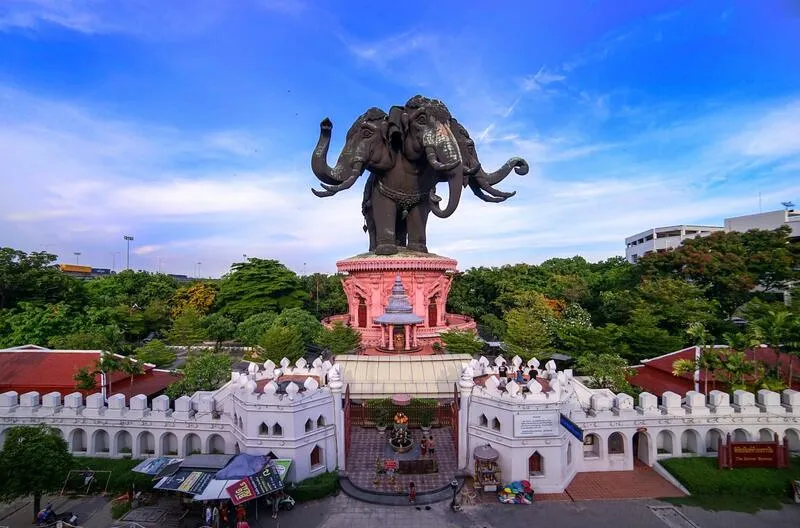
The Erawan Museum
Open Days: Open Daily
Opening Hours: 09:00 AM – 06:00 PM (Ticket Sales End at 05:00 PM)
The Erawan Museum in Samut Prakan is one of the most outstanding destinations on Bangkok’s eastern outskirts, as it combines the qualities of a museum, a symbolic spiritual site, and a monumental architectural work that visitors remember immediately at first sight. For anyone planning a visit, the essentials are simple: it is open every day, access is very convenient via the BTS Green Line by getting off at Chang Erawan Station, Exit 2, and walking a short distance, and the attraction offers far more than a giant three-headed elephant sculpture. Inside, visitors will also find fine art, cultural objects, landscaped grounds, and an atmosphere that allows a single visit to become an experience of art appreciation, learning, and quiet reflection all at once.
The museum’s greatest charm lies in the way it brings together art, belief, and symbolic design in one complete setting. The museum stands on about 12 rai of land in Bang Mueang Mai, Mueang Samut Prakan District, and was inspired by the vision of Khun Lek Viriyaphan, the creator of Ancient Siam in Samut Prakan and the Sanctuary of Truth in Pattaya. He played a major role in preserving Thai artistic and cultural heritage in a form that later generations can access more easily. Rather than simply storing historical objects in display cases, he created a place where visitors can directly experience the value of Thai art, religion, and wisdom.
What clearly sets the Erawan Museum apart from ordinary museums is that the entire building was designed as part of a monumental sculpture. The Erawan elephant, or three-headed elephant, towering above the base building is one of Thailand’s most famous copper sculptures and is widely recognized as one of the world’s largest metal Erawan elephant sculptures. The elephant and the building together stand about 43.60 meters high, roughly equivalent to a 14–17-storey building. The head alone weighs about 100 tons, while the body weighs around 150 tons, measuring about 12 meters wide and 39 meters long. This scale was not intended merely to impress. It was created to turn the cosmological concept of the universe and the 3 realms into a physical form that visitors can actually enter and experience.
The concept of the 3 worlds is the heart of the museum’s interior design. The exhibition space is divided into 3 major levels linked to cosmological beliefs found in Thai and Asian traditions. The lowest level is the underworld or Suvarnabhumi level, which displays antiques, sacred objects, and ceramics reflecting the cultural roots of Southeast Asia. The middle level represents the human world, which supports the elephant above and showcases a rich fusion of artistic forms. The upper level inside the elephant’s body represents the cosmic realm, a space with a calm, profound, and beautiful atmosphere created through light, color, decorative patterns, and sacred objects.
Seen as an architectural work, the museum reveals the artistic ambition of its creator very clearly. The lower structure is built from reinforced concrete and serves to support the enormous weight of the elephant above. Ring beams around the outer and inner sections help distribute the load to the columns both outside and inside the building. The decoration does not follow only one style. Instead, it combines several forms of art into a unified whole, including Western stained glass, Benjarong porcelain, repoussé metalwork on tin sheets by artisans from Nakhon Si Thammarat, and sculptural elements such as Naga figures, heavenly musicians, and symbolic forms produced by Thai craftsmen from different regions. The result is a space that feels refined, sacred, and visually remarkable throughout the entire visit.
One of the most memorable spaces for visitors is the main hall on the human world level. Its stained-glass dome ceiling gives the interior a beauty reminiscent of a grand Western religious structure, while at the same time it is seamlessly infused with Thai patterns, concepts, and symbolic meaning. This area does not feel like a distant or overly formal museum. Instead, it invites visitors to pause and study the details one by one, from the decorated columns to the surface ornamentation and the arrangement of each visual element, creating the feeling of walking through a story told through art rather than merely viewing displayed objects.
The interior of the elephant body, which represents the cosmic realm, is the emotional highlight of the visit. The atmosphere shifts clearly from grandeur to serenity. Inside, important sacred objects and Buddha images from different periods are displayed in a setting designed to encourage stillness and contemplation. Those interested in both art and spiritual meaning often find this area especially moving, because it reflects the intention of Khun Lek Viriyaphan, who did not wish to create only a landmark for photographs, but a place where people could better understand the value of spiritual heritage alongside artistic heritage.
The grounds around the museum are another part that should not be overlooked. The gardens do more than serve as a backdrop to the three-headed elephant. They were designed as a literary-themed garden and a walking area with an atmosphere very different from the busy surroundings of Bangkok and Samut Prakan. Visitors can spend time viewing outdoor sculptures, walking through the landscaped paths, noticing small details hidden in different corners, and photographing the elephant from many angles. Each viewpoint creates a different impression, whether emphasizing the scale of the base, the delicacy of the decorative forms, or the sheer power of the sculpture itself.
In terms of recent cultural history, the Erawan Museum reflects a period in Thai cultural preservation that went beyond the conventional museum model. It opened the way for large-scale creative works that could function at once as learning spaces, tourist attractions, and places of inner reflection. For that reason, it welcomes a broad mix of visitors, including general tourists, architecture lovers, admirers of Thai art, and those drawn to spiritual or peaceful travel experiences, without making the place feel limited to only one group.
For travelers planning a real visit, another major strength of the museum is its accessibility. By BTS Green Line, visitors can get off at Chang Erawan Station (E17), Exit 2, and walk directly to the site. This is especially convenient for both Thai and international travelers staying in Bangkok who want an easy half-day trip without relying on a private car. For those who drive, the museum can be reached via old Sukhumvit Road into Samut Prakan, and parking is available on site. That makes it easier to access than many other cultural attractions.
Anyone planning a half-day or full-day outing can also continue to other attractions nearby without difficulty, since the surrounding area includes several important sites in Samut Prakan, such as Ancient Siam, the Samut Prakan Observation Tower, the Royal Thai Navy Museum, the Samut Prakan City Pillar Shrine, and Bang Pu Recreation Center. This makes the museum suitable for family outings, photography trips, and educational travel itineraries that combine art, history, and local atmosphere in the same day.
Another reason the Erawan Museum remains so popular is its ability to balance grandeur with tranquility. From the outside, many visitors may expect only spectacle, but once inside they discover that its true distinction lies not only in its size, but in the way it tells a story through space, craftsmanship, and the rhythm of the visitor experience. People often find themselves moving gradually from excitement to calm admiration as they progress through the museum.
For international travelers, the museum is one of the best places to understand modern Thai cultural identity, because it does not limit itself to displaying antiques. Instead, it reveals the way Thai society connects art, religion, mythology, and nature in a deeply integrated way. It therefore appeals both to first-time visitors and to those who have been to Bangkok many times and want to explore a deeper cultural dimension.
For photography lovers, the Erawan Museum offers interesting opportunities from the entrance onward to the garden viewpoints outside. Morning light tends to produce sharper detail on the elephant sculpture, while late afternoon creates a softer mood that suits wide shots of the building and its gardens. The interior also contains beautiful photographic spots, though visitors should respect the rules of the venue and other guests, especially in areas where people come to worship or enjoy a quiet moment.
If asked who the Erawan Museum is best suited for, the answer is anyone looking for more than a famous check-in spot. It is ideal for those who want to spend time with one of Thailand’s most iconic architectural works, admire art rooted in belief, understand Thai cosmological ideas through real space, and step out of central Bangkok to discover a place that is nearby, easy to reach, and richer in experience than photographs alone can convey.
Overall, the Erawan Museum is not merely a landmark of Samut Prakan. It is a place that reflects Thailand’s effort to keep its artistic and cultural heritage alive in the modern world. Visitors encounter the grandeur of Thai craftsmanship, a creative interpretation of cosmological belief, and the determination of its creator to pass cultural heritage on to future generations in a form that remains accessible and meaningful. For anyone looking for a destination near Bangkok that offers beauty, depth, and memorable atmosphere, the Erawan Museum is one of the most worthwhile choices.
Getting There If traveling by BTS, get off at Chang Erawan Station (E17), Exit 2, then walk directly to the museum. By car, take old Sukhumvit Road into Mueang Samut Prakan District. The museum is easy to spot from the main road because of the giant three-headed elephant sculpture, and parking is available for visitors.
| Name | The Erawan Museum |
| Location | Bang Mueang Mai, Mueang Samut Prakan District, Samut Prakan |
| Address | 99/9 Moo 1, Sukhumvit Road, Bang Mueang Mai, Mueang Samut Prakan District, Samut Prakan 10270 |
| Coordinates | 13.6237, 100.5867 |
| Highlights | A monumental three-headed elephant sculpture, Thai cultural art museum, surrounding gardens, and walking paths around the building |
| History / Period | A concept by Khun Lek Viriyaphan, construction began in 1994 and the museum opened to the public in 2003 |
| Name Origin | Derived from “Erawan,” or the three-headed elephant in Brahmanical-Hindu belief, interpreted here as a symbol of the cosmos and sacred power |
| Distinctive Features | The elephant and building together stand about 43.60 meters high, with 3 interior levels: the underworld, the human world, and the cosmic realm, decorated with stained glass, Benjarong porcelain, and Thai metalwork |
| Travel Information | BTS Chang Erawan Station (E17), Exit 2, or arrive by car via old Sukhumvit Road; parking is available |
| Current Status | Open to visitors every day |
| Open Days | Open Daily |
| Opening Hours | 09:00 AM – 06:00 PM, ticket sales end at 05:00 PM |
| Admission Fee | Thai visitors: Adults 250 THB, Children 125 THB / Foreign visitors: Adults 500 THB, Children 250 THB |
| Facilities | Parking, ticketing area, surrounding gardens, and multilingual audio guide service |
| Main Areas / Zones | Underworld / Suvarnabhumi Level, Human World Level, Cosmic Level inside the elephant body, and the surrounding gardens and pilgrimage paths |
| Main Contact Number | 02-371-3135-6, 02-380-5244 |
| Official Website / Official Page | www.erawanmuseum.com / Facebook: ErawanMuseumSamutprakan |
| Nearby Tourist Attractions | 1. Royal Thai Navy Museum 4 km 2. Samut Prakan Observation Tower 5 km 3. Samut Prakan City Pillar Shrine 6 km 4. Phra Samut Chedi 12 km 5. Ancient Siam 16 km |
| Nearby Restaurants | 1. Loft Stilo @Erawan 0.2 km Tel. 063-752-2574 2. Dot Gelato Pak Nam 0.8 km Tel. 081-848-7241 3. Kha Moo A-Tan, Khlong Thom Erawan Market 0.8 km 4. Tae Chin Kuang 1.6 km Tel. 081-819-8075, 081-144-3391, 097-259-2391 5. Jae Phat 3 km Tel. 02-701-7148, 064-310-7686 |
| Nearby Accommodations | 1. The Ryhhton Residence - Erawan Museum 1 km Tel. 095-251-9658 2. @S115 Residence 2 km Tel. 061-520-6868 3. Marigold Sukhumvit 4 km Tel. 02-754-0355 4. Koon Hotel Sukhumvit 5 km Tel. 02-743-2844 5. Baan Paknam Hotel 6 km Tel. 091-525-1999, 02-101-9640 |
Frequently Asked Questions (FAQ)
Q: Is the Erawan Museum open every day?
A: Yes. It is open daily from 09:00 AM to 06:00 PM, and ticket sales end at 05:00 PM.
Q: How much is the admission fee for the Erawan Museum?
A: Thai visitors pay 250 THB for adults and 125 THB for children, while foreign visitors pay 500 THB for adults and 250 THB for children.
Q: How do I get to the Erawan Museum by BTS?
A: Take the BTS Green Line to Chang Erawan Station (E17), Exit 2, then walk to the museum.
Q: What are the main highlights inside the museum?
A: The museum features the underworld or Suvarnabhumi level, the human world level, the cosmic level inside the elephant body, sacred objects, Buddha images, stained-glass interiors, and the surrounding gardens.
Q: What kind of trip is the Erawan Museum suitable for?
A: It works well for both a half-day and a full-day trip, and can easily be combined with Ancient Siam, the Samut Prakan Observation Tower, or the Royal Thai Navy Museum.
Q: Is the Erawan Museum suitable for children and foreign travelers?
A: Yes. It is easy to reach, visually impressive, culturally rich, and offers multilingual audio guides, making it suitable for both children and international visitors.
Website : www.erawan-museum.com
 Website :
 Tel : 023713135-6
 Tel : 023713135-6
Fax : 023800304
 Fax : 023800304
 Category: ●Art, Culture and Heritage
 Group: ●Museums
Last Update : 7 MonthAgo
 Last Update : 7 MonthAgo
 Click to Access the Navigation Map GPS
The Erawan Museum Map
Recommend

 Historical Sites and Monuments(2)
 Landmarks and Memorials(1)
 Art, Craft Centres, Tradition(9)
Museums(5)
Art, Craft Centres, Tradition(9)
Museums(5)
 Historic Homes and Cities(1)
 Places of Worship
 Temple(30)
 Mosque(1)
 Other Sacred Sites(9)
 Suburban Living
 Local Market(1)
 Floating Market(3)
 Nature and Wildlife
 River, Canal(1)
 Bays and Beaches(2)
 Entertainment and Agricultural
 Zoos and Aquariums(1)
 Animal camps and shows(1)
 Farms, Parks and Ecotourism(1)
 Outdoor and Adventure Activities(1)
 Travel Articles, Recipes
 Travel Review, Food Review(1)


