
lovethailand home >Central Travel Attractions >Phranakhon Si Ayutthaya Travel Attractions >Phranakhon Si Ayutthaya >Pratu Chai > Wat Mahathat
TL;DR: Wat Mahathat is located at Naresuan Road, Tha Wasukri Subdistrict, Phra Nakhon Si Ayutthaya District, Phra Nakhon Si Ayutthaya Province, open Daily, hours Ticket sales 08.00 – 17.00 (last entry 18.00).
Wat Mahathat
Open Days: Daily
Opening Hours: Ticket sales 08.00 – 17.00 (last entry 18.00)
Wat Mahathat (Phra Nakhon Si Ayutthaya) is one of the most important archaeological sites within the Ayutthaya Historical Park, and it is often regarded as a key “religious core” of early Ayutthaya. In the context of an ancient capital, a temple bearing the name “Mahathat” typically signifies a sacred focal point that closely intertwined state authority with Buddhism. The temple stands near Pa Than Bridge on Ayutthaya Island, positioned in relation to the royal-temple zone and the former palace area, which makes it convenient to walk between major heritage sites in a single trip.
Chronicles and historical accounts commonly associate Wat Mahathat with Ayutthaya’s formative period. It is said to have been built during the reign of King Borommarachathirat I, and later, during the reign of King Ramesuan, relics of the Buddha were enshrined beneath the base of the temple’s principal prang in 1927 BE. The idea of “Buddha relics beneath the prang’s base” is not only a matter of devotion, but also a political language of the era, expressing that the kingdom possessed a legitimate sacred center, made visible through monumental architecture rising at the heart of the city.
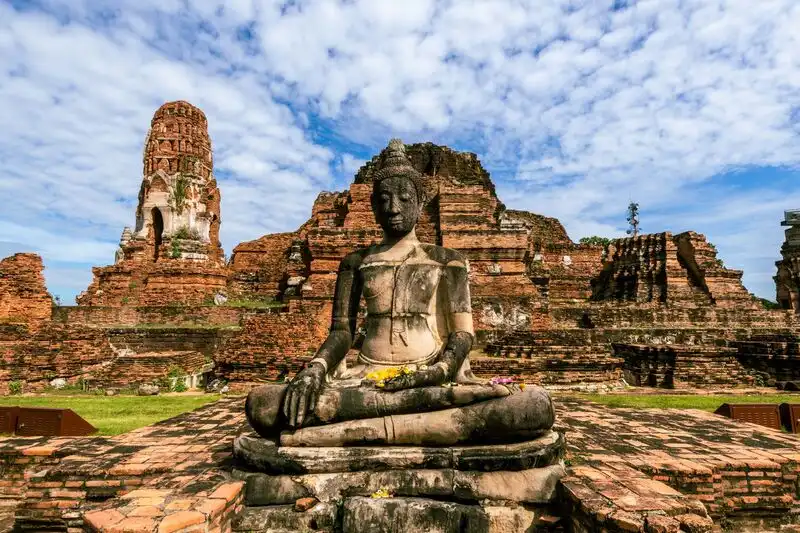
As you enter the grounds, the most striking feature is the ruin of the principal prang. This structure is considered an early Ayutthaya prang influenced by Khmer architectural forms, both in proportion, the sense of “mass” and weight, and the strong vertical emphasis of the central axis. The original lower section was built primarily with laterite, while the upper portions reinforced in later periods were constructed with brick and stucco. Evidence also indicates that King Prasat Thong undertook a restoration by heightening the prang beyond its previous scale. Today, however, the uppermost part has collapsed, leaving mainly the porch level and portions of the lower structure. It invites visitors to imagine how immense and intricately crafted the prang once was, serving as a visual “pillar” that anchored the city’s shared sense of a center.
Another layer of significance that makes Wat Mahathat more than a field of ancient bricks is the archaeological evidence uncovered through excavation. Reports describe the discovery of a stone reliquary and nested stupas, with the innermost layer containing Buddha relics and valuable ornaments. The Buddha relics were later placed at the Chao Sam Phraya National Museum, allowing visitors who want to “follow the authentic trail” to extend their day trip and view the physical evidence in a museum setting. Walking among the prang ruins as a vessel of faith, and then seeing curated artifacts in the museum, helps Ayutthaya feel less like a photo backdrop and more like a tangible historical world.
That said, the image most strongly associated with Wat Mahathat in modern searches is the “sandstone Buddha head embraced by tree roots.” It carries an unusual power because it holds beauty and sorrow at the same time. The head is not displayed complete on its pedestal; instead, it rests low to the ground, wrapped by roots that have grown over time. Many accounts suggest the head may have fallen during the sack of Ayutthaya, and the roots gradually enveloped it until it became the iconic scene seen today. A small but meaningful point for visitors is etiquette at this spot: many people choose to crouch or kneel slightly when taking photos so their eye level is not far above the Buddha head, a gesture of respect that also lends a calmer, more reverent feel to the image.
A satisfying visit that captures both story and imagery often begins with taking in the overall layout, then approaching the principal prang to observe details in the base and surviving structure. From there, visitors typically move toward the Buddha head in the roots, and finish by walking along the remains of viharns, satellite stupas, and other architectural traces. Setting aside at least 60–90 minutes keeps the pace comfortable, while those who want to photograph seriously or wait for shifting light and shadow should allow around 2 hours, especially in the morning or later afternoon when the sunlight is softer and less harsh.
For those who enjoy learning with guidance, Wat Mahathat can also be experienced through narrated interpretation. The Ayutthaya Historical Park offers an audiovisual (audio guide) service providing information for key heritage sites including Wat Phra Si Sanphet, Wat Chaiwatthanaram, and Wat Mahathat, available in both Thai and English. It is ideal for visitors who prefer to explore independently but do not want to miss context, and it helps each point on the site feel more meaningful than a series of similar-looking ruins. Once you understand where you are standing within the past, the very same brickwork starts to speak differently.
Getting There From Bangkok, the most convenient approach is to drive or take intercity transport into Ayutthaya town and then enter Ayutthaya Island toward the Naresuan Road and Historical Park area, where major monuments are concentrated. Travelers arriving by train can get off at Ayutthaya Railway Station and continue by crossing the river by ferry or using local transport such as taxis or motorcycle taxis to reach the island. Within the island, common ways to get around include tuk-tuks, local songthaews, bicycle rental, or hiring a car with a driver. For those driving, a popular route is to enter Ayutthaya town, cross Somdet Phra Naresuan Maharat Bridge, continue toward the second signalized intersection on the island, then turn onto the road that passes Bueng Phra Ram, where Wat Mahathat comes into view nearby and is easy to access.
If you want an itinerary where you can simply “walk straight to the next stop,” Wat Mahathat is exceptionally well positioned because Wat Ratchaburana is very close by. The walk is about 0.3 km, roughly 4 minutes. Many visitors begin at Wat Mahathat to see the Buddha head in the roots and the principal prang, then walk to Wat Ratchaburana to explore its prang and stories of hidden treasures, before continuing to Wat Phra Si Sanphet and the former Grand Palace area, or finishing at the Chao Sam Phraya National Museum to view artifacts in a structured presentation. This sequence creates a smooth narrative arc, moving from “sacred space” to “evidence,” and then ending with a broader “city overview” in a single day.
In the end, what keeps Wat Mahathat compelling is not only the fame of a photogenic landmark, but the feeling that you are standing in a place that truly once functioned as a center of a kingdom. The remaining ruins do not merely ask for sympathy; they invite you to listen to time. If you walk respectfully, avoid climbing, do not touch fragile structures, and treat sacred points with care, Wat Mahathat offers far more than expected: stories of authority, devotion, craftsmanship, and a responsible way of living alongside the past.
| Name | Wat Mahathat (Phra Nakhon Si Ayutthaya) |
| Address | Naresuan Road, Tha Wasukri Subdistrict, Phra Nakhon Si Ayutthaya District, Phra Nakhon Si Ayutthaya Province |
| Place Summary | A major archaeological site within the Ayutthaya Historical Park, renowned for its early-period principal prang ruins and the iconic Buddha head embraced by tree roots. |
| Highlights | Early Ayutthaya principal prang (Khmer influence), history of enshrining Buddha relics beneath the prang base, the sandstone Buddha head in tree roots, and an easy walk to Wat Ratchaburana. |
| Period / History | Associated with early Ayutthaya (often attributed to the reign of King Borommarachathirat I), with Buddha relics enshrined beneath the principal prang base in 1927 BE. |
| Key Evidence | Excavation reports describing a stone reliquary and nested stupas, with records that the Buddha relics were later placed at the Chao Sam Phraya National Museum. |
| Name Origin | The name “Mahathat” indicates a principal temple associated with Buddha relics and a sacred center of the ancient capital. |
| Site Management / Abbot (Latest) | Managed by: Ayutthaya Historical Park Office (Fine Arts Department). (As an archaeological monument site, it does not have a resident abbot like an active monastery.) |
| Open Days And Hours | Daily / Ticket sales 08.00 – 17.00 (last entry 18.00) |
| Admission Fee | Thai nationals 10 THB / Foreign visitors 80 THB |
| Travel | From Bangkok, travel to Ayutthaya town and enter Ayutthaya Island toward the Naresuan Road / Historical Park zone. By train, get off at Ayutthaya Station and continue by ferry crossing or local transport. Within the island, tuk-tuks, songthaews, bicycle rental, or private hire are commonly used. |
| Current Status | Open To Visitors |
| Contact Number | 0-3524-2525 (Ayutthaya Historical Park Office) |
| Nearby Tourist Attractions (Approx. Distance) | 1) Wat Ratchaburana – 0.3 km 2) Chao Sam Phraya National Museum – 1.5 km 3) Wat Phra Si Sanphet / Grand Palace Area – 1.2 km 4) Viharn Phra Mongkhon Bophit – 1.3 km 5) Wat Chaiwatthanaram – 5.5 km |
| Nearby Restaurants (Distance + Phone) | 1) Sukunya Bistro – 0.2 km – 089-163-7342 2) Coffee Old City Thai Bistro – 0.2 km – 089-889-9092 3) Malakor Kitchen and Cafe – 0.3 km – 091-779-6475 4) Earl Thai Restaurant – 0.4 km – 035-900-699 5) Boran Cafe and Restaurant – 0.4 km – 065-985-8385 |
| Nearby Accommodations (Distance + Phone) | 1) Ayothaya Riverside Hotel – 1.6 km – 035-243-139 2) Krungsri River Hotel – 1.7 km – 035-244-333 3) Baan Thai House – 2.2 km – 080-437-4555 4) Classic Kameo Hotel Ayutthaya – 3.2 km – 035-212-535 5) Centara Ayutthaya – 7.7 km – 035-243-555 |
Frequently Asked Questions (FAQ)
Q: What time does Wat Mahathat in Ayutthaya open?
A: Ticket sales are from 08.00 – 17.00, and the site can be visited until 18.00.
Q: How much is the entrance fee for Thai visitors and foreigners?
A: Thai nationals 10 THB, and foreign visitors 80 THB.
Q: What is the respectful way to take photos at the Buddha head in the tree roots?
A: It is recommended to crouch or kneel slightly so your eye level is not much higher than the Buddha head, and to avoid touching the roots or the sculpture.
Q: How long should I spend at Wat Mahathat to make it worthwhile?
A: 60–90 minutes is usually enough for a comfortable walk, but allow about 2 hours if you plan to photograph and explore details.
Q: Which nearby attraction can I walk to right after Wat Mahathat?
A: Wat Ratchaburana is extremely close, about a 0.3 km walk, making it easy to continue without transport.
Q: Is there any narrated service or audio guide available?
A: Ayutthaya Historical Park offers an audiovisual audio guide service in Thai and English for major monuments, including Wat Mahathat.
 Category: ●Places of Worship
 Group: ●Temple
Last Update : 9 MonthAgo
 Last Update : 9 MonthAgo
 Click to Access the Navigation Map GPS
Wat Mahathat Map
Gellery
Recommend

 Art, Culture and Heritage
 Historical Sites and Monuments(7)
 Landmarks and Memorials(6)
 Royal Palace(4)
 Art, Craft Centres, Tradition(6)
 Museums(9)
 Educational Places
 Museum for Study(1)
 Educational Gardens, Farm(2)
 Training Center(1)
Temple(133)
Training Center(1)
Temple(133)
 Church(2)
 Mosque(2)
 Other Sacred Sites(15)
 Research and Development
 Royal Project(4)
 Suburban Living
 Village, Community(10)
 Local Market(7)
 Floating Market(3)
 Nature and Wildlife
 Dam, Reservoir, Lake(1)
 River, Canal(3)
 Islands(2)
 Other natural attractions(1)
 Entertainment and Agricultural
 Animal camps and shows(2)
 Farms, Parks and Ecotourism(4)
 Travel Articles, Recipes
 Travel Review, Food Review(2)


