
lovethailand home >Central Travel Attractions
> Ang Thong Travel Attractions
TL;DR: A quick overview of attractions in Ang Thong, plus planning details, access, and key travel highlights.
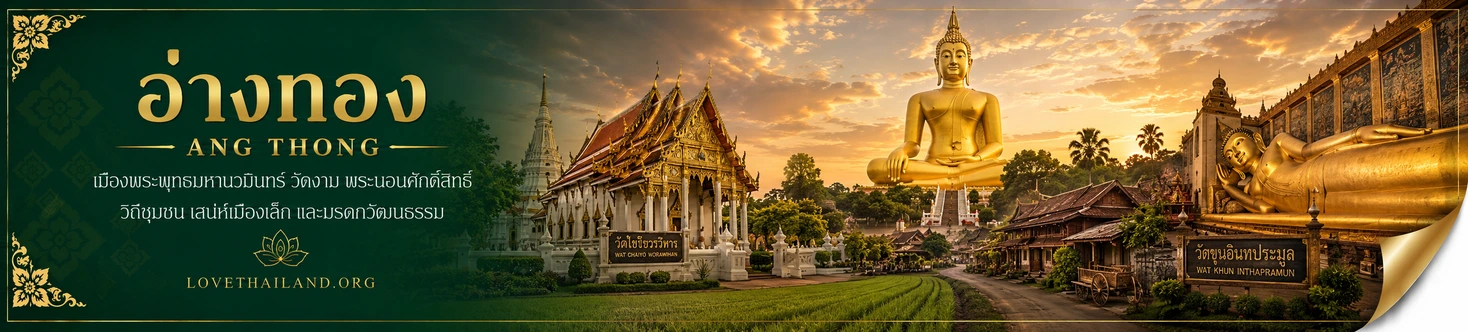
Ang Thong
Slogan : Pra Somdej Kade Chaiyo, big Mock Toh, brave hero, doll palace, famous wicker, settlement of drum, city of sleepy buddha.
Ang Thong Province is one of Thailand’s small provinces that quietly preserves a rich blend of history, culture, and traditional ways of life. Located in the central region, it lies only about 100 kilometers from Bangkok, with a travel time of approximately 1–2 hours. This makes it an ideal destination for a day trip or a relaxing weekend getaway. For travelers seeking a peaceful, simple, yet culturally profound destination, Ang Thong provides a clear and compelling answer.
Ang Thong covers an area of approximately 968.4 square kilometers (about 605,232.5 rai), ranking as the 71st smallest province in Thailand. Its geography consists of low-lying plains resembling a basin, with no mountains, making it highly suitable for agriculture—especially rice farming, which remains the primary occupation of local residents. The province is also traversed by important rivers, including the Noi River and the Chao Phraya River, both of which have played vital roles in the economy and community life since ancient times.
Historically, Ang Thong has roots dating back to the Dvaravati period. Evidence of this early settlement can be found in the ancient moated city at Huai Phai Subdistrict, Sawaeng Ha District. Later, during the Sukhothai era, the region was significantly influenced by artistic and cultural developments, particularly in Buddhist sculpture. Notable examples include the reclining Buddha images at Wat Khun Inthapramun and Wat Pa Mok Worawihan, which remain important destinations for both tourists and devotees.
During the Ayutthaya period, Ang Thong played a strategic role as a frontier town and was elevated to “Mueang Wiset Chai Chan.” It was closely associated with several historical battles, especially those against Burmese forces. This period gave rise to local heroes such as Nai Dok and Nai Thongkaew, who fought in the Battle of Bang Rachan—one of the most significant events in Thai history that continues to be remembered today.
Beyond its historical significance, Ang Thong stands out for its rich cultural heritage and local wisdom. The province is well known for traditional handicrafts such as court dolls (Tukta Chao Wang), drum-making, brick-making, and basketry. These crafts reflect the precision and skill of local artisans. Additionally, Ang Thong is considered one of the origins of “Likay,” a traditional Thai folk performance that continues to be practiced and performed during festivals and community events.
In terms of culture and traditions, Ang Thong offers a diverse and distinctive identity. Events such as the Bang Rachan Heroes Commemoration, the Tak Bat Devo ceremony, and various temple festivals reflect strong Buddhist beliefs and the enduring connection between communities and their inherited traditions.
From a tourism perspective, Ang Thong is widely known as a province rich in temples, with more than 200 sites of religious and architectural significance. One of the most prominent is Wat Muang, home to Phra Buddha Maha Nawamin Sakyamuni Sri Wiset Chai Chan, or “Luang Pho Yai,” the largest Buddha statue in Thailand. Another highlight is Wat Khun Inthapramun, where a massive reclining Buddha lies in an open field, creating a uniquely serene and picturesque setting.
In addition to temples, Ang Thong also features creative and lifestyle attractions. Ban Hun Lek (Steel Sculpture House) showcases large-scale sculptures made from scrap metal, while Talat Sala Chao Rong Thong is a historic market that retains its authentic atmosphere. Visitors can experience local ways of life and enjoy traditional foods and rare Thai desserts in one place.
Food in Ang Thong reflects simplicity yet richness in flavor. Local specialties include traditional boat noodles, grilled river fish, and classic Thai desserts made from local ingredients, such as Khanom Tan, Khanom Tuay, and layered sweets. Many communities still preserve traditional cooking methods.
The province’s economy remains largely agricultural, particularly rice farming and crop cultivation. However, cultural tourism and handicrafts have gained increasing importance in recent years, providing additional income and stimulating local economies at the community level.
For relaxation, Ang Thong offers charming cafes and peaceful retreats, including rice field cafes and garden-style coffee shops. These locations provide a tranquil atmosphere, ideal for escaping the fast pace of city life.
Getting There Ang Thong is easily accessible via multiple transportation options. The most convenient route is by car, using Highway 32 (Asian Highway) from Bangkok, taking approximately 1–2 hours. Alternatively, travelers can take a bus from Mo Chit Bus Terminal or travel by train to Ayutthaya and continue by local transport to Ang Thong.
Although Ang Thong may appear small on the map of Thailand, a visit reveals that it is rich with meaningful stories—historical depth, cultural identity, and a way of life that remains beautifully simple. It is an ideal destination for those seeking tranquility and authenticity in travel.
Overall, Ang Thong captivates visitors not through grand spectacle but through authenticity—its people, places, and accumulated history. It offers a clear view of central Thai society through riverside communities, rice fields, old markets, and living craft traditions that continue to function in everyday life.
The province’s physical landscape plays a crucial role in shaping its identity. As a flat basin with no mountains and major rivers flowing through it, Ang Thong’s economy, settlement patterns, and lifestyle have always been closely tied to water. The fertile land supports agriculture, particularly rice cultivation, and travelers can easily observe irrigation canals, farmlands, and traditional villages that still maintain a slow and simple rhythm of life.
From a tourism geography perspective, Ang Thong holds a strong advantage due to its proximity to Bangkok and Ayutthaya. It can be easily integrated into a one-day or overnight itinerary. Visitors can combine temple visits, cultural exploration, local markets, and dining experiences without excessive travel fatigue, making it suitable for families, elderly travelers, and international visitors seeking an authentic rural experience near Bangkok.
Historically, Ang Thong is not a peripheral region but an integral part of Thailand’s development. From ancient Dvaravati settlements to Sukhothai artistic influences and Ayutthaya’s political significance, the province has continuously played a role in governance, agriculture, transportation, and defense. Visiting Ang Thong is therefore not just a casual stop but a journey into another layer of Thailand’s central history.
One of the most historically significant aspects of Ang Thong is its connection to Wiset Chai Chan and the Bang Rachan battle. Local heroes and villagers who resisted Burmese invasions embody courage and collective spirit. These stories are not confined to textbooks but are still remembered through monuments, annual events, and community narratives.
In terms of religion and art, Ang Thong is a remarkable destination for those interested in Buddhist architecture and spiritual heritage. Wat Muang stands as a major landmark with its monumental Buddha statue, while Wat Khun Inthapramun offers a contrasting atmosphere with its reclining Buddha in an open rural landscape, blending spirituality with the surrounding natural environment.
Other temples such as Wat Sangkratai, Wat Ton Son, and Wat Pa Mok Worawihan each present unique architectural styles and cultural meanings. The diversity among temples reflects variations in community beliefs, artistic preferences, and historical contexts, making temple exploration in Ang Thong both educational and immersive.
A defining feature of Ang Thong is its living handicraft traditions. Unlike industrial souvenirs, local crafts here are deeply connected to families and communities. Ban Bang Chao Cha is renowned for basketry, while Ekkarat Village is famous for drum-making. These crafts represent both artistic value and cultural continuity.
The Ban Bang Sadet court doll center further highlights the province’s craftsmanship. These miniature sculptures depict traditional Thai life scenes, offering insights into daily activities, clothing, and social interactions. They demonstrate that culture is not only preserved in monuments but also in everyday life.
Ban Hun Lek adds a modern creative dimension to Ang Thong, transforming scrap metal into imaginative sculptures. This attraction broadens the province’s appeal beyond religious tourism, attracting families and photography enthusiasts.
Talat Sala Chao Rong Thong represents another key cultural space. More than just a marketplace, it reflects the structure of local society, economy, and heritage. The preserved architecture, traditional shops, and local cuisine create an authentic atmosphere distinct from modern commercial markets.
In cultural terms, Ang Thong possesses strong cultural capital. Its association with Likay performance art adds a dynamic dimension, combining music, storytelling, humor, and costume. This reinforces the province’s role as a creative cultural space.
Local festivals are closely tied to religion and community identity. These events are not staged solely for tourists but remain meaningful communal activities, making Ang Thong ideal for in-depth cultural tourism.
Food is another essential aspect. While not heavily commercialized, Ang Thong offers authentic central Thai cuisine rooted in local ingredients. River fish, traditional curries, and homemade desserts reflect the province’s agricultural and culinary heritage.
Local markets further enhance the travel experience, offering opportunities to sample traditional snacks and observe community life. The relaxed pace of exploration allows visitors to discover hidden gems without rigid planning.
The province’s economy, though primarily agricultural, is supported by community-based crafts and local trade. Tourism acts as a connector, helping preserve traditions while generating income and visibility for local communities.
For practical travel planning, organizing the trip by themes is recommended. One day can focus on temples, while another can explore markets and handicraft villages. This approach allows for a more meaningful and less rushed experience.
Seasonality also enhances the experience. The late rainy season and cool season offer particularly scenic landscapes, with green rice fields and open skies. Festival periods provide additional cultural vibrancy.
Private vehicles offer the most flexibility, but public transport options are available with some planning. Accessibility remains a strong advantage for the province.
For travelers deciding whether to include Ang Thong in their itinerary, the answer is clear. It is an ideal destination for those seeking authenticity, depth, and a slower pace of travel. Ang Thong offers substance—history, culture, community, and cuisine—woven together into a cohesive experience.
Ultimately, Ang Thong’s appeal lies not only in its landmarks but in its rhythm—its balance between tradition and daily life. It is a place where visitors can truly understand the essence of central Thai society, making it far more than just a stopover, but a destination worth exploring in depth.
Annual Festivals & Events in Ang Thong Province (2026)
| Festival Name | Date | Time | Location | Highlights |
| Bang Rachan Heroes Festival | February 2026 | 09:00 – 22:00 | Bang Rachan Memorial Park, Wiset Chai Chan District | Historical reenactments, cultural shows, local markets |
| Tak Bat Devo Festival | October 2026 | 06:00 – 10:00 | Wat Khun Inthapramun, Pho Thong District | Morning alms giving ceremony, Buddhist rituals |
| Long Boat Racing Festival | September 2026 | 08:00 – 17:00 | Chao Phraya River, Mueang Ang Thong | Traditional boat races, riverside activities |
| Songkran Festival | April 13–15, 2026 | All Day | Across the Province | Water celebrations, temple merit-making |
| Temple Fair Festival | Throughout the Year | Evening | Various Temples in Ang Thong | Likay performances, local food stalls, community events |
3–5 Days Travel Itinerary in Ang Thong (Detailed Plan)
| Day | Destination | Location | Highlights |
| Day 1 | Wat Muang | Hua Taphan District | Largest Buddha statue in Thailand |
| Day 1 | Wat Khun Inthapramun | Pho Thong District | Giant reclining Buddha in open landscape |
| Day 2 | Ban Hun Lek | Mueang Ang Thong | Creative steel sculptures |
| Day 2 | Sala Chao Rong Thong Market | Wiset Chai Chan District | Traditional market and local food |
| Day 3 | Wat Pa Mok Worawihan | Pa Mok District | Historic reclining Buddha temple |
| Day 4 | Ban Bang Sadet | Pa Mok District | Court doll handicrafts |
| Day 5 | Local Café & Rice Fields | Across Province | Relaxation and scenic countryside |
Top 10 MUST VISIT Attractions in Ang Thong
| No. | Attraction | Location | Highlights |
| 1 | Wat Muang | Hua Taphan | Giant Buddha statue |
| 2 | Wat Khun Inthapramun | Pho Thong | Reclining Buddha |
| 3 | Wat Pa Mok Worawihan | Pa Mok | Ancient temple |
| 4 | Ban Hun Lek | Mueang | Metal sculptures |
| 5 | Sala Chao Rong Thong Market | Wiset Chai Chan | Traditional lifestyle |
| 6 | Wat Sangkratai | Mueang | Tree-surrounded chapel |
| 7 | Wat Ton Son | Mueang | Large Buddha statue |
| 8 | Bang Rachan Memorial | Wiset Chai Chan | Historic battlefield |
| 9 | Ban Bang Sadet | Pa Mok | Thai handicrafts |
| 10 | Local Cafés | Across Province | Relaxing atmosphere |
Frequently Asked Questions (FAQ)
Q: Is Ang Thong suitable for a one-day trip from Bangkok?
A: Yes. Ang Thong is very suitable for a one-day trip because it is located only about 1–2 hours from Bangkok. Travelers can comfortably visit major temples, local markets, and cultural attractions within a single day. However, if you want a deeper experience covering several districts, 2–3 days would be a better choice.
Q: What is Ang Thong best known for?
A: Ang Thong is best known for its many important temples, traditional handicrafts, old communities, and peaceful central Thai countryside. Highlights include Wat Muang, Wat Khun Inthapramun, traditional drum-making villages, basketry communities, and authentic local markets.
Q: Where should first-time visitors go in Ang Thong?
A: First-time visitors should begin with Wat Muang, Wat Khun Inthapramun, Wat Sangkratai, and Sala Chao Rong Thong Market. These places represent the province’s identity very well through religion, history, architecture, and local community life.
Q: Is Ang Thong only for temple tourism?
A: No. Although temple tourism is one of the province’s strongest attractions, Ang Thong also appeals to travelers interested in handicrafts, traditional markets, local food, rural landscapes, creative attractions, and a slower, more meaningful style of travel.
Q: What is the best time to visit Ang Thong?
A: The best time to visit is during the late rainy season and the cool season, when the weather is more comfortable and the rice fields are especially beautiful. Travelers who want to experience local traditions may also choose to visit during annual festivals and temple fairs.
Q: What local food should visitors try in Ang Thong?
A: Visitors should try traditional boat noodles, grilled river fish, classic central Thai dishes, and local Thai desserts such as Khanom Tan, Khanom Tuay, and layered sweets. Many local recipes still follow traditional methods and reflect the province’s simple but rich culinary identity.
Q: Which areas are best for cultural travel in Ang Thong?
A: Wiset Chai Chan, Pho Thong, Mueang Ang Thong, and Pa Mok are among the best areas for cultural travel. These districts combine important temples, old markets, handicraft communities, and local heritage attractions in a way that gives travelers a fuller understanding of the province.
Q: Is Ang Thong a good destination for foreign travelers?
A: Yes. Ang Thong is an excellent destination for foreign travelers who want to explore Thai temples, Buddhist art, traditional communities, local markets, and authentic countryside life near Bangkok. It offers a peaceful and accessible introduction to central Thailand beyond the usual tourist routes.
Ang Thong Map

 Art, Culture and Heritage
 Landmarks and Memorials(2)
 Royal Palace(1)
 Art, Craft Centres, Tradition(2)
 Museums(2)
 Historic Homes and Cities(1)
 Educational Places
 Educational Gardens, Farm(1)
 Places of Worship
 Temple(64)
 Other Sacred Sites(4)
 Research and Development
 Royal Project(2)
 Suburban Living
 Village, Community(16)
 Local Market(1)
 Floating Market(1)
 Nature and Wildlife
 River, Canal(5)
 Other natural attractions(3)
 Entertainment and Agricultural
 Farms, Parks and Ecotourism(4)
 Outdoor and Adventure Activities(1)
 Shopping
 Shopping and Night Market(1)
 Travel Articles, Recipes
 Travel Review, Food Review(1)
 Central Thai Cuisine, Central Thai food recipes(1)


