
lovethailand home >Northeastern Travel Attractions
> Amnat Charoen Travel Attractions
TL;DR: A quick overview of attractions in Amnat Charoen, plus planning details, access, and key travel highlights.
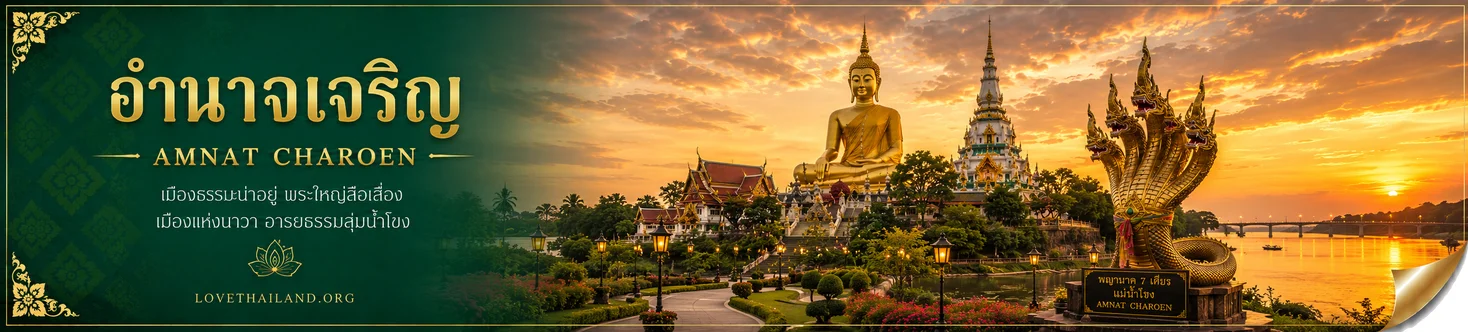
Amnat Charoen
Slogan : Phra Mongkhon, Seven River basils, Sacred caves, Phra Lao, Beautiful islands and mountain, precious silk and religious people.
Amnat Charoen is a small province in northeastern Thailand that preserves the charm of a simple lifestyle and authentic Isan culture. Although it is not a mainstream tourist destination, the province offers a peaceful atmosphere, natural beauty, and the sincerity of local people whose lives remain deeply connected to nature, religion, and long-standing traditions.
The province is characterized by low plains interspersed with gentle hills. Its soil, consisting mainly of sandy loam and laterite, supports traditional agriculture. Part of the province borders the Mekong River in Chanuman District, where Thai–Lao cultural influences blend seamlessly. Riverside life is still evident through local fishing, small-scale trade, and enduring traditions passed down through generations.
Amnat Charoen is an ideal destination for travelers seeking a true “slow life” experience. Whether visiting important temples, exploring unspoiled natural landscapes, or discovering local handicrafts, every aspect of the province reflects a unique identity distinct from more commercialized destinations.
Historically, Amnat Charoen has long been connected to Khemmarat, once a significant city in the region. During the early Rattanakosin period, the area played a role in regional political and military events in northeastern Thailand.
In 1826, a major conflict occurred between Bangkok and the army of King Anouvong of Vientiane. His forces captured Khemmarat and attempted to persuade Phra Thep Wongsa (Kam) to join them. When he refused, he was executed, marking a pivotal moment that reflected shifting power dynamics in the region.
Later, in 1858, during the reign of King Rama IV, Ban Kho Yai was elevated to city status and granted the name “Amnat Charoen.” Thao Chanthabrom (Suea) was appointed as the city ruler under Khemmarat, before the administration was later transferred to Ubon Ratchathani.
Amnat Charoen officially became a province on December 1, 1993. Although relatively new in administrative terms, it retains a rich cultural and historical heritage.
Today, the province is divided into seven districts: Mueang Amnat Charoen, Hua Taphan, Phana, Senangkhanikhom, Chanuman, Pathum Ratchawongsa, and Lue Amnat. Each district has its own unique character, traditions, and attractions.
Tourism in Amnat Charoen is particularly notable for its serene and beautiful temples. Wat Phra Mongkhon Ming Mueang serves as a spiritual center for locals, while Wat Tham Saeng Phet, set amidst nature, offers a peaceful environment ideal for meditation and relaxation.
Beyond religious sites, the province also offers natural attractions that remain largely untouched. These include community forests, small waterfalls, and agricultural areas where visitors can experience local ways of life firsthand.
Another highlight of Amnat Charoen is its traditional handicrafts, such as handwoven textiles, basketry, and other locally made products. These crafts reflect the creativity and cultural identity of the community.
The lifestyle of the people here remains simple and closely tied to nature. Most residents work in agriculture, including rice farming, gardening, and livestock raising, maintaining a balanced relationship between humans and the environment.
Getting There Travelers can reach Amnat Charoen by private car from Bangkok via Phahonyothin Road and Mittraphap Road, passing through Saraburi, Nakhon Ratchasima, and Ubon Ratchathani. The journey typically takes around 8–9 hours. Alternatively, direct buses are available from Mo Chit Bus Terminal in Bangkok.
For a faster option, visitors can fly to Ubon Ratchathani Airport and continue by car to Amnat Charoen, which takes approximately 1–1.5 hours.
With its calm atmosphere, cultural depth, and distinctive identity, Amnat Charoen is an ideal destination for travelers seeking a meaningful and authentic travel experience away from the crowds.
Annual Festivals in Amnat Charoen 2026
| Month | Festival | Location | Address | Highlights |
| January | New Year And Red Cross Fair | Amnat Charoen Provincial Hall | Arun Prasert Road, Bung Subdistrict, Mueang District | Annual Fair And Cultural Performances |
| March | Bun Phawet Festival | Temples Across The Province | All Districts In Amnat Charoen | Traditional Isan Buddhist Sermons |
| April | Songkran Festival | Amnat Charoen City Area | Municipal Area Of Amnat Charoen | Water Celebration And Merit-Making |
| May | Rocket Festival | Phana District | Phana District, Amnat Charoen | Colorful Rocket Processions |
| July | Buddhist Lent Festival | Temples Provincewide | All Districts | Candle Processions |
| October | End Of Buddhist Lent | Major Temples | Provincewide | Merit-Making And Almsgiving |
3–5 Day Amnat Charoen Itinerary
| Day | Place | Address | Activities |
| Day 1 | Wat Phra Mongkhon Ming Mueang | Bung Subdistrict, Mueang District | Temple Visit And City Exploration |
| Day 2 | Wat Tham Saeng Phet | Mueang District | Meditation And Nature Walk |
| Day 3 | Chanuman District | Chanuman District | Mekong River Experience |
| Day 4 | Local Craft Community | Phana District | Weaving And Cultural Learning |
| Day 5 | Local Market | City Area | Food Tasting And Shopping |
Top 15 Must-Visit Attractions In Amnat Charoen
| No. | Place | Address | Highlights |
| 1 | Wat Phra Mongkhon Ming Mueang | Bung Subdistrict, Mueang District | Sacred Giant Buddha |
| 2 | Wat Tham Saeng Phet | Mueang District | Peaceful Nature Temple |
| 3 | Kaeng Khan Sung | Chanuman District | Mekong River Views |
| 4 | Phu Sing | Senangkhanikhom District | Mountain Viewpoint |
| 5 | Morning Market | City Area | Local Food Experience |
| 6 | Phana Weaving Community | Phana District | Traditional Textiles |
| 7 | Nong Nam Yai | Hua Taphan District | Natural Lake |
| 8 | Wat Pa Sri Udom | Lue Amnat District | Meditation Retreat |
| 9 | Local Community Market | Pathum Ratchawongsa District | Authentic Lifestyle |
| 10 | Agricultural Learning Center | Mueang District | Farm Experience |
| 11 | Wat Phu Kaeo | Phana District | Scenic Hill Temple |
| 12 | Mekong Riverside | Chanuman District | River Scenery |
| 13 | Handicraft Villages | Multiple Districts | Local Crafts |
| 14 | Old Market Area | City Area | Vintage Atmosphere |
| 15 | Viewpoints | Various Locations | Photography Spots |
Frequently Asked Questions (FAQ)
Q: Where is Amnat Charoen located?
A: Amnat Charoen is located in northeastern Thailand (Isan region), bordering Ubon Ratchathani and close to the Mekong River along the Thai–Lao border.
Q: What is Amnat Charoen known for?
A: The province is known for its peaceful atmosphere, authentic Isan culture, beautiful temples, natural attractions, and traditional handicrafts.
Q: When is the best time to visit Amnat Charoen?
A: The best time to visit is between November and February, when the weather is cooler and more comfortable for travel.
Q: How many days are recommended for traveling in Amnat Charoen?
A: A 3–5 day trip is ideal to explore temples, natural attractions, local culture, and nearby districts at a relaxed pace.
Q: How do you get to Amnat Charoen from Bangkok?
A: You can travel by bus from Bangkok’s Mo Chit Bus Terminal, drive by car, or fly to Ubon Ratchathani Airport and continue by car for about 1–1.5 hours.
Q: Are there famous temples in Amnat Charoen?
A: Yes, notable temples include Wat Phra Mongkhon Ming Mueang and Wat Tham Saeng Phet, both known for their spiritual significance and peaceful surroundings.
Q: Is Amnat Charoen suitable for foreign tourists?
A: Yes, it is suitable for travelers seeking authentic local experiences, quiet destinations, and cultural immersion away from crowded tourist areas.
Q: What local experiences should not be missed?
A: Visitors should explore local markets, experience traditional Isan food, visit handicraft communities, and enjoy nature-based activities.
Amnat Charoen Map

 Art, Culture and Heritage
 Historical Sites and Monuments(1)
 Art, Craft Centres, Tradition(4)
 Museums(1)
 Places of Worship
 Temple(30)
 Other Sacred Sites(8)
 Suburban Living
 Village, Community(4)
 Nature and Wildlife
 National Parks and Marine Reserves(3)
 Mountain (Doi)(6)
 Dam, Reservoir, Lake(5)
 Waterfalls(3)
 Caves(2)
 River, Canal(5)
 Other natural attractions(5)
 Entertainment and Agricultural
 Zoos and Aquariums(1)
 Farms, Parks and Ecotourism(4)
 Shopping
 Shopping and Night Market(1)
 Travel Articles, Recipes
 Travel Review, Food Review(3)


