
lovethailand home >North Travel Attractions
> Lamphun Travel Attractions
TL;DR: A quick overview of attractions in Lamphun, plus planning details, access, and key travel highlights.
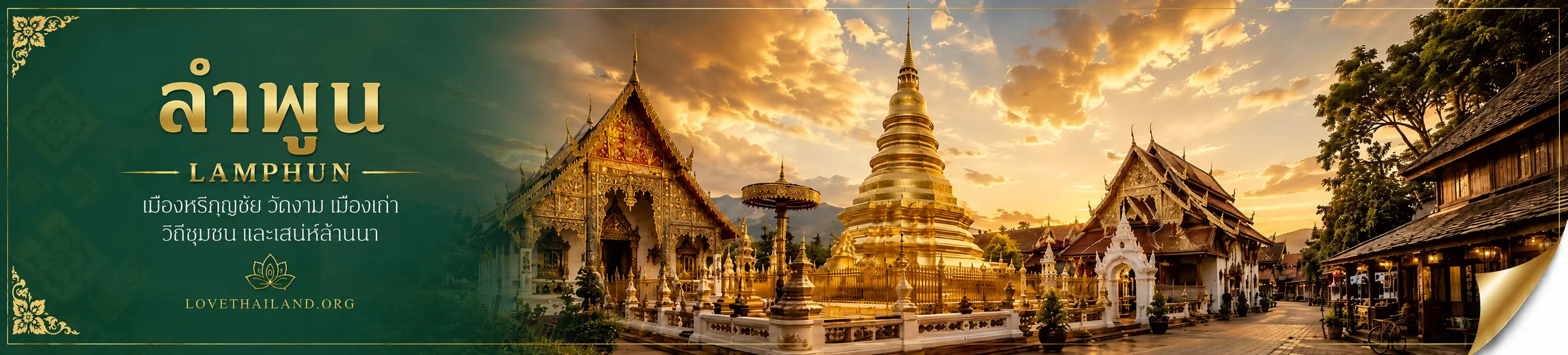
Lamphun
Slogan : Charlot is the best, amulet is magical, famous Longan, greate garlic, nice tradition, Chamadevi Sriripoonchai.
Lamphun Province is a small province in Northern Thailand, yet it is filled with one of the oldest and most significant historical narratives in the Lanna region. Despite its relatively small area, it possesses deep cultural heritage, refined artistic traditions, and a long-standing history that has earned it recognition as one of the most important ancient cities in Northern Thailand. Its origins date back to the Hariphunchai Kingdom, an ancient civilization that flourished long before the rise of Lanna.
In the past, Lamphun was known as “Hariphunchai City”, which is believed to have been established around 657 CE (B.E. 1200). The city was founded under the leadership of Hermit Wasuthep, who gathered the Lawa people to travel along the Ping River to establish a new settlement. After the city was completed, Queen Chamadevi, a princess from the Lavo Kingdom, was invited to rule as the first monarch. This marked the beginning of a prosperous civilization in terms of religion, art, and governance.
For over 600 years, Hariphunchai maintained continuous royal succession and cultural development until it became part of the Lanna Kingdom. Later, it fell under Burmese rule for more than 200 years. Eventually, King Taksin the Great supported Chao Kawila in reclaiming independence and appointed Chao Kham Fan to rule Lamphun, restoring its importance as a major center of Lanna once again.
During the Rattanakosin period, Lamphun underwent continuous administrative changes until 1932, when the traditional ruler system was abolished and Lamphun was officially established as a province. Despite these changes, it has preserved its authentic Lanna identity remarkably well to this day.
Today, Lamphun is considered a province with high potential for cultural tourism. It is rich with ancient temples, historic stupas, and authentic Lanna art known for its delicate craftsmanship and elegance. Notably, Wat Phra That Hariphunchai serves as the spiritual center of the province and is one of the most important sacred sites in Northern Thailand.
Other significant temples include Wat Chamadevi, Wat Mahawan, and Wat San Pa Yang Luang, all of which reflect the former glory of Lanna civilization. Visitors can experience tranquility, devotion, and the atmosphere of a living ancient city that still thrives today.
Lamphun is also renowned for its handicrafts, particularly “Lamphun Yok Dok Silk”, a high-level traditional textile passed down through generations. Its intricate patterns are unique to the province. Visitors can explore weaving communities such as Sri Muang Yoo and Wiang Yong villages to observe the production process and purchase high-quality products.
In terms of cuisine, Lamphun retains its Lanna culinary identity, offering dishes such as Northern-style larb, Nam Prik Noom, Hang Lay curry, and other local specialties made with fresh ingredients. Visiting Lamphun is therefore not only about sightseeing but also about experiencing culture through its flavors.
Another highlight of Lamphun is its role as a major longan-producing region. During harvest season, visitors can enjoy orchard experiences and taste fresh fruit directly from farms. Additionally, the province produces high-quality garlic, which is another important agricultural product.
Economically, Lamphun is one of the industrial hubs of Northern Thailand, with Lamphun Industrial Estate closely linked to Chiang Mai. This creates a balanced identity between cultural heritage and modern economic development.
For nature lovers, Lamphun offers experiences such as boat trips along the Ping River, countryside walks, and community-based tourism that reflects a simple and warm rural lifestyle.
Getting There Traveling to Lamphun is very convenient. It is located only about 30 kilometers from Chiang Mai, taking approximately 30–40 minutes by car, train, or public transport. This makes Lamphun an ideal destination for a day trip or a short getaway from Chiang Mai.
Lamphun is therefore a province that perfectly blends history, culture, and way of life. It is ideal for travelers who wish to experience authentic Lanna culture in a peaceful, non-crowded atmosphere filled with deep charm and memorable experiences.
Lamphun Tourism Festivals 2026
| Month | Festival Name | Location | Description |
| January | Lamphun Winter Festival & Local Products Fair | Lamphun Provincial Hall | OTOP products, local food, Lanna cultural shows, and tourism activities |
| April | Lamphun Songkran Festival | Wat Phra That Hariphunchai and citywide | Water pouring ceremony, Lanna parades, and traditional activities |
| May | Hariphunchai Sacred Water Festival | Wat Phra That Hariphunchai | Major sacred ceremony with processions and merit-making |
| July | Candle Festival | Lamphun City | Lanna-style candle procession and religious activities |
| August | Lamphun Longan Festival | Various districts | Celebration of longan harvest with parades and markets |
| November | Yi Peng Festival | Temples and communities | Lantern release and merit-making ceremonies |
| December | Lanna New Year Festival | Lamphun City | Cultural shows and winter tourism activities |
Lamphun 3–5 Day Travel Plan
| Day | Time | Activities / Places |
| Day 1 | Morning | Wat Phra That Hariphunchai + Wat Mahawan |
| Afternoon | Hariphunchai National Museum + Old Town | |
| Evening | Evening market + local food | |
| Day 2 | Morning | Wat Chamadevi + Wat San Pa Yang Luang |
| Afternoon | Silk weaving village | |
| Evening | Rice field café + sunset | |
| Day 3 | Morning | Ping River boat trip |
| Afternoon | Longan orchard | |
| Evening | Local restaurant | |
| Day 4 | Morning | Ban Hong + Wat Phra Bat Huai Tom |
| Afternoon | Karen community | |
| Evening | Homestay | |
| Day 5 | Morning | Temple visit + shopping |
| Afternoon | Café + return | |
| Evening | Return |
Top 15 Must-Visit Attractions in Lamphun
| No. | Attraction | Highlight |
| 1 | Wat Phra That Hariphunchai | Main sacred landmark |
| 2 | Wat Chamadevi | Ancient stupa |
| 3 | Wat Mahawan | Phra Rod Buddha |
| 4 | Wat San Pa Yang Luang | Beautiful temple |
| 5 | Hariphunchai Museum | History |
| 6 | Ban Hong | Nature & culture |
| 7 | Wiang Yong | Ancient community |
| 8 | Wat Phra Bat Huai Tom | Karen temple |
| 9 | Tha Sing Bridge | River view |
| 10 | Nong Dok Market | Local life |
| 11 | Longan Orchard | Famous fruit |
| 12 | Rice Field Café | Scenic view |
| 13 | Ping River | Boat trip |
| 14 | Sri Muang Yoo | Silk weaving |
| 15 | Lamphun Market | Local food |
Frequently Asked Questions (FAQ)
Q: What are the must-visit attractions in Lamphun?
A: Lamphun is rich in cultural attractions such as Wat Phra That Hariphunchai, Wat Chamadevi, Hariphunchai Museum, and traditional weaving communities like Sri Muang Yoo and Wiang Yong.
Q: How many days should I spend in Lamphun?
A: 2–3 days is recommended, but 3–5 days allows for a more complete experience.
Q: When is the best time to visit Lamphun?
A: November–February offers the best weather, along with festivals like Yi Peng and Songkran.
Q: How is Lamphun different from Chiang Mai?
A: Lamphun is quieter, more traditional, and less crowded.
Q: What food is Lamphun famous for?
A: Northern Thai dishes such as larb, nam prik noom, hang lay curry, and longan fruit.
Q: Is Lamphun easy to travel to?
A: Yes, only 30–40 minutes from Chiang Mai.
Q: What type of traveler is Lamphun suitable for?
A: Cultural, slow-life, and history travelers.
Q: Where should I go first in Lamphun?
A: Start at Wat Phra That Hariphunchai.
Lamphun Map

 Art, Culture and Heritage
 Historical Sites and Monuments(2)
 Landmarks and Memorials(8)
 Art, Craft Centres, Tradition(9)
 Museums(3)
 Historic Homes and Cities(1)
 Places of Worship
 Temple(91)
 Mosque(1)
 Other Sacred Sites(7)
 Research and Development
 Royal Project(1)
 Suburban Living
 Village, Community(13)
 Local Market(3)
 Nature and Wildlife
 National Parks and Marine Reserves(2)
 Mountain (Doi)(1)
 Dam, Reservoir, Lake(13)
 Waterfalls(3)
 Caves(4)
 River, Canal(1)
 Other natural attractions(1)
 Entertainment and Agricultural
 Farms, Parks and Ecotourism(2)
 Waterpark(1)
 Travel Articles, Recipes
 Travel Review, Food Review(1)


