
lovethailand home >North Travel Attractions
> Kamphaeng Phet Travel Attractions
TL;DR: A quick overview of attractions in Kamphaeng Phet, plus planning details, access, and key travel highlights.
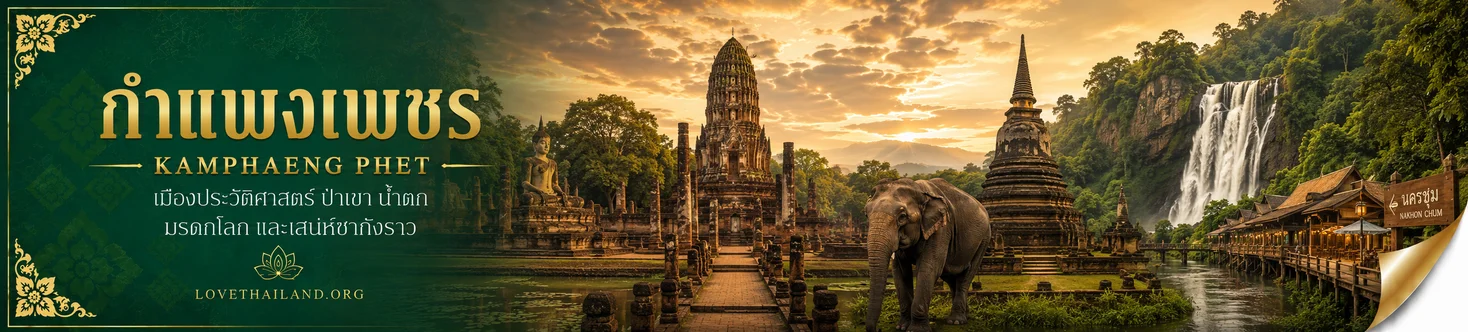
Kamphaeng Phet
Slogan : Inventory of amulet, city of strong people, big rocky, best bannana oil of Lan Kra Beu.
Kamphaeng Phet Province is a province in the lower northern region of Thailand that stands out prominently in terms of history, archaeology, culture, and natural resources. This city is not defined solely by the image of its magnificent historical park, but also reflects the prosperity of the Sukhothai Kingdom, the riverside way of life along the Ping River, and the charm of an ancient town that blends seamlessly with the calm simplicity of northern Thailand. As a result, it is considered a province with deeper and more diverse tourism dimensions than many people might expect.
Originally, Kamphaeng Phet was an important ancient city in the Ping River basin and served as a southern frontier city of the Sukhothai Kingdom. Its location was ideal for transportation, settlement, and defense, which led to the development of a strong and well-fortified city. Evidence of this can still be clearly seen today in the remains of city walls, fortifications, and moats. The name “Kamphaeng Phet” itself reflects the image of a city with walls as strong and resilient as diamonds, and this name has continuously appeared in Thai military campaigns and political history.
In later periods, Kamphaeng Phet continued to maintain its importance from the Sukhothai era through the Ayutthaya period and into the Rattanakosin era, particularly as a city located on routes connecting the northern region with the lower parts of the country. It functioned as a strategic city, a commercial center, and a prominent religious hub. This importance elevated Kamphaeng Phet beyond being merely a secondary administrative city, making it a significant part of Thailand’s state structure across multiple historical periods.
The most famous landmark of Kamphaeng Phet Province is the Kamphaeng Phet Historical Park, located on the eastern side of the Ping River in Mueang District. It is part of the UNESCO World Heritage Site “Historic Town of Sukhothai and Associated Historic Towns”, together with Sukhothai and Si Satchanalai. Within the park, there are monuments inside the city walls and the Aranyik zone located on small laterite hills. Many of the monuments are large, elegant, and reflect the distinctive beauty of Sukhothai art. This makes Kamphaeng Phet one of the most important provinces for those interested in Thai history and archaeology.
The architectural remains of Kamphaeng Phet possess a unique charm unlike other historical cities. In addition to the elegance of a secondary capital of Sukhothai, the atmosphere is solemn, grounded, and deeply connected with nature. Many monuments are surrounded by large trees and open forest areas, creating a different experience compared to more open historical sites. Visitors walking through Kamphaeng Phet Historical Park often feel a sense of tranquility, sacredness, and the grandeur of an ancient city that once played a major role in the region.
Beyond its historical dimension, Kamphaeng Phet is also rich in local culture that continues to be reflected in the daily lives of its people. This is especially evident in the old communities along the Ping River, where the atmosphere remains peaceful, simple, and closely connected to the river. The Ping River is not merely a geographical feature, but also the core of settlement, agriculture, transportation, and shared memory for local communities over a long period.
In terms of religion, Kamphaeng Phet is home to many important temples and sacred sites spread across both urban and rural areas. These include ancient temples within the historical park as well as contemporary temples that continue to serve as centers of faith for local communities. This reflects that Kamphaeng Phet is not only valuable as an ancient city, but also as a place where religion and belief remain deeply integrated into everyday life.
In terms of nature, Kamphaeng Phet is also highly abundant. The province has extensive forest areas and several national parks that enrich its identity beyond being just a historical destination. Visitors can explore both historical sites and natural attractions within a single trip, whether waterfalls, viewpoints, forests, or relaxing nature retreats. The province therefore offers a clear balance between history and nature.
Another aspect that makes Kamphaeng Phet interesting is its role as an agricultural province. Much of its land is used for farming, including field crops, fruits, and seasonal produce. This has allowed the lifestyle of local people to remain closely connected with the land and nature. The slower pace of life contributes to maintaining a friendly, simple, and authentic atmosphere.
The cuisine of Kamphaeng Phet reflects the character of the lower northern region. It includes simple local dishes, influences from central Thai cuisine, and traditional foods made from local ingredients. Visitors often experience flavors that are not overly intense, but appealing through freshness, familiarity, and the charm of dining in a small town that retains its identity.
The overall atmosphere of Kamphaeng Phet is calm, composed, and slower-paced compared to many major tourist provinces. It is ideal for travelers who enjoy exploring ancient cities without rushing, visiting temples, observing archaeological sites, photographing light and shadow on laterite walls, or spending time with nature and rivers. The province is suitable for both serious history enthusiasts and those seeking relaxation in a culturally rich environment.
Getting There Traveling to Kamphaeng Phet is convenient from Bangkok via major highways through Nakhon Sawan. It is also easily accessible from nearby provinces in the lower northern region. The province is well-positioned for travel routes connecting to Sukhothai, Phitsanulok, or Tak, making it suitable both as a standalone destination and as part of a multi-province itinerary.
With all these elements combined, Kamphaeng Phet is more than just a province known for its famous historical park. It is a destination that brings together the beauty of the past, cultural value, the tranquility of riverside life along the Ping River, and the freshness of nature in a balanced way. For those seeking to experience an ancient Thai city in a deep, quiet, and meaningful atmosphere, Kamphaeng Phet is a destination that should not be overlooked.
Annual Festivals in Kamphaeng Phet Province 2026
| Festival Name | Period | Location | Highlights |
| Nop Phra Len Phleng Festival | February 2026 | Kamphaeng Phet Historical Park | A major provincial tradition held in a historical city atmosphere, featuring traditional costumes, ancient markets, cultural performances, light and sound shows, and activities that clearly reflect the identity of Kamphaeng Phet |
| Kamphaeng Phet Loy Krathong Festival | November 2026 | Ping River, Mueang Kamphaeng Phet District | Floating krathongs in an old-town atmosphere, decorative lighting, local activities, krathong contests, and a riverside ambiance perfect for year-end tourism |
| Thai Sart Kluai Khai Festival | September 2026 | Mueang Kamphaeng Phet District | A major festival linked to the province’s famous egg bananas, including product sales, contests, food processing, and promotion of local products |
| Songkran Festival | April 2026 | City area and major temples | Traditional Thai New Year with merit-making, water pouring ceremonies, and local-style water celebrations |
| Candle Festival (Buddhist Lent) | July 2026 | Major temples | Candle parades, religious ceremonies, and community-based traditions |
| Nature Tourism Season | Nov 2026 – Jan 2027 | Khlong Lan National Park and nature areas | Cool weather, ideal for waterfalls, forests, and nature retreats |
3–5 Day Travel Plan in Kamphaeng Phet (Fully Detailed)
| Day | Route | Attractions | Activities | Highlights |
| Day 1 | Mueang Kamphaeng Phet | Kamphaeng Phet Historical Park, Wat Phra Kaew, Wat Phra That | Explore ancient ruins, take photos of the old city, learn about the history of Kamphaeng Phet, and observe Sukhothai art details | Start the trip with the heart of the province, a UNESCO World Heritage site and the most important historical highlight |
| Day 2 | City – Nakhon Chum | Nakhon Chum Community, local markets, Ping River, temples | Walk through the old community, taste local food, take lifestyle photos, and enjoy a slow riverside atmosphere | Ideal for travelers who want to see real local life beyond historical ruins |
| Day 3 | Khlong Lan | Khlong Lan National Park, Khlong Lan Waterfall | Light trekking, waterfall activities, relaxation, and photography of lush nature | A full nature day, shifting from historical exploration to green landscapes |
| Day 4 | Phran Kratai – Sai Thong Watthana | Wat Phra Borommathat, Phra Ruang Hot Spring | Temple visits, historical learning, and relaxing in natural hot springs | Combines religion, history, and relaxation in one day |
| Day 5 | Mueang Kamphaeng Phet | Morning market, walking street, souvenir shops, viewpoints | Buy souvenirs, enjoy local cuisine, and capture final memories before departure | A relaxed ending to complete the trip with food and atmosphere |
15 MUST VISIT Attractions in Kamphaeng Phet
| No. | Place Name | Category | District | Highlights |
| 1 | Kamphaeng Phet Historical Park | Historical | Mueang | UNESCO World Heritage site and the core tourism attraction of the province |
| 2 | Wat Phra Kaew | Temple / Historical | Mueang | Important site reflecting Sukhothai art and the prosperity of the ancient city |
| 3 | Wat Phra That | Temple / Historical | Mueang | Ancient chedi with a sacred atmosphere and high archaeological value |
| 4 | Wat Phra Si Iriyabot | Temple / Historical | Mueang | Famous for four Buddha postures and forest-surrounded ruins |
| 5 | Wat Chang Rop | Temple / Historical | Mueang | Iconic elephant-surrounded chedi base |
| 6 | Wat Sing | Temple / Ruins | Mueang | Quiet historical site ideal for deep exploration |
| 7 | Wat Awat Yai | Temple / Ruins | Mueang | Large temple area reflecting religious importance |
| 8 | Nakhon Chum Community | Community / Culture | Mueang | Riverside lifestyle and peaceful local charm |
| 9 | Nakhon Chum Retro Market | Culture | Mueang | Local food and traditional atmosphere |
| 10 | Ping River | Nature | Mueang | Scenic riverside views and calm atmosphere |
| 11 | Khlong Lan Waterfall | Nature | Khlong Lan | Large famous waterfall ideal for relaxation |
| 12 | Khlong Lan National Park | Nature | Khlong Lan | Rich forest and natural exploration |
| 13 | Phra Ruang Hot Spring | Nature | Sai Thong Watthana | Natural hot spring for relaxation |
| 14 | Wat Phra Borommathat | Temple | Phran Kratai | Historic temple with deep religious significance |
| 15 | Kamphaeng Phet Walking Street | Food / Culture | Mueang | Local food, souvenirs, and evening atmosphere |
Frequently Asked Questions (FAQ)
Q: What is the best time to visit Kamphaeng Phet?
A: The best time is November to February when the weather is cool and ideal for outdoor exploration.
Q: What is Kamphaeng Phet famous for?
A: Its UNESCO World Heritage historical park and natural attractions.
Q: How many days should you stay?
A: 3–5 days is recommended.
Q: Are there natural attractions?
A: Yes, including waterfalls, forests, and hot springs.
Q: Is it easy to travel?
A: Yes, about 4–5 hours from Bangkok.
Q: Where should first-time visitors go?
A: Start at the historical park.
Q: Who is it suitable for?
A: History lovers, nature travelers, and those seeking a peaceful destination.
Q: Is it suitable for families?
A: Yes, very suitable.
Q: What souvenirs are popular?
A: Egg bananas and local products.
Q: How is it different from Sukhothai?
A: More peaceful and surrounded by nature.
Kamphaeng Phet Map

 Art, Culture and Heritage
 Historical Sites and Monuments(4)
 Landmarks and Memorials(1)
 Art, Craft Centres, Tradition(4)
 Museums(4)
 Historic Homes and Cities(1)
 Places of Worship
 Temple(25)
 Other Sacred Sites(8)
 Research and Development
 Royal Project(2)
 Suburban Living
 Village, Community(2)
 Local Market(2)
 Nature and Wildlife
 National Parks and Marine Reserves(4)
 Mountain (Doi)(2)
 Dam, Reservoir, Lake(4)
 Waterfalls(4)
 Hot Springs(1)
 River, Canal(3)
 Bays and Beaches(2)
 Other natural attractions(1)
 Entertainment and Agricultural
 Farms, Parks and Ecotourism(5)
 Waterpark(1)
 Shopping
 Shopping and Night Market(1)


