
lovethailand home >Central Travel Attractions >Bangkok Travel Attractions > 50 Most Beautiful Temples in Thailand Famous Buddh..
TL;DR: 50 Most Beautiful Temples in Thailand Famous Buddhist Landmarks, open Daily, except during royal ceremonies or announced closures Opening Hours. Highlights include Admission Fee.
50 Most Beautiful Temples in Thailand Famous Buddhist Landmarks
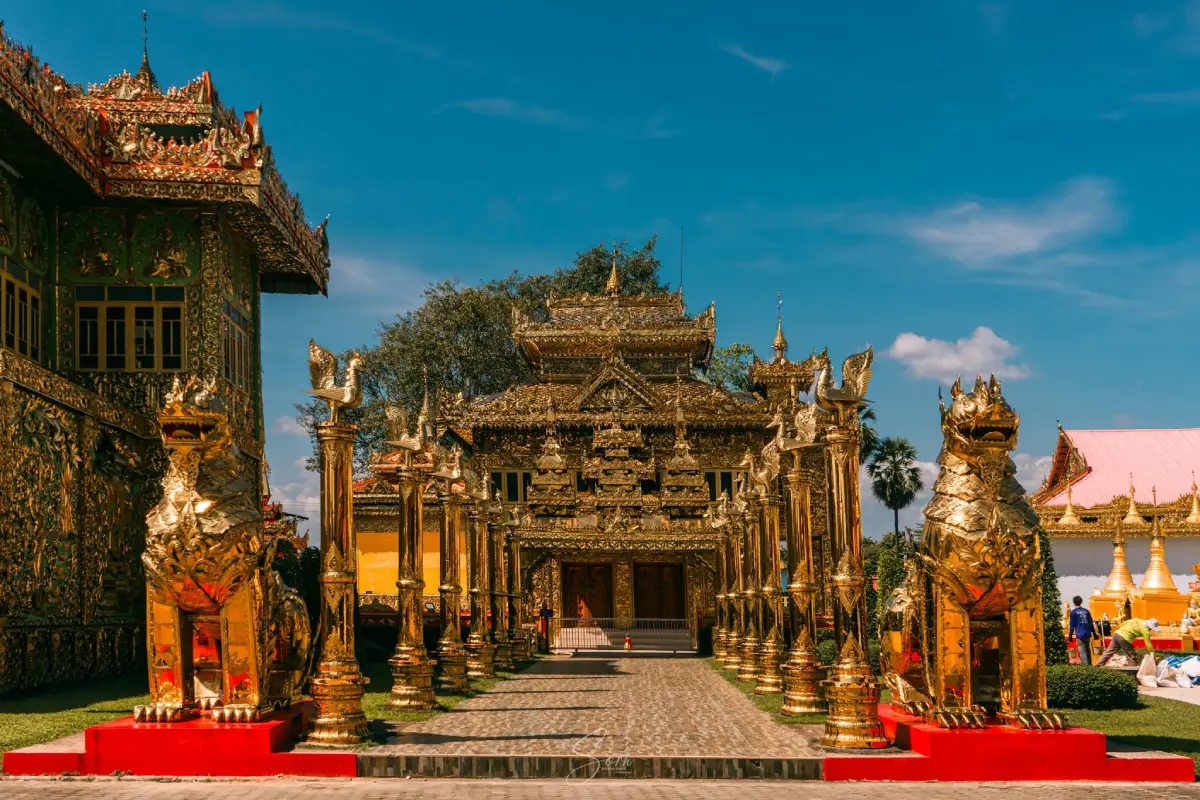
50 Most Beautiful Temples in Thailand: Famous Buddhist Landmarks, Ancient Monasteries and GPS Locations Thailand is home to an extraordinary range of Buddhist temples that embody the country’s religious heritage, artistic achievements and historical continuity. Beyond serving as places of worship, temples preserve architecture, murals, sculpture, local beliefs and regional knowledge. Visitors can discover ancient monasteries in former capitals, venerate sacred relics on mountaintops, admire cherished Buddha images and explore contemporary Buddhist art according to their interests.
For a first temple itinerary, Bangkok’s Wat Phra Kaew, Wat Pho and Wat Arun form a convenient one-day route through the historic riverside districts. Travelers with two or three days to explore the Lanna cultural region can combine Wat Phra That Doi Suthep in Chiang Mai with Wat Phra That Hariphunchai in nearby Lamphun. Phra Nakhon Si Ayutthaya is especially rewarding for studying the former royal capital through Wat Chaiwatthanaram, Wat Mahathat and other archaeological monuments.
Thai temple architecture varies widely across regions and periods. Northern Thailand is known for Lanna artistry, gilded chedis and intricately ornamented viharns. Central Thailand features imposing prangs, ordination halls and royal religious complexes influenced by Ayutthaya and Rattanakosin craftsmanship. Northeastern Thailand is home to revered relic stupas intimately connected with Mekong communities. Visiting temples therefore offers insight into Thailand’s cultural diversity as well as the opportunity for peaceful exploration.
Many historic temples remain centers of annual observances, including bathing sacred stupas, venerating Buddhist relics, candlelit circumambulation on major Buddhist holidays and local merit-making ceremonies. These events highlight the relationship between religious sites and their communities. Visitors interested in participating should check the current schedule directly with each temple, as traditional dates may follow the lunar calendar.
Thai temples also appeal to travelers interested in photography, traditional buildings and contemporary art. Wat Arun’s porcelain-decorated prang, Wat Rong Khun’s brilliant white ordination hall, Wat Pho’s monumental Reclining Buddha and the golden stupa atop Doi Suthep each express a distinctive artistic vision. They reward close observation while reminding visitors that these are sacred places rather than merely photographic backdrops.
Planning by geographical area makes temple travel more efficient. In Bangkok, MRT services, river boats and cross-river ferries connect numerous landmarks. In provinces where important temples lie in separate districts, a private car or rental vehicle is often more practical. Always check opening hours and any temporary restrictions, particularly at royal precincts and protected archaeological sites where ceremonies or conservation work may affect public access.
Respectful conduct is essential. Wear clothing that covers your shoulders and knees, remove shoes where instructed, speak quietly and follow on-site signs. Check photography restrictions before photographing Buddha images or religious ceremonies. Avoid disrespectful poses and do not obstruct people who are praying, meditating or performing rituals.
The 50 destinations in this guide include nationally renowned temples, ancient religious monuments, revered local stupas and distinctive examples of Buddhist artistry. Each entry provides its historical and cultural context, principal sights, access information and a map link so travelers can choose an itinerary that suits their interests.
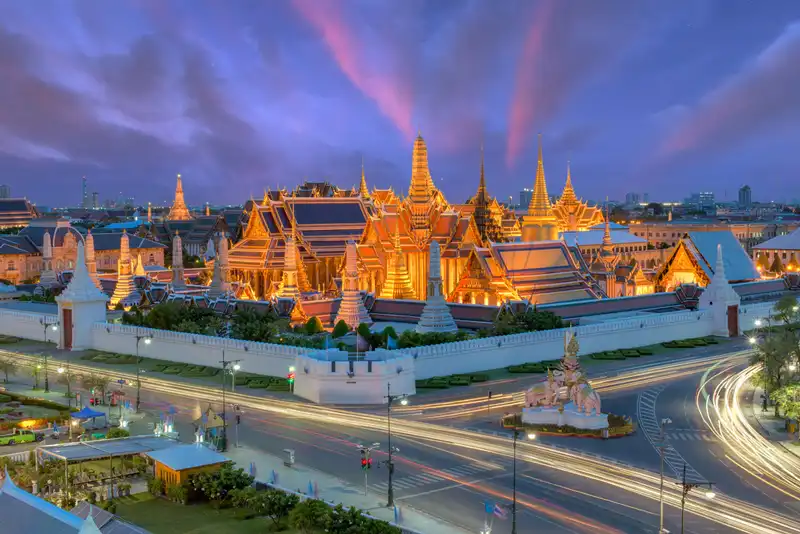
1. Wat Phra Si Rattana Satsadaram (Wat Phra Kaew), Bangkok Wat Phra Si Rattana Satsadaram, better known as Wat Phra Kaew or the Temple of the Emerald Buddha, is situated within the Grand Palace complex in Bangkok’s Phra Nakhon District. It houses the revered Phra Phuttha Maha Mani Rattana Patimakon, the Emerald Buddha, one of Thailand’s most important sacred images. The temple is celebrated for its elaborate ordination hall, richly illustrated Ramakien galleries and splendid group of golden religious monuments. It is a major destination for visitors interested in Buddhism, Thai history, royal architecture and traditional craftsmanship.
Highlights: The Emerald Buddha; the richly decorated ordination hall; Phra Si Rattana Chedi; the Phra Mondop scripture hall; the Royal Pantheon; Ramakien murals along the cloisters; and the architecture of the Grand Palace precinct.
The temple was commissioned by King Rama I when Bangkok became the capital in 1782. Established within the royal precinct, it was intended to enshrine the Emerald Buddha and host important royal ceremonies. Unlike an ordinary monastery, it has no residential monks’ quarters, reflecting its distinctive position as the royal temple of the Grand Palace.
The Emerald Buddha is a seated meditation image carved from green stone. Its history is closely connected with the Lanna and Lan Xang kingdoms and the Thonburi period before it was installed in Bangkok during the reign of Rama I. The Thai monarch ceremonially changes the Buddha image’s seasonal attire, a royal ritual expressing the figure’s importance to Buddhism and the monarchy.
The ordination hall features highly detailed glazed tiles, colored glass, gilded ornament and interior murals. The cloister walls carry an extended series of Ramakien paintings, allowing visitors to follow episodes of the epic while appreciating the relationship between literature and traditional Thai mural painting.
Other notable buildings include the gilded Phra Si Rattana Chedi, Phra Mondop and the Royal Pantheon. Together they exemplify the sophisticated architectural planning and craftsmanship of a royal religious precinct. Photography is permitted only in designated areas; restrictions inside sacred buildings must be observed.
Wat Phra Kaew can readily be combined with nearby Wat Pho and Wat Arun in a one-day visit. Arriving in the morning leaves time to explore the principal buildings without rushing. The Grand Palace enforces a dress code: covered shoulders and trousers or skirts extending below the knees are essential.
Open Days: Daily, except during royal ceremonies or announced closures Opening Hours: 08:30–16:30; ticket sales end at 15:30
Admission Fee: Free for Thai nationals on presentation of Thai ID; THB 500 for foreign visitors, including Grand Palace, Wat Phra Kaew and Queen Sirikit Museum of Textiles under ticket conditions
Location: Na Phra Lan Road, Phra Borom Maha Ratchawang Subdistrict, Phra Nakhon District, Bangkok
Getting There: Take the MRT to Sanam Chai and walk or take a short transfer to the Grand Palace entrance. Alternatively, use the Chao Phraya Express Boat to Tha Chang and walk to the visitor entrance. Drivers should anticipate heavy traffic and use public parking near Sanam Luang.

2. Wat Phra Chetuphon Wimonmangkhalaram (Wat Pho), Bangkok Wat Phra Chetuphon Wimonmangkhalaram, widely known as Wat Pho, is a first-class royal temple on Sanam Chai Road close to the Grand Palace. It is renowned for its monumental Reclining Buddha, the Four Great Chedis and its historical role as a repository of traditional Thai medicine and massage knowledge. Its architecture, religious images and inscriptions make it one of Bangkok’s most rewarding cultural landmarks.
Highlights: The giant Reclining Buddha; the Four Great Chedis; the ordination hall; Phra Buddha Theva Patimakorn; murals; Wat Pho inscriptions; and traditional Thai massage and medical knowledge.
Wat Pho dates back to the Ayutthaya era, when it was known as Wat Photharam. It underwent major restoration during the reigns of King Rama I and King Rama III. Under Rama III, Buddhist teachings, literature, medicine, history and local knowledge were systematically inscribed and displayed across the temple grounds, helping establish the complex as an important public center of learning.
The Reclining Buddha measures approximately 46 meters in length and 15 meters in height. The serene face and monumental proportions embody the aesthetics of Thai Buddhist sculpture, while the soles of the feet feature intricate mother-of-pearl representations of 108 auspicious signs. Visitors should move quietly through the pavilion and avoid obstructing worshippers.
The Four Great Chedis commemorate the early kings of the Chakri dynasty. Their surfaces are covered with vibrantly colored ceramic ornament, while the surrounding cloisters, viharns and subsidiary buildings reveal further layers of Rattanakosin craftsmanship.
Wat Pho’s inscribed stone tablets preserve an exceptional body of knowledge, including material relating to traditional Thai medicine. UNESCO included the epigraphic archives of Wat Pho in its Memory of the World Register. The temple’s association with Thai massage makes the site significant for visitors exploring the history of education and healing traditions in Thailand.
Its central location makes Wat Pho easy to combine with Wat Phra Kaew on foot. To reach Wat Arun afterward, continue to Tha Tien and take a cross-river ferry. Allow approximately one to two hours to appreciate the Reclining Buddha, ordination hall and chedis, and dress modestly throughout the visit.
Open Days: Daily Opening Hours: 08:00–19:30
Admission Fee: Free for Thai nationals with Thai ID; THB 300 per foreign visitor
Location: 2 Sanam Chai Road, Phra Borom Maha Ratchawang Subdistrict, Phra Nakhon District, Bangkok 10200
Getting There: Take the MRT to Sanam Chai and walk to Wat Pho, or travel by river boat to the Tha Tien area. Visitors coming from the Grand Palace can walk between the two attractions without taking a vehicle.

3. Wat Arun Ratchawararam Ratchaworamahawihan, Bangkok Wat Arun Ratchawararam is a first-class royal temple on the Thonburi bank of the Chao Phraya River. Its famous central prang, clad in intricate floral designs made from ceramics and Chinese porcelain, makes it one of Thailand’s most recognizable landmarks. Located in Bangkok Yai District, the temple combines riverside scenery with important religious buildings and the history of the former Thonburi capital.
Highlights: The main prang; intricate porcelain and Chinese ceramic decoration; the ordination hall; Phra Buddha Dhammisoraratchalokathatdilok; murals; and Chao Phraya River views.
The temple dates to the Ayutthaya period and was once known as Wat Chaeng. It gained prominence when King Taksin established Thonburi as his capital. For a period the temple stood within the royal precinct and housed the Emerald Buddha before the image was moved to Wat Phra Kaew in Bangkok during the early Rattanakosin era.
The great central prang was restored and expanded through the early Chakri reigns, notably under Rama II and Rama III, with construction completed during the reign of Rama IV. Its design reflects Buddhist cosmological symbolism, with surrounding prangs and decorative sculpture integrated into a monumental architectural composition.
The prang is especially striking at close range because ceramic fragments and porcelain are assembled into flowers and ornamental patterns. Changes in sunlight bring out different colors and textures across the surface. Visitors can appreciate these details from permitted walkways but must neither climb restricted structures nor touch vulnerable historic decorations.
The ordination hall enshrines Phra Buddha Dhammisoraratchalokathatdilok and contains murals and decorative features associated with Rattanakosin art. Unlike the busy grounds around the prang, the hall remains a quiet space for worship and reflection.
The temple is photogenic both from its own grounds and from across the river, especially in late afternoon as the light changes. Travelers visiting the Grand Palace and Wat Pho can reach it conveniently by crossing the river from the Tha Tien area, creating a classic Bangkok temple itinerary.
Open Days: Daily Opening Hours: 08:00–18:00
Admission Fee: Free for Thai nationals; THB 200 per foreign visitor for ticketed sightseeing areas
Location: 158 Wang Derm Road, Wat Arun Subdistrict, Bangkok Yai District, Bangkok 10600
Getting There: From Wat Pho, walk to Tha Tien Pier and board the cross-river ferry to Wat Arun Pier. Drivers can approach through Arun Amarin Road or Wang Derm Road, though parking should be checked in advance, especially on holidays.
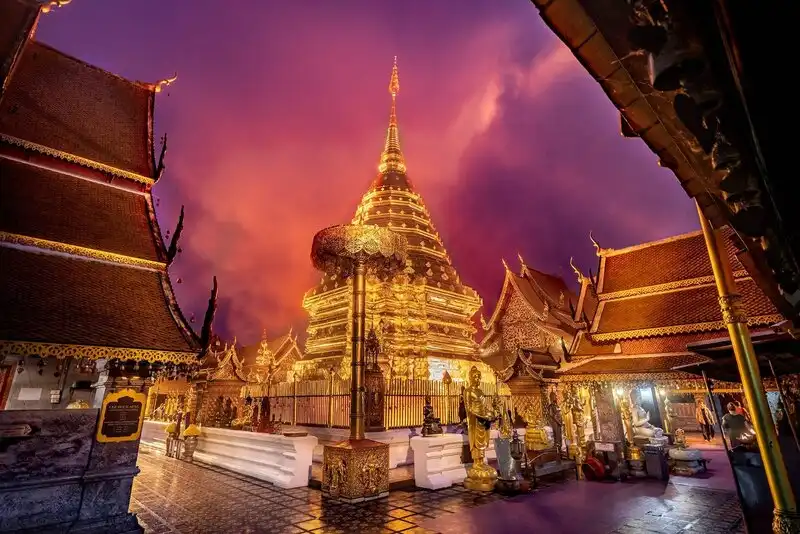
4. Wat Phra That Doi Suthep, Chiang Mai Wat Phra That Doi Suthep is one of Chiang Mai’s most revered religious landmarks, standing on Doi Suthep west of the city center. Visitors come to worship at its gleaming golden relic stupa, walk up the famous naga staircase and enjoy sweeping views across the city. It is both a major pilgrimage destination for Lanna Buddhists and one of northern Thailand’s best-known historic temples.
Highlights: The golden Lanna stupa; the 306-step naga staircase; a panoramic view of Chiang Mai; the annual walk up Doi Suthep before Visakha Bucha; and forested mountain scenery.
The temple’s foundation is associated with King Kuena of the Mangrai dynasty in the late fourteenth century. Lanna tradition tells of a white elephant carrying a Buddha relic up the mountain and stopping at the place where the stupa was constructed. This story forms a central part of the temple’s sacred identity and local heritage.
The principal stupa follows the Lanna bell-shaped tradition and is clad in gilded metal. Worshippers make offerings and walk clockwise around it as a devotional act. Visitors can study the richly decorated shrine buildings and distinctive northern Thai craftsmanship throughout the sacred courtyard.
The approach is marked by an iconic staircase of 306 steps flanked by sculpted nagas. Walking the steps is a memorable part of the pilgrimage, but a separate paid electric tram is available for those who prefer not to make the climb, including many elderly visitors.
Before Visakha Bucha each year, devotees participate in the traditional walk up Doi Suthep, known locally as Tiao Khuen Doi. This observance connects the people of Chiang Mai with their sacred mountain and remains one of the region’s most distinctive expressions of Buddhist devotion.
The viewing terrace offers expansive views over Chiang Mai when the air is clear. The mountain road includes many bends, so drivers should take care. Travelers can also explore nearby Wat Pha Lat and, when open to the public, Bhubing Palace.
Open Days: Daily Opening Hours: 05:00–19:30, according to the listed attraction information
Admission Fee: Free for Thai nationals; THB 30 for foreign visitors; electric tram charged separately
Location: Doi Suthep, Suthep Subdistrict, Mueang Chiang Mai District, Chiang Mai Province
Getting There: From Chiang Mai, follow Huay Kaew Road past Chiang Mai University and Chiang Mai Zoo, then Highway 1004 up Doi Suthep. Private cars, rentals and red songthaews serve the route. At the parking area, choose between the naga staircase and electric tram.
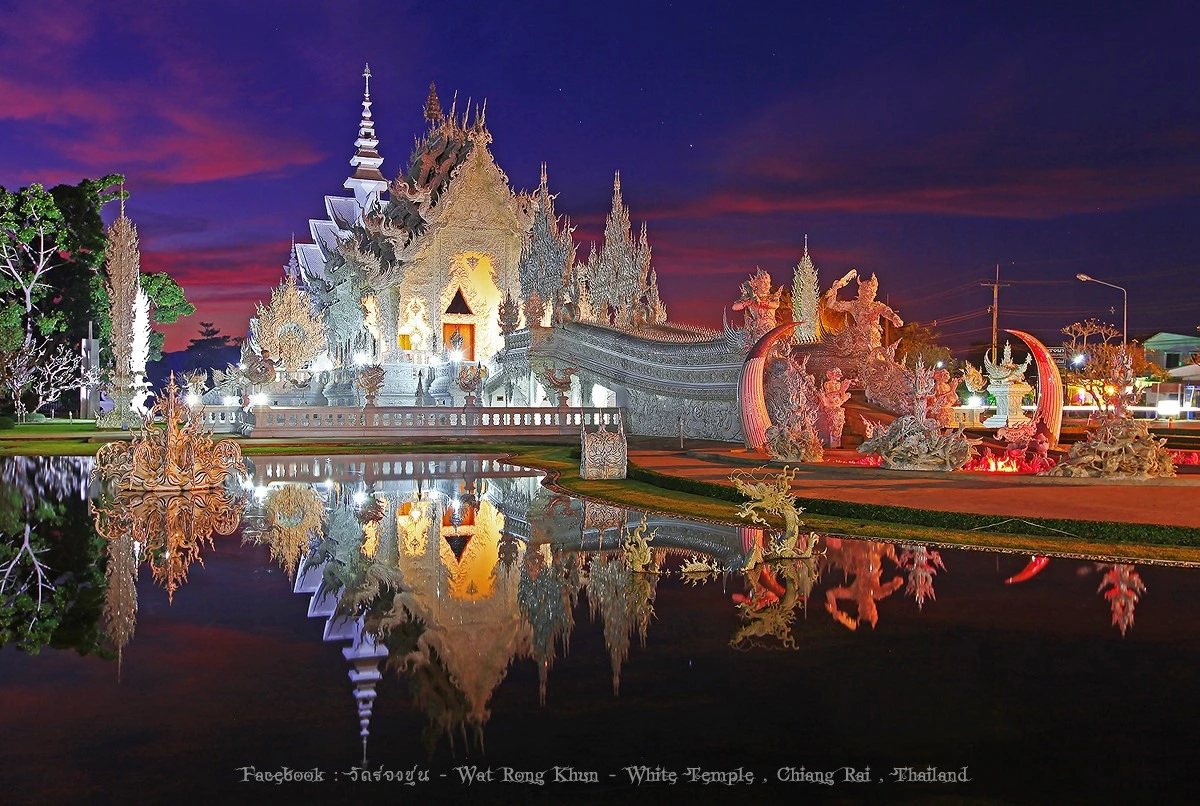
5. Wat Rong Khun (White Temple), Chiang Rai Wat Rong Khun, internationally known as the White Temple, is a contemporary Buddhist art complex in Pa O Don Chai, Chiang Rai. Conceived and developed by National Artist Chalermchai Kositpipat, the temple is distinguished by its brilliant white architecture, mirrored ornament and imaginative sculptural interpretation of Buddhist teachings. It draws visitors interested in contemporary art as well as traditional religious culture.
Highlights: The white ordination hall; the bridge symbolizing passage beyond the cycle of rebirth; sculpted hands representing suffering; mirrored ornament; a gilded building; art gallery; and artistic cave.
The project was developed as an offering of Buddhist art, using white to express purity and pieces of mirrored glass to evoke the radiance of wisdom. Classical Thai architectural forms are combined with the artist’s contemporary imagination, creating an unconventional sacred environment with symbolic meaning throughout its design.
The ordination hall is the center of the complex. Its intricate white stucco decoration and countless mirrored fragments catch the sunlight. The approach crosses a bridge over water and past sculptures designed to symbolize the renunciation of desire and the movement beyond the cycle of suffering.
Before the bridge, numerous hands reach upward from the ground as a visual metaphor for craving and attachment. Rather than treating these dramatic sculptures simply as unusual photo opportunities, visitors can appreciate the Buddhist concepts they are intended to communicate.
Other attractions include an elaborate golden building, galleries showcasing artworks and an immersive artistic cave that uses sculpture, light and sound to present Buddhist ideas. These additional areas offer a broader understanding of Chalermchai’s work across different artistic media.
Mornings are a good time for photography and more comfortable sightseeing. Stay on designated paths, do not touch artworks and respect rules restricting photography inside certain buildings. Travelers can combine a visit with Wat Rong Suea Ten or the Baan Dam Museum elsewhere in Chiang Rai.
Open Days: Daily Opening Hours: Monday–Friday 08:00–17:00; Saturday–Sunday 08:00–17:30
Admission Fee: Free for Thai nationals; THB 200 for foreign visitors from 1 January 2026, including the artistic cave under published conditions; stated exemptions for foreign visitors aged 70+ and children not taller than 120 cm
Location: 60 Moo 1, Pa O Don Chai Subdistrict, Mueang Chiang Rai District, Chiang Rai 57000
Getting There: From Chiang Rai city, take Phahonyothin Road (Highway 1) south for approximately 12 km and follow the signs. Private cars, rental vehicles and taxis provide convenient access; allow extra time on public holidays.
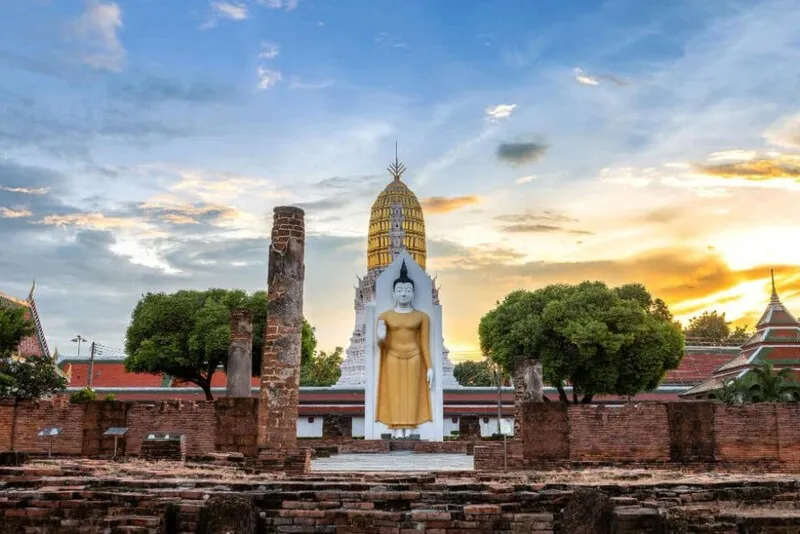
6. Wat Phra Si Rattana Mahathat Woramahawihan (Wat Yai), Phitsanulok Wat Phra Si Rattana Mahathat Woramahawihan, commonly called Wat Yai, is a first-class royal monastery beside the Nan River in Phitsanulok. Its most revered treasure is Phra Buddha Chinnarat, a celebrated bronze Buddha image renowned for exceptional craftsmanship. The temple is an important center of pilgrimage and one of the foremost cultural landmarks of the historic city of Song Khwae.
Highlights: Phra Buddha Chinnarat; the main viharn; the principal prang; the historical association of Phra Buddha Chinnasi and Phra Si Satsada; the Buddha Chinnarat worship festival; and the riverside setting.
The temple’s origins are associated with the Sukhothai period and the development of Phitsanulok, including traditions relating to King Maha Thammaracha I, or Li Thai. The bronze Phra Buddha Chinnarat represents the Buddha subduing Mara, with a graceful face, flame-shaped finial and elaborately ornamented arch framing the image.
The principal viharn draws devotees from across Thailand. Its main Buddha image is enshrined on a raised pedestal and is particularly striking when viewed from the front of the hall. During Buddhist festivals large numbers of people come to pay their respects, so visitors should keep walkways clear and remain considerate toward those praying.
The main prang and surrounding religious buildings reflect multiple phases of architectural development and restoration. Exploring these areas provides insight into the temple plan and the history of Phitsanulok as a significant political and religious center.
An annual celebration in honor of Phra Buddha Chinnarat includes devotional activities and cultural events. Dates and program details vary by year, so visitors wishing to attend should consult the current local schedule.
The temple is conveniently reached from Phitsanulok Railway Station by local transport. It can be combined with nearby Wat Nang Phaya and the historic riverside area for a rewarding day of cultural exploration.
Open Days: Daily Opening Hours: 06:00–18:00
Admission Fee: Free admission; voluntary donations are welcome
Location: Phutthabucha Road, Nai Mueang Subdistrict, Mueang Phitsanulok District, Phitsanulok Province
Getting There: From Phitsanulok Railway Station, take a taxi or local songthaew toward the Nan River and Wat Yai. Drivers arriving from Bangkok can use the Asian Highway network and follow signs into central Phitsanulok.
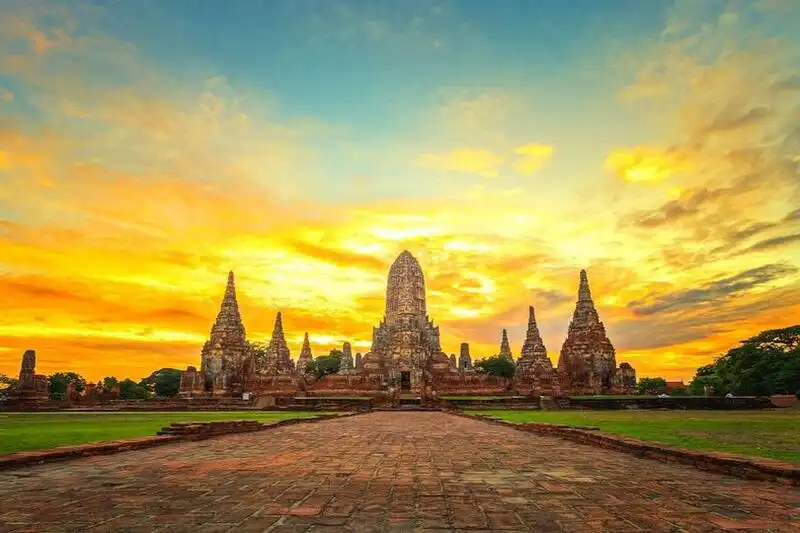
7. Wat Chaiwatthanaram, Phra Nakhon Si Ayutthaya Wat Chaiwatthanaram stands beside the Chao Phraya River on the west bank just outside Ayutthaya Island, in Ban Pom Subdistrict. Its tall central prang, subsidiary towers and surrounding galleries make it one of the former capital’s most memorable historic monuments. The temple is especially popular with travelers interested in archaeological architecture and photographs against the riverside landscape.
Highlights: The principal prang; eight surrounding corner and subsidiary prangs; cloister galleries; ancient Buddha images; Chao Phraya riverside views; and Ayutthaya-period architecture.
Built in 1630 under King Prasat Thong, the complex displays a carefully organized religious plan influenced by Khmer architectural traditions and Buddhist cosmology. A central prang dominates the layout, surrounded by smaller monuments arranged to express the symbolic order of the universe.
The principal tower demonstrates the scale of Ayutthaya brick-and-stucco construction. Walking around the grounds reveals cloisters and subsidiary prangs whose foundations and surviving surfaces allow visitors to imagine the monument at the height of the kingdom, despite centuries of deterioration and damage.
The covered galleries once held many Buddha images. Surviving bases, masonry and archaeological features can be examined from designated paths. Visitors should read the interpretation signs, refrain from climbing historic structures and avoid touching fragile brickwork.
Late afternoon is particularly atmospheric as warm light highlights the silhouette of the towers and the surrounding ruins. Traditional Thai clothing is popular for permitted photographic sessions, but visitors should remain mindful of the sacred and historic setting.
This temple can be combined with Wat Mahathat, Wat Phra Si Sanphet and Wat Ratchaburana. Visiting monuments on Ayutthaya Island before crossing toward the western bank usually makes a convenient route and reduces unnecessary backtracking.
Open Days: Daily Opening Hours: 08:00–18:00; ticket sales until 17:00
Admission Fee: THB 10 for Thai nationals; THB 80 for foreign visitors; multi-site historical park tickets may be available under Fine Arts Department conditions
Location: Ban Pom Subdistrict, Phra Nakhon Si Ayutthaya District, Phra Nakhon Si Ayutthaya 13000
Getting There: From Bangkok, take the Asian Highway to Ayutthaya, enter the city and cross to the western bank of the Chao Phraya River. Follow signs toward Wat Kasattrathirat and Wat Chaiwatthanaram. Private cars and local tuk-tuks are convenient.
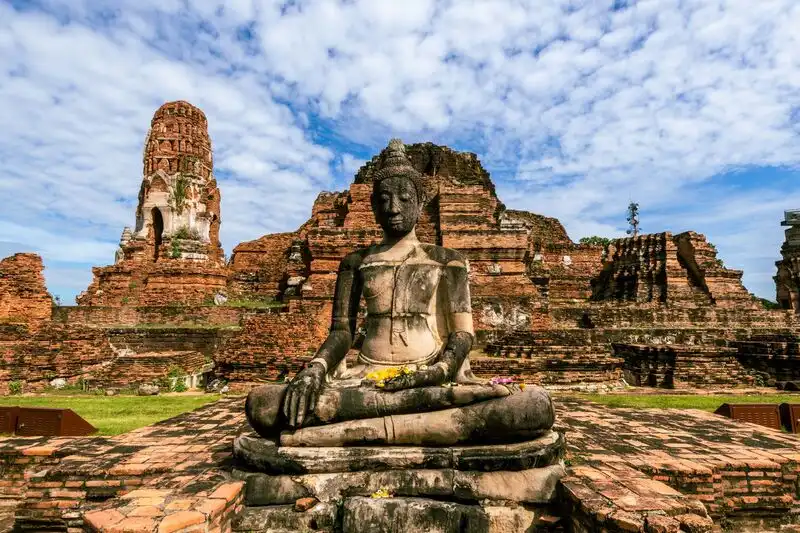
8. Wat Mahathat, Phra Nakhon Si Ayutthaya Wat Mahathat is a major archaeological temple within Ayutthaya Historical Park, close to Wat Ratchaburana on Ayutthaya Island. Its best-known feature is a sandstone Buddha head surrounded by the roots of a growing tree, one of the most recognized images of the former capital. The site also preserves the remains of its principal prang, viharns, stupas and masonry structures.
Highlights: The sandstone Buddha head embraced by tree roots; remains of the principal prang; foundations of viharns; historic chedis; and the archaeological plan of ancient Ayutthaya.
Historically, Wat Mahathat was closely connected to the Ayutthaya royal court and the enshrinement of Buddhist relics. The main prang served as an architectural and religious focal point but suffered extensive damage over successive centuries and historical upheavals.
The Buddha head held within tree roots is the landmark most visitors come to see. Over time, the growing tree enveloped the sculpture, producing an extraordinary scene. When taking photographs here, visitors are asked to crouch or kneel so that their heads remain lower than the Buddha image, and must never touch the sculpture or roots.
The surviving foundations, chedis and wall fragments reveal the former layout of this important religious complex. Following the designated walkways and reading interpretation signs helps visitors understand how the buildings functioned together.
The site particularly appeals to those interested in archaeology and history. Early morning and late afternoon provide gentler light and more comfortable conditions for walking around the exposed ruins.
Wat Ratchaburana stands nearby and is easy to visit immediately afterward. Other monuments on Ayutthaya Island, including Wat Phra Ram and Wat Phra Si Sanphet, can be explored by bicycle or tuk-tuk before continuing to Wat Chaiwatthanaram across the river.
Open Days: Daily Opening Hours: Ticket sales 08:00–17:00; visits allowed until 18:00
Admission Fee: THB 10 for Thai nationals; THB 80 for foreign visitors; combined tickets subject to the Fine Arts Department’s conditions
Location: Naresuan Road area, Ayutthaya Island, Phra Nakhon Si Ayutthaya District, Phra Nakhon Si Ayutthaya 13000
Getting There: From Bangkok, follow the Asian Highway into Ayutthaya and continue to the historic island via Naresuan Road. The temple is close to Wat Ratchaburana and can be reached by car, local tuk-tuk or rental bicycle.
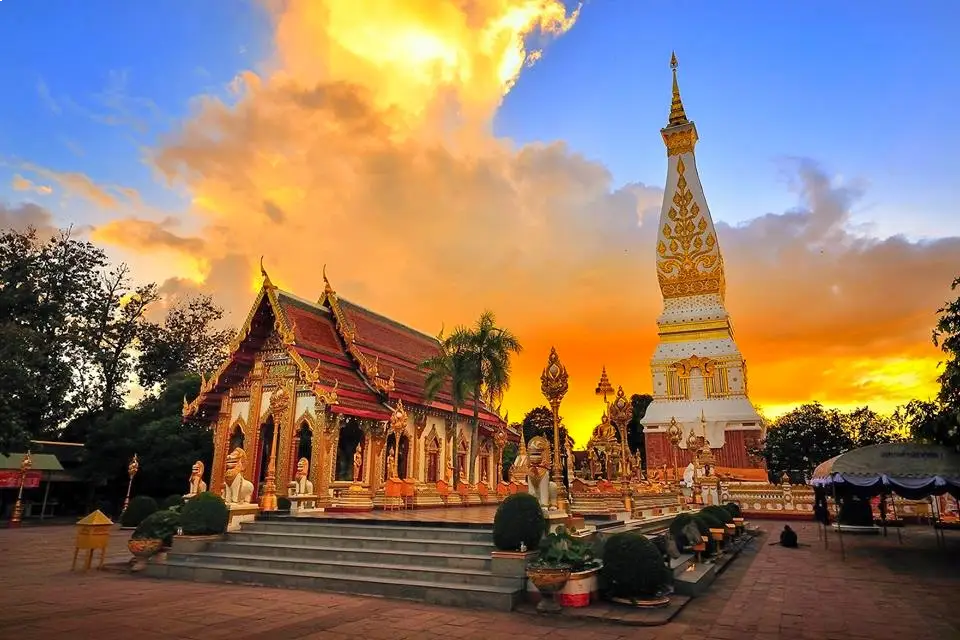
9. Wat Phra That Phanom Woramahawihan, Nakhon Phanom Wat Phra That Phanom Woramahawihan is a first-class royal monastery in That Phanom District, Nakhon Phanom Province. It houses Phra That Phanom, one of the Mekong region’s most revered sacred stupas. The soaring white monument decorated with gold is an enduring symbol of the province and a pilgrimage destination for Thai Buddhists and devotees from neighboring Mekong communities.
Highlights: Phra That Phanom sacred stupa; distinctive Mekong Buddhist architecture; the annual Phra That Phanom festival; ceremonial cloth offerings; and traditional pilgrimage activities.
According to the Uranga Chronicle, the stupa enshrines the Uranga relic, traditionally understood as a sacred relic from the breast of the Buddha. This religious tradition links the monument with generations of Buddhist devotion across both sides of the Mekong River.
The stupa has undergone numerous restorations. The earlier structure tragically collapsed in 1975, after which a new monument was erected in its place while preserving the sacred role and recognizable architectural character of Phra That Phanom. Its reconstruction stands as a testament to communal determination to restore an important pilgrimage site.
Within the monastery, the white-and-gold stupa rises above surrounding religious buildings. Pilgrims walk clockwise around it and offer flowers, incense and other devotional items in accordance with local custom. Visitors should respect the rhythm of prayers and religious ceremonies.
The annual Phra That Phanom festival attracts large crowds for merit-making, ritual worship, cloth offerings and cultural activities. Those who want to attend should confirm the schedule and reserve travel arrangements early, as the town becomes especially busy during the festivities.
The monastery is an ideal place to experience the Buddhist heritage of northeastern Thailand. A trip can include other attractions around That Phanom, the Mekong riverside and nearby Renu Nakhon, where visitors can explore Phu Thai community traditions and local cultural sites.
Open Days: Daily Opening Hours: 05:00–21:00
Admission Fee: Free admission; voluntary donations are welcome
Location: 183/13 Moo 13, Chayangkun Road, That Phanom Subdistrict, That Phanom District, Nakhon Phanom 48110
Getting There: From Nakhon Phanom city, drive south along Highway 212 toward That Phanom for approximately 52 km, passing the Renu Nakhon area. Once in That Phanom town, follow signs to the monastery on Chayangkun Road. Private cars and interdistrict buses serve the area.
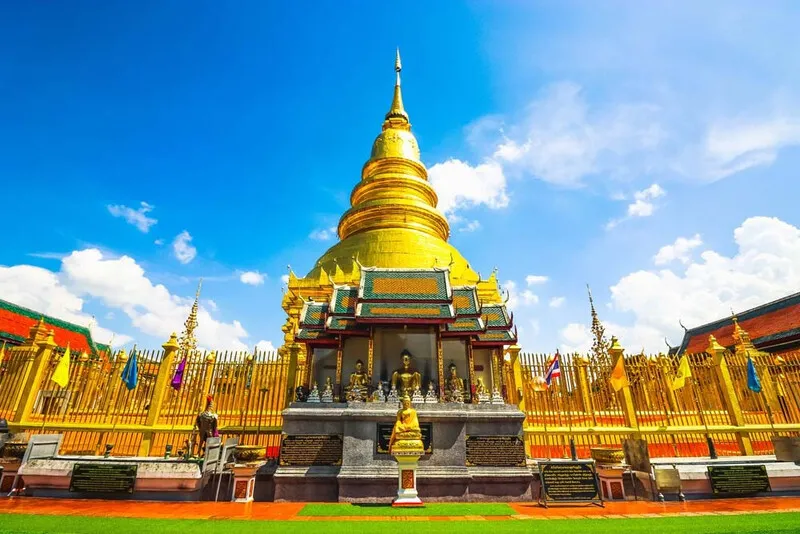
10. Wat Phra That Hariphunchai Woramahawihan, Lamphun Wat Phra That Hariphunchai Woramahawihan is an important royal monastery in the heart of Lamphun. Its golden relic stupa is deeply revered by local communities and pilgrims throughout Thailand. The complex links Buddhist worship with the history of the ancient Hariphunchai kingdom and the evolution of northern Thai and Lanna architectural traditions.
Highlights: The gilded Phra That Hariphunchai stupa; the monumental gateway; main viharn; bell tower; Lanna decorative art; and the annual bathing ceremony for the sacred stupa.
The monastery’s history is associated with legends of sacred relics and the former Hariphunchai polity, which flourished around present-day Lamphun before the rise of the Lanna kingdom. Restored and expanded across successive periods, the temple displays a combination of Hariphunchai and Lanna artistic influences.
The main relic stupa is a graceful gilded bell-shaped chedi clad in golden metal sheets. The surrounding courtyard provides space for worship and clockwise circumambulation, while detailed ornament and accompanying buildings display characteristic northern Thai craftsmanship.
The elaborate gateway at the temple entrance is a notable example of Lanna stucco decoration. Within the grounds, the main viharn and other religious structures reflect successive phases of architectural patronage and restoration.
The annual bathing ceremony of Phra That Hariphunchai is a major local Buddhist tradition. Devotees gather to honor the relic, pour ceremonial water and participate in religious rites in accordance with Lanna custom. Visitors should check the yearly schedule if they want to attend.
Because the temple stands in Lamphun’s historic center, it is easy to combine with the Hariphunchai National Museum, Queen Chamadevi Monument and nearby traditional streets. Lamphun can also be visited on a day trip from Chiang Mai.
Open Days: Daily Opening Hours: 06:30–17:00
Location: Nai Mueang Subdistrict, Mueang Lamphun District, Lamphun Province
Getting There: From Chiang Mai, follow the Chiang Mai–Lamphun route or connecting highway toward Lamphun and continue to the old-town center. Cars, rentals and intercity transport are available, followed by a short local transfer or walk.
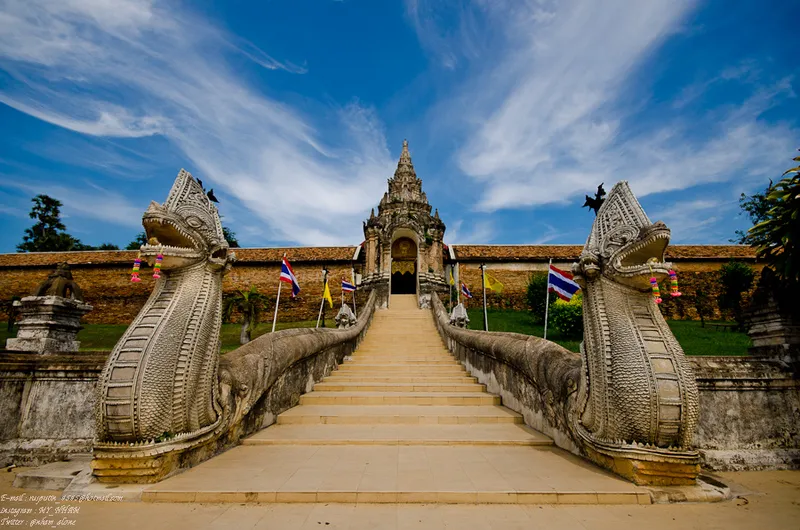
11. Wat Phra That Lampang Luang, Lampang is an ancient Buddhist temple of great historical and religious significance in northern Thailand. It stands on elevated ground in Lampang Luang Subdistrict, Ko Kha District, Lampang Province, approximately 18 kilometers from Lampang city. The temple is distinguished by its golden sacred pagoda and collection of historic wooden assembly halls, which preserve the distinctive beauty of traditional Lanna architecture. A surrounding enclosure separates the sacred precinct from the outside area, allowing visitors to experience the atmosphere of a historic Buddhist sanctuary whose origins stretch back many centuries.
Highlights: Phra That Lampang Luang, Viharn Luang, Viharn Phra Phut, Viharn Nam Taem, the traditional Lanna entrance arch, the Phra Kaeo pavilion, Phra Kaeo Don Tao, and the inverted-image phenomenon inside the Phra Bat shrine.
The history of Wat Phra That Lampang Luang is closely connected with legends surrounding the Buddha's relics and the development of Lampang during the Hariphunchai and Lanna periods. Although the temple has undergone restoration at different times, many of its historic architectural features have survived. Viharn Luang is especially important as an outstanding example of traditional Lanna timber architecture, displaying a multi-tiered roof, an exposed wooden structural system, and decorative details that demonstrate the craftsmanship of northern Thai artisans.
Phra That Lampang Luang stands at the center of the sacred precinct. The bell-shaped chedi is covered with gilded metal sheets, giving it a brilliant appearance when illuminated by sunlight. The surrounding area is used for paying homage and circumambulating the chedi according to Lanna Buddhist tradition. Visitors can appreciate the decorative details of the pagoda and explore the surrounding religious buildings within a relatively compact walking area.
Viharn Nam Taem is another building of exceptional historical and artistic value. It preserves important examples of traditional Lanna wooden architecture and mural painting. Viharn Phra Phut and the Phra Kaeo pavilion also provide opportunities to learn about the temple's sacred Buddha images and artistic heritage, particularly Phra Kaeo Don Tao, an image closely associated with the religious devotion of Lampang's people.
One of the temple's most unusual features is the inverted-image phenomenon found within the Phra Bat shrine. Light passing through a small opening into a dark interior produces an upside-down image of the outside surroundings. This natural optical effect is an interesting example of the camera obscura principle occurring within a historic religious structure. Visitors wishing to observe the phenomenon should check the access restrictions and follow instructions provided at the temple.
Wat Phra That Lampang Luang also remains closely associated with Buddhist merit-making and traditional Lanna ceremonies honoring the sacred pagoda. Local communities and devotees continue to visit the temple on important Buddhist holy days. The temple is therefore not simply a historic monument preserved for tourism, but a living place of worship that continues to play an important role in the surrounding community.
Visitors should allow approximately 1–2 hours to explore the historic halls and walk around the principal chedi. Modest clothing and respectful behavior are particularly important when entering the old wooden buildings. Travelers with additional time can combine the visit with other attractions in Ko Kha District and Lampang city, including Wat Pong Sanuk and Lampang's historic neighborhoods.
Open Days: Daily Opening Hours: 07:30 – 17:00
Address: Lampang Luang Subdistrict, Ko Kha District, Lampang Province, Thailand.
Getting There: From Lampang city, follow the main road toward Ko Kha District along the Lampang–Thoen route, then follow the signs to Lampang Luang Subdistrict. The temple is approximately 18 kilometers from the city center and can be reached by private car, rental car, or hired transport.

12. Wat Phumin, Nan is a historic temple in the center of Nan city, internationally recognized for its famous mural depicting Pu Man and Ya Man, commonly known as the "Whispering of Love." The painting has become one of the most recognizable cultural symbols of Nan Province. The temple is located in Nai Wiang Subdistrict, Mueang Nan District, close to the Nan National Museum and Wat Phra That Chang Kham Worawihan. Its distinctive architectural features include a cruciform building with entrances facing four directions and a base decorated with an impressive pair of Naga serpents.
Highlights: The Pu Man–Ya Man mural, the Whispering of Love painting, the cruciform viharn, four principal Buddha images facing the cardinal directions, the paired Naga sculptures, and murals illustrating traditional life in Nan.
The history of Wat Phumin is associated with the rulers of historic Nan, and the temple is especially valuable for its architecture and local artistic heritage. Its most unusual characteristic is the combination of the ordination hall and assembly hall within a single building. The structure has a cruciform floor plan and houses four principal Buddha images facing four different directions, an architectural arrangement rarely encountered in Thai Buddhist temples.
The murals inside the building are the temple's most significant artistic treasures. The celebrated painting of Pu Man and Ya Man portrays a Tai Lue man and woman in an intimate composition, with the man appearing to whisper into the woman's ear. The expressive body language and detailed traditional clothing create a memorable image that is widely interpreted as a representation of love and affection. Over time, the painting has become closely associated with Nan's cultural identity and tourism.
Beyond the Whispering of Love, the walls contain paintings depicting Buddhist teachings, Jataka tales, and scenes from everyday life. Traditional costumes, houses, community relationships, and elements of local society appear throughout the compositions. These paintings are valuable historical records of how people lived during the period in which the artwork was created.
Walking around the exterior reveals a distinctive multi-tiered roof and decorative features influenced by Lanna and Tai Lue craftsmanship. The paired Naga sculptures extending along the building's base are among the temple's most recognizable architectural elements. Visitors may study these details and photograph the exterior, while photography inside the building should be undertaken carefully. Flash photography should be avoided wherever prohibited to help protect the historic murals.
Wat Phumin is an ideal destination for exploring Nan's historic center on foot. The Nan National Museum, Wat Phra That Chang Kham Worawihan, and the city's central cultural square are all nearby. Together, these locations can form a half-day walking itinerary focused on temples, museums, and local history. Morning is particularly suitable for sightseeing and photography.
Overall, Wat Phumin represents the beauty of Lanna architecture and the cultural heritage of Nan through its unusual building design and remarkable mural paintings. Seeing the Whispering of Love in its original setting provides a much deeper appreciation of the artwork than viewing reproductions in books or online.
Open Days: Daily Opening Hours: 08:00 – 18:00
Address: Nai Wiang Subdistrict, Mueang Nan District, Nan Province, Thailand.
Getting There: From Nan Nakhon Airport, follow the main roads into Nan city and continue toward the historic district near the Nan National Museum. Wat Phumin stands in the city center and can be reached by private car, rental car, local taxi, or on foot from nearby attractions.
Map (GPS):Get Directions to Wat Phumin

13. Wat Phra Singh Woramahawihan, Chiang Mai is one of the most important temples in Chiang Mai's Old City. Located on Sam Lan Road in Phra Sing Subdistrict, Mueang Chiang Mai District, the temple is renowned for housing Phra Buddha Sihing, a revered Buddha image closely associated with the cultural and spiritual identity of Chiang Mai. It is also famous for Viharn Lai Kham, an outstanding example of traditional Lanna architecture. The temple has deep historical connections with the former Lanna Kingdom and continues to play a major role in local religious traditions.
Highlights: Phra Buddha Sihing, Viharn Lai Kham, Lanna mural paintings, the main viharn, principal chedi, scripture library, and the traditional Songkran procession honoring Phra Buddha Sihing.
Wat Phra Singh dates back to the reign of King Pha Yu of the Lanna Kingdom during the 14th century. It was established as an important religious sanctuary within the city of Chiang Mai. The later installation of Phra Buddha Sihing strengthened its significance and made the temple one of the city's principal centers of Buddhist devotion.
Viharn Lai Kham is particularly important for its architecture and decorative craftsmanship. Its multi-tiered roof, intricately carved wooden features, and traditional Lanna ornamentation create an elegant historic interior. The building houses Phra Buddha Sihing and contains mural paintings depicting traditional literature and aspects of everyday life in earlier times, making it an essential stop for visitors interested in northern Thai art.
In addition to Viharn Lai Kham, the temple compound contains the main assembly hall, principal chedi, scripture library, and other religious buildings maintained through successive restorations. The open courtyards provide a peaceful atmosphere where visitors can appreciate the architecture and explore the temple's historical importance at a comfortable pace.
One of the temple's most important annual traditions takes place during Chiang Mai's Songkran celebrations. Phra Buddha Sihing is ceremonially carried through the city in a procession, allowing residents and devotees to pay respect and pour water over the sacred image according to Lanna Buddhist custom. This tradition demonstrates that Wat Phra Singh is not merely a historical attraction but remains closely connected to the spiritual and cultural life of Chiang Mai today.
Visitors can combine Wat Phra Singh with Wat Chedi Luang, Wat Phan Tao, and other attractions inside Chiang Mai's Old City. Walking or cycling between temples is particularly pleasant when the weather is mild. Modest clothing is recommended, and visitors should follow the temple's rules when entering the hall that houses Phra Buddha Sihing.
Wat Phra Singh's distinctive appeal lies in its combination of Buddhist art, Lanna history, and living religious traditions. It is an excellent destination both for Buddhist pilgrims and for travelers who want to understand Chiang Mai through its architectural and cultural heritage.
Open Days: Daily Opening Hours: 06:00 – 18:30
Address: Sam Lan Road, Phra Sing Subdistrict, Mueang Chiang Mai District, Chiang Mai Province, Thailand.
Getting There: From Chiang Mai International Airport or the city center, follow the main roads toward the Old City moat and continue to Sam Lan Road. The temple is within Chiang Mai's historic walled city and can be reached by car, red songthaew, hired transport, or on foot from Suan Dok Gate and nearby landmarks.

14. Wat Chedi Luang Worawihan, Chiang Mai is a historic Buddhist temple in the heart of Chiang Mai, famous for its enormous ancient chedi, one of the most important surviving monuments of the Lanna Kingdom. Situated on Phra Pok Klao Road in Mueang Chiang Mai District's Old City, the temple offers an opportunity to admire a magnificent brick structure that retains much of its grandeur despite centuries of weathering and historical change. It also houses the Inthakhin City Pillar, an important symbol of Chiang Mai's spiritual protection and civic identity.
Highlights: The Great Chedi, Inthakhin City Pillar, main viharn, Phra Attharot Buddha image, elephant sculptures around the chedi base, and the annual Inthakhin Flower Offering Festival.
The construction of Wat Chedi Luang began during the late 14th century under King Saen Muang Ma of the Mangrai Dynasty. The structure was subsequently enlarged and developed during the reign of King Tilokaraj, becoming one of the largest and most significant religious monuments in the historic city. Its immense scale reflects the prosperity of Chiang Mai and the religious importance of the Lanna Kingdom.
The Great Chedi is a massive square-based brick-and-stucco monument. Its broad base and partially damaged upper section testify to the passage of time and major events in the temple's history. Although the structure no longer retains its original complete form, its impressive proportions remain clearly visible. Elephant sculptures and Buddha niches around the lower levels are particularly important examples of Lanna decorative art.
Wat Chedi Luang also once housed the Emerald Buddha, one of Thailand's most revered sacred images. The statue was later moved to other locations as political and religious circumstances changed. This historical association gives Wat Chedi Luang an important place in the story of the Emerald Buddha and the spiritual heritage of northern Thailand.
The Inthakhin City Pillar is another important feature within the temple grounds. Closely associated with beliefs concerning the protection and stability of Chiang Mai, the pillar is honored during the annual Inthakhin Flower Offering Festival. Residents and devotees gather to make merit, present flowers, and participate in ceremonies intended to bring blessings and prosperity to the city.
The temple also contains a large viharn and other buildings showcasing traditional northern Thai architecture. Visitors can walk around the chedi to appreciate the ancient masonry, Buddha niches, and architectural details from different perspectives. Photography is permitted in designated areas, but climbing on the monument or entering restricted historic structures should be avoided.
Its central location makes Wat Chedi Luang easy to combine with Wat Phra Singh and Wat Phan Tao in a single sightseeing itinerary. Travelers exploring Chiang Mai's Old City can begin at Tha Phae Gate and follow Ratchadamnoen Road toward the temple. Morning and late afternoon are particularly comfortable times to explore the outdoor monument.
Open Days: Daily Opening Hours: 06:00 – 17:00, according to the original LoveThailand.org attraction listing.
Address: 103 Phra Pok Klao Road, Phra Sing Subdistrict, Mueang Chiang Mai District, Chiang Mai Province, Thailand.
Getting There: From Chiang Mai International Airport, travel toward the Old City moat and continue along Phra Pok Klao Road. The temple is close to Wat Phan Tao in the central Old City area and can be reached by car, taxi, red songthaew, or on foot from nearby historic attractions.
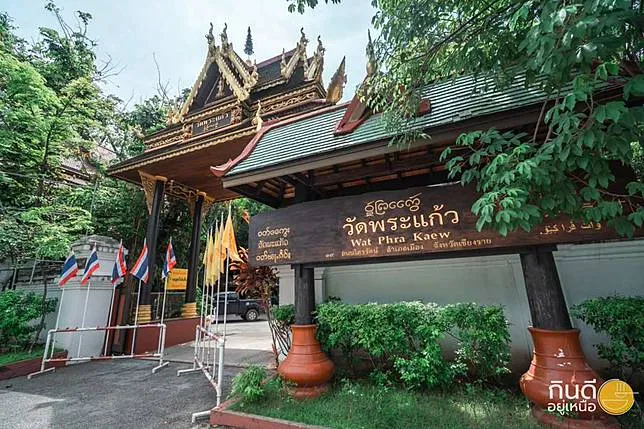
15. Wat Phra Kaew, Chiang Rai is a royal Buddhist temple located on Trairat Road in Wiang Subdistrict, Mueang Chiang Rai District. It holds a particularly important place in Thai history because it is traditionally regarded as the site where the Emerald Buddha was discovered. This sacred image is now enshrined at Wat Phra Si Rattana Satsadaram in Bangkok. Wat Phra Kaew in Chiang Rai contains an elegant Lanna-style ordination hall, the revered Chiang Rai Jade Buddha, and museum buildings that preserve the religious and artistic history of northern Thailand.
Highlights: The Chiang Rai Jade Buddha, Lanna-style ordination hall, Ho Phra Yok, Hong Luang Saeng Kaew Museum, the history of the Emerald Buddha's discovery, and the peaceful atmosphere of a historic temple in central Chiang Rai.
According to local tradition, the Emerald Buddha was discovered after lightning struck a chedi at the temple, damaging the structure and revealing a Buddha image concealed beneath a layer of plaster. Further examination uncovered a statue carved from green stone. The story is an important part of the history of the Emerald Buddha and links Wat Phra Kaew in Chiang Rai with the Lanna Kingdom and several later Thai capitals.
The Chiang Rai Jade Buddha was created at a later date and installed as a principal sacred image of the temple. It reflects the continuing devotion associated with the Emerald Buddha and the historical importance of the original discovery site. Visitors may pay respect to the image in the designated area while observing appropriate dress and respectful behavior.
The ordination hall displays traditional Lanna architectural characteristics, including a multi-tiered roof, elaborate wooden decorations, and distinctive northern Thai artistic elements. Ho Phra Yok and the museum provide additional opportunities to study the history of sacred images, Buddhist artworks, and the cultural development of Chiang Rai's communities.
Wat Phra Kaew remains an active place of Buddhist worship. The local community continues to gather here for merit-making ceremonies, particularly on important Buddhist holy days. Its significance therefore extends beyond its historical associations to its continuing role as a spiritual center for the people of Chiang Rai.
For visitors, the temple fits easily into a sightseeing itinerary around central Chiang Rai, together with Wat Phra Singh, Wat Ming Mueang, and other landmarks in the historic town. The temple is accessible by private car or local transport from the bus terminal and Chiang Rai International Airport.
Travelers interested in the history of the Emerald Buddha can use a visit to Wat Phra Kaew in Chiang Rai as a starting point for understanding the image's journey through different historical periods and comparing that story with the history of Wat Phra Kaew in Bangkok.
Open Days: Daily Opening Hours: 07:00 – 18:00. Ho Phra Yok and the museum may operate approximately 09:00 – 17:00.
Address: Trairat Road, Wiang Subdistrict, Mueang Chiang Rai District, Chiang Rai Province, Thailand.
Getting There: From central Chiang Rai, follow Trairat Road into the historic town area. The temple is close to several major landmarks and can be reached by private car, rental car, local taxi, or on foot from nearby attractions.
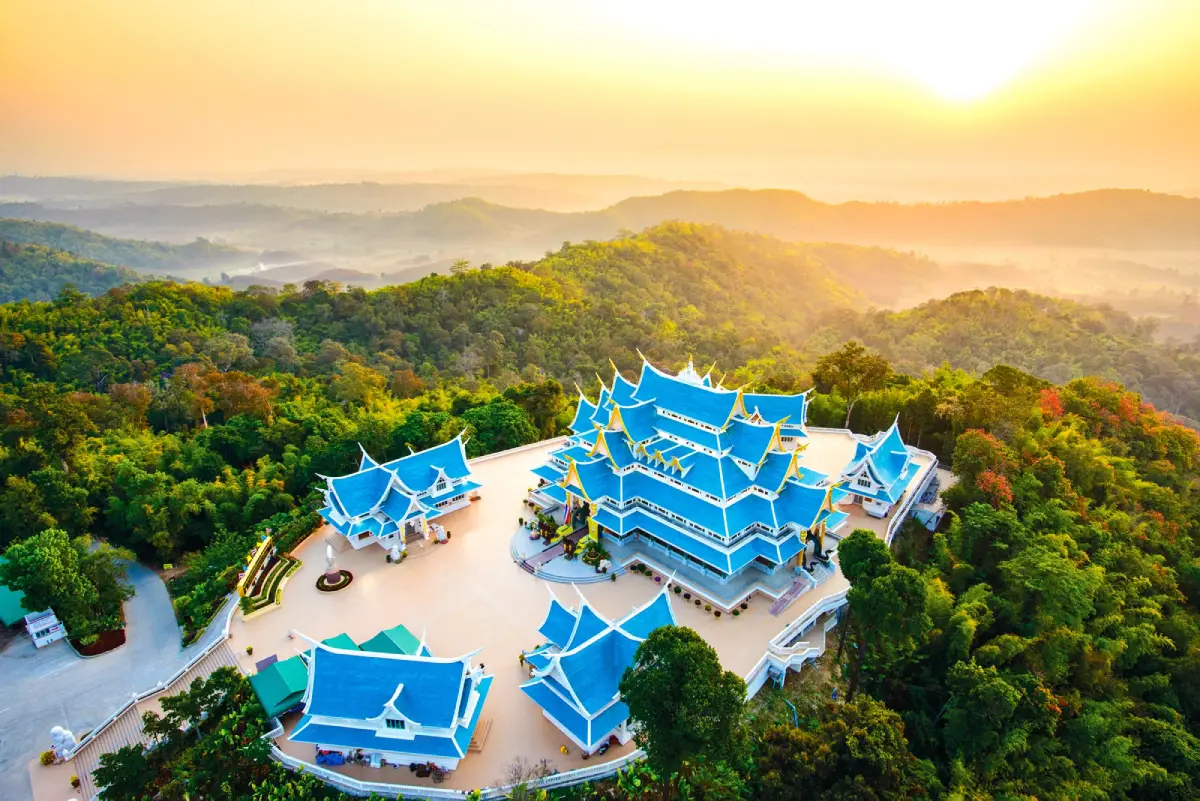
16. Wat Pa Phu Kon, Udon Thani is a forest meditation temple renowned for its magnificent viharn and white marble reclining Buddha. Located at Ban Na Kham Yai in Ban Kong Subdistrict, Na Yung District, Udon Thani Province, it lies within a forested mountain region near the provincial borders of Loei and Nong Khai. The temple combines contemporary Buddhist art with a natural landscape of densely wooded hills, making it an important destination for meditation, pilgrimage, and cultural tourism in northeastern Thailand.
Highlights: The white marble reclining Buddha, blue-green roofed viharn, contemporary Buddhist architecture, mountain scenery, and tranquil forest monastery atmosphere.
The development of Wat Pa Phu Kon has been closely connected with the preservation of natural forests and the creation of a peaceful Buddhist sanctuary. The temple stands in an ecologically important area of northeastern Thailand, including forested hills and watershed landscapes. Its setting is therefore distinctly different from that of an urban temple, offering a quiet environment surrounded by trees, mountains, and natural scenery well suited to meditation and reflection.
The viharn is particularly striking because of its elegant contemporary Thai design and distinctive blue-green roof, which contrasts beautifully with the surrounding forest. Inside is the Phra Phuttha Saiyat Lokanat Satsada Maha Muni, an impressive reclining Buddha carved from white marble. Measuring approximately 20 meters in length, the image conveys serenity and displays exceptional craftsmanship in contemporary Buddhist sculpture.
Entering the viharn offers an opportunity to experience the calm atmosphere of a sacred Buddhist space. The interior design emphasizes the beauty of the reclining Buddha and the surrounding architectural elements. Visitors should remove their shoes where required, keep their voices low, and avoid photography that might disturb worshippers or people engaged in meditation.
Beyond the viharn, Wat Pa Phu Kon is celebrated for its panoramic mountain and forest views. On clear days, visitors can see layers of wooded hills extending into the distance and enjoy air and scenery quite different from the surrounding urban areas. Walking should be restricted to designated visitor areas to preserve the peaceful environment and avoid disturbing spaces reserved for religious practice.
For those interested in spiritual travel, Wat Pa Phu Kon illustrates the principles of Thailand's forest meditation tradition, which places importance on simplicity, mindfulness, and living close to nature. Although the viharn is richly decorated, the temple's broader character remains focused on tranquility and respect for Buddhist practice.
Travelers should allow extra time to reach the temple because some sections of the route pass through mountainous terrain. Those driving should check vehicle conditions and navigation directions before departure, especially during the rainy season when fog or heavy rainfall may affect visibility. Visiting in the morning allows more time to explore the grounds and return before dark.
Overall, Wat Pa Phu Kon is among Thailand's most distinctive temples for its combination of Buddhist art and natural beauty. Visitors can pay respect to the white marble reclining Buddha, admire the ornate viharn, and experience the peaceful forest landscape within a single destination.
Open Days: Daily Opening Hours: 08:30 – 17:00 for visits to the viharn.
Address: Ban Na Kham Yai, Ban Kong Subdistrict, Na Yung District, Udon Thani Province, Thailand.
Getting There: From Udon Thani city, travel toward Ban Phue District and Na Yung District, then continue to Ban Na Kham Yai and follow the signs to Wat Pa Phu Kon. The final section includes winding mountain roads and uphill stretches. A private or rental car is generally more convenient than public transportation.
Map (GPS):Get Directions to Wat Pa Phu Kon

17. Wat Phra That Pha Sorn Kaew, Phetchabun is a mountain temple famous for its colorful mosaic-covered pagoda and five enormous white Buddha images arranged in an overlapping, graduated composition. Located in Khaem Son Subdistrict, Khao Kho District, Phetchabun Province, near the Phitsanulok–Lom Sak highway, the temple stands in a spectacular mountain landscape. Its combination of contemporary Buddhist art, hillside architecture, and seasonal mist makes it one of Thailand's best-known religious and cultural attractions.
Highlights: Five white Buddha images, the seven-tiered lotus-shaped Phra That Pha Sorn Kaew pagoda, colorful mosaic decoration, panoramic mountain views, and the misty atmosphere of Khao Kho.
Wat Phra That Pha Sorn Kaew was developed from the idea of creating a peaceful place for Buddhist meditation amid the natural beauty of the Phetchabun mountains. The temple emphasizes tranquility and spiritual practice while incorporating imaginative Buddhist art and architecture. Its structures therefore differ considerably from those of traditional historic temples.
The five white Buddha images, arranged from largest to smallest in an overlapping formation, are the temple's most recognizable landmark. Their unusual composition creates a striking sight even from a distance. On misty days, clouds drifting around the surrounding mountains add to the serene visual effect. Visitors can admire and photograph the images from areas open to the public, subject to the temple's rules.
The Phra That Pha Sorn Kaew pagoda is designed in a seven-tiered lotus-inspired form. Its surfaces are decorated with ceramic tiles, bowls, ornamental objects, and colorful materials arranged into intricate patterns. When sunlight strikes the decoration, the surface sparkles in different colors depending on the viewing angle. This elaborate design demonstrates how art can express Buddhist faith through imaginative contemporary craftsmanship.
The temple's beauty is not limited to its buildings. Mountain ridges surrounding the site create impressive scenery, and mist can sometimes be seen drifting through the valleys. Photographers often prefer morning visits for softer light and views of the mountains. However, caution is necessary on wet or foggy days when steep access roads may become slippery and visibility can be reduced.
Although Wat Phra That Pha Sorn Kaew is a popular tourist attraction, it remains an active Buddhist temple and meditation center. Visitors should dress modestly, maintain a quiet atmosphere, avoid blocking walkways or ceremonial areas, and take photographs only where permitted.
The temple is well suited to a Khao Kho itinerary that includes Phu Thap Boek and attractions along Highway 12. Extra travel time should be allowed for mountain roads and possible parking congestion during weekends and public holidays.
Overall, Wat Phra That Pha Sorn Kaew stands out for its contemporary Buddhist architecture, monumental Buddha images, and dramatic mountain setting. It is an excellent destination for travelers who want to appreciate a beautiful temple while experiencing the natural scenery and peaceful atmosphere of Khao Kho.
Open Days: Daily Opening Hours: 08:00 – 17:00
Address: Khaem Son Subdistrict, Khao Kho District, Phetchabun Province, Thailand.
Getting There: From Phitsanulok or Phetchabun, follow Highway 12 along the Phitsanulok–Lom Sak route toward Khaem Son Subdistrict. Turn onto the hillside access road following signs to Wat Phra That Pha Sorn Kaew. Several sections are steep and winding, so additional care is recommended during the rainy season.
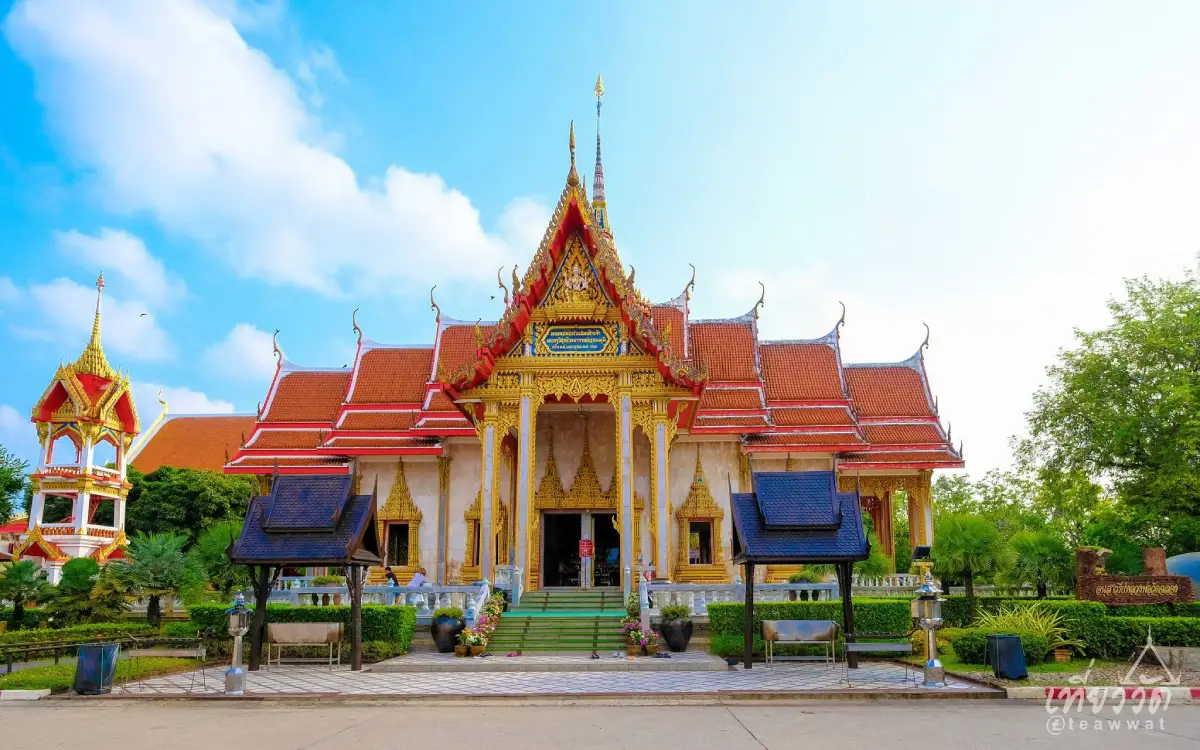
18. Wat Chalong (Wat Chaiyathararam), Phuket is one of Phuket's most important Buddhist temples, located on Chao Fa West Road in Chalong Subdistrict, Mueang Phuket District. The temple is widely known for its statues of Luang Pho Chaem, Luang Pho Chuang, and Luang Pho Klueam, revered monks who have long been respected by the people of Phuket. Its magnificent sacred pagoda, decorated with traditional Thai architectural details, is another major attraction. Wat Chalong is a popular destination for visitors wishing to pay respect and experience local Buddhist culture while exploring Phuket.
Highlights: Statues of Luang Pho Chaem, Luang Pho Chuang, and Luang Pho Klueam; Phra Mahathat Chedi Phra Chom Thai Barami Prakat; the ordination hall; and traditional Thai temple architecture.
The history of Wat Chalong is closely associated with the development of Phuket's communities. Luang Pho Chaem is especially remembered for his important role during a period of social unrest under King Rama V. His influence and service earned deep respect from local residents, helping establish the temple as a spiritual center that continues to attract devotees today.
Inside the temple, a hall houses statues of its most revered monks. Buddhist worshippers regularly visit to pay their respects and seek blessings on important occasions. The atmosphere reflects the devotion of Phuket's communities. Visitors should follow the temple's regulations concerning incense, candles, and religious offerings.
Phra Mahathat Chedi Phra Chom Thai Barami Prakat is an impressive multi-level religious structure decorated with elaborate traditional Thai motifs. Its interior contains Buddha images and sacred objects, while the architectural details can be appreciated from the visitor areas. The building offers an opportunity to explore the artistic craftsmanship associated with contemporary Thai Buddhist religious architecture.
Wat Chalong is also closely connected with Phuket's community traditions. The annual Wat Chalong Fair is a well-known local celebration featuring merit-making activities and the lively atmosphere of a traditional Thai temple fair. Visitors who wish to attend should check the dates each year, as the schedule may change according to announcements by the organizers.
Travelers can combine Wat Chalong with the Big Buddha of Phuket and scenic viewpoints in the southern part of the island. The accessibility of each attraction should be checked separately, as some sites may restrict access for safety reasons. Most visitors should allow approximately 1–2 hours to pay respects and explore the temple architecture.
Situated near a major road, Wat Chalong is easy to reach from Phuket Town and the island's popular beach areas. It is particularly suitable for travelers who want to combine cultural sightseeing with a day exploring the island's beaches and natural scenery.
Open Days: Daily Opening Hours: 07:00 – 17:00
Admission Fee: Free admission. Voluntary donations and merit-making contributions are welcome.
Address: 70 Moo 6, Chao Fa West Road, Chalong Subdistrict, Mueang Phuket District, Phuket Province, Thailand.
Getting There: From Phuket Town, follow Chao Fa West Road, also known as Highway 4021, toward Chalong Subdistrict. The temple is located near the main road with signs directing visitors to the entrance. It can be reached by private car, rental vehicle, taxi, or ride-hailing service from Phuket Town and the surrounding beach areas.
Map (GPS):Get Directions to Wat Chalong

19. Wat Tham Suea, Kanchanaburi is a Buddhist temple renowned for its enormous golden Buddha image and towering hilltop pagoda. Located in Muang Chum Subdistrict, Tha Muang District, Kanchanaburi Province, the temple occupies a scenic hillside overlooking rice fields, the Mae Klong River, and surrounding mountains. It is an attractive destination for visitors interested in Buddhist worship, beautiful temple architecture, and panoramic views of rural Kanchanaburi.
Highlights: Phra Phuttha Chinnapratarnporn, Ket Kaew Maha Prasat Pagoda, the hillside staircase, viewpoints over rice fields and the Mae Klong River, and contemporary Thai religious architecture.
Wat Tham Suea originally developed from a small meditation site around a cave on a hillside. Over time, it was transformed into a larger temple complex containing imposing religious buildings and a monumental Buddha image that has become the site's principal landmark. One of the temple's distinctive characteristics is its elevated setting, allowing its buildings and sacred image to be seen from a considerable distance.
Phra Phuttha Chinnapratarnporn is a massive golden Buddha image set on a raised platform. Its serene expression and brilliant finish make it the main focus of worship and photography at the temple. Visitors often come to offer prayers and photograph the statue from the front courtyard, while remaining respectful of people engaged in religious ceremonies.
Ket Kaew Maha Prasat Pagoda is a tall religious structure featuring elaborate architectural forms and detailed ornamentation. It stands out prominently against the surrounding landscape and contributes to the temple's recognizable skyline. Visitors can admire its design and explore accessible areas while learning more about the decorative traditions of Thai Buddhist architecture.
Visitors can reach the upper temple grounds by climbing a long staircase along the hillside or by using the tram service when available. Some sections of the stairs are steep. Older visitors and people with limited mobility should choose an option appropriate to their physical condition and check the tram's operating arrangements beforehand.
The elevated temple grounds provide beautiful views of green rice fields during the growing season, the Mae Klong River, and distant hills. These panoramic scenes are particularly popular with photographers. Morning and late afternoon usually offer more comfortable temperatures and attractive natural lighting.
Wat Tham Suea can be combined with nearby Wat Tham Khao Noi, as well as other attractions in Tha Muang District and Kanchanaburi city. Travelers coming from Bangkok can plan a day trip if they depart early and allow sufficient time for the journey.
The temple's distinctive appeal comes from its combination of monumental Buddhist imagery, ornate architecture, and a peaceful rural landscape. Visitors can experience both the spiritual significance of the site and the natural beauty of Kanchanaburi in a single visit.
Open Days: Daily Opening Hours: Generally 08:00 – 17:00
Address: Muang Chum Subdistrict, Tha Muang District, Kanchanaburi Province, Thailand.
Getting There: From Kanchanaburi city, travel toward Tha Muang District and Muang Chum Subdistrict, following signs to Wat Tham Suea and the parking area at the foot of the hill. Visitors can then use the staircase or tram according to the temple's operating conditions. From Bangkok, follow Phetkasem Road toward Kanchanaburi before turning onto the local roads leading to Tha Muang District.
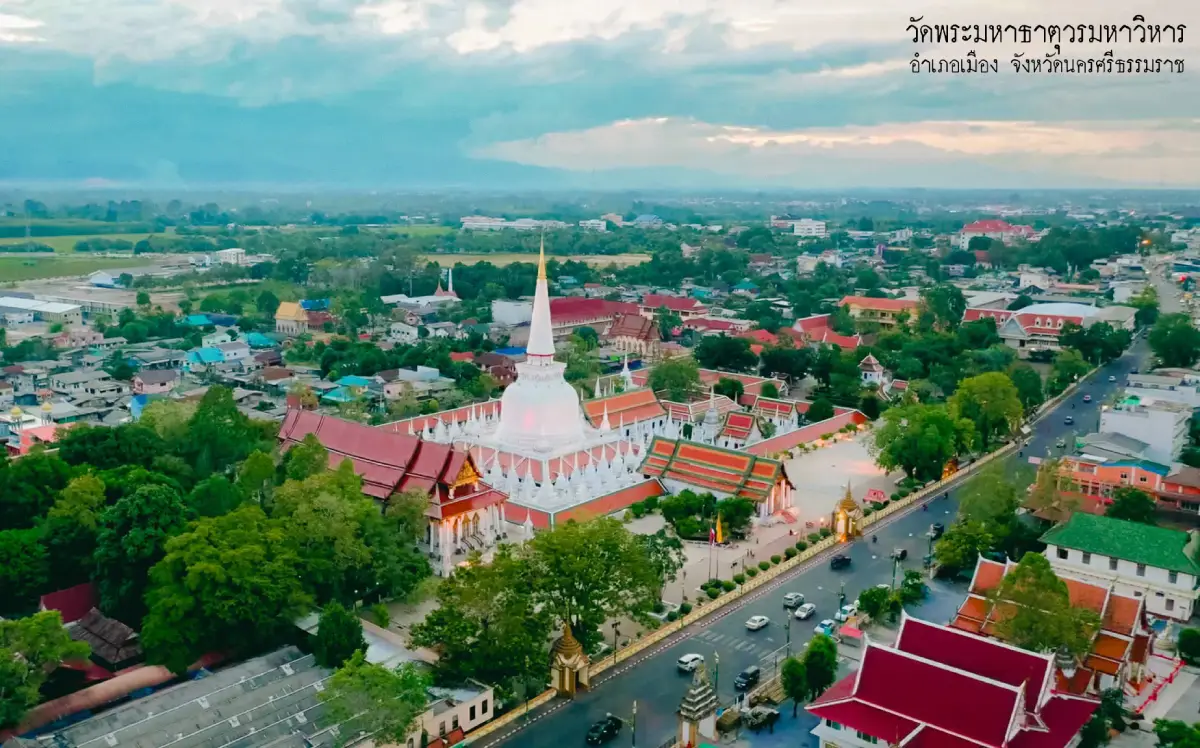
20. Wat Phra Mahathat Woramahawihan, Nakhon Si Thammarat is a first-class royal Buddhist temple and one of the most important sacred sites in southern Thailand. Located on Ratchadamnoen Road in central Nakhon Si Thammarat, it is famous for Phra Borommathat Chedi, a magnificent Sri Lankan-style bell-shaped stupa crowned with a golden spire. The temple is a major center of devotion for local residents and Buddhists from across Thailand. Its significance encompasses religious history, traditional architecture, and long-established local ceremonies.
Highlights: Phra Borommathat Chedi, its Sri Lankan-inspired architectural form, Wihan Phra Song Ma, Wihan Khian, Wihan Phra At, the Hae Pha Khuen That cloth-offering tradition, and the temple's historical role as a center of Buddhism in southern Thailand.
Wat Phra Mahathat Woramahawihan has a long history associated with the spread of Buddhism across the southern Thai peninsula. According to local traditions surrounding the founding of Nakhon Si Thammarat, the great stupa was built to enshrine sacred relics of the Buddha. This belief established the site as a major religious destination that has attracted Buddhist pilgrims throughout successive historical periods.
Phra Borommathat Chedi is the temple's most important architectural feature. The stupa has a white bell-shaped body inspired by Sri Lankan Buddhist architecture and a golden spire rising prominently above the surrounding buildings. Its form reflects the influence of Buddhist traditions from Sri Lanka on the development of religion and architecture in southern Thailand.
Several additional assembly halls and religious structures stand within the temple grounds. Each displays distinctive architectural features and historical details, allowing visitors to observe evidence of restoration and development across different periods. Visitors should follow the temple's dress code and remove their shoes before entering buildings where this is required.
The Hae Pha Khuen That ceremony is among Nakhon Si Thammarat's most celebrated Buddhist traditions. During the festival, devotees carry a long ceremonial cloth, known as pha phra bot, in a procession before presenting it as an offering to be wrapped around the sacred stupa. The ceremony expresses devotion to the Buddha and preserves a religious tradition that has been passed down through generations.
The atmosphere at Wat Phra Mahathat Woramahawihan combines the calm of a sacred Buddhist sanctuary with the energy of visitors attending major religious festivals. Travelers interested in history can spend time exploring the different buildings and architectural details, while those wishing to pay respect to the sacred relics may prefer a morning visit when temperatures are generally more comfortable.
The temple is conveniently located for visits to other attractions in Nakhon Si Thammarat city, including the Nakhon Si Thammarat National Museum, historic neighborhoods, and cultural sites. Its position along one of the city's principal roads makes it an accessible stop on a cultural sightseeing itinerary.
Overall, Wat Phra Mahathat Woramahawihan represents the religious and historical heritage of southern Thailand through its revered Sri Lankan-style stupa, historic temple buildings, and the Hae Pha Khuen That tradition. It is a significant destination for visitors wishing to pay homage and learn about the history of Nakhon Si Thammarat.
Open Days: Daily Opening Hours: 08:00 – 16:30
Admission Fee: Free admission. Visitors may make voluntary donations according to their faith.
Address: Ratchadamnoen Road, Nai Mueang Subdistrict, Mueang Nakhon Si Thammarat District, Nakhon Si Thammarat 80000, Thailand.
Getting There: From Nakhon Si Thammarat Airport, follow the main roads into the city and continue onto Ratchadamnoen Road. The temple is located in the historic urban area and is clearly signposted. It can be reached by private car, rental vehicle, taxi, or local transport services.

21. Wat Benchamabophit Dusitwanaram, Bangkok, commonly known as the Marble Temple, is a magnificent royal Buddhist monastery located on Si Ayutthaya Road in Dusit District, Bangkok. The temple is celebrated for its exceptionally elegant architecture, particularly its ordination hall decorated with white marble imported from Italy. Traditional Thai artistic forms blend harmoniously with Western building materials and construction techniques. Wat Benchamabophit is one of Bangkok's most important destinations for travelers interested in Rattanakosin architecture and the artistic transformations that occurred as Thailand increasingly embraced international influences.
Highlights: The marble ordination hall, replica of Phra Buddha Chinnarat, galleries containing Buddha images from different historical periods, intricately carved marble, stained-glass windows, and Thai architecture from the reign of King Rama V.
Wat Benchamabophit Dusitwanaram underwent its most significant development during the reign of King Chulalongkorn, Rama V. The king commissioned a new ordination hall and supporting buildings designed to combine traditional Thai architecture with carefully selected imported materials. The project reflected Bangkok's growing prosperity during the late 19th and early 20th centuries, when public buildings, royal residences, and religious architecture were undergoing considerable artistic and technological development.
The ordination hall is the temple's most important architectural feature. White marble surfaces, elegant columns, intricately decorated gables, and traditional roof ornaments create an exceptionally refined appearance. Inside stands a replica of Phra Buddha Chinnarat, modeled after the revered Buddha image at Wat Phra Si Rattana Mahathat Woramahawihan in Phitsanulok Province. Visitors can appreciate the beauty of the principal image while examining the carefully planned interior of the sacred hall.
The galleries behind the ordination hall are another essential part of the visit. They house a remarkable collection of Buddha images representing different artistic periods and geographical traditions. Visitors can compare facial expressions, body proportions, hand gestures, and decorative details to understand how Buddhist sculpture developed throughout Thai history and across neighboring cultural regions.
The courtyard and covered galleries are especially attractive for architectural photography. Pale marble contrasts beautifully with the colorful roof tiles and greenery of the temple grounds. Morning light often provides particularly appealing conditions for photographing the buildings. Visitors should avoid obstructing worshippers and refrain from using flash photography in areas where restrictions apply.
Wat Benchamabophit also holds considerable historical significance because of its close association with King Rama V and the development of Bangkok's Dusit district. Travelers interested in the history of the Thai monarchy can combine a visit with landmarks around Dusit Palace and Ananta Samakhom Throne Hall, subject to the current access restrictions of individual sites.
The temple is particularly suitable for visitors who appreciate architectural craftsmanship as well as Buddhist cultural heritage. Modest clothing and an unhurried approach allow time to observe its many decorative details. Approximately one to two hours should be sufficient to explore the ordination hall, galleries, and principal architectural features.
Open Days: Generally daily Opening Hours: Approximately 08:00 – 18:30
Admission Fee: Thai nationals: Free. Foreign visitors: Approximately THB 200 per person according to the source article. Confirm the current posted rate before visiting.
Address: Si Ayutthaya Road, Dusit Subdistrict, Dusit District, Bangkok, Thailand.
Getting There: From Victory Monument, follow Ratchawithi Road toward Dusit District or approach the temple along Si Ayutthaya Road near the Dusit Palace area. Visitors can travel by private car, public bus, taxi, or ride-hailing service. Drivers should check available parking facilities before departure.
Map (GPS):Get Directions to Wat Benchamabophit

22. Wat Saket Ratchaworamahawihan and the Golden Mount, Bangkok is a historic royal Buddhist temple famous for Phra Borom Banphot, commonly known as the Golden Mount. The golden chedi stands atop an artificial hill in central Bangkok. Located in Ban Bat Subdistrict, Pom Prap Sattru Phai District, near Khlong Mahanak and the historic Phra Nakhon area, the temple offers an unusual combination of religious heritage and panoramic city views. Visitors can climb a winding staircase to pay respect to the sacred Buddha relics and admire Bangkok from above.
Highlights: Phra Borom Banphot or the Golden Mount, the golden chedi, sacred Buddha relics, the staircase leading to the summit, panoramic views of historic Bangkok, and the annual Golden Mount Festival.
Wat Saket traces its history to the Ayutthaya period, when it was originally known as Wat Sakae. The temple underwent major restoration during the reign of King Rama I and was subsequently given the name Wat Saket. Development of the Golden Mount began during the reign of King Rama III and continued through later reigns until the site became one of Bangkok's most recognizable religious landmarks.
The Golden Mount is a landscaped artificial hill with a winding staircase leading toward the summit. Along the route are resting areas, viewpoints, and decorative religious features. The walk gradually reveals views of the surrounding historic neighborhoods. At the top stands the golden chedi, which enshrines sacred Buddha relics and serves as an important destination for Buddhist pilgrims.
Climbing the Golden Mount offers a different experience from visiting a conventional temple at street level. Visitors can observe historic Bangkok from increasingly elevated viewpoints while enjoying the changing scenery along the route. On clear days, several important buildings and landmarks are visible across the city. Morning and late afternoon are especially suitable for sightseeing and photography because temperatures are generally more comfortable.
The annual festival honoring the Buddha relics and the Golden Mount is among Bangkok's long-established religious celebrations. Traditionally associated with the Loy Krathong period, the event features Buddhist ceremonies and cultural activities that attract local residents and visitors. Travelers wishing to experience the festival should confirm its annual schedule because dates and arrangements can change.
Several historic attractions are located nearby, including the Mahakan Fort area, Wat Ratchanatdaram, Loha Prasat, and Ratchadamnoen Avenue. This makes the Golden Mount an excellent stop on a walking itinerary exploring the temples and historic landmarks of Bangkok's Old Town.
Families traveling with children or older visitors should consider the physical effort involved in climbing the staircase. Suitable walking shoes, drinking water, and occasional rest stops are recommended. Visitors should also observe any restrictions associated with weather conditions or temple ceremonies.
Open Days: Daily Opening Hours: 07:30 – 19:00 according to the original attraction listing.
Address: Ban Bat Subdistrict, Pom Prap Sattru Phai District, Bangkok, Thailand.
Getting There: From Sanam Luang or Ratchadamnoen Avenue, follow Lan Luang Road and Chakkraphatdi Phong Road toward Wat Saket. Travelers using the MRT can get off at Sam Yot Station and continue on foot or by local taxi, depending on their preferred route. The temple is within walking distance of Wat Ratchanatdaram and the historic Mahakan Fort area.
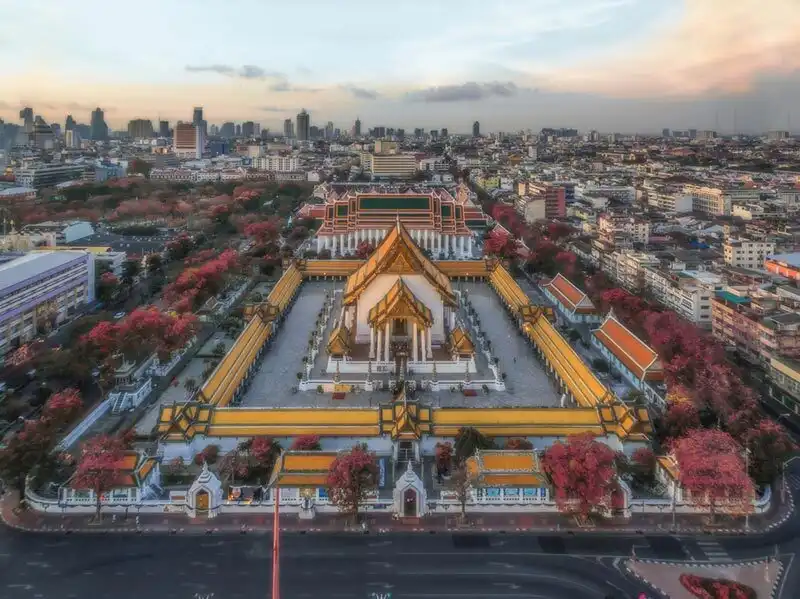
23. Wat Suthat Thepwararam Ratchaworamahawihan, Bangkok is a first-class royal Buddhist temple situated on Bamrung Mueang Road in Sao Chingcha Subdistrict, Phra Nakhon District, Bangkok, close to the Giant Swing and Bangkok City Hall. The temple is distinguished by its enormous assembly hall, the revered Phra Si Sakyamuni Buddha image brought from Sukhothai, impressive mural paintings, and architectural features dating from the early Rattanakosin period. It is one of Bangkok's most significant religious monuments and an outstanding example of traditional Thai royal craftsmanship.
Highlights: Phra Si Sakyamuni, the grand viharn, Phra Phuttha Trilokachet, the large ordination hall, intricately carved wooden doors, mural paintings, and the nearby Giant Swing.
Construction of Wat Suthat began during the reign of King Rama I, who intended to establish a grand royal monastery in the new capital and provide an appropriate home for an important Buddha image. Building work continued under King Rama II and was completed during the reign of King Rama III. The resulting complex contains architectural and decorative elements reflecting the craftsmanship and royal artistic traditions of several reigns.
Phra Si Sakyamuni is a large bronze Buddha image in the subduing Mara posture, originally brought from Wat Mahathat in the ancient city of Sukhothai. Enshrined within the grand viharn, it is highly significant both spiritually and artistically. Its elegant proportions and characteristic features represent the refined Buddhist sculpture of the Sukhothai period.
The grand viharn is renowned for its impressive scale and extraordinary architectural details, including its elaborate roof, columns, carved wooden doors, and mural paintings. The ordination hall is another major building, notable for its size and refined decoration. Inside stands Phra Phuttha Trilokachet, the principal Buddha image of the hall.
The temple's mural paintings are among its most valuable cultural features. They demonstrate how religious teachings and narratives were expressed through visual art in the early Rattanakosin period. Visitors interested in Buddhist history can examine the paintings and their symbolic details while respecting restrictions on photography and maintaining the peaceful atmosphere of the sacred buildings.
The Giant Swing standing outside the temple is another famous Bangkok landmark. Historically connected with Brahmanical religious ceremonies, it represents a different aspect of Thailand's cultural and spiritual heritage. Visitors can photograph the structure from the surrounding public area and combine the experience with an exploration of Wat Suthat and the historic Bamrung Mueang neighborhood.
Travelers planning to visit several temples in one day can combine Wat Suthat with Wat Ratchanatdaram, Wat Saket, and Wat Ratchabophit. The MRT and walking are practical options for exploring this part of Bangkok, where traffic can be heavy and parking limited.
Open Days: Daily Opening Hours: The original Thai article recommends visiting the viharn between 08:30 – 16:00. Other temple areas may remain open later.
Admission Fee: Thai nationals: Free. Foreign visitors: THB 100 per person for the visitor areas where admission is charged.
Address: 146 Bamrung Mueang Road, Sao Chingcha Subdistrict, Phra Nakhon District, Bangkok 10200, Thailand.
Getting There: Take the MRT Blue Line to Sam Yot Station, then walk along Bamrung Mueang Road toward the Giant Swing and Wat Suthat. Drivers can approach via Bamrung Mueang Road, Dinso Road, or Ti Thong Road. Parking availability should be checked before departure.
Map (GPS):Get Directions to Wat Suthat Thepwararam

24. Wat Ratchanatdaram Worawihan (Loha Prasat), Bangkok is a royal Buddhist temple renowned for Loha Prasat, an unusual religious structure characterized by its tiered roofs and numerous metal spires. Located on Maha Chai Road in Phra Nakhon District, near Ratchadamnoen Avenue and the historic Mahakan Fort, the temple is an important architectural and historical landmark. Loha Prasat is especially remarkable because this type of Buddhist structure is exceptionally rare, distinguishing it from more familiar Thai chedis and prangs.
Highlights: Loha Prasat with 37 spires, its distinctive Buddhist architectural design, the ordination hall, Phra Phuttha Setthatamamunin, and views of the Ratchadamnoen historic district.
Wat Ratchanatdaram was established during the reign of King Nangklao, Rama III, in honor of his granddaughter, Princess Somanass Waddhanawathy. It was designed as an important royal monastery with several significant religious buildings and has undergone restoration and development throughout subsequent periods.
Loha Prasat is the temple's most recognizable feature. Its 37 spires and multiple roof levels are associated with Buddhist teachings and the religious symbolism of sacred architecture. The building contains internal walkways and spaces where visitors can learn about its structural design and historical significance, subject to the temple's current access arrangements.
The architecture differs considerably from conventional chedis and prangs. Its carefully arranged tiers and spires create a rhythmic architectural silhouette that is visible from a distance. Sunlight falling on the golden-colored upper sections gives the building a particularly striking appearance.
Within the temple compound are an ordination hall and other structures displaying the craftsmanship of the Rattanakosin period. Visitors can appreciate their decorative details and learn about the monastery's history while observing the rules governing access to religious buildings and Loha Prasat itself.
Wat Ratchanatdaram is ideally situated for an Old Town sightseeing itinerary. The Golden Mount, Wat Saket, Ratchadamnoen Avenue, and other historic attractions are nearby. Visitors can photograph Loha Prasat from the front courtyard before continuing on foot toward Wat Saket.
Overall, Wat Ratchanatdaram is especially rewarding for travelers interested in architectural forms that differ from the typical Thai temple. The 37-spired Loha Prasat demonstrates how religious ideas can be expressed through an innovative and visually memorable sacred structure.
Open Days: Daily Opening Hours: 08:00 – 17:00
Address: Maha Chai Road, Bowon Niwet Subdistrict, Phra Nakhon District, Bangkok, Thailand.
Getting There: From Democracy Monument, follow Ratchadamnoen Klang Road toward Mahakan Fort and turn onto Maha Chai Road. The temple is close to this junction and can be reached by public bus, taxi, or MRT to Sam Yot Station followed by a short local transfer or walk.

25. Wat Yai Chai Mongkhon, Phra Nakhon Si Ayutthaya is an ancient Buddhist temple famous for its enormous victory chedi and its historical association with King Naresuan the Great. Located in Khlong Suan Phlu Subdistrict, Phra Nakhon Si Ayutthaya District, the temple is a popular destination for Buddhist pilgrims and visitors exploring Ayutthaya's historical landmarks. Its principal attractions include a towering chedi, a reclining Buddha, and rows of Buddha images surrounding the monument.
Highlights: The Great Victory Chedi, reclining Buddha, King Naresuan memorial area, rows of Buddha images draped in yellow robes, and elevated views from the chedi precinct.
Wat Yai Chai Mongkhon has origins in the early Ayutthaya period and became particularly prominent through its association with King Naresuan the Great. The great chedi is traditionally connected with the king's victory in the celebrated elephant duel, an event remembered in Thai historical narratives. The temple consequently holds an important place in the country's historical memory and Buddhist traditions.
The Great Victory Chedi is the central architectural landmark of the complex. Its immense structure can be seen from a considerable distance, while surrounding rows of Buddha images and restored monuments create a distinctive historic atmosphere. Visitors can explore the accessible sections and photograph the architecture, taking care when climbing steps in areas where elevated access is permitted.
Another important feature is the large reclining Buddha within the temple grounds. Devotees regularly come to pay respect and present offerings according to Buddhist tradition. The temple also includes an area associated with King Naresuan, reflecting its historical connection with one of Ayutthaya's most celebrated monarchs.
Unlike many ruined monasteries within Ayutthaya Historical Park, Wat Yai Chai Mongkhon remains an active Buddhist temple with resident monks. Visitors can therefore experience an unusual combination of historic architecture and religious activities that continue in the present day.
The temple is convenient for an itinerary beginning outside Ayutthaya's central island before continuing to Wat Mahathat, Wat Phra Si Sanphet, and Wat Chaiwatthanaram. Travelers arriving by train can get off at Ayutthaya Railway Station and take a local taxi or tuk-tuk to the temple.
For photography enthusiasts, the rows of Buddha images surrounding the great chedi are particularly memorable. Morning and late afternoon are generally the most comfortable times to explore the outdoor grounds, allowing visitors to appreciate the architecture without the strongest midday heat.
Open Days: Daily Opening Hours: 08:00 – 17:00
Admission Fee: Thai nationals: Generally free. Foreign visitors: THB 20 per person according to the original source information. Rates are subject to change.
Address: Khlong Suan Phlu Subdistrict, Phra Nakhon Si Ayutthaya District, Phra Nakhon Si Ayutthaya 13000, Thailand.
Getting There: From Bangkok, follow the Asian Highway toward Ayutthaya and continue toward the Wat Sam Pluem junction and Wat Yai Chai Mongkhon. The temple is accessible by private car, local tuk-tuk, or taxi from Ayutthaya Railway Station.
Map (GPS):Get Directions to Wat Yai Chai Mongkhon
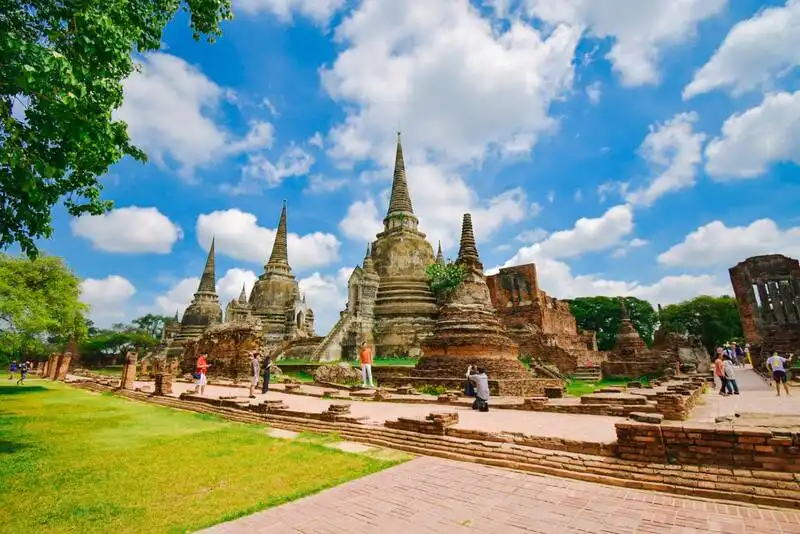
26. Wat Phra Si Sanphet, Phra Nakhon Si Ayutthaya is one of the most important historical monuments within the former Royal Palace grounds of Ayutthaya. Situated inside Ayutthaya Historical Park, it is famous for three beautifully aligned bell-shaped chedis that have become an iconic symbol of the UNESCO World Heritage city. Wat Phra Si Sanphet served as the royal temple of the Ayutthaya palace and did not accommodate a resident monastic community in the way that most Buddhist temples do. This distinctive role makes the site especially significant for understanding the religious ceremonies and history of the Ayutthaya royal court.
Highlights: Three bell-shaped chedis, foundations of the royal assembly hall, the history of Phra Si Sanphet Dayan, the former Royal Palace precinct, and architecture from the middle Ayutthaya period.
The area occupied by Wat Phra Si Sanphet was originally associated with the Royal Palace of Ayutthaya. During the reign of King Borommatrailokkanat, part of the palace precinct was designated for a royal Buddhist temple where important state and court ceremonies could be performed. The monastery therefore functioned as a sacred ceremonial space directly connected with the monarchy.
The three principal chedis are the site's most recognizable structures. Built in the Sri Lankan-inspired bell-shaped style, they stand on raised bases along a single architectural axis. The monuments were constructed at different times to enshrine the royal ashes of Ayutthaya kings. Their forms illustrate the influence of Sri Lankan Buddhist architecture and its development into the distinctive artistic traditions of Ayutthaya.
The great assembly hall once housed Phra Si Sanphet Dayan, a monumental standing Buddha image covered in gold that was among the most important sacred images of the Ayutthaya court. Although the statue suffered extensive destruction during the fall of Ayutthaya in 1767, its history remains an essential part of the temple's heritage.
Exploring Wat Phra Si Sanphet allows visitors to observe building foundations, old walls, and other archaeological remains that reveal the layout of the former royal monastery. Interpretive signs provide information on the relationship between the sacred precinct, the Royal Palace, and important ceremonies performed during the Ayutthaya period.
The temple is one of Ayutthaya's most photographed locations, particularly from viewpoints that frame all three chedis in a single composition. Morning and late afternoon offer comfortable conditions for exploring the ruins and appreciating their architectural forms.
Wat Phra Si Sanphet can be visited together with Viharn Phra Mongkhon Bophit, Wat Phra Ram, Wat Mahathat, and Wat Ratchaburana. All are located within or close to Ayutthaya's central island, making them suitable for an itinerary using a bicycle, tuk-tuk, or hired vehicle.
Because the monastery is an important archaeological monument, visitors should stay on designated routes, avoid climbing on the chedis and old walls, and refrain from touching fragile historic brickwork. These precautions help protect the site for future generations.
Open Days: Daily Opening Hours: Generally 08:00 – 18:30. Confirm current ticket office hours before visiting.
Admission Fee: Admission charges apply under the Fine Arts Department's historical monument regulations, with separate rates for Thai nationals and foreign visitors. Confirm current admission and combined-ticket prices before entering.
Address: Ayutthaya Historical Park, Pratu Chai Subdistrict, Phra Nakhon Si Ayutthaya District, Phra Nakhon Si Ayutthaya 13000, Thailand.
Getting There: From Bangkok, take the Asian Highway toward Ayutthaya and continue into the historic island area. Follow signs for the former Royal Palace and Viharn Phra Mongkhon Bophit. Wat Phra Si Sanphet is located within the same historic precinct and can be reached by private car, tuk-tuk, or rental bicycle.
Map (GPS):Get Directions to Wat Phra Si Sanphet

27. Wat Phra That Chae Haeng, Nan is one of Nan's most revered Buddhist temples, situated on a hill in Muang Tuet Subdistrict, Phu Phiang District, Nan Province. The temple is famous for its golden sacred relic pagoda, which displays influences from traditional Lanna architecture and has long been a spiritual landmark for the people of Nan. Located a short distance from Nan city, the temple attracts Buddhist devotees and travelers interested in historic Buddhist architecture and sacred relic traditions.
Highlights: The golden Phra That Chae Haeng pagoda, its gilded bell-shaped chedi, main viharn, Naga staircase, traditional Lanna entrance arch, and the Hok Peng annual worship festival.
The temple's history is closely associated with the development of historic Nan, particularly during the time of ruler Chao Phraya Kan Mueang and the construction of important religious monuments when Nan maintained cultural connections with Sukhothai and Lanna. The chedi has undergone restoration over the centuries and continues to be a major center of local Buddhist devotion.
Phra That Chae Haeng is a bell-shaped chedi covered with gilded metal sheets, displaying architectural influences associated with Phra That Hariphunchai in Lamphun. The golden pagoda stands on an elevated base, surrounded by areas where devotees perform religious ceremonies and walk clockwise around the sacred monument. Visitors can appreciate the chedi's intricate design and traditional ornamentation at close range.
The entrance features a staircase and Naga sculptures that demonstrate characteristic Lanna craftsmanship. Passing through the decorated gateway leads into the main sacred precinct, where the viharn and golden pagoda stand prominently. The temple remains well maintained as an active place of worship and continues to welcome Buddhist pilgrims and general visitors.
The Hok Peng Festival is an important annual Buddhist celebration in Nan, traditionally held according to the Lanna lunar calendar. Devotees gather to honor the sacred pagoda, make merit, and participate in religious ceremonies. The festival helps preserve the cultural and spiritual relationship between the temple and the surrounding community.
Wat Phra That Chae Haeng is also associated with the Lanna belief in zodiac-year relic pagodas. It is traditionally regarded as the sacred pagoda for people born in the Year of the Rabbit, who often visit to seek blessings and spiritual well-being. However, the temple welcomes all visitors regardless of their birth year or religious background.
Travelers can combine Wat Phra That Chae Haeng with Wat Phumin, Wat Phra That Chang Kham Worawihan, and other cultural attractions in Nan city. Its location relatively close to the city center makes it an accessible stop on a one-day temple sightseeing itinerary.
Open Days: Daily Opening Hours: 06:00 – 18:00
Address: Muang Tuet Subdistrict, Phu Phiang District, Nan Province, Thailand.
Getting There: From central Nan, cross the Nan River and follow the road toward Phu Phiang District, using signs for Wat Phra That Chae Haeng. The temple is located on elevated ground a short distance from the city and can be reached by private car, rental vehicle, or local taxi.

28. Wat Phra That Cho Hae, Phrae is one of Phrae Province's most important sacred temples, located in Cho Hae Subdistrict, Mueang Phrae District. The temple is renowned for its brilliant golden relic pagoda, which stands on elevated ground and serves as a major spiritual landmark for local residents. It has considerable historical and architectural significance and remains an important venue for Buddhist festivals and community religious traditions.
Highlights: The golden Phra That Cho Hae, its eight-sided Lanna-style pagoda, main viharn, traditional decorative craftsmanship, the annual Phra That Cho Hae Worship Festival, and its association with the Year of the Tiger.
The history of Phra That Cho Hae is connected with the construction and restoration of important religious monuments in northern Thailand. The sacred pagoda has long been revered by the people of Phrae. Its distinctive design features an eight-sided base with twelve recessed corners and a height of approximately 33 meters. The structure is built of brick and stucco and covered with gilded metal plates that create its characteristic golden appearance.
The area around the pagoda is used for worship and Buddhist ceremonies. Visitors can walk around the sacred structure, explore the main viharn, and examine the distinctive features of Lanna architecture visible throughout the temple grounds.
According to Lanna Buddhist tradition, Phra That Cho Hae is the sacred relic pagoda associated with people born in the Year of the Tiger. Visitors born under this zodiac sign often come to pay homage and seek blessings. Nevertheless, the temple remains an important religious destination for all Buddhist devotees and travelers interested in local history and culture.
The annual Phra That Cho Hae Worship Festival is one of Phrae's major religious celebrations. Traditionally scheduled according to the local lunar calendar, the event brings together devotees for Buddhist ceremonies and cultural activities. Visitors interested in the festival should check the annual dates before traveling.
Wat Phra That Cho Hae is located relatively close to Phrae city and can be combined with Wat Phra Bat Ming Mueang Worawihan, Vongburi House, and other historic attractions. This makes it suitable for a day trip focused on the province's religious heritage and traditional architecture.
Morning and late afternoon are particularly comfortable times to visit because much of the temple courtyard is exposed to sunlight. Visitors should dress modestly and avoid disrupting Buddhist worship or ceremonies while photographing the pagoda.
Open Days: Daily Opening Hours: 06:00 – 18:00
Admission Fee: Free admission. Visitors may make voluntary donations.
Address: Cho Hae Subdistrict, Mueang Phrae District, Phrae Province, Thailand.
Getting There: From Phrae city, follow the Phrae–Cho Hae route toward Cho Hae Subdistrict and continue following signs to Wat Phra That Cho Hae. The temple stands on a hill and can be reached by private car, rental car, or local taxi.
Map (GPS):Get Directions to Wat Phra That Cho Hae
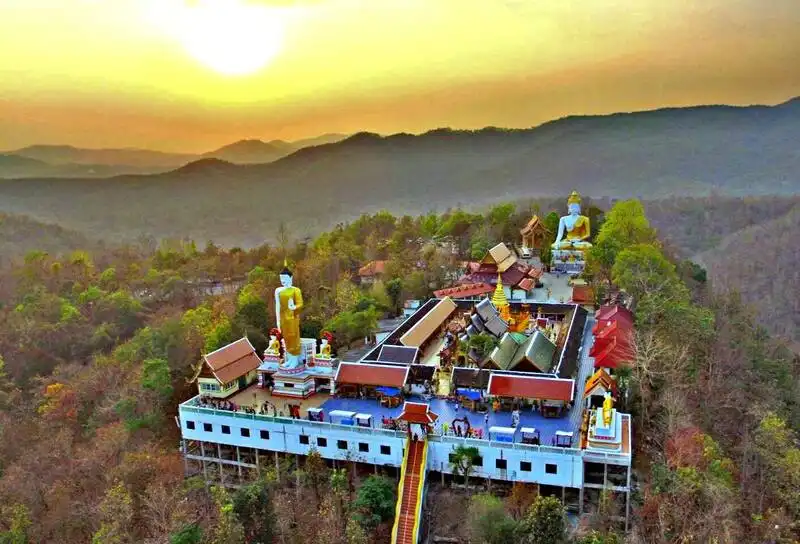
29. Wat Phra That Doi Kham, Chiang Mai is a historic Buddhist temple situated on a hill in Mae Hia Subdistrict, Mueang Chiang Mai District. The temple is known for its ancient relic pagoda and the revered Luang Pho Than Jai Buddha image, which attracts a steady stream of Buddhist devotees. Its elevated location also provides attractive views of Chiang Mai and the surrounding landscape, combining Lanna religious heritage with a scenic mountain atmosphere.
Highlights: Luang Pho Than Jai, the historic Phra That Doi Kham pagoda, a large Buddha image, panoramic viewpoints overlooking Chiang Mai, and a peaceful hillside temple setting.
Wat Phra That Doi Kham has a history deeply connected with Lanna traditions and the spread of Buddhism in the Chiang Mai region. Its name and religious heritage are linked with local legends and the character of the surrounding landscape. Over the centuries, the temple has undergone restoration and development while continuing to serve as a place of worship for nearby communities.
The sacred relic pagoda is among the temple's most significant features. Designed in a traditional Lanna style, it is an important focus of religious devotion. Visitors can pay respect to the pagoda and examine its architectural details within the areas open to the public.
Luang Pho Than Jai is a highly revered Buddha image that attracts visitors seeking blessings according to their personal beliefs. Many devotees present jasmine flowers as offerings, following a local custom closely associated with the image. Visitors should follow the temple's regulations governing offerings and maintain order during busy periods.
Another attraction is the viewpoint overlooking Chiang Mai. On clear days, visitors can admire the city and surrounding mountains from the hillside courtyard. This makes Wat Phra That Doi Kham particularly appealing to travelers who want to combine Buddhist worship with scenic photography and a short escape from the busy Old City.
The temple can be included in an itinerary with Royal Park Rajapruek and Chiang Mai Night Safari, both located in the southern part of Chiang Mai. Traveling by private car or rental vehicle is convenient for visitors planning to explore several destinations in the area.
The approach to the temple includes an uphill road and a parking area. Drivers should use caution on steep sections and allow additional time during weekends and holidays, when many devotees visit Luang Pho Than Jai. Morning is generally a pleasant time for worship and sightseeing.
Open Days: Daily Opening Hours: 06:00 – 18:00
Address: Mae Hia Subdistrict, Mueang Chiang Mai District, Chiang Mai Province, Thailand.
Getting There: From Chiang Mai city, follow Canal Road or the route toward Royal Park Rajapruek, then follow signs up the hill to Wat Phra That Doi Kham. The temple is accessible by private car, rental vehicle, or hired taxi. Extra care is recommended on the uphill approach and during busy holiday periods.
Map (GPS):Get Directions to Wat Phra That Doi Kham

30. Wat Bowonniwet Vihara Ratchaworawihan, Bangkok is a first-class royal Buddhist monastery of great religious and historical significance. Located on Phra Sumen Road in Bowon Niwet Subdistrict, Phra Nakhon District, Bangkok, the temple is especially important as a major center of the Dhammayut monastic order. Several Thai monarchs have spent periods in the monkhood or resided here during their religious training. The temple contains an elegant ordination hall, historic chedi, and religious buildings that represent the artistic heritage of the Rattanakosin period.
Highlights: Phra Buddha Chinnasi, Phra Buddha Suwannakhet, the principal chedi, ordination hall, mural paintings, and the temple's historical importance to the Dhammayut monastic tradition.
Wat Bowonniwet Vihara was established during the reign of King Rama III and rose to greater prominence when Prince Mongkut, later King Rama IV, resided here as a Buddhist monk before ascending the throne. Its history is closely linked with the development of the Dhammayut order and the modernization of Buddhist monastic practice during the Rattanakosin period.
The ordination hall is one of the temple's most important buildings, distinguished by refined architecture and elaborate interior decoration. It houses Phra Buddha Chinnasi and Phra Buddha Suwannakhet, two highly revered Buddha images. Visitors can appreciate their artistic characteristics and the temple's architectural details while observing the rules governing entry into sacred spaces.
The principal chedi is another significant feature of the monastery, representing religious architectural traditions of the Rattanakosin period. Other buildings and monuments within the compound are connected with the temple's royal history and the activities of distinguished members of the Thai Buddhist Sangha.
Wat Bowonniwet Vihara has played a prominent role in the Dhammayut monastic order, functioning as a center for Buddhist learning and the observance of monastic discipline. Visitors interested in Thai Buddhist history can explore the monastery's associations with the monarchy, senior monks, and Supreme Patriarchs who have contributed to the development of Buddhism in Thailand.
Despite its location close to busy historic neighborhoods, the temple grounds maintain a relatively tranquil atmosphere. Visitors can walk around the accessible courtyards and admire the historic architecture, but should avoid entering monks' residential quarters or disturbing religious activities without permission.
Wat Bowonniwet Vihara can be combined with Wat Chana Songkhram, Phra Sumen Road, Phra Sumen Fort, and the Bang Lamphu neighborhood. Together, these attractions offer a rewarding walking route through Bangkok's Old Town, where religious heritage, historic buildings, and traditional communities remain closely connected.
The monastery is particularly valuable for visitors interested in Buddhist institutional history and Thailand's royal heritage. Its significance extends beyond architectural beauty to the important role it has played in the development of Thai Buddhism during the Rattanakosin period.
Open Days: Generally daily Opening Hours: Approximately 08:00 – 17:00. Access to individual buildings may vary according to temple activities.
Address: 248 Phra Sumen Road, Bowon Niwet Subdistrict, Phra Nakhon District, Bangkok 10200, Thailand.
Getting There: From Democracy Monument, follow Ratchadamnoen Klang Road and continue toward Phra Sumen Road. The temple is close to Bang Lamphu and Khao San Road and can be reached by public bus, taxi, or local transport. Visitors exploring the historic city can also walk here from nearby landmarks along Phra Sumen Road.
Map (GPS):Get Directions to Wat Bowonniwet Vihara

31. Wat Ratchabophit Sathit Maha Simaram Ratchaworawihan, Bangkok is a first-class royal Buddhist temple renowned for its remarkable combination of traditional Thai architecture and Western decorative influences. Located on Fueang Nakhon Road in Phra Nakhon District, Bangkok, the temple was established during the reign of King Chulalongkorn, Rama V. It is highly significant for its connections with the Thai monarchy, the history of Buddhism, and architectural developments during the late 19th century, when Thailand was experiencing increasing cultural exchange with Europe.
Highlights: The bell-shaped principal chedi, ordination hall decorated with Benjarong-style ceramic tiles, European-inspired interior decoration, royal cemetery, Phra Buddha Angkhirot, and architecture from the reign of King Rama V.
Construction of Wat Ratchabophit began in 1869 as a royal monastery associated with King Rama V. The temple's name refers to the arrangement of boundary markers surrounding its sacred precinct. The complex includes an ordination hall, assembly hall, principal chedi, and several supporting buildings carefully arranged to create a harmonious architectural composition.
The principal chedi is a bell-shaped structure standing at the center of the sacred compound. It is surrounded by religious buildings decorated with elaborate patterns and glazed ceramic tiles. The ordination hall is especially striking for its colorful exterior and refined traditional Thai features, including its roof ornaments and decorative doorways.
One of the temple's most unusual features is the interior of the ordination hall, which incorporates European architectural and decorative influences. Its columns, ornamental patterns, and spacious interior differ noticeably from the conventional mural-covered interiors of many Thai temples. Enshrined inside is Phra Buddha Angkhirot, the temple's principal Buddha image.
Wat Ratchabophit also contains a royal cemetery associated with members of the Thai royal family. The memorial structures display a variety of architectural styles and offer valuable insights into the artistic and historical traditions of the royal court. Visitors interested in history can explore the areas open to the public while respecting restricted memorial spaces.
Beyond its architectural importance, the temple has played a significant role in Thailand's Buddhist community and has been associated with senior monks and Supreme Patriarchs. Its history is closely connected with Buddhist education, monastic administration, and the religious traditions of the Rattanakosin period.
The temple offers excellent opportunities for architectural photography, particularly the colorful glazed tiles, entrances, layered roofs, and principal chedi. Visitors should photograph only permitted areas and avoid disturbing monks or worshippers. Wat Ratchabophit can also be combined with Wat Suthat, Wat Pho, and other historic attractions in Bangkok's Phra Nakhon district.
Open Days: Daily Opening Hours: 08:00 – 17:00
Address: 2 Fueang Nakhon Road, Wat Ratchabophit Subdistrict, Phra Nakhon District, Bangkok, Thailand.
Getting There: Take the MRT to Sam Yot Station, then walk or use local transport toward Fueang Nakhon Road and Wat Ratchabophit. Drivers may approach via Ratchabophit Road or Fueang Nakhon Road, although parking in Bangkok's historic center can be limited.
Map (GPS):Get Directions to Wat Ratchabophit

32. Wat Traimit Witthayaram Worawihan, Bangkok is a royal Buddhist temple celebrated for Phra Phuttha Maha Suwanna Patimakon, commonly known as the Golden Buddha. Located near Talat Noi and Chinatown in Samphanthawong District, Bangkok, the temple is easily accessible from Hua Lamphong Railway Station and the Chinatown Gate. It is an important destination for travelers interested in ancient Buddha images, the history of Bangkok's Chinese community, and traditional Buddhist architecture within one of the capital's oldest commercial districts.
Highlights: Phra Phuttha Maha Suwanna Patimakon, the Golden Buddha, the commemorative Maha Mondop, the Golden Buddha exhibition, and the Yaowarat Heritage Center.
Wat Traimit originated as an older temple in Bangkok before undergoing restoration and development in later periods. Its most significant historical event occurred during the relocation of a Buddha image that had been covered with plaster. When part of the covering was damaged, the image beneath was discovered to be made of solid gold. This discovery brought the Golden Buddha widespread recognition and transformed the temple into an important religious destination for worshippers from around the world.
The Golden Buddha is a large seated image in the subduing Mara posture, displaying distinctive characteristics of Sukhothai Buddhist sculpture. Cast in gold and weighing several tons, the image is admired for its serene facial expression, elegant proportions, and beautifully finished golden surface.
The image is now enshrined within a multi-level commemorative Maha Mondop. The building provides space for worship as well as exhibitions exploring the historical background of the Buddha image. Visitors can pay their respects and learn about the statue's discovery through the displays housed within the structure.
The temple's museums present information on the Golden Buddha, the techniques used in creating Buddhist sculpture, and the circumstances surrounding its relocation and discovery. The Yaowarat Heritage Center also introduces the development of Bangkok's Chinese communities and the historic commercial importance of Chinatown.
Wat Traimit is an excellent starting point for exploring Yaowarat and Talat Noi. Visitors can continue along Charoen Krung Road and Yaowarat Road, discovering historic architecture, traditional shops, street markets, and Thai-Chinese culinary heritage. The temple's location near Hua Lamphong makes it convenient to reach by public transportation.
Visitors should wear modest clothing and observe the rules for entering the building that houses the Golden Buddha. Photography restrictions may apply in sacred or exhibition areas. Those wishing to explore the museums should check their opening schedules separately from the general opening hours of the temple.
Open Days: Generally daily Opening Hours: Approximately 08:00 – 17:00. Museum opening hours and closing days may differ.
Admission Fee: The general temple grounds are accessible for worship. Admission fees apply to certain visitor areas and museum exhibitions according to the type of ticket. Check the current rates before visiting.
Address: Charoen Krung Road, Talat Noi Subdistrict, Samphanthawong District, Bangkok, Thailand.
Getting There: Take the MRT to Hua Lamphong Station and walk toward Wat Traimit. Drivers can approach via Charoen Krung Road near Odeon Circle and the Chinatown Gate. Visitors staying in Yaowarat can also walk to the temple from nearby Chinatown attractions.
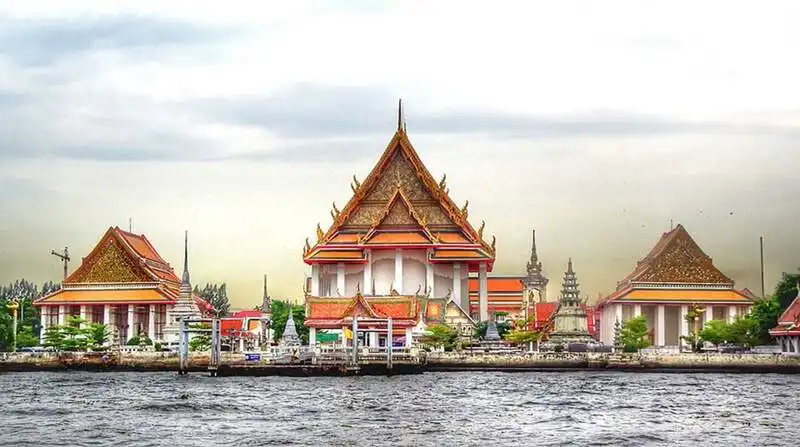
33. Wat Kanlayanamit Woramahawihan, Bangkok is a royal Buddhist temple situated beside the Chao Phraya River in Thon Buri District, Bangkok. It is renowned for Phra Phuttha Trai Rattana Nayok, also known as Luang Pho To, a monumental seated Buddha image deeply revered by Thai Buddhists and Thai-Chinese communities. The temple stands close to the historic Kudi Chin neighborhood and is an important cultural landmark reflecting the connections between Buddhism, Thai architecture, and the multicultural history of communities along the Thon Buri riverfront.
Highlights: Phra Phuttha Trai Rattana Nayok or Luang Pho To, the enormous royal assembly hall, the riverside bell tower, Thai and Chinese architectural influences, and the historic Kudi Chin community.
Wat Kanlayanamit was established during the reign of King Rama III by Chao Phraya Nikonbodin, also known as To Kanlayanamit. He donated land and constructed the temple before presenting it to the monarchy as a royal monastery. Its development was closely connected with the expansion of communities and commercial activity along the Chao Phraya River during the early Rattanakosin period. The temple subsequently became an important spiritual center for both Thai and Chinese residents.
Phra Phuttha Trai Rattana Nayok is an enormous Buddha image in the subduing Mara posture, housed inside the main royal assembly hall. The image is characterized by its peaceful expression and impressive scale. Devotees commonly refer to it as Luang Pho To and visit to pay respect, make offerings, and seek blessings according to their personal beliefs.
The main assembly hall was designed on a monumental scale to accommodate the large Buddha image. It provides a spacious setting for worship and religious activities. Elsewhere within the grounds are an ordination hall, chedis, and supporting buildings displaying architectural features associated with the Rattanakosin period.
The temple's riverside location is another distinctive attraction. The Chao Phraya River was once Bangkok's principal transportation and commercial route, and the temple's position reflects the importance of riverfront communities in the city's historical development. Visitors can appreciate the river scenery and connect their visit with nearby Wat Arun and the Kudi Chin neighborhood.
Kudi Chin is particularly significant for its diverse cultural history. The neighborhood preserves traces of Thai-Chinese and Thai-Portuguese communities, Buddhist temples, Christian religious buildings, and distinctive local traditions. A visit to Wat Kanlayanamit can therefore form part of a broader walking tour focused on multicultural life in historic Thon Buri.
Allow at least one hour to pay respect to Luang Pho To and explore the temple grounds. Those wishing to continue through Kudi Chin and nearby religious landmarks may need several additional hours. Modest clothing and a quiet, respectful manner are important inside the main assembly hall.
Open Days: Daily Opening Hours: 06:00 – 18:00
Admission Fee: Generally free admission. Voluntary donations are welcome.
Address: 371 Wat Kanlaya Subdistrict, Thon Buri District, Bangkok, Thailand.
Getting There: Take the MRT to Itsaraphap Station, then walk or use local transport toward Wat Kanlayanamit and Kudi Chin. Drivers can approach through Arun Amarin Road and the local streets of Thon Buri. River transport may also be convenient depending on the available pier services.
Map (GPS):Get Directions to Wat Kanlayanamit

34. Wat Phra Phutthabat Ratchaworamahawihan, Saraburi is an important royal Buddhist monastery located in Khun Khlon Subdistrict, Phra Phutthabat District, Saraburi Province. It is renowned for the sacred Buddha footprint enshrined within an elaborately decorated mondop. The temple is one of Thailand's most significant pilgrimage destinations, with historical connections to the Ayutthaya Kingdom and a long tradition of Buddhist devotees traveling here to pay homage.
Highlights: The sacred Buddha footprint, the ornate multi-tiered mondop, Naga staircase, ordination hall, Ayutthaya and Rattanakosin architectural features, and the annual Buddha Footprint Worship Festival.
The temple's history is closely associated with the reign of King Songtham of Ayutthaya. According to traditional accounts, a sacred footprint was discovered on a stone surface in the surrounding hills. A mondop was subsequently built over the footprint, and the area developed into an important religious sanctuary for the royal court and Buddhist devotees.
The mondop is admired for its traditional Thai architecture, including its tiered roof and intricate decorative craftsmanship. Inside is the sacred Buddha footprint, the principal object of devotion. The approach includes a Naga staircase and architectural details that reflect the site's long-standing religious importance.
Worship of the Buddha footprint is associated with the Buddhist practice of remembering and honoring the Buddha. Devotees bring flowers, incense, candles, and other offerings in accordance with local religious traditions. Visitors should follow the temple's regulations and maintain a respectful atmosphere inside the mondop.
The annual Buddha Footprint Worship Festival is one of Saraburi's most important religious celebrations. Large numbers of devotees travel to the temple to offer prayers and participate in Buddhist ceremonies. Dates may vary according to the traditional calendar, so visitors should confirm the annual program and allow additional travel time during the festival.
The temple also contains religious buildings and artistic features restored during different historical periods. These structures provide opportunities to appreciate the continuity between Ayutthaya and Rattanakosin architectural traditions.
Wat Phra Phutthabat is accessible from Bangkok for a day trip. It can also be combined with other religious and cultural attractions in Phra Phutthabat District and Saraburi city. Visitors should allow sufficient time to explore the sacred precinct rather than rushing through the principal mondop.
Open Days: Daily Opening Hours: 07:00 – 17:00
Address: Khun Khlon Subdistrict, Phra Phutthabat District, Saraburi Province, Thailand.
Getting There: From Bangkok, travel north along Phahonyothin Road toward Saraburi. Continue toward Phra Phutthabat District and follow signs to Wat Phra Phutthabat Ratchaworamahawihan. Visitors can travel by private car or take an intercity bus to Saraburi before transferring to local transport.
Map (GPS):Get Directions to Wat Phra Phutthabat
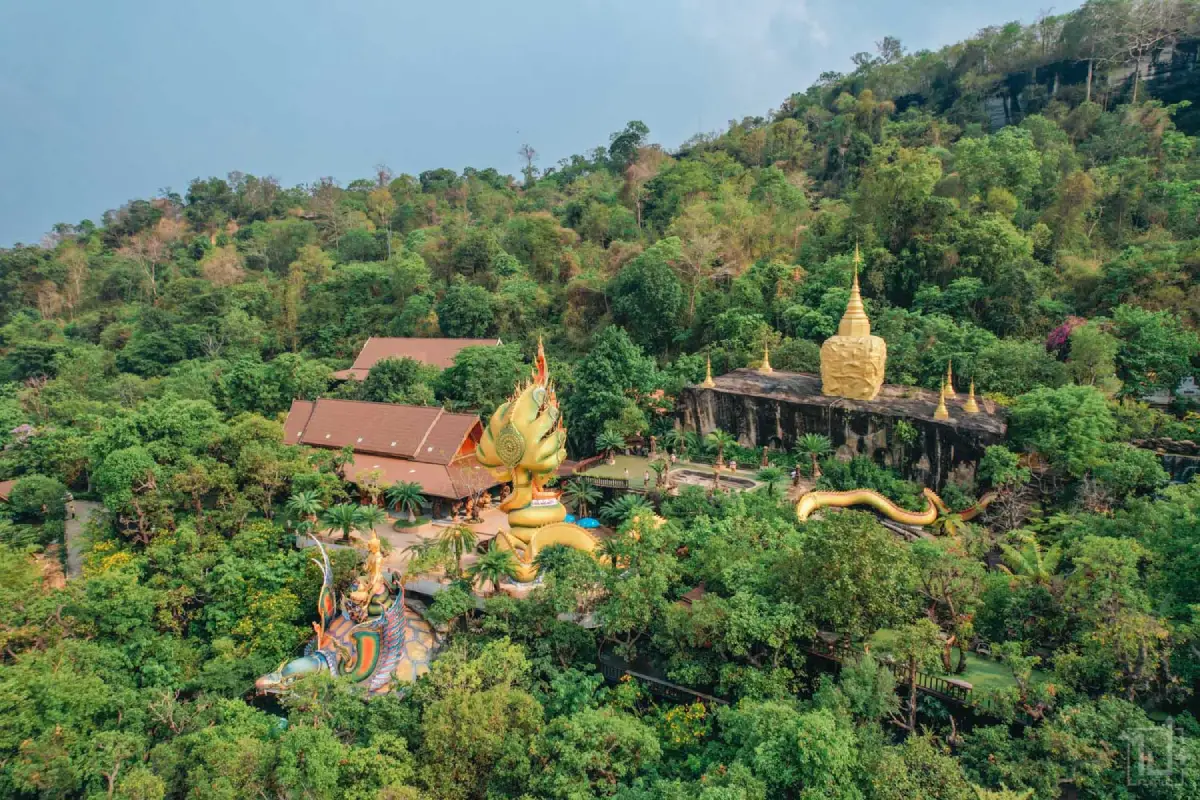
35. Wat Tham Pha Daen, Sakon Nakhon is a mountain temple famous for its extensive sandstone carvings and Buddhist sculptures set among natural rock formations. Located near Ban Dong Noi in Dong Mafai Subdistrict, Mueang Sakon Nakhon District, Sakon Nakhon Province, the temple is distinguished by the combination of contemporary Buddhist art, mountain scenery, and a peaceful forest environment. It is an important destination for Buddhist worship, meditation, and cultural sightseeing in northeastern Thailand.
Highlights: Mountain Buddha images, large sandstone carvings depicting Buddhist teachings and narratives, scenic viewpoints, religious sculptures, and the surrounding forest landscape.
Wat Tham Pha Daen developed as a place for Buddhist meditation and religious practice within the mountainous terrain of Sakon Nakhon. Over time, large-scale Buddhist artworks were carved into natural rock surfaces, transforming the site into a distinctive religious and artistic destination. The carvings allow visitors to experience Buddhist stories and teachings through monumental sculptures rather than conventional temple murals.
The sandstone carvings are among the temple's most remarkable attractions. They feature images and forms representing Buddhist history, revered monks, and religious principles. Visitors can follow the designated paths to appreciate the scale of the carvings and study their artistic and spiritual symbolism.
The temple is surrounded by wooded hills, creating a quiet atmosphere appropriate for contemplation. Natural viewpoints offer expansive scenery on clear days, allowing visitors to enjoy the landscape while exploring the temple's sculptures and religious buildings.
Because the temple is situated on a mountainside, its walkways, terraces, and viewing areas follow the natural slope of the land. Comfortable walking shoes are recommended, especially during the rainy season when steps and exposed stone surfaces may become slippery.
Wat Tham Pha Daen remains an active place of Buddhist worship and meditation. Visitors should maintain a peaceful atmosphere, avoid loud conversations, and refrain from disturbing monks or people engaged in religious practice.
Travelers can combine Wat Tham Pha Daen with other attractions in Sakon Nakhon, including Wat Phra That Choeng Chum Worawihan and Nong Han Lake. Additional travel time should be allowed for the mountain approach, and local weather conditions should be checked before departure.
The temple's distinctive appeal lies in the integration of Buddhist artistic craftsmanship with the natural mountain environment. A visit provides opportunities to appreciate religious sculpture, practice quiet reflection, and enjoy the scenic landscape of northeastern Thailand.
Open Days: Daily Opening Hours: 06:00 – 17:00
Address: Ban Dong Noi, Dong Mafai Subdistrict, Mueang Sakon Nakhon District, Sakon Nakhon 47000, Thailand.
Getting There: From Sakon Nakhon city, take the local road toward Dong Mafai Subdistrict and follow signs to Wat Tham Pha Daen. The final approach climbs into the mountains and includes steep sections. Travelers should use a roadworthy vehicle and drive carefully, particularly during rainy weather.
Map (GPS):Get Directions to Wat Tham Pha Daen
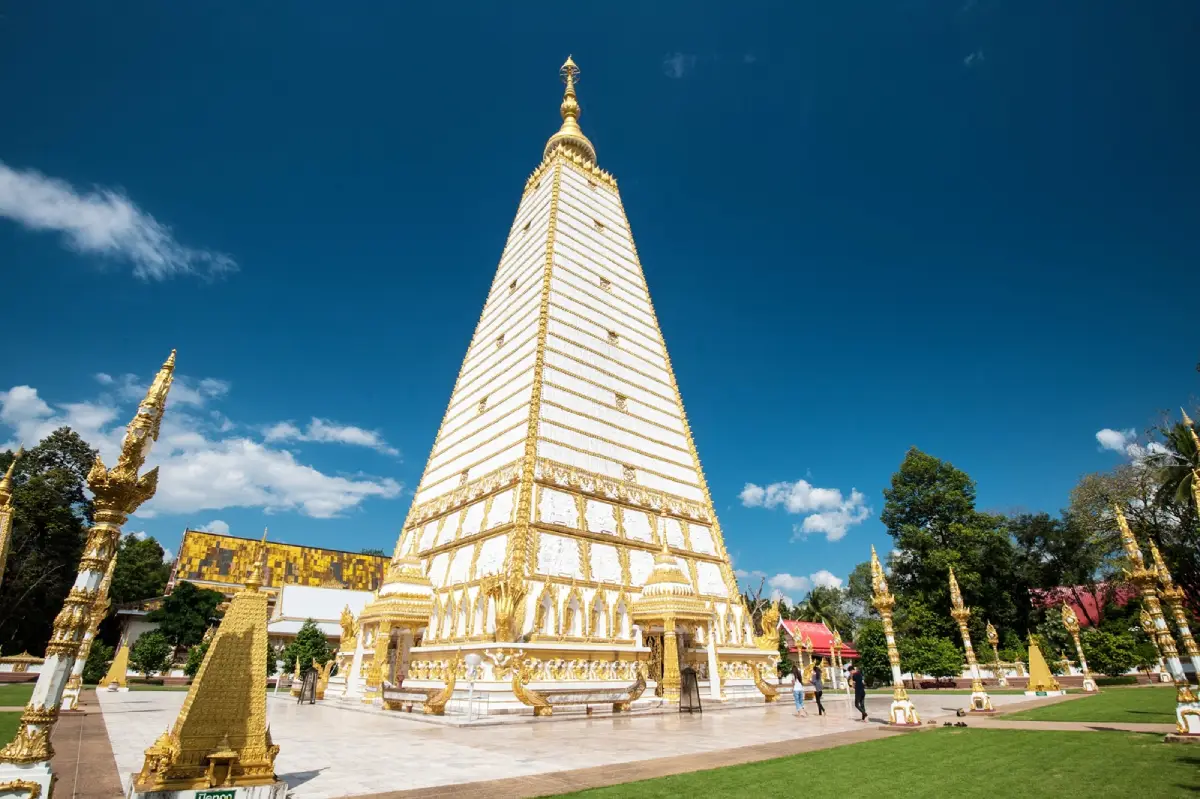
36. Wat Phra That Nong Bua, Ubon Ratchathani is an important Buddhist temple situated on Thamma Withi Road in Nai Mueang Subdistrict, Mueang Ubon Ratchathani District. It is especially famous for Phra That Chedi Si Maha Pho, a striking religious monument inspired by the Mahabodhi Temple at Bodh Gaya in India. The temple is a significant landmark of Ubon Ratchathani, distinguished by its tall white and gold chedi and elaborate decorative elements. Its architecture reflects the historical and spiritual connections between Buddhism in Thailand and the land where the Buddha attained enlightenment.
Highlights: Phra That Chedi Si Maha Pho, Bodh Gaya-inspired architecture, white and gold decorative craftsmanship, sacred Buddha images, and the atmosphere of an important urban temple in Ubon Ratchathani.
Wat Phra That Nong Bua was developed as an important religious center in Ubon Ratchathani, with the intention of creating a sacred pagoda that symbolizes Bodh Gaya, the site of the Buddha's enlightenment. Its architecture draws inspiration from the Mahabodhi Temple in India, particularly its tall central tower and richly decorated exterior.
Phra That Chedi Si Maha Pho stands prominently at the center of the temple grounds. Its tall structure rises above a substantial base, while its white surfaces and golden ornamentation create an elegant appearance. Visitors can appreciate the full proportions of the building from the front courtyard and examine the decorative motifs from different angles.
Within the sacred precinct are spaces for Buddhist worship and religious activities. Visitors can pay respect to the Buddha images and explore accessible sections of the temple while maintaining modest dress and respectful behavior. As an active religious site, the temple continues to host ceremonies and community Buddhist activities.
The temple is particularly interesting from an architectural perspective because it demonstrates how a sacred architectural model from India has been reinterpreted in the cultural context of northeastern Thailand. Travelers familiar with photographs of the Mahabodhi Temple at Bodh Gaya may recognize similarities in the proportions and decorative treatment of the principal monument.
Wat Phra That Nong Bua is also connected with the religious life of Ubon Ratchathani, a province renowned for its annual Candle Festival during the Buddhist Lent period. Visitors traveling at that time can explore the city's Buddhist traditions and combine temple sightseeing with cultural festivities according to the annual schedule.
The front courtyard provides a particularly attractive viewpoint for photography, allowing the entire chedi to be captured in a single composition. Visitors should photograph from designated areas and avoid interrupting worshippers or ceremonies.
Because the temple stands within Ubon Ratchathani city, it can easily be combined with Thung Si Mueang, Wat Si Ubon Rattanaram, and other cultural landmarks. Private cars and local taxis provide convenient transportation between these locations.
Overall, Wat Phra That Nong Bua is a distinctive destination for visitors interested in the relationship between Thai Buddhism and Buddhist architectural traditions from India. It combines religious importance with a memorable white-and-gold sacred monument.
Open Days: Daily Opening Hours: 06:00 – 20:00
Admission Fee: Free admission. Voluntary donations are welcome.
Address: Thamma Withi Road, Nai Mueang Subdistrict, Mueang Ubon Ratchathani District, Ubon Ratchathani Province, Thailand.
Getting There: From Ubon Ratchathani Airport, follow the main roads toward the city center and continue to Thamma Withi Road. Wat Phra That Nong Bua is situated in an established urban neighborhood and can be reached by private car, rental vehicle, or taxi from the airport and bus terminal.
Map (GPS):Get Directions to Wat Phra That Nong Bua
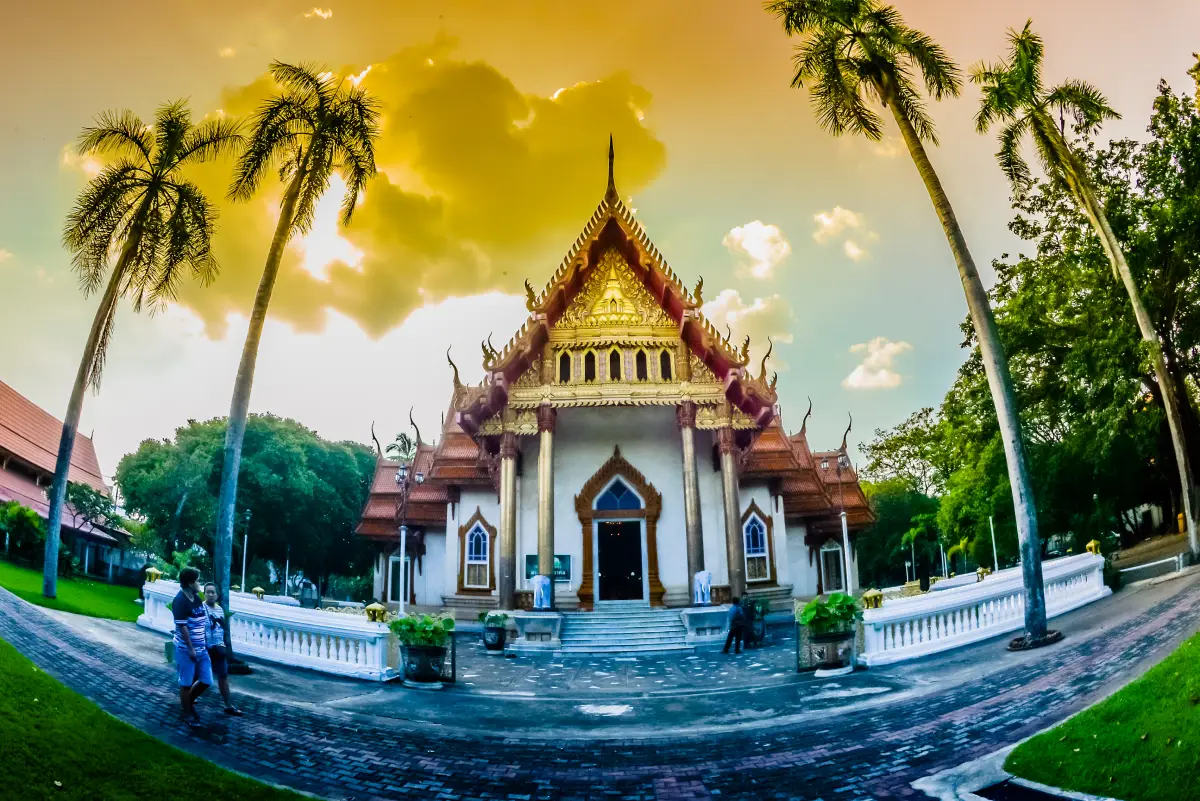
37. Wat Si Ubon Rattanaram (Wat Si Thong), Ubon Ratchathani is an important royal Buddhist temple located on Upparat Road in Nai Mueang Subdistrict, Mueang Ubon Ratchathani District. It is particularly renowned for Phra Kaew Butsarakham, a revered Buddha image that holds great spiritual significance for the people of Ubon Ratchathani. The temple also features an elegant ordination hall and a museum dedicated to the history of Buddhism and the cultural heritage of the region.
Highlights: Phra Kaew Butsarakham, the traditional Thai ordination hall, Wat Si Ubon Rattanaram Museum, the history of Ubon Ratchathani, and Buddhist religious ceremonies.
The temple's history is closely connected with the settlement and development of Ubon Ratchathani. Originally known as Wat Si Thong, it was later developed and given its present royal name. It continues to serve as an important Buddhist institution while preserving religious artifacts and examples of the province's artistic heritage.
Phra Kaew Butsarakham is a revered Buddha image distinguished by its beautiful golden-yellow appearance. It is enshrined in an appropriate sacred setting and is regarded as one of the city's important religious treasures. Devotees regularly visit to pay respect and seek blessings according to their personal beliefs.
The ordination hall displays elegant traditional Thai architecture and refined decorative craftsmanship. Visitors can appreciate its exterior and religious interior while observing the temple's dress code and rules for entering sacred buildings. The temple remains an active place for Buddhist ceremonies and merit-making on important religious occasions.
The museum provides additional opportunities to learn about the history of Buddhism and local cultural traditions in Ubon Ratchathani. Its collections present objects and stories associated with the temple and the surrounding community. Visitors intending to explore the museum should check its operating schedule separately from the temple's general worship hours.
Located close to Thung Si Mueang and the historic urban center, Wat Si Ubon Rattanaram is well suited to a cultural sightseeing route that also includes Wat Phra That Nong Bua and other important local temples. Travelers can begin by paying respect to Phra Kaew Butsarakham before exploring the city later in the day.
For visitors interested in the history of Ubon Ratchathani, the temple offers insight into the relationship between Buddhism, the development of the city, and regional artistic traditions. Its sacred Buddha image, historic buildings, and museum provide different perspectives on the province's cultural identity.
Open Days: Daily Opening Hours: Temple grounds 04:30 – 22:00. Museum: Wednesday – Sunday, 08:00 – 16:00, according to the source article.
Admission Fee: Free admission to the temple and museum according to the original attraction information.
Address: Upparat Road, Nai Mueang Subdistrict, Mueang Ubon Ratchathani District, Ubon Ratchathani Province, Thailand.
Getting There: From Ubon Ratchathani Airport, travel into the city center and follow Upparat Road toward Wat Si Ubon Rattanaram. The temple is accessible by private car, rental vehicle, taxi, or ride-hailing service. It is also convenient for visitors exploring Thung Si Mueang on foot.
Map (GPS):Get Directions to Wat Si Ubon Rattanaram
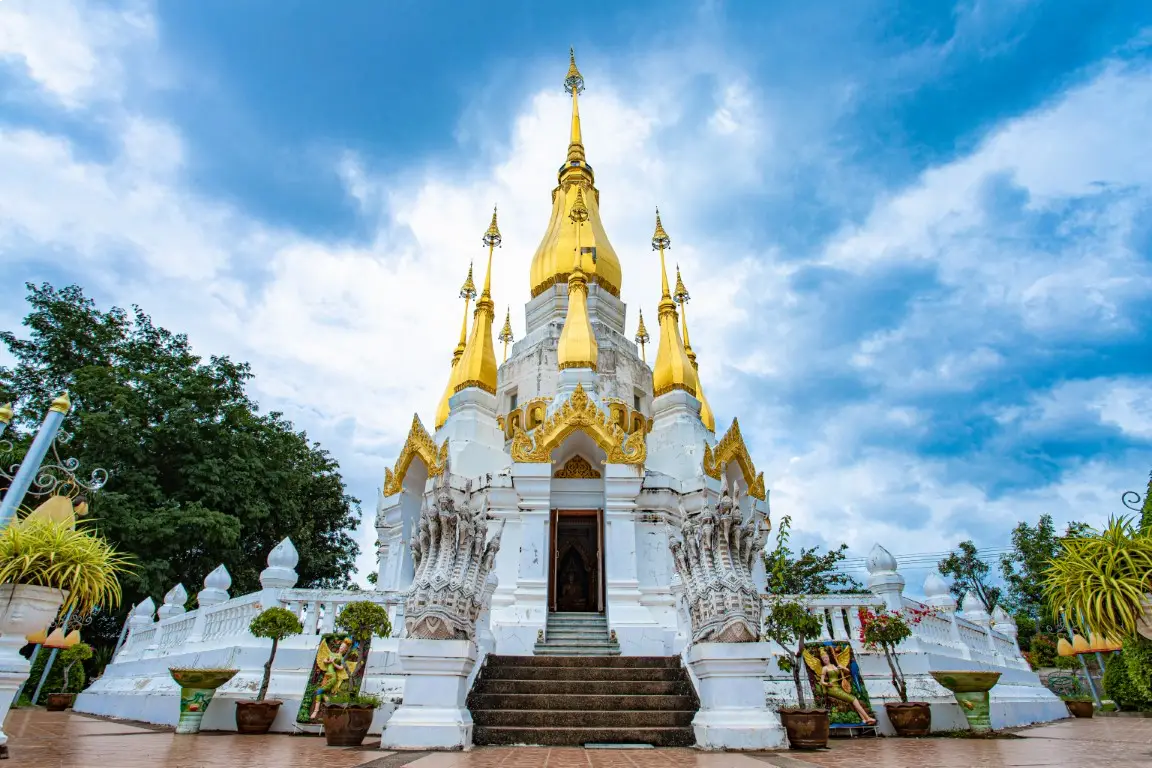
38. Wat Tham Khuha Sawan, Ubon Ratchathani is an important Buddhist temple in Khong Chiam District, Ubon Ratchathani Province. Situated on elevated ground, it provides beautiful views of the Mekong River and surrounding landscapes. The temple is known for its natural cave, religious buildings, chedi, and scenic viewpoints. It offers visitors an opportunity to experience the distinctive riverfront geography of the Thai–Lao border region while exploring a peaceful Buddhist sanctuary.
Highlights: Tham Khuha Sawan Cave, the temple's chedi and religious buildings, panoramic Mekong River views, sacred Buddha images, and mountain scenery around Khong Chiam.
Wat Tham Khuha Sawan developed from a meditation site in the mountainous landscape of Khong Chiam. Its natural cave became part of the religious precinct, and the area was gradually developed into a temple for Buddhist worship and meditation. The setting illustrates the close relationship between Thailand's forested mountain landscapes and Buddhist religious practice.
The cave and surrounding sacred areas offer a calm environment for paying respect and quietly exploring the natural surroundings. Visitors should use care when walking on sloping paths and steps, particularly during rainy weather when surfaces may become slippery.
One of the temple's most attractive features is its viewpoint overlooking the Mekong River. On clear days, visitors can see the river and surrounding countryside extending into the distance. The elevated setting makes it a popular location for landscape photography, although visitors should remain within designated viewing areas.
Wat Tham Khuha Sawan can be combined with other attractions in Khong Chiam District, including the Two-Color River viewpoint and Pha Taem National Park. Travelers should check travel distances and opening hours for each destination before departure.
The temple is particularly suitable for visitors interested in both Buddhist culture and nature. Its religious precinct and dramatic river landscape provide a balanced experience of spiritual sightseeing and scenic exploration along the Mekong.
Morning visits are generally comfortable for walking around the temple, while late afternoon can provide attractive natural light over the river. Travelers returning through rural or mountainous roads should allow adequate time to reach their accommodation before dark.
Open Days: Daily Opening Hours: 08:00 – 18:00
Admission Fee: Free admission.
Address: Khong Chiam Subdistrict, Khong Chiam District, Ubon Ratchathani Province, Thailand.
Getting There: From Ubon Ratchathani city, follow Highway 217 and connecting roads toward Khong Chiam District. Continue along the local roads following signs to Wat Tham Khuha Sawan. A private car or rental vehicle is convenient for reaching the temple and exploring nearby attractions.
Map (GPS):Get Directions to Wat Tham Khuha Sawan
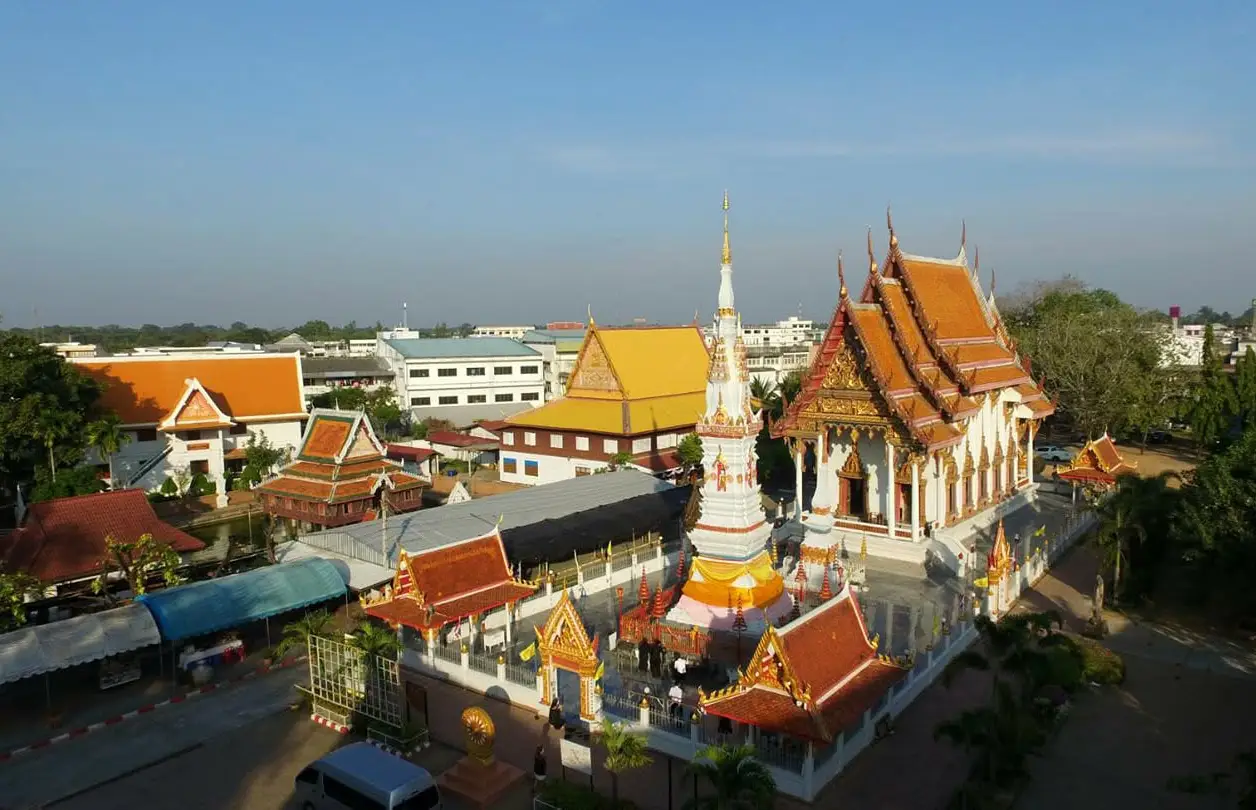
39. Wat Mahathat, Yasothon is an important historic Buddhist temple located in central Yasothon. The temple is famous for Phra That Anon, a sacred relic monument revered by the people of Yasothon, and an elegant traditional scripture library built over water. The temple serves as a spiritual center for the local community while preserving valuable examples of northeastern Thai architecture and religious history.
Highlights: Phra That Anon, the traditional overwater scripture library, ordination hall, Isan and Lan Xang artistic influences, and the history of Yasothon.
The history of Wat Mahathat is closely associated with the foundation and development of Yasothon. It has long served as an important religious center for local residents, and its architectural features reflect northeastern Thai craftsmanship and the cultural traditions of the Mekong River region.
Phra That Anon is the temple's principal sacred monument. Its distinctive pagoda design reflects local Isan architectural influences and holds considerable spiritual significance for Buddhist devotees. Visitors regularly pay respect to the chedi and learn about its connection with the history of Yasothon.
The overwater scripture library is another exceptionally valuable feature of the temple. Built with a traditional wooden structure above a pond, it reflects historical methods of safeguarding palm-leaf Buddhist manuscripts. Positioning the library over water helped discourage insects and certain animals from reaching sacred documents, demonstrating the practical knowledge and conservation methods developed by earlier generations.
Visitors interested in traditional architecture can appreciate the timber framework, roof design, and decorative details of the scripture library and surrounding buildings. Photography should be restricted to permitted areas, and historic wooden features should not be touched unnecessarily.
Wat Mahathat remains an active Buddhist monastery and a venue for community merit-making and religious traditions. Visitors can experience the atmosphere of a historic temple that continues to play an important role in local spiritual life.
The temple can be combined with historic neighborhoods and cultural attractions in Yasothon city. It is a particularly rewarding destination for travelers interested in northeastern Thai architectural heritage and the preservation of Buddhist manuscripts.
Wat Mahathat is significant not only as a place of worship but also as a site preserving important evidence of regional religious architecture. Phra That Anon and the overwater scripture library represent two distinctive dimensions of the cultural heritage of Yasothon.
Open Days: Daily Opening Hours: 08:00 – 17:00
Admission Fee: Free admission.
Address: Nai Mueang Subdistrict, Mueang Yasothon District, Yasothon Province, Thailand.
Getting There: From Chaeng Sanit Road or the main roads leading into Yasothon city, continue toward the historic center and follow signs to Wat Mahathat. The temple is accessible by private car, rental vehicle, or local taxi.
Map (GPS):Get Directions to Wat Mahathat, Yasothon

40. Wat Ratchaburana, Phra Nakhon Si Ayutthaya is an important archaeological monument within Ayutthaya Historical Park, located on the central island near Wat Mahathat. It is renowned for its monumental central prang and ancient crypt, where numerous important artifacts were discovered. The temple has exceptional historical and archaeological value because it provides evidence of the Ayutthaya royal court, Khmer-influenced religious architecture, and beliefs concerning royal merit-making.
Highlights: The central prang, the ancient crypt of Wat Ratchaburana, archaeological treasures recovered from the crypt, remains of the main assembly hall, and historic structures within Ayutthaya's central island.
Wat Ratchaburana was founded in 1424 during the reign of King Borommarachathirat II, also known as Chao Sam Phraya. Its establishment is associated with events surrounding the succession to the Ayutthaya throne and the construction of a religious monument dedicated to the king's two elder brothers. The temple consequently has considerable importance for understanding royal history and political developments in the Ayutthaya Kingdom.
The central prang is the temple's principal architectural feature. Its tall profile and elaborate stucco ornamentation represent the artistic traditions of early Ayutthaya. Although parts of the building have deteriorated over time, significant decorative details and architectural elements remain visible around its base and upper structure.
The crypt beneath the central prang is particularly significant to archaeology. Excavations revealed gold ornaments and numerous other valuable artifacts that provide insights into the artistic traditions, religious beliefs, and material culture of the Ayutthaya royal court. Some objects associated with the discoveries can be studied at the Chao Sam Phraya National Museum.
Walking through Wat Ratchaburana allows visitors to examine the remains of the main assembly hall, the central prang, and surrounding structures that reveal the layout of an important Ayutthaya-period temple. Interpretive signs explain the archaeological significance of the monuments. Visitors should use designated paths and avoid climbing on fragile historic structures.
Wat Ratchaburana stands opposite the Wat Mahathat area, making the two temples convenient to visit together. Travelers can continue to Wat Phra Si Sanphet and Viharn Phra Mongkhon Bophit on the same day. Those interested in the history of Ayutthaya should also allow time to explore the Chao Sam Phraya National Museum.
The central prang and surrounding ruins are particularly attractive for photography during the morning and late afternoon. Visitors should dress respectfully and follow the regulations of Ayutthaya Historical Park to help protect the site's cultural heritage.
Wat Ratchaburana is much more than a scenic archaeological attraction. It preserves important evidence of royal history, architectural development, and archaeological discoveries from the Ayutthaya Kingdom. Studying the temple and its ancient crypt provides a deeper understanding of one of Thailand's most important historic cities.
Open Days: Daily Opening Hours: 08:00 – 18:00
Admission Fee: Admission fees apply according to the Fine Arts Department's regulations, with separate rates for Thai nationals and foreign visitors. Confirm current prices before visiting.
Address: Tha Wasukri Subdistrict, Phra Nakhon Si Ayutthaya District, Phra Nakhon Si Ayutthaya 13000, Thailand.
Getting There: From Bangkok, follow the Asian Highway toward Ayutthaya and continue into the historic island area. Wat Ratchaburana is located near Wat Mahathat and can be reached by private car, tuk-tuk, or rental bicycle. Visitors should use designated parking areas when exploring the archaeological park.
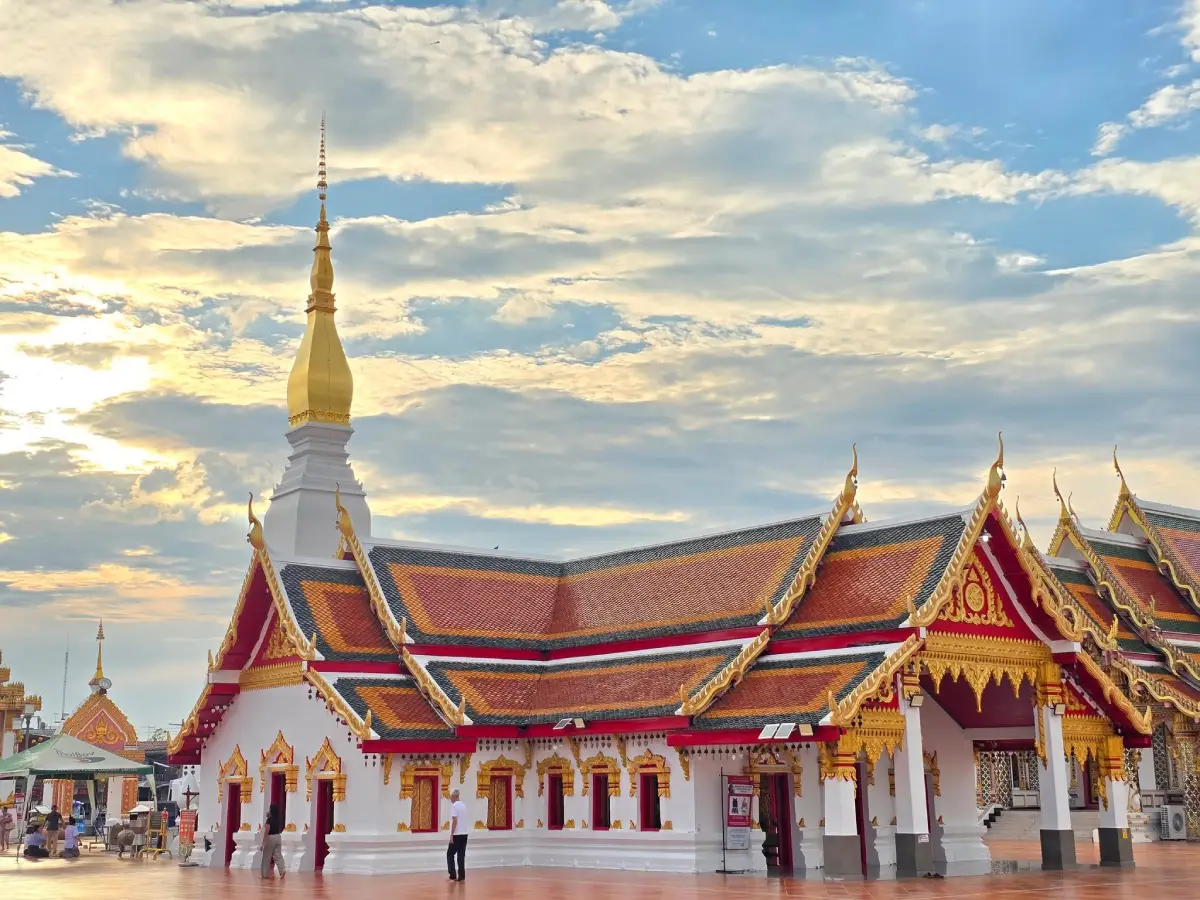
41. Wat Phra That Choeng Chum, Sakon Nakhon is one of the most important Buddhist temples in Sakon Nakhon Province, situated in the heart of Sakon Nakhon city. It is renowned for Phra That Choeng Chum, a white sacred stupa crowned with a golden spire that serves as a major spiritual landmark for local residents and Buddhist devotees from throughout Thailand. The temple also contains a viharn housing Luang Pho Phra Ong Saen, a revered Buddha image closely associated with the province. Its religious buildings reflect the artistic traditions and Buddhist beliefs of northeastern Thailand and the Mekong cultural region, making the temple an important destination for pilgrimage, cultural exploration, and local history.
Highlights: Phra That Choeng Chum, Luang Pho Phra Ong Saen, the main viharn, northeastern Thai and Mekong-inspired religious architecture, and the annual Phra That Choeng Chum Worship Festival.
The history of Phra That Choeng Chum is connected with legends of sacred Buddha footprints and the long-standing Buddhist traditions of northeastern Thailand. According to local religious belief, the stupa stands above footprints associated with past Buddhas and Gotama Buddha. These traditions have made Phra That Choeng Chum an important sacred monument visited by generations of worshippers.
Phra That Choeng Chum is a white, square-based stupa topped with a golden finial. Its architecture reflects the artistic traditions of the region and influences from the wider Mekong cultural landscape. From the temple courtyard, the structure rises prominently above the surrounding buildings. Worshippers traditionally walk clockwise around the stupa while paying respect, following established Buddhist customs.
The temple's viharn houses Luang Pho Phra Ong Saen, a highly revered Buddha image regarded as an important spiritual treasure of Sakon Nakhon. Many visitors begin their visit by paying respect to the Buddha image before continuing to the sacred stupa. The viharn remains an active space for Buddhist worship and community religious activities.
The annual Phra That Choeng Chum Worship Festival is one of the province's important religious celebrations. It brings together Buddhist devotees for merit-making ceremonies, offerings, and cultural activities reflecting local spiritual traditions. Visitors wishing to attend should consult the annual schedule, as festival arrangements follow religious and community calendars.
Because the temple is located in central Sakon Nakhon, it can easily be combined with sightseeing around Nong Han Lake and the city's other cultural attractions. Visitors should allow approximately one hour for worship and an unhurried exploration of the principal buildings. Morning is often preferable for those wishing to avoid the midday heat.
Wat Phra That Choeng Chum is therefore an important destination for understanding the Buddhist artistic heritage, religious history, and cultural identity of Sakon Nakhon. It provides an excellent starting point for exploring other sacred landmarks in the province, including Wat Tham Pha Daen.
Open Days: Daily Opening Hours: 08:00 – 18:00. Additional religious activities may take place during festivals and Buddhist holy days.
Admission Fee: Free admission. Voluntary donations are welcome.
Address: 1255 Phra That Choeng Chum Subdistrict, Mueang Sakon Nakhon District, Sakon Nakhon 47000, Thailand.
Getting There: From Sakon Nakhon Airport, follow the main roads toward the city center and continue to the Phra That Choeng Chum area. The temple is conveniently located near established urban neighborhoods and can be reached by private car, rental vehicle, or local taxi.
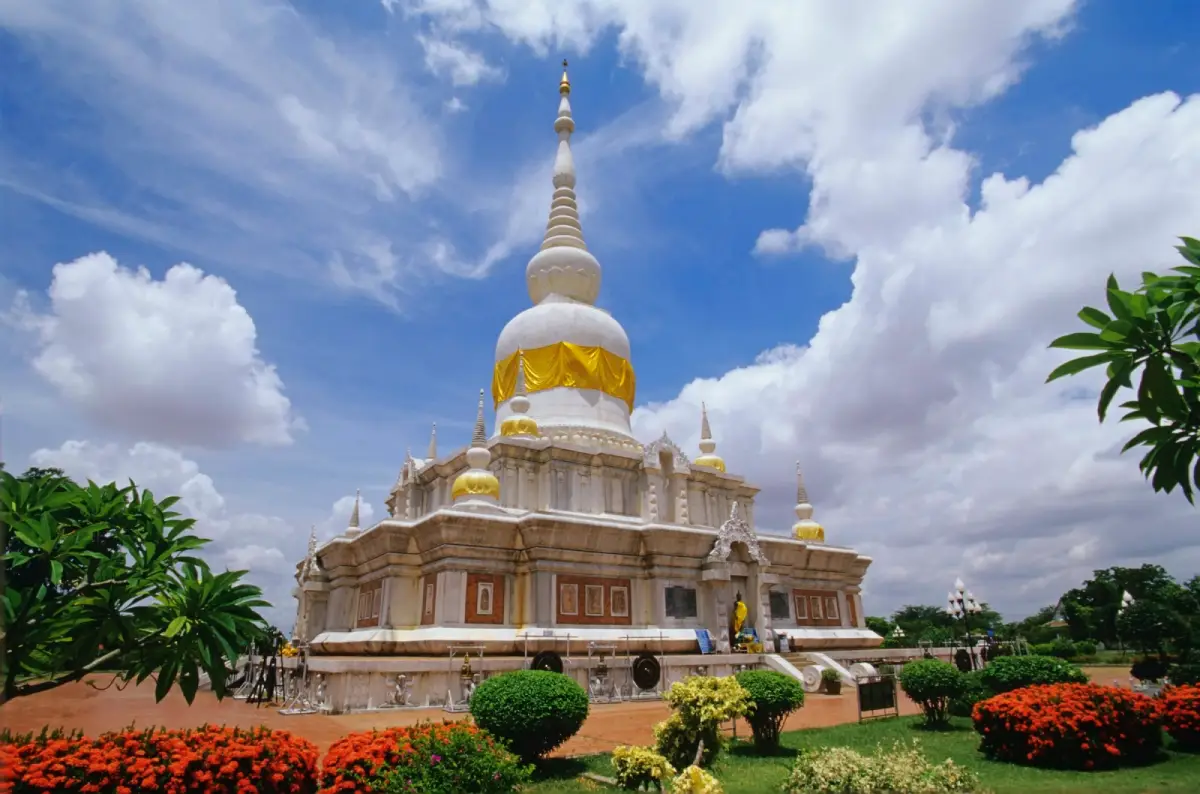
42. Phra That Na Dun, Maha Sarakham is one of the most important Buddhist sacred monuments in Maha Sarakham Province. Located within the Buddhist Center of Isan in Na Dun District, the site is distinguished by a magnificent white-and-gold stupa built to enshrine sacred Buddha relics discovered in the archaeological area of the ancient city of Nakhon Champa Si. Phra That Na Dun combines religious significance with historical and archaeological value, making it a destination for Buddhist pilgrims as well as travelers interested in the ancient cultures of northeastern Thailand.
Highlights: Phra That Na Dun, the Buddhist Center of Isan, the discovery of sacred Buddha relics, the ancient city of Nakhon Champa Si, and the annual Phra That Na Dun Worship Festival.
The historical importance of Phra That Na Dun is closely linked with archaeological discoveries in Na Dun District, an area associated with the ancient settlement of Nakhon Champa Si. This settlement developed during the period when Dvaravati cultural influences extended across northeastern Thailand. The discovery of Buddhist relics and other artifacts led to the construction of the present stupa as a place of enshrinement and a center of devotion for local communities.
The stupa incorporates architectural forms inspired by historic Buddhist art and combines them with modern building techniques. Its white-and-gold structure stands prominently within landscaped grounds, surrounded by pathways and open spaces for Buddhist ceremonies. Visitors can appreciate the monument from several viewpoints and observe its distinctive proportions and decoration.
The Buddhist Center of Isan extends across a spacious landscape containing religious facilities, gardens, and areas intended for cultural and educational activities. Visitors can walk around the sacred stupa and learn more about the ancient settlement and archaeological discoveries associated with the surrounding region.
The annual Phra That Na Dun Worship Festival is one of Maha Sarakham's important Buddhist celebrations. Worshippers gather to make merit, pay respect to the sacred relics, and participate in religious and cultural activities. The festival continues to strengthen the relationship between the local community and the religious monument.
Travelers interested in history and archaeology can combine Phra That Na Dun with other archaeological sites associated with Nakhon Champa Si. These visits provide a broader understanding of the development of ancient communities and Buddhism in northeastern Thailand. Because the site is situated outside Maha Sarakham city, sufficient travel time should be allowed.
Phra That Na Dun is also suitable for families, with open grounds and a peaceful atmosphere. Visitors exploring the outdoor areas during the warmer hours should bring sun protection and follow the rules of the religious precinct.
Open Days: Daily Opening Hours: 08:00 – 17:00
Admission Fee: Free admission.
Address: Ban Na Dun, Khok Dong Kheng area, Phra That Subdistrict, Na Dun District, Maha Sarakham Province, Thailand.
Getting There: From Maha Sarakham city, follow the road toward Na Dun District and continue along the signposted route to the Buddhist Center of Isan and Phra That Na Dun. Traveling by private or rental car is convenient, particularly for those wishing to explore nearby archaeological attractions.
Map (GPS):Get Directions to Phra That Na Dun
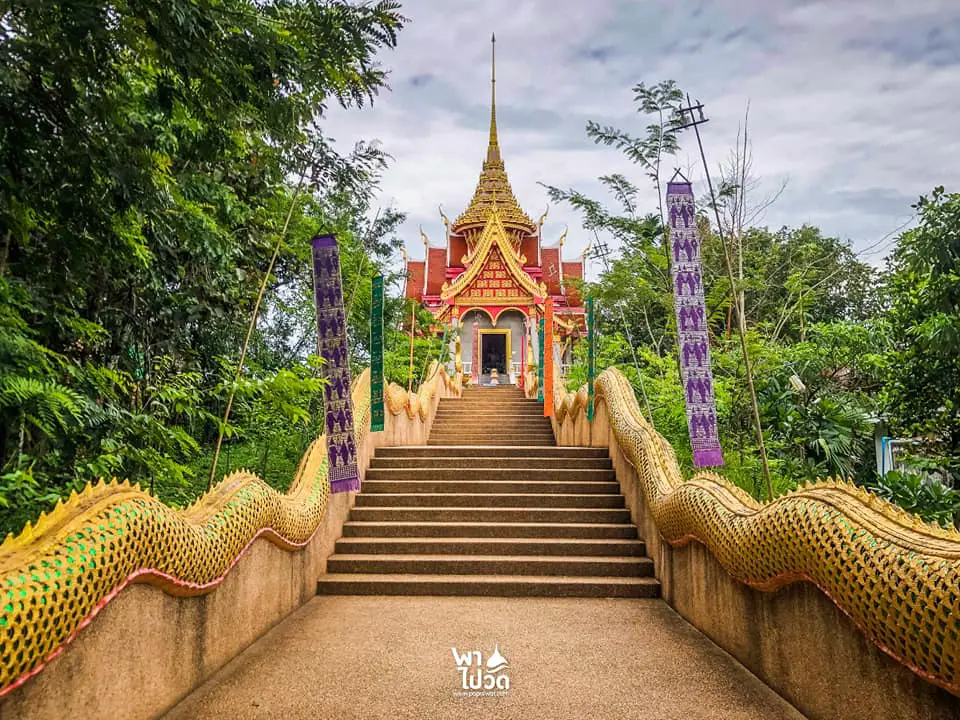
43. Wat Pha Tak Suea, Nong Khai is a mountain temple in Pha Tang Subdistrict, Sangkhom District, Nong Khai Province, renowned for its panoramic views of the Mekong River and a glass skywalk extending over the edge of a cliff. The elevated location provides sweeping views of the river and landscapes on both the Thai and Lao sides of the border. It is an appealing destination for Buddhist devotees, nature enthusiasts, and travelers interested in scenic photography along the Mekong River.
Highlights: The glass skywalk, panoramic Mekong River viewpoints, views toward Laos, sacred Buddha images, and the mountainous landscape of Sangkhom District.
Wat Pha Tak Suea originally served as a place of Buddhist meditation and a spiritual center for the local community. Its popularity increased because of the remarkable Mekong River scenery visible from the cliff. A viewing platform was subsequently developed to allow more visitors to appreciate the landscape from an elevated position.
The glass skywalk extends outward from the cliff, providing visitors with a dramatic perspective of the valley below. Its transparent flooring allows people to look down beneath their feet while enjoying a broad view of the Mekong River. Visitors must observe the safety requirements, including any restrictions on access and the use of protective shoe covers.
From the viewpoint, the Mekong River can be seen winding through the surrounding mountains and riverside communities. Seasonal changes in water level may alter the appearance of the landscape. During periods of lower water, sandbanks and the contours of the river can become more visible, creating distinctive natural scenery.
The temple grounds also contain Buddha images and spaces for religious activities. Visitors can pay respect to the sacred images before or after visiting the viewpoint. Keeping worship and sightseeing activities appropriately separate helps maintain the peaceful character of the temple.
Clear weather is preferable for photography because dense mist or heavy rain can obscure the landscape. Skywalk access may be restricted during strong winds, rain, or other unsafe conditions. Travelers should check the current operating status before beginning the journey.
Wat Pha Tak Suea can be included in an itinerary exploring the Mekong riverside attractions of Sangkhom District. Those traveling from Nong Khai city should allow sufficient time for the drive, as the route follows the river and passes through sections of hilly terrain.
The temple's distinctive appeal lies in its combination of Buddhist worship and an exceptional natural viewpoint. Visitors can experience the religious atmosphere of the temple and enjoy sweeping views of the Mekong River from the glass skywalk during the same visit.
Open Days: Daily Opening Hours: Temple grounds 06:00 – 18:00. Glass skywalk 09:30 – 16:30.
Admission Fee: No general admission fee. A separate shoe-cover fee may apply to visitors using the glass skywalk.
Address: Pha Tang Subdistrict, Sangkhom District, Nong Khai Province, Thailand.
Getting There: From Nong Khai city, follow Highway 211 along the Mekong River toward Sangkhom District. Continue toward Pha Tang Subdistrict and follow signs to Wat Pha Tak Suea. The route includes curves and hilly sections, so drivers should check their vehicles and allow additional travel time, especially during the rainy season.
Map (GPS):Get Directions to Wat Pha Tak Suea
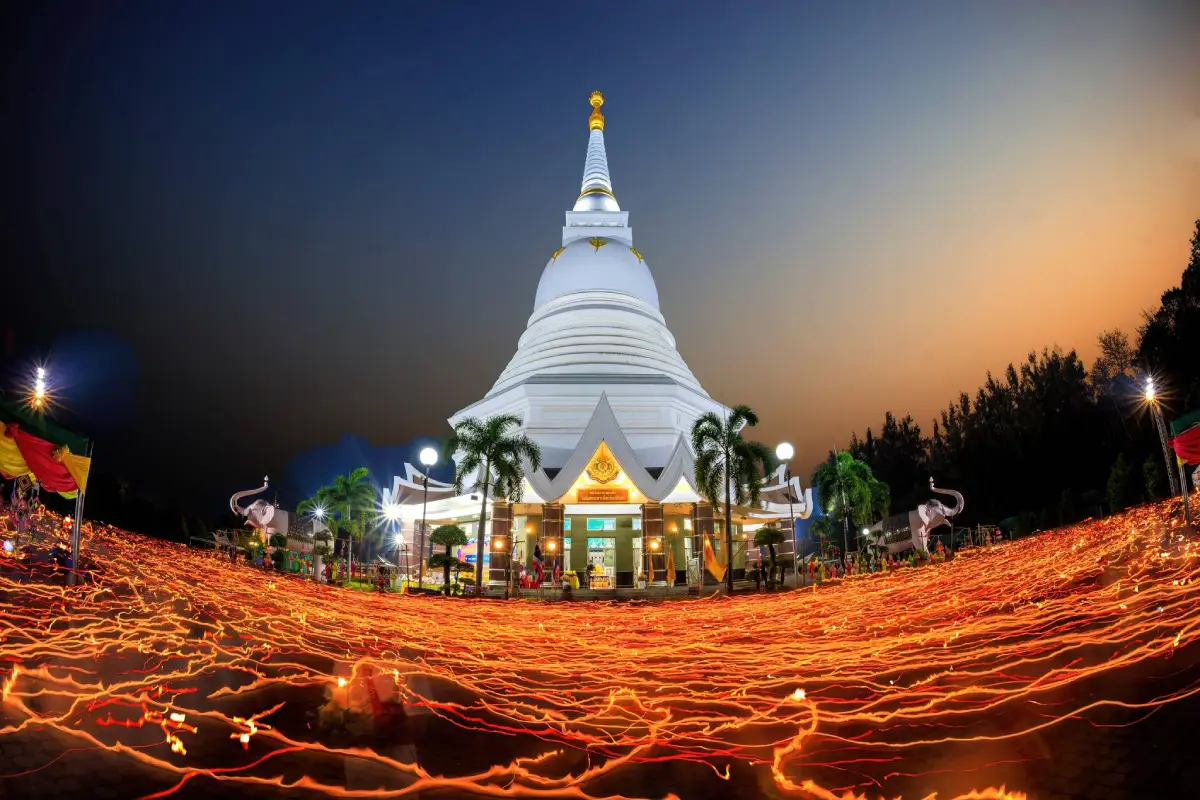
44. Wat Pa Ban Kho, Udon Thani is a Buddhist forest meditation monastery located at Ban Kho in Khuea Nam Subdistrict, Ban Phue District, Udon Thani Province. The temple is respected for its peaceful woodland setting and its role in the practice and study of Buddhist meditation. It is particularly suitable for visitors interested in spiritual travel who wish to spend time in a quiet environment away from the activity of the city.
Highlights: Thai forest monastic traditions, meditation facilities, Buddhist teaching and study, woodland surroundings, and the daily religious life of forest monks.
Wat Pa Ban Kho plays an important role in preserving the forest meditation traditions of northeastern Thailand. Its religious activities emphasize mindfulness, concentration, and careful observance of Buddhist monastic discipline. The surrounding trees and natural landscape contribute to an atmosphere particularly appropriate for meditation and reflection.
The temple grounds contain religious buildings, monks' residences, and designated spaces for Buddhist study and meditation. Unlike major temples developed primarily as tourist attractions, Wat Pa Ban Kho places particular importance on peace, discipline, and maintaining an appropriate environment for spiritual practice.
Visitors can appreciate the quiet forest atmosphere and learn about the character of Thai forest monastic life from public areas. Anyone wishing to participate in meditation activities or stay at the monastery should contact the temple in advance to confirm the arrangements and rules.
Modest clothing, quiet conversation, and respectful behavior are essential when visiting Wat Pa Ban Kho. Visitors should not enter monks' residential areas without permission. Photography should be limited to appropriate areas and should never disturb monks or laypeople engaged in meditation.
Because the monastery is located in Ban Phue District, travelers can combine a visit with other religious and historical attractions in Udon Thani Province. Journey times should be checked in advance, as some sites are located a considerable distance from the city center.
Wat Pa Ban Kho is valuable as a center of Buddhist meditation and religious learning. It demonstrates that Thailand's temples are diverse in character, with some emphasizing quiet spiritual practice rather than monumental architecture or large-scale tourist attractions.
Open Days: Daily Opening Hours: 08:00 – 17:00
Address: Ban Kho, Khuea Nam Subdistrict, Ban Phue District, Udon Thani Province, Thailand.
Getting There: From Udon Thani city, travel toward Ban Phue District and continue to Khuea Nam Subdistrict and Ban Kho. Follow local signs to Wat Pa Ban Kho. A private car or rental vehicle is convenient for reaching the monastery and exploring nearby locations.
Map (GPS):Get Directions to Wat Pa Ban Kho
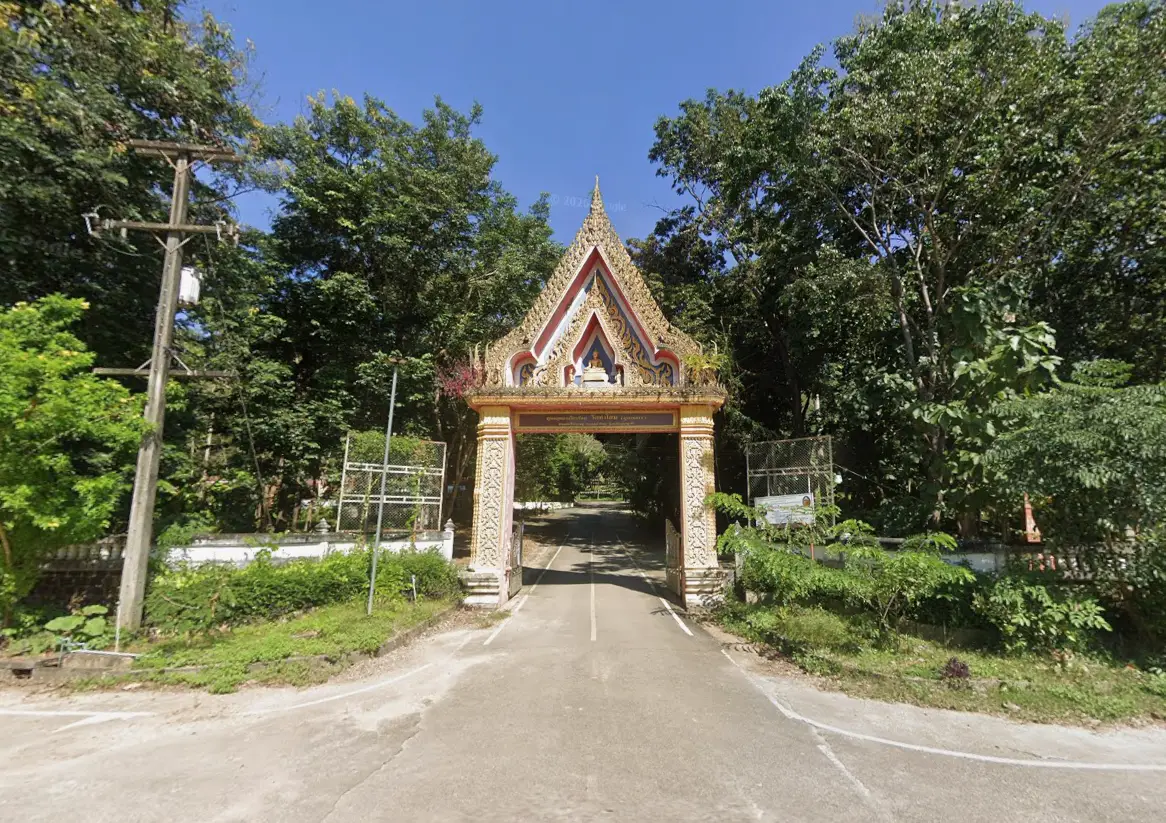
45. Wat Phu Na Lao, Udon Thani is a Buddhist temple and meditation site located in Si Samran Subdistrict, Nam Som District, Udon Thani Province, within a landscape surrounded by mountains and forests. The temple is distinguished by its peaceful natural setting and is particularly suitable for visitors wishing to make merit, practice meditation, and experience the simplicity of a rural Buddhist sanctuary.
Highlights: Hillside religious buildings, meditation areas, natural mountain scenery, forest surroundings, and the tranquil atmosphere of Nam Som District.
Wat Phu Na Lao is situated in an area characterized by natural landscapes and woodland. The environment is suitable for quiet reflection and meditation. The monastery's development reflects the importance of preserving the surrounding natural setting and maintaining the simple lifestyle associated with Buddhist forest traditions.
The temple grounds contain monks' residences and spaces for Buddhist ceremonies that have been arranged to suit the surrounding terrain. Visitors can explore designated public areas and appreciate the mountain and forest atmosphere while avoiding sections reserved for monks or private meditation.
The distinctive appeal of Wat Phu Na Lao is its peaceful setting, which differs from the atmosphere of more heavily visited temples. Travelers looking for a break from urban life can spend time observing the natural surroundings and paying respect according to Buddhist customs.
For nature photographers, the mountains and trees around the temple provide scenery that changes with the seasons. The area can be particularly green after rainfall. However, visitors should choose safe viewpoints and avoid taking photographs in ways that interrupt religious activities.
Travelers should check the condition of access roads before visiting, as the temple is located in a rural and mountainous district. Those driving are advised to use reliable navigation and return before dark, particularly during the rainy season when wet roads and reduced visibility may affect travel.
Wat Phu Na Lao offers another perspective on Buddhist temples in northeastern Thailand, emphasizing the peaceful environment of a forest monastery rather than elaborate religious buildings. It is an appropriate destination for visitors interested in nature, simplicity, and respectful spiritual exploration.
Open Days: Daily Opening Hours: 08:00 – 17:00
Address: Si Samran Subdistrict, Nam Som District, Udon Thani Province, Thailand.
Getting There: From Udon Thani city, follow the main route toward Nam Som District, then continue to Si Samran Subdistrict and follow local signs to Wat Phu Na Lao. A private or rental car is recommended because public transport services in the surrounding rural area may be limited.
Map (GPS):Get Directions to Wat Phu Na Lao
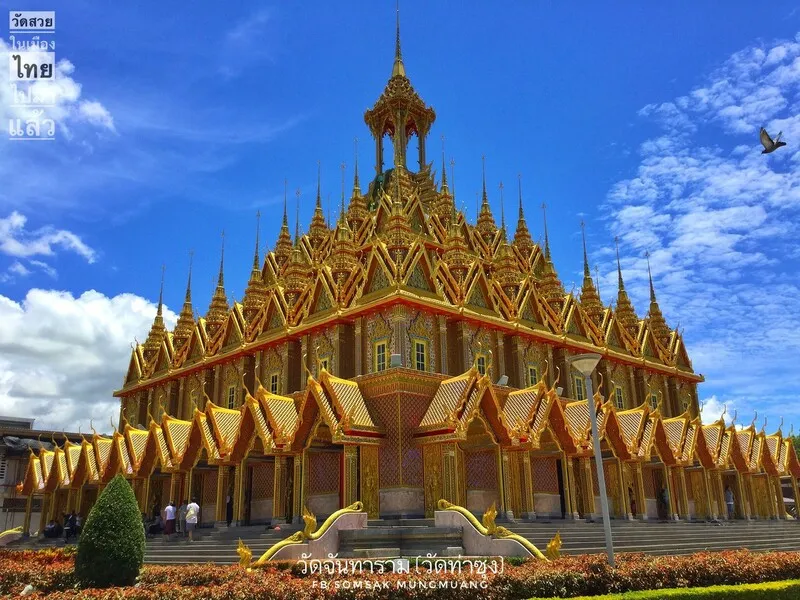
46. Wat Chantharam (Wat Tha Sung), Uthai Thani is a Buddhist temple celebrated for its extraordinary 100-meter Crystal Hall, whose interior is decorated with countless mirrors and reflective surfaces. Located in Nam Suem Subdistrict, Mueang Uthai Thani District, Uthai Thani Province, the temple is an important spiritual center for followers of Luang Pho Ruesi Ling Dam, formally known as Phra Ratchaphrommayan. This influential Buddhist monk was widely respected for his teachings and promotion of meditation practice. The temple features large religious buildings, sacred Buddha images, and impressive examples of contemporary Buddhist architecture, making it an important destination for worship and cultural sightseeing.
Highlights: The 100-meter Crystal Hall, Golden Castle, replica of Phra Buddha Chinnarat, important Buddha images, memorials associated with Luang Pho Ruesi Ling Dam, and elaborate mirror-decorated Buddhist architecture.
Wat Tha Sung originated as an older temple near the Sakae Krang River before undergoing extensive development under the leadership of Luang Pho Ruesi Ling Dam. His teachings emphasized Buddhist principles and meditation practice, attracting devotees from throughout Thailand. The temple gradually expanded to include major religious buildings and spaces capable of accommodating large numbers of worshippers.
The 100-meter Crystal Hall is the temple's most recognizable architectural attraction. Its interior is covered with countless reflective surfaces, including decorated columns, walls, and architectural details. When light enters the building, it creates a brilliant display of reflections throughout the hall. Sacred Buddha images and religious objects are enshrined inside, providing an impressive setting for Buddhist worship.
Visitors should plan their arrival around the Crystal Hall's opening sessions because the building is not open continuously throughout the day. Travelers coming from other provinces should confirm the schedule before departure to ensure sufficient time to enjoy the interior and participate in religious activities.
The Golden Castle is another magnificent structure within the temple grounds. It is distinguished by traditional Thai architectural forms and elaborate golden decoration. The detailed craftsmanship reflects the devotion of those who contributed to the development of the temple and provides attractive photography opportunities in areas open to visitors.
Wat Chantharam remains an important center of Buddhist meditation and merit-making in the tradition established by Luang Pho Ruesi Ling Dam. Devotees continue to visit for religious activities, particularly during Buddhist holidays and scheduled temple events. Those wishing to participate in meditation programs should review the temple's regulations and timetable in advance.
Travelers can combine Wat Tha Sung with the historic Sakae Krang riverside community and other attractions in Uthai Thani city. It is advisable to visit the temple during one of the Crystal Hall's opening periods before continuing to the old market, riverside neighborhoods, and local restaurants.
Wat Tha Sung is one of Thailand's most distinctive temples for its spectacular contemporary architecture and intricate mirror decoration. Visitors can appreciate the visual beauty of its religious structures while experiencing the continuing spiritual traditions associated with this important Buddhist monastery.
Open Days: Daily Opening Hours: The 100-meter Crystal Hall opens 09:00 – 11:30 and 14:00 – 16:00. Other buildings may have different opening hours.
Address: Nam Suem Subdistrict, Mueang Uthai Thani District, Uthai Thani Province, Thailand.
Getting There: From Bangkok, take the Asian Highway northward before turning toward Uthai Thani Province. From the provincial town, follow the road toward Nam Suem Subdistrict and Wat Chantharam. The temple is accessible by private car, rental vehicle, or local taxi. Visitors should plan their arrival to coincide with the Crystal Hall's opening sessions.
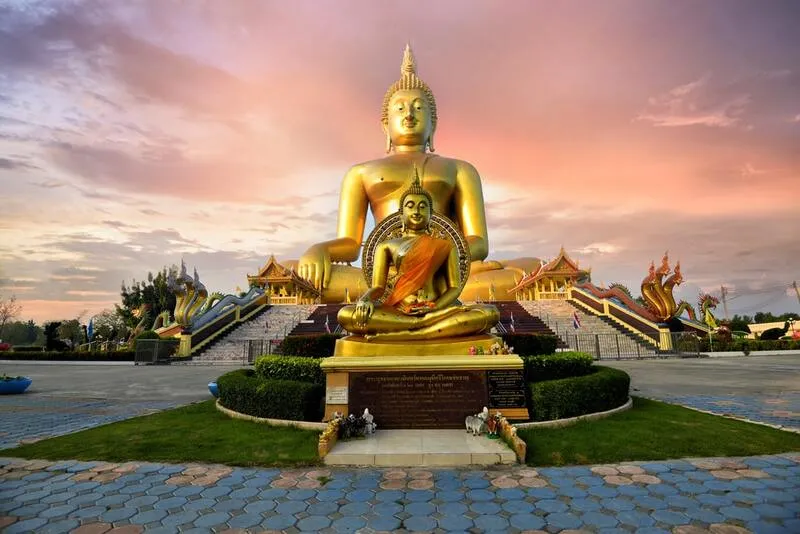
47. Wat Muang, Ang Thong is a Buddhist temple renowned for Phra Phuttha Mahanawamin Sakyamuni Si Wiset Chai Chan, commonly known as Luang Pho Yai, a colossal golden Buddha image in the subduing Mara posture. Located in Hua Taphan Subdistrict, Wiset Chai Chan District, Ang Thong Province, the temple has become one of the region's most recognizable religious landmarks. Visitors come to pay respect to the magnificent Buddha image, experience the atmosphere of a rural central Thai community, and explore religious artworks within the temple grounds.
Highlights: Luang Pho Yai, Phra Phuttha Mahanawamin Sakyamuni Si Wiset Chai Chan, the enormous golden seated Buddha image, the area beneath the Buddha's hand, and Buddhist moral-themed sculptures.
Wat Muang has its origins in the religious history of the local community of Wiset Chai Chan District. The temple was subsequently restored and developed into a major center of Buddhist devotion. Construction of the monumental Buddha image was a particularly significant undertaking, bringing the temple national recognition and attracting pilgrims from many provinces.
Luang Pho Yai stands approximately 93 meters tall and is one of the most imposing Buddha images in Thailand. The enormous seated figure can be seen from a considerable distance. Its golden appearance and graceful proportions create a memorable impression from the moment visitors approach the temple, especially when viewed in relation to the smaller buildings and surrounding countryside.
At the base of the statue are areas for worship and close-up viewing. Some devotees approach the area near the Buddha's hand to make wishes and pay respect according to personal beliefs. Visitors should follow the temple's regulations, especially during periods when large numbers of worshippers gather.
The temple grounds also contain sculptures and displays illustrating Buddhist moral teachings, including good conduct, the consequences of actions, and traditional beliefs about karma. These displays provide an alternative form of religious education. Families visiting with young children should exercise discretion because some sculptures may depict frightening imagery.
Photographing Luang Pho Yai is a popular activity. Visitors can take pictures from the courtyard directly in front of the Buddha or from more distant viewpoints to capture the entire monument. Morning and late afternoon generally provide more comfortable temperatures and suitable natural light.
Wat Muang can be combined with Wat Khun Inthapramun and other religious attractions in Ang Thong Province. It is suitable for a day trip from Bangkok, provided sufficient time is allowed for driving between the different districts.
Wat Muang is important both as a center of community devotion and as the home of an extraordinary contemporary Buddha image that has become a symbol of Ang Thong Province. A visit offers opportunities for Buddhist worship and an appreciation of large-scale modern religious sculpture.
Open Days: Daily Opening Hours: 06:00 – 18:00
Address: Hua Taphan Subdistrict, Wiset Chai Chan District, Ang Thong Province, Thailand.
Getting There: From Bangkok, follow the Asian Highway toward Ang Thong Province before continuing to Wiset Chai Chan District and Hua Taphan Subdistrict. Follow signs for Wat Muang. The temple is conveniently reached by private car or rental vehicle, and the giant Buddha image becomes visible as visitors approach the area.
Map (GPS):Get Directions to Wat Muang

48. Wat Khun Inthapramun, Ang Thong is a historic Buddhist temple famous for its enormous outdoor reclining Buddha image. Located in Inthapramun Subdistrict, Pho Thong District, Ang Thong Province, the temple is distinguished by a reclining Buddha approximately 50 meters long, admired for its serene facial expression and graceful proportions. The temple has historical connections with the Ayutthaya period and continues to attract Buddhist devotees who come to make merit and pay respect to the sacred image.
Highlights: The approximately 50-meter-long reclining Buddha, ruins of an ancient viharn, Ayutthaya-period religious history, and the traditional ceremony of offering a robe to the reclining Buddha.
Wat Khun Inthapramun has a history stretching back to the Ayutthaya period. Its monumental reclining Buddha is an important surviving example of Buddhist art and devotion from earlier times. The temple's name is associated with the local legend of Khun Inthapramun, a story preserved in the historical traditions of the surrounding community.
The reclining Buddha lies in an extended position with its head resting on a pillow-like support. Its peaceful expression and impressive length can be appreciated from several viewpoints. Because the image stands in the open air, visitors can see its full dimensions while walking around the designated worship areas.
Historically, the Buddha image was housed within a viharn. As the building deteriorated over the centuries, much of its original structure was lost, leaving the reclining Buddha exposed to the sky amid the remains of the historic temple. The relationship between the immense sculpture and the surviving architectural ruins offers a powerful reminder of the site's age and religious significance.
A traditional robe-offering ceremony for the reclining Buddha is among the temple's notable religious activities. Local residents and Buddhist devotees participate by offering cloth to the sacred image and taking part in ceremonies according to local custom. Visitors wishing to observe or join the event should check the dates each year.
The temple is particularly attractive for travelers interested in historic Buddhist sculpture. The outdoor setting allows photographs of the reclining Buddha against the surviving structures of the old viharn. Visitors should avoid touching the image without permission and maintain respectful behavior when religious ceremonies are taking place.
Wat Khun Inthapramun is located in Pho Thong District, making it possible to combine a visit with Wat Muang and other attractions in Ang Thong Province. It is a rewarding stop on a cultural day trip focused on monumental Buddha images and central Thai Buddhist heritage.
The temple's importance lies in preserving a remarkable reclining Buddha that remains a center of community devotion despite the changes and deterioration of its surrounding buildings. Its cultural value is therefore both historical and spiritual.
Open Days: Daily Opening Hours: 06:00 – 18:00
Address: Inthapramun Subdistrict, Pho Thong District, Ang Thong Province, Thailand.
Getting There: From Ang Thong town, follow the main road toward Pho Thong District and continue to Inthapramun Subdistrict, following signs to Wat Khun Inthapramun. Private cars and rental vehicles are convenient for visiting this temple together with other nearby religious landmarks.
Map (GPS):Get Directions to Wat Khun Inthapramun
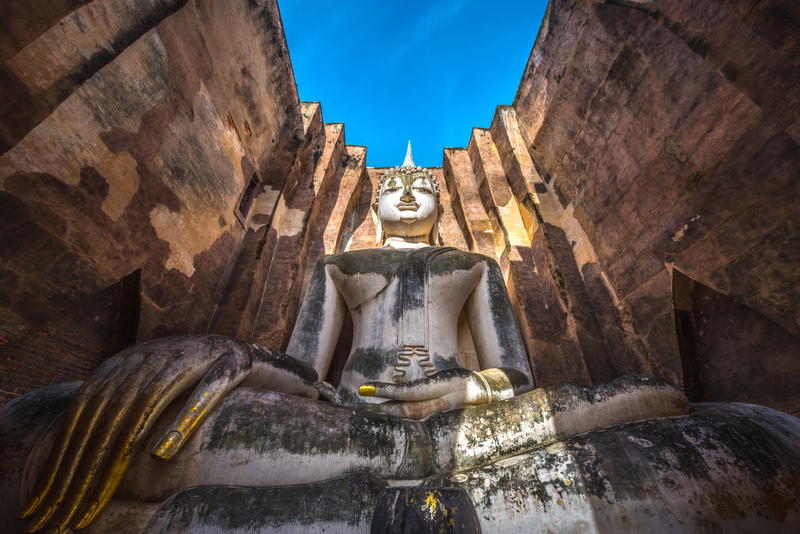
49. Wat Si Chum, Sukhothai is an important archaeological monument located north of the principal area of Sukhothai Historical Park, in Mueang Kao Subdistrict, Mueang Sukhothai District. It is famous for Phra Achana, an enormous seated Buddha image in the subduing Mara posture, enshrined within an ancient mondop. A tall opening in the front wall provides an unforgettable view of the Buddha, making the temple one of the most recognizable landmarks of historic Sukhothai. Wat Si Chum is an essential destination for visitors interested in Thai history, Buddhist sculpture, and Sukhothai-period architecture.
Highlights: Phra Achana, the monumental ancient mondop, Sukhothai Buddhist art, passages within the mondop walls, and the legend of the Speaking Buddha.
Wat Si Chum dates from the Sukhothai period and is distinguished by its massive brick-built mondop. The building has thick walls and a tall opening in its eastern facade, allowing the seated Buddha image to be seen from outside. The relationship between the structure and the statue creates an extraordinary visual impression, with the immense Buddha framed by the architectural opening.
Phra Achana is an enormous seated Buddha image in the subduing Mara posture. Its serene expression, elegant proportions, and traditional Sukhothai artistic features make it one of Thailand's most celebrated historic Buddha images. Visitors can view the statue from the front of the mondop and examine the graceful details of its face, body, and hand resting upon the knee.
Within the thick walls of the mondop are historic passages and internal spaces that have attracted interest from historians and archaeologists. A well-known local legend concerning the Speaking Buddha is associated with these architectural features. However, visitors studying the temple's history should distinguish traditional stories from archaeological evidence.
Wat Si Chum is particularly popular with photographers because Phra Achana can be framed through the towering entrance of the mondop. Morning light often produces attractive conditions for capturing the Buddha image. Visitors should maintain an appropriate distance from the monument and avoid obstructing those who are paying respect.
The temple can be visited together with the central area of Sukhothai Historical Park, Wat Mahathat, and Wat Sa Si. Bicycles and cars are convenient for traveling between the different archaeological zones. Travelers interested in the history of Sukhothai should allow time to read the interpretive signs and appreciate the architectural details.
Wat Si Chum has exceptional artistic importance because it demonstrates the ability of Sukhothai craftsmen to create monumental Buddhist sculpture and architecture in a powerful visual relationship. The sight of Phra Achana within the ancient mondop remains one of the most memorable experiences in Sukhothai Historical Park.
Open Days: Daily Opening Hours: 06:30 – 19:30 according to the original attraction information.
Admission Fee: Admission charges apply in designated areas of Sukhothai Historical Park under the Fine Arts Department's regulations. Check current ticket prices before visiting.
Address: Northern area of Sukhothai Historical Park, Mueang Kao Subdistrict, Mueang Sukhothai District, Sukhothai Province, Thailand.
Getting There: From Sukhothai town, follow Highway 12 toward Sukhothai Historical Park. Continue through the historic area toward Wat Si Chum, located north of the central archaeological zone. Visitors can travel by private car, rental vehicle, or bicycle using designated tourist routes.
Map (GPS):Get Directions to Wat Si Chum
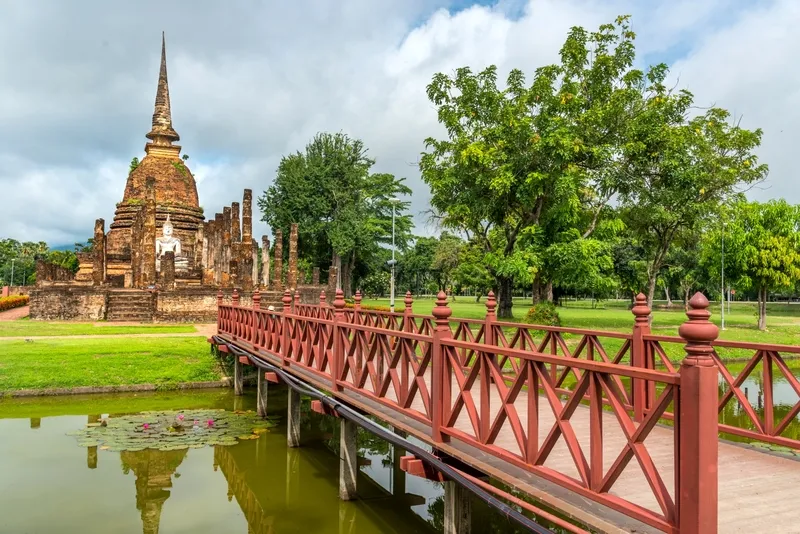
50. Wat Sa Si, Sukhothai is an important ancient temple situated on an island within a pond in the central zone of Sukhothai Historical Park, Mueang Kao Subdistrict, Mueang Sukhothai District. The temple is distinguished by its Sri Lankan-style bell-shaped chedi, historic viharn, and Buddha image surrounded by a peaceful waterside landscape. Visitors frequently come to appreciate the architectural beauty of the Sukhothai period and photograph the reflections of the ancient monuments on the water.
Highlights: The Sri Lankan-style bell-shaped chedi, ancient Buddha image, historic viharn, bridge leading to the island, reflections of the monuments on the pond, and the peaceful atmosphere of Sukhothai Historical Park.
Wat Sa Si was established during the Sukhothai period and reflects the influence of Sri Lankan Buddhist architecture on the development of sacred monuments in the ancient kingdom. Its location on an island within a pond demonstrates the relationship between religious architecture, landscaping, and the historic city's water management system.
The principal chedi is constructed in a Sri Lankan-inspired bell-shaped form and stands on a raised base. It represents an important example of Buddhist architectural traditions adopted and adapted during the Sukhothai period. Visitors can examine the proportions of the chedi and compare them with other religious monuments throughout the historical park.
The viharn area contains a Buddha image and surviving foundations of the ancient religious building. Although parts of the original structure remain only as bases and columns, these archaeological features help visitors understand the arrangement of worship spaces within a Sukhothai-period monastery.
The beauty of Wat Sa Si comes from the harmony between its historic monuments, water, and surrounding trees. From the shore, visitors can see the chedi and Buddha image standing on the small island, creating a serene composition unlike temples situated on ordinary dry ground.
Morning and the period before sunset are especially attractive for photography, as natural light enhances the textures of the ancient brickwork and creates reflections on the pond. Visitors should remain on designated pathways and bridges, avoid climbing on the monuments, and take care near the water.
Wat Sa Si can easily be combined with Wat Mahathat, Wat Traphang Ngoen, and other monuments in the central zone of Sukhothai Historical Park. Cycling is a popular way to explore the area, allowing travelers to visit multiple historic temples while enjoying the peaceful atmosphere of the old city.
For visitors interested in Sukhothai's history, Wat Sa Si illustrates the connections between ancient urban planning, water management, and Buddhist religious architecture. It is therefore more than a picturesque photography location; it is an important archaeological site for understanding the structure and artistic traditions of historic Sukhothai.
Wat Sa Si provides a fitting conclusion to a journey through 50 beautiful temples and Buddhist landmarks in Thailand. Its simple bell-shaped chedi, ancient Buddha image, and calm water setting demonstrate that the country's religious heritage is expressed not only through monumental architecture but also through the harmony of sacred spaces and natural landscapes.
Open Days: Daily Opening Hours: Monday – Friday and Sunday 06:30 – 19:30; Saturday 06:30 – 21:00, according to the original attraction information.
Admission Fee: The temple is within the central zone of Sukhothai Historical Park, where admission charges apply under the Fine Arts Department's regulations. Visitors should confirm current ticket prices and conditions before entering.
Address: Central zone of Sukhothai Historical Park, Mueang Kao Subdistrict, Mueang Sukhothai District, Sukhothai Province, Thailand.
Getting There: From Sukhothai town, follow Highway 12 toward Sukhothai Historical Park. Enter the central archaeological zone and continue on foot or by bicycle to Wat Sa Si, located on an island within a pond. Visitors arriving by car should park in designated areas before exploring the historic monuments.
Map (GPS):Get Directions to Wat Sa Si
Summary Table: 50 Beautiful Temples in Thailand, Temple Types and Visiting Guidelines
| Temple / Place | Province | Highlights | Admission Fee | Map |
| 1. Wat Phra Kaew | Bangkok | Emerald Buddha, royal ordination hall, Phra Si Rattana Chedi and Ramakien murals | Thai Nationals: Free; Foreign Visitors: THB 500 | GPS |
| 2. Wat Pho | Bangkok | Giant Reclining Buddha, four royal chedis and traditional Thai medicine inscriptions | Thai Nationals: Free; Foreign Visitors: THB 300 | GPS |
| 3. Wat Arun | Bangkok | Porcelain-decorated central prang and Chao Phraya River views | Thai Nationals: Free; Foreign Visitors: THB 200 | GPS |
| 4. Wat Phra That Doi Suthep | Chiang Mai | Golden stupa, 306-step Naga staircase and Chiang Mai city views | Thai Nationals: Free; Foreign Visitors: THB 30; Tram Extra | GPS |
| 5. Wat Rong Khun | Chiang Rai | White ordination hall, symbolic bridge and contemporary Buddhist art | Thai Nationals: Free; Foreign Visitors: THB 200 | GPS |
| 6. Wat Phra Si Rattana Mahathat | Phitsanulok | Phra Buddha Chinnarat and the principal viharn | Free | GPS |
| 7. Wat Chaiwatthanaram | Phra Nakhon Si Ayutthaya | Central prang, surrounding towers and historic Ayutthaya architecture | Thai Nationals: THB 10; Foreign Visitors: THB 80 | GPS |
| 8. Wat Mahathat, Ayutthaya | Phra Nakhon Si Ayutthaya | Buddha head embedded in tree roots and ancient prang ruins | Thai Nationals: THB 10; Foreign Visitors: THB 80 | GPS |
| 9. Wat Phra That Phanom | Nakhon Phanom | Sacred Phra That Phanom and the stupa cloth-offering tradition | Free | GPS |
| 10. Wat Phra That Hariphunchai | Lamphun | Golden chedi, Lanna gateway and Hariphunchai–Lanna architecture | Confirm Before Visiting | GPS |
| 11. Wat Phra That Lampang Luang | Lampang | Traditional Lanna wooden halls, golden chedi and inverted-image phenomenon | Confirm Before Visiting | GPS |
| 12. Wat Phumin | Nan | Whispering of Love mural and cruciform assembly hall | Confirm Before Visiting | GPS |
| 13. Wat Phra Singh Woramahawihan | Chiang Mai | Phra Buddha Sihing, Viharn Lai Kham and Lanna murals | Confirm Before Visiting | GPS |
| 14. Wat Chedi Luang | Chiang Mai | Historic Great Chedi and Inthakhin City Pillar | Confirm Before Visiting | GPS |
| 15. Wat Phra Kaew, Chiang Rai | Chiang Rai | Historical discovery of the Emerald Buddha, Chiang Rai Jade Buddha and Lanna art | Confirm Before Visiting | GPS |
| 16. Wat Pa Phu Kon | Udon Thani | White marble Reclining Buddha, blue-roofed viharn and mountains | Confirm Before Visiting | GPS |
| 17. Wat Phra That Pha Sorn Kaew | Phetchabun | Five white Buddha images, mosaic chedi and Khao Kho mountain views | Confirm Before Visiting | GPS |
| 18. Wat Chalong | Phuket | Luang Pho Chaem, sacred pagoda and annual Wat Chalong Fair | Free | GPS |
| 19. Wat Tham Suea, Kanchanaburi | Kanchanaburi | Phra Phuttha Chinnapratarnporn, Ket Kaew Maha Prasat Pagoda and rice-field views | Check Tram Charges Separately | GPS |
| 20. Wat Phra Mahathat Woramahawihan | Nakhon Si Thammarat | Sri Lankan-style sacred stupa and Hae Pha Khuen That tradition | General Temple Areas: Free | GPS |
| 21. Wat Benchamabophit | Bangkok | Marble ordination hall, Phra Buddha Chinnarat replica and Buddha galleries | Thai Nationals: Free; Foreign Visitors: Approx. THB 200 (Unconfirmed) | GPS |
| 22. Wat Saket and the Golden Mount | Bangkok | Golden Mount chedi and views over Bangkok Old Town | Check Golden Mount Admission | GPS |
| 23. Wat Suthat Thepwararam | Bangkok | Phra Si Sakyamuni, the royal viharn and Giant Swing | Thai Nationals: Free; Foreign Visitors: THB 100 | GPS |
| 24. Wat Ratchanatdaram | Bangkok | Loha Prasat with 37 spires and distinctive Rattanakosin architecture | Confirm Before Visiting | GPS |
| 25. Wat Yai Chai Mongkhon | Phra Nakhon Si Ayutthaya | Great Victory Chedi, Reclining Buddha and history of King Naresuan | Thai Nationals: Generally Free; Foreign Visitors: THB 20 in Earlier Listings | GPS |
| 26. Wat Phra Si Sanphet | Phra Nakhon Si Ayutthaya | Three bell-shaped royal chedis within the ancient palace precinct | Fine Arts Department Admission Applies | GPS |
| 27. Wat Phra That Chae Haeng | Nan | Golden chedi, Year of the Rabbit association and Hok Peng tradition | Confirm Before Visiting | GPS |
| 28. Wat Phra That Cho Hae | Phrae | Golden chedi, Lanna art and Year of the Tiger association | Free | GPS |
| 29. Wat Phra That Doi Kham | Chiang Mai | Luang Pho Than Jai, ancient chedi and views of Chiang Mai | Confirm Before Visiting | GPS |
| 30. Wat Bowonniwet Vihara | Bangkok | Phra Buddha Chinnasi, principal chedi and Dhammayut history | Confirm Before Visiting | GPS |
| 31. Wat Ratchabophit | Bangkok | Thai-European architecture, golden chedi and royal cemetery | Confirm Before Visiting | GPS |
| 32. Wat Traimit | Bangkok | Golden Buddha and exhibitions on the Buddha image and Chinatown | Admission Applies to Certain Areas and Museums | GPS |
| 33. Wat Kanlayanamit | Bangkok | Luang Pho To, main viharn and historic Kudi Chin neighborhood | Free | GPS |
| 34. Wat Phra Phutthabat | Saraburi | Sacred Buddha footprint, ornate mondop and worship festival | Confirm Before Visiting | GPS |
| 35. Wat Tham Pha Daen | Sakon Nakhon | Buddhist sandstone carvings, mountain art and scenic viewpoints | Confirm Before Visiting | GPS |
| 36. Wat Phra That Nong Bua | Ubon Ratchathani | Bodh Gaya-inspired white-and-gold sacred pagoda | Free | GPS |
| 37. Wat Si Ubon Rattanaram | Ubon Ratchathani | Phra Kaew Butsarakham and the temple museum | Free According to Earlier Listings | GPS |
| 38. Wat Tham Khuha Sawan | Ubon Ratchathani | Natural cave and panoramic Mekong River viewpoint | Free | GPS |
| 39. Wat Mahathat, Yasothon | Yasothon | Phra That Anon and traditional overwater scripture library | Free | GPS |
| 40. Wat Ratchaburana | Phra Nakhon Si Ayutthaya | Historic central prang, royal crypt and archaeological discoveries | Fine Arts Department Admission Applies | GPS |
| 41. Wat Phra That Choeng Chum | Sakon Nakhon | Phra That Choeng Chum and Luang Pho Phra Ong Saen | Free | GPS |
| 42. Phra That Na Dun | Maha Sarakham | White-and-gold relic stupa, Buddhist Center of Isan and ancient Nakhon Champa Si | Confirm Before Visiting | GPS |
| 43. Wat Pha Tak Suea | Nong Khai | Glass skywalk overlooking the Mekong River | Free According to Earlier Listings; Check Skywalk Requirements | GPS |
| 44. Wat Pa Ban Kho | Udon Thani | Forest meditation monastery and natural surroundings | Confirm Before Visiting | GPS |
| 45. Wat Phu Na Lao | Udon Thani | Hillside meditation sanctuary and forest scenery | Confirm Before Visiting | GPS |
| 46. Wat Chantharam (Wat Tha Sung) | Uthai Thani | 100-meter Crystal Hall, Golden Castle and Luang Pho Ruesi Ling Dam | Confirm Before Visiting | GPS |
| 47. Wat Muang | Ang Thong | Enormous golden seated Buddha and Buddhist moral sculptures | Confirm Before Visiting | GPS |
| 48. Wat Khun Inthapramun | Ang Thong | Outdoor Reclining Buddha and the ruins of an ancient viharn | Confirm Before Visiting | GPS |
| 49. Wat Si Chum | Sukhothai | Phra Achana and monumental ancient mondop | Historical Park Admission Applies | GPS |
| 50. Wat Sa Si | Sukhothai | Sri Lankan-style chedi on an island in Sukhothai Historical Park | Included in Historical Park Admission | GPS |
| Types of Buddhist Temples and Sacred Sites in Thailand | ||||
| Royal Temples (Phra Aram Luang) | Temples officially granted royal monastery status, classified by rank and formal designation, including first-, second- and third-class royal temples, and designations such as Ratchaworamahawihan, Woramahawihan, Ratchaworawihan, Worawihan and Samanya. | Examples: Wat Pho, Wat Arun and Wat Benchamabophit. | ||
| Non-Royal or Community Temples (Wat Rat) | Temples that have not been granted formal royal monastery status. They may still be historically important community monasteries or contain outstanding religious artworks. | Check the official name and formal status of each individual temple. | ||
| Active Monasteries With Resident Monks | Temples still used for monastic ceremonies, merit-making, Dhamma teaching and community activities. | Maintain a quiet atmosphere and distinguish the public sacred precinct (Phutthawat) from monks’ residential areas (Sangkhawat). | ||
| Abandoned Temples and Archaeological Monuments | Former temple sites with no resident monks, sometimes protected and managed by government heritage-conservation authorities. | Examples: Wat Chaiwatthanaram, Wat Mahathat in Ayutthaya, Wat Phra Si Sanphet and Wat Ratchaburana. | ||
| Forest Temples and Meditation Monasteries | Temples emphasizing meditation and a quiet, simple lifestyle, sometimes situated in forests or mountainous environments. | Examples: Wat Pa Phu Kon, Wat Pa Ban Kho and Wat Phu Na Lao. | ||
| Relic Pagoda Temples and Pilgrimage Centers | Sites featuring sacred relic stupas or major pilgrimage monuments, sometimes associated with ceremonies for bathing or draping a relic pagoda with cloth. | Examples: Wat Phra That Doi Suthep, Wat Phra That Phanom, Wat Phra That Hariphunchai and Wat Phra That Cho Hae. | ||
| Temples of Historical Significance | Temples associated with former capitals, kingdoms, monarchs or major historical events, with surviving artistic or archaeological evidence. | Examples: Wat Chedi Luang, Wat Phra Si Sanphet and Wat Yai Chai Mongkhon. | ||
| Temples Featuring Contemporary Buddhist Art | Temples that apply Buddhist artistic concepts to contemporary architectural or sculptural forms. | Examples: Wat Rong Khun, Wat Phra That Pha Sorn Kaew and Wat Chantharam (Wat Tha Sung). | ||
| Mountain, Cave and Viewpoint Temples | A grouping based on landscape and visitor experience, rather than legal or ecclesiastical status. | Examples: Wat Tham Pha Daen, Wat Tham Suea, Wat Pha Tak Suea and Wat Phra That Doi Kham. | ||
| Temples and Sacred Places With Learning Collections | Places containing museums, inscriptions, murals, scripture libraries or exhibitions on religion and culture. | Examples: Wat Pho, Wat Phumin, Wat Traimit and Wat Mahathat in Yasothon. | ||
| Buddhist Sacred Sites That Are Not Temples | Some stupas, Buddhist parks and sacred sites are religious attractions but should not be described as temples without supporting evidence. | Example from the list: Phra That Na Dun, Maha Sarakham Province. | ||
| Monastic Orders and Temple Traditions | Active Thai Buddhist monasteries may belong to the Mahanikaya or Dhammayut order. This classification is separate from the distinction between royal and non-royal temples. | An example connected with the history of the Dhammayut order is Wat Bowonniwet Vihara. | ||
| Recommendations and Etiquette for Visiting Thai Temples | ||||
| Clothing | Wear modest shirts with sleeves and trousers or skirts covering the knees; avoid short or excessively revealing clothing. Some temples have stricter requirements. | Check the dress code for Wat Phra Kaew and royal precinct attractions before visiting. | ||
| Shoes and Hats | Remove shoes and hats before entering buildings where required; use designated entrances and shoe storage areas. | Do not wear shoes on worship platforms or the raised bases supporting Buddha images. | ||
| Quietness and Respect | Silence mobile phones, lower your voice and avoid disturbing ceremonies or people meditating. | Do not sit with your feet pointing toward Buddha images or Buddhist monks. | ||
| Photography | Check signs restricting photography and flash use, especially inside ordination halls, viharns, museums and around murals. | Do not touch Buddha images, murals or archaeological objects, and avoid blocking walkways. | ||
| Monastic Offerings and Donations | Select suitable items for offerings, follow the temple’s procedures and donate through channels officially provided by the temple. | Avoid purchasing offerings from or giving money to individuals who have no connection with the temple. | ||
| Interacting With Monks | Speak politely and follow temple rules about presenting offerings and approaching monks. | Ask temple staff if you are uncertain about appropriate conduct. | ||
| Participating in Ceremonies | Check ceremony dates and times, including candlelit processions, relic bathing, cloth-offering processions and annual religious festivals. | Dress respectfully, arrive on time and follow the guidance of staff or ceremony organizers. | ||
| Children and Older Visitors | Bring drinking water and comfortable walking shoes, and assess stairs and sloping ground before visiting. | Hilltop temples, caves and viewpoints may be unsuitable for visitors with mobility limitations. | ||
| Admission and Service Charges | Check ticket rates for Thai nationals and foreign visitors, and distinguish general entrance fees from tram, museum and other service charges. | A temple with free entrance may still charge for specific activities or services. | ||
| Best Times to Visit | Morning or late afternoon is often more comfortable for outdoor temples, but visits must remain within each site’s opening hours. | Avoid arriving close to closing time and check for royal ceremonies or special festivals. | ||
| Safety at Archaeological Sites | Use designated paths; do not climb brick ruins, walls or chedis or enter areas closed for conservation. | Protect cultural heritage and supervise children closely. | ||
| Transportation and Parking | Use the GPS links in the table to plan a route and verify current entrances and open parking areas before departure. | MRT and ferries are useful in Bangkok; check road conditions when driving to mountain temples. | ||
| Weather | Bring suitable sun protection, water, umbrellas and rain gear according to local conditions. | Be careful on slippery steps and mountain roads, and during fog or strong winds at viewpoints. | ||
| Cleanliness | Do not litter or disturb animals; follow restrictions on bringing food or drinks into sacred areas. | Help protect the environment of the temple and its neighboring communities. | ||
| Checking Current Information | Verify opening days, visiting hours, ticket prices, restoration closures and access restrictions before travelling. | Information in this table helps with trip planning but does not guarantee real-time prices or opening hours. | ||
Note: The categories above include formal ecclesiastical status and visitor-oriented categories, which are different classification systems. A single temple may belong to more than one group. Admission fees are based on the information compiled for this article and may change, especially foreign visitor tickets, tram fares, museum admission and archaeological monument fees. Always check official information before travelling.
Frequently Asked Questions (FAQ)
Q: What are some of the most beautiful temples to visit in Thailand?
A: Thailand has many beautiful Buddhist temples with distinctive characteristics, including Wat Phra Kaew, Wat Pho and Wat Arun in Bangkok; Wat Phra That Doi Suthep in Chiang Mai; Wat Rong Khun in Chiang Rai; Wat Phra That Pha Sorn Kaew in Phetchabun; Wat Phra That Phanom in Nakhon Phanom; and Wat Phra Mahathat Woramahawihan in Nakhon Si Thammarat. Travelers interested in history can explore temples in Ayutthaya and Sukhothai historical parks, while nature lovers may prefer mountain temples with scenic viewpoints.
Q: Which temples should I visit in Bangkok if I only have one day?
A: A practical one-day route is Wat Phra Kaew, Wat Pho and Wat Arun because the three sites are near one another and can be connected by walking and a cross-river ferry. Begin at Wat Phra Kaew in the morning, walk to Wat Pho, then cross the Chao Phraya River from Tha Tien to Wat Arun in the afternoon. If you have additional time, consider Wat Suthat, Wat Ratchanatdaram or Wat Saket according to your interests.
Q: Which beautiful temples in Thailand charge admission fees?
A: Some temples and archaeological sites charge admission, particularly for foreign visitors. Examples include Wat Phra Kaew, Wat Pho, Wat Arun, Wat Rong Khun and Wat Suthat. Wat Chaiwatthanaram, Wat Mahathat in Ayutthaya, Wat Phra Si Sanphet, Wat Ratchaburana and monuments in Sukhothai Historical Park charge fees under the responsible authority’s conditions. Some temples offer free general access but charge separately for trams or museums.
Q: Which temples in northern Thailand should I not miss?
A: Northern Thailand has important temples renowned for Lanna architecture, including Wat Phra That Doi Suthep, Wat Phra Singh, Wat Chedi Luang and Wat Phra That Doi Kham in Chiang Mai; Wat Rong Khun and Wat Phra Kaew in Chiang Rai; Wat Phra That Hariphunchai in Lamphun; Wat Phra That Lampang Luang in Lampang; Wat Phumin and Wat Phra That Chae Haeng in Nan; and Wat Phra That Cho Hae in Phrae. Each is distinguished by different pagodas, viharns, murals and traditions.
Q: Which beautiful temples in Thailand are suitable for photography?
A: Wat Rong Khun is suitable for photographing white architecture and mirrored decoration. Wat Arun has a beautiful prang beside the Chao Phraya River. Wat Phra That Pha Sorn Kaew features five white Buddha images among the mountains. Wat Pa Phu Kon has a blue-green viharn surrounded by nature, and Wat Benchamabophit is notable for marble architecture. Wat Chaiwatthanaram and Wat Sa Si are also excellent for photographing ruins in the morning or late afternoon. Always observe photography restrictions inside temple buildings and avoid disturbing worshippers.
Q: Which temples in Thailand have large Buddha images worth visiting?
A: Wat Muang in Ang Thong houses Phra Phuttha Mahanawamin Sakyamuni Si Wiset Chai Chan, an enormous golden Buddha image. Wat Phra That Pha Sorn Kaew in Phetchabun has five overlapping white Buddha images. Wat Tham Suea in Kanchanaburi houses Phra Phuttha Chinnapratarnporn. Wat Pho in Bangkok and Wat Khun Inthapramun in Ang Thong are also known for impressive reclining Buddha images.
Q: Where are Thailand’s historically important ancient temples?
A: Historically significant temples include Wat Mahathat, Wat Chaiwatthanaram, Wat Phra Si Sanphet and Wat Ratchaburana in Ayutthaya, reflecting the former capital’s prosperity. Wat Si Chum and Wat Sa Si in Sukhothai are important examples of Sukhothai-period Buddhist art. Wat Phra That Lampang Luang and Wat Phra That Hariphunchai preserve the religious and architectural history of northern Thailand.
Q: Which zodiac-year relic pagodas are included in the list of 50 temples?
A: According to Lanna tradition, Wat Phra That Chae Haeng in Nan is associated with the Year of the Rabbit, and Wat Phra That Cho Hae in Phrae is associated with the Year of the Tiger. Beliefs about relic pagodas for birth years vary according to local tradition. Interested visitors can learn about their cultural significance and pay respect according to personal faith.
Q: How should I dress when visiting temples in Thailand?
A: Wear modest shirts with sleeves and trousers or skirts covering the knees. Avoid tight-fitting or overly revealing clothing. Remove shoes before entering designated religious buildings, speak quietly and respect areas used for worship. Wat Phra Kaew and other major temples may have strict dress codes, so check the site’s rules before visiting.
Q: Which months are best for visiting temples in Thailand?
A: November to February is generally suitable for visiting outdoor temples in many regions because the weather is usually cooler than during the hot season, especially in northern and central Thailand. However, weather differs between southern Thailand and individual provinces. If visiting during festivals such as Songkran, relic pagoda worship events or the Hae Pha Khuen That tradition, check the annual program and prepare for larger crowds.
 Category: ●Travel Articles, Recipes
 Group: ●Travel Review, Food Review
Last Update : 5 DayAgo
 Last Update : 5 DayAgo
Recommend

 Art, Culture and Heritage
 Historical Sites and Monuments(3)
 Landmarks and Memorials(23)
 Royal Palace(13)
 Art, Craft Centres, Tradition(35)
 Museums(59)
 Historic Homes and Cities(3)
 Art Gallery(16)
 Educational Places
 Museum for Study(6)
 Library(4)
 Places of Worship
 Temple(72)
 Church(2)
 Mosque(67)
 Other Sacred Sites(8)
 Research and Development
 Royal Project(1)
 Suburban Living
 Village, Community(5)
 Local Market(9)
 Floating Market(2)
 Nature and Wildlife
 River, Canal(3)
 Bays and Beaches(1)
 Other natural attractions(1)
 Entertainment and Agricultural
 Zoos and Aquariums(5)
 Animal camps and shows(5)
 Stadium(9)
 Farms, Parks and Ecotourism(20)
 Amusement Park(1)
 Waterpark(4)
 Theater(7)
 Cinema(1)
 Shopping
 Shopping and Night Market(20)
 Department Store(7)
 Spas and Wellness
 Spas and Wellness(1)
 Restaurant
 Michelin Star(5)
 Accommodation
 Hotel(3)
 Call Customer Service in Tourism
 Call Customer Service in Tourism(1)
Travel Review, Food Review(41)
 Royal Thai Desserts and Recipes(56)


