
lovethailand home >North Travel Attractions >Phitsanulok Travel Attractions >Muang Phitsanulok >Nai Muang > Wat Phra Si Rattana Mahathat Woramahawihan
TL;DR: Wat Phra Si Rattana Mahathat Woramahawihan is located at Phuttha Bucha Road, Nai Mueang Subdistrict, Mueang Phitsanulok District, Phitsanulok Province, open Daily, hours 06.00 – 18.00.
Wat Phra Si Rattana Mahathat Woramahawihan
Open Days: Daily
Opening Hours: 06.00 – 18.00
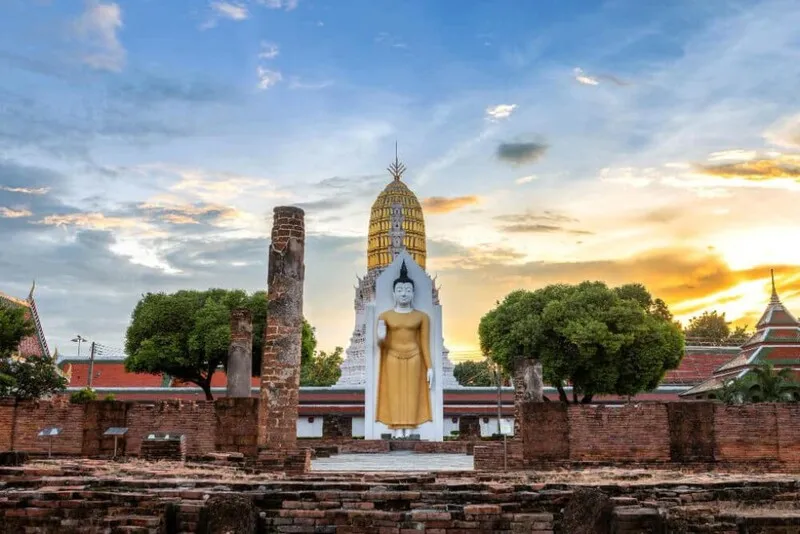
Wat Phra Si Rattana Mahathat Woramahawihan in Phitsanulok Province, widely known as Wat Yai, is one of the most important royal temples in Thailand. Located on Phuttha Bucha Road in Nai Mueang Subdistrict, Mueang Phitsanulok District, on the eastern bank of the Nan River, the temple is the spiritual heart of Phitsanulok and one of the most revered Buddhist pilgrimage sites in the country. Its most important sacred image is Phra Buddha Chinnarat, a magnificent bronze Buddha image regarded as one of the most beautiful Buddha images in Thailand.
For many Thai people, visiting Phitsanulok is not complete without paying respect to Phra Buddha Chinnarat. The temple is more than a religious site; it is a living center of faith, history, royal patronage, Buddhist art, and community life. Foreign travelers who visit Wat Yai can experience a powerful combination of sacred atmosphere, classical Thai art, ancient architecture, and everyday Buddhist devotion. The temple is also conveniently located near Wat Nang Phaya, Wat Ratchaburana, Chan Palace, and the Nan River, making it an ideal starting point for exploring the historic heart of Phitsanulok.
Wat Phra Si Rattana Mahathat Woramahawihan was established around the same period as the founding of Phitsanulok city, traditionally associated with B.E. 1900. Over the centuries, the temple became a major religious and cultural center. Today it preserves many important ancient monuments and sacred objects, including Phra Buddha Chinnarat, Phra Luea, Phra Attharot, the principal prang, the small vihara of Phra Luea, the mother-of-pearl doors, and the rare object known as Phra Chao Khao Niphphan, which represents the Buddha entering parinirvana.
The heart of the temple is Phra Buddha Chinnarat, a large bronze Buddha image in the subduing Mara posture. The image measures 5 sok, 1 khuep, and 5 inches across the lap, and 7 sok in height. Phra Buddha Chinnarat is admired for its graceful proportions, soft body outline, arched eyebrows, flame-shaped finial, serene facial expression, and the distinctive feature of fingers of equal length, known as dighanguli. These details create an image that is both majestic and deeply compassionate, giving worshippers a sense of calm as soon as they enter the main vihara.
The creation of Phra Buddha Chinnarat is associated with King Maha Thammaracha I, also known as Phaya Lithai of Sukhothai. The king commissioned Phra Buddha Chinnarat together with Phra Buddha Chinnasi and Phra Si Satsada. These 3 Buddha images are among the most important works of Sukhothai Buddhist art. Phra Buddha Chinnasi is now enshrined at Wat Bowonniwet Vihara, while Phra Si Satsada is enshrined at Wat Suthat Thepwararam in Bangkok. Phra Buddha Chinnarat remains in Phitsanulok and continues to be one of the most beloved Buddha images in Thailand.
The beauty of Phra Buddha Chinnarat is enhanced by the magnificent carved wooden halo known as the ruean kaeo. This decorative frame was created during the Ayutthaya period and is one of the most striking artistic features of the vihara. At the ends of the frame are makara figures, mythical creatures with dragon-like bodies and elephant-like trunks. In the middle are hora figures, and 2 guardian deities stand protectively near the Buddha image. The composition is both symbolic and visually powerful, expressing the sacred universe surrounding the Buddha.
Another masterpiece inside the temple is the mother-of-pearl inlaid doors at the front entrance of the vihara. These doors were made in B.E. 2299 during the late Ayutthaya period in the reign of King Borommakot. The central vertical section is decorated with phum khao bin motifs, flanked by scrolling kanok patterns. The central panel includes a diamond-shaped section known as nom ok lao, with a miniature pavilion containing the una-lome symbol of the Buddha. The lower section includes Hanuman supporting the base, while guardian figures and mythical creatures decorate the composition.
The door panels include rich imagery from the Himavanta forest, such as lions, elephant-lions, garudas, kinnari dancers, and other mythical beings. There are also circular decorative motifs and crab-claw-style border patterns. Originally, the vihara doors were carved from teak wood. After the mother-of-pearl doors were completed, the old carved teak doors were moved to the vihara of Phra Thaen Sila At in Uttaradit Province. This history shows the continuing movement, preservation, and reuse of important Thai sacred art across regions.
Within the temple compound is Phra Luea, a smaller Buddha image connected with a local story about the casting of Phra Buddha Chinnarat, Phra Buddha Chinnasi, and Phra Si Satsada. According to tradition, King Lithai ordered craftsmen to gather the leftover bronze from the casting of the 3 major Buddha images and use it to cast a smaller Buddha image called Phra Luea, together with 2 standing disciple images. The bricks used in the casting furnace were gathered on a pedestal, and 3 sacred Bodhi trees were planted there, known as the 3 Bodhi trees.
A small vihara was later built between the Bodhi trees to enshrine Phra Luea and the disciple images. Local believers associate the name Phra Luea with the idea of abundance, because luea in Thai can mean “left over” or “remaining in plenty.” For this reason, many business owners, merchants, and people involved in finance come to pay respect to Phra Luea for auspiciousness, prosperity, and the hope of having enough to live comfortably.
A devotional chant associated with worship at the temple is: “Buddha bucha maha techa wanto, Dhamma bucha maha panna wanto, Sangha bucha maha phoka waho ti loka, nakang apichayamā.” The chant reflects reverence for the Buddha, the Dhamma, and the Sangha, the 3 pillars of Buddhism. It also expresses the wish for strength, wisdom, abundance, and auspiciousness in life.
Behind the main vihara stands Phra Attharot, a standing Buddha image in the gesture of forbidding relatives. The image is 18 sok high and was created around the same period as Phra Buddha Chinnarat. It was originally enshrined in a large vihara that later collapsed, leaving only several large laterite pillars. This area is known as Noen Wihan Kao Hong, or the mound of the nine-room vihara. Phra Attharot provides an important sense of the original scale and grandeur of the temple compound in earlier times.
The principal prang of Wat Phra Si Rattana Mahathat is another major architectural feature. It belongs to the early Ayutthaya artistic period and has a twenty-indented-corner base. The structure was originally a Sukhothai-style lotus-bud chedi, later transformed into a prang during the Ayutthaya period. This transformation makes the prang an important architectural witness to the transition from Sukhothai to Ayutthaya artistic traditions. Visitors who walk around the prang can observe how form, function, and religious symbolism changed across historical periods.
The temple also contains Wihan Klaep and the rare object known as Phra Chao Khao Niphphan, an Ayutthaya-period sacred object representing the Buddha entering parinirvana. It is designed as a stone coffin representing the Buddha’s relic casket, decorated with lacquer, mirror inlay, and ornamental patterns. At one end, the Buddha’s 2 feet extend outward, while the figure of Mahakassapa Thera is shown paying respect to the Buddha’s body. This object is especially valuable because it gives visitors a concrete artistic representation of one of the most profound moments in Buddhist tradition.
Wat Phra Si Rattana Mahathat Woramahawihan remains a major center for Buddhist festivals and religious activities. The annual Phra Buddha Chinnarat worship festival is one of the most important events in Phitsanulok. During this period, worshippers from many provinces come to make merit, listen to sermons, pay respect to the Buddha image, and participate in cultural activities. The festival demonstrates that Phra Buddha Chinnarat is not only an ancient image but also a living center of devotion for people across Thailand.
The temple remains active today under the leadership of Phra Thep Rattanamuni, also known as Surachai Surachayo, the abbot of Wat Phra Si Rattana Mahathat Woramahawihan. The temple continues to support monastic practice, religious ceremonies, heritage preservation, and community activities. This living role is important because Wat Yai is not only a historical monument; it is still a functioning royal temple where monks, local residents, pilgrims, and travelers gather every day.
Getting There is very easy because the temple is located in the center of Phitsanulok city on Phuttha Bucha Road, near the Nan River. Travelers arriving by train can get off at Phitsanulok Railway Station and continue by local taxi, songthaew, tuk-tuk, or ride-hailing service. Those traveling by private car can follow city routes directly to the temple. Because the area is part of the old city, visitors should plan extra time during weekends, Buddhist holy days, and major festivals when the temple becomes especially busy.
The best time to visit is in the morning or late afternoon, when the weather is cooler and the atmosphere is calmer. Visitors should allow at least 1 to 2 hours to worship Phra Buddha Chinnarat and explore the main vihara, the carved halo, the mother-of-pearl doors, Phra Luea, Phra Attharot, the principal prang, and other important structures. Respectful dress and quiet behavior are expected, as this is both a major tourist attraction and a sacred Buddhist site.
Wat Phra Si Rattana Mahathat Woramahawihan is suitable for many types of travelers: Buddhist pilgrims, history lovers, students, photographers, art enthusiasts, and foreign visitors interested in Thai culture. For international travelers, the temple is one of the best places to understand how Thai Buddhism brings together art, ritual, royal history, community identity, and everyday faith. The experience is not only visual but also emotional, because the devotion surrounding Phra Buddha Chinnarat can be felt throughout the vihara.
A visit to Wat Yai can be combined with nearby attractions. Wat Nang Phaya and Wat Ratchaburana are within easy walking distance. Chan Palace and Sgt. Maj. Thawee Folk Museum add further historical and local context. Wat Chulamani, another important ancient temple, can also be added to a broader cultural route. Together, these places allow visitors to understand Phitsanulok as a city of faith, art, royal memory, and riverside history.
Wat Phra Si Rattana Mahathat Woramahawihan is therefore much more than a famous temple in Phitsanulok. It is one of Thailand’s great religious and artistic treasures. Phra Buddha Chinnarat remains the spiritual center of the temple, while the surrounding monuments and sacred objects reveal the richness of Thai Buddhist art from the Sukhothai and Ayutthaya periods. For anyone visiting Phitsanulok, this temple offers a profound encounter with Thai history, devotion, and beauty.
| Name | Wat Phra Si Rattana Mahathat Woramahawihan |
| Common Names | Wat Yai, Wat Phra Si, Wat Luang Pho Yai, Wat Phra Buddha Chinnarat |
| Location | Phuttha Bucha Road, Nai Mueang Subdistrict, Mueang Phitsanulok District, Phitsanulok Province |
| Address | 92/3 Phuttha Bucha Road, Nai Mueang Subdistrict, Mueang Phitsanulok District, Phitsanulok 65000 |
| Coordinates | Approximately 16.8238, 100.2628 |
| Highlights | Phra Buddha Chinnarat, carved wooden halo, mother-of-pearl doors, Phra Luea, Phra Attharot, principal prang, and Phra Chao Khao Niphphan |
| History | Established around the founding of Phitsanulok in B.E. 1900, preserving major Buddhist art from the Sukhothai and Ayutthaya periods. The temple is a first-class royal temple of the Woramahawihan rank. |
| Name Origin | The formal name reflects its status as an important royal Buddhist temple associated with sacred relics, while the common name Wat Yai reflects its role as the main spiritual temple of Phitsanulok. |
| Distinctive Features | Phra Buddha Chinnarat is a large bronze Buddha image in the subduing Mara posture, admired for its graceful proportions, flame finial, serene expression, and dighanguli finger feature. |
| Key Evidence | Phra Buddha Chinnarat, Ayutthaya-period carved halo, mother-of-pearl doors dated B.E. 2299, Phra Luea, Phra Attharot, principal prang, and Phra Chao Khao Niphphan |
| Travel Information | Located in central Phitsanulok near the Nan River. Accessible from Phitsanulok Railway Station by local taxi, songthaew, tuk-tuk, ride-hailing service, or private car. |
| Current Status | Active royal temple and major religious, historical, and cultural attraction in Phitsanulok |
| Open Days | Daily |
| Opening Hours | 06.00 – 18.00 |
| Facilities | Worship areas, temple grounds, nearby shops, nearby restaurants, restrooms, nearby parking areas, and old city services |
| Main Areas / Zones | Main vihara of Phra Buddha Chinnarat, Phra Luea vihara, Phra Attharot area, principal prang, Wihan Klaep, mother-of-pearl door area, and ancient monument zones |
| Abbot / Caretaker | Phra Thep Rattanamuni (Surachai Surachayo) |
| Main Contact Number | 055-258966 |
| Official Website / Official Page | Wat Phra Si Rattana Mahathat, Phitsanulok official page |
| Nearby Tourist Attractions | 1. Wat Nang Phaya, about 0.2 km 2. Wat Ratchaburana, about 0.3 km 3. Chan Palace, about 1 km 4. Sgt. Maj. Thawee Folk Museum, about 3 km 5. Wat Chulamani, about 6 km |
| Nearby Restaurants | 1. Racha Khao Niao Wat Yai, about 0.2 km 2. Khao Niao Pa Yao, about 0.2 km 3. Hanging-Leg Noodles Phitsanulok Song Khwae, about 0.2 km 4. Dragon River Avenue Restaurant, about 1 km, Tel. 099-374-7447, 055-242-242 5. Amore Restaurant at Topland Hotel, about 1 km |
| Nearby Accommodations | 1. Topland Hotel, about 0.3 km, Tel. 055-247-800 2. Holatel Phitsanulok, about 0.5 km 3. Karma Home Hostel, about 0.8 km 4. Dragon River Avenue Hotel, about 1 km, Tel. 099-374-7447, 055-242-242 5. Wangchan Riverview Hotel, about 1 km |
Frequently Asked Questions (FAQ)
Q: Where is Wat Phra Si Rattana Mahathat Woramahawihan located?
A: It is located on Phuttha Bucha Road in Nai Mueang Subdistrict, Mueang Phitsanulok District, Phitsanulok Province, on the eastern bank of the Nan River.
Q: What are the common names of this temple?
A: The temple is commonly known as Wat Yai, Wat Phra Si, Wat Luang Pho Yai, or Wat Phra Buddha Chinnarat.
Q: Why is Phra Buddha Chinnarat important?
A: Phra Buddha Chinnarat is a large bronze Buddha image in the subduing Mara posture and is widely regarded as one of the most beautiful Buddha images in Thailand.
Q: What are the opening hours of Wat Yai?
A: The temple is open daily from 06.00 to 18.00.
Q: Who is the abbot of Wat Phra Si Rattana Mahathat Woramahawihan?
A: The abbot is Phra Thep Rattanamuni (Surachai Surachayo).
Q: What important objects can visitors see inside the temple?
A: Visitors can see Phra Buddha Chinnarat, the carved wooden halo, mother-of-pearl doors, Phra Luea, Phra Attharot, the principal prang, Wihan Klaep, and Phra Chao Khao Niphphan.
Q: How long should visitors spend at the temple?
A: Visitors should allow at least 1 to 2 hours to worship and explore the main artistic and historical features of the temple.
Q: What nearby places can be visited after Wat Yai?
A: Nearby places include Wat Nang Phaya, Wat Ratchaburana, Chan Palace, Sgt. Maj. Thawee Folk Museum, and Wat Chulamani.
Tel : 0552527423
 Tel : 0552527423
 Category: ●Places of Worship
 Group: ●Temple
Last Update : 5 MonthAgo
 Last Update : 5 MonthAgo
 Click to Access the Navigation Map GPS
Wat Phra Si Rattana Mahathat Woramahawihan Map
Recommend

 Art, Culture and Heritage
 Historical Sites and Monuments(1)
 Landmarks and Memorials(2)
 Art, Craft Centres, Tradition(3)
 Museums(3)
 Educational Places
 Educational Gardens, Farm(1)
Temple(29)
Educational Gardens, Farm(1)
Temple(29)
 Mosque(1)
 Other Sacred Sites(3)
 Research and Development
 Royal Project(1)
 Suburban Living
 Village, Community(1)
 Nature and Wildlife
 National Parks and Marine Reserves(7)
 Mountain (Doi)(4)
 Dam, Reservoir, Lake(5)
 Waterfalls(19)
 Caves(3)
 River, Canal(9)
 Other natural attractions(1)
 Entertainment and Agricultural
 Farms, Parks and Ecotourism(2)
 Outdoor and Adventure Activities(1)
 Travel Articles, Recipes
 Travel Review, Food Review(1)


