
lovethailand home >Northeastern Travel Attractions >Sakon Nakhon Travel Attractions >Muang Sakon Nakhon >That Choeng Chum > Wat Phra That Choeng Chum
TL;DR: Wat Phra That Choeng Chum is located at 1255 Phra That Choeng Chum Subdistrict, Mueang Sakon Nakhon District, Sakon Nakhon 47000, Thailand, open Open Daily, hours 08.00 - 18.00.
Wat Phra That Choeng Chum
Open Days: Open Daily
Opening Hours: 08.00 - 18.00
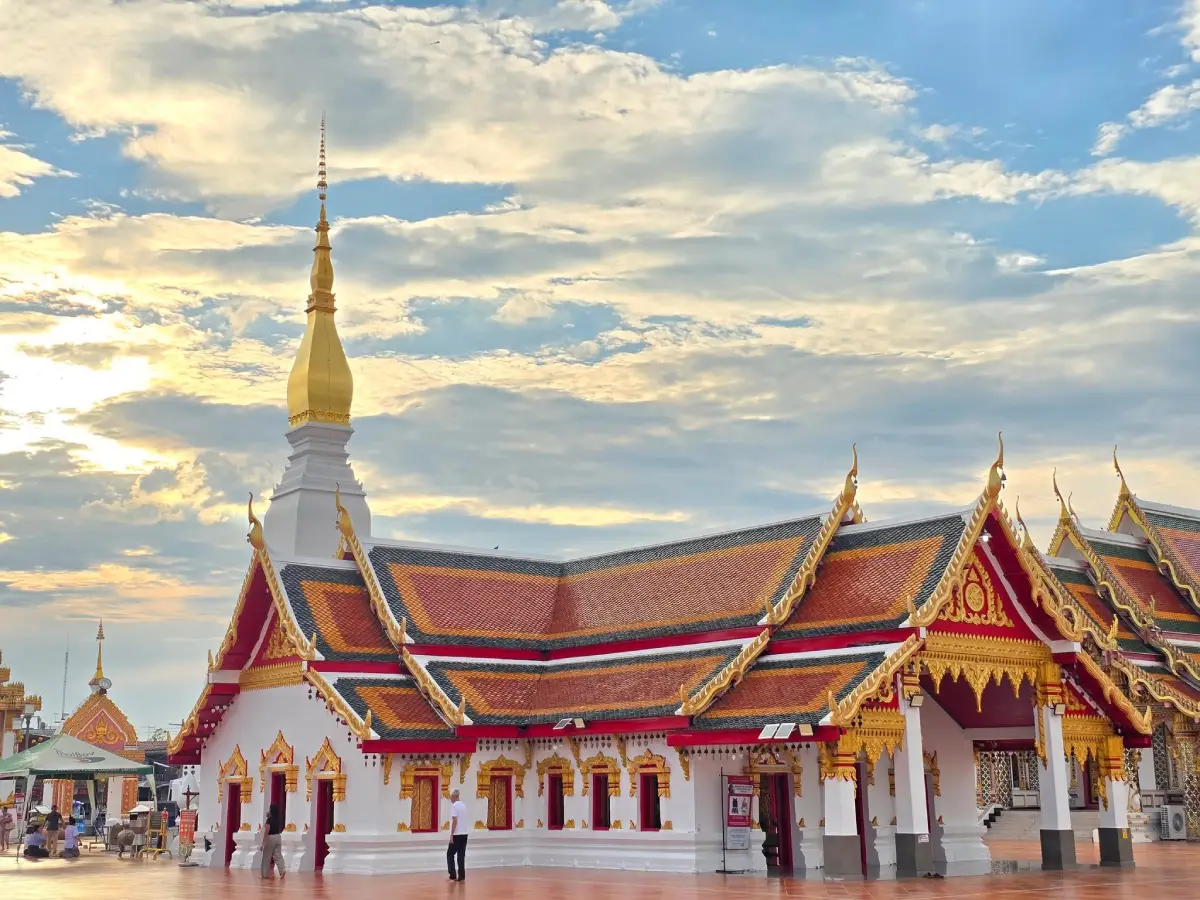
Wat Phra That Choeng Chum In Sakon Nakhon, officially known as Wat Phra That Choeng Chum Worawihan, is one of the most important sacred landmarks in Sakon Nakhon Province. Located on Charoen Mueang Road and Rueang Sawat Road in the heart of Mueang Sakon Nakhon District, the temple is a second-class royal temple of the Worawihan rank and a major spiritual center for the province. It is home to the white stupa of Phra That Choeng Chum, the revered Luang Pho Phra Ong Saen Buddha image, historic temple structures, annual Buddhist ceremonies, and one of the strongest living faith traditions in Northeastern Thailand. For visitors, this temple is not simply a beautiful religious site. It is a place where local history, Buddhist belief, Khmer and Lan Xang artistic layers, and the identity of Sakon Nakhon meet in one sacred landscape.
The Phra That Choeng Chum stupa stands prominently within the temple grounds and faces east toward Nong Han Lake. It is a brick-and-plaster chedi with a square base, rising about 24 meters high. The upper section forms a lotus-like angular shape, simple and dignified, without heavy ornamentation. Above the stupa is a golden umbrella finial made of pure gold weighing 247 baht in traditional Thai weight. This combination of a white body and golden spire has become one of the most recognizable images of Sakon Nakhon. The stupa has 4 arched doorways around the base. The northern, southern, and western arches are false Khmer-style entrances, while the true entrance is on the eastern side. Inside, the structure enshrines the footprints of 4 Buddhas: Kakusandha, Konagamana, Kassapa, and Gotama.
Phra That Choeng Chum is important both as a Buddhist sanctuary and as an archaeological site. The area reflects multiple historical layers. Early features are linked with Khmer art, including the old sandstone and laterite elements and the ancient Khmer inscription found near the entrance passage. Later, the stupa received strong Lan Xang influence, visible in the form of the present chedi. This layered history makes the temple an important place for understanding how sacred architecture in Northeastern Thailand developed over time. Although the exact date of its first construction is not clearly recorded, Phra That Choeng Chum has long been regarded as the principal sacred monument of Sakon Nakhon.
Local legend connects the stupa with King Suwannaphingkhara and the act of building a chedi to cover the sacred Buddha footprints. Such legends give the site more than historical value. They make it a place of memory, devotion, and identity. The name “Choeng Chum” has become associated with a sacred gathering point where Buddha footprints, faith, and community meet. For local Buddhists, this is not only an old stupa. It is the spiritual heart of the city and a place where generations of people have come to pay respect, ask for blessings, and feel connected with the roots of Sakon Nakhon.
Near the stupa, inside the temple’s main hall, is Luang Pho Phra Ong Saen, one of the most revered Buddha images in Sakon Nakhon. The image is in the Mara-Vijaya posture and is associated with Chiang Saen artistic style. It measures about 2 meters across the lap and about 3.20 meters from the base to the top of the head, seated on a pedestal about 1.35 meters high. The Buddha image faces east, with its back toward Phra That Choeng Chum. Local people have revered Luang Pho Phra Ong Saen for generations, and many visitors pay respect to this image before or after circumambulating the stupa.
The reverence for Luang Pho Phra Ong Saen is deeply rooted in local faith. The image is not valued only for its artistic beauty, but also for its role as a spiritual refuge for the people of Sakon Nakhon. On Buddhist holy days, especially in the evening, many local residents come to worship both the stupa and Luang Pho Phra Ong Saen. This regular practice shows that the temple is not a passive heritage site. It is a living religious place where faith continues through everyday acts of worship, merit-making, chanting, and quiet prayer.
Wat Phra That Choeng Chum Worawihan is formally registered as a royal temple. It belongs to the Mahanikaya order, was established as a temple in 1757, and received its official consecrated boundary in 1972. The temple covers about 18 rai, 1 ngan, and 27 square wa. Its position in the city is highly significant. The southern side connects with Charoen Mueang Road, the western side connects with Rueang Sawat Road, and the eastern side relates to the Nong Han landscape. This central location makes the temple both a sacred site and an essential urban landmark.
The old ordination hall is another valuable element of the temple. Built in 1827 during the period of Phra Thani as local ruler, the old hall has the character of an open Isan sim, with a wooden structure, brick-and-plaster walls, and a roof once covered with wooden tiles. Inside are mural and decorative elements including vine patterns and old painted details. The old ordination hall helps visitors understand that the temple’s value extends beyond the stupa. It also preserves local religious architecture and artistic memory from earlier periods of Sakon Nakhon’s history.
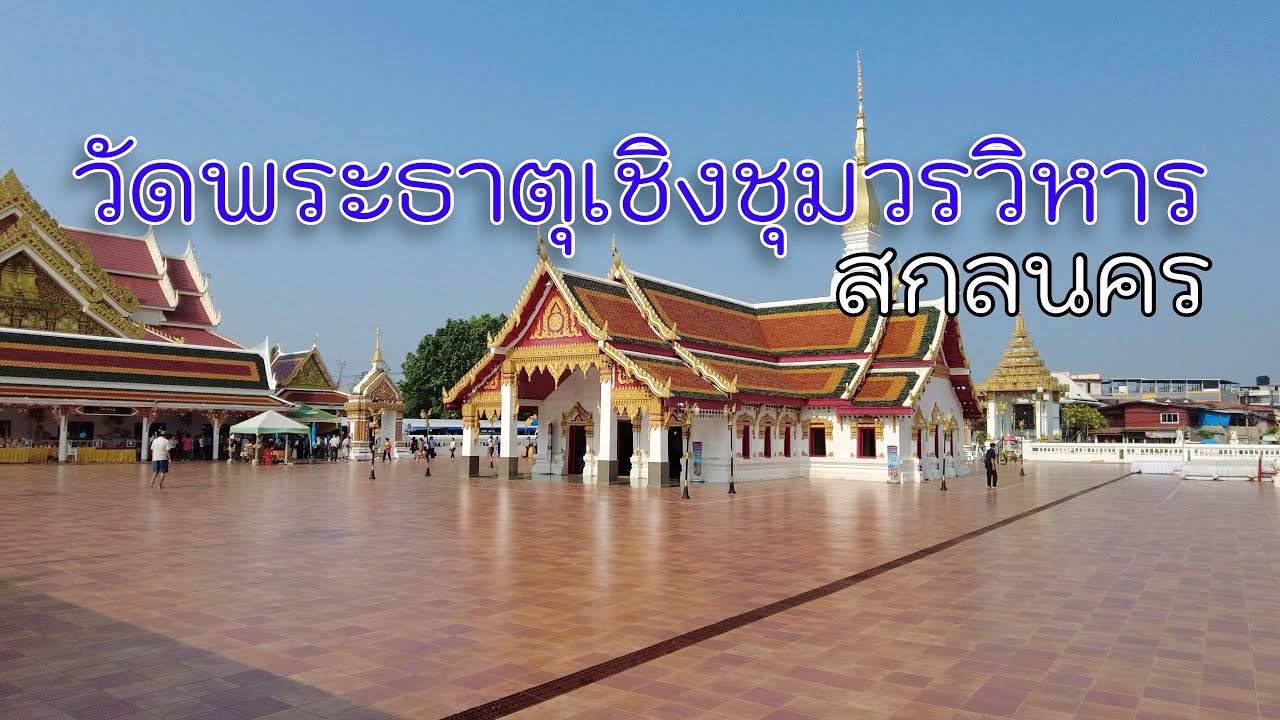
The temple grounds are arranged around the stupa, the hall of Luang Pho Phra Ong Saen, ceremonial areas, and walking spaces for worshippers. Visitors can purchase flowers, candles, and incense from designated areas, make offerings, pay respect inside the hall, and walk quietly around the stupa. The wide courtyard gives clear views of the white chedi and is especially beautiful in the morning and late afternoon. Because the temple is located in the city center, it is closely connected with shops, local streets, parking areas, food stalls, and nearby public spaces.
The atmosphere of Wat Phra That Choeng Chum changes throughout the day. Morning is suitable for a calm visit with soft light and fewer people. Midday is good for observing architectural details and photographing the stupa, though the courtyard can be warm. Late afternoon is one of the best times to visit because the light softens, the white stupa glows warmly, and local worshippers begin to arrive. On Buddhist holy days and during annual festivals, the evening atmosphere becomes especially meaningful as people gather for worship and merit-making.
The temple’s most important annual event is the Festival Of Worshiping Phra That Choeng Chum And Luang Pho Phra Ong Saen. It is held every year from the 9th waxing-moon day to the 15th waxing-moon day of the 2nd lunar month. The festival includes almsgiving, worship of the stupa and Luang Pho Phra Ong Saen, Buddhist ceremonies, cultural performances, devotional dances, community activities, and public participation by monks, government agencies, local organizations, and residents. The festival is one of the most important religious events in Sakon Nakhon and confirms the temple’s role as the province’s spiritual center.
This annual festival is more than a temple fair. It is a moment when the people of Sakon Nakhon return to their city’s sacred center. Families, officials, monks, community groups, and visitors come together to make merit and honor the stupa. The festival lasts several days, allowing people to join morning almsgiving, daytime worship, evening ceremonies, and cultural programs. Its continuity shows that Phra That Choeng Chum remains central to the province’s religious calendar and civic identity.
Wat Phra That Choeng Chum is also closely connected with the Wax Castle Procession Festival, one of Sakon Nakhon’s most famous traditions. During the end of Buddhist Lent, local communities create elaborately decorated wax castles and bring them to the temple as offerings. This links the temple with local craftsmanship, seasonal merit-making, and community art. The wax castle tradition reinforces the temple’s role as a living center of Buddhist devotion, not only during the 2nd lunar month festival but also during the major merit-making season of Ok Phansa.
Phra That Choeng Chum is one of the symbolic images of Sakon Nakhon Province. The stupa appears in the provincial seal and in the province’s well-known identity phrase referring to Phra That Choeng Chum as the sacred monument of the city. For many travelers, visiting Sakon Nakhon feels incomplete without paying respect here. The temple is often the first or final stop of a city itinerary because it represents the province’s faith, history, and sense of place.
From an artistic point of view, the stupa is powerful because of its restrained form. The square base gives a sense of stability. The white body creates purity and calmness. The golden spire adds sacred brilliance. The structure does not need excessive decoration to create impact. Its strength lies in proportion, placement, and meaning. The mixture of Khmer traces and Lan Xang form also gives the monument historical depth that can be appreciated by visitors interested in Buddhist art and regional history.
From a religious point of view, visiting the temple is simple and accessible. Worshippers usually pay respect to Luang Pho Phra Ong Saen, offer flowers and candles, then proceed to the stupa for prayer or circumambulation. Many come to ask for blessing, safety, good fortune, health, and family peace. International visitors who are unfamiliar with Thai temple practice can still visit respectfully by dressing modestly, speaking softly, observing local behavior, and not interrupting those who are praying.
For foreign travelers, Wat Phra That Choeng Chum offers a clear introduction to Buddhist sacred geography in Northeastern Thailand. This is not only a temple and not only a stupa. It is a place where Buddha-footprint belief, Khmer history, Lan Xang art, a revered local Buddha image, annual festivals, and living community faith exist together. A visit here helps travelers understand that temples in Thailand are often religious, historical, artistic, and social spaces at the same time.
Getting There is easy because the temple is in central Sakon Nakhon. From Sakon Nakhon Airport, visitors can take a taxi, rental car, or local transport into town and continue to the temple. From the city center, use Charoen Mueang Road or Rueang Sawat Road. The temple is close to Sa Phang Thong, Somdet Phra Srinagarindra Park, Nong Han Lake, and the old town area. Visitors with private cars can use parking areas in front of or near the temple according to temple and municipal arrangements.
Visitors should allow at least 1 - 2 hours for a complete visit. This gives enough time to pay respect to Luang Pho Phra Ong Saen, walk around the stupa, observe the old ordination hall, photograph the courtyard, and continue to nearby areas such as Sa Phang Thong, the indigo textile street area, and the old town. On weekends or during festivals, the surrounding area may become more active with markets, community stalls, and local events.
Respectful behavior is important. Visitors should dress modestly, remove shoes in designated areas, avoid climbing on the stupa base, avoid touching sacred objects inappropriately, speak softly inside the halls, and be mindful of people who are praying. During Buddhist holy days and the annual festival, the temple can be crowded, so visitors should move carefully and give priority to worshippers taking part in religious activities.
Facilities around the temple are convenient because of its city-center location. Visitors can find parking areas, flower and candle offering points, restrooms in or near the temple area, merit-making points, shops, cafés, restaurants, hotels, and city transport. The temple can easily be included in a half-day Sakon Nakhon city route together with Wat Pa Sutthawat, the Ajahn Mun Bhuridatto Museum, Nong Han Lake, Sakon Nakhon City Museum, and Phra That Narai Cheng Weng.
Food and accommodation are easy to find nearby. The area around the temple and central Sakon Nakhon includes old local restaurants, pad Thai shops, rice soup restaurants, cafés, bakery shops, shopping-center restaurants, and hotels in several price ranges. Visitors attending the annual festival should reserve accommodation in advance because many worshippers and travelers come to the city during the festival period.
The beauty of Wat Phra That Choeng Chum is not limited to its white stupa and golden spire. Its deeper value lies in the way it connects many layers of time: sacred Buddha-footprint legend, Khmer traces, ancient inscriptions, Lan Xang influence, the city’s revered Buddha image, annual worship, the Wax Castle Procession, and the faith of present-day residents. Every layer contributes to making the temple one of the most meaningful places in Sakon Nakhon.
Wat Phra That Choeng Chum in Sakon Nakhon is therefore an essential destination for anyone who wants to understand the province deeply. It is a sacred stupa, a royal temple, a historical monument, a living Buddhist center, and the spiritual heart of the city. Visitors who come with respect will gain not only beautiful photographs, but also a clearer understanding of Sakon Nakhon’s faith, art, history, and community identity.
| Place Name | Wat Phra That Choeng Chum Sakon Nakhon / Wat Phra That Choeng Chum Worawihan |
| Place Type | Second-Class Royal Temple Of The Worawihan Rank, Mahanikaya Order, And The Principal Sacred Monument Of Sakon Nakhon |
| Main Location | Charoen Mueang Road And Rueang Sawat Road, Central Sakon Nakhon City, Mueang Sakon Nakhon District |
| Address | 1255 Phra That Choeng Chum Subdistrict, Mueang Sakon Nakhon District, Sakon Nakhon 47000, Thailand |
| Approximate Coordinates | 17.1628, 104.1489 |
| Highlights | White Phra That Choeng Chum Stupa With A Pure-Gold Umbrella Spire, Luang Pho Phra Ong Saen, Old Ordination Hall, Khmer And Lan Xang Artistic Layers, Annual Worship Festival, And The Wax Castle Procession Offering Site |
| History / Importance | A Long-Standing Sacred Monument Of Sakon Nakhon, Built Over The Footprints Of 4 Buddhas And Revered As The Province’s Main Spiritual Center |
| Name Origin | The Name Refers To A Sacred Gathering Place Connected With Buddha Footprints And Community Faith, With Local Legend Linking The Stupa To The Enshrinement Of Sacred Footprints And Royal Devotion |
| Stupa Characteristics | Brick-And-Plaster Chedi With A Square Base, About 24 Meters High, Lotus-Like Angular Upper Section, Pure-Gold Umbrella Spire Weighing 247 Baht, And 4 Arched Doorways With The True Entrance On The East |
| Main Buddha Image | Luang Pho Phra Ong Saen, A Chiang Saen-Style Buddha Image In The Mara-Vijaya Posture, About 2 Meters Across The Lap And About 3.20 Meters High From Base To Crown |
| Travel Information | From Central Sakon Nakhon, Use Charoen Mueang Road Or Rueang Sawat Road To Reach The Temple Directly. The Temple Is Near Sa Phang Thong, Somdet Phra Srinagarindra Park, Nong Han Lake, And The Old Town Area |
| Current Status | Open To Visitors And Worshippers As A Major Religious Site And The Central Sacred Landmark Of Sakon Nakhon Province |
| Open Days | Open Daily |
| Opening Hours | 08.00 - 18.00; On Buddhist Holy Days And During Annual Festivals, Evening Activities Follow The Temple’s Program |
| Fees | No Admission Fee; Donations Can Be Made Voluntarily |
| Facilities | Parking Area, Worship Areas, Flower And Candle Offering Points, Restrooms In Or Near The Temple Area, Temple Halls, Merit-Making Points, Shops Around The Temple, And Connections To Central Sakon Nakhon Attractions |
| Main Areas / Zones | Phra That Choeng Chum Stupa Luang Pho Phra Ong Saen Hall Old Ordination Hall Stupa Circumambulation Courtyard Flower And Candle Offering Area Temple Halls And Ceremony Areas Annual Worship Festival Ground Connection Area To Sa Phang Thong And The Old Town |
| Annual Festival / Important Traditions | The Festival Of Worshiping Phra That Choeng Chum And Luang Pho Phra Ong Saen Is Held From The 9th To The 15th Waxing-Moon Day Of The 2nd Lunar Month Every Year. The Temple Is Also A Major Offering Site For Sakon Nakhon’s Wax Castle Procession During Ok Phansa |
| Caretaker / Abbot | Phra Thep Sitthisophon (Surasi Kittisophano), Abbot Of Wat Phra That Choeng Chum Worawihan And Advisor To The Ecclesiastical Governor Of Region 8 |
| Contact Numbers | Wat Phra That Choeng Chum Worawihan Tel. 042-711-132 / 089-941-3972 |
| Visitor Guidelines | Dress Respectfully, Remove Shoes In Designated Areas, Speak Softly, Do Not Climb On The Stupa Base, Do Not Touch Sacred Objects Inappropriately, And Respect Worshippers Taking Part In Religious Activities |
| Nearby Tourist Attractions | 1. Sa Phang Thong And Somdet Phra Srinagarindra Park, About 0.5 km 2. Indigo Textile Street And Sakon Nakhon Old Town Area, About 0.8 km 3. Nong Han Lake And Central Lakeside Area, About 1 km 4. Wat Pa Sutthawat And Ajahn Mun Bhuridatto Museum, About 2 km 5. Sakon Nakhon City Gate And Ruam Jai Thai Sakon Square, About 4 km 6. Sakon Nakhon City Museum, About 6 km 7. Phra That Narai Cheng Weng, About 7 km |
| Nearby Restaurants | 1. Mae Lek Pad Thai Beside Wat Phra That Choeng Chum, About 0.3 km 2. Ma-Kin Behind Wat Phra That Choeng Chum, About 0.5 km 3. Kuai Tiao Ruea Thai Wat, Wat Phra That Choeng Chum Branch, About 0.8 km 4. Sam Ka Khao Tom, About 1 km, Tel. 098-661-9100 5. ChillCup, About 2 km, Tel. 081-059-6210, 097-158-5748 6. Bai Tong Bakery And Thai Lod Chong, About 2 km, Tel. 088-510-5358 7. MK Restaurants Lotus Sakon Nakhon, About 4 km, Tel. 042-722-645 8. Café Amazon PTT Pratu Mueang Sakon Nakhon, About 4 km, Tel. 084-031-4920 |
| Nearby Accommodations | 1. Imperial Sakon Hotel, About 1.5 km, Tel. 042-711-119 2. Dusit Hotel Sakon Nakhon, About 1.5 km, Tel. 042-711-198 3. The Majestic Sakon Nakhon Hotel, About 2 km, Tel. 042-733-771 4. The Room Boutique Hotel, About 3 km, Tel. 099-262-9269 5. Hop Inn Sakon Nakhon, About 4 km, Tel. 042-716-399 6. Sakol Grand Palace Hotel, About 5 km, Tel. 042-714-886 |
Frequently Asked Questions (FAQ)
Q: Where Is Wat Phra That Choeng Chum Located?
A: Wat Phra That Choeng Chum Worawihan is located at 1255 Phra That Choeng Chum Subdistrict, Mueang Sakon Nakhon District, Sakon Nakhon Province, in the city center near Sa Phang Thong, Nong Han Lake, and the old town area.
Q: What Are The Opening Days And Hours?
A: The temple is open daily from 08.00 to 18.00. On Buddhist holy days and during annual festivals, evening activities follow the temple’s program.
Q: Is There An Admission Fee?
A: No. There is no admission fee for visiting the temple. Visitors may make voluntary donations according to their faith.
Q: Why Is Phra That Choeng Chum Important?
A: Phra That Choeng Chum is the principal sacred monument of Sakon Nakhon. It enshrines the footprints of 4 Buddhas and has long served as the province’s central Buddhist landmark and spiritual symbol.
Q: Who Is Luang Pho Phra Ong Saen?
A: Luang Pho Phra Ong Saen is a revered Chiang Saen-style Buddha image in the Mara-Vijaya posture, enshrined in the hall near the stupa. It is one of Sakon Nakhon’s most respected Buddha images.
Q: When Is The Annual Worship Festival Held?
A: The annual festival honoring Phra That Choeng Chum and Luang Pho Phra Ong Saen is held from the 9th to the 15th waxing-moon day of the 2nd lunar month every year.
Q: How Can Visitors Get There From Central Sakon Nakhon?
A: Visitors can reach the temple by Charoen Mueang Road or Rueang Sawat Road. It is centrally located and convenient by private car, rental car, taxi, or local transport.
Q: What Nearby Places Can Visitors See After The Temple?
A: Nearby places include Sa Phang Thong, Somdet Phra Srinagarindra Park, Indigo Textile Street, Nong Han Lake, Wat Pa Sutthawat, Ajahn Mun Bhuridatto Museum, Sakon Nakhon City Museum, and Phra That Narai Cheng Weng.
 Category: ●Places of Worship
 Group: ●Temple
Last Update : 3 MonthAgo
 Last Update : 3 MonthAgo
 Click to Access the Navigation Map GPS
Wat Phra That Choeng Chum Map
Recommend

 Art, Culture and Heritage
 Historical Sites and Monuments(9)
 Landmarks and Memorials(2)
 Royal Palace(1)
 Art, Craft Centres, Tradition(8)
 Museums(3)
 Educational Places
 Educational Gardens, Farm(2)
Temple(18)
 Church(2)
 Other Sacred Sites(4)
 Research and Development
 Royal Project(3)
 Suburban Living
 Village, Community(7)
 Nature and Wildlife
 National Parks and Marine Reserves(4)
 Mountain (Doi)(3)
 Dam, Reservoir, Lake(14)
 Waterfalls(4)
 Caves(4)
 River, Canal(9)
 Bays and Beaches(1)
 Islands(1)
 Other natural attractions(5)
 Entertainment and Agricultural
 Zoos and Aquariums(1)
 Farms, Parks and Ecotourism(4)
 Outdoor and Adventure Activities(1)
 Travel Articles, Recipes
 Travel Review, Food Review(1)


