
lovethailand home >North Travel Attractions >Chiang Rai Travel Attractions >Muang Chiang Rai >Pa O Don Chai > Wat Rong Khun
TL;DR: Wat Rong Khun is located at Pa O Don Chai Subdistrict, Mueang Chiang Rai District, Chiang Rai, open Open daily, hours Monday–Friday 08:00 – 17:00 / Saturday–Sunday 08:00 – 17:30.
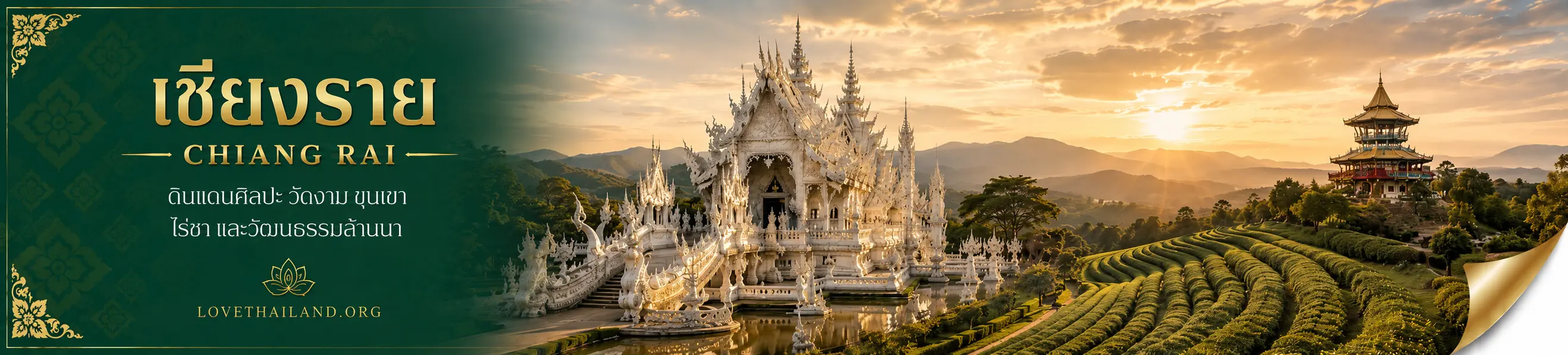
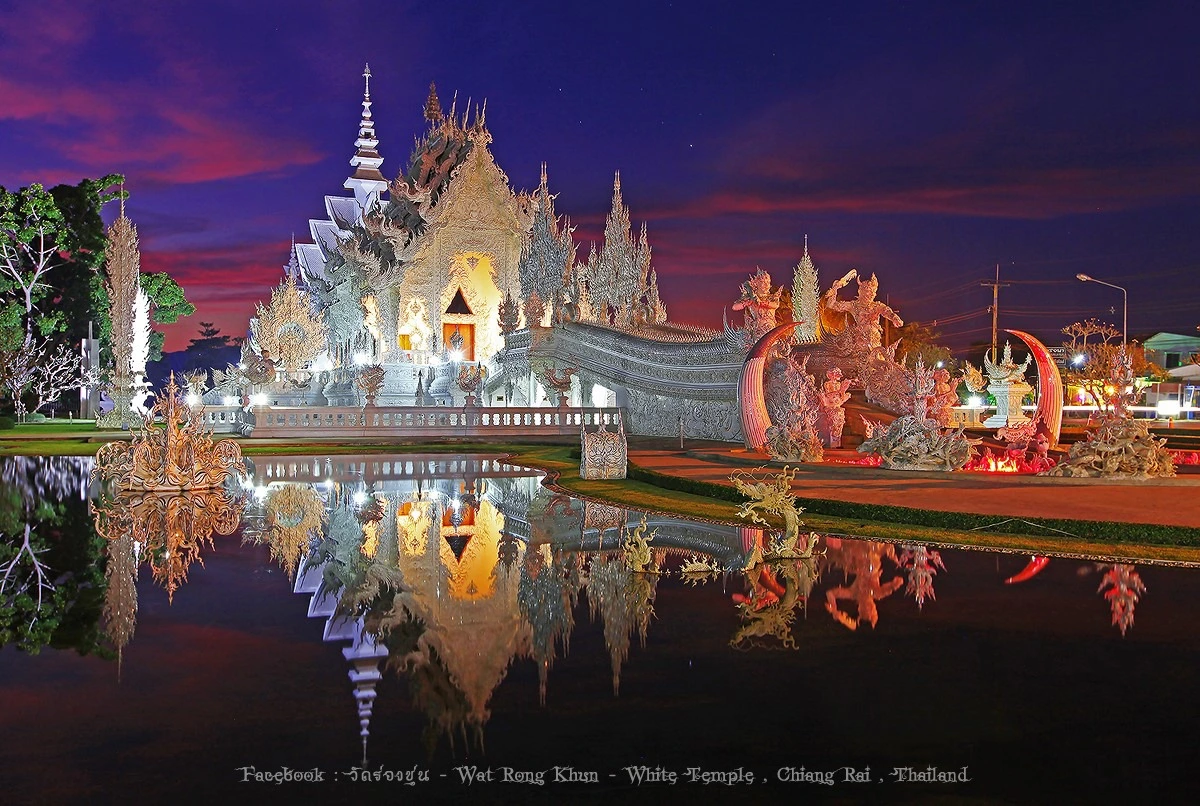
Wat Rong Khun
Open Days: Open daily
Opening Hours: Monday–Friday 08:00 – 17:00 / Saturday–Sunday 08:00 – 17:30
Wat Rong Khun, widely known as the White Temple, is one of the most famous landmarks in Chiang Rai and one of the most recognizable temples in Thailand. It is not simply a Buddhist temple for merit-making. It is also a monumental work of Buddhist-inspired contemporary art created by Chalermchai Kositpipat, the celebrated national artist from Chiang Rai, who has dedicated decades of his life to turning this temple into a work of art for the nation and an offering to Buddhism.
In simple terms, Wat Rong Khun stands out because it combines visual beauty, spiritual symbolism, and a powerful artistic vision in one place. Every major structure, from the white ubosot and the bridge leading to it to the dramatic sculptures and the golden building, carries symbolic meaning. Visiting the temple is therefore more than sightseeing. It is a walk through a carefully designed spiritual narrative expressed through art.
The temple is located in Pa O Don Chai Subdistrict, Mueang Chiang Rai District, about 12 kilometers from Chiang Rai city center. That makes it easy to visit even on a short trip, and it is often included in Chiang Rai day itineraries together with Singha Park, the Blue Temple, and other well-known attractions.
The story of Wat Rong Khun began long before it became world-famous. The area around Ban Rong Khun was originally a small local settlement. The word “Rong Khun” came from a local stream known for its cloudy water, and the village name stayed with the community over time. The temple itself first developed as a local religious center for villagers who wanted a place of faith and spiritual support within the community.
Over the years, the temple had to be relocated more than once because of practical problems such as erosion and unsuitable ground conditions. Later abbots and community leaders helped develop the temple further, including the construction of earlier religious buildings. By the late twentieth century, however, the old ubosot had become severely deteriorated and could no longer serve its full religious purpose.
The most important turning point came in 1997, when Chalermchai Kositpipat stepped in to take over the design and reconstruction of the current temple. Instead of creating an ordinary renovation, he reimagined the site as a complete Buddhist art project. He funded much of the work himself and openly declared his intention to devote his life to the creation of Wat Rong Khun. Even today, the project remains ongoing, and that unfinished quality is part of its identity.
What makes Wat Rong Khun so memorable is that it is built as a visual language of Buddhist ideas. The white color of the ubosot symbolizes the purity of the Buddha. The embedded mirror pieces represent wisdom and the radiance of enlightened truth. From a distance, the temple appears dazzling and almost unreal. Up close, the details become even more striking, revealing the immense craftsmanship involved in every surface and decorative element.
One of the strongest symbolic features is the bridge leading to the ubosot. Visitors must cross this bridge to reach the main hall. Below and in front of it are numerous outstretched hands, representing craving, suffering, greed, and the uncontrolled desires of worldly life. The act of crossing the bridge therefore represents leaving the cycle of suffering behind and moving toward a higher spiritual state.
Other parts of the structure continue this symbolic system. The demon-like jaws or fangs represent defilements within the human mind. The rows of figures along the bridge correspond to inner impurities. The center of the path symbolizes Mount Meru. Four large celestial lotus forms near the approach refer to the four stages of noble attainment in Buddhism. Even the staircase is meaningful, with its three levels standing for impermanence, suffering, and non-self.
Another element many visitors remember immediately is the golden building. Its bright gold color contrasts sharply with the white ubosot. This is intentional. While the white hall represents purity of mind and the path toward enlightenment, the gold structure symbolizes material attachment, worldly desire, and human obsession with wealth and appearance. This contrast is one of the temple’s most direct visual teachings.
Inside the ubosot, the experience changes again. The murals combine Buddhist themes with modern references in a way that surprises many first-time visitors. Rather than presenting only traditional religious imagery, the paintings reflect chaos, violence, modern civilization, and humanity’s moral conflicts. The result is not decorative in a conventional sense. It is meant to provoke reflection on how modern life intersects with suffering, desire, and the search for liberation.
Wat Rong Khun also holds an important place in Chiang Rai’s modern identity. It has become one of the province’s strongest visual symbols and one of the main reasons travelers include Chiang Rai in their northern Thailand itinerary. For international visitors, it is often their first introduction to the idea that Thai temple art can be experimental, contemporary, and globally relevant while still remaining deeply rooted in Buddhist thought.
The temple has also survived major challenges. On May 5, 2014, a strong earthquake centered in Chiang Rai caused serious damage to parts of the temple complex, including the ubosot and several artistic details. Repairs and restoration followed, and the temple later reopened. That period reinforced how much care and maintenance a place like Wat Rong Khun requires, especially because of its complexity and heavy visitor traffic.
Today, Wat Rong Khun remains active, open to visitors, and still under long-term development. Chalermchai Kositpipat has repeatedly explained that the entire vision may take far longer than one lifetime to complete. That is part of what makes the temple unusual: it is not a finished monument frozen in time, but an evolving work of Buddhist art still being shaped according to the artist’s imagination and long-term plan.
For travelers, the temple is best enjoyed without rushing. Setting aside at least one to two hours is recommended, especially if you want time for photographs, close observation of the sculptural details, and a proper walk through the main sections. Morning light is often the most pleasant, and arriving early usually makes it easier to enjoy the atmosphere before the busiest crowds arrive.
Although it is one of Chiang Rai’s best-known tourist attractions, Wat Rong Khun is still a temple and should be approached respectfully. Visitors should dress modestly, follow temple rules, and be mindful that some areas are more sensitive than others. The temple’s popularity does not reduce its religious meaning, and respectful behavior makes the visit more fitting and more rewarding.
One practical detail worth knowing is the current entrance policy. Thai visitors are still admitted free of charge. For international visitors, the entrance fee has been adjusted to 200 baht per person from January 1, 2026. This change reflects the increasing costs of maintenance, preservation, and visitor management for a highly detailed landmark that receives large numbers of guests each year.
Getting There Wat Rong Khun is very easy to reach from central Chiang Rai. It lies along Phahonyothin Road on the route toward Mae Lao, about 12 kilometers from the city center. By car, taxi, or hired transport, the journey usually takes around 20 to 25 minutes. Its accessibility is one reason it works so well as part of a one-day Chiang Rai itinerary.
Another practical advantage is the number of nearby cafes, restaurants, and hotels. This makes the temple convenient not only for a short stop but also for travelers who want to build a flexible day around the visit, with time for food, coffee, or an overnight stay nearby.
| Name | Wat Rong Khun |
| Location | Pa O Don Chai Subdistrict, Mueang Chiang Rai District, Chiang Rai |
| Address | Ban Rong Khun, Pa O Don Chai Subdistrict, Mueang Chiang Rai District, Chiang Rai 57000 |
| Coordinates | Located on Phahonyothin Road, about 12 km from Chiang Rai city center |
| Highlights | White ubosot, symbolic bridge, Buddhist contemporary art, golden building, landmark photo spots |
| History | An older community temple site, with the current artistic reconstruction led by Chalermchai Kositpipat since 1997 and still continuing today |
| Name Origin | Derived from the local village name Ban Rong Khun, linked to a stream with cloudy water in the past |
| Distinctive Features | A white contemporary Buddhist temple that uses architecture and sculpture to communicate Buddhist teachings through art |
| Travel Information | About 20–25 minutes from Chiang Rai city by car, taxi, or hired transport via Phahonyothin Road |
| Current Status | Open to visitors and still being developed as part of the long-term artistic master plan |
| Open Days | Open daily |
| Opening Hours | Monday–Friday 08:00 – 17:00 / Saturday–Sunday 08:00 – 17:30 |
| Fees | Thai visitors: free / International visitors: 200 baht per person |
| Main Areas / Zones | White ubosot, symbolic bridge, sculpture zone, golden building, art exhibition hall |
| Abbot / Caretaker | Acting Abbot: Phra Kittipong Kalyano / Artistic design and concept by Chalermchai Kositpipat |
| Main Contact Number | 053-673579, 053-673967 |
| Official Website / Official Page | www.watrongkhun.org / Wat Rong Khun - White Temple official page |
| Nearby Tourist Attractions | 1. Chalermchai Kositpipat Art Gallery 1 km 2. Singha Park Chiang Rai 3 km 3. Chiang Rai Clock Tower 11 km 4. Wat Rong Suea Ten 13 km 5. Wat Huay Pla Kang 14 km |
| Nearby Restaurants | 1. Mae Pimpron Khao Soi Chiang Rai 1 km Tel. 081-603-3614 2. Lan Mai Hom 1 km Tel. 081-594-9419, 088-266-5317, 053-673582 3. GREENHUT 88 Coffee 1 km Tel. 089-950-0990 4. Kru Srichan Coffee @ White Temple 1 km 5. Nature Future Caffé White Temple Shop 1 km Tel. 053-659-880 |
| Nearby Accommodations | 1. 777 Food & Bed 1 km Tel. 089-759-8707 2. One Budget Hotel Chiangrai Phahonyothin 7 km Tel. 063-207-8848 3. Chom Chiang Rai Hotel 9 km Tel. 053-602642, 098-724-6987 4. Haksabai Hotel Chiangrai 10 km Tel. 098-836-9299, 053-773-735 5. Heun Baan Rong Khun Resort 1 km |
Frequently Asked Questions (FAQ)
Q: Is Wat Rong Khun open every day?
A: Yes. It is open daily, with slightly longer hours on weekends.
Q: How much is the entrance fee at Wat Rong Khun?
A: Thai visitors enter free of charge, while international visitors pay 200 baht per person.
Q: How much time should I spend at Wat Rong Khun?
A: Around 1 to 2 hours is a good amount of time for most visitors.
Q: What is the most important highlight of the temple?
A: The white ubosot and the symbolic Buddhist art created by Chalermchai Kositpipat are the main highlights.
Q: Is it easy to get there from Chiang Rai city?
A: Yes. The temple is about 12 kilometers from the city center and usually takes around 20 to 25 minutes by car.
Q: What places can I visit after Wat Rong Khun?
A: Good nearby choices include Singha Park, Chiang Rai Clock Tower, Wat Rong Suea Ten, and Wat Huay Pla Kang.
 Category: ●Places of Worship
 Group: ●Temple
Last Update : 6 MonthAgo
 Last Update : 6 MonthAgo
 Click to Access the Navigation Map GPS
Wat Rong Khun Map
Gellery
Recommend

 Art, Culture and Heritage
 Historical Sites and Monuments(3)
 Landmarks and Memorials(7)
 Art, Craft Centres, Tradition(6)
 Museums(8)
 Historic Homes and Cities(1)
 Educational Places
 Museum for Study(1)
 Library(1)
 Educational Gardens, Farm(3)
Temple(38)
Educational Gardens, Farm(3)
Temple(38)
 Other Sacred Sites(5)
 Research and Development
 Royal Project(9)
 Suburban Living
 Village, Community(16)
 Local Market(5)
 Nature and Wildlife
 National Parks and Marine Reserves(20)
 Mountain (Doi)(20)
 Dam, Reservoir, Lake(8)
 Waterfalls(16)
 Hot Springs(6)
 Caves(8)
 River, Canal(10)
 Sea, Beach(1)
 Other natural attractions(3)
 Entertainment and Agricultural
 Animal camps and shows(1)
 Farms, Parks and Ecotourism(9)
 Waterpark(1)
 Shopping
 Shopping and Night Market(2)
 Call Customer Service in Tourism
 Call Customer Service in Tourism(1)
 Travel Articles, Recipes
 Travel Review, Food Review(1)
 Food Menu, North Recipes(1)


