
lovethailand home >North Travel Attractions
> Nan Travel Attractions
TL;DR: A quick overview of attractions in Nan, plus planning details, access, and key travel highlights.
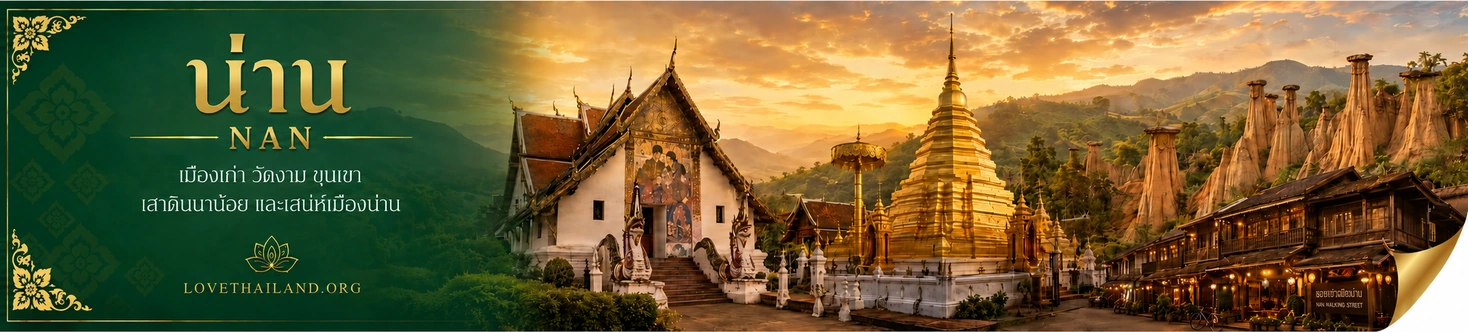
Nan
Slogan : Famous the race broadcast, land of black irory, painthing of Wat Phumin, land of gold orange, brilliantly of Pratard Chae Hang.
Nan Province is one of the most distinctive provinces in Thailand. This small city, nestled among the mountains of northern Thailand, does not stand out for urban development or modernity. Instead, it shines through the beauty of its natural landscapes, a simple way of life, and a culture that has been firmly preserved from the past to the present. Traveling to Nan is therefore not just about visiting a destination, but about “returning to experience something simple and genuine,” which is increasingly rare in today’s world.
The geography of Nan Province consists almost entirely of complex mountain ranges, with the Luang Prabang Range and the Phi Pan Nam Range forming natural boundaries. This creates breathtaking scenery filled with rich forests that remain highly fertile, serving as an important watershed for the Nan River, which flows downstream to nourish the Chao Phraya basin. The natural diversity of this area is therefore crucial both ecologically and for the livelihoods of local communities.
Looking back into history, Nan Province originated from “Mueang Pua,” an ancient settlement that once flourished before eventually developing into Nan. The city was once an independent state with its own rulers and maintained close ties with the Lanna Kingdom. This relationship led to a unique blend of culture and artistic expression that remains clearly visible today.
During the height of Lanna’s influence, Nan was considered one of the key cities with significant roles in both politics and culture. However, the city experienced several periods of change, particularly during wars with Burma, which caused severe damage. At times, it was even abandoned before being restored again during the Rattanakosin era.
In more recent history, Nan also played an important role in political movements, especially during periods of ideological conflict in mountainous areas. These conflicts eventually subsided, allowing the province to return to stability and develop into a major tourist destination today.
The charm of Nan lies not only in its landscape or history but also in the way of life of its people, who continue to live simply and warmly. Most residents are engaged in agriculture, such as rice farming, corn cultivation, and fruit orchards, maintaining a close relationship with nature.
The Tai Lue culture is another essential element that gives Nan its distinctive identity. The Tai Lue people have their own language, clothing, and traditions that differ clearly from other regions. In particular, the weaving of “Lai Nam Lai” patterned textiles is a delicate craft that deeply reflects local wisdom and heritage.
In terms of tourism, Nan offers a wide range of attractions, including historically significant temples such as Wat Phumin, known for its unique cruciform architecture and famous mural paintings recognized nationwide, as well as Wat Phra That Chae Haeng, which serves as a spiritual center for the people of Nan.
In addition, there are many beautiful natural attractions such as Doi Samer Dao, a well-known viewpoint for sea mist and stargazing, and the ancient Bo Kluea salt wells, where traditional salt-making methods have been passed down through generations.
Traveling in Nan is not just about visiting places but about experiencing moments—waking up early to see the mist, driving along winding mountain roads, interacting with locals, and embracing a slow-paced lifestyle that many travelers seek.
Getting There Nan can be reached by air, private car, or bus. Nan Airport is located very close to the city center, making travel highly convenient.
Once you truly experience Nan, you will realize that it is not just a destination, but an unforgettable “experience” that many wish to return to again.
Nan Tourism Festivals 2026
| Month | Festival Name | Venue | Details |
| January | New Year at Doi Samer Dao | Si Nan National Park | Enjoy sea mist, sunrise, and nature tourism activities |
| February | Chompoo Phu Kha Festival | Doi Phu Kha National Park | See one of the world’s rare flowers that blooms only once a year |
| April | Nan Songkran Festival | Nan City | Water-pouring rituals for Buddha images, Lanna parades, and traditional water festivities |
| July | Candle Procession Festival | Temples in the city | Candle processions and religious activities |
| October | Long Boat Racing Festival | Nan River | A major traditional long-boat racing competition |
| November | Yi Peng Loy Krathong | Nan City | Floating lanterns and city decorations with Lanna lanterns |
3–5 Day Nan Travel Plan
| Day | Time | Activities / Places |
| Day 1 | Morning | Wat Phumin + Wat Phra That Chae Haeng |
| Afternoon | Nan Museum + Old Town Walk | |
| Evening | Nan Walking Street | |
| Day 2 | Morning | Doi Samer Dao |
| Afternoon | Pha Chu | |
| Evening | Stargazing / Camping | |
| Day 3 | Morning | Ancient Bo Kluea Salt Wells |
| Afternoon | Sapan | |
| Evening | Homestay Stay |
15 MUST VISIT Places in Nan
| Rank | Place | Highlight |
| 1 | Wat Phumin | The Whisper of Love mural |
| 2 | Wat Phra That Chae Haeng | Sacred stupa |
| 3 | Doi Samer Dao | Sea of mist |
| 4 | Bo Kluea | Mountain salt |
| 5 | Sapan | Village in the middle of the valley |
| 6 | Doi Phu Kha | Chompoo Phu Kha flowers |
| 7 | Pha Chu | Mountain views |
| 8 | Nan National Museum | Local history and artifacts |
| 9 | Nan Walking Street | Local food and handicrafts |
| 10 | Wat Ming Mueang | Beautiful Lanna architecture |
| 11 | Wat Sri Panton | Golden temple design |
| 12 | Pua District | Scenic rice fields and mountain atmosphere |
| 13 | Thai Lue villages | Traditional local lifestyle |
| 14 | Wang Sila Laeng | Rocky stream and natural scenery |
| 15 | Ban Huai Kon | Mountain border atmosphere |
Frequently Asked Questions (FAQ)
Q: What are the main attractions in Nan Province?
A: Nan Province offers a wide variety of attractions, both cultural and natural. Important places include Wat Phumin, famous for its mural known as “The Whisper of Love,” Wat Phra That Chae Haeng, the province’s sacred stupa, as well as natural sites such as Doi Samer Dao, the ancient Bo Kluea salt wells, and Sapan Village, which has a peaceful atmosphere and beautiful mountain views. In addition, visitors can explore the walking street and Tai Lue communities to experience local life up close.
Q: How many days should I spend in Nan?
A: If you want to fully explore the city, major temples, and natural attractions, at least 3–5 days are recommended. On the first day, you can visit places in Nan town such as Wat Phumin and the walking street. On the second day, you can head to Doi Samer Dao or Pha Chu. On the third day, you can continue to Bo Kluea or Sapan. If you have more time, you can expand your trip to Doi Phu Kha and deeper mountain areas to enjoy nature more completely.
Q: When is the best time to visit Nan?
A: Nan can be visited throughout the year, but the most popular season is winter, from around November to February, when the weather is cool and comfortable, making it ideal for enjoying sea mist and mountain scenery. In addition, the period from late rainy season to early winter offers lush green landscapes, while summer is suitable for slow travel in the town and local communities.
Q: How is Nan different from other northern tourist provinces?
A: Nan stands out for its peace and natural atmosphere, which has not yet been overly commercialized. Unlike larger provinces that attract heavy tourist crowds, Nan still preserves its traditional community lifestyle, especially its Tai Lue culture. This makes it ideal for travelers seeking a quiet retreat and an authentic local experience.
Q: Is it difficult to travel to Nan?
A: Traveling to Nan is very convenient today. Visitors can fly directly to Nan Nakhon Airport, which is located near the city center, or travel by car along scenic mountain roads. There are also bus services from Bangkok and nearby provinces.
Q: What is special about Nan’s local food?
A: Nan’s local food has its own unique identity, including dishes such as khao soi, nam ngiao, northern-style larb, and Nan-style khao lam made without coconut milk, giving it a naturally fragrant sweetness. There are also many local dishes prepared with regional ingredients such as wild vegetables and meats cooked in the Lanna style.
Q: What type of travelers is Nan suitable for?
A: Nan is ideal for travelers seeking peace and quiet, nature lovers, and people interested in local culture. It is also perfect for photographers, slow-life travelers, and those who want to escape the chaos of big cities. In addition, it suits travelers who enjoy mountain roads and experience-based tourism.
Q: If I am visiting Nan for the first time, where should I start?
A: It is best to begin in Nan town with sites such as Wat Phumin, Wat Phra That Chae Haeng, and the Nan National Museum. After that, you can plan to continue to natural attractions such as Doi Samer Dao, Bo Kluea, and Sapan, so that you can experience both culture and nature in one trip.
Q: What are Nan’s cultural highlights?
A: One of Nan’s strongest cultural highlights is its Tai Lue heritage, which is reflected in the local language, clothing, and handicrafts, especially Lai Nam Lai woven textiles. In addition, Nan is rich in Lanna temples and artistic traditions, along with local festivals that continue to be preserved and celebrated.
Q: How should I prepare for a trip to Nan?
A: You should bring warm clothing if traveling in winter, wear shoes suitable for walking in mountain areas, and plan your routes in advance, as some locations are remote and connected by winding roads. It is also important to respect local culture, especially by dressing appropriately when visiting temples.
Nan Map

 Art, Culture and Heritage
 Landmarks and Memorials(6)
 Art, Craft Centres, Tradition(6)
 Museums(4)
 Historic Homes and Cities(1)
 Art Gallery(1)
 Educational Places
 Educational Gardens, Farm(1)
 Places of Worship
 Temple(68)
 Church(1)
 Other Sacred Sites(19)
 Research and Development
 Royal Project(2)
 Suburban Living
 Village, Community(13)
 Local Market(1)
 Nature and Wildlife
 National Parks and Marine Reserves(9)
 Mountain (Doi)(6)
 Dam, Reservoir, Lake(16)
 Waterfalls(28)
 Hot Springs(1)
 Caves(11)
 River, Canal(5)
 Other natural attractions(10)
 Entertainment and Agricultural
 Farms, Parks and Ecotourism(4)
 Outdoor and Adventure Activities(2)
 Travel Articles, Recipes
 Travel Review, Food Review(1)


