
lovethailand home >North Travel Attractions
> Phrae Travel Attractions
TL;DR: A quick overview of attractions in Phrae, plus planning details, access, and key travel highlights.
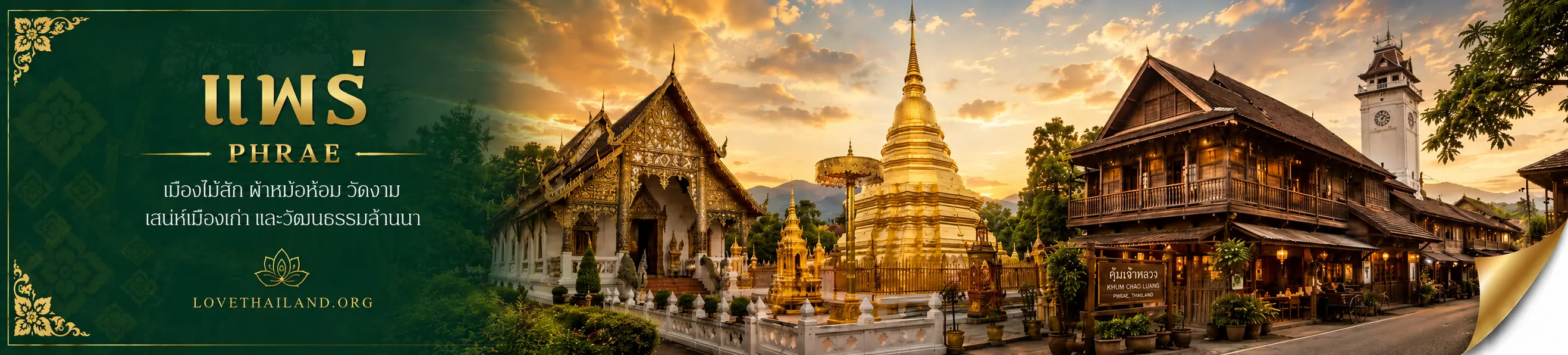
Phrae
Slogan : Morhom, teak, land of love for Pra Law, Prha That Cho Hae Sri Muang, circulate of goat ghost town, people very kind.
Phrae Province is one of the ancient cities in northern Thailand with a long history spanning over a thousand years. It is filled with stories, beliefs, and cultural heritage that have been continuously passed down from the past to the present. This city was not only a center of Lanna civilization in the past, but also a land closely connected to the classic Thai literature “Lilit Phra Lo,” which reflects a great love story and tragic romance that still resonates deeply with people today.
The charm of Phrae does not lie only in its history, but also in its way of life, culture, and local traditions that have been well preserved. These include Lanna art, traditional wooden architecture, and distinctive northern cuisine such as Khanom Jeen Nam Ngiao, Kaeng Hang Lay, and various local dishes made from natural ingredients.
In addition, Phrae Province features a landscape dominated by mountains, forests, and rivers, especially the Yom River which flows through the heart of the province, enriching the surrounding areas. This makes Phrae an ideal destination for nature tourism combined with cultural learning.
Phrae is located in the upper northern region of Thailand and has a long history dating back to around the 12th Buddhist century. It was once an independent city-state before being incorporated into the Lanna Kingdom, a period during which Phrae flourished in trade, culture, and religion.
The name of Phrae has evolved over time. Historical evidence shows that the city has been known by several names such as “Mueang Phon,” the oldest original name, later appearing as “Mueang Kosai” in the Chiang Saen chronicles, and “Mueang Phlae” in the inscription of King Ramkhamhaeng. Eventually, it became “Phrae,” the name still used today.
Archaeological discoveries in the province indicate human settlement since prehistoric times, including stone tools such as chipped and polished axes found in Long District and Wang Chin District.
Another important story that has made Phrae widely recognized is its connection to “Wiang Srong,” believed to be located in present-day Song District, which is associated with the literary tale Lilit Phra Lo.
Today, Phrae Province is divided into 8 districts: Mueang Phrae, Sung Men, Den Chai, Long, Wang Chin, Song, Rong Kwang, and Nong Muang Khai. Each district has its own unique charm in terms of culture, lifestyle, and attractions.
Phrae is considered one of Thailand’s emerging “secondary cities” that is gaining popularity due to its peaceful atmosphere, making it ideal for travelers seeking relaxation and authentic Lanna experiences.
Phrae offers a wide range of attractions including nature, history, and culture. One of its most iconic landmarks is “Phae Mueang Phi Forest Park,” featuring unique soil pillars shaped by erosion over thousands of years.
In addition to natural attractions, Phrae is home to many important temples such as “Wat Phra That Cho Hae,” the sacred pagoda of those born in the Year of the Tiger, and “Wat Phra Bat Ming Mueang Worawihan,” the first royal temple of the province.
For those interested in local culture, visiting “Kad Kong Kao,” the old walking street of Phrae, is a must. Visitors can experience the atmosphere of the old town while shopping for local products, handicrafts, and tasting authentic local food.
Another highlight of Phrae is its historic teakwood houses such as “Khum Wongburi” and “Khum Chao Luang,” which reflect the province’s prosperity during its time as a major teak trading hub.
In terms of nature, Phrae also offers peaceful attractions such as Mae Yom National Park, Wiang Kosai National Park, and Mae Koeng Luang Waterfall, ideal for those seeking tranquility.
There are also interesting cultural communities such as Ban Na Tong and Ban Thung Hong, famous for traditional indigo-dyed fabric (Mo Hom), where visitors can learn and try dyeing themselves.
Getting There Travelers can reach Phrae by car (7–8 hours from Bangkok), by train via Den Chai Station, or by air through Phrae Airport.
Phrae can be visited year-round. Winter offers cool weather, the rainy season provides lush greenery, and summer is suitable for cultural tourism.
Phrae is therefore a perfect destination for all types of travelers, offering authenticity, natural beauty, and cultural richness in a peaceful setting.
Phrae Festivals 2026
| Month | Festival | Location | Highlights |
| January | Phrae Winter Festival and Local Products Fair | Phrae City Hall Ground | OTOP products, local food, Lanna performances |
| February | Cho Hae Pagoda Worship Festival | Wat Phra That Cho Hae | Sacred religious ceremonies |
| April | Songkran Festival | Phrae City | Water festival and traditional rituals |
| June | Mo Hom Fabric Festival | Ban Thung Hong | Indigo dye demonstrations and shopping |
| October | End of Buddhist Lent | Major temples across the province | Merit-making and candle ceremonies |
| November | Loy Krathong Festival | Yom River / Kad Kong Kao | Floating krathongs and Lanna atmosphere |
| December | Winter Tourism Festival | Mae Yom National Park | Cool weather, mist, natural scenery |
3–5 Day Phrae Travel Itinerary (Realistic Plan)
| Day | Itinerary |
| Day 1 | Phrae city tour – Wat Phra Bat Ming Mueang – Khum Chao Luang – Khum Wongburi – Kad Kong Kao |
| Day 2 | Wat Phra That Cho Hae – Phae Mueang Phi – Ban Thung Hong |
| Day 3 | Mae Yom National Park – Mae Koeng Luang Waterfall |
| Day 4 | Song District – Wiang Srong – Community tourism |
| Day 5 | Long District – Wang Chin – Souvenir shopping |
15 MUST VISIT Attractions in Phrae
| No. | Place | Type | Highlight |
| 1 | Wat Phra That Cho Hae | Temple | Sacred pagoda |
| 2 | Phae Mueang Phi | Nature | Unique soil formations |
| 3 | Khum Chao Luang | History | Teak mansion |
| 4 | Khum Wongburi | Architecture | Pink teak house |
| 5 | Kad Kong Kao | Culture | Walking street |
| 6 | Wat Phra Bat Ming Mueang | Temple | Royal temple |
| 7 | Ban Thung Hong | Community | Indigo fabric |
| 8 | Mae Yom National Park | Nature | Forest landscape |
| 9 | Mae Koeng Luang Waterfall | Nature | Large waterfall |
| 10 | Wiang Srong | History | Lilit Phra Lo legend |
| 11 | Wat Chom Sawan | Temple | Burmese-style art |
| 12 | Ban Na Tong | Community | Local lifestyle |
| 13 | Doi Leng | Nature | Mountain views |
| 14 | Wiang Kosai National Park | Nature | Waterfalls and forest |
| 15 | Den Chai Railway Station | Landmark | Main gateway |
Frequently Asked Questions (FAQ)
Q: What is Phrae known for?
A: Phrae is known for its rich history, Lanna temples, natural attractions, and traditional indigo textiles.
Q: How many days should I spend in Phrae?
A: 3–5 days is recommended to explore all major attractions.
Q: What are must-visit places in Phrae?
A: Wat Phra That Cho Hae, Phae Mueang Phi, Khum Chao Luang, and Kad Kong Kao.
Q: When is the best time to visit Phrae?
A: November to February offers the best weather.
Q: Who is Phrae suitable for?
A: Nature lovers, cultural travelers, and those seeking peaceful destinations.
Q: Is traveling to Phrae convenient?
A: Yes, accessible by car, train, and airplane.
Phrae Map

 Art, Culture and Heritage
 Historical Sites and Monuments(4)
 Landmarks and Memorials(5)
 Art, Craft Centres, Tradition(3)
 Museums(6)
 Historic Homes and Cities(2)
 Educational Places
 Museum for Study(1)
 Educational Gardens, Farm(2)
 Places of Worship
 Temple(31)
 Other Sacred Sites(8)
 Suburban Living
 Village, Community(6)
 Local Market(1)
 Nature and Wildlife
 National Parks and Marine Reserves(4)
 Dam, Reservoir, Lake(14)
 Waterfalls(6)
 Hot Springs(1)
 Caves(5)
 River, Canal(3)
 Islands(1)
 Other natural attractions(5)
 Entertainment and Agricultural
 Farms, Parks and Ecotourism(5)
 Outdoor and Adventure Activities(1)
 Travel Articles, Recipes
 Travel Review, Food Review(2)


