
lovethailand home >South Travel Attractions
> Chumphon Travel Attractions
TL;DR: A quick overview of attractions in Chumphon, plus planning details, access, and key travel highlights.
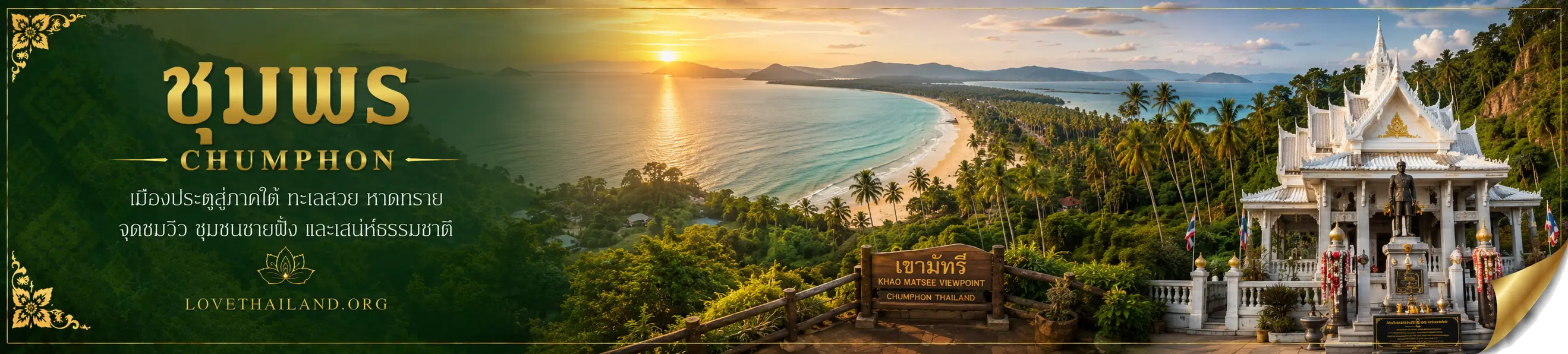
Chumphon
Slogan : The door of south, worship prince Choomporn, see coffee gaden, beach, great banana, famous nest.
Chumphon is widely recognized as the “Gateway to Southern Thailand,” serving as a historic frontier city and an essential passage between the central region and the southern peninsula. This coastal province holds a unique identity shaped by both geography and history. In ancient times, Chumphon was considered one of the “Twelve Zodiac Cities” and was known for its abundance of natural resources, including lush forests, fertile plains, and rich marine ecosystems. What sets Chumphon apart is its rare geographical advantage: it connects the Gulf of Thailand to the Andaman Sea, making it one of the few provinces in Thailand where such diversity exists within a single area.
Covering an area of approximately 6,010 square kilometers, Chumphon features a diverse landscape that transitions dramatically from west to east. The western side is dominated by the Tenasserim Range and the Phuket Mountain Range, forming a natural border between Thailand and Myanmar. These highlands gradually slope down toward the eastern lowlands, creating a variety of ecosystems that support both agriculture and biodiversity.
In the eastern region, dense forests and mountainous terrain serve as the origin of several important short rivers, including the Tha Taphrao River, Lang Suan River, and Sawi River. These waterways play a crucial role in sustaining local agriculture and communities, while also contributing to the province’s ecological richness.
The central area of Chumphon is characterized by rolling plains and fertile river basins, which account for approximately one-quarter of the province’s total land area. This region is highly suitable for agriculture and is known for producing a variety of crops, particularly fruits such as durian, mangosteen, and longkong. These products are not only consumed locally but are also exported, contributing significantly to the provincial economy.
Along the eastern coastline lies a long stretch of flat and gently curving beaches facing the Gulf of Thailand. Unlike more rugged coastlines, Chumphon’s beaches are known for their smooth sands and serene atmosphere. The relatively low level of commercial development helps preserve the natural beauty of the coastline, making it an ideal destination for travelers seeking tranquility and authenticity.
Historically, Chumphon’s name has appeared in records as early as 555 CE (B.E. 1098), when it functioned as a frontier city under the administration of Nakhon Si Thammarat. The provincial emblem features a goat, reflecting its identity as one of the zodiac cities. During the Ayutthaya period, particularly under the reign of King Borommatrailokkanat, Chumphon was part of the southern administrative region of the kingdom. Later, during the reign of King Rama V, it was established as a “Monthon” (administrative circle), and eventually became a province following the abolition of the Monthon system.
The origin of the name “Chumphon” is subject to several interpretations. One theory suggests it comes from “Chumnum Phon,” meaning a gathering of troops, as the area historically served as a staging ground for military campaigns from both the north and south. Another interpretation derives from “Chumnum Phon” in the sense of gathering blessings, referring to ancient rituals performed before armies marched into battle. These ceremonies were conducted to seek victory and boost morale, aligning with the meaning of assembling to receive blessings.
Another plausible origin is linked to local flora, specifically the “Ma Duea Chumphon” (Chumphon fig tree), which once grew abundantly along the Tha Taphrao River. This tree became a symbolic element of the province and is reflected in its official emblem.
Today, Chumphon is administratively divided into 8 districts: Mueang Chumphon, Lang Suan, Sawi, Tha Sae, Pathio, Lamae, Phato, and Thung Tako. Each district offers distinct landscapes and cultural experiences, ranging from coastal tourism to mountainous eco-adventures.
Beyond its geography and history, Chumphon is increasingly recognized for its role in Thailand’s tourism network. It serves not only as a destination but also as a strategic transit hub for travelers heading to popular islands such as Koh Tao, Koh Phangan, and Koh Samui. However, those who take the time to explore Chumphon itself will discover that it is far more than just a gateway—it is a destination rich in natural beauty, cultural depth, and authentic local experiences.
Getting There Traveling to Chumphon is highly convenient, with multiple transportation options available. Visitors can reach the province by car via Highway 4 (Phetkasem Road), by train through Chumphon Railway Station, or by air via Chumphon Airport. Additionally, ferry services operate from Chumphon’s piers, providing direct connections to nearby islands, making it an important logistical hub for southern travel routes.
For travelers seeking an experience that combines untouched beaches, vibrant marine life, cultural heritage, and a relaxed atmosphere, Chumphon offers a compelling alternative to Thailand’s more commercialized destinations. It is a place where nature remains abundant, traditions are preserved, and every journey reveals something new.
Annual Festivals and Tourism Events in Chumphon (2026)
| No. | Festival Name | Date | Location | Highlights |
| 1 | Chumphon Marine Festival | March 2026 | Hat Sai Ri, Mueang District | Marine tourism promotion, seafood fair, cultural shows |
| 2 | Chumphon Fruit Festival | August 2026 | Lang Suan District | Durian, mangosteen, longkong exhibitions and competitions |
| 3 | Migratory Hawk Festival | September–October 2026 | Khao Dinsor, Pathio District | Witness thousands of hawks migrating from Siberia |
3–5 Day Travel Itinerary in Chumphon (Detailed Plan)
| Day | Location | Highlights |
| Day 1 | Hat Sai Ri / Prince of Chumphon Shrine | Pay respect to the Father of the Royal Thai Navy and enjoy sunset views |
| Day 2 | Mu Ko Chumphon National Park | Island hopping, snorkeling, coral reef exploration |
| Day 3 | Thung Wua Laen Beach / Khao Matsee Viewpoint | Relaxing beach atmosphere and panoramic ocean views |
| Day 4 | Phato District | Experience rafting, waterfalls, and rainforest nature |
| Day 5 | Local Markets / Food Tour | Taste local cuisine and fresh seafood |
Top 10 Must-Visit Attractions in Chumphon
| No. | Attraction | Location | Highlights |
| 1 | Thung Wua Laen Beach | Pathio District | White sandy beach, clear water |
| 2 | Hat Sai Ri | Mueang District | Historic beach and royal shrine |
| 3 | Mu Ko Chumphon National Park | Mueang District | Diving and marine biodiversity |
| 4 | Khao Matsee Viewpoint | Mueang District | Panoramic coastal views |
| 5 | Koh Ngam | Mu Ko Chumphon | Twin islands and sandbar |
| 6 | Koh Mattra | Mu Ko Chumphon | Snorkeling paradise |
| 7 | Phato Rafting | Phato District | Adventure rafting in rainforest |
| 8 | Khao Dinsor | Pathio District | Hawk watching viewpoint |
| 9 | Lang Suan Market | Lang Suan District | Local lifestyle and food |
| 10 | Sawi River | Sawi District | Scenic river and local culture |
Frequently Asked Questions (FAQ)
Q: What makes Chumphon different from other provinces in Thailand?
A: Chumphon stands out as the “Gateway to Southern Thailand,” offering a rare combination of mountains, forests, islands, and beaches in one province. It is less crowded than major tourist destinations, making it ideal for travelers seeking a peaceful and authentic experience.
Q: When is the best time to visit Chumphon?
A: The best time to visit is from February to September, when the sea is calm and ideal for snorkeling and island hopping. September to October is also popular for watching migratory hawks at Khao Dinsor.
Q: Is Chumphon worth visiting or just a transit point?
A: Chumphon is much more than a transit hub. It offers beautiful beaches, rich marine biodiversity, cultural attractions, and a relaxed atmosphere that many travelers find more appealing than crowded destinations.
Q: What are the must-do activities in Chumphon?
A: Key activities include snorkeling in Mu Ko Chumphon National Park, relaxing at Thung Wua Laen Beach, visiting the Prince of Chumphon Shrine, and enjoying panoramic views at Khao Matsee.
Q: Is Chumphon suitable for family travel?
A: Yes, Chumphon is very family-friendly. It offers safe beaches, nature-based activities, and cultural attractions suitable for all ages.
Q: How do I get to Chumphon?
A: You can travel by car via Highway 4, by train to Chumphon Railway Station, or by air to Chumphon Airport. Ferry services are also available to nearby islands such as Koh Tao.
Q: What food is Chumphon famous for?
A: Chumphon is known for southern Thai cuisine such as spicy curry (Gaeng Tai Pla), stir-fried curry paste (Kua Kling), fresh seafood, and tropical fruits like durian, mangosteen, and longkong.
Q: Is Chumphon good for snorkeling and diving?
A: Yes, Chumphon is one of Thailand’s best-kept secrets for snorkeling and diving, with clear waters and rich coral reefs around islands like Koh Ngam and Koh Mattra.
Q: How many days should I spend in Chumphon?
A: A 3-day trip is enough for major highlights, but 4–5 days is recommended for a more complete experience, including island tours and nature activities.
Q: Are there islands near Chumphon worth visiting?
A: Yes, Mu Ko Chumphon National Park includes several beautiful islands such as Koh Ngam and Koh Mattra, known for their clear water and marine life.
Chumphon Map

 Art, Culture and Heritage
 Historical Sites and Monuments(1)
 Landmarks and Memorials(2)
 Art, Craft Centres, Tradition(3)
 Museums(2)
 Educational Places
 Educational Gardens, Farm(1)
 Places of Worship
 Temple(31)
 Other Sacred Sites(10)
 Research and Development
 Royal Project(1)
 Suburban Living
 Village, Community(5)
 Local Market(1)
 Nature and Wildlife
 National Parks and Marine Reserves(7)
 Mountain (Doi)(5)
 Dam, Reservoir, Lake(1)
 Waterfalls(26)
 Hot Springs(1)
 Caves(21)
 River, Canal(7)
 Bays and Beaches(30)
 Islands(13)
 Other natural attractions(7)
 Entertainment and Agricultural
 Farms, Parks and Ecotourism(3)
 Outdoor and Adventure Activities(4)
 Shopping
 Shopping and Night Market(1)
 Travel Articles, Recipes
 Travel Review, Food Review(1)


