
lovethailand home >Northeastern Travel Attractions >Yasothon Travel Attractions >Muang Yasothon >Nai Muang > Wat Mahathat
TL;DR: Wat Mahathat is located at Nai Mueang Subdistrict, Mueang Yasothon District, Yasothon Province, open Daily, hours 08.00 – 17.00.
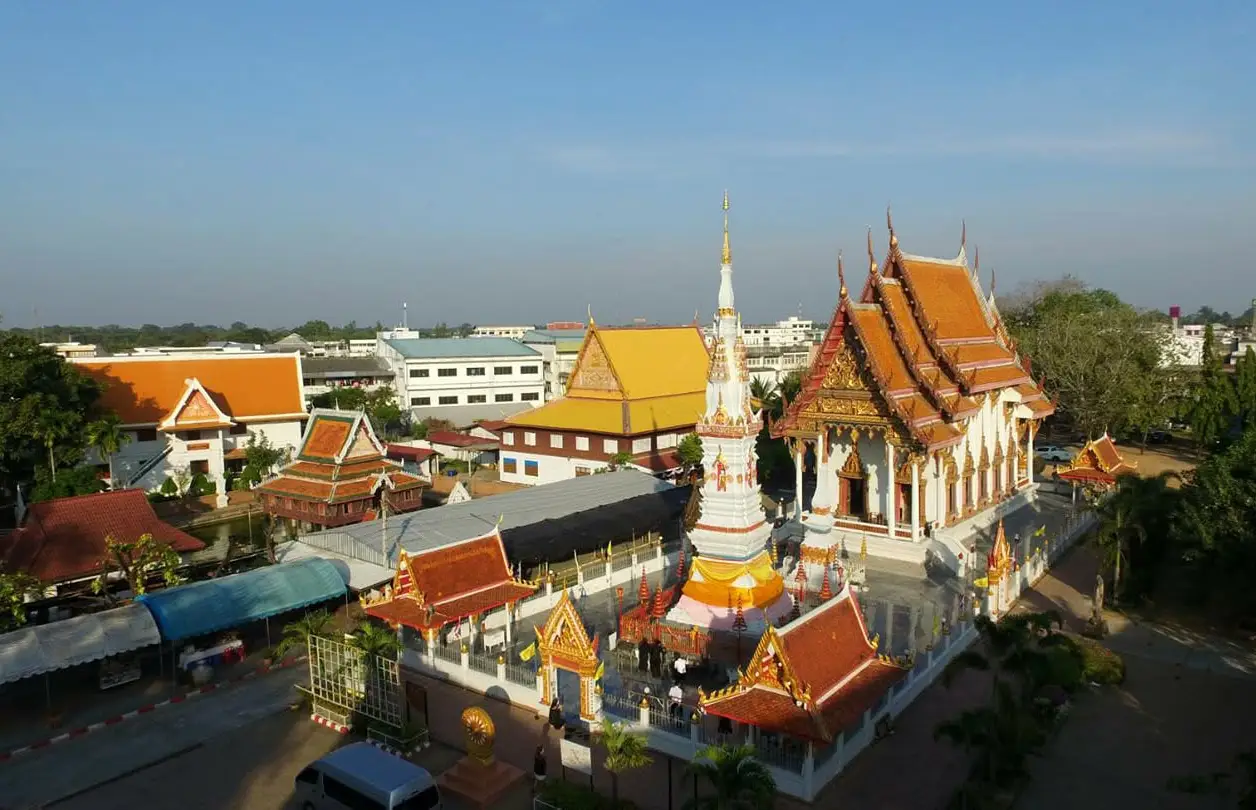
Wat Mahathat
Open Days: Daily
Opening Hours: 08.00 – 17.00
Wat Mahathat Yasothon is one of the most important royal temples in Yasothon Province. Located in Nai Mueang Subdistrict, Mueang Yasothon District, the temple stands at the historical and spiritual heart of the city. It is closely connected with the founding history of Yasothon, the faith of local people, Lao-Isan Buddhist art, and several major religious monuments. The most important sacred objects in the temple are Phra Phuttha Butsayarat, also known as Phra Kaeo Yot Nam Khang, and Phra That Yasothon, also known as Phra That Anon. Together, these sacred sites make Wat Mahathat not only a place for worship, but also an essential cultural and historical landmark for travelers who want to understand Yasothon in depth.
Wat Mahathat is a temple where visitors can see several layers of Yasothon’s identity in one place. Inside the temple are Phra That Anon, a historic stupa believed to enshrine relics of Phra Ananda; Phra Phuttha Butsayarat, the revered city Buddha image; a wooden scripture hall built over water; the ordination hall; monastic areas; and several important religious spaces. These features reflect the city’s relationship with Buddhism, local leadership, the Lao cultural world, and the early development of Yasothon as an urban community in northeastern Thailand.
The history of Wat Mahathat is connected with the settlement of people who moved from the Vientiane and Nong Bua Lam Phu region into the area that later became Yasothon. Local narratives refer to leaders such as Phra Wo, Phra Ta, Thao Na, Thao Kham Sing, and Thao Kham Pha. The area was once known as Dong Phi Sing, and the original temple was called Wat Thung Sawang. Later, after a major stupa was built in the temple, the name was changed to Wat Mahathat. That stupa is now known as Phra That Anon, one of the most important religious monuments in Yasothon.
The importance of Wat Mahathat does not come only from its age. It comes from the way the temple has served as the spiritual center and cultural memory of Yasothon for generations. The temple is linked with the legend of Phra Ananda’s relics, the royal presentation of Phra Phuttha Butsayarat by King Rama III, the preservation of palm-leaf manuscripts from Vientiane, and the annual celebration of Phra That Anon. These elements make Wat Mahathat a living cultural document in the middle of Yasothon city.
Phra Phuttha Butsayarat, or Phra Kaeo Yot Nam Khang, is one of the most significant sacred objects in the temple and in Yasothon Province. It is a small seated Buddha image in meditation posture, created in the Chiang Saen artistic style. It is revered as the city Buddha image of Yasothon. Its historical importance is tied to King Rama III, who presented the image to Phra Sunthon Ratchawongsa, the first ruler of Yasothon. The image therefore connects local devotion with royal history and the identity of Yasothon as a city.
The name Phra Kaeo Yot Nam Khang, meaning “the dewdrop crystal Buddha,” reflects the clear and refined appearance of the image. For local people, it is more than an artwork. It is a symbol of protection, good fortune, and the spiritual identity of Yasothon. Visitors who come to Wat Mahathat often pay respect to this image as an important part of their visit. For cultural travelers, the image helps explain how a small sacred object can carry deep historical and emotional significance for an entire province.
Phra That Yasothon, or Phra That Anon, stands in front of the ordination hall and is one of the temple’s major landmarks. It is an old stupa with a square plan and a form influenced by Lao Buddhist architecture. Its upper part has a shape that recalls other important stupas in northeastern Thailand. The stupa is believed to contain relics of Phra Ananda, one of the Buddha’s closest disciples. Because of this belief, Phra That Anon has become a major center of faith for the people of Yasothon.
The legend of Phra That Anon tells of two men from Vientiane, Chettanuwin and Chindachan, who traveled on pilgrimage and received relics associated with Phra Ananda. After difficulties in returning to Vientiane, they later came to the area of present-day Yasothon and joined with Iang Wetha, a Khmer ruler, to build a stupa at Dong Phi Sing. This story gives Phra That Anon a sacred narrative that links Yasothon with Vientiane, Buddhist relic traditions, and the broader spiritual geography of the region.
Architecturally, Phra That Anon has a square base, masonry construction, lotus-shaped base details, niches on 4 sides, standing Buddha images, and a distinctive tiered upper structure. The stupa shows strong Lao-Isan artistic influence and is often compared with other important local monuments such as That Kong Khao Noi. The form of the stupa is not only beautiful but also meaningful. It reflects religious symbolism, local craftsmanship, and the historical relationship between Yasothon and the wider Lao cultural sphere.
The area around Phra That Anon is the main devotional space for visitors. People come to pay respect, take photographs, and observe the architectural details of the stupa. Its white surface gives the monument a calm and luminous appearance, especially in the morning or late afternoon light. Visitors should take time to view the base, niches, upper tiers, and overall position of the stupa within the temple compound. These details help reveal the historical and religious importance of the monument.
Another major feature of Wat Mahathat is the scripture hall built over water. This wooden structure stands in a pond northeast of Phra That Anon. It was created to preserve palm-leaf manuscripts, Buddhist scriptures, and traditional texts brought from Vientiane. Its location over water had a practical purpose: to help protect manuscripts from termites and other pests. At the same time, the water setting gives the structure a sense of sacred separation and serenity.
The scripture hall is important both architecturally and culturally. Its wooden construction, carved doors, gilded decorative patterns, and central-water setting show the sophistication of local craftsmanship. It also reflects the high value that the community placed on Buddhist learning. In traditional temple culture, palm-leaf manuscripts were not ordinary documents; they were vessels of sacred knowledge. For this reason, the scripture hall at Wat Mahathat is one of the most meaningful structures in the temple compound.
Wat Mahathat was officially registered as a historic site by the Fine Arts Department, confirming its national cultural value. The registered historic components include Phra That Anon, the small stupa containing the remains of Phra Wichai Khattiya Wongsa, and the scripture hall. This recognition shows that Wat Mahathat is not only a local place of worship but also a protected heritage site. Its preservation is important for the cultural memory of Yasothon and for the study of Isan Buddhist architecture.
The small stupa containing the remains of Phra Wichai Khattiya Wongsa is another meaningful structure inside the temple. Although it is less famous than Phra That Anon, it helps connect the temple with important figures in local history. Its presence shows that Wat Mahathat also served as a memorial space for leaders and respected people associated with the city. This adds another historical layer to the temple compound.
Every year, Wat Mahathat holds the celebration of Phra That Anon in March. The celebration takes place around the 13th, 14th, and 15th waxing-moon days of the 3rd lunar month according to Isan tradition. On the first night, devotees gather to honor the stupa, often wearing white and participating in religious rites. On the following nights, the celebration continues with local activities and festive performances. This annual event keeps the stupa active in community life and preserves a tradition that has been passed down through generations.
The annual celebration shows that Phra That Anon is not merely an ancient monument. It remains a living center of worship and community participation. Local people return to the temple to make merit, pray, perform rituals, and maintain the connection between the historic stupa and present-day Yasothon society. For travelers visiting in March, the event offers a deeper view of how faith and heritage continue to function in a real community setting.
Wat Mahathat is a third-class royal temple of the ordinary type under the Mahanikaya order. The current abbot is Phra Thep Wongsa Chan, who also serves as the ecclesiastical provincial governor of Yasothon. This gives the temple an important role not only for local residents but also for the Buddhist administration of the province. Major ceremonies, merit-making events, and religious activities are regularly connected with the temple.
A meaningful visit should begin with paying respect to Phra Phuttha Butsayarat, then continue to Phra That Anon, the scripture hall, and the other historic structures. This order allows visitors to understand the temple through 3 main themes: sacred devotion, historic architecture, and the preservation of Buddhist knowledge. Rushing through only one part of the temple would miss the depth of the site.
Because Wat Mahathat is located in central Yasothon, it can easily be combined with nearby attractions. Important places nearby include Yasothon City Pillar Shrine, Ban Sing Tha Old Town, Singha Tha Museum, Wat Sing Tha, Phaya Thaen Park, the Giant Toad Museum, and That Kong Khao Noi. A half-day route can begin at Wat Mahathat, continue to the city pillar shrine and Ban Sing Tha, and end with a café or local restaurant in town. A full-day route can add Phaya Thaen Park and That Kong Khao Noi.
The temple is suitable for many types of visitors. History lovers can learn about the foundation of Yasothon and its connection with Vientiane and the Lao cultural world. Art and architecture enthusiasts can study Phra That Anon and the scripture hall. Buddhist pilgrims can pay respect to Phra Phuttha Butsayarat and Phra That Anon. Foreign travelers can use the temple as an accessible introduction to Lao-Isan religious heritage in northeastern Thailand.
There is no admission fee to visit Wat Mahathat. Visitors should dress modestly, speak quietly inside religious areas, remove shoes before entering sacred buildings, and avoid touching historic objects or fragile structures. Photography is possible in suitable areas, but visitors should be respectful, especially when local people are praying or ceremonies are taking place. These simple practices help preserve the peaceful atmosphere of the temple.
The best time to visit is in the morning or late afternoon, when the weather is more comfortable and the light is better for viewing the stupa and the wooden scripture hall. Morning light gives Phra That Anon a calm and soft appearance, while late afternoon is ideal for continuing to Ban Sing Tha Old Town and nearby cafés. Travelers who visit in March may be able to experience the annual celebration of Phra That Anon, one of the temple’s most important traditions.
Getting There is convenient because Wat Mahathat is located in Yasothon city. From Yasothon Bus Terminal, visitors can take local transport or a hired vehicle into the city center. Travelers driving by private car can enter the city via Chaeng Sanit Road and continue toward the temple area. Useful landmarks include Wat Mahathat Royal Temple, Wat Sing Tha, Ban Sing Tha Old Town, and Yasothon City Pillar Shrine. Once in the area, walking is a good way to explore the temple and nearby old-town attractions.
Visitors arriving by car should park only in permitted areas around the temple or nearby community spaces. Walking from Wat Mahathat to the city pillar shrine and Ban Sing Tha Old Town is a practical way to experience the historical center of Yasothon. The distance between these attractions is short, and walking allows travelers to notice old buildings, local shops, cafés, and the quiet rhythm of the city.
A practical half-day itinerary begins at Wat Mahathat in the morning. Visitors can pay respect to Phra Phuttha Butsayarat, view Phra That Anon, walk around the scripture hall, and then continue to Yasothon City Pillar Shrine and Ban Sing Tha Old Town. After that, they can stop at a café or local restaurant. This route gives a clear and compact view of the city’s religious, historical, and architectural identity.
Travelers with a full day can add Phaya Thaen Park, the Giant Toad Museum, and That Kong Khao Noi. Phaya Thaen Park and the Giant Toad Museum introduce local legends and modern symbols of Yasothon, while That Kong Khao Noi adds another important historic monument to the trip. Combined with Wat Mahathat, these sites give visitors a complete picture of Yasothon as a city of Buddhist heritage, local legends, historic memory, and community culture.
Food options around Wat Mahathat and Ban Sing Tha include local noodles, Isan food, cafés, rice porridge, and restaurants near the Lam Thuan area. Khao Pun Nam Ngua Yai Nang is a local food stop behind Wat Mahathat. Vachi Old Town Specialty Coffee fits naturally with a walk through Ban Sing Tha. Khao Tom Yok Yasothon is suitable for an evening meal, while Tud Ting Lap Ped is a well-known Isan restaurant. Baan Khun Ya Rim Thuan offers a pleasant dining atmosphere near the water, and Arabus Experience Café is convenient for coffee in the city center.
For accommodation, staying in Yasothon city is the most convenient choice. Hotels such as BM Grand Hotel, JP Emerald Hotel, The Colour Hotel Yasothon, The Green Park Grand Hotel Yasothon, The Zen Hotel Yasothon, and Big Elephant Hotel are within a practical distance of Wat Mahathat and nearby attractions. Staying in the city allows travelers to visit Wat Mahathat, Ban Sing Tha, Phaya Thaen Park, restaurants, and cafés without needing to change hotels.
Wat Mahathat should be understood as the historical heart of Yasothon, not just a temple for a quick visit. Phra Phuttha Butsayarat reveals the link between Yasothon and the royal court of Bangkok. Phra That Anon reflects Buddhist relic traditions and connections with the Lao cultural world. The scripture hall preserves the memory of Buddhist learning and palm-leaf manuscript culture. The annual celebration of Phra That Anon shows how ancient faith continues in present-day community life.
Overall, Wat Mahathat Yasothon is an essential destination for anyone who wants to understand the depth of the province. Yasothon is known for the Bun Bang Fai Rocket Festival, but its cultural identity is much broader. This temple brings together history, Buddhism, architecture, local leadership, royal connections, Lao-Isan art, and living community faith. For both Thai and foreign travelers, Wat Mahathat offers a complete and meaningful introduction to the spiritual and historical core of Yasothon.
| Name | Wat Mahathat Yasothon |
| Official Name | Wat Mahathat Royal Temple |
| Location | Nai Mueang Subdistrict, Mueang Yasothon District, Yasothon Province |
| Address | Nai Mueang Subdistrict, Mueang Yasothon District, Yasothon 35000 |
| Highlights | Phra Phuttha Butsayarat, Phra Kaeo Yot Nam Khang, Phra That Yasothon or Phra That Anon, the wooden scripture hall over water, the annual Phra That Anon celebration, and the founding history of Yasothon |
| History | Connected with the settlement of Phra Wo, Phra Ta, and leaders from the Vientiane cultural region around 1770 – 1776. The temple was formerly known as Wat Thung Sawang and later became Wat Mahathat after the construction of Phra That Anon |
| Name Origin | The name Wat Mahathat is associated with the city’s important stupa, Phra That Yasothon or Phra That Anon, which serves as a major spiritual center of Yasothon |
| Distinctive Features | A royal temple in central Yasothon with registered historic monuments, Phra Phuttha Butsayarat, Phra That Anon, and a wooden scripture hall over water |
| Travel Information | Located in Yasothon city and accessible by private car, rental car, hired vehicle, or local transport. Useful landmarks include Wat Mahathat Royal Temple, Wat Sing Tha, and Ban Sing Tha Old Town |
| Current Status | Open To Visitors And Active As A Royal Temple For Buddhist Ceremonies And Local Religious Activities |
| Open Days | Daily |
| Opening Hours | 08.00 – 17.00 |
| Fees | Free Admission |
| Facilities | Temple worship areas, ordination hall, stupa courtyard, wooden scripture hall, walking areas, and nearby permitted parking areas |
| Main Areas / Zones | 1. Ordination Hall 2. Phra Phuttha Butsayarat Or Phra Kaeo Yot Nam Khang 3. Phra That Yasothon Or Phra That Anon 4. Wooden Scripture Hall Over Water 5. Stupa Containing The Remains Of Phra Wichai Khattiya Wongsa 6. Phra That Worship Courtyard 7. Annual Phra That Anon Celebration Area |
| Abbot / Caretaker | Phra Thep Wongsa Chan (Samlee Kuttasilo), Abbot Of Wat Mahathat Royal Temple And Ecclesiastical Provincial Governor Of Yasothon |
| Tradition / Important Ceremony | Annual Phra That Anon Celebration, held in March around the 13th, 14th, and 15th waxing-moon days of the 3rd lunar month according to Isan tradition |
| Nearby Tourist Attractions | 1. Yasothon City Pillar Shrine, About 0.4 km 2. Ban Sing Tha Old Town, About 0.5 km 3. Singha Tha Museum, About 0.6 km 4. Wat Sing Tha, About 0.7 km 5. Phaya Thaen Park / Giant Toad Museum, About 2.5 km 6. That Kong Khao Noi, About 12 km |
| Nearby Restaurants | 1. Khao Pun Nam Ngua Yai Nang, About 0.2 km, Tel. 092-495-8632 2. Vachi Old Town Specialty Coffee, About 0.6 km, Tel. 062-994-2559 3. Arabus Experience Café Yasothon Municipal Market, About 0.8 km, Tel. 098-280-5288 4. Khao Tom Yok Yasothon, About 1.1 km, Tel. 093-329-3779 5. Tud Ting Lap Ped, About 1.6 km, Tel. 045-711-600 6. Baan Khun Ya Rim Thuan, About 1.9 km, Tel. 095-231-2221 |
| Nearby Accommodations | 1. BM Grand Hotel, About 0.9 km, Tel. 045-712-333 2. JP Emerald Hotel, About 1.2 km, Tel. 045-714-456 3. The Colour Hotel Yasothon, About 1.4 km, Tel. 045-971-794 4. The Green Park Grand Hotel Yasothon, About 1.8 km, Tel. 045-714-700 5. The Zen Hotel Yasothon, About 2.3 km, Tel. 045-711-455 6. Big Elephant Hotel, About 3.2 km, Tel. 045-711-123 |
Frequently Asked Questions (FAQ)
Q: Where Is Wat Mahathat Yasothon Located?
A: Wat Mahathat Yasothon is located in Nai Mueang Subdistrict, Mueang Yasothon District, Yasothon Province, near Ban Sing Tha Old Town, Yasothon City Pillar Shrine, and Wat Sing Tha.
Q: What Are The Opening Hours Of Wat Mahathat Yasothon?
A: The temple is open daily from 08.00 to 17.00.
Q: Is There An Admission Fee?
A: No. Visitors can enter the temple, pay respect, and view the main historic monuments without an admission fee.
Q: What Are The Most Important Sacred Objects At Wat Mahathat Yasothon?
A: The most important sacred objects are Phra Phuttha Butsayarat, also known as Phra Kaeo Yot Nam Khang, Phra That Yasothon or Phra That Anon, and the historic wooden scripture hall over water.
Q: Why Is Phra That Anon Important?
A: Phra That Anon is believed to enshrine relics of Phra Ananda, one of the Buddha’s closest disciples, and serves as a major spiritual center of Yasothon.
Q: Does Wat Mahathat Yasothon Have An Annual Festival?
A: Yes. The annual Phra That Anon celebration is held in March around the 13th, 14th, and 15th waxing-moon days of the 3rd lunar month according to Isan tradition.
Q: What Nearby Attractions Can Be Combined With Wat Mahathat Yasothon?
A: Nearby attractions include Yasothon City Pillar Shrine, Ban Sing Tha Old Town, Singha Tha Museum, Wat Sing Tha, Phaya Thaen Park, the Giant Toad Museum, and That Kong Khao Noi.
Q: Is Wat Mahathat Yasothon Suitable For Foreign Travelers?
A: Yes. The temple is easy to reach, historically important, and offers a clear introduction to Lao-Isan Buddhist art, Yasothon’s city history, and living local faith.
 Category: ●Places of Worship
 Group: ●Temple
Last Update : 2 MonthAgo
 Last Update : 2 MonthAgo
 Click to Access the Navigation Map GPS

 Art, Culture and Heritage
 Historical Sites and Monuments(6)
 Landmarks and Memorials(1)
 Art, Craft Centres, Tradition(4)
 Museums(1)
 Historic Homes and Cities(1)
Temple(22)
 Church(1)
 Other Sacred Sites(10)
 Research and Development
 Royal Project(2)
 Suburban Living
 Village, Community(3)
 Local Market(1)
 Nature and Wildlife
 National Parks and Marine Reserves(2)
 Mountain (Doi)(2)
 Dam, Reservoir, Lake(7)
 River, Canal(2)
 Bays and Beaches(1)
 Other natural attractions(2)
 Entertainment and Agricultural
 Farms, Parks and Ecotourism(1)
 Travel Articles, Recipes
 Travel Review, Food Review(2)


