
lovethailand home >Central Travel Attractions >Phranakhon Si Ayutthaya Travel Attractions >Phranakhon Si Ayutthaya >Tha Wasukri > Wat Phra Si Sanphet
TL;DR: Wat Phra Si Sanphet is located at Ayutthaya Historical Park, Pratu Chai Subdistrict, Phra Nakhon Si Ayutthaya District, Phra Nakhon Si Ayutthaya Province; located north of, open Open Daily, hours 08.00 – 18.30.
Wat Phra Si Sanphet
Open Days: Open Daily
Opening Hours: 08.00 – 18.30
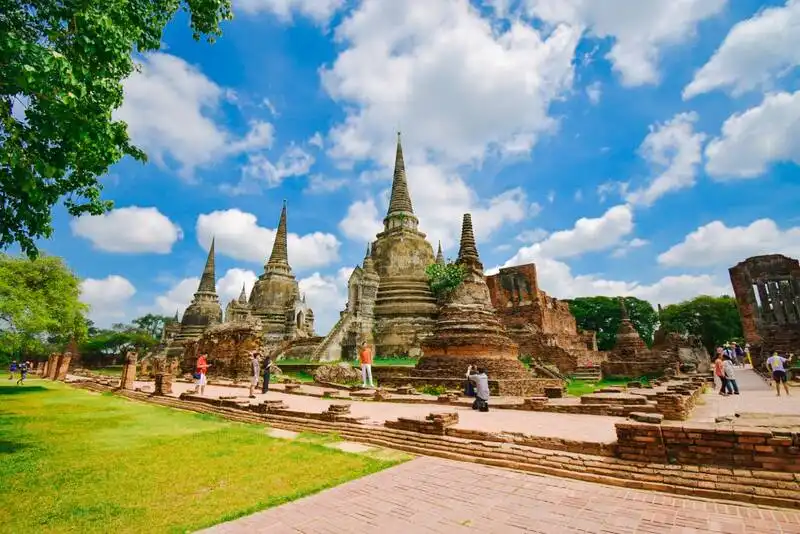
Wat Phra Si Sanphet is often called the “heart of Ayutthaya” without anyone needing to oversell it. The moment you step into the historic compound, you meet the city’s most iconic image head-on—three Sri Lankan-style chedis standing in a striking row at the center of what was once the Grand Palace, with Viharn Phra Mongkhon Bophit just a short distance to the south. This is not simply a photogenic ruin. It was a royal temple built “inside the palace” and used in ceremonies of the court, which is why many people describe its role as comparable to Bangkok’s Temple of the Emerald Buddha in terms of ceremonial importance and sacred prestige.
If you want to understand Ayutthaya in a way that feels tangible, Wat Phra Si Sanphet is an ideal starting point. Its story spans the founding era, the fall of the kingdom, and later restoration. In the reign of King Ramathibodi I (King U-Thong), this area was once part of the royal residential compound. Later, King Borommatrailokanat moved the palace farther north and dedicated the former palace grounds to build a temple within the palace boundary. He ordered the establishment of the sacred precinct for major state rites, which gave Wat Phra Si Sanphet its unique status as a temple with no resident monastic community—not a neighborhood temple, but a ceremonial space of the royal court.
The period that shaped the temple’s most recognizable identity came in the reign of King Ramathibodi II, who ordered the construction of two large chedis in 2035 BE. The first, to the east, was built to enshrine the royal ashes of King Borommatrailokanat, his father. The second, the central chedi, was built to enshrine the royal ashes of King Borommarachathirat III, his elder brother. When you look closely, the placement of these chedis is not only about beauty—it reflects how sacred space, royal memory, and authority were arranged at the heart of the capital.
In 2042 BE, a large assembly hall (viharn) was built, and in 2043 BE the king commissioned a standing Buddha image eight wa tall (about 16 meters), covered in gold weighing 286 chang (about 171 kilograms). Enshrined in the viharn, it was named “Phra Si Sanphet Dayan.” The statue became a symbol of Ayutthaya’s artistic and economic prosperity. After the fall of Ayutthaya in 2310 BE, the Burmese set fire to the structure and stripped away all the gold, leaving a scar of history that makes later generations want to see the site in person—because Ayutthaya’s grandeur often feels even sharper when you stand amid what was destroyed.
During the Rattanakosin period, King Rama I ordered the damaged parts of the principal image to be transferred to Bangkok. The fragments that could not be restored were placed inside a large chedi constructed for this purpose, which he named “Chedi Sanphet Dayan.” This chapter shows that even when the old capital was abandoned for a time, its meaning was not. The act of preserving fragments and formally naming a monument helped bind the legacy of the old kingdom to the new era.
The third chedi, to the west, was commissioned by King Borommarachathirat IV (Somdet Phra Nophutthangkun), the royal son, to enshrine the ashes of King Ramathibodi II. All three chedis follow the Sri Lankan style. Between each chedi stands a masonry structure believed to have been added around the reign of King Prasat Thong, with evidence of another restoration around the reign of King Borommakot, before modern conservation brought the complex closer to the condition seen today. These layers of restoration matter, because Wat Phra Si Sanphet is not a “single-ruin story”—it is a living record of how different generations cared for, repaired, and reinterpreted the heart of the old capital.
You do not need to be a scholar to enjoy walking here. Try asking simple questions as you move through the open grounds: Why are the chedis aligned in a straight row? Why does the central space feel like a ceremonial court rather than a community temple? Why are certain foundations left as traces instead of rebuilt over? When you look through that lens, you begin to see this site as “royal architecture” more than “everyday devotional architecture,” and that contrast is exactly what makes it stand out among Ayutthaya’s many temples.
Another reason people love this place is the photography. You can capture wide shots that frame all three chedis, or close-up details of old brick, weathered plaster, and time-worn surfaces. For softer light and fewer crowds, morning is usually best. If you want dramatic skies and stronger shadows, late afternoon can be rewarding too. Just come prepared with a hat, water, and sun protection—the open grounds and Ayutthaya sun rarely show mercy.
Getting There If you drive from Bangkok, a common route is via Highway 32 (the Asian Highway), entering Ayutthaya’s island area and continuing toward Si Sanphet Road, which connects several key heritage sites around the former Grand Palace zone. Overall, it is a straightforward drive and works well as a day trip.
If you arrive by train at Ayutthaya Railway Station, you can typically continue by local shared transport or hired vehicles into the island area. Many travelers choose to hire a ride to loop through multiple temples in one day to save time, but it is wise to agree on the price clearly before departing.
Once you reach the temple area, the most efficient way to explore is to group sites by zone. Wat Phra Si Sanphet sits extremely close to Viharn Phra Mongkhon Bophit (about 0.1 km), making it easy to connect on foot. From there, you can continue to Wat Ratchaburana, Wat Mahathat, or the Chao Sam Phraya National Museum without moving your vehicle too often. If you prefer a relaxed walking route, this zone is one of the most rewarding in Ayutthaya.
In terms of etiquette, even though Wat Phra Si Sanphet is an open-air historic monument, it remains a place of religious and historical significance. Dress respectfully, avoid climbing on chedi bases or fragile ruins, and help keep the grounds clean so the old capital remains meaningful and beautiful for future visitors. Small acts—staying on paths, not touching ancient masonry, and not leaving litter—are the simplest form of respect.
Finally, even if you have limited time, visiting this single site can give you a concentrated sense of Ayutthaya’s royal past. If you have more time, the experience becomes even richer when you continue to nearby temples, because each site adds context to the next—like assembling a clearer and more complete picture of the old capital, one piece at a time. When you walk out, it becomes easy to understand why this temple is considered one of Ayutthaya’s most important symbols.
| Name | Wat Phra Si Sanphet |
| Location | Ayutthaya Historical Park, Pratu Chai Subdistrict, Phra Nakhon Si Ayutthaya District, Phra Nakhon Si Ayutthaya Province; located north of Viharn Phra Mongkhon Bophit |
| Address | Ayutthaya Historical Park, Pratu Chai Subdistrict, Phra Nakhon Si Ayutthaya District, Phra Nakhon Si Ayutthaya Province, Thailand |
| Overview | A former royal temple within the Grand Palace grounds of Ayutthaya, used for major court ceremonies; no resident monks; best known for three Sri Lankan-style chedis aligned in a row |
| Highlights | (1) Three Sri Lankan-style chedis, (2) Royal-temple role comparable to Bangkok’s Temple of the Emerald Buddha, (3) The story of Phra Si Sanphet Dayan and post-fall history, (4) Central island location with easy walking connections, (5) Iconic photo angles representing Ayutthaya |
| Period | Ayutthaya Period (temple development across multiple reigns) |
| Key Evidence | Three Sri Lankan-style chedis; foundations of viharn and intervening structures; architectural traces within the former palace precinct |
| Custodian / Abbot | As a historic monument within the park, it has no resident abbot — managed by Ayutthaya Historical Park (Fine Arts Department) |
| Open Days | Open Daily |
| Opening Hours | 08.00 – 18.30 |
| Fees / Combined Ticket | Thai Nationals: 10 THB / Combined Ticket: 40 THB; Foreign Visitors: 50 THB / Combined Ticket: 220 THB |
| Travel | By Car: via Highway 32 into the island area, then to Si Sanphet Road; By Train: arrive at Ayutthaya Station and continue by local transport or hired vehicle into the island zone |
| Current Status | Open to visitors as part of Ayutthaya Historical Park |
| Contact Number | Ayutthaya Historical Park Office: 035 245123–4 |
| Nearby Tourist Attractions (Approx. Distance) | 1) Viharn Phra Mongkhon Bophit — 0.1 km 2) Chao Sam Phraya National Museum — 0.7 km 3) Wat Mahathat — 1.0 km 4) Wat Ratchaburana — 1.0 km 5) Wat Chaiwatthanaram — 2.3 km |
| Popular Restaurants Nearby (Approx. Distance + Phone) | 1) Busaba Ayutthaya Cuisine — 0.7 km — 084 026 2657 2) Baan Ton Sai — 0.8 km — 081 567 0315 3) Ko Jieb (Phra Non) — 0.7 km — 035 241 437 4) Dessert Bar by Busaba — 0.7 km — 084 026 2657 5) Scoops Me Up Gelato Old City — 1.0 km — 061 515 9445 |
| Popular Accommodations Nearby (Approx. Distance + Phone) | 1) The Park Ayutthaya Resort and Spa — 0.8 km — 086 327 4489 2) Krungsri River Hotel — 2.6 km — 035 244 333 3) sala ayutthaya — 3.1 km — 035 242 588 4) Kantary Hotel Ayutthaya — 5.2 km — 035 337 177 5) Centara Ayutthaya — 6.2 km — 035 243 120 |
Frequently Asked Questions (FAQ)
Q: Is Wat Phra Si Sanphet open every day?
A: Yes. It is open daily.
Q: What are the latest opening hours for Wat Phra Si Sanphet?
A: 08.00 – 18.30.
Q: Is there an admission fee?
A: Yes. There is an admission fee, and a combined ticket is available for multiple sites within Ayutthaya Historical Park.
Q: Why are there no resident monks at Wat Phra Si Sanphet?
A: Because it served as a royal temple inside the Grand Palace precinct, used for major court ceremonies rather than as a community monastery.
Q: What is the must-see highlight inside the site?
A: The three Sri Lankan-style chedis aligned in a row, and the overall layout that reflects its role as a royal ceremonial temple.
Q: When is the best time for photography?
A: Morning offers softer light and fewer crowds. Late afternoon can also be beautiful for dramatic skies, but come prepared for strong sun.
Q: Can I walk from the temple to Viharn Phra Mongkhon Bophit?
A: Yes. It is very close and easy to reach on foot.
Q: Is this a convenient day trip from Bangkok?
A: Yes. You can drive via Highway 32 or take a train to Ayutthaya and continue into the island zone by local transport.
Q: Where can I contact for the most up-to-date information?
A: Contact the Ayutthaya Historical Park Office using the phone number listed in the summary table.
 Category: ●Places of Worship
 Group: ●Temple
Last Update : 9 MonthAgo
 Last Update : 9 MonthAgo
 Click to Access the Navigation Map GPS
Wat Phra Si Sanphet Map
Gellery
Recommend

 Art, Culture and Heritage
 Historical Sites and Monuments(7)
 Landmarks and Memorials(6)
 Royal Palace(4)
 Art, Craft Centres, Tradition(6)
 Museums(9)
 Educational Places
 Museum for Study(1)
 Educational Gardens, Farm(2)
 Training Center(1)
Temple(133)
Training Center(1)
Temple(133)
 Church(2)
 Mosque(2)
 Other Sacred Sites(15)
 Research and Development
 Royal Project(4)
 Suburban Living
 Village, Community(10)
 Local Market(7)
 Floating Market(3)
 Nature and Wildlife
 Dam, Reservoir, Lake(1)
 River, Canal(3)
 Islands(2)
 Other natural attractions(1)
 Entertainment and Agricultural
 Animal camps and shows(2)
 Farms, Parks and Ecotourism(4)
 Travel Articles, Recipes
 Travel Review, Food Review(2)


