
lovethailand home >Northeastern Travel Attractions >Ubon Ratchathani Travel Attractions >Muang Ubon Ratchathani >Nai Muang > Wat Si Ubon Rattanaram (Wat Si Thong)
TL;DR: Wat Si Ubon Rattanaram (Wat Si Thong) is located at Upparat Road, Nai Mueang Subdistrict, Mueang Ubon Ratchathani District, Ubon Ratchathani Province, south of the former provincial hall and, open Daily, hours 04.30 – 22.00.
Wat Si Ubon Rattanaram (Wat Si Thong)
Open Days: Daily
Opening Hours: 04.30 – 22.00
Wat Si Ubon Rattanaram, also known as Wat Si Thong, in Ubon Ratchathani is one of the most important royal temples in the old city area of Ubon Ratchathani. Located on Upparat Road in Nai Mueang Subdistrict, Mueang Ubon Ratchathani District, the temple stands just south of the former provincial hall and close to Thung Si Mueang, the Ubon Ratchathani City Pillar Shrine, and Ubon Ratchathani National Museum. The temple is especially revered because it enshrines Phra Kaew Busarakham, the sacred Buddha image regarded as one of the guardian Buddha images of Ubon Ratchathani. This small but deeply revered image, carved from busarakham crystal, has been associated with the founding families, the sacred history of the city, and the annual Songkran procession in which local people pay respect and bathe the image for blessing.
Wat Si Ubon Rattanaram carries several layers of cultural value. It is a sacred temple where people come to pay respect to Phra Kaew Busarakham. It is also a historic temple established in 1855 during the reign of King Rama IV, connected with the early development of the Dhammayut monastic order in Ubon Ratchathani. Architecturally, the temple is famous for its ordination hall, which was built in the style of Wat Benchamabophit Dusitwanaram in Bangkok. Culturally, the temple is part of the living memory of the city because Phra Kaew Busarakham was used as the principal sacred image in old oath-taking ceremonies and continues to be carried in the annual Songkran procession. For international travelers, this temple offers a clear and meaningful introduction to the relationship between Buddhism, local history, royal monastic institutions, and community devotion in northeastern Thailand.
The temple was originally named Wat Si Thong. The name is connected with a local story about a golden light seen within the donated garden area on the night the land was offered for the establishment of the temple. Because this golden light was regarded as an auspicious sign, the temple was named Si Thong, meaning golden glory. The land was donated by Uppahat Tho, an important local figure from the Na Ubon family, who offered about 25 rai of land for the establishment of a Dhammayut temple. Phra Thewathammi (Mao), a respected monk from Wat Supattanaram Worawihan, was invited to become the first abbot. Under his leadership, monastic residences, worship buildings, halls, and early temple structures were gradually developed.
The later name, Wat Si Ubon Rattanaram, preserves the temple’s deeper identity. Si Ubon refers to Ubon Ratchathani, while Rattanaram suggests a temple associated with a precious jewel or sacred gem. This meaning is closely tied to Phra Kaew Busarakham, the revered crystal Buddha image enshrined inside the ordination hall. Local people still affectionately call the temple Wat Si Thong because the old name remains deeply rooted in community memory. The two names together tell the story of the temple: a place born from a golden auspicious sign and later recognized as a royal monastery protecting one of the most important sacred images of Ubon Ratchathani.
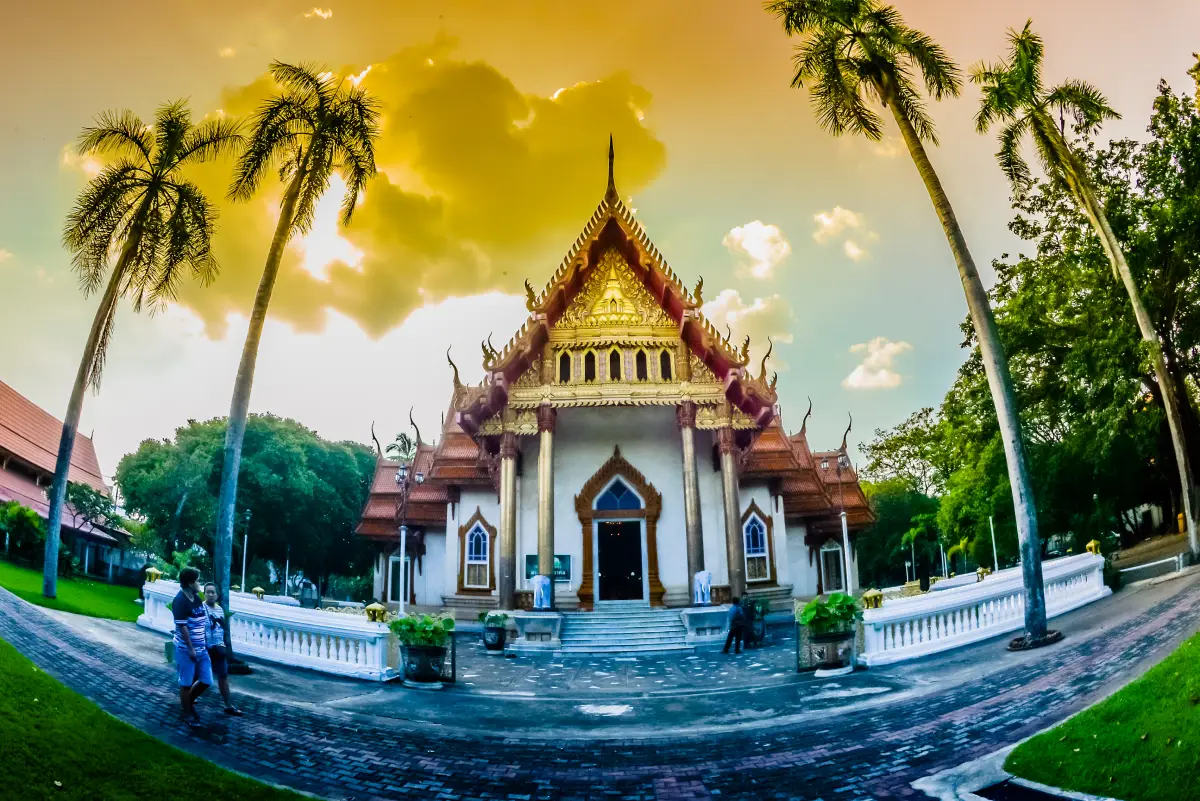
The ordination hall is one of the most impressive features of Wat Si Ubon Rattanaram. It was built in the architectural style of Wat Benchamabophit Dusitwanaram in Bangkok, giving the temple a refined and elegant appearance. The hall has a graceful multi-tiered roof, ornamental gable details, balanced proportions, and a formal layout that reflects the aesthetic of a royal temple. At the same time, the building belongs fully to the city of Ubon Ratchathani because it serves as the sacred home of Phra Kaew Busarakham and as a place where local people continue to worship. This combination of Bangkok-inspired architecture and local devotion makes the ordination hall one of the most distinctive temple buildings in the city.
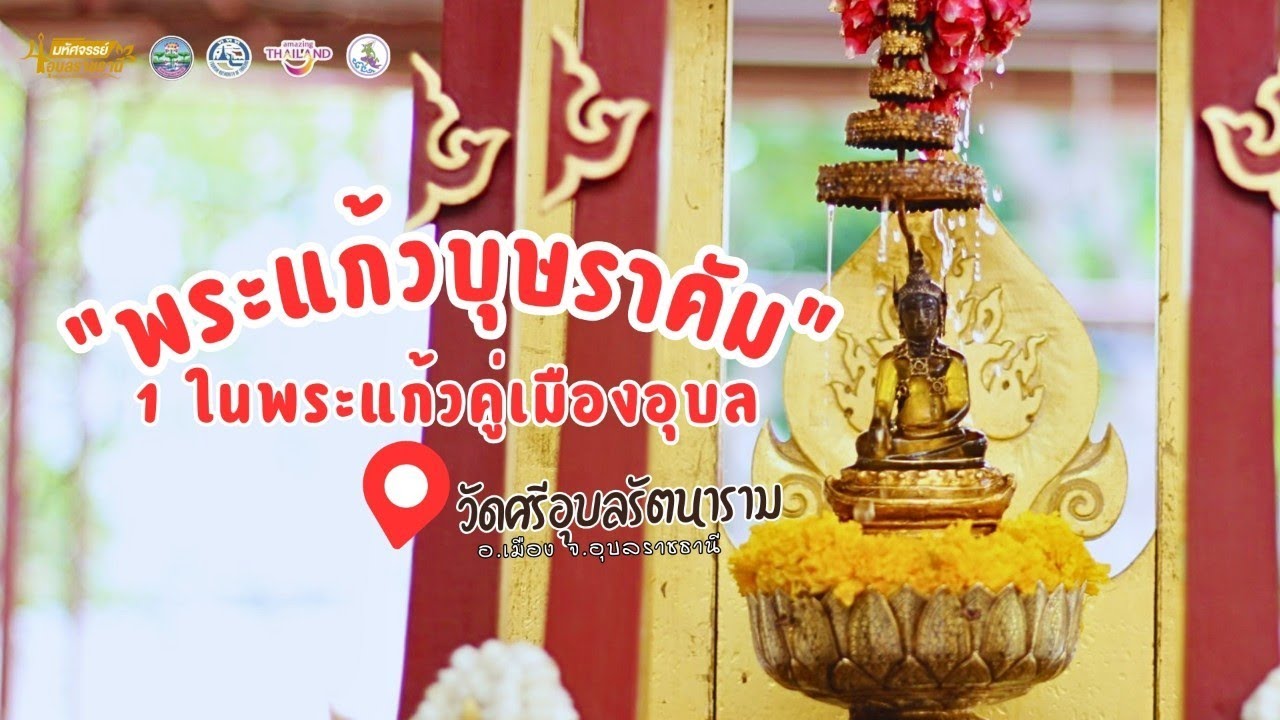
Inside the ordination hall is Phra Kaew Busarakham, the sacred Buddha image most closely associated with the temple. The image is in the subduing Mara posture and is carved from busarakham crystal. It is small in physical size, but immense in spiritual importance. The head is adorned with golden hair-like details, the body is decorated with ornaments, and the base is covered in gold. The image is admired not only because of its material and craftsmanship, but because of its long journey through history and the devotion that has surrounded it for generations. For the people of Ubon Ratchathani, Phra Kaew Busarakham is not simply an antique Buddha image. It is a living symbol of protection, continuity, and city identity.
The legend of Phra Kaew Busarakham links the image with the wider history of the Mekong region and the founding lineage of Ubon Ratchathani. According to local tradition, Phra Wor, together with descendants of Phra Ta such as Thao Kham Phong, Thao Thit Phrom, and Thao Kam, brought the image from the kingdom of Si Sattanakhanahut, or Vientiane. The image was first enshrined at Ban Don Mot Daeng before being brought into Ubon Ratchathani and eventually enshrined at Wat Si Ubon Rattanaram. This journey gives the Buddha image historical and emotional depth. It connects the temple with migration, political change, family lineage, religious devotion, and the creation of a new city on the Mun River.
Another strand of local tradition links Phra Kaew Busarakham with Chiang Rung, Lan Xang, Nong Bua Lam Phu, and the movements of the Phra Wor and Phra Ta communities before their arrival in Ubon Ratchathani. These layered narratives make the image more than a single temple object. It becomes a sacred witness to the movement of people, the spread of Buddhist faith, and the formation of regional identity across the Thai-Lao cultural world. When local people describe Phra Kaew Busarakham as a city Buddha image, the phrase carries real historical weight. The image represents continuity from old communities to the present city of Ubon Ratchathani.
During the period of absolute monarchy, Wat Si Ubon Rattanaram was used for the oath-taking ceremony known as the Drinking of the Water of Allegiance. Phra Kaew Busarakham was invited to preside over the ceremony. This was an important ritual of loyalty, truth, and responsibility in traditional governance. The use of Phra Kaew Busarakham as the presiding sacred image shows how deeply the image was trusted as a witness of sincerity and moral duty. The temple therefore played not only a religious role but also a civic and political role in the old structure of Ubon Ratchathani. It stood at the point where faith, authority, and city order met.
The annual Songkran procession of Phra Kaew Busarakham is one of the most meaningful traditions connected with the temple. On 13 April each year, the image is brought down from the ordination hall and carried in procession around Ubon Ratchathani so that local people and visitors can pay respect and bathe the image. This ceremony allows the sacred image to move from the temple into the city, symbolically blessing the community for the Thai New Year. Families, elders, children, workers, and visitors gather to participate. The procession is therefore both a religious event and a shared civic memory. It shows how a Buddha image can remain central to city life through repeated annual practice.
The Songkran ceremony also marks the opening of the traditional New Year season for many people in Ubon Ratchathani. The bathing of Phra Kaew Busarakham is believed to bring blessing, peace, and prosperity. For local families, the event is a time to reconnect with the city’s sacred centre. For visitors, it is a rare chance to see living Buddhist devotion beyond ordinary sightseeing. The image is not kept only as a museum-like treasure. It becomes part of the streets, the community, and the annual rhythm of the city. This is one of the clearest signs that Wat Si Ubon Rattanaram remains a living temple, not only a historic monument.
Another important area within the temple is the Si Ubon Rattanaram Museum. The museum is housed in an old wooden building that formerly served as a ho chaek, or temple communal hall. It is a large two-storey hardwood building with both architectural and historical value. Inside are Buddhist images, religious objects, scripture cabinets, palm-leaf manuscripts, manuscript wrappers, and other objects connected with Buddhist life in the Isan region. The museum helps visitors understand the temple beyond the ordination hall. It shows how Buddhist knowledge was preserved, wrapped, stored, displayed, and passed down through community participation.
The manuscript wrappers displayed in the museum are especially meaningful. In traditional Isan Buddhist culture, palm-leaf manuscripts preserved sermons, doctrine, stories, ritual texts, local knowledge, and religious learning. Creating manuscripts was considered a major act of merit. Women in the community, who did not usually inscribe the manuscripts themselves, often contributed through weaving cloth wrappers for them. These wrappers protected sacred texts and also represented devotion, skill, and the role of women in Buddhist cultural life. The museum therefore helps visitors see that Buddhism in Ubon Ratchathani was supported not only by monks and rulers, but by families, craft workers, and lay communities.
Wat Si Ubon Rattanaram is a third-class royal monastery of the ordinary type under the Dhammayut order. This status gives the temple an important role in provincial religious ceremonies, royal kathin offerings, Buddhist events, and monastic activities. Phra Ratchathammasuthi (Thongkhu Sukkhawattano, Pali Grade 6) serves as the abbot of the temple and is an important Dhammayut monk in the province. The temple’s role is therefore wider than tourism. It remains a centre for Buddhist practice, formal ceremonies, community merit-making, and provincial religious life.
Architecturally, Wat Si Ubon Rattanaram is an excellent place to understand how central Thai royal temple design was adapted into a local context. The ordination hall recalls the refinement of Wat Benchamabophit in Bangkok, but its meaning in Ubon Ratchathani comes from Phra Kaew Busarakham, the Songkran procession, local legends, and the temple’s museum. The building may appear to reflect Bangkok style, but the spiritual content belongs deeply to Ubon Ratchathani. This is what makes the temple so interesting. It is not simply a copy of another temple. It is a sacred space where national architectural influence and local identity meet.
For Thai visitors, the temple is ideal for worship and old-city walking. A good visit begins inside the ordination hall, where visitors pay respect to Phra Kaew Busarakham. After that, walk outside to observe the roofline, gable details, and architectural balance of the ordination hall. If visiting between Wednesday and Sunday, continue to the Si Ubon Rattanaram Museum to see Buddhist objects, palm-leaf manuscript culture, and the old wooden hall. From the temple, visitors can walk or drive a short distance to Thung Si Mueang, the City Pillar Shrine, Ubon Ratchathani National Museum, and Wat Thung Si Mueang. This route gives a compact but rich view of the old city.
For foreign travelers, Wat Si Ubon Rattanaram is a strong introduction to Buddhism in Ubon Ratchathani because it combines a sacred city image, Mekong-region historical memory, royal temple status, Bangkok-inspired architecture, local museum culture, and an annual Songkran procession. It shows that Buddhism in Ubon Ratchathani is not confined to temple buildings. It is linked with rulers, migration, family memory, oath ceremonies, manuscript culture, public festivals, and the daily faith of local people. Travelers interested in Thai Buddhism, Isan culture, or sacred art will find this temple especially rewarding.
Wat Si Ubon Rattanaram is open daily for worship from 04.30 to 22.00, and admission is free. The Si Ubon Rattanaram Museum inside the temple opens Wednesday to Sunday from 08.00 to 16.00 and also does not charge admission. Visitors who want to see both the ordination hall and the museum should plan their visit during museum opening days. Early morning is suitable for quiet worship, while late afternoon is good for combining the temple with Thung Si Mueang and nearby old-city restaurants. During Songkran, the temple is especially important because of the Phra Kaew Busarakham procession.
Respectful behaviour is essential. Wat Si Ubon Rattanaram is a royal monastery, an active Buddhist temple, and the home of a sacred city Buddha image. Visitors should dress modestly, remove shoes before entering the ordination hall, keep voices low, avoid touching sacred objects, and follow any photography rules inside the ordination hall and museum. Photography outside the buildings is generally suitable, but inside sacred spaces visitors should observe signs or ask temple staff. A calm and respectful visit allows travelers to experience the temple not only as a visual landmark but as a living spiritual centre.
Getting There is easy because the temple is located on Upparat Road in the old city area of Ubon Ratchathani, near Thung Si Mueang and the City Pillar Shrine. From Ubon Ratchathani International Airport, the trip usually takes about 10 to 15 minutes depending on traffic. From Ubon Ratchathani Railway Station in Warin Chamrap District, visitors can cross the Mun River into the city and continue to Upparat Road, normally taking about 15 to 25 minutes. The temple can be reached by private car, taxi, local hired vehicle, songthaew, or ride-hailing service.
Wat Si Ubon Rattanaram can be included in several sightseeing routes. A temple-focused route can connect it with Wat Thung Si Mueang, Wat Maha Wanaram, Wat Supattanaram Worawihan, and Wat Phra That Nong Bua. A historical route can include Ubon Ratchathani National Museum, Thung Si Mueang, the City Pillar Shrine, and the old-town area. During Songkran, the temple should be a main stop because of the annual procession of Phra Kaew Busarakham. This makes the temple important in both ordinary travel and festival travel.
Overall, Wat Si Ubon Rattanaram is one of the most meaningful temples in Ubon Ratchathani. It preserves Phra Kaew Busarakham, a sacred Buddha image tied to the city’s founding memory. It contains a Bangkok-inspired ordination hall, a museum of Buddhist objects and manuscript culture, a royal monastery identity, and a living Songkran tradition. A visit here is not only an opportunity to worship or admire architecture. It is a direct encounter with the religious heart of Ubon Ratchathani, expressed through a sacred image, a royal temple, community tradition, and the enduring faith of local people.
| Name | Wat Si Ubon Rattanaram / Wat Si Thong, Ubon Ratchathani |
| Location | Upparat Road, Nai Mueang Subdistrict, Mueang Ubon Ratchathani District, Ubon Ratchathani Province, south of the former provincial hall and near Thung Si Mueang and the City Pillar Shrine |
| Address | 129 Upparat Road, Nai Mueang, Mueang Ubon Ratchathani, Ubon Ratchathani 34000, Thailand |
| Coordinates | 15.228056, 104.856111 |
| Highlights | Phra Kaew Busarakham, The Sacred City Buddha Image Of Ubon Ratchathani, The Wat Benchamabophit-Inspired Ordination Hall, Si Ubon Rattanaram Museum, And The Songkran Procession Of Phra Kaew Busarakham |
| History | Established In 1855 During The Reign Of King Rama IV. Formerly Known As Wat Si Thong, The Temple Became An Important Dhammayut Royal Monastery And The Home Of Phra Kaew Busarakham. |
| Name Origin | Wat Si Thong Refers To The Auspicious Golden Light Seen In The Donated Garden Area, While Wat Si Ubon Rattanaram Refers To A Sacred Temple Of Ubon Ratchathani Associated With A Precious Jewel-Like Buddha Image. |
| Distinctive Features | An Ordination Hall Built In The Style Of Wat Benchamabophit In Bangkok, Enshrining Phra Kaew Busarakham, A Small Subduing-Mara Buddha Image Carved From Busarakham Crystal And Revered As A City Buddha Image Of Ubon Ratchathani |
| Travel Information | Located On Upparat Road Near Thung Si Mueang And The City Pillar Shrine. The Temple Is About 10 – 15 Minutes From Ubon Ratchathani International Airport And About 15 – 25 Minutes From Ubon Ratchathani Railway Station By Car, Depending On Traffic. |
| Current Status | Open To Visitors And Still Used As An Active Royal Buddhist Monastery With Religious Ceremonies, Provincial Buddhist Events, And The Annual Songkran Procession Of Phra Kaew Busarakham |
| Open Days | Daily |
| Opening Hours | 04.30 – 22.00 |
| Fees | Free Admission |
| Museum Opening Hours | Si Ubon Rattanaram Museum Opens Wednesday – Sunday, 08.00 – 16.00, Closed Monday – Tuesday, Free Admission |
| Facilities | Parking Area, Worship Area, Ordination Hall, Museum, Restrooms, Temple Courtyard, Walkways, And Spaces For Buddhist Ceremonies |
| Main Areas / Zones | Wat Benchamabophit-Inspired Ordination Hall Phra Kaew Busarakham Enshrinement Area Si Ubon Rattanaram Museum Former Ho Chaek / Old Temple Communal Hall Buddhist Image And Religious Object Display Area Palm-Leaf Manuscript And Manuscript Wrapper Display Area Temple Courtyard And Songkran Ceremony Area Monastic And Royal Monastery Activity Areas |
| Caretaker | Wat Si Ubon Rattanaram Royal Monastery, The Dhammayut Monastic Community, And Buddhist Supporters In Ubon Ratchathani |
| Abbot | Phra Ratchathammasuthi (Thongkhu Sukkhawattano, Pali Grade 6) |
| First Abbot | Phra Thewathammi (Mao) |
| Main Contact Number | Wat Si Ubon Rattanaram: 045-240-005 Si Ubon Rattanaram Museum: 045-241-660, 087-239-2559 |
| Important Annual Tradition | The Songkran Procession And Bathing Ceremony Of Phra Kaew Busarakham Begins On 13 April Every Year, Allowing Local People And Visitors To Pay Respect And Bathe The Sacred City Buddha Image. |
| Nearby Tourist Attractions | 1. Thung Si Mueang, About 0.2 km 2. Ubon Ratchathani City Pillar Shrine, About 0.2 km 3. Ubon Ratchathani National Museum, About 0.4 km 4. Wat Thung Si Mueang, About 0.8 km 5. Wat Maha Wanaram / Wat Pa Yai, About 1.7 km 6. Wat Supattanaram Worawihan, About 1.8 km 7. Wat Burapharam, About 2.5 km 8. Wat Phra That Nong Bua, About 4.5 km |
| Nearby Restaurants | 1. Arabus Experience Café, Central Ubon Ratchathani, About 0.3 km, Tel. 098-280-5260 2. Pak Mor Na Amper (Pak Mor Robot), About 0.3 km, Tel. 086-710-9768 3. Guay Tiew Mit Samphan Ubon Ratchathani, About 0.3 km, Tel. 085-611-6420 4. Kole Bakery Bar Main Branch, About 0.4 km, Tel. 061-294-6535 5. Normal Ubon, About 0.4 km, Tel. 088-225-1000 6. The Ratchathani Hotel And Restaurant, About 0.5 km, Tel. 090-270-1010 |
| Nearby Accommodations | 1. The Ratchathani Hotel, About 0.5 km, Tel. 045-244-388 2. Ubon Hotel, About 0.7 km, Tel. 045-241-045 3. YUU Hotel & Cafe, About 1 km, Tel. 085-614-1111 4. T3 House, About 1.2 km, Tel. 045-244-911 5. Laithong Hotel, About 1.5 km, Tel. 045-264-271 6. Nartsiri Hotel, About 2 km, Tel. 082-369-3252, 045-262-980, 045-243-051-2 |
Frequently Asked Questions (FAQ)
Q: Where is Wat Si Ubon Rattanaram located?
A: Wat Si Ubon Rattanaram is located at 129 Upparat Road, Nai Mueang Subdistrict, Mueang Ubon Ratchathani District, Ubon Ratchathani Province, near Thung Si Mueang, the City Pillar Shrine, and Ubon Ratchathani National Museum.
Q: What are the opening hours of Wat Si Ubon Rattanaram?
A: The temple is open daily for worship from 04.30 to 22.00. Si Ubon Rattanaram Museum inside the temple opens Wednesday to Sunday from 08.00 to 16.00.
Q: Is there an admission fee?
A: No. Admission to the temple and the museum is free.
Q: What is Wat Si Ubon Rattanaram famous for?
A: The temple is famous for Phra Kaew Busarakham, the sacred city Buddha image of Ubon Ratchathani, its Wat Benchamabophit-inspired ordination hall, Si Ubon Rattanaram Museum, and the annual Songkran procession of Phra Kaew Busarakham.
Q: What kind of Buddha image is Phra Kaew Busarakham?
A: Phra Kaew Busarakham is a Buddha image in the subduing Mara posture, carved from busarakham crystal. It is revered as one of the most important sacred Buddha images of Ubon Ratchathani.
Q: Who is the abbot of Wat Si Ubon Rattanaram?
A: The abbot of Wat Si Ubon Rattanaram is Phra Ratchathammasuthi (Thongkhu Sukkhawattano, Pali Grade 6).
Q: When is the Phra Kaew Busarakham procession held?
A: The procession is held during Songkran, beginning on 13 April every year, when Phra Kaew Busarakham is carried around Ubon Ratchathani for public worship and bathing.
Q: What nearby attractions can be visited after Wat Si Ubon Rattanaram?
A: Nearby attractions include Thung Si Mueang, the Ubon Ratchathani City Pillar Shrine, Ubon Ratchathani National Museum, Wat Thung Si Mueang, Wat Maha Wanaram, Wat Supattanaram Worawihan, and Wat Burapharam.
 Category: ●Places of Worship
 Group: ●Temple
Last Update : 3 MonthAgo
 Last Update : 3 MonthAgo
 Click to Access the Navigation Map GPS
Wat Si Ubon Rattanaram (Wat Si Thong) Map
Recommend

 Art, Culture and Heritage
 Historical Sites and Monuments(5)
 Landmarks and Memorials(2)
 Royal Palace(1)
 Art, Craft Centres, Tradition(7)
 Museums(3)
Temple(37)
 Other Sacred Sites(4)
 Research and Development
 Royal Project(2)
 Suburban Living
 Village, Community(2)
 Local Market(4)
 Nature and Wildlife
 National Parks and Marine Reserves(5)
 Mountain (Doi)(6)
 Dam, Reservoir, Lake(8)
 Waterfalls(12)
 Hot Springs(1)
 Caves(2)
 River, Canal(11)
 Bays and Beaches(8)
 Islands(2)
 Other natural attractions(6)
 Entertainment and Agricultural
 Zoos and Aquariums(2)
 Animal camps and shows(1)
 Farms, Parks and Ecotourism(1)
 Waterpark(1)
 Travel Articles, Recipes
 Travel Review, Food Review(1)


