
lovethailand home >Northeastern Travel Attractions >Maha Sarakham Travel Attractions >Na Dun >Phra That > Phra That Na Dun
TL;DR: Phra That Na Dun is located at Ban Na Dun, Khok Dong Kheng Area, Phra That Subdistrict, Na Dun District, Maha Sarakham Province, open Daily, hours 08.00 – 17.00.
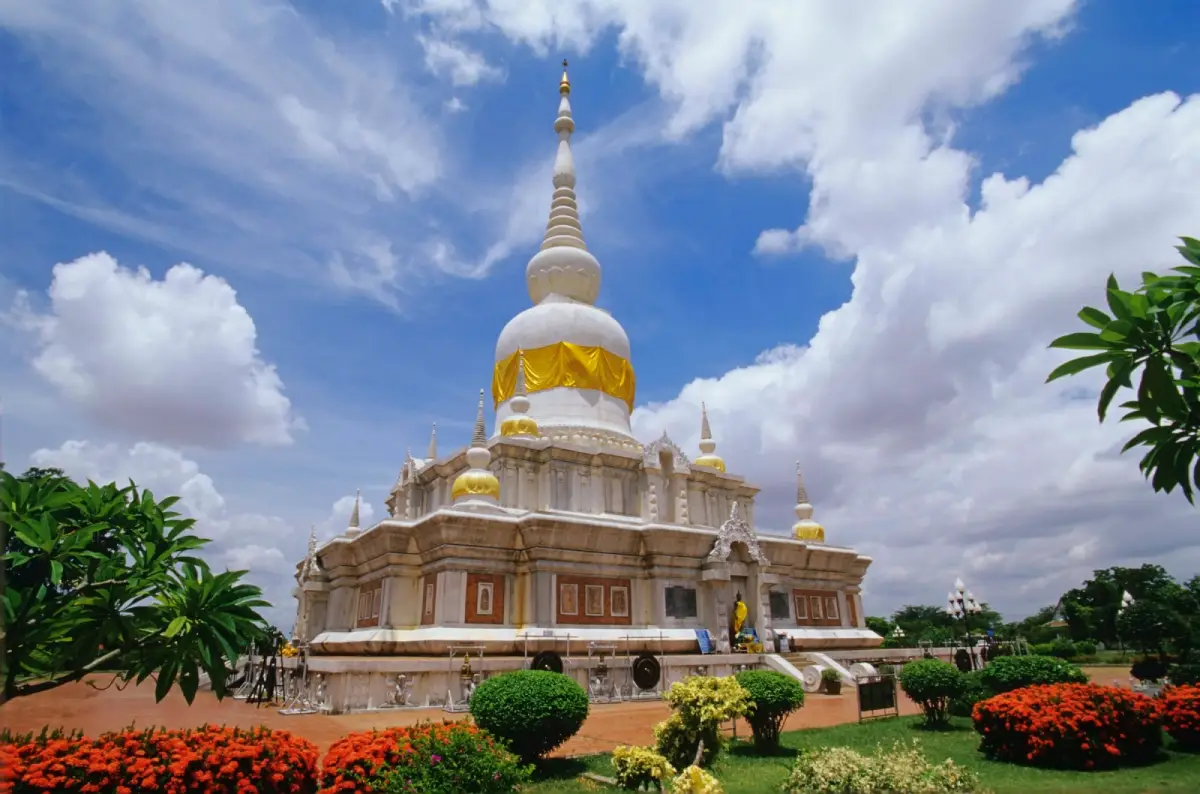
Phra That Na Dun
Open Days: Daily
Opening Hours: 08.00 – 17.00
Phra That Na Dun in Maha Sarakham Province, also known as Phra Borommathat Na Dun, is one of the most important Buddhist pilgrimage sites in northeastern Thailand. Located in Ban Na Dun, Khok Dong Kheng area, Phra That Subdistrict, Na Dun District, Maha Sarakham Province, the stupa is widely known as the “Buddhist Center of Isan”. It enshrines sacred relics of the Buddha discovered in the ancient city area of Nakhon Champa Si, making it both a revered religious site and a significant historical landmark.
The importance of Phra That Na Dun lies not only in the beauty of its white-and-gold stupa, but also in the historical landscape beneath it. Na Dun District was once associated with Nakhon Champa Si, an ancient city that flourished during the Dvaravati period around the 13th to 15th Buddhist centuries. Numerous archaeological objects discovered in this area show that Na Dun was once a prosperous center of religion, art, trade, settlement, and cultural exchange in the central Isan region.
Phra That Na Dun is suitable for travelers who want to combine Buddhist worship, history, archaeology, and quiet reflection in one visit. The site stands within a large area known as the Buddhist Center of Isan, with the main stupa at its heart. Around it are open ceremonial spaces, walking areas, cultural and religious museum zones, an arboretum, an herb garden, rest pavilions, water features, and landscaped green areas. This makes the site meaningful not only for worshippers, but also for cultural travelers and students of Thai history.
The modern history of Phra That Na Dun began in 1979, when relics of the Buddha were discovered in an ancient mound in Na Dun District. The relics were enshrined within a three-layered reliquary: the inner container made of gold, the middle container made of silver, and the outer container made of bronze. These containers were placed inside a small metal stupa. The discovery was regarded as one of the most significant Buddhist and archaeological events in Maha Sarakham Province.
After the discovery, local people, government agencies, and Buddhist communities agreed that a permanent stupa should be built to enshrine the relics with dignity. The Thai government approved the construction of Phra That Na Dun on a site covering more than 902 rai at Khok Dong Kheng. The location is about 2 km southwest of the excavation site and about 1 km south of the Na Dun District Office. The project was intended to create a major Buddhist and cultural center for northeastern Thailand.
The construction of the Buddhist Center of Isan took place between 1982 and 1986. Phra That Na Dun was designed as the central sacred structure of the complex. Its multi-tiered form, elegant white body, golden upper section, and symbolic spire create a calm and dignified appearance. The relics of the Buddha are enshrined within the stupa, making it a sacred destination for Buddhists from Maha Sarakham, across Isan, and throughout Thailand.
Nakhon Champa Si is essential to understanding Phra That Na Dun. The ancient city area contains traces of moats, earthworks, ancient sites, votive tablets, pottery, and other cultural objects. Many important artifacts discovered in the area are preserved and displayed at Khon Kaen National Museum and local museums connected with Champa Si history. These remains show that Na Dun was once a major historical settlement long before the rise of modern provincial towns.
The cultural development of Nakhon Champa Si reflects Buddhist influence, Dvaravati art, and the emergence of urban life in ancient Isan. The discovery of Buddha relics and other artifacts is therefore part of a wider historical picture. It shows that the area around Na Dun was not an isolated rural settlement, but a place of religious and cultural importance within the ancient landscape of northeastern Thailand.
Visitors interested in archaeology should visit Phra That Na Dun together with Champa Si Museum. The stupa represents the living Buddhist devotion that grew from the relic discovery, while the museum helps explain the ancient city, archaeological objects, and cultural context. Seeing both places allows visitors to understand why Phra That Na Dun is more than a beautiful stupa; it is a bridge between ancient history and living faith.
The stupa itself is striking for its calm and dignified appearance. Its white surface gives a feeling of purity, while the golden details add a sense of auspiciousness and sacred importance. The broad plaza around the stupa allows visitors to walk in a clockwise direction, pray, meditate, and view the monument from different angles. On clear days, the stupa stands out beautifully against the sky and becomes one of the most memorable images of Maha Sarakham Province.
Phra That Na Dun is an important place for merit-making and prayer. Visitors come to ask for blessings, inner peace, success in study and work, family well-being, good health, and safe travel. Some come specifically to worship the Buddha relics, while others visit with family members to teach younger generations about local history. The site is also especially important during the annual worship festival, when the area becomes a major gathering place of faith.
The annual Phra Borommathat Na Dun worship festival is one of the most important religious events in Maha Sarakham Province. It is held around Makha Bucha Day and includes merit-making, processions, candlelight ceremonies, cultural performances, and Buddhist activities. The festival reflects the collective devotion of local communities and reinforces the role of Phra That Na Dun as a spiritual center of the province.
During the annual festival, the area becomes much more crowded than usual. Travelers who want to experience the living faith of Maha Sarakham should consider visiting during this period, but they should plan carefully for traffic, parking, and accommodation. Those who prefer a quiet visit for meditation, photography, or personal worship should choose a weekday or early morning outside the festival period.
The Buddhist Center of Isan around Phra That Na Dun was planned as more than a single religious monument. Its surrounding areas include Champa Si Museum, an arboretum, an herb garden, pavilions, water areas, walking paths, and green spaces. These elements support the site’s role as a center of Buddhism, culture, learning, and peaceful recreation in northeastern Thailand.
Champa Si Museum is one of the most useful places to visit after paying respect at the stupa. It helps explain the ancient city, artifacts, religious history, and cultural development of the Na Dun area. For students, cultural travelers, and foreign visitors, the museum adds essential context and turns a temple visit into a deeper historical experience.
The surrounding grounds are suitable for a calm walk. Visitors can begin by paying respect to the main stupa, then walk clockwise around it, rest in the pavilions, explore the green areas, and continue to the museum or nearby archaeological sites. This slower style of travel allows visitors to experience the site through faith, nature, and historical learning.
From an art and heritage perspective, Phra That Na Dun is a modern sacred stupa built to preserve and honor an ancient relic discovery. It is not an original ancient monument in the same sense as a Khmer sanctuary or archaeological ruin. Its significance comes from the way it connects ancient Dvaravati evidence with contemporary Buddhist devotion. It transforms an archaeological discovery into a living place of worship.
For the people of Maha Sarakham, Phra That Na Dun is one of the province’s strongest symbols. It brings together history, Buddhism, relic worship, local pride, and Isan identity. Many families visit during important days such as New Year, Songkran, Buddhist holy days, birthdays, or before beginning important life events. Worshipping at Phra That Na Dun is therefore both a religious act and a cultural family tradition.
For foreign travelers, Phra That Na Dun should be understood as a Buddhist relic stupa rather than simply a temple. It enshrines relics of the Buddha discovered in an ancient Dvaravati-period context and is connected with the ancient city of Nakhon Champa Si. This explanation helps visitors understand why the site is so deeply revered by local people and why it is considered the Buddhist Center of Isan.
Visitors should dress modestly and behave respectfully. Quiet speech is recommended around worship areas. Visitors should not climb on restricted structures, touch sacred objects unnecessarily, or disturb people who are praying. During the annual festival, visitors should give space to processions, monks, and ritual participants. Respectful behavior is essential at a sacred Buddhist site.
The best times to visit are in the morning or late afternoon, when the weather is cooler and the light is suitable for photography. Morning visits are peaceful and ideal for worship and reflection. Late afternoon offers softer light and a calm atmosphere around the stupa. Visitors who wish to make offerings should prepare flowers, candles, incense, or other appropriate items and follow local guidance.
Getting There from Maha Sarakham city is straightforward by private car. Take Highway 2040 through Kae Dam District and Wapi Pathum District, then turn right onto Highway 2045 toward Na Dun District. The road is paved throughout the route. The distance from Maha Sarakham city is about 65 km. Traveling by private car is the most convenient option because visitors can continue easily to Champa Si Museum, Ku Santarat, Ku Noi, and restaurants in Na Dun.
Public transport is also possible, but it requires more planning. Travelers can take a bus or van on the Maha Sarakham – Buriram route and get off near the Na Dun intersection, then continue by local transport to Phra That Na Dun, which is about 2.5 km from the intersection. Because local transport may not be available at all times, visitors who want to see several places in Na Dun should consider hiring a local vehicle.
A half-day itinerary can include Phra That Na Dun, Champa Si Museum, and nearby community areas. A full-day route can add Ku Santarat, Ku Noi, Wat Pa Kung, or Kae Dam Wooden Bridge. This kind of trip allows visitors to experience Buddhist relic worship, Dvaravati history, Khmer-period remains, and local Isan community life in one journey.
Restaurants, cafés, and accommodations around Na Dun have become more available. Visitors can find local Thai restaurants, noodle shops, grilled chicken, cafés, resorts, pool villas, and small local accommodations. During the annual worship festival, long weekends, and Buddhist holidays, advance booking is recommended because many people travel to Na Dun during these periods.
A visit to Phra That Na Dun can take from 1 hour to half a day, depending on interest. A short visit is enough for worship and photography, but travelers who want to understand the site properly should allow more time for the museum, gardens, and nearby archaeological places. A slower visit reveals the full value of Phra That Na Dun as both a sacred Buddhist site and a historical gateway to ancient Isan.
Overall, Phra That Na Dun in Maha Sarakham is much more than a large stupa. It brings together Buddha relics, the ancient city of Nakhon Champa Si, Dvaravati archaeological evidence, Isan Buddhist devotion, an annual worship festival, and the landscape of the Buddhist Center of Isan. Anyone who wants to understand Maha Sarakham deeply should visit Phra That Na Dun at least once and experience its calm atmosphere, historical depth, and living faith.
| Name | Phra That Na Dun, or Phra Borommathat Na Dun |
| Location | Ban Na Dun, Khok Dong Kheng Area, Phra That Subdistrict, Na Dun District, Maha Sarakham Province |
| Address | Phra That Subdistrict, Na Dun District, Maha Sarakham 44180, Thailand |
| Coordinates | 15.703254, 103.227114 |
| Highlights | Major Buddhist relic stupa of Maha Sarakham Province, known as the Buddhist Center of Isan and connected with the ancient city of Nakhon Champa Si |
| History | Associated with Nakhon Champa Si and Dvaravati-period archaeology from around the 13th to 15th Buddhist centuries. Buddha relics were discovered in 1979, and the present stupa was constructed between 1982 and 1986. |
| Name Origin | The name Phra That Na Dun refers to the sacred stupa located in Na Dun District. Phra Borommathat means a stupa enshrining relics of the Buddha. |
| Distinctive Features | White-and-gold stupa standing at the center of the Buddhist Center of Isan, surrounded by worship areas, cultural learning spaces, gardens, and landscaped grounds |
| Sacred Objects / Key Features | Buddha relics, gold reliquary, silver reliquary, bronze reliquary, miniature stupa, Phra That Na Dun stupa, and surrounding worship area |
| Related Tradition / Ritual | Annual Phra Borommathat Na Dun worship festival around Makha Bucha Day, with merit-making, processions, candlelight ceremonies, and Buddhist activities |
| Travel Information | From Maha Sarakham city, take Highway 2040 through Kae Dam and Wapi Pathum, then turn right onto Highway 2045 toward Na Dun District. The route is paved throughout and is about 65 km from the city. |
| Current Status | Open daily for worshippers and visitors |
| Open Days | Daily |
| Opening Hours | 08.00 – 17.00 |
| Fees | No admission fee |
| Facilities | Parking area, worship plaza, walking paths around the stupa, rest pavilions, water areas, arboretum, herb garden, and visitor service areas |
| Main Areas / Zones | Phra That Na Dun stupa, clockwise walking area, worship plaza, Champa Si Museum, arboretum, herb garden, rest pavilions, water areas, and Buddhist Center of Isan grounds |
| Caretaker / Related Authority | Phra Borommathat Na Dun Development and Conservation Fund, Phra That Subdistrict local authority, and public agencies in Na Dun District |
| Main Contact Number | Phra That Na Dun, Tel. 043-797-129 Phra That Subdistrict Administrative Organization, Tel. 043-750-374 |
| Official Website / Official Page | Nakhon Champa Si Historical Study Center, Phra That Na Dun, and Phra That Subdistrict Administrative Organization, Na Dun District, Maha Sarakham Province |
| Nearby Tourist Attractions | 1. Champa Si Museum, about 1 km 2. Phan Pi Champa Si Nakhon Community Market, about 1 km 3. Nakhon Champa Si Archaeological Area, about 2 km 4. Ku Santarat, about 6 km 5. Ku Noi, about 7 km 6. Na Dun District and Phra That Community Area, about 2 km 7. Wat Pa Kung or Wat Prachakhom Wanaram, about 35 km 8. Kae Dam Wooden Bridge, about 45 km |
| Nearby Restaurants | 1. Chang Thong Kham Elephant Dung Coffee, about 1 km, Tel. 093-686-9016, 080-604-2879 2. Kuai Tiao Ruea Chao Wang, about 1 km 3. Wichian Buri Grilled Chicken, Original Branch, about 1 km 4. Krua Na Dun, about 2 km, Tel. 093-475-7855 5. Lo Don Non Na Cafe, about 3 km, Tel. 092-489-3008 6. 4 NAKA CAFE 2465, about 3 km, Tel. 089-518-7526 |
| Nearby Accommodations | 1. Inaka Resort, about 3 km, Tel. 089-518-7526 2. INAKA Pool Villa, about 3 km, Tel. 082-935-4598, 083-369-0694 3. Lo Don Non Na, about 3 km, Tel. 092-489-3008 4. Lookkaew Resort Na Dun Branch, about 5 km, Tel. 043-020-442 5. Baan Charnchol Resort Maha Sarakham, about 49 km, Tel. 094-929-6201 6. Top Inn Hotel Maha Sarakham, about 65 km, Tel. 043-711-979 |
Frequently Asked Questions (FAQ)
Q: Where is Phra That Na Dun located?
A: Phra That Na Dun is located in Ban Na Dun, Khok Dong Kheng area, Phra That Subdistrict, Na Dun District, Maha Sarakham Province.
Q: Why is Phra That Na Dun important?
A: It is a major Buddhist relic stupa of Maha Sarakham Province and the Buddhist Center of Isan. It enshrines relics of the Buddha discovered in the ancient city area of Nakhon Champa Si.
Q: What are the opening hours of Phra That Na Dun?
A: Phra That Na Dun is open daily from 08.00 to 17.00.
Q: Is there an admission fee?
A: No. Visitors can enter and pay respect to Phra That Na Dun free of charge during opening hours.
Q: When is the annual Phra That Na Dun worship festival held?
A: The annual worship festival is held around Makha Bucha Day and includes merit-making, processions, candlelight ceremonies, and Buddhist activities.
Q: How is Phra That Na Dun connected with Nakhon Champa Si?
A: Na Dun District was once associated with the ancient city of Nakhon Champa Si, a Dvaravati-period settlement where Buddha relics and many archaeological objects were discovered.
Q: How can travelers get from Maha Sarakham city to Phra That Na Dun?
A: From Maha Sarakham city, take Highway 2040 through Kae Dam and Wapi Pathum, then turn right onto Highway 2045 toward Na Dun District. The distance is about 65 km.
Q: What nearby places can travelers visit after Phra That Na Dun?
A: Travelers can continue to Champa Si Museum, Phan Pi Champa Si Nakhon Community Market, Ku Santarat, Ku Noi, Wat Pa Kung, and Kae Dam Wooden Bridge.
 Category: ●Places of Worship
 Group: ●Other Sacred Sites
Last Update : 2 MonthAgo
 Last Update : 2 MonthAgo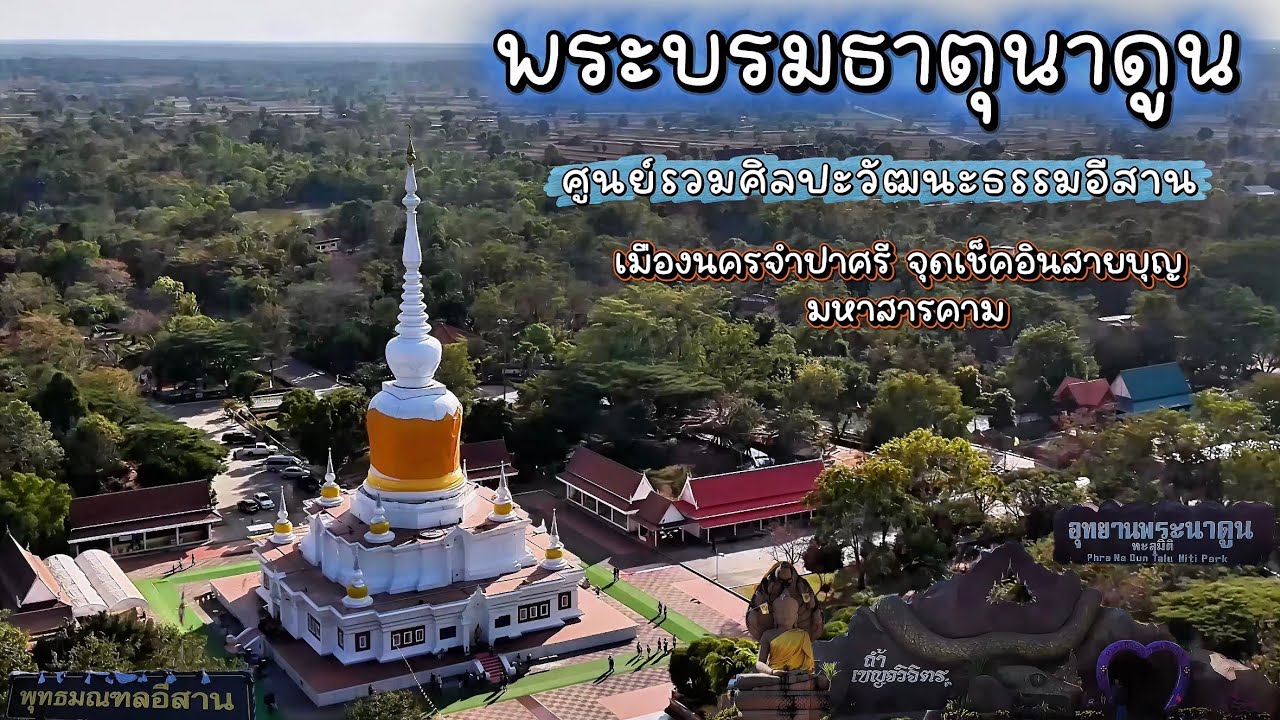
 Click to Access the Navigation Map GPS
 Art, Culture and Heritage
 Historical Sites and Monuments(4)
 Art, Craft Centres, Tradition(5)
 Museums(3)
 Temple(17)
Other Sacred Sites(7)
Temple(17)
Other Sacred Sites(7)
 Research and Development
 Royal Project(2)
 Suburban Living
 Village, Community(5)
 Nature and Wildlife
 National Parks and Marine Reserves(3)
 Dam, Reservoir, Lake(10)
 River, Canal(2)
 Bays and Beaches(2)
 Other natural attractions(2)
 Entertainment and Agricultural
 Farms, Parks and Ecotourism(3)
 Travel Articles, Recipes
 Food Menu, Northeastern Recipes(1)


