
lovethailand home >Central Travel Attractions >Phranakhon Si Ayutthaya Travel Attractions > 20 Best Train Trips in Thailand
TL;DR: 20 Best Train Trips in Thailand.
20 Best Train Trips in Thailand
20 Best Train Trips in Thailand: Scenic Railway Routes, Historic Cities, Beaches, and Travel Itineraries Traveling by train is one of the most rewarding ways to explore Thailand because the journey itself becomes part of the experience. Whether you are watching rice fields pass by your window, observing houses and local communities along the railway, arriving in a historic city, or traveling through mountains, across rivers, and toward the coast, Thailand offers a remarkable variety of railway journeys. The country's rail network connects many important travel destinations, allowing visitors to plan anything from a simple day trip to an overnight getaway, depending on the distance, available connections, and preferred travel pace.
For travelers wondering where to go by train in Thailand, this guide brings together 20 railway travel routes across the country, covering Central, Northern, Eastern, Northeastern, and Southern Thailand. The destinations range from convenient trips near Bangkok, such as Ayutthaya, Nakhon Pathom, Mahachai, and Mae Klong, to scenic railway journeys through Kanchanaburi, Khun Tan, and Chiang Mai, as well as attractive destinations in Southern Thailand. Each route includes carefully selected places to visit, suggested sightseeing times, and practical guidance on reaching the attractions from the railway station.
Train travel in Thailand suits many kinds of visitors, including people traveling without a private car, budget-conscious travelers, families who want their children to experience a railway journey, older travelers who prefer a more relaxed pace, and international visitors interested in discovering Thai culture and everyday life through public transportation. Some attractions can be reached on foot or by a short local taxi ride from the station, while others require an additional bus, ferry, boat, or longer road transfer. Planning each journey around the train timetable and local transportation options is therefore essential.
Travelers who wish to experience all 20 routes as separate trips should allow approximately 41 sightseeing days based on the recommended itineraries. Additional time may be needed for travel between regions, overnight rail journeys, and connections between trains. However, there is no need to complete all 20 routes in a single journey. Visitors can simply choose the destinations that interest them most, with options ranging from one-day excursions to two-day, one-night breaks and three-day itineraries that are ideal for weekends or longer holidays.
Before traveling, check the latest departure and arrival times with the State Railway of Thailand through its D-Ticket system or official railway timetable. Different services may have different stopping patterns, journey times, and operating days. This is particularly important for special tourist trains, including the Pa Sak Jolasid Dam excursion and the Suan Son Pradipat beach train, which operate according to specific programs and announced schedules rather than as unrestricted daily tourist services.
Route 1: Bangkok to Ayutthaya by Train — A One-Day Journey Through a UNESCO World Heritage City Phra Nakhon Si Ayutthaya is one of the best destinations for anyone beginning to explore Thailand by train. The city can be reached from Bangkok on Northern Line or Northeastern Line trains that stop at Ayutthaya Railway Station. The journey generally takes approximately 1 hour 30 minutes to 2 hours, depending on the departure station and train service. After arriving at Ayutthaya Station, visitors can continue to Ayutthaya Island by local transport or by using an appropriate river-crossing connection.
The appeal of traveling to Ayutthaya by train lies in the experience of moving from Thailand's modern capital to the former royal capital, which was once a major political, economic, religious, and international trading center of Siam. The Historic City of Ayutthaya was inscribed on the UNESCO World Heritage List in 1991. Visiting Ayutthaya is therefore much more than an opportunity to photograph ancient ruins. It is a journey into the history and prosperity of the Ayutthaya Kingdom, revealed through the temples, religious monuments, and architectural remains that survive today.
A full day is recommended for this route. Allow approximately 3–4 hours for the return train journey, around 4–5 hours to explore the historic monuments, and an additional 1–2 hours for meals and transportation between attractions.
1.1 Wat Mahathat, Ayutthaya
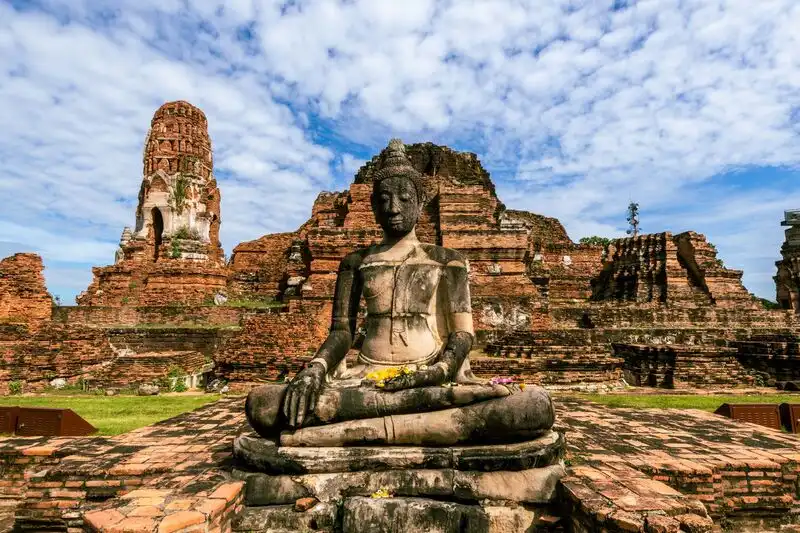
Wat Mahathat is one of the most significant ancient monuments within Ayutthaya Historical Park. Located in the central area of Ayutthaya Island, the temple was closely associated with Buddhism during the Ayutthaya period. Its grounds contain the remains of prangs, chedis, assembly halls, and other religious buildings that reflect the temple's former importance. Although many structures were damaged during historical conflicts, the surviving remains provide a clear impression of the architectural traditions and religious functions of a major temple in the former capital.
The temple's most famous feature is a sandstone Buddha head embraced by the roots of a bodhi tree. This remarkable image has become one of the best-known symbols of Ayutthaya. Visitors can walk through the surrounding archaeological site and examine the surviving structures while following the conservation rules and showing respect toward the Buddha images and sacred grounds.
Allow approximately 45–60 minutes to explore Wat Mahathat. It is an ideal first stop on an Ayutthaya railway day trip after crossing from the railway station to the historic island.
More Information:Wat Mahathat, Phra Nakhon Si Ayutthaya
1.2 Wat Ratchaburana, Ayutthaya

Wat Ratchaburana is located close to Wat Mahathat and is another important temple associated with the Ayutthaya Kingdom. It was established during the reign of King Borommarachathirat II, also known as Chao Sam Phraya, in the 15th century. The temple is particularly notable for its large central prang, decorated with stucco patterns and architectural features typical of the early Ayutthaya period. The surrounding grounds also contain the remains of assembly halls, chedis, and other buildings that demonstrate the temple's importance as a religious site associated with the royal court.
Wat Ratchaburana also has considerable archaeological significance because precious historical objects and gold artifacts were discovered in a crypt beneath the main prang. These discoveries provide important evidence of artistic craftsmanship and cultural life during the Ayutthaya period. Travelers interested in history can appreciate both the temple's architecture and the archaeological discoveries that have contributed to a deeper understanding of the ancient kingdom.
Since Wat Ratchaburana is located very close to Wat Mahathat, the two temples can easily be visited one after the other. Allow approximately 45–60 minutes to explore Wat Ratchaburana. There is no need to return to the railway station between the two attractions.
More Information:Wat Ratchaburana, Phra Nakhon Si Ayutthaya
1.3 Wat Phra Si Sanphet, Ayutthaya
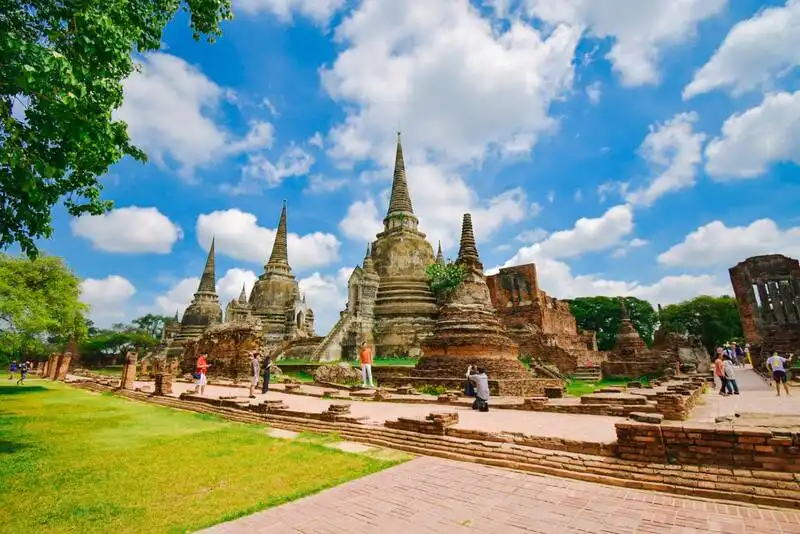
Wat Phra Si Sanphet was one of the most important royal temples within the Grand Palace complex of the Ayutthaya Kingdom. It played a significant role in royal ceremonies and religious activities associated with the court, unlike ordinary monasteries where monks resided permanently. Its most recognizable features are the three elegant bell-shaped chedis standing in a row, which have become an enduring symbol of Ayutthaya Historical Park.
Exploring Wat Phra Si Sanphet offers visitors an opportunity to understand the relationship between royal authority and Buddhism during the Ayutthaya period. The surrounding area also contains other historical monuments and archaeological sites, making it an excellent location for walking and photography, particularly during the cooler parts of the day.
Allow approximately 45–60 minutes to visit Wat Phra Si Sanphet. It can be scheduled as the final major attraction of the afternoon before returning to Ayutthaya Railway Station. Be sure to allow sufficient time for local traffic and the transfer back to the station before the return train departs.
More Information:Wat Phra Si Sanphet, Phra Nakhon Si Ayutthaya
One-Day Ayutthaya Train Itinerary Begin the morning by traveling from Bangkok on a train that stops at Ayutthaya Railway Station. Upon arrival, continue to Ayutthaya Island and visit Wat Mahathat and Wat Ratchaburana, which are located close to each other. Allow approximately 2 hours to explore both temples. After lunch, continue to Wat Phra Si Sanphet in the afternoon before making your way back to the station for the return train to Bangkok.
For transportation within the historic city, visitors can use local taxis, tuk-tuks, or rented bicycles, depending on the weather and their preferred level of physical activity. If you would like to add Wat Chaiwatthanaram to your itinerary, allow extra time for transportation outside Ayutthaya Island and check your return train schedule in advance.
Route 2: Bangkok to Nakhon Pathom by Train — A One-Day Visit to Phra Pathom Chedi and Sanam Chandra Palace Nakhon Pathom is a historic destination near Bangkok that is well suited to a railway day trip. Several important religious and historical sites are located within the city, especially Phra Pathom Chedi, which is one of the province's most recognizable landmarks. Travelers can take a Southern Line train that stops at Nakhon Pathom Railway Station and continue to the major attractions on foot or by local transport.
This journey is particularly suitable for visitors interested in Thai culture, Buddhist pilgrimage sites, and local history. It also offers opportunities to explore an older urban environment, discover traditional markets, and enjoy local food. The attractions can be covered comfortably in a single day without the need for an overnight stay.
Allow approximately 1–2 hours for the train journey in each direction, depending on the departure station and train service, together with around 4–5 hours of sightseeing and approximately 1 hour for meals.
2.1 Wat Phra Pathom Chedi Ratchaworamahawihan

Wat Phra Pathom Chedi Ratchaworamahawihan is one of the most important religious landmarks in Nakhon Pathom Province. At the heart of the temple complex stands the enormous Phra Pathom Chedi, an important monument in the history of Buddhism in Thailand. Its massive bell-shaped structure rises prominently above the city and can be seen from many surrounding areas, making it the province's most recognizable symbol and a major pilgrimage destination.
The temple grounds contain assembly halls and sacred areas associated with the restoration and development of Phra Pathom Chedi during the Rattanakosin period. Visitors can explore the surrounding architecture, learn about the religious significance of the monument, and experience the atmosphere of a city in which the great stupa remains a central focus of Buddhist devotion.
One of the greatest advantages for train travelers is the temple's convenient location within Nakhon Pathom city, relatively close to Nakhon Pathom Railway Station. This makes it an excellent first destination after arriving by train.
Allow approximately 60–90 minutes for the visit, including time to pay respect to the Buddha images and walk around the monumental stupa.
More Information:Wat Phra Pathom Chedi Ratchaworamahawihan, Nakhon Pathom
2.2 Sanam Chandra Palace
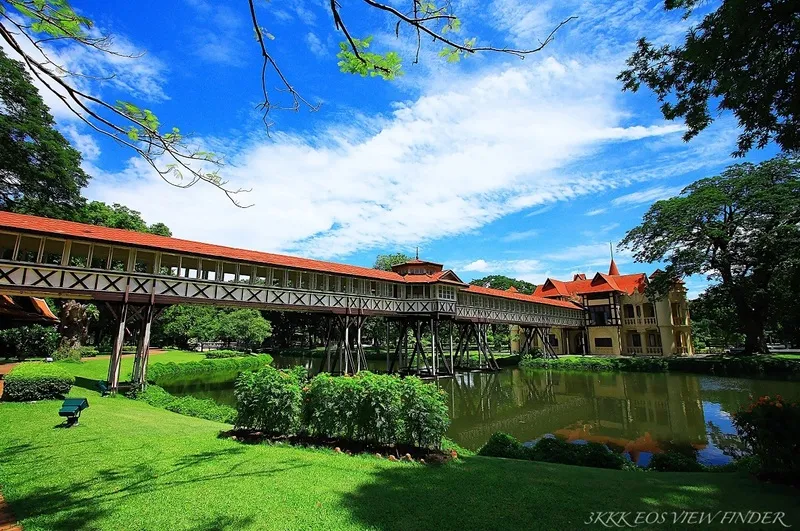
Sanam Chandra Palace is an important historic royal residence located within Nakhon Pathom city. Constructed during the reign of King Vajiravudh, Rama VI, the palace complex contains royal halls and residences displaying a variety of architectural styles, including traditional Thai designs and Western influences. Landscaped gardens and green spaces surrounding the buildings contribute to the peaceful atmosphere of the palace grounds.
Among the palace's most notable features are its association with the history of King Rama VI and its distinctive architectural buildings, including Phiman Pathom Hall, Vajariromaya Hall, and Chali Mongkol Asana Residence. Each reflects different architectural influences and contributes to the historical significance of the complex.
Sanam Chandra Palace can be included as the second major stop after visiting Phra Pathom Chedi. Visitors can travel by local taxi from the stupa or Nakhon Pathom Railway Station. Allow approximately 60–90 minutes to explore the palace grounds and available historical buildings. Access to individual buildings is subject to the opening arrangements and visiting regulations established by the responsible authorities.
More Information:Sanam Chandra Palace, Nakhon Pathom
One-Day Nakhon Pathom Train Itinerary Start by taking a train from Bangkok to Nakhon Pathom Railway Station. From the station, continue to Phra Pathom Chedi in the morning to pay respect at the stupa, explore the surrounding grounds, and enjoy a meal in the city center. In the afternoon, travel to Sanam Chandra Palace to admire the architecture and learn about its history before returning to Nakhon Pathom Railway Station for the train journey back to Bangkok.
This itinerary is particularly suitable for travelers who prefer a relaxed pace, especially those interested in temples, royal palaces, and historical landmarks. Visitors with less than a full day can also choose to focus on Phra Pathom Chedi and the nearby market area without including the palace.
Route 3: Bangkok to Mahachai by Train — A One-Day Journey Through Seafood Markets and the Tha Chalom Fishing Community The railway journey from Wongwian Yai Station to Mahachai Station in Samut Sakhon Province is one of Thailand's most distinctive local train experiences. The line passes through traditional neighborhoods, markets, houses, and urban areas that have developed alongside the railway. Travelers can experience an older style of rail transportation that continues to serve local communities traveling between Bangkok and Samut Sakhon.
The Wongwian Yai–Mahachai railway is part of the Mae Klong Railway. The journey takes approximately 1 hour each way and is well suited to a day trip. Travelers wishing to continue toward Mae Klong can take a ferry across the Tha Chin River to Tha Chalom and then board another train on the Ban Laem–Mae Klong section of the railway.
The appeal of this route extends beyond the train journey itself. It also offers an opportunity to discover local fishing communities, seafood trading traditions, and the history of settlements along the Tha Chin River, all of which have played a significant role in the development of Samut Sakhon Province.
3.1 Mahachai Railway Station

Mahachai Railway Station is the terminus of the railway line from Wongwian Yai. It is located in the busy Mahachai urban area, surrounded by markets and commercial activity. Upon arrival, visitors immediately encounter the atmosphere of a local railway station closely connected with everyday community life, quite different from large intercity stations designed primarily for long-distance travel.
The station and its surroundings are interesting because of the nearby markets and trading streets. Visitors can observe the station buildings, photograph the railway atmosphere, and watch local residents using the train for their daily journeys. Photography should be limited to permitted areas, and visitors must avoid entering the tracks or areas reserved for railway operations.
For this itinerary, allow approximately 20–30 minutes to explore the station area before continuing to nearby Mahachai Market.
More Information:Mahachai Railway Station, Samut Sakhon
3.2 Mahachai Market (Municipal Pier)

Mahachai Market is one of the main commercial areas of Samut Sakhon Province, well known for fresh seafood, processed seafood products, and local goods that reflect the community's close relationship with the fishing industry. The market is filled with shops and trading activities that form part of everyday life in the area.
Travelers arriving by train can walk from Mahachai Station to the market to browse seafood products and local food. They can also experience the riverside atmosphere of the Tha Chin River, which has long been an important transportation route for surrounding communities.
One of the market's most appealing qualities is that it remains a genuine center of local commerce rather than a market established solely for tourists. Visitors can explore the shops, choose souvenirs, and enjoy lunch before continuing to the nearby ferry pier.
Allow approximately 60–90 minutes to explore Mahachai Market, with additional time if you plan to have a meal or purchase a substantial number of souvenirs.
More Information:Mahachai Market, Samut Sakhon
3.3 Tha Chalom Fishing Village

Tha Chalom is a historic community on the banks of the Tha Chin River that has long played an important role in trade and water transportation in Samut Sakhon. Its history is closely connected with the development of local urban administration. Tha Chalom became the location of Thailand's first sanitary district, established during the reign of King Chulalongkorn, Rama V, in 1905.
Today, Tha Chalom retains the atmosphere of a riverside community, with local life closely linked to fishing, trade, and river transportation. Visitors can cross the river from Mahachai by ferry and explore the community on foot along suitable routes. They can also continue to Ban Laem Railway Station to experience the second section of the Mae Klong Railway.
For travelers interested in local history, Tha Chalom provides insight into the development of community administration during the reign of King Rama V. Meanwhile, those who enjoy slow travel can experience the riverside atmosphere and everyday life of a neighborhood that feels distinctly different from central Bangkok.
Allow approximately 60–90 minutes for Tha Chalom, excluding the time needed to wait for the ferry or continue to Ban Laem Railway Station.
More Information:Tha Chalom Fishing Village, Samut Sakhon
One-Day Mahachai Train Itinerary Begin the journey at Wongwian Yai Station in the morning aboard a train on the Mahachai Line. Upon reaching Mahachai Station, spend approximately 20–30 minutes exploring the station area. Continue on foot to Mahachai Market, allowing around 1–2 hours to browse the shops and have a meal before heading to the pier to cross the Tha Chin River.
In the afternoon, explore Tha Chalom to learn about the community's history and riverside way of life. Afterward, cross the river back to Mahachai and board a return train to Wongwian Yai. If you wish to continue to Mae Klong, check the Ban Laem–Mae Klong train timetable in advance and adjust your sightseeing time accordingly, as this section has fewer train services than the Wongwian Yai–Mahachai Line.
Route 4: Bangkok to Mae Klong by Train — A One-Day Journey to the Famous Railway Market and Riverside Communities Taking the train to Mae Klong in Samut Songkhram Province is one of Thailand's most distinctive railway travel experiences. This local railway journey brings together everyday community life, traditional markets, and riverside settlements. Its most famous attraction is the Mae Klong Railway Market, also known as Rom Hoop Market, where vendors operate their stalls close to an active railway track. As a train approaches, shopkeepers fold away their awnings and move their goods clear of the passing train, creating a remarkable scene that has become internationally famous among travelers.
For visitors beginning their journey in Bangkok, the railway route to Mae Klong is particularly interesting because it involves two separate train journeys. First, travelers take a train from Wongwian Yai Station to Mahachai Station. They then continue to the ferry pier, cross the Tha Chin River to the Tha Chalom side, and make their way to Ban Laem Railway Station to board another train on the Ban Laem–Mae Klong Line. The combination of train travel, a river crossing, and another local railway journey makes this route especially appealing to visitors who enjoy slow travel and want to observe everyday life along the way.
The Ban Laem–Mae Klong train journey takes approximately 1 hour. The route passes through residential communities, coconut plantations, agricultural areas, and several small local railway stations before reaching Mae Klong Market, the final destination. Traveling all the way from Bangkok to Mae Klong generally requires allowing at least 3–4 hours, including the railway connection, the walk to the ferry pier, the river crossing, and waiting time between services. The actual journey time depends on the train departures selected and how well the connections align.
This route is recommended as a one-day trip, with an early departure and a return journey planned in advance. Train services between Ban Laem and Mae Klong are relatively limited, so travelers should organize their sightseeing around the available departures. Visitors wishing to explore the railway market and important temples in Mae Klong town can generally allocate around 3–4 hours for sightseeing. Those who also want to visit Amphawa should allow additional travel time and may prefer to stay overnight to explore the area more comfortably.
4.1 Mae Klong Railway Market (Rom Hoop Market)
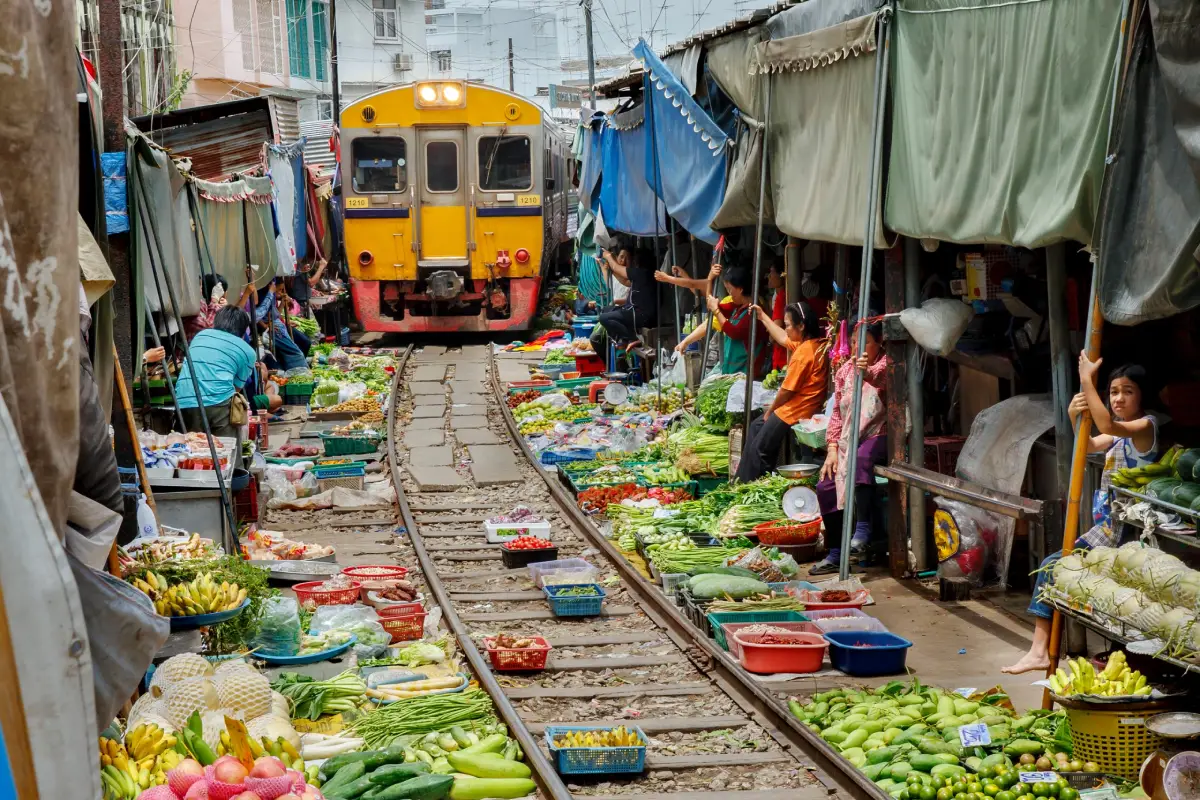
Mae Klong Railway Market is one of the most famous tourist attractions in Samut Songkhram Province. Located along the railway tracks near Mae Klong Railway Station, the market is remarkable for the close relationship between everyday trading activities and an operational railway line. Vendors set up their stalls beside the tracks, and when a train approaches, they fold back their umbrellas and awnings and move any goods that might obstruct the train. Once the train has passed, the stalls are quickly arranged again, and normal trading resumes.
This unusual scene illustrates how local communities have adapted their trading activities to coexist with an established transportation route. Mae Klong Railway Market is therefore much more than a place to photograph a passing train. It is also an opportunity to observe local commerce, everyday routines, and the economy of a traditional Thai market. Visitors can browse stalls selling vegetables, fruit, fresh seafood, and prepared local food while experiencing a market that operates according to the rhythm of the railway timetable.
The most popular times to visit are when trains are arriving at or departing from Mae Klong Railway Station. However, safety must always come first. Visitors should stand in designated safe areas, avoid extending their hands, cameras, or other equipment toward moving trains, and never remain on the tracks as a train approaches. Instructions from railway staff and market vendors should be followed carefully.
Allow approximately 60–90 minutes to explore Mae Klong Railway Market, browse the stalls, and watch a train pass at a suitable time. Travelers who want to photograph the market without rushing should allow additional time and check the latest train timetable with the State Railway of Thailand before traveling.
More Information:Mae Klong Railway Market (Rom Hoop Market), Samut Songkhram
4.2 Wat Phet Samut Worawihan (Wat Ban Laem)

Wat Phet Samut Worawihan, widely known as Wat Ban Laem, is an important royal Buddhist temple in Samut Songkhram Province. Located within Mae Klong town, it has long been a spiritual center for local residents. The temple is particularly famous for housing Luang Pho Ban Laem, a highly revered Buddha image that attracts worshippers and visitors who come to pay their respects and seek blessings.
Luang Pho Ban Laem is a standing Buddha image depicted in the posture of holding an alms bowl, a form that differs from many principal Buddha images found in Thai temple ordination halls. The devotion shown toward Luang Pho Ban Laem reflects the longstanding relationship between Buddhism and the communities along the Mae Klong River. The temple continues to serve important religious, ceremonial, and community functions and remains a significant center of local faith.
Travelers arriving at Mae Klong Railway Station can conveniently visit Wat Phet Samut Worawihan after exploring the railway market because the temple is located within the same urban area. Including this temple adds a cultural and spiritual dimension to the journey, complementing the market experience with an opportunity to discover local Buddhist traditions and religious art.
Allow approximately 45–60 minutes to pay respect to Luang Pho Ban Laem and explore the temple grounds. Visitors should dress modestly and follow the temple's rules of conduct, particularly when entering sacred buildings and areas used for religious ceremonies.
More Information:Wat Phet Samut Worawihan (Wat Ban Laem), Samut Songkhram
4.3 King Rama II Memorial Park
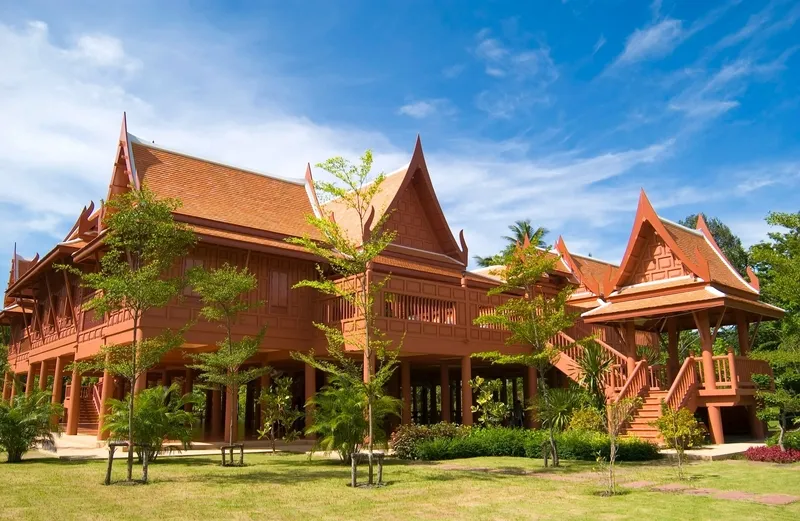
King Rama II Memorial Park is located in Amphawa District, Samut Songkhram Province. It is a cultural and historical attraction dedicated to King Phutthaloetla Naphalai, Rama II, and his contributions to Thai literature, performing arts, and traditional culture. The park features landscaped grounds and traditional Thai-style buildings designed to reflect the architecture and atmosphere of Thai society in earlier periods.
The park is particularly interesting for its presentation of traditional arts, literary heritage, classical dance, and cultural life during the early Rattanakosin period. Visitors can learn about King Rama II's importance as a monarch renowned for his support of arts and culture, while exploring traditional Thai houses and garden areas that help illustrate the architectural characteristics of the period.
For travelers following the railway route to Mae Klong, King Rama II Memorial Park is an optional additional attraction rather than a stop immediately beside the railway station. The park is in Amphawa District, so reaching it from Mae Klong requires an additional bus, taxi, or other local road transfer. This makes it most suitable for visitors who have sufficient time after exploring Mae Klong or who choose to stay overnight in Samut Songkhram.
Allow approximately 60–90 minutes to explore the memorial park, excluding travel time between Mae Klong town and Amphawa. Travelers with a limited return train schedule should prioritize Mae Klong Railway Market and Wat Phet Samut Worawihan, leaving the memorial park as an additional stop only when the available time allows.
More Information:King Rama II Memorial Park, Samut Songkhram
One-Day Mae Klong Train Itinerary Travelers starting in Bangkok should leave Wongwian Yai Station early in the morning and take a train to Mahachai Station. From Mahachai, continue to the ferry pier, cross the Tha Chin River to Tha Chalom, and make your way to Ban Laem Railway Station. A train departing Ban Laem at approximately 10:10 AM and arriving at Mae Klong around 11:10 AM is an example of a connection that has been used on this line, although travelers must confirm that these times still apply on their actual travel date. When available, this connection provides a convenient opportunity to visit Mae Klong Railway Market and enjoy lunch in the town center.
After exploring the railway market, continue to Wat Phet Samut Worawihan to pay respect to Luang Pho Ban Laem, allowing approximately 45–60 minutes for the temple visit. Then return to Mae Klong Railway Station for the train journey back. If the selected return train departs at approximately 3:30 PM, travelers will have a little over 4 hours in Mae Klong town, although they should return to the station with sufficient time to board and confirm that the service is operating according to the selected schedule.
Visitors wishing to include King Rama II Memorial Park in Amphawa should consider making this an overnight trip or using a different form of transport for the return journey. Adding Amphawa to a one-day railway itinerary may leave insufficient time to return to Mae Klong Station for the final suitable train service.
Allow approximately 9–12 hours for the complete Mae Klong journey, including the railway trips from Bangkok, train connections, the ferry crossing, sightseeing, and the return journey. The most important planning requirement is to check the timetables for both railway sections before setting out.
Route 5: Bangkok to Lop Buri by Train — A One-Day Journey to Phra Prang Sam Yot and the Historic City of Lavo Lop Buri is another excellent historical destination for travelers exploring Thailand by train. The old town contains several important archaeological sites within a relatively compact area, allowing visitors to move between major attractions without spending the entire day traveling long distances. Travelers can take a Northern Line train that stops at a suitable station in Lop Buri and begin exploring a city whose history extends through the Dvaravati period, the era of Khmer cultural influence, and the Ayutthaya Kingdom.
Lop Buri's appeal lies in the diversity of historical evidence found within the same urban area. Visitors can explore Khmer-influenced prangs, ancient Buddhist religious monuments, and a royal palace associated with King Narai the Great. Together, these landmarks provide an opportunity to understand the development of Lavo and Lop Buri through architectural remains that continue to shape the city's character today.
For the railway journey from Bangkok to Lop Buri, allow approximately 2–3 hours each way as an initial planning estimate, depending on the departure station, train type, and selected service. A one-day return trip should include around 4–5 hours of sightseeing in the city, with sufficient additional time for the return railway journey and any waiting between services.
Visitors who enjoy exploring historic towns on foot can begin with the archaeological sites near the old Lop Buri Railway Station before walking or taking a local taxi to Phra Prang Sam Yot and Phra Narai Ratchaniwet. However, railway operations and stopping patterns in Lop Buri have changed with the development of the railway system. Some services may use Lop Buri 2 Station rather than the old station in the historic center. Travelers must therefore confirm their actual arrival and departure stations before organizing their sightseeing route.
Visiting during cooler hours is recommended, particularly when exploring several open-air archaeological sites in a single day. It is also advisable to bring drinking water, sun protection, and comfortable walking shoes, as the city's historical attractions are primarily outdoor destinations.
5.1 Wat Phra Si Rattana Mahathat, Lop Buri
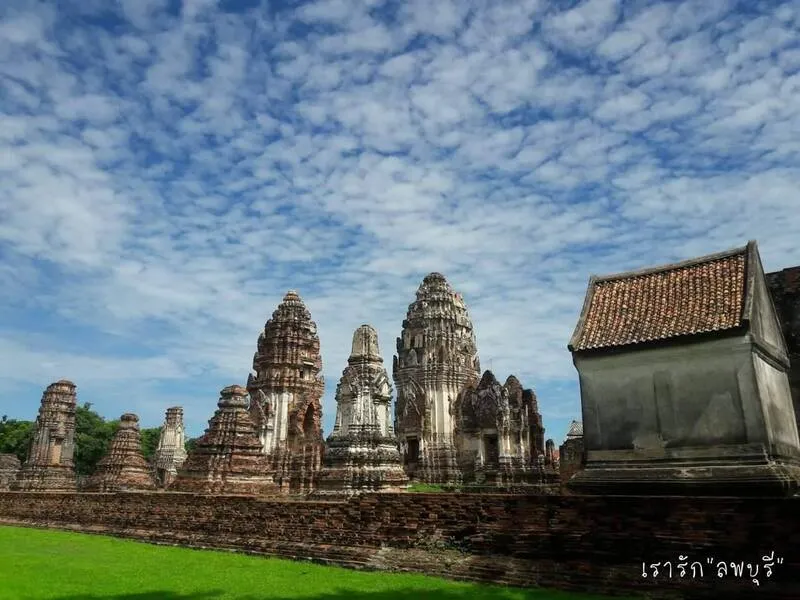
Wat Phra Si Rattana Mahathat is an important archaeological site in the historic city of Lop Buri. It is located close to the old Lop Buri Railway Station, making it a convenient attraction for travelers who arrive at that station or arrange a local transfer into the historic district. The temple grounds contain architectural remains from several historical periods, particularly the central prang and the ruins of religious buildings that demonstrate Lop Buri's longstanding importance as a center of religion and culture.
One of the temple's most interesting features is the opportunity to study architectural development across different periods. The remains include elements influenced by Khmer art as well as architectural features associated with the Ayutthaya period. Although most of the buildings survive as archaeological ruins, the overall arrangement of the structures and the relationships between important religious buildings remain visible.
The surviving prang, religious structures, and decorative elements help illustrate the transformation of religious architecture across successive periods. They also provide evidence of Lop Buri's position within wider cultural networks connecting Central Thailand with the ancient Khmer world and later the Ayutthaya Kingdom.
Beginning the historic-city itinerary at Wat Phra Si Rattana Mahathat provides an excellent introduction to Lop Buri's history before continuing to Phra Prang Sam Yot and Phra Narai Ratchaniwet. Visitors arriving at Lop Buri 2 Station should arrange an onward road transfer rather than assuming the temple is within walking distance of their arrival platform.
Allow approximately 45–60 minutes to explore Wat Phra Si Rattana Mahathat. Bring drinking water, a hat, and sun protection, as much of the archaeological site is exposed to the sun.
More Information:Wat Phra Si Rattana Mahathat, Lop Buri
5.2 Phra Prang Sam Yot
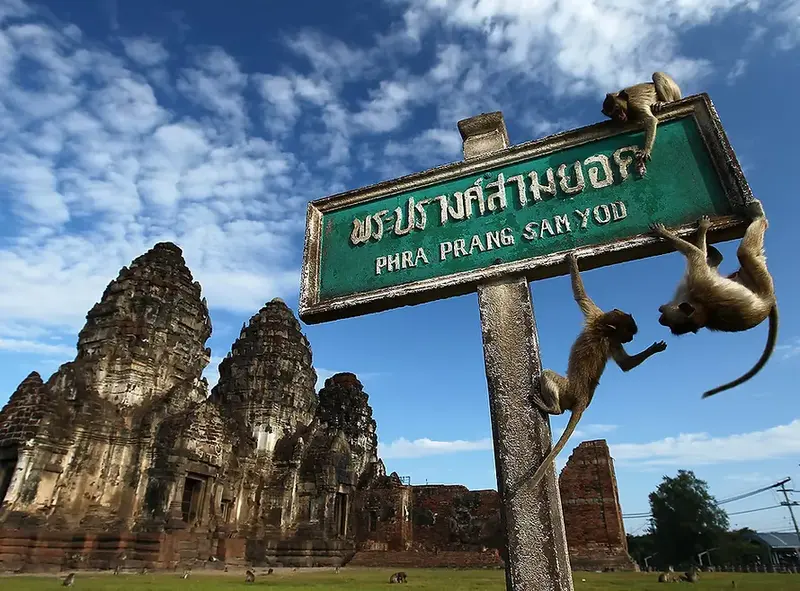
Phra Prang Sam Yot is one of the most recognizable tourist attractions in Lop Buri Province. The monument consists of three prangs standing in a row and connected by passageways. Its architecture reflects the influence of the Khmer Bayon style, which is associated with the history of Lavo during a period when Khmer culture played an important role in the region.
Phra Prang Sam Yot is historically and artistically significant because of its laterite construction, surviving stucco decoration, and architectural features that reflect religious beliefs of the past. The site also reveals how Lop Buri changed over successive periods, from the era of Khmer influence to the adaptation of religious spaces during the Ayutthaya period.
The monument's three connected towers are especially significant for understanding Khmer-influenced religious architecture. Historical interpretations associate the site with Mahayana Buddhist beliefs and later religious transformations. The surviving structure therefore represents more than one phase of religious and architectural development, illustrating the complexity of Lop Buri's cultural history.
Another appealing aspect of the monument is its location within Lop Buri's historic district, making it convenient to continue walking to other nearby attractions, such as San Phra Kan Shrine and Wat Nakhon Kosa. This makes Phra Prang Sam Yot an excellent stop on a walking tour of the old town without requiring a private vehicle throughout the day.
Monkeys may be encountered around Phra Prang Sam Yot and the surrounding areas. Visitors should keep food, drinks, and easily grabbed belongings securely stored, avoid feeding the monkeys, and maintain a safe distance to protect both people and animals. Glasses, phones, and loose accessories should also be secured when walking through areas where monkeys are present.
Allow approximately 45–60 minutes to explore Phra Prang Sam Yot. Additional time can be allocated for studying the monument's architectural details or exploring nearby historic attractions.
More Information:Phra Prang Sam Yot, Lop Buri
5.3 Phra Narai Ratchaniwet (King Narai's Palace)
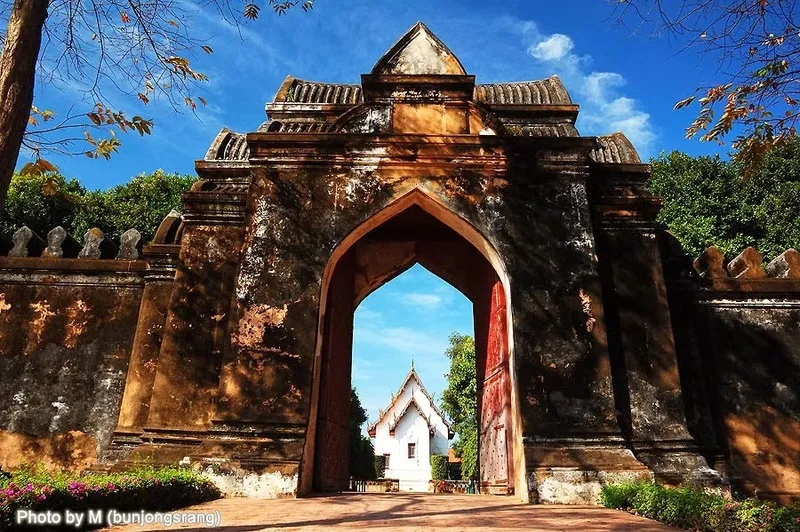
Phra Narai Ratchaniwet, also known as King Narai's Palace, is an important historic royal palace in Lop Buri. It was built during the reign of King Narai the Great and reflects Lop Buri's significance as a political and administrative center during the later Ayutthaya period. The palace is closely associated with an era when the Siamese royal court maintained extensive contacts with Western nations, particularly in diplomacy, trade, and the exchange of knowledge.
The palace complex contains several historical buildings and archaeological remains that illustrate architectural styles from the reign of King Narai, along with additional structures constructed in later periods. This architectural diversity makes Phra Narai Ratchaniwet important for the study of Thai history, artistic traditions, and Siam's relationships with the wider world.
King Narai's reign is especially well known for its international diplomatic relationships and the presence of foreign missions in Siam. The palace therefore provides an important setting for understanding the history of international contact during the Ayutthaya period. Visitors can study the surviving architectural remains and see how royal spaces were designed to accommodate administrative, ceremonial, and residential functions.
Today, part of the palace complex houses the King Narai National Museum, which displays historical artifacts and exhibitions relating to Lop Buri's development. Visitors interested in history can explore the city's story from ancient times through the Rattanakosin period by visiting both the architectural remains and the museum collections.
For visitors traveling by train, Phra Narai Ratchaniwet is an ideal afternoon stop after exploring Wat Phra Si Rattana Mahathat and Phra Prang Sam Yot. Allow approximately 60–90 minutes for the palace and museum. Check the museum's opening days before traveling because access to the indoor exhibitions may follow different arrangements from the outdoor archaeological areas.
More Information:Phra Narai Ratchaniwet, Lop Buri
One-Day Lop Buri Train Itinerary Leave Bangkok in the morning aboard a train serving Lop Buri. Before departure, confirm whether the train uses the historic Lop Buri Station or Lop Buri 2 Station, as this affects the distance and transportation required to reach the old town. After arriving in the historic district, begin with Wat Phra Si Rattana Mahathat, allowing approximately 45–60 minutes to explore the archaeological site before continuing to Phra Prang Sam Yot.
At Phra Prang Sam Yot, spend approximately 45–60 minutes studying the Bayon-style architecture and experiencing the historic district. Visitors can also observe the nearby surroundings and continue to other attractions within walking distance when time permits. Keep food and personal belongings securely stored in areas where monkeys may be present.
After visiting Phra Prang Sam Yot and having lunch, continue to Phra Narai Ratchaniwet to learn about King Narai the Great and the Ayutthaya court. Allow approximately 60–90 minutes to explore the palace grounds and museum before returning to the appropriate railway station for the train journey back to Bangkok.
If you would like to include additional attractions in the old town, consider San Phra Kan Shrine or other archaeological sites along the same route. However, be mindful of the midday heat and walking distances between locations. Starting with the attraction closest to your arrival point and gradually moving through the historic district can make the itinerary easier to manage.
Allow approximately 9–12 hours for the complete Lop Buri excursion, including the return train journey. This route is particularly suitable for travelers interested in history, culture, architecture, and exploring an ancient Thai town without needing a private car.
Route 6: Bangkok to Suan Son Pradipat by Train — A One-Day Beach Escape Near Hua Hin Suan Son Pradipat is a seaside destination in Hua Hin District, Prachuap Khiri Khan Province, ideal for visitors who want to combine a relaxing beach holiday with the experience of traveling by train. The railway journey from Bangkok follows the Southern Line through towns, rural communities, and agricultural landscapes before reaching the coastal area of Prachuap Khiri Khan Province, where Suan Son Pradipat Beach is the main attraction.
The State Railway of Thailand operates special tourist train programs to Suan Son Pradipat, providing an appealing alternative for travelers who want to enjoy a beach excursion without driving. However, operating days, boarding stations, departure times, and train arrangements may vary between programs. Visitors should therefore check the latest details directly with the State Railway of Thailand before planning their trip.
Suan Son Pradipat is well suited to travelers who want to relax on the beach, walk beneath the coastal casuarina trees, enjoy seafood, and experience a quieter seaside atmosphere than some of the busier tourist areas in central Hua Hin. There are also other interesting attractions nearby, including Rajabhakti Park and Wat Khao Takiap, which can be added when sufficient time and suitable onward transportation are available.
The railway journey itself is part of the appeal of this excursion. Traveling from Bangkok toward the Gulf of Thailand allows passengers to observe changing scenery, including urban neighborhoods, agricultural landscapes, and coastal communities. Rather than concentrating solely on the destination, visitors can enjoy a slower pace of travel and the experience of arriving at the coast by train.
For a one-day return excursion from Bangkok, allow approximately 12–15 hours in total, including several hours of train travel each way and around 3–4 hours to enjoy the beach. Visitors using a special tourist train should plan their activities around the program's official schedule and avoid adding too many attractions that could interfere with the return departure.
6.1 Suan Son Pradipat Beach

Suan Son Pradipat is a coastal recreation area known for its long beach and distinctive rows of casuarina trees. It is located in Nong Kae Subdistrict, Hua Hin District, Prachuap Khiri Khan Province. The surrounding atmosphere is particularly appealing to visitors looking for a straightforward and relaxing seaside experience, with opportunities to walk along the shore, enjoy views of the Gulf of Thailand, and spend time surrounded by nature.
The main attraction of Suan Son Pradipat is not adventure tourism or large entertainment complexes, but rather its peaceful coastal environment and relaxed atmosphere. The open shoreline offers pleasant sea views, while the coastal trees provide a distinctive setting and shaded areas in parts of the beach. Families and groups of friends often visit to relax, take photographs, walk by the sea, and enjoy meals together.
Arriving on a special tourist train adds another dimension to the Suan Son Pradipat experience. Rather than driving directly to the beach, travelers can begin enjoying their holiday while aboard the train, watching the scenery gradually change from a major city to rural landscapes and coastal settlements.
Visitors who enjoy nature photography can spend time capturing the shoreline, coastal trees, sea views, and changing light throughout the day. The beach is especially appealing in the morning and late afternoon when temperatures are generally more comfortable. Travelers should nevertheless plan their activities around the available train schedule rather than assuming that an entire day can be spent on the beach.
Families should bring suitable clothing, sun protection, drinking water, and other essential supplies, particularly when traveling with young children or older relatives. Anyone planning to swim should pay attention to sea conditions and warnings from local staff and avoid entering the water in areas where dangerous conditions have been reported.
Allow approximately 3–4 hours to enjoy Suan Son Pradipat Beach. This provides time to relax, stroll along the shore, have a meal, and prepare to board the return train without rushing.
More Information:Suan Son Pradipat, Prachuap Khiri Khan
6.2 Rajabhakti Park

Rajabhakti Park is an important historical and commemorative attraction in Hua Hin District, Prachuap Khiri Khan Province. The park was established to honor significant kings from Thailand's past. Its most striking feature is a group of seven monumental royal statues standing in an impressive row, representing important periods in the country's history, including national defense, independence, governance, and development.
The seven monarchs represented at the park are King Ramkhamhaeng the Great, King Naresuan the Great, King Narai the Great, King Taksin the Great, King Buddha Yodfa Chulaloke the Great, King Mongkut, and King Chulalongkorn. Each played an important role in the history and development of Thailand.
The park provides a setting where visitors can learn about these monarchs while viewing the large statues and the surrounding landscape. The scale and arrangement of the monuments create a distinctive visual impression, with the statues standing against the open sky and nearby mountains.
Visiting Rajabhakti Park adds a historical dimension to a beach-focused train trip. Travelers can admire the monumental statues, learn about the lives and achievements of the kings represented, and explore the spacious grounds with their open plazas and mountainous backdrop.
For visitors traveling by train to Suan Son Pradipat, Rajabhakti Park is an optional attraction that can be considered when sufficient time and suitable transportation are available. The park is not conveniently accessible on foot from every part of Suan Son Pradipat Beach, so an onward road transfer should be planned in advance.
Allow approximately 45–60 minutes to visit Rajabhakti Park, excluding transportation time. Travelers on a one-day special tourist train excursion should check the return boarding time before deciding to include the park in their itinerary.
More Information:Rajabhakti Park, Prachuap Khiri Khan
6.3 Wat Khao Takiap
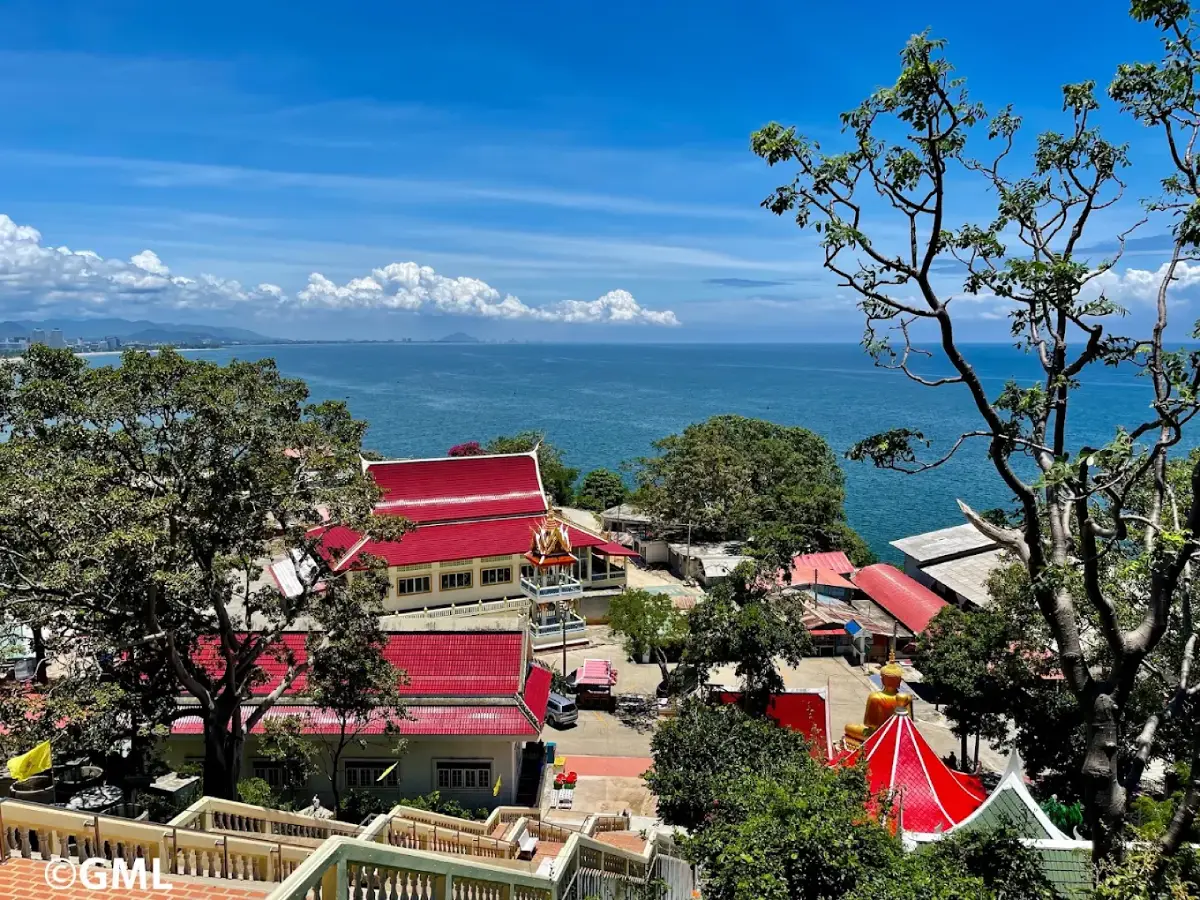
Wat Khao Takiap is an important Buddhist temple and popular tourist attraction in Hua Hin District. It is located on Khao Takiap, a hill near the coast to the south of central Hua Hin. The area is known for combining a religious setting with coastal scenery and elevated views of the surrounding landscape, allowing visitors to experience both Buddhist culture and natural beauty in a single destination.
Several viewpoints around the temple and nearby hill provide views of Hua Hin's coastline and the Gulf of Thailand from above. These scenic surroundings make Wat Khao Takiap particularly appealing to visitors who enjoy coastal photography and exploring viewpoints with a different perspective on the seaside town.
In addition to its scenic setting, Wat Khao Takiap remains an active Buddhist temple where visitors come to worship and pay respect to sacred images. The temple is therefore both a destination for sightseeing and an important religious space for worshippers.
Travelers should dress modestly, maintain a respectful atmosphere, and follow the temple's visiting rules. Monkeys may also be encountered around Khao Takiap, so visitors should avoid carrying exposed food to attract them and should not approach the animals unnecessarily. Personal belongings should be kept secure.
For travelers arriving at Suan Son Pradipat by train, Wat Khao Takiap is an additional attraction that requires onward transportation within the Hua Hin area. It should not be treated as a compulsory stop on a short beach excursion because traveling to the temple and returning to the station could leave too little time to enjoy the beach or catch the return train comfortably.
Allow approximately 45–60 minutes to explore Wat Khao Takiap, excluding the time needed to travel from Suan Son Pradipat or the selected railway station.
More Information:Wat Khao Takiap, Prachuap Khiri Khan
One-Day Suan Son Pradipat Train Itinerary Travelers departing from Bangkok should begin by selecting a State Railway of Thailand tourist train program to Suan Son Pradipat that operates on their chosen travel date. Check the boarding station, departure time, expected arrival, and scheduled return boarding time before the trip. After reaching the destination, spend most of the available time relaxing at Suan Son Pradipat Beach so that the experience remains enjoyable without rushing between too many places.
During the first part of the visit, travelers can walk among the coastal trees, stroll along the shoreline, take photographs of the beach, or relax in areas provided for visitors. After lunch, spend the afternoon enjoying the coastal atmosphere before preparing to return to the train at the scheduled time.
If you wish to visit Rajabhakti Park or Wat Khao Takiap, choose just one additional attraction according to your interests and confirm transportation arrangements before leaving Suan Son Pradipat. Both places require time away from the beach and a return transfer, so it is important to allow enough time to reach the train before departure.
Visitors who want to explore all three attractions—Suan Son Pradipat, Rajabhakti Park, and Wat Khao Takiap—at a relaxed pace should consider spending one night in Hua Hin. An overnight stay provides more time for each destination. For travelers primarily interested in the experience of taking a day-trip train to the beach, Suan Son Pradipat should remain the main destination, with the itinerary organized around the tourist train's operating schedule.
Allow approximately 12–15 hours for the complete one-day Suan Son Pradipat excursion, including the train journey from Bangkok and time spent at the beach. The actual duration depends on the schedule of the tourist train operating on the chosen date.
Route 7: Bangkok to Hua Hin by Train — A Two-Day, One-Night Escape to a Historic Seaside Resort, Sandy Beaches, and Night Markets Hua Hin is a long-established seaside resort town in Prachuap Khiri Khan Province, closely connected to the history of railway development in Thailand. Traveling from Bangkok to Hua Hin by train is therefore more than simply a way to reach the coast. It offers an opportunity to experience the atmosphere of a historic resort destination that grew alongside the Southern Railway, developing into one of Thailand's best-known seaside towns.
The appeal of taking the train to Hua Hin lies in the variety of experiences available within a relatively compact destination. Visitors can admire the historic architecture associated with Hua Hin Railway Station, spend time walking along the famous beach, enjoy seafood, and explore the lively atmosphere of Hua Hin Night Market. This itinerary is suitable for couples, families, groups of friends, and independent travelers who want to visit the coast without using a private car.
Travelers departing from Bangkok can choose a Southern Line train that stops at Hua Hin Railway Station. However, it is essential to check the departure station for the particular service, as different train categories may operate from different Bangkok terminals. Journey times and onboard facilities also vary. For preliminary planning, allow approximately 3–5 hours each way, depending on the service, and always use the confirmed timetable for the train you intend to take.
A two-day, one-night trip is recommended because it allows enough time to explore the railway station, beach, and night market without rushing to catch an evening train back to Bangkok. Staying overnight also gives travelers the chance to enjoy the seaside atmosphere early the following morning before returning to the capital.
Hua Hin is particularly convenient for visitors who prefer a combination of historical sightseeing and leisurely coastal activities. The principal attractions can be organized into a practical itinerary, with the railway station as an arrival point, the beach as the main afternoon destination, and the night market as an evening activity. This arrangement reduces unnecessary travel between locations and leaves sufficient time for meals and relaxation.
7.1 Hua Hin Railway Station
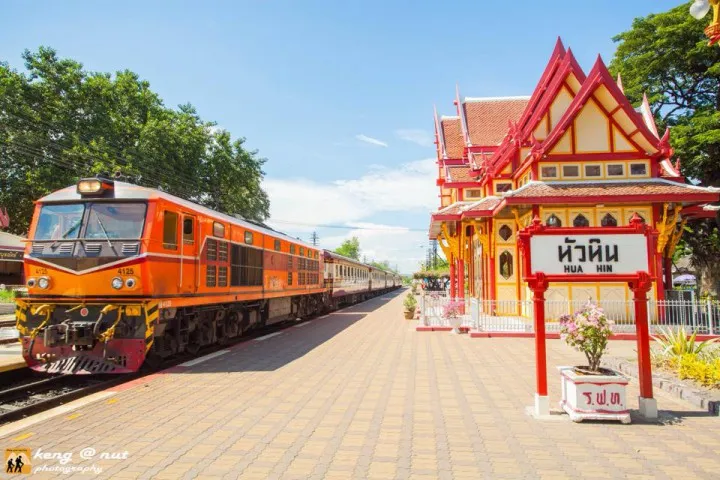
Hua Hin Railway Station is one of Thailand's most recognizable railway landmarks. It is closely associated with the transformation of Hua Hin into a fashionable seaside resort during the Rattanakosin period. The station's distinctive architecture and historical features have made it a popular photography destination for visitors arriving in the town by train.
The station area contains architectural elements associated with Thailand's railway heritage, particularly the characteristic rooflines, decorative colors, and the royal pavilion known as Phra Mongkut Klao Pavilion. These features offer visitors an opportunity to appreciate the historical relationship between railway development and the growth of seaside tourism. The arrival of rail transportation played an important role in making Hua Hin more accessible and helping establish its reputation as a resort town.
The development of railway transportation contributed to Hua Hin's transformation from a coastal settlement into a destination associated with royal residences, leisure travel, and seaside holidays. The station therefore has significance beyond its transportation function, providing an important connection between the history of tourism and the development of modern infrastructure in Thailand.
For visitors arriving by train, the station is a natural starting point for sightseeing. Travelers can admire the station buildings and take photographs from permitted public areas before continuing into the town center. However, it is important to remain within designated passenger and visitor areas and avoid railway tracks, operational facilities, or places where trains may be moving.
Allow approximately 30–45 minutes to explore the station and its surroundings before continuing to your accommodation or the next attraction. If you are carrying large suitcases, consider leaving your luggage at your hotel before beginning your sightseeing activities, as this will make traveling around Hua Hin much more convenient.
More Information:Hua Hin Railway Station, Prachuap Khiri Khan
7.2 Hua Hin Beach (Hat Hua Hin)

Hua Hin Beach is one of the most famous seaside destinations in Prachuap Khiri Khan Province and has long been at the heart of tourism in Hua Hin. The beach stretches along the Gulf of Thailand, offering space for walking, relaxing, and enjoying coastal scenery. Its atmosphere changes throughout the day according to the weather, tides, and seasonal sea conditions.
What makes Hua Hin Beach particularly appealing is the combination of its historic resort-town character and modern tourism facilities. Visitors can experience a beach associated with Thailand's long tradition of seaside holidays while remaining close to restaurants, hotels, markets, and shopping areas. This makes the beach convenient for travelers who want a relaxed coastal experience without spending considerable time traveling between distant attractions.
The shoreline is also part of Hua Hin's cultural identity as one of Thailand's earliest prominent seaside resort destinations. Generations of visitors have traveled to the town for the beach and its relaxed atmosphere, and the arrival of the railway helped make these seaside experiences more accessible to travelers from Bangkok and other parts of the country.
Popular activities include walking along the shoreline, watching the sunrise, taking photographs of the sea, relaxing on the beach, and enjoying meals in the surrounding area. Visitors who wish to swim should pay attention to wave conditions, currents, and any local safety warnings. Always select an appropriate and safe area, particularly when traveling with children.
For railway travelers, Hua Hin Beach is best scheduled for the afternoon of the first day or the morning of the second day. Unlike attractions with fixed admission periods, the beach allows visitors considerable flexibility in how they spend their time. Travelers can reach different beach access points from Hua Hin Railway Station by local taxi or by walking through the town, depending on the distance and the entrance they choose.
Allow approximately 2–3 hours for a relaxed visit to Hua Hin Beach, with additional time if you plan to have a meal or watch the sunrise. If you are staying overnight, choosing accommodation with convenient access to the beach and railway station can make the second day's travel arrangements considerably easier.
More Information:Hat Hua Hin, Prachuap Khiri Khan
7.3 Hua Hin Night Market

Hua Hin Night Market is one of the town's best-known evening attractions. Located in central Hua Hin, the market features numerous food stalls, seafood restaurants, dessert vendors, souvenir shops, and other local businesses. Its lively evening atmosphere makes it an excellent place to visit after spending the afternoon relaxing by the sea.
One of the market's main attractions is the wide selection of seafood and Thai dishes, together with local desserts and snacks that visitors can enjoy while exploring the market. Travelers can choose meals according to their preferences and spend time discovering Hua Hin's distinctive nighttime atmosphere. The market offers a convenient introduction to the town's food scene without requiring a long journey outside the city center.
Beyond food, the night market provides an opportunity to browse clothing, souvenirs, handicrafts, and other products. Walking through the market allows visitors to observe how tourism and local commerce come together in a lively urban setting, particularly during the evening when residents and travelers gather to eat and shop.
Hua Hin Night Market also reflects the character of modern Hua Hin as a destination where local residents, Thai tourists, and international visitors share the same commercial and dining spaces. Visiting the market on the first evening adds another dimension to the railway journey, bringing together railway heritage, natural coastal scenery, and local food culture within a single itinerary.
Allow approximately 60–90 minutes to explore the market, or up to 2 hours if you intend to enjoy a leisurely dinner and shop for souvenirs. If your accommodation is in central Hua Hin, you may be able to reach the market on foot or by a short taxi ride, depending on the hotel's location.
More Information:Hua Hin Night Market, Prachuap Khiri Khan
Two-Day, One-Night Hua Hin Train Itinerary On the first day, depart from Bangkok on a Southern Line train that stops at Hua Hin Railway Station. Ideally, choose a service arriving in the morning or before the early afternoon so that you have enough time to explore the town. Begin by visiting the station buildings and taking photographs in permitted areas, allowing approximately 30–45 minutes. Then continue to your accommodation to leave your luggage or check in before starting your sightseeing activities.
During the afternoon, visit Hua Hin Beach for a relaxing walk by the sea and enjoy approximately 2–3 hours of beach time. Return to your accommodation afterward, then head to Hua Hin Night Market in the evening. Spend around 1–2 hours enjoying dinner, trying local snacks and desserts, and shopping for souvenirs before returning to your hotel for the night.
On the second day, consider getting up early to enjoy Hua Hin Beach again, particularly around sunrise when the coastal scenery is especially appealing for photography and a peaceful morning walk. After breakfast, spend some time exploring the town or relaxing at your accommodation before checking out and making your way back to Hua Hin Railway Station for the return journey to Bangkok.
If you would like to add Rajabhakti Park or Wat Khao Takiap to the itinerary, consider scheduling one of them on the second day only if you have arranged suitable transportation and have enough time between hotel checkout and your return train. Both attractions are outside the central walking area and require additional travel time.
A two-day, one-night Hua Hin railway trip is ideal for travelers who want to combine seaside relaxation with the history of one of Thailand's most established resort towns. By using trains for intercity travel and local transportation only where necessary, visitors can explore Hua Hin without a private car. Always check the return train timetable and allow sufficient time to reach the station before departure.
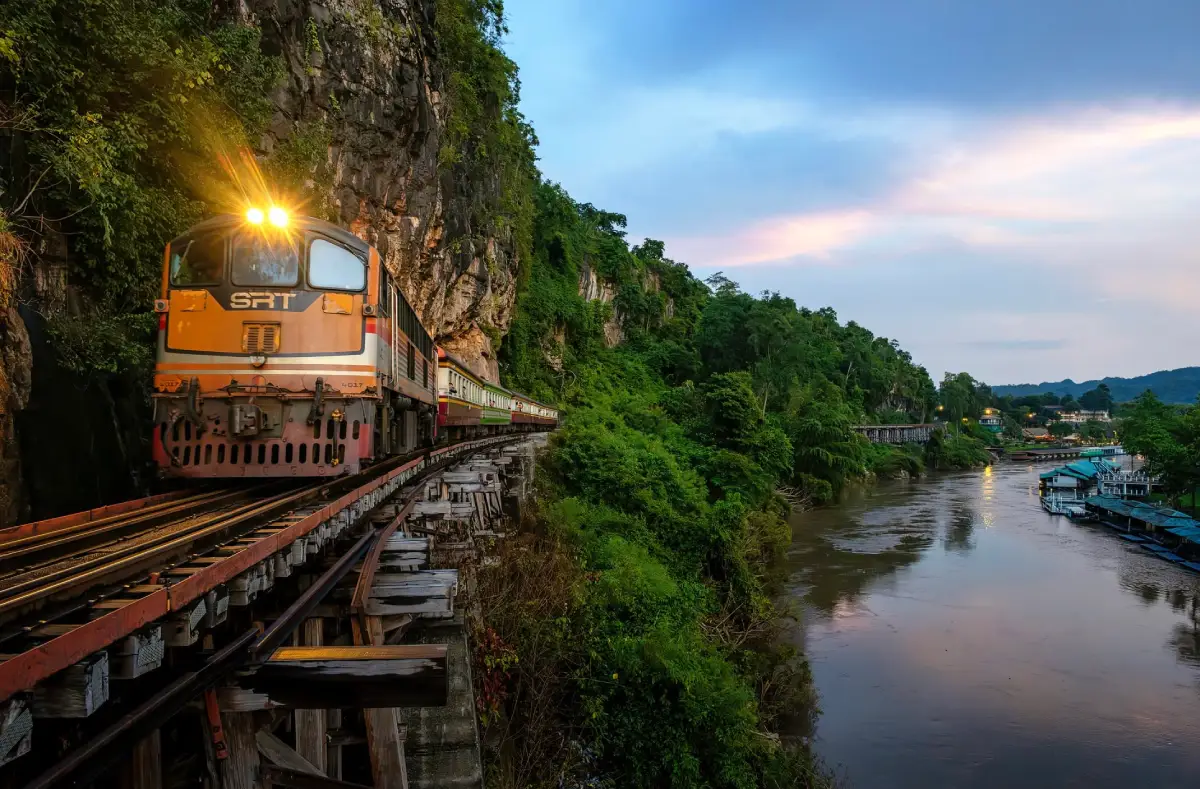
Route 8: Thon Buri to Kanchanaburi and Tham Krasae by Train — A Two-Day, One-Night Journey Along the Death Railway and Through World War II History Kanchanaburi is home to one of Thailand's most historically significant railway journeys. The railway line through the province is much more than a transportation route connecting towns and communities. It is closely linked to events during World War II, particularly the construction of the Thailand–Burma Railway, widely known as the Death Railway.
The appeal of traveling through Kanchanaburi by train lies in the opportunity to experience history along the actual railway corridor. Travelers can cross the famous Bridge over the River Kwai, admire views of the Khwae Noi River and surrounding mountains, and continue toward Tham Krasae, where the railway runs along a limestone cliff. This route combines impressive natural scenery with historical events that deserve thoughtful exploration and understanding.
Visitors departing from Bangkok can consider the regular passenger trains operating from Thon Buri Railway Station toward Kanchanaburi and Nam Tok. It is important to choose a service that stops at the stations required for your itinerary. Another option is to travel on a special excursion train organized by the State Railway of Thailand, although these services operate according to specific schedules and announced programs.
A two-day, one-night itinerary is recommended because several important attractions are located considerable distances apart. This is particularly true of the Bridge over the River Kwai in Mueang Kanchanaburi District and Tham Krasae in Sai Yok District. Travelers who wish to visit both places primarily by train need to examine the timetable carefully and select accommodation in a location that makes the next day's journey convenient.
Visitors interested in World War II history should also learn about the prisoners of war and civilian laborers who were forced to construct the railway under extremely difficult conditions. Many people died during the construction and related wartime operations. These locations should therefore be approached not only as scenic tourist attractions but also as memorial landscapes that deserve respect for the lives lost and the suffering caused by the war.
The landscape itself makes the Kanchanaburi railway journey especially memorable. The railway passes through rural communities, forested areas, and sections where mountains rise above the river valleys. Passengers can enjoy the changing scenery while learning how the natural environment influenced the construction of the historic railway. Some sections remain especially significant because the railway builders were required to work through difficult terrain under harsh conditions.
8.1 Bridge over the River Kwai

The Bridge over the River Kwai is one of Kanchanaburi's most famous landmarks and one of the world's best-known symbols of the Thailand–Burma Railway. The bridge crosses the Khwae Yai River and is associated with the history of World War II, when the railway was constructed using large numbers of Allied prisoners of war and civilian laborers under Japanese military control.
The significance of the Bridge over the River Kwai extends far beyond its steel structure. It represents the human suffering, loss of life, and long-lasting consequences of war. Today, the bridge is both a major historical tourist attraction and a place of remembrance. It also offers visitors an opportunity to learn about railway transportation and the wider history of Southeast Asia during World War II.
The bridge also occupies an important place in the international memory of the war because the Thailand–Burma Railway has been the subject of numerous historical accounts, publications, and cultural representations. Visiting the actual site enables travelers to connect these stories with the landscape and infrastructure that remain today.
Visitors can admire the bridge from the surrounding public areas and choose viewpoints that clearly reveal the structure crossing the river. Passenger trains can still be seen traveling across the bridge, demonstrating that parts of this historic railway corridor remain in active use. However, safety is essential. Travelers should not obstruct the railway, enter restricted areas, or ignore railway signals and instructions from staff.
Travelers using a train that stops near the Bridge over the River Kwai may be able to leave the train and explore the site before continuing their journey. However, they must confirm whether the selected service stops at the appropriate station and arrange transportation to accommodation or other attractions in advance.
Allow approximately 60–90 minutes to visit the Bridge over the River Kwai. Additional time is recommended for travelers who also want to explore museums, memorials, or other historical sites within Kanchanaburi town.
More Information:Bridge Over The River Kwai, Kanchanaburi
8.2 Death Railway
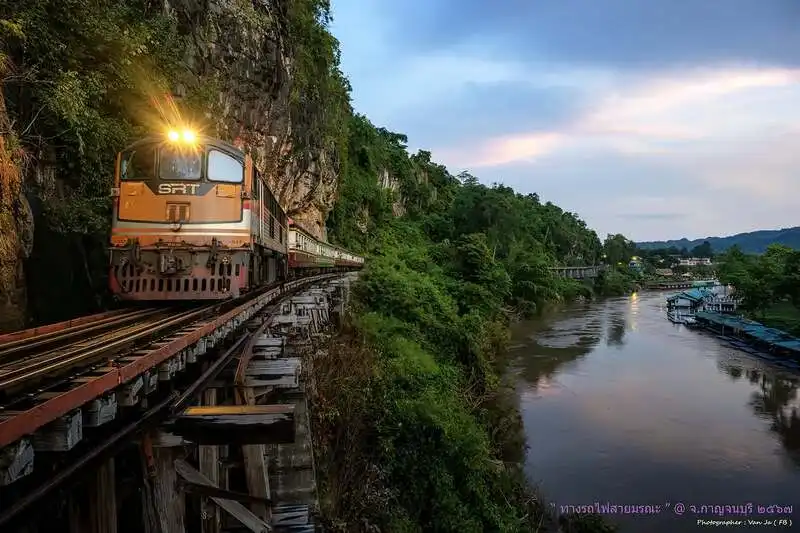
The Death Railway is the widely used name for the Thailand–Burma Railway, which was constructed during World War II under the direction of the Japanese military. The railway was intended to provide a transportation route for military personnel and supplies through difficult mountain and forest terrain. Its construction relied heavily on Allied prisoners of war and civilian laborers from several countries, many of whom were forced to work in exceptionally harsh conditions.
Workers faced major obstacles, including difficult terrain, inadequate food and medical supplies, disease, and extremely demanding labor. Large numbers of people died during construction and related operations. The history of the railway therefore provides important evidence of the devastating human consequences of war. Understanding this background is essential when appreciating the scenic railway journey that visitors can experience today.
The surviving operational section in Thailand connects the Kanchanaburi area with Sai Yok District and Nam Tok Railway Station. Along the way, the railway passes several historically important locations, including the Bridge over the River Kwai and the cliffside railway near Tham Krasae. Traveling along the line allows visitors to observe the challenging landscape through which the original railway was constructed and gain a stronger appreciation of the difficulties faced by those who built it.
One of the most celebrated scenic sections is the railway beside the limestone cliffs near Tham Krasae. From the train, passengers can admire views of the Khwae Noi River and the surrounding landscape. Photography is particularly popular here, but passengers should remain safely inside the train and never lean out of the windows or extend cameras and other equipment beyond the carriage in a dangerous manner.
The railway's historical importance is inseparable from its natural setting. Mountain slopes, rivers, and forested areas posed considerable engineering challenges during its construction. Today, these same landscapes provide passengers with exceptional views and a reminder that the railway was built at enormous human cost.
The best way to experience the Death Railway is as part of the train journey itself, rather than attempting to walk along the tracks. Visitors who wish to explore the historic infrastructure more closely should use authorized viewing areas and locations specifically open to the public.
More Information:Death Railway, Kanchanaburi
8.3 Tham Krasae Cave

Tham Krasae Cave is located in Sai Yok District, Kanchanaburi Province. It is a limestone cave closely associated with the Death Railway and is one of the most important sightseeing stops for travelers exploring the mountainous section of the railway. Its distinctive location beside a cliff provides views of the railway curving along the mountainside and the Khwae Noi River flowing below.
The cave contains a Buddhist worship area where visitors can pay respect to a Buddha image inside the natural rock chamber. At the same time, the surrounding area is famous for its dramatic railway scenery, with the historic railway running along the cliff face. Travelers can therefore experience the limestone mountain landscape, river views, and the history of the railway's construction during World War II within a single destination.
The railway beside Tham Krasae is especially popular because of its striking scenery. The sight of a train traveling along the cliffside timber-supported railway with limestone mountains and the river in the background has become one of the most recognizable images associated with the Kanchanaburi railway journey.
From the surrounding viewpoints, travelers can observe how the railway follows the natural contours of the cliff. This setting also illustrates why constructing the railway through Kanchanaburi's mountainous terrain presented such considerable challenges during World War II. The scenic beauty of the area and its difficult history are both essential aspects of the experience.
Travelers arriving by train can plan to disembark at Tham Krasae Station on a service that stops there, then explore the cave and authorized viewpoints. Photography should be restricted to safe public areas. Visitors must not stand on the railway tracks or bridges when trains are approaching or passing, and extra care should be taken around narrow paths and elevated terrain.
Allow approximately 60–90 minutes to explore Tham Krasae Cave and the surrounding viewpoints, excluding the time required to wait for another train or continue to accommodation. Travelers wishing to study the history and enjoy the scenery in greater detail should select an itinerary with sufficient time between services. It is not advisable to leave a train at Tham Krasae without first confirming how and when the onward journey will take place.
More Information:Tham Krasae Cave, Kanchanaburi
8.4 Sai Yok Noi Waterfall
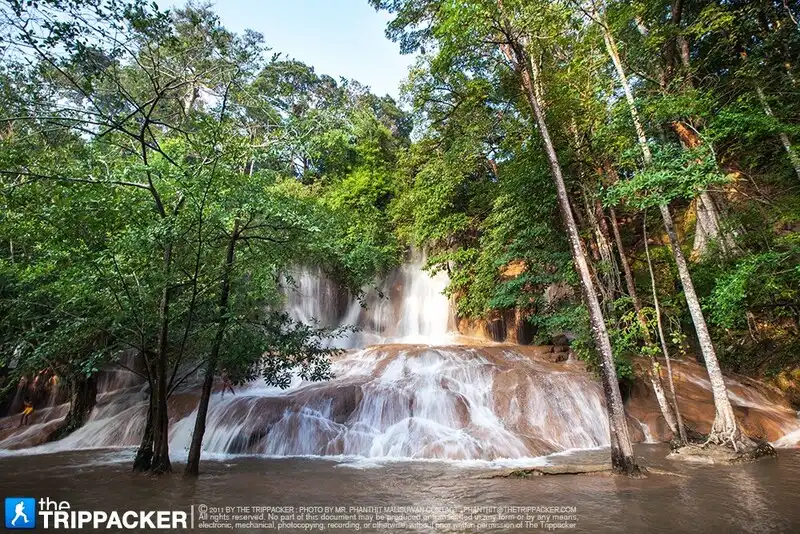
Sai Yok Noi Waterfall is a well-known natural attraction in Sai Yok District, Kanchanaburi Province. Located near a major road through the district, it can be included as an additional destination for visitors traveling on the Kanchanaburi–Nam Tok railway line. The waterfall is distinguished by water flowing over layers of limestone surrounded by vegetation, creating a pleasant setting for relaxation and nature photography.
The waterfall's appearance changes according to seasonal rainfall and water availability. When water levels are sufficient, the cascading streams flow visibly across the limestone formations amid green surroundings. During drier periods, the volume of water may decrease. Visitors should therefore consider seasonal conditions when deciding when to travel.
The natural setting makes Sai Yok Noi Waterfall appealing for visitors seeking a relaxing break after exploring historical railway locations. Its combination of limestone formations, greenery, and flowing water offers a different perspective on the landscape of Kanchanaburi, complementing the railway's mountainous scenery and riverside views.
For railway travelers, Sai Yok Noi Waterfall can sometimes be included after visiting Tham Krasae, provided that the train timetable and return transportation arrangements allow it. However, it should not be assumed that both attractions can be visited comfortably using a single train connection. Rail services between these locations are limited, and there may not be enough time to disembark and explore every stop.
Visitors exploring the waterfall should be careful on slippery limestone surfaces, especially after heavy rainfall or when water levels are high. Avoid areas marked as restricted or dangerous, remain alert to water conditions, and supervise young children closely.
Allow approximately 60–90 minutes to explore Sai Yok Noi Waterfall, together with additional time for the transfer from the railway station or selected drop-off point. The return train timetable should always be checked before leaving the station area for the waterfall.
More Information:Sai Yok Noi Waterfall, Kanchanaburi
Two-Day, One-Night Kanchanaburi–Tham Krasae Train Itinerary On the first day, depart from Thon Buri Railway Station in Bangkok on a train traveling toward Kanchanaburi. Choose a stop that is convenient for visiting Kanchanaburi town or the Bridge over the River Kwai. Upon arrival, begin with the bridge, allowing approximately 60–90 minutes to admire the historic structure and explore the surrounding area. Afterward, have lunch and consider visiting other historical attractions in town if time permits.
During the afternoon of the first day, visitors interested in World War II history can continue learning about the Thailand–Burma Railway at museums or memorial sites in Kanchanaburi. After sightseeing, travel to your accommodation. It is advisable to choose a hotel or guesthouse with convenient access to the railway station or with reliable transportation arrangements for the following morning.
On the second day, take a train from a suitable station in Kanchanaburi toward Tham Krasae, making sure that the selected service stops there. The journey provides an opportunity to enjoy the scenery of the Death Railway, particularly where the tracks pass through mountainous areas and beside the Khwae Noi River. After arriving at Tham Krasae, spend approximately 60–90 minutes exploring the cave and authorized viewpoints before continuing your journey according to the arrangements made in advance.
Travelers wishing to include Sai Yok Noi Waterfall on the same day should study the railway timetable carefully or arrange a local taxi to travel between attractions and provide greater flexibility. If the available services do not allow enough time for a safe and comfortable return journey, consider visiting the waterfall on an additional day or extending the itinerary to three days and two nights.
The recommended duration for the Kanchanaburi–Tham Krasae route is two days and one night, with the Bridge over the River Kwai and Tham Krasae Cave as the principal sightseeing stops. Traveling along the Death Railway is the central railway experience, while Sai Yok Noi Waterfall can be included when the timetable and onward transportation arrangements permit.
Route 9: Bangkok to Pa Sak Jolasid Dam by Train — A One-Day Scenic Journey on Thailand's Famous Floating Train and a Visit to Lop Buri's Sunflower Fields Taking the special floating train to Pa Sak Jolasid Dam in Lop Buri Province is one of Thailand's most distinctive railway experiences. Part of the railway runs across a large reservoir, allowing passengers to admire expansive views of water from inside the train. When reservoir levels are sufficiently high, water surrounds the raised railway embankment, creating the impression that the train is traveling directly across the surface of the lake.
This scenic railway route is especially interesting because it brings together rail transportation, the natural landscape, and one of Thailand's important water development projects. Pa Sak Jolasid Dam is a royal-initiative project that plays a significant role in water management, irrigation, and flood mitigation within the Pa Sak River Basin. At the same time, the area around the dam has become an attractive destination for sightseeing, relaxation, and seasonal tourism.
The State Railway of Thailand organizes special excursion trains to Pa Sak Jolasid Dam during announced operating periods. The available dates, boarding stations, departure times, and sightseeing activities may differ between programs. Travelers should therefore select a date when the special excursion is operating and check the booking arrangements before planning their journey. The floating train is not a sightseeing service that can be assumed to operate every day throughout the year.
Visitors hoping to see the famous sight of a train surrounded by water should understand that the scenery depends on the reservoir's water level. During periods of lower water, the landscape around the railway may look different from promotional photographs showing water stretching out on both sides. However, the railway journey still provides an opportunity to appreciate the surrounding landscape and the reservoir area as they appear on the actual travel date.
This route is recommended as a one-day excursion organized around the special tourist train's official schedule. For preliminary planning, travelers should allow approximately 10–13 hours for the complete return journey and sightseeing activities. The actual duration must be based on the particular excursion program selected. Additional attractions outside the scheduled route should not be included unless suitable transportation and sufficient time have been arranged.
9.1 Pa Sak Jolasid Dam

Pa Sak Jolasid Dam extends across areas of Lop Buri and Saraburi Provinces. It is a major earth-fill dam constructed to store water within the Pa Sak River Basin and is an important part of water-resource management in Central Thailand. The project supports irrigation, agricultural water supply, and flood mitigation in downstream areas. It therefore serves both as significant public infrastructure and as an educational destination for visitors interested in Thailand's water management systems.
The dam's main attraction for tourists is its expansive reservoir surrounded by the landscapes of Lop Buri Province. Visitors can admire views of the water and natural surroundings from areas open to the public while learning about the importance of the dam to nearby communities and agricultural land. The large reservoir creates a different atmosphere from the urban attractions normally associated with railway day trips from Bangkok.
The relationship between the dam and the surrounding agricultural landscape is particularly important because the reservoir plays a role in managing water availability for communities and farmland in the river basin. Visiting the area offers an opportunity to recognize how major water infrastructure can influence settlement patterns, agriculture, flood management, and local economic activities.
For passengers on the floating train excursion, the most memorable part of the experience begins when the train enters the section of railway crossing the reservoir. During periods of high water, passengers can see water extending along both sides of the train, producing the famous floating-train effect. This unusual perspective distinguishes the journey from visiting the dam by car and is the central attraction of the special railway excursion.
In addition to enjoying the scenery from the train, travelers may have an opportunity to visit the dam area if the excursion program includes a scheduled stop. Depending on the arrangements, visitors can spend time relaxing, taking photographs, and learning about the dam project in areas open to the public. It is important to check the official program because stopping locations and the amount of sightseeing time available can differ between excursion services.
Allow approximately 60–90 minutes to explore the dam area if the tourist train itinerary provides sufficient time. Visitors must observe all site regulations and avoid entering operational areas of the dam without permission.
More Information:Pa Sak Cholasit Dam, Lop Buri
9.2 Lopburi Sunflower Fields

The sunflower fields are among Lop Buri Province's best-known seasonal attractions, particularly during the cooler months toward the end of the year when farmers in several areas cultivate sunflowers. During the flowering season, large fields of bright yellow blossoms create colorful landscapes, often with hills and rural scenery in the background. These views make the fields popular places for relaxation and photography.
Lop Buri has sunflower plantations in several different areas, and each field may have its own planting and blooming schedule. Travelers should therefore confirm which fields are open to visitors and whether the flowers are actually in bloom before setting out. The sunflowers do not bloom simultaneously across the entire province, and the fields are not year-round attractions.
In addition to their appeal as photography destinations, sunflower fields provide visitors with an opportunity to observe the agricultural landscape of Lop Buri and appreciate the seasonal relationship between farming and tourism. During flowering periods, some farms welcome visitors to walk through designated areas, while others may operate primarily as agricultural plantations without organized visitor facilities.
Visitors taking the floating train to Pa Sak Jolasid Dam may be able to include a sunflower field as an additional attraction if the official excursion program provides an appropriate stop or transportation connection. However, travelers should not assume that every sunflower field is near a railway station or within walking distance of the dam. Sunflower plantations are distributed across several parts of Lop Buri Province, and reaching an individual field may require a separate road transfer.
Popular activities include walking along designated paths through the flower fields, taking photographs, and enjoying the rural agricultural setting. Visitors should remain on the routes provided by field owners, avoid stepping on or damaging sunflower plants, and refrain from picking flowers without permission. Any admission conditions or visiting rules established by individual farms should also be respected.
Allow approximately 30–60 minutes to visit one sunflower field, excluding travel time from the dam or railway station. Travelers wishing to visit several plantations should choose an itinerary that includes transportation between them or consider arranging a separate sightseeing trip on another day.
More Information:Lopburi Sunflower Fields, Lop Buri
One-Day Pa Sak Jolasid Dam Floating Train Itinerary Begin by selecting a date when the State Railway of Thailand operates its special excursion train to Pa Sak Jolasid Dam, then book a ticket through the official booking channels. On the day of travel, arrive at the designated departure station according to the time printed on your ticket. Bring drinking water, light snacks, and suitable photography equipment for a railway journey lasting several hours.
During the journey, enjoy watching the landscape change from urban neighborhoods to rural areas. As the train reaches the section crossing the Pa Sak Jolasid reservoir, admire the scenery from a safe position inside the carriage. Passengers should not lean out of windows or extend equipment outside the train in a way that could create a safety risk.
When the train reaches the scheduled stopping point or activity area specified in the excursion program, visitors can enjoy the reservoir views, take photographs, and have a meal within the time provided by the railway staff. If the selected program includes transportation to nearby attractions or sunflower fields, travelers can join those activities under the announced conditions. If no such service is included, it is advisable to remain within the designated sightseeing area rather than arranging an independent excursion that could interfere with the return departure.
If the excursion includes a suitable connection to a sunflower field during the flowering season, travelers can take advantage of the opportunity to photograph the plantations and enjoy the rural scenery. However, this additional activity should remain secondary to the train's official itinerary, because the floating train's departure schedule takes priority over independently arranged sightseeing.
After completing the scheduled activities, return to the train at the appointed time for the journey back to the departure station. The Pa Sak Jolasid floating train is particularly suitable for travelers seeking an unusual scenic railway experience without organizing a private vehicle. It also offers an opportunity to learn about Thailand's water infrastructure and the seasonal landscapes of Lop Buri Province.
The recommended duration for this route is one day, with approximately 10–13 hours allocated to the return train journey and scheduled activities. However, travelers must confirm the actual operating date, boarding station, departure and return times, and stopping arrangements of the selected tourist train before traveling.
Route 10: Bangkok to Pattaya by Train — A Two-Day, One-Night Coastal Journey to Pattaya Beach, the Sanctuary of Truth, and Khao Phra Tam Nak Pattaya is one of Thailand's best-known seaside destinations, located in Chon Buri Province on the eastern coast of the Gulf of Thailand. The city is recognized for its beaches, waterfront atmosphere, tourist facilities, and diverse attractions that combine natural scenery with cultural and architectural experiences. Traveling from Bangkok to Pattaya by train offers an alternative to driving and provides an opportunity to experience the Eastern Railway Line before continuing to the city's coastal attractions.
The appeal of visiting Pattaya by train lies in the contrast between the railway journey and the bustling seaside destination awaiting travelers at the end of the route. As the train passes through communities and landscapes in Eastern Thailand, passengers can observe everyday life along the railway before arriving in a major tourist city. Once in Pattaya, visitors can spend time by the sea, explore the remarkable wooden architecture of the Sanctuary of Truth, and enjoy panoramic views of the coastline from Khao Phra Tam Nak.
Pattaya is particularly suitable for a short holiday because its principal attractions offer different experiences within the same destination. Pattaya Beach is ideal for relaxing and enjoying the coastal atmosphere, the Sanctuary of Truth introduces visitors to traditional woodcarving and philosophical concepts expressed through architecture, while Khao Phra Tam Nak provides an elevated viewpoint overlooking Pattaya Bay.
Travelers departing from Bangkok should select a train on the Eastern Line that stops at Pattaya Railway Station or another appropriate station for their destination. Railway services to Pattaya have different operating patterns depending on the train category and day of travel, so passengers should check the latest timetable with the State Railway of Thailand before planning their journey. The railway station is not located directly on Pattaya Beach, and an onward road transfer is required to reach the main tourist areas.
For travelers without a private car, local taxis and other suitable transport services can be used between Pattaya Railway Station, accommodation, and individual attractions. Because the Sanctuary of Truth is located in the northern part of Pattaya and Khao Phra Tam Nak is farther south, grouping activities by area can help reduce unnecessary journeys across the city.
A two-day, one-night itinerary is recommended. The first day can focus on the railway journey, Pattaya Beach, and the Sanctuary of Truth, while the second day can be reserved for Khao Phra Tam Nak and a relaxed return to the railway station. Travelers should consider traffic conditions and the return train timetable when arranging transport, especially if the selected train operates only at particular times or on designated days.
10.1 Pattaya Beach

Pattaya Beach is one of the most recognizable coastal attractions in Chon Buri Province. Located in the central area of Pattaya, the beach extends along Pattaya Bay and is closely associated with the city's development into a major tourist destination. Its broad coastal setting, surrounding hotels, restaurants, shopping areas, and entertainment facilities make it a convenient starting point for visitors exploring Pattaya.
The beach is particularly appealing because visitors can experience the atmosphere of a busy seaside city while enjoying views of the Gulf of Thailand. The waterfront offers opportunities to walk along the shore, relax, take photographs, and observe the activities taking place in the surrounding coastal area. The character of Pattaya Beach differs from quieter and more remote beaches because it combines natural scenery with a lively urban environment.
Pattaya's development as an international tourist destination has transformed the coastline over time. Today, the beachfront represents an important part of the city's tourism economy, bringing together accommodation providers, restaurants, transportation services, and businesses serving both Thai and international travelers. Exploring the beach area offers visitors a direct introduction to the character of Pattaya as a modern seaside destination.
Visitors can enjoy the beach at different times of day, although the morning and late afternoon are generally more comfortable for walking and photography. Those wishing to swim or participate in water activities should check the sea conditions and follow local safety instructions. Visitors should also respect designated activity areas and remain aware of the movement of boats and other watercraft.
For travelers arriving by train, Pattaya Beach requires a local transport connection from Pattaya Railway Station. It is advisable to travel to accommodation first if carrying luggage, then visit the beach during the afternoon when there is enough time to explore the waterfront without rushing. Those staying in central Pattaya may be able to walk between some beachfront destinations, depending on the hotel's location.
Allow approximately 90 minutes to 2 hours to experience Pattaya Beach, with additional time for meals, shopping, or relaxing by the sea. The beach is an excellent first attraction for visitors who want to become familiar with the city before continuing to its cultural landmarks.
More Information:Pattaya Beach, Chon Buri
10.2 Sanctuary of Truth

The Sanctuary of Truth is one of Pattaya's most distinctive architectural and cultural attractions. Located in the Na Kluea area of Chon Buri Province, the structure stands beside the sea and is celebrated for its extensive use of carved wood. Its design incorporates artistic and philosophical ideas drawn from Buddhist and Hindu traditions, expressing concepts relating to human existence, morality, the universe, and the relationship between people and nature.
What makes the Sanctuary of Truth exceptional is the remarkable amount of detail in its wooden sculptures and architectural decoration. Large carved figures, ornate columns, decorative panels, and elaborate roof structures demonstrate the skills of woodcarvers and traditional craftspeople. The building is not simply a conventional temple or museum; it is an artistic and philosophical project in which architecture serves as a means of communicating ideas about religion, culture, and human life.
The structure was conceived by Thai businessman Lek Viriyaphant, who was also associated with other major cultural projects in Thailand. Work on the Sanctuary of Truth began in 1981, and its construction has involved extensive traditional craftsmanship over many decades. The continuing nature of the project makes it especially interesting for visitors who wish to understand how large-scale wooden architecture can be created and maintained through specialized artistic knowledge.
The carvings throughout the building draw on stories, symbolism, and philosophical concepts connected with Asian civilizations. Figures of deities and mythical beings appear alongside decorative motifs that communicate moral teachings and ideas concerning human relationships. Visitors interested in architecture can study the craftsmanship, while those interested in cultural history can consider the religious and philosophical traditions that influenced the artistic design.
The Sanctuary of Truth is located outside the central beachfront area, so visitors arriving by train should arrange a taxi or another suitable road transfer. Because the property includes areas associated with ongoing construction and maintenance, travelers must follow all visitor regulations and safety instructions. Access to particular sections may depend on guided-tour arrangements and operational conditions.
Allow approximately 90 minutes to 2 hours to visit the Sanctuary of Truth, including time to admire the wooden architecture, study its carvings, and explore areas open to visitors. It is advisable to check the current visiting arrangements and admission conditions before traveling, especially during busy holiday periods.
More Information:Sanctuary of Truth, Chon Buri
10.3 Khao Phra Tam Nak (Khao Phra Bat)

Khao Phra Tam Nak, also known as Khao Phra Bat, is a prominent hill in Pattaya that offers panoramic views of Pattaya Bay and the surrounding coastline. Located between central Pattaya and the Jomtien area, it is a popular destination for visitors who want to appreciate the city's coastal geography from an elevated viewpoint.
The main attraction of Khao Phra Tam Nak is the sweeping view across the curved shoreline of Pattaya Bay. From the viewpoint, visitors can observe the relationship between the beach, the urban landscape, surrounding buildings, and the Gulf of Thailand. This elevated perspective is particularly appealing for photography, especially during periods of clear weather when visibility across the bay is good.
The hill is also associated with important local landmarks and religious sites, giving the area cultural significance beyond its scenic views. Visitors may encounter spaces used for worship or remembrance, and should respect the surrounding environment and the rules applicable to each area. The combination of natural elevation, religious associations, and urban scenery makes Khao Phra Tam Nak a distinctive attraction within Pattaya.
Visiting the viewpoint offers an opportunity to understand Pattaya's geography in a way that is difficult to appreciate from the beachfront alone. Looking down toward the bay reveals the coastal shape of the city, while the surrounding hills demonstrate how Pattaya's development has expanded across a landscape of beaches, elevated terrain, and urban neighborhoods.
For railway travelers, Khao Phra Tam Nak is best reached by taxi or another suitable vehicle from central Pattaya. It is not a convenient walking destination from Pattaya Railway Station or the Sanctuary of Truth. Scheduling the viewpoint as an independent attraction on the second day is a practical way to avoid spending too much time traveling between distant parts of the city on the first day.
Allow approximately 45–60 minutes to visit Khao Phra Tam Nak and enjoy the views. Morning or late afternoon is generally preferable for comfortable sightseeing, but visitors should select a time that allows a safe return to their accommodation or railway station.
More Information:Khao Phra Tam Nak (Khao Phra Bat), Chon Buri
Two-Day, One-Night Pattaya Train Itinerary On the first day, depart from Bangkok on a train serving Pattaya Railway Station, choosing a service that operates on the intended travel date. After arriving, use a local taxi or another appropriate transport service to reach your accommodation and leave your luggage. Once you have settled in, continue to Pattaya Beach to enjoy the coastal atmosphere, walk along the shore, and have a meal in the surrounding area.
Spend approximately 90 minutes to 2 hours exploring Pattaya Beach before traveling to the Sanctuary of Truth in the afternoon, provided that the selected arrival time and attraction's visiting arrangements allow it. Allocate approximately 90 minutes to 2 hours for the Sanctuary of Truth to appreciate the wooden architecture and its intricate carvings. Since the site is located in northern Pattaya, arranging onward transportation in advance will help make the itinerary more efficient.
During the evening, return to your accommodation or enjoy dinner in an appropriate part of the city. A relaxed schedule is particularly beneficial after traveling by train and visiting two attractions in different areas of Pattaya. Visitors can use the evening to enjoy the seaside atmosphere without adding another major attraction that would require a lengthy transfer.
On the second day, begin with Khao Phra Tam Nak, allowing approximately 45–60 minutes to admire the panoramic views of Pattaya Bay and take photographs. Afterward, have breakfast or lunch according to your departure schedule, then return to your accommodation to collect your luggage before traveling to Pattaya Railway Station.
Before confirming the itinerary, check the return railway service carefully. Train departures from Pattaya may differ according to the day of the week and type of service, so travelers should not assume that several return trains will be available throughout the day. If the train schedule does not suit your preferred departure time, consider adjusting the itinerary or making alternative transport arrangements.
A two-day, one-night Pattaya railway trip is ideal for travelers interested in combining beaches, distinctive architecture, and scenic viewpoints. The route demonstrates how a train journey can be used as the main intercity transport connection while local road services provide access to individual attractions within a coastal tourist city.
Route 11: Bangkok to Khun Tan and Lamphun by Train — A Two-Day, One-Night Journey Through a Historic Railway Tunnel and the Ancient Hariphunchai Kingdom Khun Tan and Lamphun offer one of Northern Thailand's most interesting combinations of railway history, mountain scenery, and ancient Buddhist culture. The journey follows the Northern Railway Line through the highland landscapes between Lampang and Lamphun, passing through the historic Khun Tan Railway Tunnel before continuing toward Lamphun, a province renowned for its connections with the Hariphunchai Kingdom.
The appeal of this railway route lies in the opportunity to experience two very different aspects of Northern Thailand in one trip. Khun Tan represents the history of railway engineering and the challenge of constructing a transportation route through mountainous terrain, while Lamphun introduces travelers to the religious monuments, architecture, and cultural traditions of one of the region's oldest historical cities.
The Khun Tan Railway Tunnel is particularly significant because of its role in connecting Lampang and Lamphun through the mountain range separating the two provinces. Construction of the tunnel required extensive engineering work through difficult terrain, making it an important achievement in the development of Thailand's Northern Railway. For passengers, the journey through the tunnel remains a memorable part of traveling between Central and Northern Thailand by train.
Lamphun is equally appealing for its historical and spiritual heritage. The city is closely associated with the Hariphunchai Kingdom, which developed as an important center of Mon Buddhist culture before the establishment of the Lanna Kingdom. Important monuments such as Wat Phra That Hariphunchai Woramahawihan and Wat Chamthewi provide evidence of the city's religious and architectural traditions, while Ku Chang–Ku Ma reflects local beliefs and legends associated with Hariphunchai history.
Travelers beginning in Bangkok can choose a Northern Line train that passes through the Khun Tan area and continues toward Lamphun or Chiang Mai. However, not every train stops at Khun Tan Railway Station, and some services travel directly through the tunnel without allowing passengers to disembark. Anyone wishing to visit the tunnel area on foot should select a service that actually stops at Khun Tan and confirm the onward journey before traveling.
The journey from Bangkok to Northern Thailand can take many hours, and an overnight train may be a practical choice. The recommended itinerary provides two days and one night for sightseeing in the Khun Tan–Lamphun area, excluding any additional overnight train journeys required to reach the destination or return to Bangkok.
Because the principal attractions are spread between a mountain railway station and Lamphun city, transportation planning is especially important. Khun Tan Railway Station is not within walking distance of the historic temples in Lamphun. Travelers will need a suitable onward train connection or road transfer to move between these areas, and should select accommodation with convenient access to the intended sightseeing route.
11.1 Khun Tan Railway Tunnel

Khun Tan Railway Tunnel is one of Thailand's most historically significant railway engineering landmarks. Located along the Northern Railway between Lampang and Lamphun, the tunnel passes through the Khun Tan mountain range and forms an important part of the railway connection between Central Thailand and the northern provinces.
The tunnel is particularly noteworthy because it was constructed through mountainous terrain during a period when railway building required intensive labor and complex engineering solutions. Its completion helped establish a continuous railway connection through the mountains, contributing to the development of transportation, trade, and travel in Northern Thailand.
The surrounding landscape is characterized by forests, mountains, and the cooler atmosphere of the highlands. Traveling through this section of the Northern Railway offers passengers views of a natural environment quite different from the plains and urban communities encountered farther south. For railway enthusiasts, the tunnel represents a distinctive landmark along the route to Lamphun and Chiang Mai.
The tunnel is also closely associated with Khun Tan Railway Station, which is located near its northern entrance. Visitors who arrive on a train that stops at Khun Tan can appreciate the mountain setting and observe the railway infrastructure from public areas where access is permitted. The station's location provides a distinctive atmosphere for visitors interested in transportation history and mountain scenery.
However, Khun Tan Railway Tunnel remains part of an active railway line. Visitors must never walk inside the tunnel or enter restricted railway areas. Trains can approach with limited visibility, and the tunnel does not provide a safe pedestrian route. Photography and sightseeing should be limited to authorized areas around the station and nearby public spaces.
Travelers who plan to leave the train at Khun Tan must confirm that their selected train stops there and that an onward service or suitable road transfer is available. Because train frequency may be limited, disembarking without a confirmed plan can result in a lengthy wait or difficulty continuing to Lamphun city.
Allow approximately 45–60 minutes to explore the accessible station surroundings and learn about the railway tunnel. Travelers interested in walking through nearby natural areas should prepare a separate itinerary with appropriate footwear, sufficient time, and information about the routes open to visitors.
More Information:Khun Tan Railway Tunnel, Lamphun
11.2 Wat Phra That Hariphunchai Woramahawihan
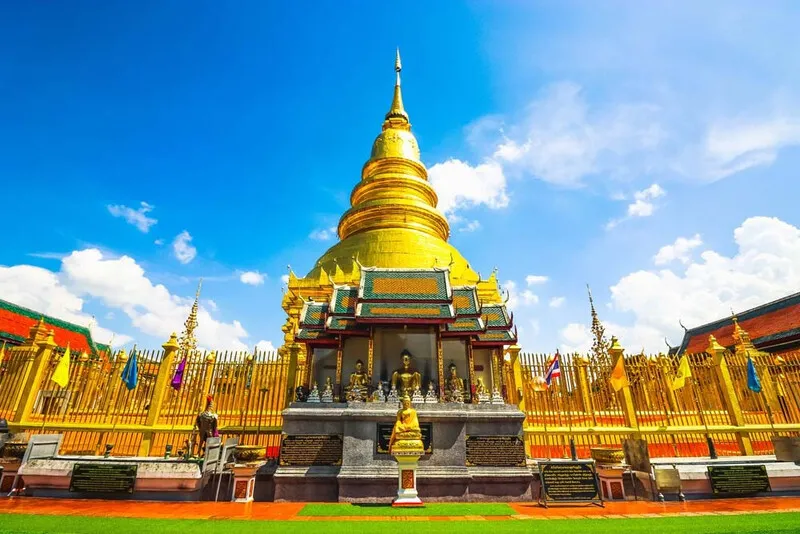
Wat Phra That Hariphunchai Woramahawihan is one of the most important Buddhist temples in Lamphun Province and a major spiritual landmark of Northern Thailand. Located in the historic center of Lamphun city, the temple is closely associated with the ancient Hariphunchai Kingdom and the development of Buddhism in the region.
The temple's most prominent feature is its golden principal chedi, which stands as a symbol of religious devotion and the province's historical identity. The chedi is revered as a sacred monument associated with Buddhist relics and has long attracted worshippers from Lamphun and other parts of Thailand. Its architectural form and golden decoration create a distinctive appearance that makes the temple one of the region's most recognizable religious sites.
Wat Phra That Hariphunchai is particularly significant because Lamphun was an important center of Hariphunchai civilization before the expansion of the Lanna Kingdom. The temple therefore represents a connection between the religious traditions of the earlier kingdom and the Buddhist culture that continued to develop throughout Northern Thailand.
Within the temple grounds are assembly halls, important Buddha images, and architectural features reflecting different periods of religious patronage and restoration. Visitors can explore the religious complex while learning about the relationship between Buddhist worship, royal traditions, and the historical development of Lamphun.
The temple is also associated with local religious traditions and important Buddhist observances. One well-known custom is the annual celebration honoring Phra That Hariphunchai, during which worshippers gather to pay respect to the sacred chedi. These activities reflect the continuing role of the temple as a center of community faith rather than simply a historical tourist attraction.
For railway travelers, Wat Phra That Hariphunchai is an ideal main destination after reaching Lamphun city. Visitors arriving at Lamphun Railway Station will need to continue into the historic center by local transportation, depending on their luggage and accommodation location. The temple can be combined with visits to Wat Chamthewi and other nearby cultural landmarks.
Allow approximately 60–90 minutes to visit the temple, pay respect to the principal chedi, and admire the surrounding architecture. Visitors should dress modestly, remove their shoes where required, and follow the temple's rules during religious ceremonies.
More Information:Wat Phra That Hariphunchai Woramahawihan, Lamphun
11.3 Wat Chamthewi

Wat Chamthewi is an important historic Buddhist temple in Lamphun Province, closely associated with the history of Queen Chamthewi and the ancient Hariphunchai Kingdom. The temple is particularly well known for its distinctive stepped chedi, which represents an important example of religious architecture associated with the Hariphunchai cultural tradition.
The temple's principal historical structure is often referred to as Ku Kut Chedi. Its design features a series of progressively smaller levels adorned with niches containing standing Buddha images. This architectural arrangement differs from the bell-shaped chedis commonly found at many other Thai temples, making Wat Chamthewi particularly interesting for visitors studying Buddhist art and architecture.
The temple is associated with Queen Chamthewi, a central figure in the historical traditions of Lamphun. According to the region's historical narratives, she played an important role in the establishment and early development of Hariphunchai as a center of government and Buddhist culture. Her name remains deeply connected with the identity of Lamphun and its ancient monuments.
Wat Chamthewi offers visitors an opportunity to explore religious architecture that reflects the earlier history of Northern Thailand before the emergence of Lanna as a major regional kingdom. The surviving structures provide evidence of artistic and religious traditions that developed within the Hariphunchai cultural sphere.
Beyond the architectural importance of the chedi, the temple has a peaceful atmosphere suitable for visitors who want to learn about Lamphun's heritage at a slower pace. It is particularly rewarding to visit after Wat Phra That Hariphunchai because the two temples provide different perspectives on the city's long Buddhist history.
For train travelers, Wat Chamthewi requires a local road transfer from Lamphun Railway Station or the historic town center. It should be included in the same sightseeing day as other Lamphun attractions rather than treated as a stop directly beside the railway line.
Allow approximately 45–60 minutes to explore Wat Chamthewi and appreciate its architecture, history, and peaceful surroundings.
More Information:Wat Chamthewi, Lamphun
11.4 Ku Chang–Ku Ma

Ku Chang–Ku Ma is a historical and cultural site in Lamphun associated with local traditions and stories surrounding Queen Chamthewi and the Hariphunchai Kingdom. The site is particularly interesting because it reflects how historical memory, religious beliefs, and local legends have been preserved through places that continue to be respected by the community.
The name Ku Chang–Ku Ma refers to structures connected with traditions concerning an important elephant and horse associated with Queen Chamthewi. In local cultural narratives, these animals held symbolic significance, and the structures connected with them became part of Lamphun's historical landscape and community beliefs.
The site offers an opportunity to learn about how local communities remember the ancient Hariphunchai period through stories and places that are meaningful beyond their architectural form. Unlike major temples whose historical importance is primarily expressed through large chedis and religious buildings, Ku Chang–Ku Ma is especially associated with local tradition and cultural memory.
Visitors can explore the site and consider the relationship between the historical figure of Queen Chamthewi and the legends that developed around her. These stories are an important part of Lamphun's cultural heritage, although they should be understood as traditional narratives rather than treated automatically as independently established historical events.
For travelers exploring Lamphun by train, Ku Chang–Ku Ma is an additional stop that can be included after visiting Wat Phra That Hariphunchai and Wat Chamthewi. Transportation should be arranged according to the actual route and the location of the accommodation or railway station.
Allow approximately 30–45 minutes to visit Ku Chang–Ku Ma. Travelers with a strong interest in Lamphun's history and local beliefs may wish to spend additional time learning about the traditions connected with the site.
More Information:Ku Chang–Ku Ma in Lamphun
Two-Day, One-Night Khun Tan–Lamphun Train Itinerary On the first day, travel from Bangkok on a Northern Line train that passes through the Khun Tan mountain area. Choose a service that stops at Khun Tan Railway Station only if you intend to disembark and have confirmed how you will continue afterward. If no suitable train connection is available, enjoy the tunnel passage from the train and continue directly to Lamphun for sightseeing.
When visiting the Khun Tan station area, allow approximately 45–60 minutes to admire the mountain scenery and learn about the railway tunnel. Stay within authorized areas and do not walk into the tunnel or along the active railway. Afterward, travel onward toward Lamphun city using a confirmed rail connection or suitable road transportation.
Upon reaching Lamphun city, travel to your accommodation and leave your luggage before visiting Wat Phra That Hariphunchai Woramahawihan. Allow approximately 60–90 minutes to explore the temple and pay respect to the golden chedi. During the evening, enjoy a meal in the town center and experience the atmosphere of the historic city before returning to your accommodation.
On the second day, begin with Wat Chamthewi, spending approximately 45–60 minutes studying the stepped chedi and its Hariphunchai architectural features. Then continue to Ku Chang–Ku Ma to learn about local legends and historical traditions connected with Queen Chamthewi, allowing around 30–45 minutes.
After completing the sightseeing activities, return to the accommodation to collect your luggage and continue to the appropriate railway station for your onward or return journey. If traveling back to Bangkok by overnight train, arrange the evening departure according to the actual railway timetable and allow sufficient time for transportation to the station.
The recommended sightseeing duration for the Khun Tan–Lamphun route is two days and one night in the destination area. Travelers must allow additional time for the long-distance train journeys to and from Bangkok. This itinerary combines the history of railway engineering with the religious and cultural heritage of the Hariphunchai Kingdom, making it particularly attractive to visitors interested in both transportation history and Northern Thai civilization.
Route 12: Bangkok to Chiang Mai by Train — A Three-Day, Two-Night Journey Through Lanna History, Ancient Temples, and Traditional Markets Chiang Mai is one of Northern Thailand's most important destinations for cultural and historical tourism. The city is renowned for its Lanna heritage, ancient Buddhist temples, distinctive architecture, traditional markets, local food, and surrounding mountain landscapes. Traveling from Bangkok to Chiang Mai by train is an especially memorable experience because the Northern Railway passes through several regions before entering the mountains and valleys of Northern Thailand.
The appeal of visiting Chiang Mai by train lies in the opportunity to combine the long-distance railway journey with a detailed exploration of the former capital of the Lanna Kingdom. Chiang Mai was founded in 1296 by King Mangrai and developed as an important political, religious, and cultural center of Northern Thailand. Its historic old city still preserves traces of the original urban plan, including sections of city walls, gates, and the moat, together with temples that reflect centuries of Buddhist patronage and artistic development.
Chiang Mai's distinctive cultural identity is visible in the architectural features of its temples, the traditions of local communities, and the everyday activities taking place around markets and historic neighborhoods. Visitors can explore important religious landmarks such as Wat Phra Singh Woramahawihan, Wat Chedi Luang Worawihan, and Wat Chiang Man, while also experiencing the atmosphere of Kad Warorot, one of the city's best-known traditional markets.
For travelers departing from Bangkok, the Northern Railway provides services to Chiang Mai, including trains that travel overnight. Choosing an appropriate sleeper service can make a long journey more comfortable and allow travelers to arrive in the morning, depending on the timetable. However, the total travel time depends on the selected train, and passengers should check the actual departure and arrival times before making accommodation arrangements.
Chiang Mai Railway Station is located outside the historic old city's central area. Travelers arriving by train generally need to continue by local taxi, red shared taxi, or another suitable transport service to reach their accommodation and the main attractions. Choosing a hotel within or close to the old city is convenient for exploring several historic temples, while accommodation near the railway station may be preferable for travelers prioritizing transportation connections.
A three-day, two-night itinerary is recommended for exploring the principal cultural attractions at a comfortable pace. The first day can focus on the old city's most important temples, the second day on additional historic religious sites and their architectural heritage, and the third day on Kad Warorot and local food before returning to the railway station. Travelers should remember that three days and two nights refers to time spent in Chiang Mai, not necessarily the total duration of the journey from and back to Bangkok.
The city's cultural appeal extends beyond monuments and museums. Traditional Northern Thai food, religious ceremonies, local handicrafts, and the everyday life of its markets all contribute to the visitor experience. Travelers who spend enough time walking through the historic neighborhoods can observe the relationship between Chiang Mai's past as a Lanna capital and its present identity as a major cultural city.
12.1 Wat Phra Singh Woramahawihan

Wat Phra Singh Woramahawihan is one of Chiang Mai's most important Buddhist temples, located in the western part of the historic old city. The temple is closely associated with Lanna religious traditions and is particularly famous for the revered Phra Buddha Sihing image. Its buildings and artistic decorations provide excellent examples of Northern Thai Buddhist architecture and craftsmanship.
The temple was established during the Lanna period and developed into an important center of Buddhist worship and religious patronage. Its historical significance reflects the close relationship between the rulers of Chiang Mai and Buddhist institutions, which played essential roles in religious education, cultural continuity, and community life.
Among its most distinctive architectural features is the beautiful Lai Kham Viharn, whose decorative elements and interior artwork reflect the artistic traditions of the Lanna region. Visitors can admire the proportions of the building, the elaborate woodwork, and the religious images that form part of the temple's sacred environment.
Wat Phra Singh is also associated with important Buddhist observances and Chiang Mai's Songkran traditions. The Phra Buddha Sihing image holds particular significance during the traditional Thai New Year, when religious activities connected with the image become part of the city's cultural celebrations. These traditions demonstrate that the temple continues to play an active role in the religious life of Chiang Mai rather than existing solely as a historical monument.
The temple grounds contain additional religious buildings and monuments that reflect different periods of construction, restoration, and artistic development. Walking through the complex allows visitors to appreciate the way Lanna Buddhist architecture combines decorative details, sacred spaces, and a layout suited to religious activities.
For travelers arriving by train, Wat Phra Singh is an excellent first destination after checking into accommodation within or near the old city. Although the temple is not within convenient walking distance of Chiang Mai Railway Station, it can be reached by local transport. Once in the old city, visitors can combine the temple with other nearby historical attractions.
Allow approximately 60–90 minutes to visit Wat Phra Singh Woramahawihan, including time to admire the architecture and pay respect to important Buddha images. Visitors should dress modestly and observe the rules applicable to active Buddhist temples.
More Information:Wat Phra Singh Woramahawihan, Chiang Mai
12.2 Wat Chedi Luang Worawihan

Wat Chedi Luang Worawihan is a major Buddhist temple located in the historic center of Chiang Mai. It is particularly renowned for the remains of its enormous ancient chedi, which represents one of the most important surviving monuments of the Lanna Kingdom. The scale of the structure provides a strong impression of Chiang Mai's historical importance as a religious and political center.
The temple's principal chedi was constructed during the Lanna period and developed into one of the city's most significant religious monuments. Although parts of the original structure were damaged in the past, the surviving remains demonstrate the ambitious scale of Lanna religious architecture and the importance attached to major Buddhist monuments.
The massive chedi is distinguished by its broad base, rising terraces, and decorative features, including sculptural elements associated with Lanna art. Visitors can study the structure from surrounding areas and observe the combination of monumental design and historical craftsmanship that has made Wat Chedi Luang one of Chiang Mai's most recognizable landmarks.
The temple is also historically significant because the Emerald Buddha, now enshrined at Wat Phra Kaew in Bangkok, was once housed at Wat Chedi Luang. This connection reflects the role Chiang Mai played within the wider religious and political history of mainland Southeast Asia.
Wat Chedi Luang remains an active Buddhist temple with religious buildings and spaces used for worship. Visitors can admire the ancient chedi while also experiencing the atmosphere of a functioning religious institution. Religious activities and important Buddhist observances continue to contribute to the temple's significance for local residents.
For travelers exploring Chiang Mai by train, Wat Chedi Luang can conveniently be included in a walking itinerary within the old city after reaching the area by local transport from the railway station. It is particularly suitable for visiting on the same day as Wat Phra Singh because both are located within the historic city walls.
Allow approximately 60–90 minutes for Wat Chedi Luang Worawihan. Visitors who enjoy architectural photography may wish to spend additional time examining the ancient chedi and other religious buildings around the complex.
More Information:Wat Chedi Luang Worawihan, Chiang Mai
12.3 Wat Chiang Man
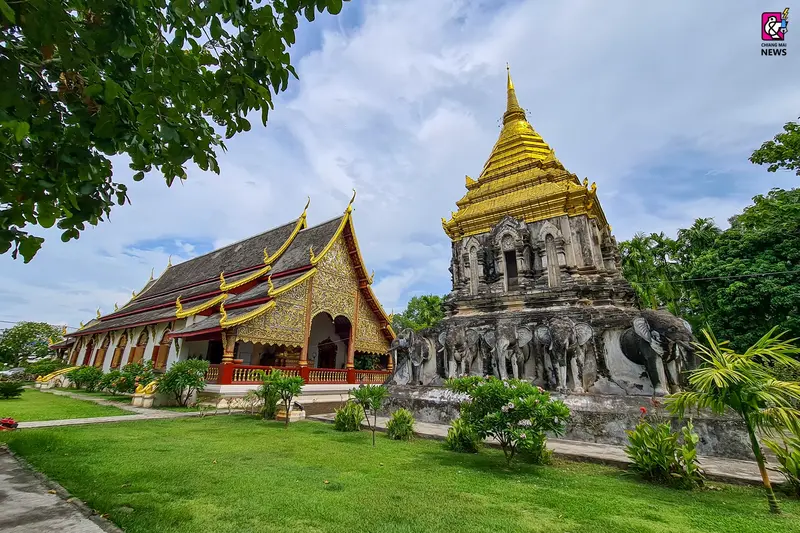
Wat Chiang Man is one of Chiang Mai's oldest and most historically significant Buddhist temples. Located in the northeastern area of the old city, the temple is associated with the founding of Chiang Mai by King Mangrai in 1296. Its history connects it directly with the early development of the city as the capital of the Lanna Kingdom.
The temple is particularly noteworthy for its distinctive chedi supported by sculpted elephants around the base, an architectural feature that reflects artistic traditions of the Lanna period. This design gives Wat Chiang Man a recognizable character and offers visitors an opportunity to examine one of the early religious monuments associated with Chiang Mai's foundation.
Within the temple grounds are additional historic religious structures and revered Buddha images. The temple is particularly associated with important sacred images traditionally known as Phra Sila and Phra Sae Tang Khamani, the latter often referred to as the Crystal Buddha. These images are important to the religious traditions of the temple and its local community.
Wat Chiang Man provides an opportunity to understand the relationship between the founding of Chiang Mai and the establishment of Buddhist institutions. Temples played essential roles in shaping the cultural and spiritual identity of the Lanna capital, and Wat Chiang Man remains a major landmark connected with the city's earliest history.
Compared with some of Chiang Mai's larger and busier temples, Wat Chiang Man offers a setting where visitors can appreciate historical architecture and religious art at a more relaxed pace. The temple's layout, chedi, and surrounding buildings provide insight into the evolution of Lanna craftsmanship and religious traditions.
For travelers using public transport, Wat Chiang Man is convenient to include in an itinerary exploring the northern section of Chiang Mai's old city. After arriving from the railway station and checking into accommodation, visitors can explore the temple and continue to other attractions within the old city by walking or using local transport as appropriate.
Allow approximately 45–60 minutes to visit Wat Chiang Man. As it is an active Buddhist temple, visitors should dress appropriately and respect religious activities taking place on the grounds.
More Information:Wat Chiang Man, Chiang Mai
12.4 Kad Warorot (Kad Luang)

Kad Warorot, widely known locally as Kad Luang, is one of Chiang Mai's most important traditional markets. Located near the Ping River in the central city, the market has long served as a major commercial center for local residents and traders. It is especially popular among visitors looking for Northern Thai food, traditional products, textiles, and souvenirs.
The market's significance lies in its role as a genuine trading center that continues to serve the daily needs of Chiang Mai residents. Unlike shopping attractions developed exclusively for tourists, Kad Warorot combines everyday commerce with an extensive selection of regional specialties, making it a rewarding place to experience the city's food culture and commercial traditions.
Visitors can explore stalls selling dried foods, regional snacks, Northern Thai sausages, chili pastes, traditional sweets, fresh ingredients, and local products. The variety of goods reflects the culinary traditions of Northern Thailand and the influence of the different communities that have contributed to Chiang Mai's urban economy.
The area around Kad Warorot is also connected with the history of commerce along the Ping River. The market's location near important urban trading routes illustrates how river transportation and commercial communities helped shape the development of Chiang Mai beyond its historic walled center.
For international travelers, Kad Warorot offers an opportunity to experience a different side of Chiang Mai from its ancient temples. Exploring the market provides insights into everyday shopping, regional ingredients, food preservation techniques, and the products valued by local residents. Visitors can also purchase souvenirs or food products to take home, subject to applicable transportation and customs regulations.
For railway travelers, Kad Warorot is best visited after reaching the central city by taxi or another local transport service. It can be included on the final morning before returning to Chiang Mai Railway Station, although visitors should leave enough time to travel from the market to the station and prepare for the departure.
Allow approximately 60–90 minutes to explore Kad Warorot, with additional time for meals or shopping. Visitors interested in food culture may prefer to visit earlier in the day, when many traditional food traders are active.
More Information:Kad Warorot (Kad Luang), Chiang Mai
Three-Day, Two-Night Chiang Mai Train Itinerary On the first day, arrive at Chiang Mai Railway Station according to the train service selected from Bangkok. Continue by local taxi, red shared taxi, or another suitable transport service to accommodation within or near the old city, where you can leave your luggage or check in. Once settled, begin exploring Chiang Mai's historic center, starting with Wat Phra Singh Woramahawihan.
Allow approximately 60–90 minutes at Wat Phra Singh to admire the Lanna architecture and pay respect to the important Buddha images. Afterward, enjoy a local meal and continue to Wat Chedi Luang Worawihan, spending another 60–90 minutes exploring the enormous ancient chedi and surrounding religious buildings. These temples are both within the old city, making them practical choices for the first day's sightseeing.
During the evening of the first day, return to your accommodation or spend time exploring an appropriate part of Chiang Mai's central area. Visitors interested in Northern Thai food can sample regional dishes according to their preferences. Keeping the evening relatively relaxed allows time to recover after the long-distance railway journey.
On the second day, begin with Wat Chiang Man in the northern part of the old city. Spend approximately 45–60 minutes studying the temple's early Lanna architecture, elephant-supported chedi, and religious history. Afterward, continue exploring the old city's streets, surviving walls, gates, or nearby cultural attractions according to the time available.
The second afternoon can be reserved for exploring Chiang Mai's cultural atmosphere at a comfortable pace. Visitors can enjoy a meal, learn more about Lanna craftsmanship, or revisit a temple of particular interest. The purpose of this day is to appreciate the historical character of Chiang Mai rather than travel between too many distant attractions.
On the third day, visit Kad Warorot (Kad Luang) to experience a traditional Chiang Mai market, explore Northern Thai food products, and purchase souvenirs. Allow approximately 60–90 minutes for shopping and browsing. Afterward, return to your accommodation to collect your luggage and make your way to Chiang Mai Railway Station according to the selected train departure.
If traveling back to Bangkok by overnight sleeper train, the return journey may extend beyond the third sightseeing day. Travelers should therefore check both the railway timetable and accommodation arrangements carefully when calculating the total duration of the holiday.
A three-day, two-night Chiang Mai railway itinerary combines four important cultural attractions: Wat Phra Singh Woramahawihan, Wat Chedi Luang Worawihan, Wat Chiang Man, and Kad Warorot. Together, these destinations introduce travelers to the city's Lanna Buddhist heritage, ancient architecture, local commerce, and regional food traditions. It is an excellent route for visitors seeking a culturally focused Northern Thailand journey without relying on a private car for the intercity portion of the trip.
Route 13: Bangkok to Nong Khai by Train — A Three-Day, Two-Night Journey Along the Mekong River, Exploring Tha Sadet Market, Sala Kaeo Ku, and the Thai–Lao Friendship Bridge Nong Khai is one of Thailand's most fascinating destinations along the Mekong River. Located in the northeastern part of the country on the border with Laos, the province is known for its riverside scenery, distinctive cultural heritage, religious traditions, and longstanding connections with communities on both sides of the Mekong. Traveling from Bangkok to Nong Khai by train offers an opportunity to experience Thailand's Northeastern Railway while discovering a border city where everyday life remains closely connected to the great river.
The appeal of traveling to Nong Khai by train lies in the combination of a long-distance railway journey and the cultural atmosphere of a Mekong riverside destination. Passengers can observe the changing landscapes of Northeastern Thailand before arriving in a province whose history and economy have been influenced by trade, transportation, religion, and the movement of people between Thailand and Laos.
Nong Khai offers several attractions that reveal different aspects of the city's identity. Tha Sadet Market introduces visitors to local commerce and the atmosphere of the Mekong waterfront. Sala Kaeo Ku provides an unusual artistic and spiritual experience through its monumental sculptures inspired by Buddhist and Hindu beliefs. Meanwhile, the First Thai–Lao Friendship Bridge illustrates the importance of cross-border transportation and modern regional connections.
The province is also interesting for its religious and cultural traditions, particularly the influence of Buddhism and beliefs associated with the Mekong River. Local temples, riverside communities, and markets reflect a way of life that has developed through centuries of interaction between neighboring regions. Visitors interested in cultural tourism can therefore experience far more than scenic river views.
Travelers departing from Bangkok can use Northeastern Line trains serving Nong Khai Railway Station. Long-distance and overnight services are particularly suitable for visitors who want to arrive in the province without spending an entire sightseeing day on the train. However, passengers should check the actual departure station, train category, and arrival time before booking accommodation or arranging local transportation.
After arriving at Nong Khai Railway Station, travelers need to continue by local taxi or another appropriate transport service to reach the town center and riverside attractions. Tha Sadet Market is located within the urban area, while Sala Kaeo Ku and the Friendship Bridge require separate road transfers. Although all three attractions are in the Nong Khai area, they should not be treated as locations that can all be reached conveniently on foot from the railway station.
A three-day, two-night itinerary is recommended. The first day can focus on Tha Sadet Market and the Mekong waterfront, the second day on Sala Kaeo Ku and the Thai–Lao Friendship Bridge, and the third day on local food, shopping, or a relaxed riverside visit before returning to the railway station. Travelers using overnight trains should allow additional time for the journeys to and from Bangkok.
13.1 Tha Sadet Market
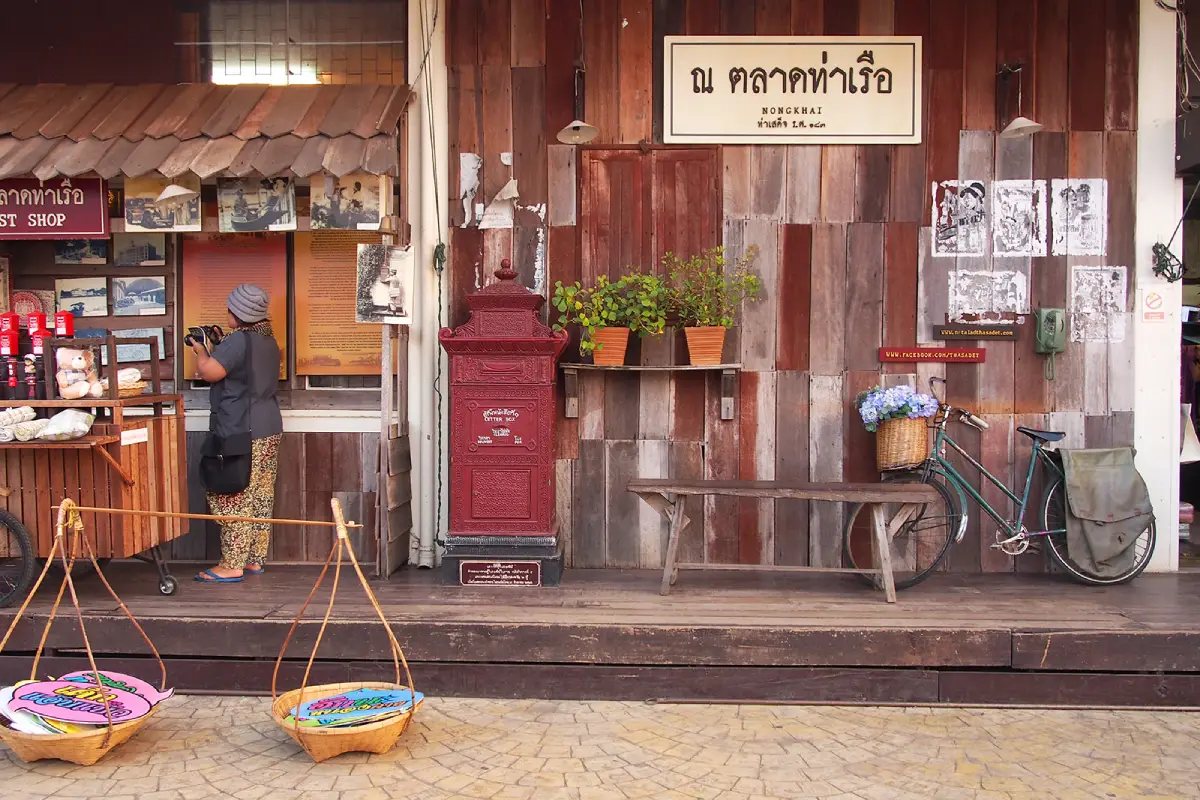
Tha Sadet Market is one of the best-known attractions in Nong Khai Province. Located in the town center near the Mekong River, the market has long been associated with trading activities along the Thai–Lao border. Its atmosphere reflects the relationship between Nong Khai's commercial development and its location beside an important international river.
The market is recognized for its variety of products, including local food, clothing, souvenirs, processed food products, and other goods connected with regional commerce. Visitors can explore the shopping streets, observe everyday trading activities, and experience the character of a market that attracts both local residents and travelers.
One of Tha Sadet Market's most appealing features is its proximity to the Mekong waterfront. Travelers can combine shopping with a walk along nearby riverside areas, enjoying views across the river toward Laos. The landscape provides an important sense of place and helps explain why Nong Khai has historically been closely linked to transportation and commercial exchange along the Mekong.
The market is also an interesting destination for visitors who want to experience Nong Khai through food and local products. Exploring the stalls offers an opportunity to discover regional flavors and observe the everyday economic activities of a northeastern border town. The variety of shops may change over time, so visitors should allow themselves enough time to browse the area rather than expecting every vendor to sell the same products throughout the year.
For travelers arriving by train, Tha Sadet Market is an excellent first sightseeing destination after reaching the town center and leaving luggage at accommodation. Although it is not directly beside Nong Khai Railway Station, a local road transfer provides a practical connection. Visitors staying near the Mekong waterfront may also be able to return to the market and surrounding streets on foot during their stay.
Allow approximately 60–90 minutes to explore Tha Sadet Market, with additional time for meals, shopping, or walking along the river. The market can be particularly enjoyable when combined with a relaxed afternoon exploring the waterfront and observing the atmosphere of Nong Khai's riverside communities.
More Information:Tha Sadet Market, Nong Khai
13.2 Wat Khaek (Sala Kaeo Ku)
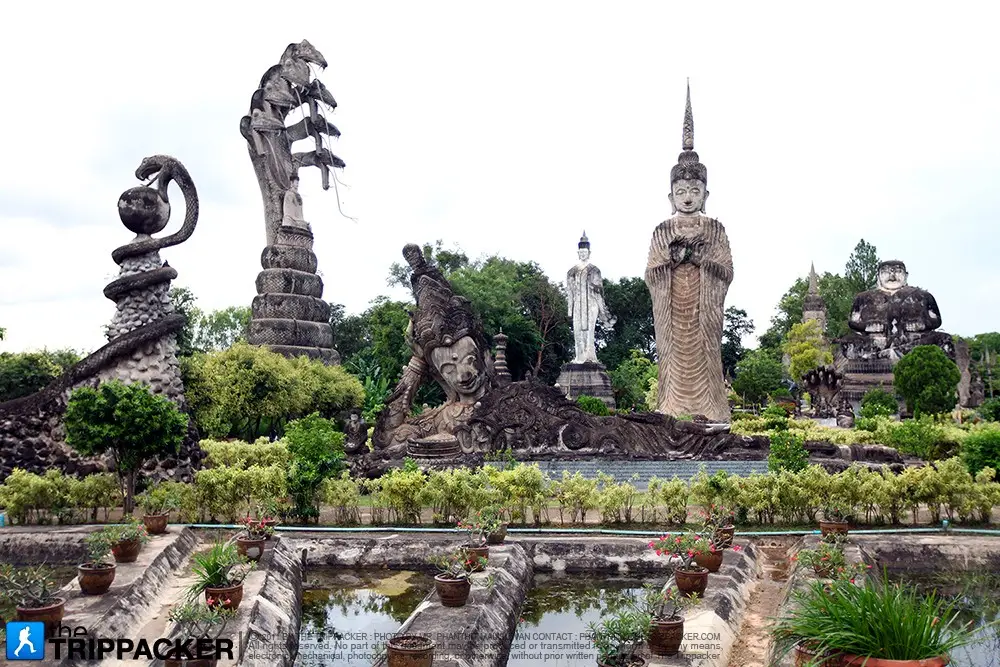
Sala Kaeo Ku, also known as Wat Khaek, is one of Nong Khai's most unusual cultural attractions. The site is renowned for its large concrete sculptures inspired by Buddhist and Hindu religious traditions, together with philosophical ideas concerning human existence, morality, karma, and the spiritual world. Its distinctive artistic character makes it very different from the conventional Buddhist temples commonly visited in Northeastern Thailand.
The sculpture park is closely associated with the spiritual teachings and artistic vision of Luang Pu Bunleua Sulilat, who developed religious sculpture projects reflecting a combination of beliefs and philosophical concepts. The figures at Sala Kaeo Ku are notable for their monumental scale, symbolic forms, and detailed designs, which create an extraordinary landscape filled with images of deities, mythical creatures, and religious figures.
Visitors walking through the site can observe sculptures portraying Buddhist and Hindu imagery, including representations associated with the Buddha, naga serpents, and other figures found in South and Southeast Asian religious traditions. The arrangement of these sculptures offers an opportunity to consider how religious stories and philosophical ideas can be expressed through monumental public art.
Some sculptures are especially striking because of their size and elaborate composition. Their artistic forms create dramatic perspectives and make the site a popular destination for photography. However, the sculptures should also be appreciated as expressions of particular beliefs and teachings rather than treated merely as decorative objects.
Sala Kaeo Ku is important to Nong Khai's cultural identity because it represents a distinctive chapter in the region's religious and artistic history. The site demonstrates how individual spiritual movements and local artistic practices can contribute to the diversity of cultural attractions within a province already strongly associated with Buddhist traditions along the Mekong River.
For travelers arriving by train, Sala Kaeo Ku requires a road transfer from Nong Khai town or accommodation near the riverside. It is best visited as part of a planned sightseeing day rather than as an attraction reached directly from the railway station. Arranging transportation in advance is particularly helpful for travelers who also intend to visit the First Thai–Lao Friendship Bridge on the same day.
Allow approximately 60–90 minutes to explore Sala Kaeo Ku and admire the sculptures. Visitors should respect any religious activities taking place on the grounds, avoid climbing on the sculptures, and follow the site's rules for photography and access to particular areas.
More Information:Wat Khaek (Sala Kaeo Ku), Nong Khai
13.3 First Thai–Lao Friendship Bridge
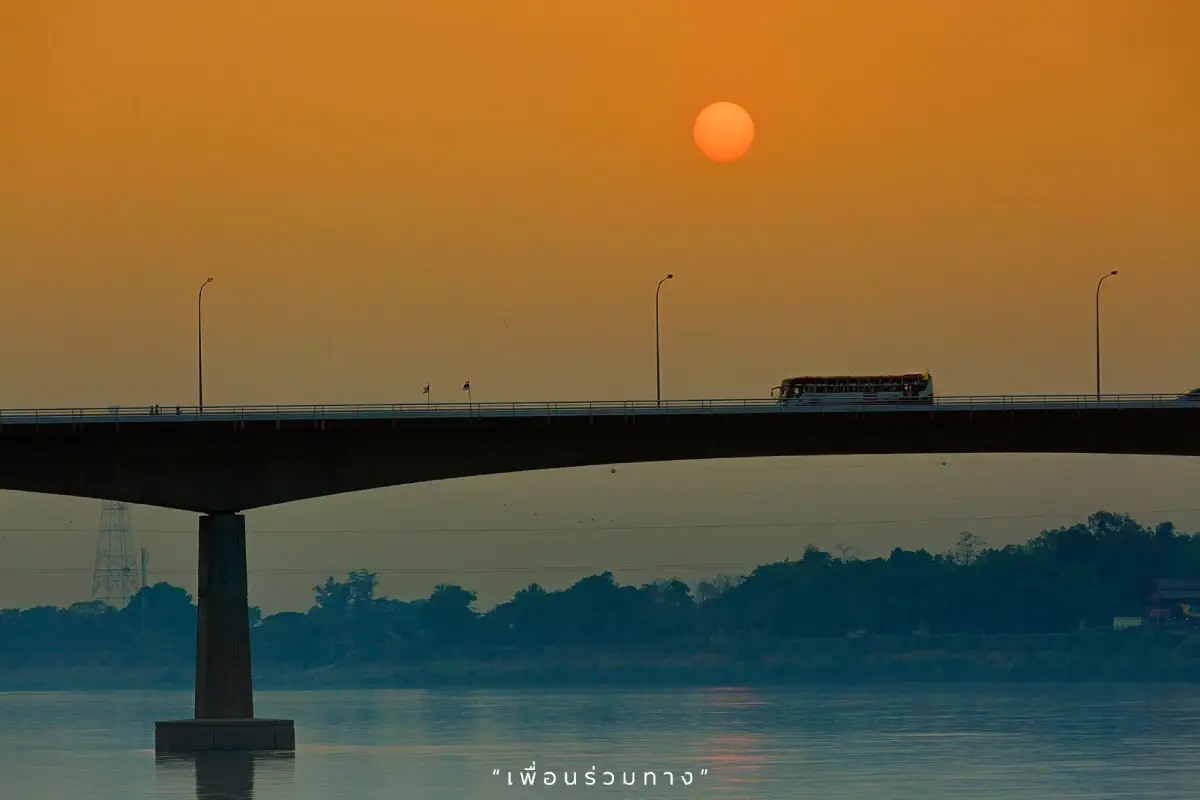
The First Thai–Lao Friendship Bridge is an important international transportation landmark connecting Nong Khai Province in Thailand with the area near Vientiane in Laos. Spanning the Mekong River, the bridge represents a major development in transportation and economic cooperation between the two neighboring countries.
The bridge officially opened in 1994 and became an important route for the movement of people and goods across the Thai–Lao border. Its construction improved connectivity between communities on both sides of the Mekong, while also supporting regional trade, tourism, and international transportation.
For visitors interested in geography and infrastructure, the bridge offers a clear illustration of Nong Khai's role as a gateway to Laos. The Mekong River forms part of the international boundary in this area, and the bridge provides a direct transportation connection across it. The surrounding landscape helps visitors appreciate the scale and importance of the river to both countries.
The bridge is also significant within the broader development of transportation in mainland Southeast Asia. Road and rail connections between Thailand and Laos have contributed to improved regional mobility and have strengthened Nong Khai's importance as a border transportation center.
Visitors should distinguish between sightseeing around the bridge and crossing into Laos. Crossing the international border requires compliance with immigration, visa, passport, and other entry regulations applicable to each traveler. A visit to the bridge viewpoint does not automatically include permission to cross the border or enter the railway and immigration facilities.
For travelers who arrive in Nong Khai by train, the Friendship Bridge can be included as a sightseeing stop using a local taxi or another suitable road transfer. Visitors should use designated viewing areas and avoid entering restricted border infrastructure or attempting to walk onto sections of the bridge that are not open to pedestrians.
Allow approximately 30–60 minutes to view the bridge and explore public areas where access is permitted. Travelers intending to cross into Laos should prepare a separate itinerary with sufficient time for immigration procedures and onward transportation.
More Information:First Thai–Lao Friendship Bridge, Nong Khai
Three-Day, Two-Night Nong Khai Train Itinerary On the first day, arrive at Nong Khai Railway Station according to the selected train schedule from Bangkok. After reaching the station, continue by local taxi or another suitable transport service to accommodation in Nong Khai town, preferably in an area that provides convenient access to the Mekong waterfront. Leave your luggage or check in before beginning sightseeing.
Spend the first afternoon exploring Tha Sadet Market, allowing approximately 60–90 minutes to browse the shops and experience the atmosphere of local trade. Continue walking through accessible riverside areas, enjoying views of the Mekong River and observing the surrounding communities. This relaxed itinerary is especially suitable after a long-distance overnight train journey.
On the second day, begin with Sala Kaeo Ku, allowing approximately 60–90 minutes to explore the large sculptures and consider the religious and philosophical concepts represented by the artwork. After lunch, continue by road to the First Thai–Lao Friendship Bridge, where approximately 30–60 minutes can be allocated to viewing the bridge from public areas and learning about Nong Khai's role as an international border city.
During the evening of the second day, return to Nong Khai town and spend time enjoying local food or relaxing near the Mekong River. Travelers interested in the region's cultural traditions can use the opportunity to explore the riverside atmosphere and learn more about how the Mekong has influenced commerce, settlement, and daily life.
On the third day, enjoy breakfast and use the remaining time for shopping, visiting riverside areas, or resting before the return train. Return to your accommodation to collect your luggage and arrange transportation to Nong Khai Railway Station, allowing sufficient time for the journey and station procedures before departure.
This three-day, two-night Nong Khai itinerary combines three different perspectives on the province: the commercial and cultural atmosphere of Tha Sadet Market, the artistic and spiritual heritage of Sala Kaeo Ku, and the modern transportation significance of the First Thai–Lao Friendship Bridge. Together, they provide a rewarding introduction to a northeastern border province with deep connections to the Mekong River.
Route 14: Bangkok to Ubon Ratchathani by Train — A Three-Day, Two-Night Journey Through Buddhist Architecture, Isan Culture, and Historic City Landmarks Ubon Ratchathani is one of the most important cultural and historical destinations in Northeastern Thailand. The province is widely recognized for its Buddhist temples, distinctive Isan traditions, religious craftsmanship, and annual cultural celebrations. Traveling from Bangkok to Ubon Ratchathani by train provides an opportunity to experience the Northeastern Railway before exploring a city with a rich religious identity and longstanding cultural connections with communities across the Mekong region.
The appeal of visiting Ubon Ratchathani by train lies in the diversity of attractions within the greater urban area. Visitors can admire the remarkable architectural design of Wat Nong Bua, discover the historic wooden scripture hall at Wat Thung Si Muang, and explore Thung Si Mueang, a public square closely associated with important civic and cultural activities. Together, these locations introduce travelers to the province's religious heritage, architectural craftsmanship, and community traditions.
Ubon Ratchathani also plays an important role in the cultural geography of Thailand's northeastern region. Its identity has been shaped by Buddhist scholarship, settlement along river systems, traditional craftsmanship, and the development of urban communities. Religious institutions continue to have a strong presence in everyday life, and major festivals bring together local residents and visitors interested in the region's distinctive traditions.
One of the most famous cultural events associated with Ubon Ratchathani is the Candle Festival, which is traditionally connected with the beginning of Buddhist Lent. The festival is celebrated through elaborate candle sculptures and ceremonial processions, reflecting the skills of local artisans and the religious devotion of the community. Visitors traveling during the festival period may experience a different atmosphere from that found during ordinary sightseeing days.
Travelers departing from Bangkok can choose a Northeastern Line train serving Ubon Ratchathani Railway Station. Although the station carries the provincial name, it is located in Warin Chamrap District, on the opposite side of the Mun River from much of the central Ubon Ratchathani urban area. Visitors must therefore arrange onward transportation from the railway station to the historic city and its principal attractions.
Long-distance and overnight trains can be useful for visitors who want to avoid spending a full sightseeing day on the journey from Bangkok. However, the actual departure station, arrival time, and type of service should be checked in advance. Travelers should also allow time for the road transfer between Warin Chamrap Railway Station and accommodation in the city center.
A three-day, two-night itinerary is recommended. The first day can focus on the journey into the city and a visit to Wat Nong Bua, the second day on Wat Thung Si Muang and Thung Si Mueang, and the third day on local food, shopping, or additional sightseeing before returning to the railway station. The order can be adjusted according to the arrival and departure times of the selected trains.
14.1 Wat Nong Bua
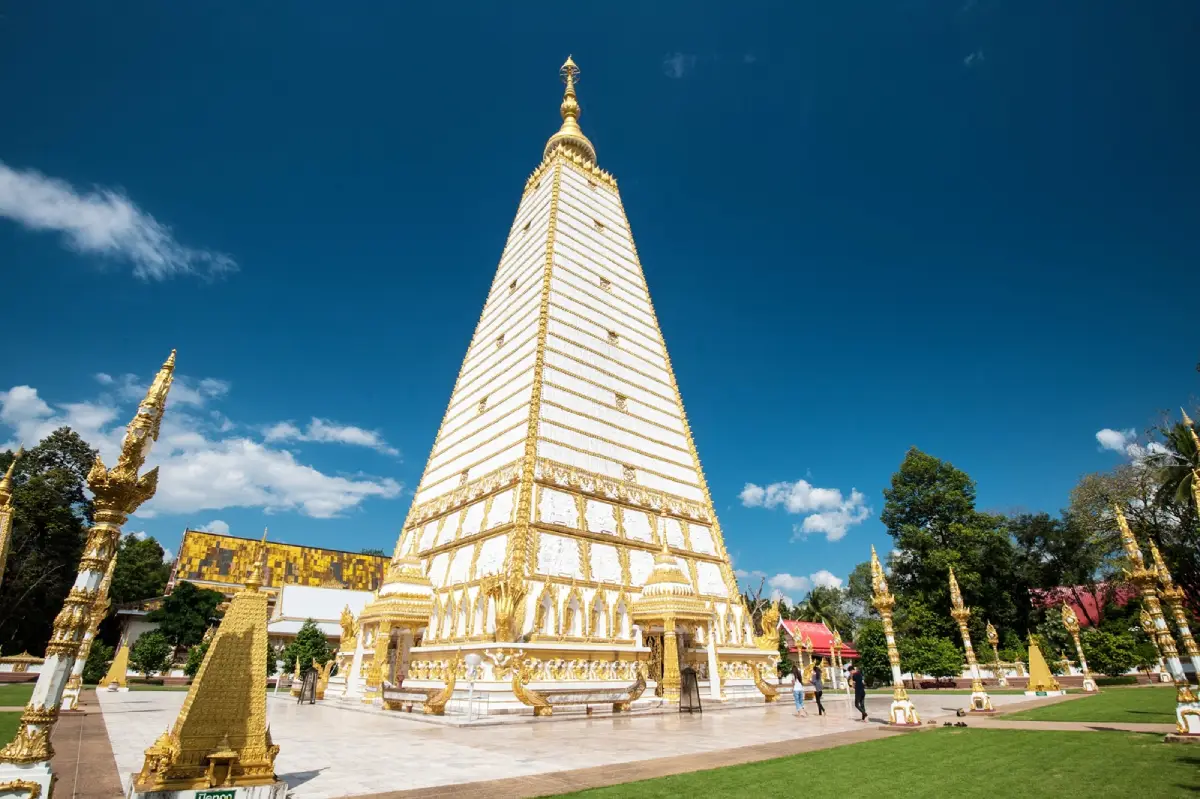
Wat Nong Bua is one of the most recognizable Buddhist temples in Ubon Ratchathani Province. Located in the Mueang Ubon Ratchathani area, the temple is particularly famous for its impressive chedi, whose architectural design was inspired by the Mahabodhi Temple at Bodh Gaya in India, the sacred place associated with the Buddha's enlightenment.
The temple's principal chedi is distinguished by its tall structure, decorative details, and harmonious combination of white and gold. Its design creates a striking visual impression that differs from many traditional northeastern Thai chedis. The architecture reflects Buddhist connections across countries and demonstrates how sacred architectural concepts can be adapted into a distinctive local religious monument.
Wat Nong Bua is significant not only as an architectural attraction but also as an active center of Buddhist worship. Visitors can experience the temple's spiritual atmosphere while studying the symbolism expressed through its religious buildings and decorative features. Its architectural inspiration also provides an opportunity to understand the relationship between Thai Buddhist traditions and important places in the history of Buddhism in India.
One of the most appealing aspects of the temple is the opportunity to appreciate the chedi from different perspectives within the grounds. The building's proportions, decorative patterns, and architectural details are particularly attractive to visitors interested in religious architecture and photography. The surrounding religious spaces also provide a peaceful environment for paying respect and observing Buddhist practices.
The temple is closely associated with Ubon Ratchathani's identity as a center of Buddhist culture. Its distinctive appearance makes it a popular destination for Thai visitors and international travelers who want to discover important religious landmarks beyond the better-known temple cities of Central and Northern Thailand.
For travelers arriving by train, Wat Nong Bua requires an onward road transfer from Ubon Ratchathani Railway Station in Warin Chamrap District. It is practical to visit after checking into accommodation in the city. Local taxis or other suitable transportation services can be used to connect the railway station, hotel, and temple.
Allow approximately 60–90 minutes to visit Wat Nong Bua, admire its chedi, and explore the grounds. Visitors should dress modestly, respect religious activities, and follow the temple's visiting regulations.
More Information:Wat Nong Bua, Ubon Ratchathani
14.2 Wat Thung Si Muang
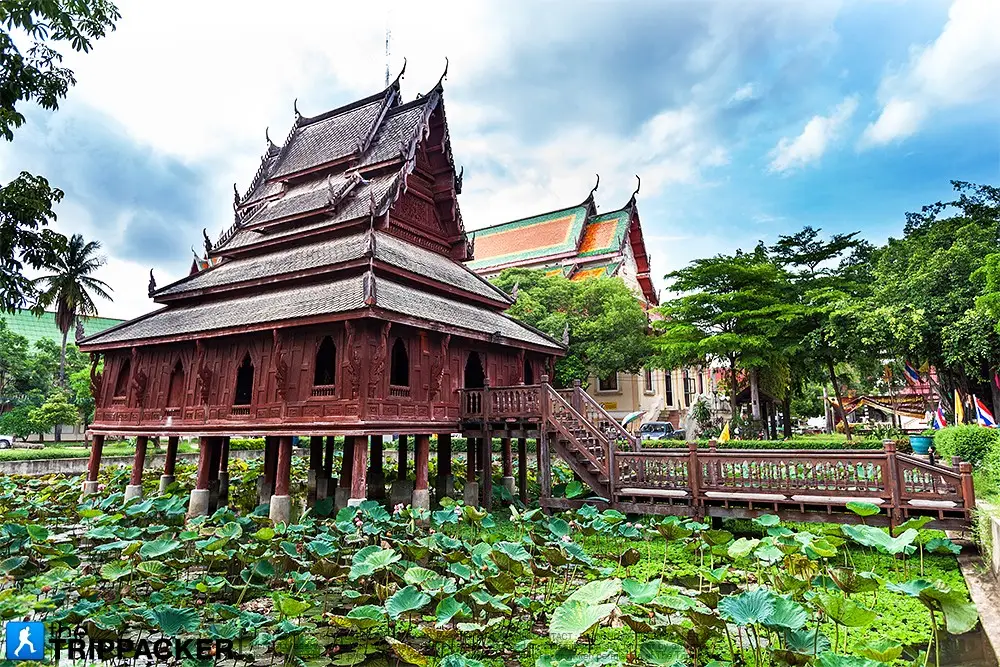
Wat Thung Si Muang is an important historic Buddhist temple in central Ubon Ratchathani. The temple is especially renowned for its traditional wooden scripture hall, known in Thai as a Ho Trai, which stands above a pond. This distinctive structure is one of the province's most significant examples of traditional religious architecture and reflects the craftsmanship and Buddhist literary traditions of the region.
The Ho Trai was designed as a place to preserve Buddhist scriptures and important religious manuscripts. Its location above water helped protect these valuable materials from certain insects and other environmental threats. This practical function demonstrates how traditional architectural knowledge was adapted to the requirements of religious education and manuscript preservation.
The wooden scripture hall is particularly interesting because of its architectural details, which reflect local craftsmanship and artistic influences associated with the northeastern region. Visitors can observe the proportions of the building, decorative woodwork, and the relationship between the structure and the surrounding pond, all of which contribute to its distinctive appearance.
Wat Thung Si Muang also has cultural significance as part of the history of Buddhist scholarship in Ubon Ratchathani. Temples traditionally served as centers of learning, where religious manuscripts were studied, preserved, and transmitted between generations. The surviving scripture hall therefore represents both an architectural landmark and a reminder of the role Buddhist institutions played in maintaining knowledge and cultural traditions.
The temple grounds contain other religious structures and spaces used for worship. Visitors can appreciate the peaceful atmosphere and learn about the architectural heritage of the city while observing the etiquette appropriate to an active Buddhist temple.
For travelers visiting Ubon Ratchathani by train, Wat Thung Si Muang is a practical attraction to include while exploring the historic city center. It can be combined with Thung Si Mueang, which is located in the central urban area, reducing the need for long journeys between sightseeing stops.
Allow approximately 45–60 minutes to visit Wat Thung Si Muang and study its historic scripture hall. Visitors should remain in permitted areas and follow any conservation-related restrictions applying to the wooden structure.
More Information:Wat Thung Si Muang, Ubon Ratchathani
14.3 Thung Si Mueang
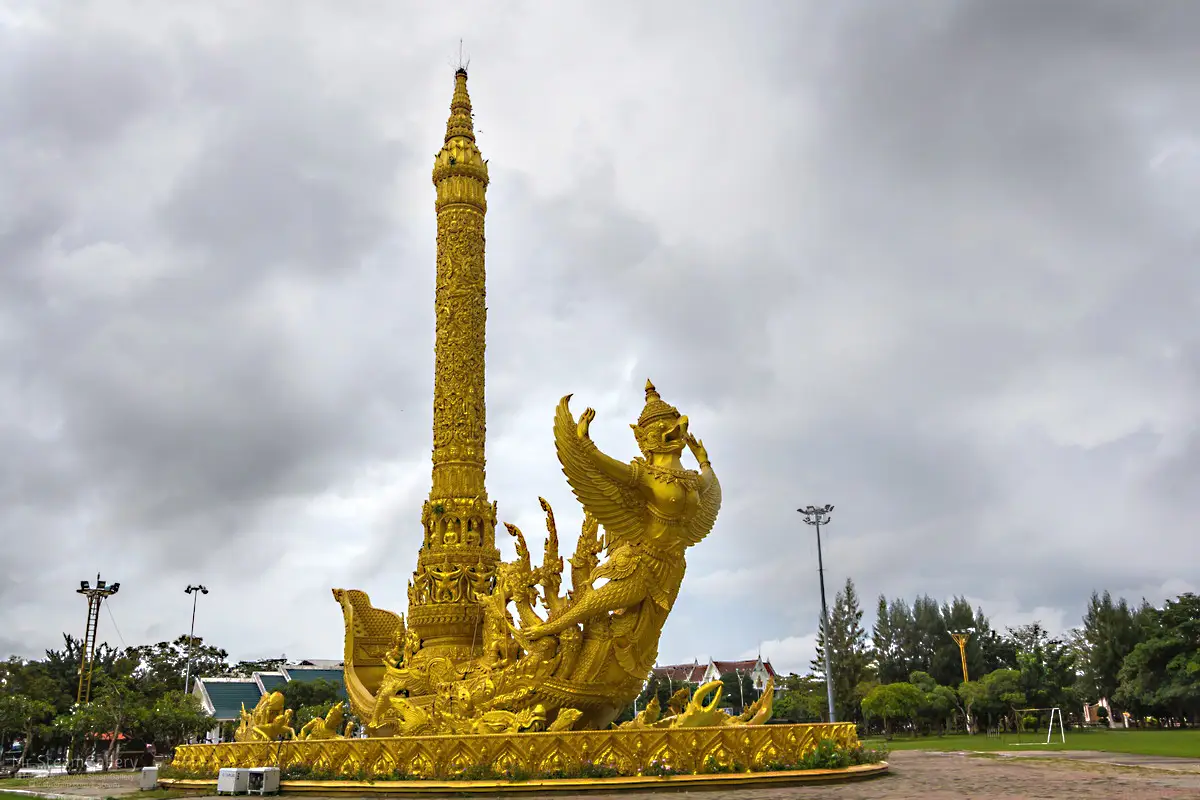
Thung Si Mueang is an important public space in the center of Ubon Ratchathani. The area serves as a recreational ground, community gathering place, and venue associated with major provincial activities. Its central location makes it a convenient stop for visitors exploring the city's historical and cultural attractions.
The significance of Thung Si Mueang extends beyond its function as an urban park. The grounds are associated with civic events, community celebrations, and cultural activities that reflect the identity of Ubon Ratchathani. As a public space, it provides a setting where residents and visitors can participate in or observe activities connected with the city's cultural life.
Thung Si Mueang is particularly associated with the province's famous Candle Festival, an important Buddhist cultural celebration held around the beginning of Buddhist Lent. The festival features elaborate candle sculptures and processions that demonstrate the craftsmanship of local artisans. The event highlights Ubon Ratchathani's religious traditions and the artistic heritage that continues to be passed down through generations.
Outside major festival periods, Thung Si Mueang offers a different atmosphere as an urban recreational space. Visitors can walk through the grounds, relax, and observe everyday activities in the city center. It provides a pleasant contrast to temple sightseeing and offers an opportunity to experience how local residents use public areas in their daily lives.
The square and surrounding district also help visitors understand the structure of Ubon Ratchathani's urban center. Nearby streets, religious landmarks, and public buildings contribute to the character of the area, making Thung Si Mueang an interesting location for appreciating both the historic and contemporary aspects of the city.
For travelers arriving by train, Thung Si Mueang can be reached by road from Ubon Ratchathani Railway Station in Warin Chamrap District. It is best combined with a visit to Wat Thung Si Muang or other central attractions, particularly when staying in the city center.
Allow approximately 30–60 minutes to explore Thung Si Mueang during an ordinary sightseeing day. Travelers visiting during a major festival should allow substantially more time according to the event program and local transportation conditions.
More Information:Thung Si Mueang, Ubon Ratchathani
Three-Day, Two-Night Ubon Ratchathani Train Itinerary On the first day, arrive at Ubon Ratchathani Railway Station in Warin Chamrap District according to the selected train timetable. Continue by taxi or another suitable road transport service to accommodation in central Ubon Ratchathani. After leaving your luggage or checking in, begin sightseeing with a visit to Wat Nong Bua.
Spend approximately 60–90 minutes at Wat Nong Bua admiring its distinctive chedi and studying the religious architecture inspired by Bodh Gaya. Afterward, enjoy a meal in the city and return to your accommodation for a relaxed evening. Travelers arriving late in the day can adjust the schedule by moving the temple visit to the following morning.
On the second day, begin with Wat Thung Si Muang, allowing approximately 45–60 minutes to appreciate the historic wooden scripture hall and surrounding religious architecture. Continue to Thung Si Mueang to explore the city's central public space, observe the urban atmosphere, and learn about its role in major provincial celebrations.
During the afternoon, enjoy local northeastern food or explore additional cultural attractions according to the time available. If your visit coincides with the Ubon Ratchathani Candle Festival, consult the official event program in advance and adjust the itinerary to allow time for the processions and displays. The festival may attract large crowds and affect transportation within the city.
On the third day, enjoy breakfast and use the remaining time for local shopping, visiting nearby attractions, or relaxing before the return journey. Collect your luggage and allow sufficient time to travel from central Ubon Ratchathani across the Mun River to Ubon Ratchathani Railway Station in Warin Chamrap District.
The recommended duration for this route is three days and two nights, with Wat Nong Bua, Wat Thung Si Muang, and Thung Si Mueang as the principal attractions. Together, they provide an introduction to the architectural heritage, religious traditions, and cultural identity of Ubon Ratchathani. Travelers returning to Bangkok by overnight train should account for the additional travel time beyond the final sightseeing day.
Route 15: Bangkok to Nakhon Ratchasima by Train — A Two-Day, One-Night Journey to the Thao Suranari Monument and the Historic Heart of Korat Nakhon Ratchasima, commonly known as Korat, is one of the most important cities in Northeastern Thailand. The province serves as a major transportation and economic gateway between Central Thailand and the northeastern region. Its long history, cultural traditions, historic landmarks, and urban development make it an appealing destination for travelers who want to explore an important regional city by train.
Traveling from Bangkok to Nakhon Ratchasima by train provides an opportunity to experience the Northeastern Railway and observe the landscapes connecting the Central Plains with the Khorat Plateau. The journey introduces visitors to one of the country's most significant railway corridors, which has played an important role in the movement of people and goods between Bangkok and Northeastern Thailand.
The appeal of visiting Nakhon Ratchasima lies in its combination of local history, urban culture, and important landmarks. Two of the city's most recognizable attractions are the Thao Suranari Monument and Pratu Chumphon, both located in the historic urban center. These sites are closely linked to the history and identity of Korat and can be explored together as part of a short cultural sightseeing itinerary.
Nakhon Ratchasima also offers an opportunity to appreciate the development of a major northeastern city beyond its ancient monuments. Markets, local food, and urban neighborhoods reflect the daily lives of residents, while historic landmarks reveal important events and cultural traditions that continue to shape the city's identity. The province's role as a regional transportation center makes railway travel a particularly appropriate way to experience the city.
Travelers departing from Bangkok can choose Northeastern Line trains that stop at Nakhon Ratchasima Railway Station. Different services have different stopping patterns, travel times, and departure stations, so it is advisable to confirm the exact train before making travel arrangements. After reaching Nakhon Ratchasima Station, visitors can continue to the city center by local taxi or another suitable transport service.
A two-day, one-night itinerary is recommended for visitors who want to explore the city without rushing. The first day can focus on the Thao Suranari Monument and the historic district, while the second day can be reserved for Pratu Chumphon, local food, shopping, and the return train journey. Travelers who prefer a shorter trip may also be able to visit the principal monuments in a single day, provided the train timetable allows sufficient time for sightseeing.
15.1 Thao Suranari Monument
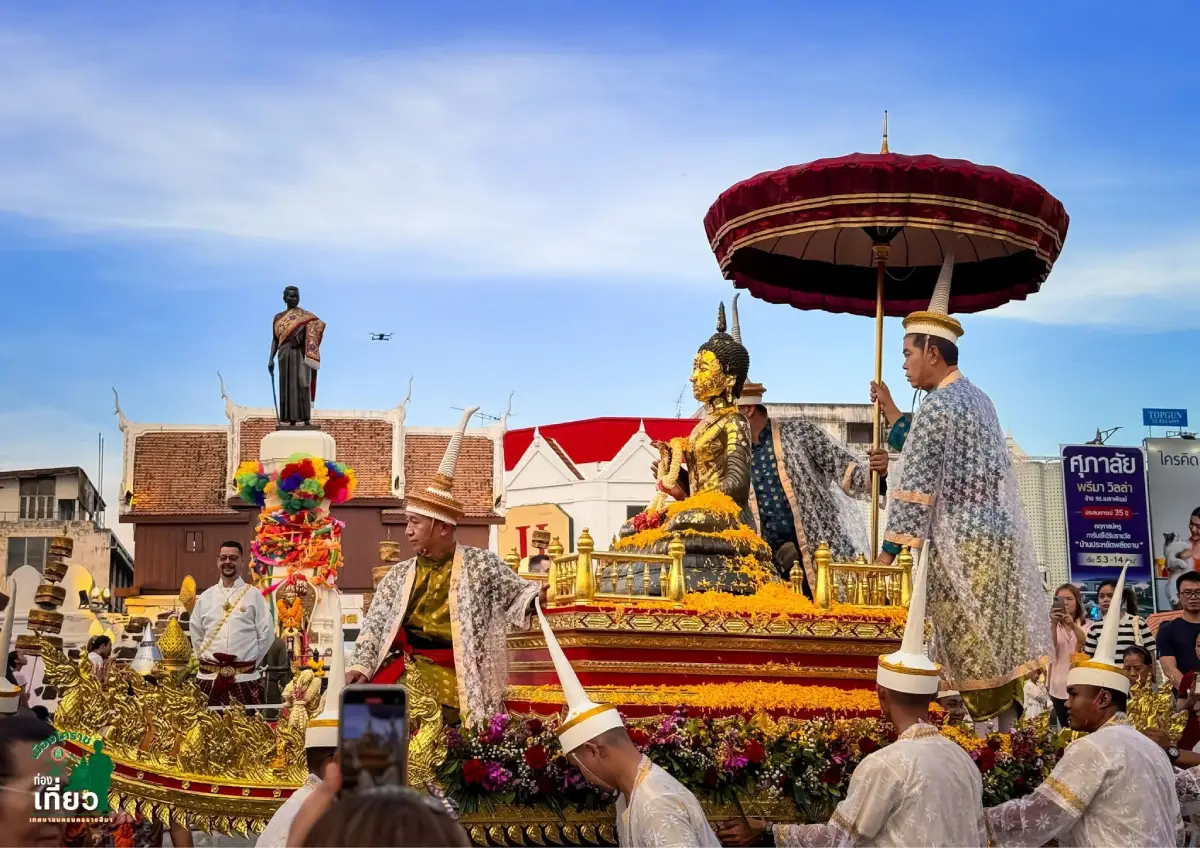
The Thao Suranari Monument is one of the most important historical and cultural landmarks in Nakhon Ratchasima Province. Located in the heart of Korat, the monument honors Thao Suranari, widely known as Ya Mo, a historical figure deeply respected by the people of Nakhon Ratchasima. The monument serves as a symbol of local pride, courage, and the city's historical identity.
Thao Suranari is associated with events during the reign of King Rama III, particularly the resistance connected with the conflict involving Anouvong of Vientiane in 1826. In local historical traditions, she is remembered for her courage and leadership during a period of crisis. Her story occupies an important place in the collective memory of the people of Korat and continues to be commemorated through local ceremonies and expressions of devotion.
The monument is a popular place for residents and visitors to pay respect and make offerings. Its location in the central city creates a focal point for community gatherings, cultural activities, and important local events. Visitors can observe the relationship between the monument and the surrounding urban environment, which reflects the continuing significance of Ya Mo to the identity of Nakhon Ratchasima.
The site is also associated with the annual celebration honoring Thao Suranari, which brings together cultural performances, ceremonial activities, and public gatherings. These events reflect the importance of local historical memory and the traditions through which residents express respect for a figure closely connected with their city.
The Thao Suranari Monument is particularly interesting for travelers studying regional Thai history because it demonstrates how local historical figures become symbols of community identity. Visiting the monument provides an opportunity to appreciate not only the artistic form of the memorial but also its continuing cultural meaning.
For railway travelers, the monument is a practical first stop after reaching central Nakhon Ratchasima from the railway station. It is located close to Pratu Chumphon, allowing both landmarks to be visited during the same walking itinerary once visitors have reached the historic center.
Allow approximately 30–60 minutes to visit the Thao Suranari Monument, observe the surrounding area, and learn about the history associated with Ya Mo. Visitors should respect worshippers and avoid interfering with ceremonial activities.
More Information:Thao Suranari Monument, Nakhon Ratchasima
15.2 Pratu Chumphon
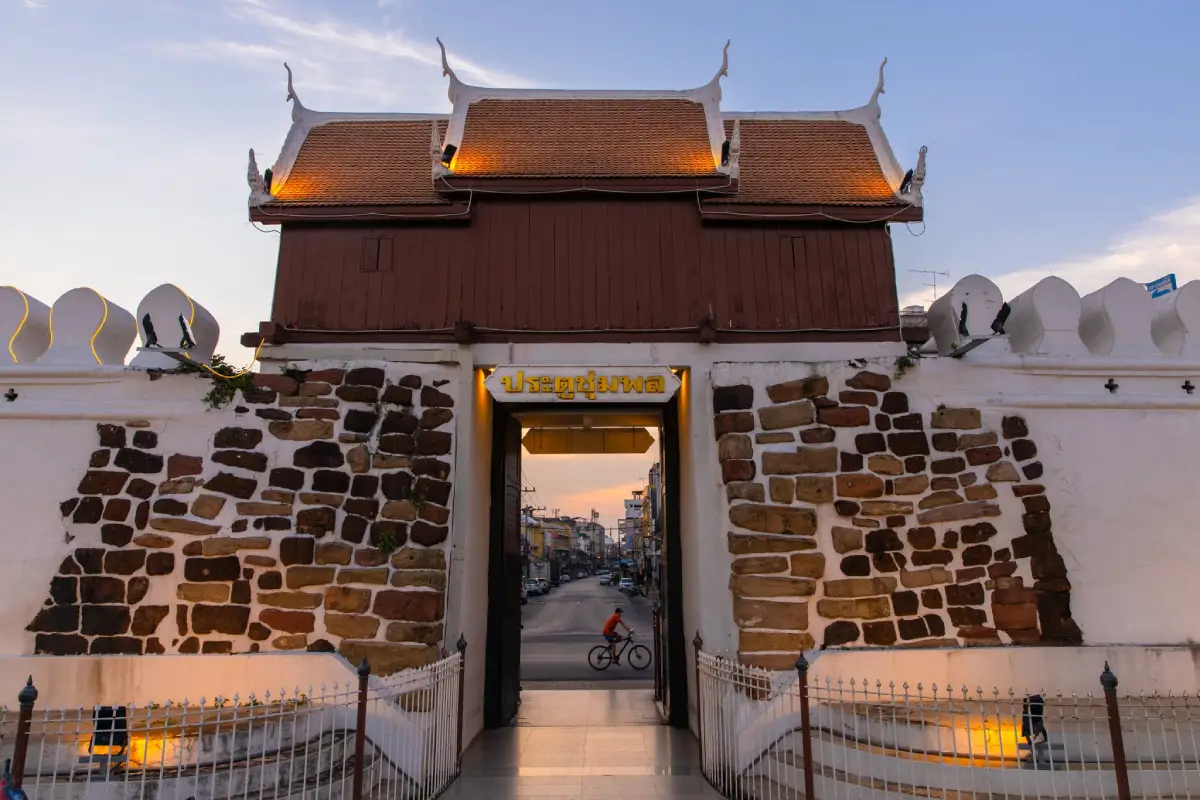
Pratu Chumphon, also known as Chumphon Gate, is an important historic landmark in the center of Nakhon Ratchasima. It is associated with the city's historic fortifications and provides a visible reminder of Korat's development as a strategic regional center. The gate is located near the Thao Suranari Monument, making it one of the most convenient historical attractions to visit while exploring the central city.
The significance of Pratu Chumphon lies in its connection with the historical layout and defensive infrastructure of Nakhon Ratchasima. City gates and walls once played important roles in controlling access, protecting settlements, and defining the boundaries of important urban areas. The surviving gate therefore offers a valuable connection to earlier periods of the city's history.
Pratu Chumphon is also associated with local beliefs and traditions. Some residents and visitors regard passing through the gate as an act connected with good fortune and the historical spirit of the city. These beliefs contribute to the cultural importance of the landmark, although they should be understood as local traditions rather than established historical facts.
The gate's location within the modern urban landscape illustrates how historic structures can remain meaningful even as the surrounding city changes. Roads, commercial areas, and modern buildings have developed nearby, but Pratu Chumphon continues to serve as a recognizable symbol of Nakhon Ratchasima's historical heritage.
For visitors interested in architecture and urban history, Pratu Chumphon provides an opportunity to study the surviving elements of a historic city gate and consider the development of Korat from a fortified settlement into one of Northeastern Thailand's major metropolitan centers.
Travelers arriving by train can visit Pratu Chumphon after taking a taxi or another suitable transport service from Nakhon Ratchasima Railway Station to the Thao Suranari Monument area. Once in the historic center, the gate is conveniently located for a short walking visit.
Allow approximately 20–30 minutes to explore Pratu Chumphon and take photographs. It can be combined with a visit to the Thao Suranari Monument without requiring a separate long-distance transfer.
More Information:Pratu Chumphon, Nakhon Ratchasima
Two-Day, One-Night Nakhon Ratchasima Train Itinerary On the first day, depart from Bangkok on a Northeastern Line train serving Nakhon Ratchasima Railway Station. Upon arrival, continue by local taxi or another suitable transport service to accommodation near the central city. After leaving your luggage or checking in, begin sightseeing at the Thao Suranari Monument, allowing approximately 30–60 minutes to explore the site and learn about the historical traditions associated with Ya Mo.
After visiting the monument, continue on foot to Pratu Chumphon, which is located nearby. Spend approximately 20–30 minutes exploring the gate and its historical setting. Visitors can then enjoy lunch or dinner in the central city and explore the surrounding streets according to the time available.
During the evening of the first day, return to your accommodation or enjoy the atmosphere of central Korat. Staying overnight allows travelers to explore the city at a relaxed pace without having to return to Bangkok on the same day as the outward railway journey.
On the second day, enjoy breakfast and use the remaining time to explore local markets, sample northeastern food, or revisit historical attractions in the city center. If you are interested in additional landmarks, select those that can be reached comfortably without affecting the scheduled return train journey.
Before departure, return to your accommodation to collect your luggage and travel to Nakhon Ratchasima Railway Station. Allow sufficient time for local traffic, station access, and boarding, particularly if using a service with limited departures at your preferred time.
This two-day, one-night Nakhon Ratchasima railway itinerary focuses on the Thao Suranari Monument and Pratu Chumphon as the principal historic attractions. Together, they introduce visitors to Korat's regional identity, local historical traditions, and surviving urban heritage while demonstrating how a major northeastern city can be explored by train and local transportation.
Route 16: Bangkok to Chumphon by Train — A Three-Day, Two-Night Journey to Thung Wua Laen Beach, Hat Sai Ri Beach, and the Gulf of Thailand Chumphon is a coastal province on the Gulf of Thailand, often described as the gateway to Southern Thailand. The province is distinguished by its beaches, offshore islands, fishing communities, and varied landscapes that combine an extensive coastline with mountain ranges. Traveling from Bangkok to Chumphon by train is a practical option for visitors who want a seaside holiday without driving a private car, while also experiencing the Southern Railway as it connects important towns and communities across Thailand.
The appeal of traveling to Chumphon by train lies in the diversity of its coastal attractions. Thung Wua Laen Beach is known for its long sandy shoreline and relaxed atmosphere, making it particularly suitable for visitors seeking a peaceful seaside escape. Hat Sai Ri Beach, meanwhile, combines natural scenery with historical significance through its association with Admiral Prince Abhakara Kiartivongse, Prince of Chumphon, who is widely honored as the Father of the Royal Thai Navy.
Chumphon also plays an important role in Thailand's fishing industry and coastal transportation. Many communities along the province's shoreline have maintained strong connections with fishing, seafood trading, and marine resources over generations. Visiting Chumphon therefore offers more than an opportunity to relax on the beach. It also allows travelers to discover the traditions and everyday activities of communities whose livelihoods are closely linked to the Gulf of Thailand.
The province's coastal geography creates different kinds of sightseeing experiences. Some beaches provide open views of the sea and long stretches of sand suitable for walking, while other coastal areas are associated with fishing communities, religious landmarks, and local historical traditions. Travelers interested in slow travel can enjoy these differences by organizing a relaxed itinerary rather than attempting to visit too many locations in a single day.
Travelers departing from Bangkok can choose a Southern Line train that stops at Chumphon Railway Station. The departure station in Bangkok, journey time, and onboard facilities depend on the selected service, so passengers should confirm the timetable with the State Railway of Thailand. An overnight train may be particularly convenient for visitors who want to arrive in Chumphon during the morning and begin sightseeing without spending most of their first day traveling.
After arriving at Chumphon Railway Station, visitors can continue into the town center to leave their luggage or check into accommodation before traveling to the beaches. It is important to understand that Thung Wua Laen Beach and Hat Sai Ri Beach are not located within walking distance of the railway station. A taxi, prearranged transfer, or another suitable form of road transportation will be needed to reach the coast and travel between the attractions.
A three-day, two-night itinerary is recommended. The first day can focus on arriving in Chumphon and relaxing at Thung Wua Laen Beach. The second day can be reserved for Hat Sai Ri Beach and the nearby historical sites associated with Prince of Chumphon. The final day provides an opportunity to relax, enjoy local food, or purchase dried seafood and other regional products before returning to Chumphon Railway Station.
16.1 Thung Wua Laen Beach
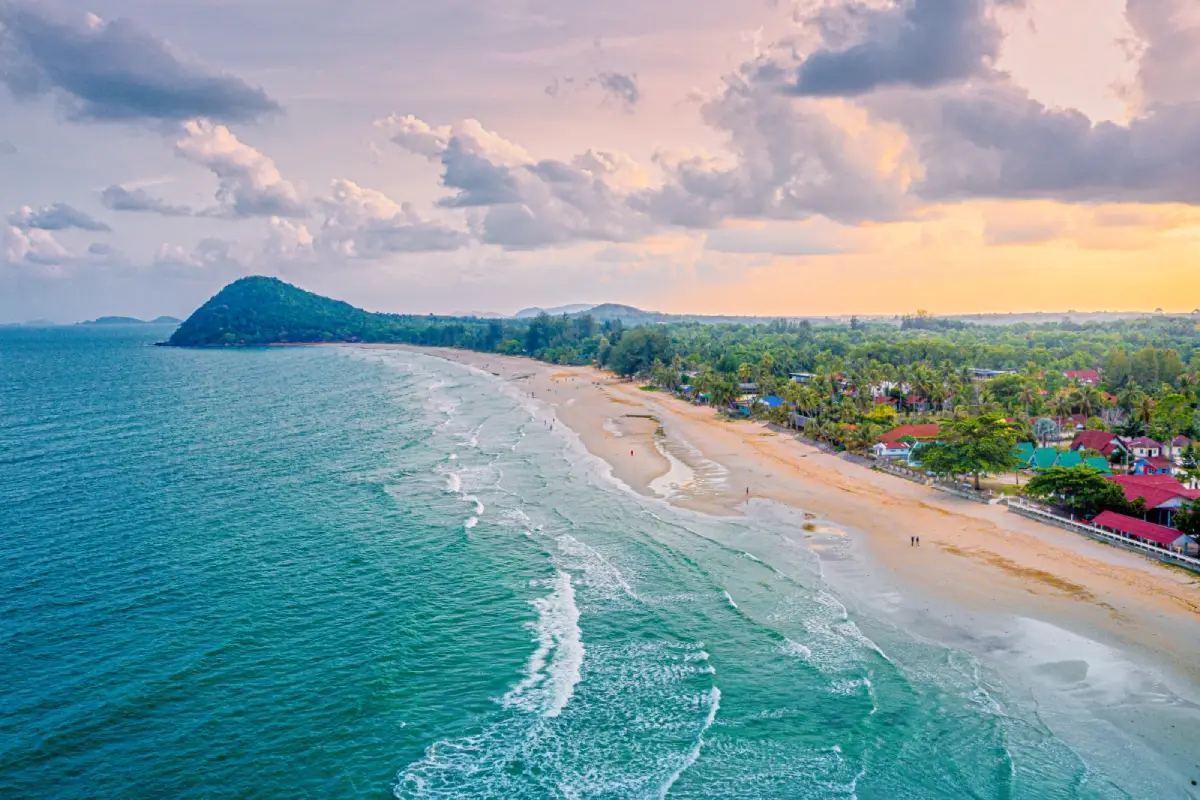
Thung Wua Laen Beach is one of the best-known coastal attractions in Chumphon Province. Located in Saphli Subdistrict, Pathio District, it features a long sandy shoreline facing the Gulf of Thailand and is popular among travelers looking for a relaxing natural environment. The beach is particularly appealing because of its pale sand, open coastal scenery, and pleasant atmosphere for walking and photography.
One of the main attractions of Thung Wua Laen Beach is the opportunity to enjoy simple seaside activities in an attractive setting. Visitors can walk along the coast, admire the changing colors of the sea, and spend time relaxing with family or friends. The beach is especially pleasant during the morning and late afternoon, when temperatures are generally more comfortable than during the middle of the day.
The character of Thung Wua Laen is also shaped by the surrounding tourism community. Accommodation and restaurants can be found in the broader beach area, allowing visitors to stay close to the sea and experience the coastal atmosphere at different times of day. Choosing accommodation near the beach is particularly suitable for travelers who prefer slow travel and want to avoid making repeated journeys between the coast and Chumphon town.
The beach provides an attractive setting for nature photography, particularly when the early morning light illuminates the shoreline and the Gulf of Thailand. Visitors can enjoy photographing the sand, sea, and surrounding landscape while appreciating the calm pace of life in a coastal community. Staying overnight makes it easier to experience the beach before it becomes busier later in the day.
For travelers interested in swimming or other marine activities, participation should depend on the actual weather, sea conditions, and services available on the date of travel. Wave conditions in the Gulf of Thailand can change with the seasons, so visitors should pay attention to local warnings and avoid swimming when waves are high or currents are dangerous. Children should always be supervised near the water.
Travelers arriving by train should arrange transportation from Chumphon Railway Station to Thung Wua Laen Beach in advance. Since the beach is located in Pathio District rather than beside the town-center railway station, walking from the station is not a practical option. Visitors planning to stay near the beach should ask their accommodation provider whether transfers can be arranged or organize another suitable road connection.
Allow approximately 2–3 hours for a visit to Thung Wua Laen Beach, although travelers who want to relax more fully may prefer to spend half a day or stay overnight. Sunrise and late afternoon are particularly appealing times for walking along the shore, weather permitting.
More Information:Thung Wua Laen Beach, Chumphon
16.2 Hat Sai Ri Beach
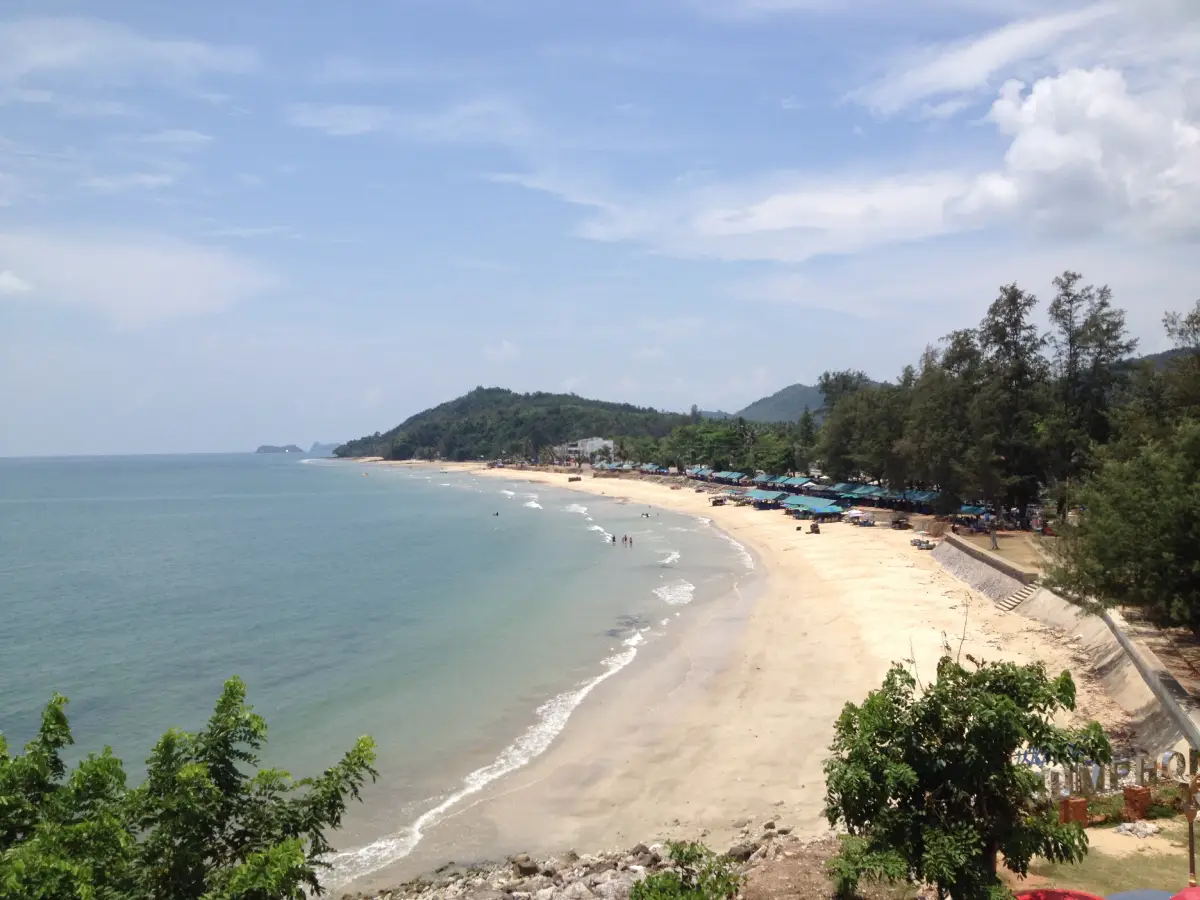
Hat Sai Ri Beach is an important tourist destination in Chumphon Province, located in Hat Sai Ri Subdistrict, Mueang Chumphon District. The area is known for its views of the Gulf of Thailand and its coastal landscape, which provides an attractive setting for relaxation. It is also historically significant because of the nearby shrine dedicated to Admiral Prince Abhakara Kiartivongse, Prince of Chumphon, a highly respected figure in the history of the Royal Thai Navy.
The natural appeal of Hat Sai Ri Beach comes from its coastal scenery, with the shoreline extending alongside a landscape that includes nearby hills. Visitors can walk along the beach, relax, enjoy the views, and experience the quieter atmosphere of Chumphon's coastline. The surroundings are suitable for visitors who prefer a combination of nature and cultural sightseeing rather than spending the entire day on recreational beach activities.
What distinguishes Hat Sai Ri from many other beaches is its close association with the history of the Royal Thai Navy. The surrounding area includes a place of remembrance dedicated to Admiral Prince Abhakara Kiartivongse, who played an important role in the modernization and development of Thailand's naval forces. His contributions to naval education and maritime affairs have led to his enduring recognition as the Father of the Royal Thai Navy.
Visiting the beach and the nearby memorial area allows travelers to combine sightseeing with an introduction to an important chapter in Thailand's maritime history. The setting reflects the relationship between Chumphon's coastal geography and the traditions of communities whose lives have long been connected with the sea. Visitors may choose to pay their respects at the shrine before exploring the surrounding coastline.
Hat Sai Ri also offers opportunities to observe the broader coastal environment and aspects of local life. Travelers interested in photography can capture views of the Gulf of Thailand, the surrounding landscape, and the changing light over the sea. The morning and late afternoon are generally suitable for exploring the area comfortably, while the actual conditions depend on the weather and season.
For those traveling by train, Hat Sai Ri Beach requires a road transfer from Chumphon Railway Station because it is located along the coast outside the town center. Travelers should arrange suitable transportation in both directions, particularly if they also plan to visit Thung Wua Laen Beach. The two beaches are separate destinations, so enough time should be allowed for traveling between them rather than assuming that they are within walking distance of each other.
Allow approximately 90–120 minutes to explore Hat Sai Ri Beach, excluding the journey from Chumphon town. Additional time may be appropriate for visitors who want to pay their respects at the Prince of Chumphon shrine, learn about the historical significance of the area, and enjoy the surrounding coastal scenery.
More Information:Hat Sai Ri Beach, Chumphon
Three-Day, Two-Night Chumphon Train Itinerary On the first day, arrive at Chumphon Railway Station on the selected train from Bangkok. Continue into Chumphon town to enjoy a meal, leave your luggage, or check into accommodation before arranging a road transfer to Thung Wua Laen Beach in Pathio District. Spend the afternoon relaxing by the sea, walking along the shoreline, and enjoying the coastal scenery for approximately 2–3 hours. Travelers who want to experience the beach at sunrise should consider staying overnight in the surrounding area.
On the second day, travel from Thung Wua Laen Beach to Hat Sai Ri Beach in Mueang Chumphon District. Because these destinations are not next to each other, arranging transportation in advance is recommended. Upon arrival, explore the shoreline and visit the nearby shrine honoring Admiral Prince Abhakara Kiartivongse where public access is permitted. Allow approximately 2–3 hours for the day's principal sightseeing activities.
During the afternoon of the second day, visitors can choose to spend additional time relaxing along the coast or return to Chumphon town to enjoy local food and explore the atmosphere of the surrounding communities. Anyone wishing to include another coastal viewpoint should check the road route and arrange appropriate transportation rather than attempting to add too many distant attractions to the schedule.
The second evening can be spent relaxing at accommodation near the coast or in Chumphon town. Travelers should consider the location of their hotel in relation to the railway station, especially if the return train on the following day departs early. Staying outside the town center may provide a more peaceful beach experience, but additional travel time will be required to reach the station.
On the third day, enjoy a relaxed breakfast, explore the surrounding area if time permits, or purchase local products and souvenirs before returning to Bangkok. Allow sufficient time to collect your luggage and travel from the beach or accommodation to Chumphon Railway Station. The journey should be planned around the confirmed train departure rather than assuming that a return service will be available at any preferred time.
A three-day, two-night Chumphon itinerary is ideal for travelers who want to focus on Thung Wua Laen Beach and Hat Sai Ri Beach without rushing. Visitors who wish to include additional beaches or coastal viewpoints should organize transportation within the province carefully. The train provides a convenient connection to Chumphon, but road transportation remains necessary for reaching the principal seaside attractions.
Route 17: Bangkok to Trang by Train — A Three-Day, Two-Night Journey Through Southern Thai Food Culture, Pak Meng Beach, and Ko Mook–Emerald Cave Trang is a province in Southern Thailand renowned for its distinctive cuisine, cultural traditions, local communities, and the natural beauty of the Andaman Sea. Traveling from Bangkok to Trang by train offers an opportunity to experience a long-distance journey through Southern Thailand before arriving in a city celebrated for its traditional breakfast culture and its connections to some of the country's most remarkable coastal attractions.
The appeal of traveling to Trang by train lies in the combination of an atmospheric historic town and the breathtaking coastline of the Andaman Sea. Travelers can begin by exploring the streets and food culture of Trang town before continuing toward Pak Meng Beach, a well-known seaside destination and an important access point for boat journeys to nearby islands.
Trang's cultural identity is closely connected with its food traditions, which reflect influences from Thai and Chinese communities that have settled in the province over generations. Traditional breakfasts are especially popular, featuring dim sum, Trang-style roasted pork, coffee, and local cakes. Spending time in the city before heading to the coast allows visitors to appreciate this distinctive culinary heritage alongside the province's natural attractions.
The province also has a rich history of trade and transportation, with its urban communities developing connections through commercial networks across Southern Thailand and the Malay Peninsula. The railway helped connect Trang with other parts of the country, while the coastline and surrounding islands have long supported fishing, maritime activities, and local livelihoods. These historical connections contribute to Trang's identity as a destination combining cultural heritage and coastal tourism.
Visitors departing from Bangkok can choose a Southern Line train serving Trang Railway Station. An overnight journey is a practical option for travelers who want to arrive in Trang in the morning and begin sightseeing without spending most of the first day on transportation. However, passengers should confirm the actual departure station, train service, travel duration, and arrival time with the State Railway of Thailand before organizing the itinerary.
After arriving at Trang Railway Station, visitors can explore the town center, enjoy a traditional breakfast, and leave their luggage at accommodation. Traveling onward to Pak Meng Beach and the piers used for boat trips to Ko Mook requires a separate road transfer because the coastal attractions are not located beside the railway station. Travelers should arrange transportation in advance, particularly if they plan to join an early-morning boat tour.
A three-day, two-night itinerary is recommended. The first day can focus on experiencing Trang town and traveling to Pak Meng Beach, while the second day can be reserved for a boat excursion to Ko Mook and Emerald Cave. The third day provides an opportunity to enjoy a traditional breakfast, purchase local souvenirs, and return to Trang Railway Station before the journey back to Bangkok.
Travelers planning to explore Trang's islands must also consider the weather and the seasonal conditions of the Andaman Sea. During the southwest monsoon period, stronger winds and waves may affect boat operations and access to protected natural areas. Emerald Cave is subject to seasonal conservation restrictions and safety regulations, so visitors should check current announcements from Hat Chao Mai National Park and the boat operator before confirming their plans.
17.1 Pak Meng Beach
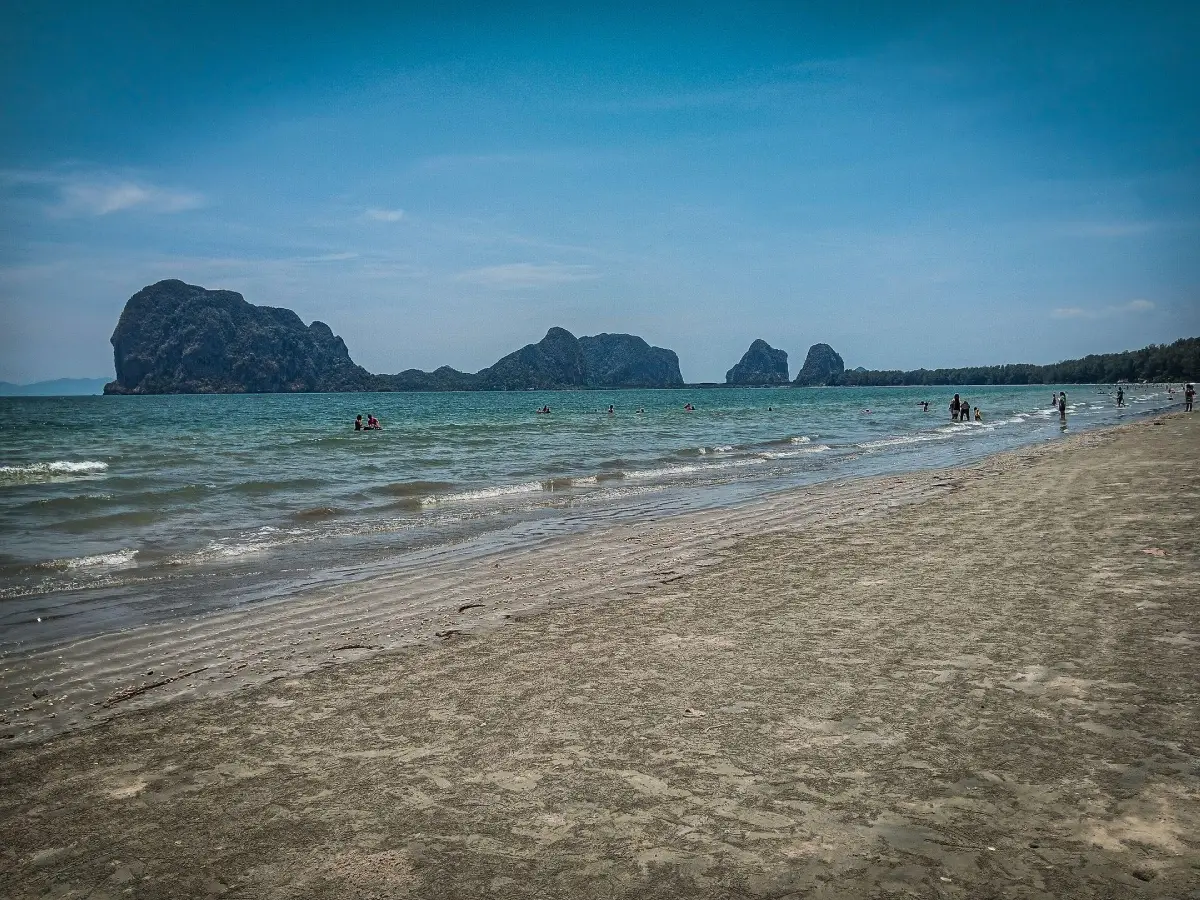
Pak Meng Beach is one of the best-known coastal attractions in Trang Province. Located in Mai Fat Subdistrict, Sikao District, it faces the Andaman Sea and offers views of offshore islands and limestone formations rising from the water. The beach is especially attractive because of its coastal scenery and relaxed atmosphere, making it suitable for walking, resting, and watching the sunset.
Pak Meng is also an important destination for travelers exploring the islands of Trang. Its location near boat departure facilities makes the area a convenient place to stay before embarking on a marine excursion. Visitors can spend the night near the coast, then continue to a suitable pier early the following morning for a boat trip to Ko Mook or other islands included in the selected itinerary.
One of the beach's most distinctive qualities is the surrounding landscape of limestone islands and coastal formations, which creates a different visual character from many beaches along the Gulf of Thailand. The combination of sea, islands, and changing light makes Pak Meng particularly appealing for landscape photography and relaxed sightseeing.
During the late afternoon, visitors can enjoy views of the setting sun and the silhouettes of islands across the Andaman Sea. The scenery varies according to the weather and seasonal conditions, but the coastal setting remains a major reason travelers choose Pak Meng as a place to relax before or after exploring the offshore islands.
The area around Pak Meng Beach is also associated with the coastal tourism economy of Trang. Restaurants and visitor services in the surrounding area provide opportunities to enjoy seafood and local dishes, while the nearby boat connections support travel to the islands. The beach therefore functions both as a destination in its own right and as a gateway to other parts of Trang's marine landscape.
For visitors arriving by train, Pak Meng Beach requires a road transfer from Trang Railway Station to Sikao District. Travelers should consider arranging a taxi, accommodation transfer, or another suitable vehicle before leaving the town center. If planning to visit Ko Mook the following day, it is advisable to confirm the selected pier, departure time, and boat arrangements before settling in for the evening.
Allow approximately 2–3 hours to explore Pak Meng Beach, with additional time for meals and sunset photography. Staying overnight near the coast can be particularly convenient for travelers who want to depart early on a boat excursion the following morning.
More Information:Pak Meng Beach, Trang
17.2 Ko Mook–Emerald Cave
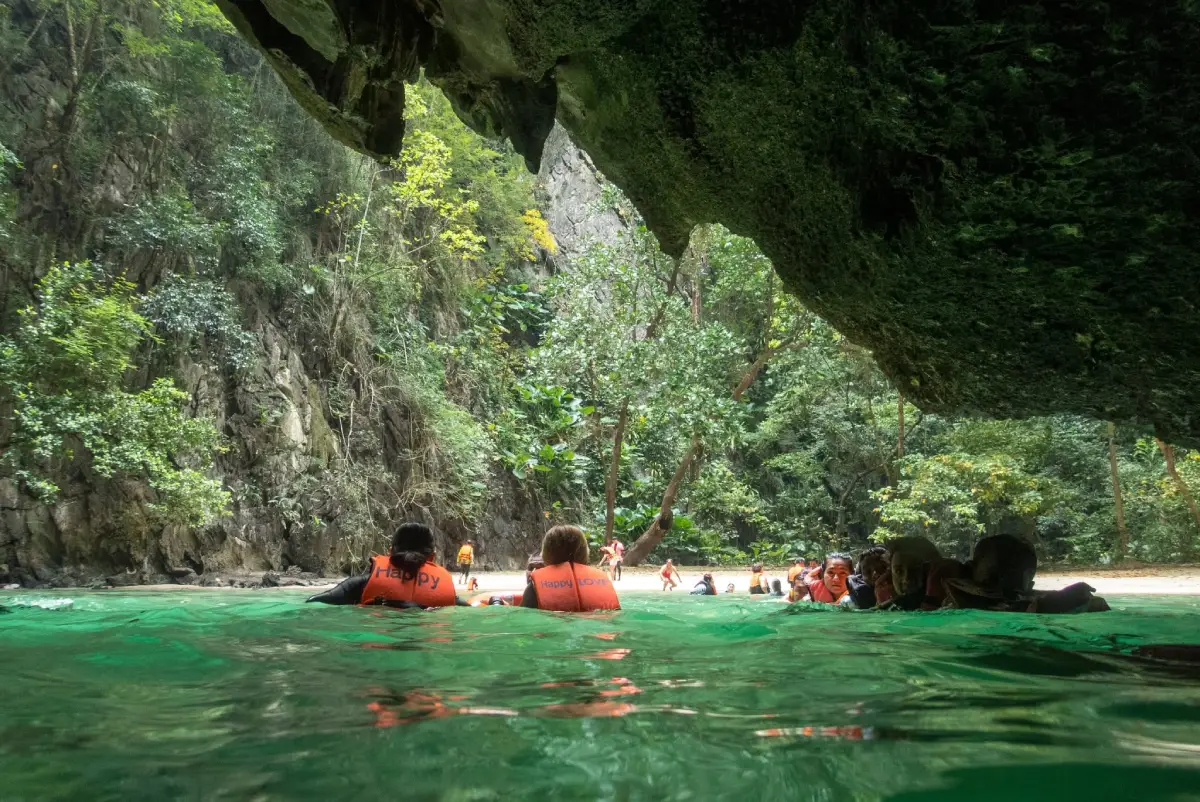
Ko Mook and Emerald Cave are among the most famous marine attractions in Trang Province. Located in the Ko Libong area of Kantang District, Emerald Cave lies on the western side of Ko Mook and is an important natural attraction within Hat Chao Mai National Park. Its most distinctive feature is a passage through a sea cave that connects the open sea with a secluded sandy beach enclosed by towering limestone cliffs.
Emerald Cave is known for its unusual natural formation. Visitors enter through a water-filled passage that extends through a dark limestone cave before emerging into a hidden open-air area. Inside is a sandy beach surrounded by steep rock walls, creating a remarkable landscape that feels separate from the sea outside. The cave's name is associated with the greenish color of the water, which can become particularly striking when light reflects through the entrance under suitable conditions.
Ko Mook itself is also an interesting destination because of its island environment, coastal communities, and local fishing traditions. Travelers who choose to stay overnight on the island can spend more time discovering its beaches and community atmosphere than those who visit only as part of a day tour. However, accommodation arrangements and boat schedules should be checked carefully before traveling to an island destination.
The entrance to Emerald Cave is especially unusual because visitors generally need to float or swim through a water-filled passage rather than walk along a dry tunnel. The passage can be dark and is affected by the tide and sea conditions. The experience therefore requires appropriate safety arrangements and should be undertaken with a knowledgeable guide or an established boat operator familiar with the conditions at the site.
Visitors must wear life jackets and follow the instructions of their guides and park officials. Entering the cave without appropriate supervision is not recommended. Travelers who are uncomfortable in deep water, dark enclosed spaces, or physically demanding marine environments should inform the tour operator before booking and choose an activity suited to their abilities.
Access to Emerald Cave also depends on national park regulations and seasonal conservation measures. The area may be closed during parts of the monsoon season to protect the environment and ensure visitor safety. Travelers should therefore confirm that Emerald Cave is officially open on the intended date, rather than assuming that boat trips are available throughout the year.
For visitors beginning the journey at Trang Railway Station, reaching Ko Mook involves several stages. First, travelers must take a road transfer to Pak Meng Pier or another suitable departure point serving the island. They then continue by tour boat or another authorized marine service. The boat journey from the Pak Meng area to Emerald Cave may take approximately 40 minutes under suitable conditions, although actual travel times depend on the vessel, route, weather, and sea state.
Allow at least half a day for an excursion to Ko Mook and Emerald Cave, and consider reserving a full day when including travel between accommodation and the pier, waiting time, the cave visit, and additional island stops. Visitors should not schedule a tightly timed boat excursion immediately before an important railway departure because sea conditions and transport connections can affect the return journey.
More Information:Ko Mook–Emerald Cave, Trang
Three-Day, Two-Night Trang Train Itinerary On the first day, arrive at Trang Railway Station on the selected service from Bangkok. Begin with a traditional Trang breakfast, which may include dim sum, Trang-style roasted pork, coffee, and local cakes. Afterward, spend some time exploring the town center or resting before continuing by road to accommodation near Pak Meng Beach or another suitable coastal location for the following day's boat excursion.
During the first afternoon, spend approximately 2–3 hours relaxing at Pak Meng Beach. Walk along the shoreline, admire the limestone islands across the Andaman Sea, and enjoy a meal in the surrounding area. If the weather is suitable, sunset can be an especially appealing time for coastal photography. Travelers staying near the beach should confirm their boat departure arrangements and transportation to the pier before the following morning.
On the second day, begin the marine excursion according to the departure time provided by the boat operator. Travel to Ko Mook and Emerald Cave as part of a suitable guided tour, allowing at least half a day or a full day depending on the selected itinerary. During the excursion, wear a life jacket, follow safety instructions, and respect the regulations of Hat Chao Mai National Park.
After returning from the boat trip, spend the remainder of the second day relaxing near Pak Meng Beach or travel back to Trang town for the evening. Travelers who intend to return to Bangkok by train on the third day may find it more convenient to spend the second night in or near the town center, reducing the time needed to reach Trang Railway Station.
On the third day, enjoy another traditional Trang breakfast, explore the town center if time permits, and purchase regional food products or other souvenirs. Return to your accommodation to collect your luggage before traveling to Trang Railway Station for the train journey back to Bangkok. Allow enough time for road transportation, particularly if staying outside the town center.
A three-day, two-night Trang itinerary is ideal for travelers who want to combine the province's food culture with Pak Meng Beach and Ko Mook–Emerald Cave. However, visitors traveling during a period when national park authorities have closed the cave for environmental recovery, or when sea conditions make boating unsafe, should substitute town-based or mainland attractions rather than attempting to enter a restricted marine area.
Route 18: Bangkok to Hat Yai and Songkhla by Train — A Three-Day, Two-Night Journey Through Kim Yong Market and the Historic Streets of Songkhla Old Town Hat Yai and Songkhla are two important urban destinations within Songkhla Province, each offering a distinctive experience. Hat Yai is recognized as a major commercial, transportation, and food center of Southern Thailand, while Songkhla city is known for its historic port-town character, traditional neighborhoods, old buildings, and cultural heritage shaped by generations of diverse communities. Combining the two cities in a single railway-based itinerary provides visitors with an opportunity to experience the contrasting identities of Southern Thailand.
Traveling from Bangkok to Hat Yai by train is an appealing choice for visitors who want to experience a long-distance journey on the Southern Railway. Hat Yai Junction Railway Station is an important part of Thailand's southern rail network, providing connections along major routes through the peninsula and serving travelers moving between important towns and neighboring countries. Arriving by train places visitors close to one of the busiest commercial districts in Southern Thailand.
The appeal of this route lies in the combination of modern commerce and historic urban culture. Travelers can begin by exploring Kim Yong Market in central Hat Yai, where a wide variety of food products, souvenirs, and everyday goods reflect the city's commercial importance. They can then continue by road to Songkhla Old Town, where historic buildings, traditional streets, and long-established communities preserve the atmosphere of an important port city.
Hat Yai's commercial identity is closely linked to its role as a regional transportation hub. The railway has contributed to the movement of people, goods, and commercial activities across Southern Thailand, while the surrounding markets and business districts reflect the city's position within regional trading networks. Visitors who begin their sightseeing near the railway station can observe the everyday relationship between transportation and commerce that continues to shape Hat Yai.
Songkhla city offers a very different experience. Its historic neighborhoods reflect the development of a trading settlement influenced by Chinese, Thai, and other cultural traditions. The architectural heritage of Songkhla Old Town includes traditional shophouses, historic streets, and buildings displaying a mixture of Chinese and Western design influences. Exploring these streets provides an opportunity to appreciate the city's long history as a center of trade and settlement near Songkhla Lake.
It is important to understand that Hat Yai and Songkhla are separate cities. Hat Yai Junction Railway Station is located in Hat Yai District, while Songkhla Old Town is in Mueang Songkhla District. Traveling between them requires a road connection by bus, taxi, or another suitable vehicle. Visitors should plan enough time for this transfer rather than assuming that the old town can be reached on foot from Hat Yai Railway Station.
A three-day, two-night itinerary is recommended. The first day can focus on arriving at Hat Yai Junction and exploring Kim Yong Market. The second day is best reserved for Songkhla Old Town and its historic neighborhoods. The third day can be used for additional shopping, local food, or a relaxed morning before returning to the railway station for the train journey back to Bangkok.
Travelers using an overnight train should prepare for a long-distance journey and confirm the return schedule in advance. This is particularly important if they intend to travel from Songkhla city to Hat Yai on the same day as their return train, because road traffic and transport connections can affect the time required to reach the station.
18.1 Kim Yong Market
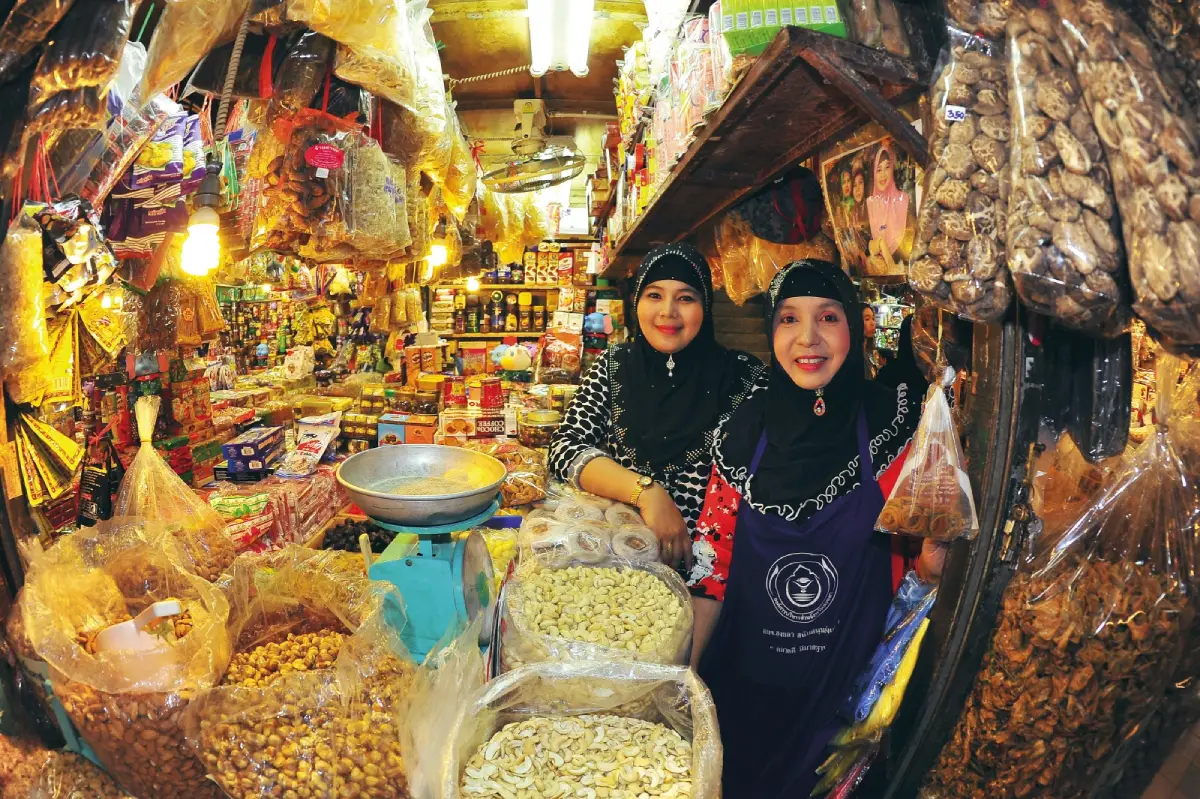
Kim Yong Market is one of the most important markets and best-known tourist attractions in Hat Yai District, Songkhla Province. Located in the central commercial area of Hat Yai, the market reflects the city's importance as a trading and economic center of Southern Thailand. It is popular among both local residents and visitors seeking a wide range of food products, everyday goods, and souvenirs.
One of Kim Yong Market's defining characteristics is the variety of products available. Shops sell dried foods, snacks, processed fruit, nuts, tea, coffee, clothing, and other merchandise from different sources. The market's commercial atmosphere reflects Hat Yai's connections with trading networks within Thailand and across nearby international borders.
Kim Yong Market is also an interesting destination for travelers who want to observe the everyday commercial culture of Hat Yai. The surrounding shopping district is characterized by active retail businesses and a steady flow of shoppers. Walking through the market offers an opportunity to appreciate how commerce contributes to the identity of this important southern city.
The market is particularly appealing to visitors interested in regional food culture. Products and food traditions in Hat Yai reflect influences from Thai, Chinese, and Malay communities, all of which have contributed to the city's culinary identity. Visitors can explore local snacks and ingredients while observing the variety of goods sold throughout the shopping area.
Beyond food products, Kim Yong Market is a practical place for purchasing souvenirs and gifts. Travelers can browse packaged snacks, local food products, and other merchandise before returning home. Anyone planning to take food across an international border should check the customs and import regulations of the destination country before making purchases.
For visitors arriving by train, Kim Yong Market is particularly convenient because it is located in central Hat Yai, relatively close to Hat Yai Junction Railway Station. Travelers may be able to reach it on foot from suitable parts of the station area or use a short local taxi ride, depending on their luggage, the weather, and their preferred route. This makes it an excellent first attraction after arriving in Hat Yai.
Allow approximately 60–90 minutes to explore Kim Yong Market. Travelers who want to purchase a large number of souvenirs or enjoy a meal in the surrounding shopping district can allocate additional time. Visiting during the morning or daytime is generally preferable for exploring a wider selection of market stalls and shops.
More Information:Kim Yong Market, Songkhla
18.2 Songkhla Old Town
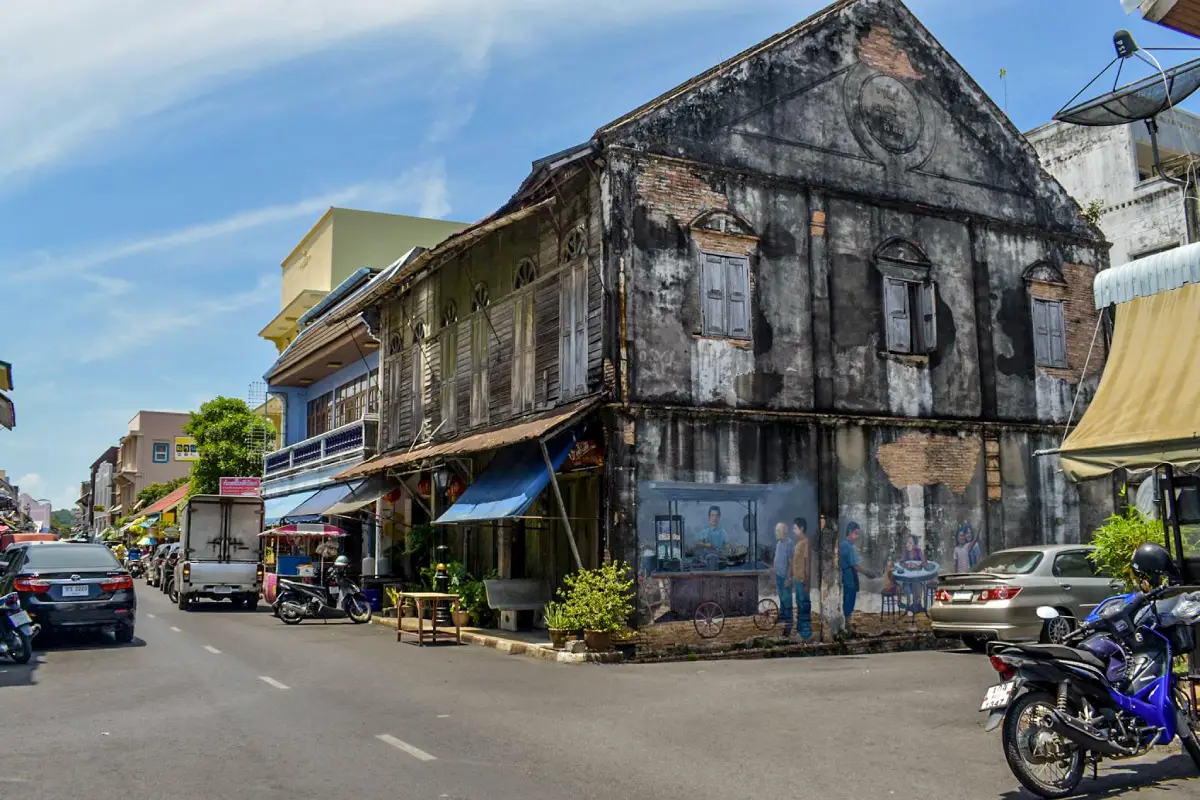
Songkhla Old Town is one of the most important historical and cultural districts in Songkhla Province. Located in Mueang Songkhla District, the area is renowned for its historic buildings, traditional streets, and communities that preserve the heritage of a former trading port near Songkhla Lake. Among its best-known streets are Nakhon Nok Road, Nakhon Nai Road, and Nang Ngam Road, which visitors can explore to appreciate the architecture and everyday life of the old town.
The historical importance of Songkhla Old Town is closely connected with its role in maritime commerce and the interaction of different cultural communities. These influences contributed to the development of buildings that combine Chinese and Western architectural features, as well as traditional shophouse designs suited to the commercial and residential needs of a port-town population.
Walking through the old town, visitors can observe differences in building facades, doors, windows, balconies, and decorative details that reflect changes in architectural preferences over time. Some historic buildings have been adapted into restaurants, cafés, creative spaces, and businesses that continue to operate within the traditional streetscape. This combination of old architecture and contemporary activity gives Songkhla Old Town a character that is both historically meaningful and lively.
Nang Ngam Road is particularly popular because of its traditional food shops, local desserts, and historic buildings. The street offers an opportunity to experience the relationship between the city's culinary traditions and its long-established trading communities. Visitors can enjoy local dishes while exploring a neighborhood in which food culture and historic architecture exist side by side.
Nakhon Nok Road and Nakhon Nai Road are also important components of the old town's historical landscape. Their buildings and streets provide evidence of earlier settlement patterns and the development of commercial activities. Walking through all three principal streets gives travelers a broader understanding of how Songkhla developed as a center of trade, residence, and cultural exchange.
Songkhla Old Town is also known for artistic works displayed on walls and public spaces, including street art that reflects local people, food, and everyday activities. These creative additions contribute to the area's modern cultural identity while drawing attention to the stories and traditions of the community. Visitors can photograph artworks in publicly accessible areas, but should respect private property and avoid disturbing residents.
The attraction of Songkhla Old Town extends beyond individual buildings or artworks. Its significance lies in the continuing relationship between the historic environment and the people who live and work there. Traditional businesses, local food, and community activities help preserve the character of the old town, allowing visitors to experience a historic district that remains part of everyday urban life.
For travelers arriving by train at Hat Yai Junction, reaching Songkhla Old Town requires a road journey to Mueang Songkhla District. A bus, taxi, or another suitable transport service should be arranged for the transfer between the two cities. Because the old town is not located near Hat Yai Railway Station, it is practical to dedicate most of the second sightseeing day to Songkhla rather than attempting several round trips between the cities.
Allow approximately 2–3 hours to explore Songkhla Old Town, with the option to extend the visit to half a day if you want to enjoy local food, examine the buildings, and explore the historic streets in greater detail. Morning and late afternoon are generally more comfortable for walking, particularly during hot weather.
More Information:Songkhla Old Town
Three-Day, Two-Night Hat Yai–Songkhla Train Itinerary On the first day, arrive at Hat Yai Junction Railway Station on the selected train from Bangkok. Continue to accommodation in central Hat Yai to leave your luggage or check in before visiting Kim Yong Market. Spend approximately 60–90 minutes exploring the shops, browsing food products, and purchasing souvenirs.
During the afternoon of the first day, enjoy the commercial atmosphere of central Hat Yai and sample local southern Thai food. Travelers can explore nearby shopping streets according to their interests before returning to their accommodation. Staying near Hat Yai Junction Railway Station or within the central commercial district can make both the first day and final departure more convenient.
On the second day, travel from Hat Yai to Songkhla city in the morning using a suitable bus, taxi, or another road transport service. After arriving in Mueang Songkhla District, begin exploring Songkhla Old Town, focusing on Nakhon Nok Road, Nakhon Nai Road, and Nang Ngam Road. Allow approximately 2–3 hours to enjoy the historic architecture, traditional streets, and community atmosphere.
During the afternoon, continue exploring the old town or relax in the surrounding area before returning to Hat Yai. Travelers who want to add Samila Beach or other attractions in Songkhla city should allow additional time and arrange appropriate transportation. It is advisable not to include too many distant locations within the same day, as this can make the journey unnecessarily rushed.
On the third day, enjoy breakfast and spend the remaining time shopping or exploring central Hat Yai before returning to Bangkok. Travelers may wish to revisit a market or local food shop before collecting their luggage and continuing to Hat Yai Junction Railway Station according to the confirmed train departure time.
The three-day, two-night Hat Yai–Songkhla itinerary focuses on Kim Yong Market in Hat Yai and Songkhla Old Town in Mueang Songkhla District. Organizing the journey around these two separate urban areas allows visitors to appreciate the contrast between a major modern commercial center and a historic port town, while using the railway as the principal means of intercity travel.
Route 19: Bangkok to Nakhon Si Thammarat by Train — A Three-Day, Two-Night Cultural Journey to Wat Phra Mahathat, Southern Thai Shadow Puppetry, and the Historic City Wall Nakhon Si Thammarat is one of Southern Thailand's most historically and culturally significant provinces. Its heritage is closely associated with the spread of Buddhism, the development of important regional kingdoms, traditional performing arts, and the preservation of southern Thai customs. Traveling from Bangkok to Nakhon Si Thammarat by train offers an opportunity to experience the Southern Railway before exploring an ancient city whose religious and cultural influence extends far beyond the province itself.
The appeal of visiting Nakhon Si Thammarat by train lies in the diversity of historical and cultural attractions within the old city. Travelers can pay respect at Wat Phra Mahathat Woramahawihan, one of the most important Buddhist temples in Southern Thailand, discover the traditional art of Nang Talung shadow puppetry at Ban Nang Talung Suchart Subsin, and explore the surviving Nakhon Si Thammarat City Wall, an important reminder of the city's former defensive infrastructure.
Nakhon Si Thammarat has a long history as a major religious and cultural center of the Malay Peninsula. The city was historically associated with the kingdom and regional polity known as Tambralinga and later became an important center of Theravada Buddhism. Its religious institutions, artistic traditions, and urban development contributed to the transmission of cultural influences across Southern Thailand and neighboring regions.
One of the province's most important characteristics is the relationship between Buddhism and everyday cultural life. Religious traditions continue to influence community activities, while local craftsmanship and performing arts preserve knowledge passed down through generations. The province is particularly associated with the Hae Pha Khuen That tradition, a major religious ceremony involving the offering of cloth to honor the sacred relic stupa at Wat Phra Mahathat Woramahawihan.
Nakhon Si Thammarat is also renowned for its southern Thai performing arts, especially Nang Talung, a form of shadow puppetry in which leather figures are used to tell stories through a combination of dialogue, music, movement, and traditional performance techniques. Visiting a center dedicated to preserving this art allows travelers to appreciate the cultural heritage that continues to define the province.
Travelers departing from Bangkok can use Southern Line railway services to reach Nakhon Si Thammarat, selecting an appropriate direct service or a connection through a major railway junction according to the available timetable. The journey covers a considerable distance, so an overnight train can be a practical option for visitors wishing to spend more of their holiday exploring the destination rather than traveling during daylight hours.
After arriving at Nakhon Si Thammarat Railway Station, travelers can continue to accommodation and the historic city using local taxis or other suitable transport services. Several major attractions are located within the urban area, but the distances between individual sites and the railway station may make a combination of walking and short road transfers more convenient than relying exclusively on walking.
A three-day, two-night itinerary is recommended. The first day can focus on Wat Phra Mahathat Woramahawihan and the city's Buddhist heritage. The second day is suitable for learning about southern Thai shadow puppetry at Ban Nang Talung Suchart Subsin and exploring the surviving city wall. The third day can be reserved for local food, shopping, or further cultural sightseeing before returning to the railway station.
This itinerary is particularly suitable for travelers interested in history, Buddhism, traditional arts, and the cultural development of Southern Thailand. Rather than concentrating on beaches or large entertainment attractions, the journey offers an opportunity to explore the distinctive identity of an ancient southern city through its sacred monuments, performing arts, and surviving urban heritage.
19.1 Wat Phra Mahathat Woramahawihan
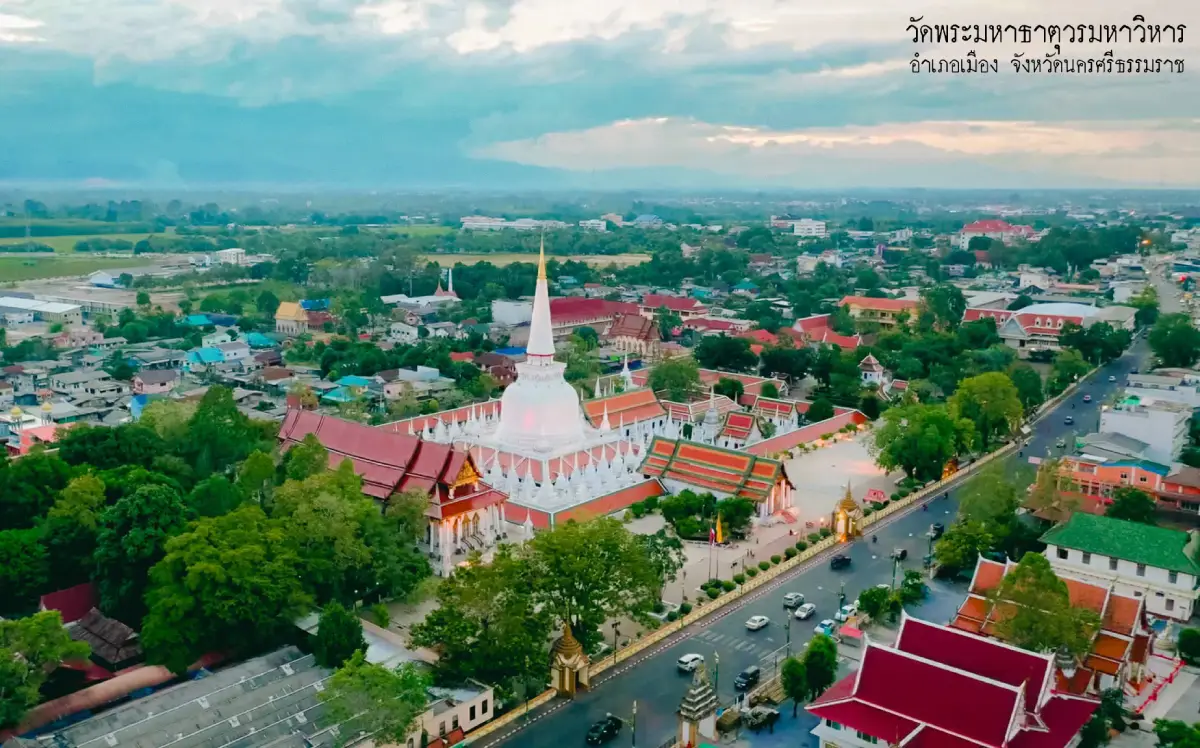
Wat Phra Mahathat Woramahawihan is one of the most important Buddhist temples in Southern Thailand and a major historical landmark of Nakhon Si Thammarat Province. Located on Ratchadamnoen Road in the historic city, the temple is particularly renowned for its principal stupa, which is revered as an important repository of Buddhist relics. The monument has long been a center of religious devotion and an enduring symbol of the province's spiritual identity.
The temple's historical significance is closely connected with the development of Theravada Buddhism in Southern Thailand. Nakhon Si Thammarat became an important center of Buddhist religious learning and practice, and the sacred stupa played a central role in the city's religious traditions. The temple's influence extends beyond local worship because of its longstanding association with Buddhist culture across the southern peninsula.
The principal stupa is distinguished by its elegant architectural form and impressive scale. Its historical development reflects different phases of religious patronage, restoration, and the continuity of Buddhist practices. Surrounding religious buildings and sacred structures further contribute to the importance of the complex as both a place of worship and a major heritage site.
One of the temple's most important traditions is Hae Pha Khuen That, a ceremonial procession in which devotees bring a long piece of cloth to be offered around the sacred stupa. This tradition is associated with important Buddhist observances and demonstrates the continuing devotion of local communities to the relic monument. The ceremony is an important expression of Nakhon Si Thammarat's religious identity and attracts participants from different parts of Thailand.
For visitors interested in religious architecture, Wat Phra Mahathat provides an opportunity to appreciate the relationship between sacred monuments, Buddhist beliefs, and the development of southern Thai artistic traditions. The arrangement of religious buildings and the importance of the principal stupa reflect the central role Buddhism has played in the city's history.
The temple also offers valuable insights into the continuity of cultural traditions. While many historic sites are preserved primarily as archaeological monuments, Wat Phra Mahathat remains an active religious institution where worshippers continue to participate in ceremonies, make offerings, and express their faith. Visitors can therefore experience a place where history and contemporary religious life remain closely connected.
Travelers arriving by train can reach Wat Phra Mahathat from Nakhon Si Thammarat Railway Station by local taxi or another suitable transport service. The temple is located within the historic city and can be combined with visits to other cultural attractions in the surrounding area. Choosing accommodation in the town center may reduce travel time between the principal sightseeing destinations.
Allow approximately 60–90 minutes to explore Wat Phra Mahathat Woramahawihan, admire the sacred stupa, and learn about its religious significance. Visitors should dress modestly, remove their shoes where required, and respect areas reserved for religious ceremonies. Additional time may be needed during major festivals when large numbers of worshippers visit the temple.
More Information:Wat Phra Mahathat Woramahawihan, Nakhon Si Thammarat
19.2 Ban Nang Talung Suchart Subsin
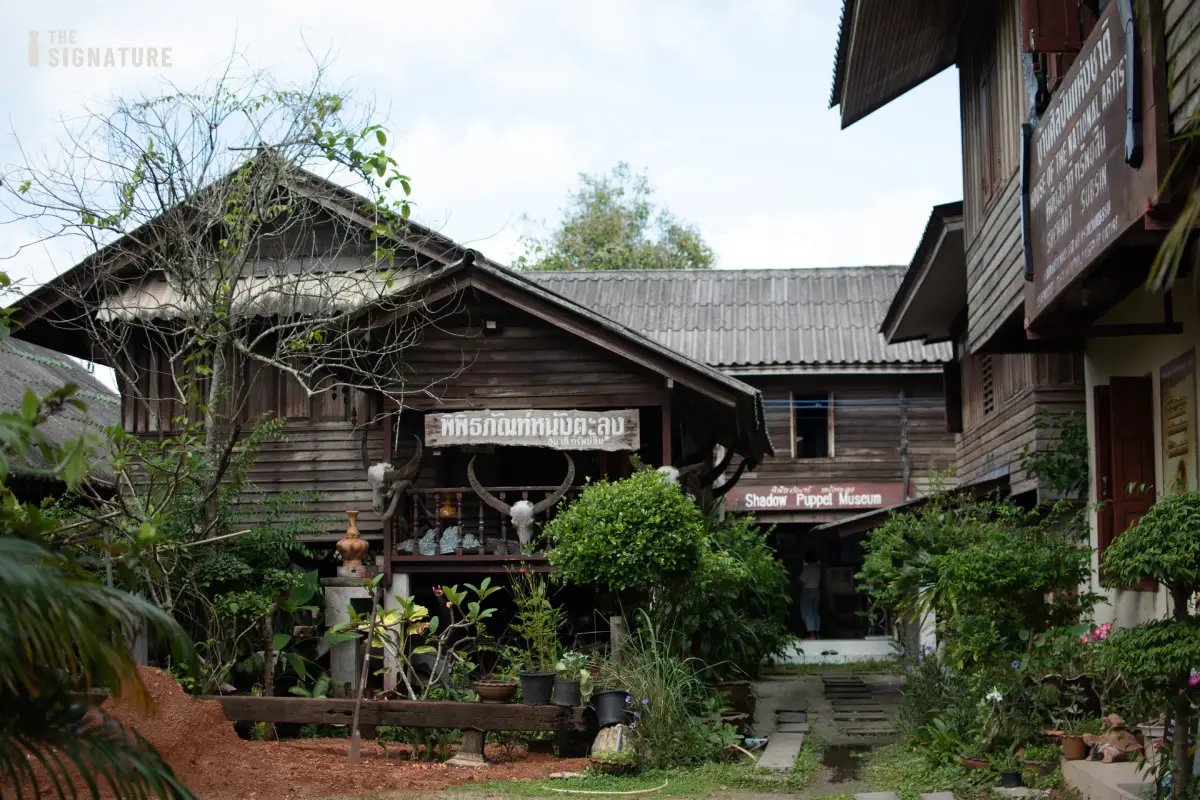
Ban Nang Talung Suchart Subsin is one of Nakhon Si Thammarat's most distinctive cultural attractions. Located within the urban area, it is dedicated to preserving the traditional southern Thai performing art known as Nang Talung, or shadow puppetry. The center is associated with the work of Suchart Subsin, an important figure in the preservation and transmission of this traditional art.
Nang Talung is a traditional form of storytelling in which intricately carved leather puppets are manipulated behind an illuminated screen. The shadows created by the figures are used to present characters and scenes from stories, accompanied by dialogue, narration, music, and expressive performance. The art combines visual craftsmanship with spoken language, humor, cultural knowledge, and the skills of the puppeteer.
The creation of Nang Talung puppets is itself an important traditional craft. Figures are made from prepared animal hide, which is cut and carved into detailed shapes representing different characters. Individual puppets may contain elaborate decorative patterns and carefully designed features that help distinguish royal figures, heroes, comic characters, and other personalities used in performances.
The puppeteer is central to the success of a Nang Talung performance. A skilled performer must manipulate multiple characters, provide distinctive voices, coordinate dialogue, and work with the accompanying musicians. Performances often combine traditional stories with observations of contemporary society, allowing the art to remain meaningful and entertaining for different generations of audiences.
Ban Nang Talung Suchart Subsin provides visitors with an opportunity to learn about the puppets, their construction, and the cultural significance of the performance tradition. The collection includes shadow puppets and materials associated with the development of the art, illustrating the variety of designs and techniques used by performers and craftspeople.
The cultural importance of the center lies in its contribution to the preservation of knowledge that might otherwise decline as entertainment preferences and community practices change. By maintaining a collection of puppets and sharing information about traditional techniques, the center helps visitors understand why Nang Talung remains an important expression of southern Thai identity.
For international visitors, the attraction is particularly rewarding because it introduces a performing art that differs from conventional theater and many other forms of puppetry. Even travelers unfamiliar with the southern Thai dialect can appreciate the craftsmanship of the figures, the relationship between light and shadow, and the visual storytelling techniques that define the tradition.
Travelers arriving by train can reach Ban Nang Talung Suchart Subsin from Nakhon Si Thammarat Railway Station or accommodation in the historic city by local taxi or another suitable transport service. It can be combined with other attractions within the urban area, especially for visitors spending several days exploring the province's religious and cultural heritage.
Allow approximately 60–90 minutes for a visit to Ban Nang Talung Suchart Subsin, with additional time if a demonstration or organized cultural activity is available. Travelers particularly interested in performance traditions may wish to enquire about opportunities to observe puppet-making techniques or learn more about the stories and music associated with Nang Talung.
More Information:Ban Nang Talung Suchart Subsin, Nakhon Si Thammarat
19.3 Nakhon Si Thammarat City Wall
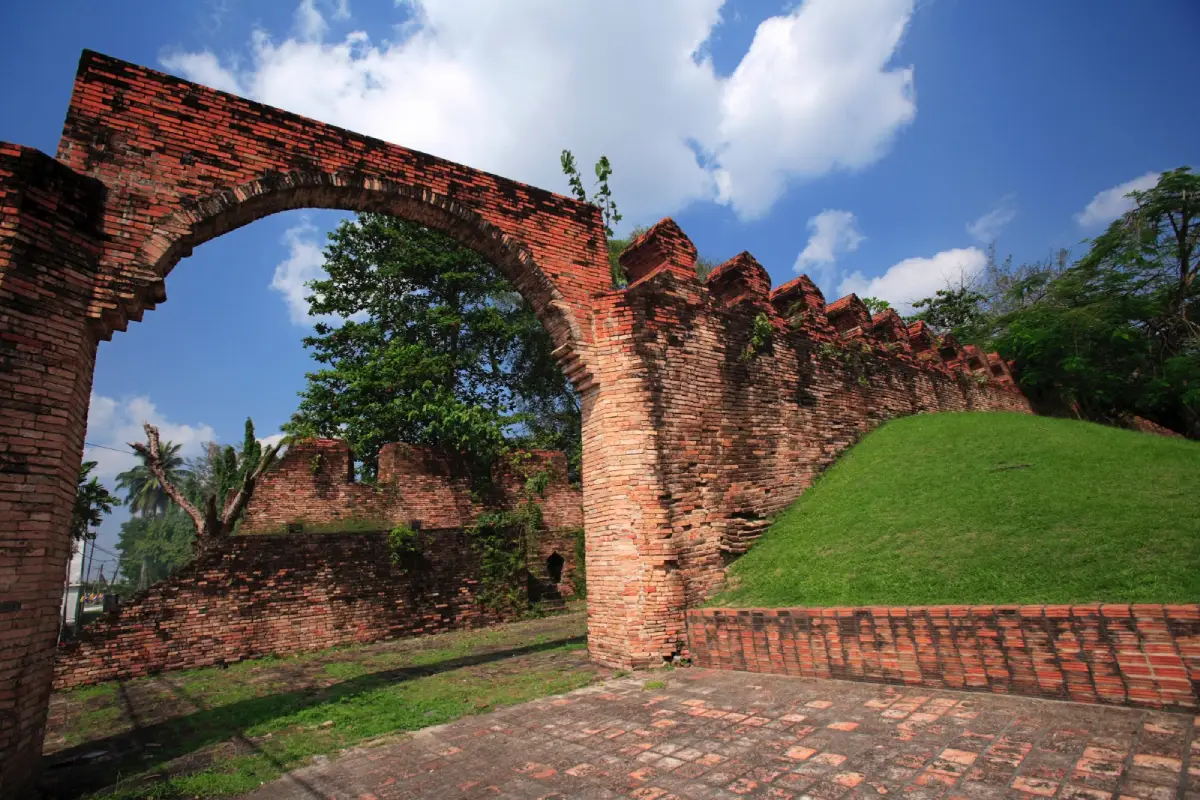
Nakhon Si Thammarat City Wall is an important historical landmark representing the city's development as a major fortified settlement in Southern Thailand. The surviving walls provide evidence of the defensive infrastructure once used to protect an important urban center, while also illustrating the historical significance of Nakhon Si Thammarat as a regional political and administrative city.
The history of the city wall is closely connected with the development of Nakhon Si Thammarat as an important settlement on the Malay Peninsula. Defensive structures, gates, and surrounding urban features helped define the boundaries of the historic city and played roles in controlling access, organizing settlement, and protecting the population during periods of conflict.
The surviving sections of the wall offer visitors an opportunity to appreciate the scale and arrangement of the former city fortifications. Although the original defensive system has changed over time through construction, restoration, and urban development, the remaining structures preserve an important physical connection with the past.
The wall also illustrates how the historical city developed in relation to its surrounding landscape and transportation routes. Nakhon Si Thammarat's importance was shaped by political authority, religious institutions, and commercial connections across Southern Thailand. The defensive infrastructure formed part of the wider urban system that supported these activities.
Today, the city wall remains an important visual landmark within Nakhon Si Thammarat. Its presence in the modern urban environment demonstrates how historic structures can continue to contribute to local identity even after their original defensive functions are no longer required. Visitors can observe the relationship between the ancient wall and the surrounding roads, public spaces, and contemporary city life.
The attraction is particularly interesting for travelers who enjoy urban history and architecture because it offers a different perspective from the religious monuments and traditional performing arts found elsewhere in the city. Visiting the wall after Wat Phra Mahathat and Ban Nang Talung Suchart Subsin provides a broader understanding of Nakhon Si Thammarat's historical development.
For travelers arriving by train, the city wall can be reached from Nakhon Si Thammarat Railway Station or accommodation in the town center by a local road transfer. Visitors can explore public areas surrounding the surviving structures, taking care to respect conservation measures and avoid climbing on sections of the historic wall where access is not permitted.
Allow approximately 30–60 minutes to visit Nakhon Si Thammarat City Wall and photograph its historic architecture. The site can be included in the same sightseeing day as other attractions within the old city, depending on the route and transportation arrangements.
More Information:Nakhon Si Thammarat City Wall
Three-Day, Two-Night Nakhon Si Thammarat Train Itinerary On the first day, arrive at Nakhon Si Thammarat Railway Station according to the selected train schedule from Bangkok. Continue by local taxi or another suitable transport service to accommodation within or near the historic city. After leaving your luggage or checking in, begin sightseeing at Wat Phra Mahathat Woramahawihan, allowing approximately 60–90 minutes to admire the sacred stupa, explore the religious buildings, and appreciate the temple's historical significance.
After visiting Wat Phra Mahathat, enjoy a meal in the city and spend the afternoon exploring the surrounding historic streets or relaxing at accommodation. Travelers particularly interested in religious culture may wish to learn more about the Hae Pha Khuen That tradition and the temple's continuing importance as a pilgrimage destination. The first evening can be spent enjoying southern Thai food and the atmosphere of Nakhon Si Thammarat's town center.
On the second day, visit Ban Nang Talung Suchart Subsin to learn about traditional shadow puppetry. Allow approximately 60–90 minutes to explore the collection and study the craftsmanship and cultural traditions associated with Nang Talung. If a demonstration or educational activity is available, consider adjusting the schedule to allow sufficient time to participate.
After lunch, continue to Nakhon Si Thammarat City Wall. Spend approximately 30–60 minutes exploring the accessible areas and learning about the historical development of the former fortified city. The two attractions provide complementary experiences: one focuses on the preservation of traditional performing arts, while the other illustrates the city's political and defensive history.
During the evening of the second day, return to the town center for dinner or a relaxed walk through appropriate public areas. Travelers interested in local food can explore southern Thai dishes and traditional snacks, while those who prefer a quieter evening can return to their accommodation before the final day's journey.
On the third day, enjoy breakfast and use the remaining time to explore local markets, purchase souvenirs, or visit additional cultural attractions according to the available time. Return to your accommodation to collect your luggage and arrange transportation to Nakhon Si Thammarat Railway Station for the return journey to Bangkok.
The recommended duration for the Nakhon Si Thammarat itinerary is three days and two nights in the destination area. Travelers using overnight trains or connecting services should allow additional time for the long-distance railway journeys. The route is particularly suitable for visitors interested in Buddhism, southern Thai traditions, performing arts, and the historical development of an important cultural city.
Route 20: Bangkok to Phatthalung by Train — A Three-Day, Two-Night Journey to Khao Ok Thalu, the Historic Governor's Palace, and Thale Noi Wetlands Phatthalung is a culturally rich province in Southern Thailand, known for its limestone mountains, traditional communities, historic buildings, and the extensive freshwater wetland landscapes associated with the Songkhla Lake system. Traveling from Bangkok to Phatthalung by train offers an opportunity to experience the Southern Railway before discovering a destination that combines natural scenery with local history and distinctive southern Thai traditions.
The appeal of visiting Phatthalung by train lies in the variety of attractions that can be explored during a short holiday. Khao Ok Thalu, a dramatic limestone mountain rising near the center of Phatthalung town, is one of the province's most recognizable landmarks. Wang Kao–Wang Mai, the historic Governor's Palace of Phatthalung, introduces visitors to the province's administrative and architectural heritage. Thale Noi, meanwhile, provides an opportunity to experience one of Southern Thailand's most important freshwater wetland environments, renowned for its birdlife, aquatic plants, and traditional fishing communities.
Phatthalung has a long history connected with settlement, agriculture, local administration, and cultural traditions within the southern peninsula. Its historical identity is reflected in religious sites, traditional houses, community crafts, and performing arts, especially Nang Talung shadow puppetry and Nora, a southern Thai dance-drama tradition. These cultural expressions remain important parts of the province's heritage and help distinguish Phatthalung from destinations known primarily for beaches or island tourism.
The province's natural geography is equally significant. Limestone formations rise above the surrounding lowlands, while wetlands and freshwater ecosystems support agricultural activities, fishing traditions, and wildlife. The landscape surrounding Thale Noi is particularly important because of its relationship with the wider Songkhla Lake Basin, one of Southern Thailand's major wetland systems.
Travelers departing from Bangkok can choose a Southern Line train that stops at Phatthalung Railway Station. Depending on the service, an overnight journey may be a convenient way to reach the province while preserving time for sightseeing during the day. However, travelers should confirm the actual departure station, timetable, and arrival time before making accommodation and transportation arrangements.
After arriving at Phatthalung Railway Station, visitors can continue to accommodation in the town center and explore Khao Ok Thalu and other urban attractions. Wang Kao–Wang Mai requires an additional road transfer, while Thale Noi is located farther from the railway station in Khuan Khanun District. Visitors should therefore organize local transportation carefully, particularly for the early-morning boat excursion that is one of the main attractions at Thale Noi.
A three-day, two-night itinerary is recommended. The first day can focus on Khao Ok Thalu and the atmosphere of Phatthalung town. The second day is suitable for visiting Wang Kao–Wang Mai and learning about the province's historical development. The third day can be devoted to an early-morning boat excursion at Thale Noi before returning to the railway station, provided that the return train schedule allows enough time.
Visitors who want to enjoy Thale Noi without rushing may prefer to spend the second night near the wetlands rather than in Phatthalung town. Staying close to the boat departure area can make an early-morning excursion more convenient, particularly for travelers interested in birdwatching or photographing aquatic plants in the soft morning light. However, transportation between the wetlands, accommodation, and the railway station should be arranged in advance.
20.1 Khao Ok Thalu
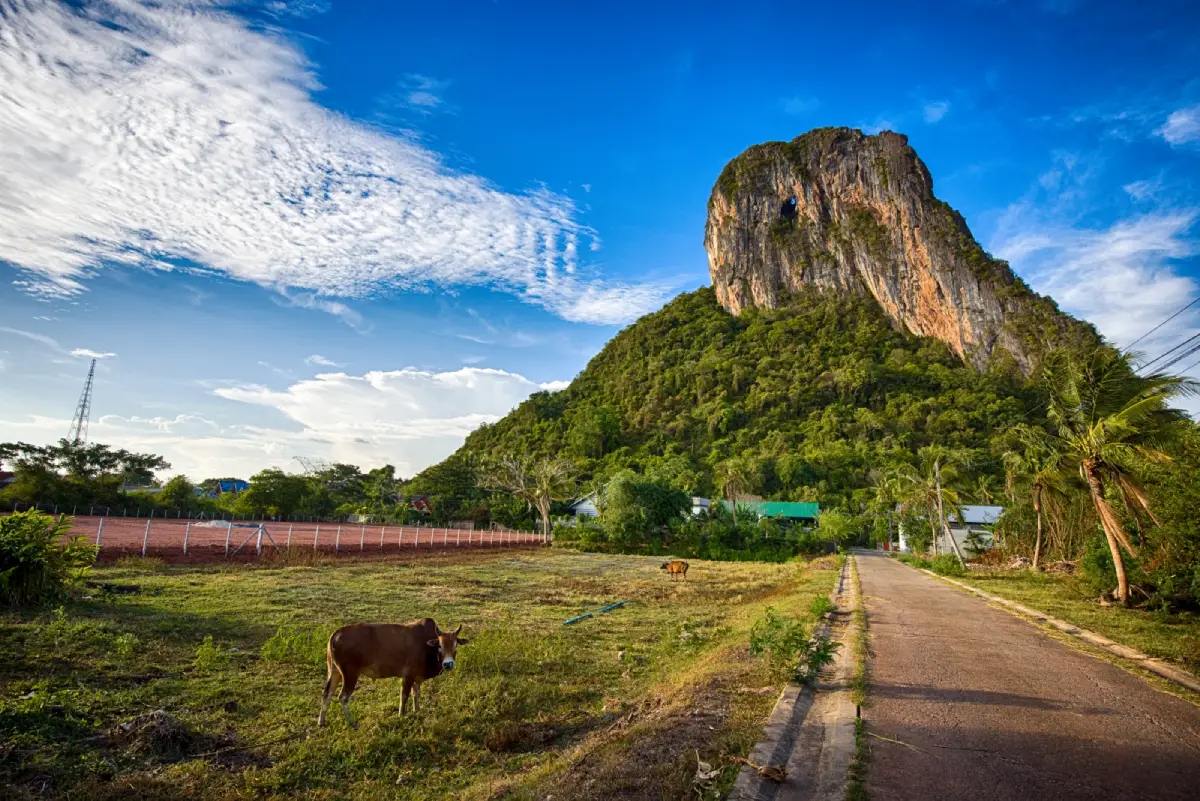
Khao Ok Thalu is one of Phatthalung Province's most recognizable natural landmarks. The limestone mountain rises prominently near the center of Phatthalung town and is particularly famous for the large natural opening in the rock near its upper section. This distinctive feature has made the mountain an enduring symbol of the province and an important part of its geographical identity.
The name Khao Ok Thalu refers to the mountain's unusual opening, which appears as a large hole passing through the limestone formation. The feature is associated with natural geological processes that have shaped the rock over a long period. Its dramatic appearance makes the mountain easily recognizable from the surrounding urban area.
Khao Ok Thalu is particularly interesting because it provides a strong contrast between the natural limestone landscape and the surrounding town. Visitors can observe the mountain from different viewpoints within Phatthalung and appreciate how it rises above the lower terrain. The mountain is visible from several parts of the city, including areas around the railway station, making it an appealing introduction to the destination for passengers arriving by train.
The mountain is also associated with local traditions and the cultural identity of Phatthalung. Over time, its unusual appearance has contributed to stories and beliefs connected with the landscape. For residents, Khao Ok Thalu represents more than a geographical feature; it is a landmark closely associated with the identity and historical memory of the province.
Visitors interested in outdoor activities may consider exploring permitted routes around the mountain or climbing toward elevated viewpoints where access is officially allowed. However, the terrain can be steep and physically demanding. Anyone attempting an ascent should assess their fitness, wear appropriate footwear, carry drinking water, and avoid climbing during heavy rain, extreme heat, or poor visibility.
For travelers who prefer a less strenuous experience, viewing Khao Ok Thalu from the surrounding town can be equally rewarding. Photographs taken from suitable public areas can capture the distinctive limestone formation and its relationship with the cityscape without requiring a climb.
Travelers arriving at Phatthalung Railway Station can use a local taxi or another suitable form of transportation to reach accessible areas near the mountain. The proximity of Khao Ok Thalu to the urban area makes it a practical first attraction after arriving in Phatthalung, although reaching particular viewpoints or trail entrances may require additional travel.
Allow approximately 45–60 minutes to admire the mountain and take photographs from accessible viewpoints. Travelers intending to climb should allow considerably more time and consider the physical demands, route conditions, and available daylight before setting out.
More Information:Khao Ok Thalu, Phatthalung
20.2 Wang Kao–Wang Mai (The Governor's Palace of Phatthalung)
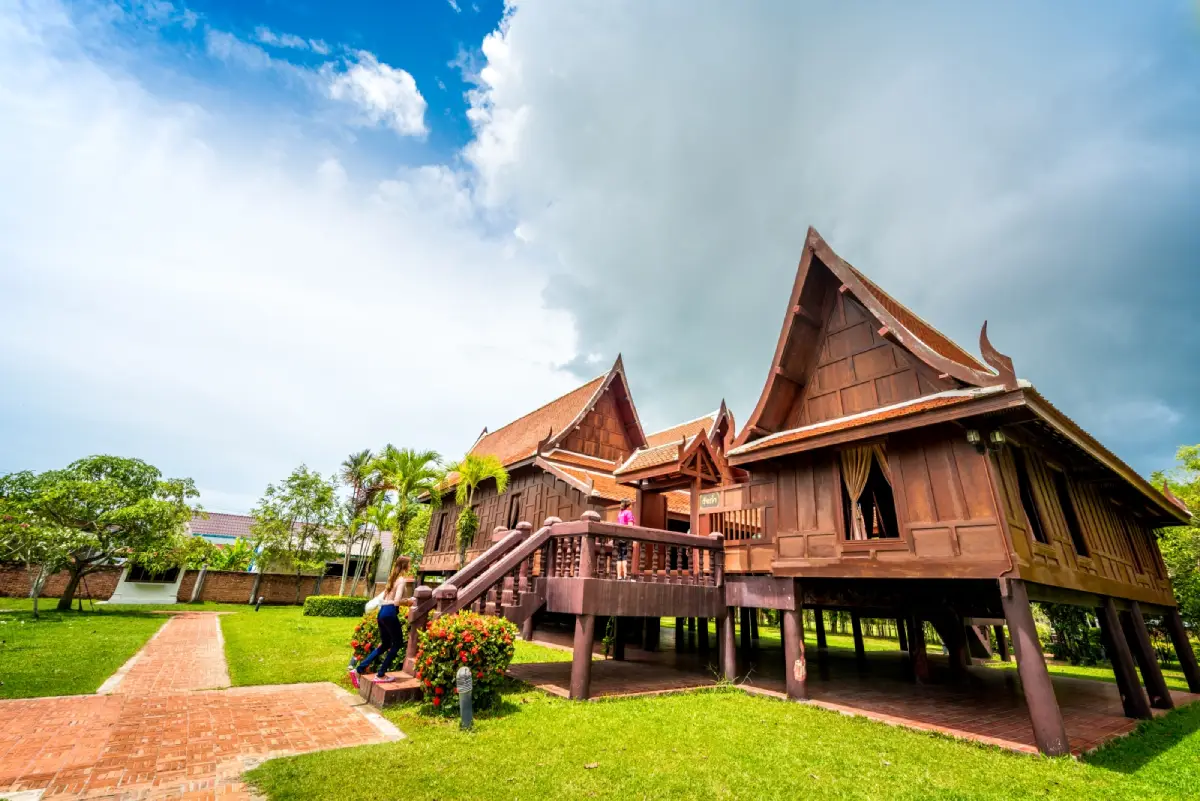
Wang Kao–Wang Mai, also known as the Governor's Palace of Phatthalung, is one of the province's most important historical and architectural attractions. Located in Lam Pam Subdistrict, Mueang Phatthalung District, the palace complex preserves buildings associated with the administration and residential life of former provincial governors. Its traditional architecture provides valuable insights into the history of local government and the lifestyles of important families in Southern Thailand.
The historical significance of Wang Kao–Wang Mai lies in its connection with the development of Phatthalung's administration during earlier periods. The buildings served as residential and administrative spaces associated with provincial leadership, demonstrating the relationship between local governance, architecture, and community life.
The palace complex contains buildings constructed using traditional architectural techniques suited to the southern Thai environment. Wooden structures, elevated floor levels, roof forms, and other architectural features reflect knowledge of local materials and climatic conditions. These elements provide an opportunity to understand how historical residences were designed for daily life in a tropical region.
Visitors can explore the buildings and surrounding grounds to appreciate their historical character and craftsmanship. Architectural details such as timber construction, windows, verandas, and interior arrangements offer insights into the practical and social functions of traditional residences. The complex is particularly appealing to travelers interested in historic houses and the preservation of regional architecture.
Wang Kao–Wang Mai also illustrates the importance of preserving buildings associated with local administration. While larger royal palaces and national monuments often receive considerable attention, provincial residences provide equally valuable evidence of how government, society, and everyday life developed outside the capital.
The site's value extends beyond the individual buildings because it represents a preserved part of Phatthalung's historical landscape. The surrounding environment helps visitors imagine the relationship between the former administrative residence and the local communities that developed nearby.
For travelers arriving by train, Wang Kao–Wang Mai requires a road transfer from Phatthalung Railway Station or accommodation in the town center. The palace is located in Lam Pam rather than immediately beside the railway line, so visitors should arrange suitable local transportation and allow time for the return journey.
The attraction generally opens Wednesday through Sunday, from 8:30 AM to 4:30 PM. Visitors should organize the itinerary around these opening days, as the palace is not normally open on Monday and Tuesday. Scheduling the palace visit for the second day works well when that day falls within the regular operating schedule.
Allow approximately 60–90 minutes to explore Wang Kao–Wang Mai, study the traditional architecture, and learn about the history of Phatthalung's provincial administration. Visitors should observe conservation rules, avoid touching fragile historic materials, and follow any restrictions on entry to individual rooms or buildings.
More Information:Wang Kao–Wang Mai, Phatthalung
20.3 Thale Noi
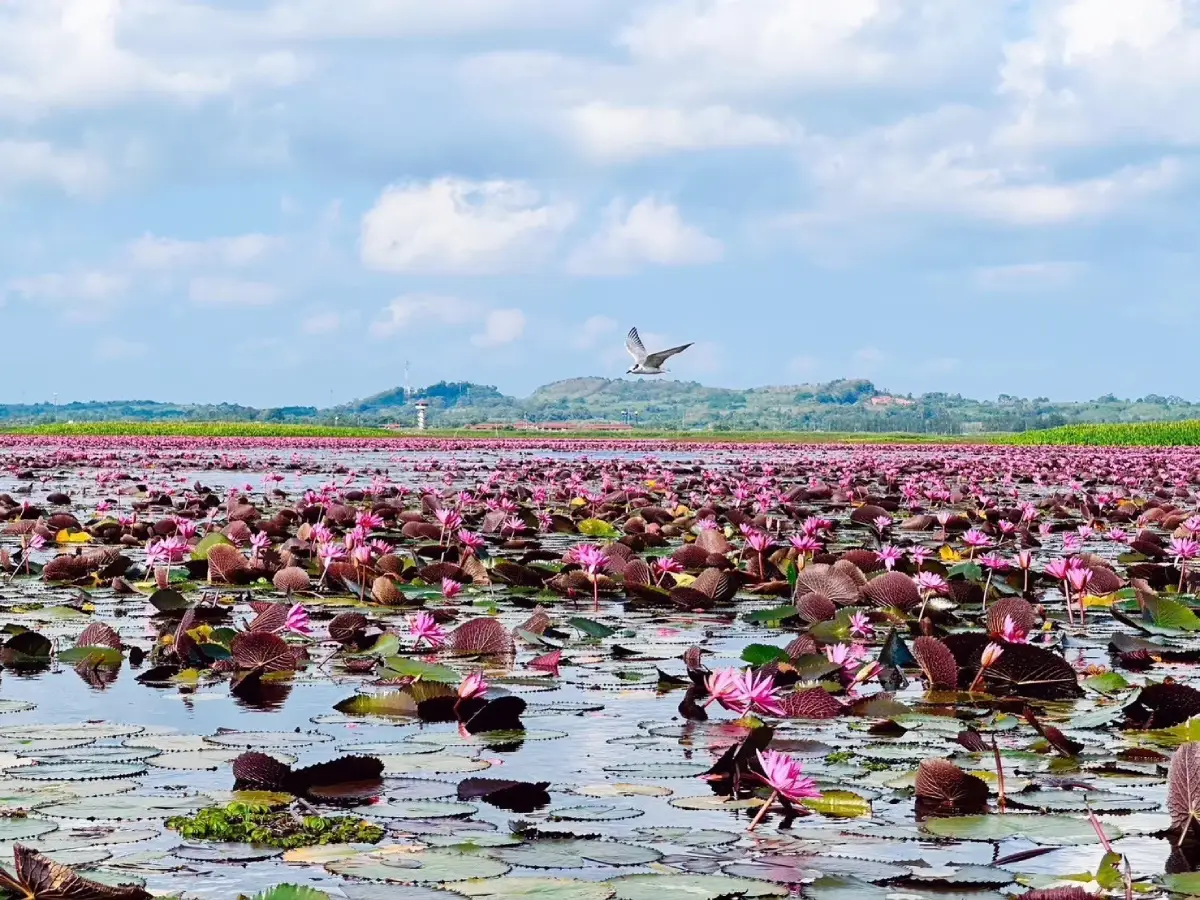
Thale Noi is one of Southern Thailand's most important freshwater wetland attractions. Located in Khuan Khanun District, Phatthalung Province, it forms part of the wider wetland environment associated with the Songkhla Lake system. The area is particularly renowned for its aquatic vegetation, waterbirds, traditional fishing activities, and the scenic landscapes that can be explored by boat.
The natural importance of Thale Noi lies in its extensive wetland habitats, which support a variety of plant and animal species. The freshwater environment provides feeding, breeding, and resting areas for numerous birds, including both resident species and seasonal visitors. As a result, Thale Noi is a major destination for birdwatching and nature photography in Southern Thailand.
One of the most appealing features of Thale Noi is the presence of aquatic plants, including pink water lilies that create colorful landscapes during suitable seasons and flowering conditions. When the flowers are in bloom, their pink blossoms contrast beautifully with the surrounding green vegetation and open water, making the wetlands especially attractive for photographers and nature enthusiasts.
The wetland environment also supports traditional fishing communities whose lifestyles have long depended on freshwater resources. Visitors traveling by boat may observe fishing equipment, local boats, and activities connected with the sustainable use of the lake environment. These scenes provide insights into the relationship between the wetland ecosystem and the communities that have developed around it.
Thale Noi is protected within a conservation framework that recognizes the importance of maintaining wetland habitats and wildlife populations. Visitors should therefore approach the area as a natural environment requiring responsible tourism rather than simply as a location for sightseeing. Protecting the habitats of birds and aquatic species is essential to preserving the wetland's long-term ecological value.
Boat excursions are among the most popular ways to experience Thale Noi. Traveling across the water allows visitors to admire the open wetland landscape, observe birds, and view aquatic plants from different perspectives. The scenery changes with the time of day, water levels, weather, and seasonal conditions, so each excursion may offer a different experience.
Early morning is generally the preferred time for a boat trip because temperatures are usually more comfortable and birds may be particularly active. The soft morning light also creates attractive conditions for landscape photography. Travelers who hope to see blooming water lilies should check seasonal conditions rather than assuming that flowers will be equally abundant throughout the year.
The wetland is also culturally significant because of the communities that have maintained traditional livelihoods around the lake. Fishing practices, local crafts, and knowledge of the seasonal environment contribute to the cultural landscape of Thale Noi. Visitors who take time to observe these aspects of local life can develop a broader understanding of the destination beyond its natural scenery.
For travelers arriving by train, Thale Noi requires a road transfer from Phatthalung Railway Station or the town center to Khuan Khanun District. Because early-morning boat trips are recommended, it may be more convenient to arrange accommodation near the wetlands on the night before the excursion. Visitors staying in Phatthalung town should organize transportation sufficiently early to reach the boat departure area at the preferred time.
Boat operators and local guides can help visitors explore suitable areas of the wetlands. Travelers should wear life jackets, follow boating safety instructions, and avoid disturbing wildlife. Feeding wild birds, approaching nesting areas too closely, or entering restricted conservation zones can damage the environment and should be avoided.
Allow approximately 1–2 hours for a boat excursion at Thale Noi, with additional time for transportation, photography, and visits to nearby communities. Visitors who want to focus on birdwatching or nature photography may prefer a longer excursion, depending on local conditions and the arrangements offered by authorized operators.
More Information:Thale Noi, Phatthalung
Three-Day, Two-Night Phatthalung Train Itinerary On the first day, arrive at Phatthalung Railway Station according to the selected train timetable from Bangkok. Continue to accommodation in Phatthalung town to leave your luggage or check in before beginning sightseeing. Start with Khao Ok Thalu, spending approximately 45–60 minutes admiring the mountain from accessible viewpoints and photographing its distinctive limestone formation.
Travelers who want to explore the mountain more actively should allow additional time and prepare appropriate footwear, drinking water, and sun protection. However, visitors should avoid attempting a demanding climb immediately after a long overnight railway journey if they are tired or unprepared. The mountain can be enjoyed from viewpoints around town without completing an ascent.
During the afternoon of the first day, enjoy local food and explore the atmosphere of Phatthalung town. The remainder of the day can be spent relaxing at accommodation or discovering other nearby attractions according to the available time. Travelers interested in southern Thai cultural traditions may also use the opportunity to learn about the province's connection with Nang Talung and Nora performing arts.
On the second day, travel by road to Wang Kao–Wang Mai in Lam Pam Subdistrict. Allow approximately 60–90 minutes to explore the historic buildings, appreciate their architectural features, and learn about the lives and administrative responsibilities of former provincial governors. Because the palace is normally open Wednesday through Sunday, the itinerary should be adjusted if the second day falls on Monday or Tuesday.
After visiting Wang Kao–Wang Mai, enjoy a meal and continue exploring nearby cultural attractions if suitable transportation is available. During the late afternoon, consider traveling to accommodation near Thale Noi so that the early-morning boat excursion on the following day can begin without a long road journey from Phatthalung town.
On the third day, begin early with a boat trip at Thale Noi. The recommended starting time is around sunrise, depending on the arrangements provided by the local boat operator and the prevailing weather conditions. Spend approximately 1–2 hours exploring the wetlands, observing waterbirds, admiring aquatic plants, and appreciating the traditional fishing landscape.
After completing the boat excursion, return to accommodation for breakfast and collect your luggage. Continue by road to Phatthalung Railway Station for the return train or onward journey. Travelers should allow enough time for transportation from Thale Noi to the station and should not arrange a tightly timed railway departure immediately after the boat trip.
The recommended duration for the Phatthalung itinerary is three days and two nights, with Khao Ok Thalu, Wang Kao–Wang Mai, and Thale Noi as the principal attractions. Together, these destinations introduce visitors to the province's limestone landscapes, historical architecture, cultural traditions, and freshwater wetland ecosystems. Travelers using overnight trains to or from Bangkok should account for the additional railway journey time beyond the three sightseeing days.
Summary Table: 20 Best Train Trips in Thailand Thailand's 20 recommended railway journeys offer a wide range of travel experiences, from convenient day trips near Bangkok to overnight adventures exploring historic cities, mountain scenery, religious landmarks, traditional markets, and coastal destinations. The itineraries include 7 one-day excursions, 5 two-day trips, and 8 three-day trips, representing a combined total of 41 sightseeing days when completed as separate journeys.
The table below compares all 20 routes, including recommended travel duration, principal railway stations, major attractions, onward transportation, and the types of experiences each destination offers. These durations are suggested sightseeing plans rather than fixed railway packages. Travelers should allow additional time for long-distance train journeys, overnight services, and connections between regions.
| Total Number of Routes | 20 train travel routes across Thailand, covering Central, Northern, Eastern, Northeastern, and Southern Thailand. |
| Combined Sightseeing Duration | 41 days across 20 separate itineraries, excluding additional interregional transfers and overnight railway journeys where applicable. |
| Route 1: Bangkok–Ayutthaya | Recommended Duration: 1 Day Main Railway Station: Ayutthaya Railway Station Major Attractions: Wat Mahathat, Wat Ratchaburana, and Wat Phra Si Sanphet Onward Transportation: Local taxi, tuk-tuk, bicycle, or suitable transport to Ayutthaya Island Best For: UNESCO World Heritage sightseeing, Ayutthaya history, Buddhist architecture, and ancient temples Travel Highlight: Exploring the historic remains of Thailand's former royal capital on a convenient railway day trip from Bangkok |
| Route 2: Bangkok–Nakhon Pathom | Recommended Duration: 1 Day Main Railway Station: Nakhon Pathom Railway Station Major Attractions: Wat Phra Pathom Chedi Ratchaworamahawihan and Sanam Chandra Palace Onward Transportation: Walking and short local taxi transfers according to the selected route Best For: Buddhist pilgrimage, royal history, monumental religious architecture, and cultural sightseeing Travel Highlight: Visiting Phra Pathom Chedi and exploring an important historic royal residence |
| Route 3: Bangkok–Mahachai | Recommended Duration: 1 Day Main Railway Stations: Wongwian Yai and Mahachai Major Attractions: Mahachai Railway Station, Mahachai Market, and Tha Chalom Fishing Village Onward Transportation: Walking within the market area and ferry transportation across the Tha Chin River Best For: Local railway experiences, seafood markets, historic riverside communities, and traditional commerce Travel Highlight: Experiencing the Wongwian Yai–Mahachai Railway and crossing the river to Tha Chalom |
| Route 4: Bangkok–Mae Klong | Recommended Duration: 1 Day Main Railway Route: Wongwian Yai–Mahachai, ferry to Tha Chalom, then Ban Laem–Mae Klong Major Attractions: Mae Klong Railway Market (Rom Hoop Market), Wat Phet Samut Worawihan (Wat Ban Laem), and King Rama II Memorial Park as an optional extension Onward Transportation: Ferry between Mahachai and Tha Chalom; local transportation for Amphawa Best For: Railway markets, community life, Buddhist culture, and riverside heritage Travel Highlight: Watching a train pass through Mae Klong Railway Market while vendors move their awnings and goods |
| Route 5: Bangkok–Lop Buri | Recommended Duration: 1 Day Main Railway Stations: Lop Buri or Lop Buri 2, depending on the selected train Major Attractions: Wat Phra Si Rattana Mahathat, Phra Prang Sam Yot, and Phra Narai Ratchaniwet Onward Transportation: Local road transfer when required, followed by walking between attractions in the historic district Best For: Khmer-influenced architecture, ancient Lavo history, and Ayutthaya-period royal heritage Travel Highlight: Exploring historic monuments associated with several important periods of Thai history |
| Route 6: Bangkok–Suan Son Pradipat | Recommended Duration: 1 Day Railway Service: State Railway of Thailand special tourist train, subject to announced operating dates Major Attractions: Suan Son Pradipat Beach, Rajabhakti Park, and Wat Khao Takiap as optional additional stops Onward Transportation: Road transfers required for additional attractions outside the beach area Best For: Beach relaxation, scenic railway excursions, family holidays, and coastal sightseeing Travel Highlight: Traveling from Bangkok to a seaside destination on a special excursion train |
| Route 7: Bangkok–Hua Hin | Recommended Duration: 2 Days, 1 Night Main Railway Station: Hua Hin Railway Station Major Attractions: Hua Hin Railway Station, Hat Hua Hin, and Hua Hin Night Market Onward Transportation: Walking and local taxis within Hua Hin town Best For: Historic seaside resorts, beach holidays, seafood, and night markets Travel Highlight: Combining railway heritage with a relaxed overnight stay beside the Gulf of Thailand |
| Route 8: Kanchanaburi–Tham Krasae | Recommended Duration: 2 Days, 1 Night Main Railway Route: Thon Buri–Kanchanaburi–Tham Krasae–Nam Tok, using appropriate stopping services Major Attractions: Bridge Over The River Kwai, Death Railway, Tham Krasae Cave, and Sai Yok Noi Waterfall as an optional extension Onward Transportation: Train connections and local road transfers according to sightseeing arrangements Best For: World War II history, mountain scenery, historic railway engineering, and riverside landscapes Travel Highlight: Riding the historic railway along the limestone cliffs overlooking the Khwae Noi River |
| Route 9: Bangkok–Pa Sak Jolasid Dam | Recommended Duration: 1 Day Railway Service: Seasonal floating train excursion organized by the State Railway of Thailand Major Attractions: Pa Sak Jolasid Dam and Lopburi Sunflower Fields when seasonal conditions and transportation arrangements permit Onward Transportation: Follow the excursion program and any officially arranged local transfers Best For: Scenic train photography, reservoir landscapes, and seasonal countryside experiences Travel Highlight: Riding across a reservoir on the railway popularly known as Thailand's floating train |
| Route 10: Bangkok–Pattaya | Recommended Duration: 2 Days, 1 Night Main Railway Station: Pattaya Railway Station Major Attractions: Pattaya Beach, Sanctuary of Truth, and Khao Phra Tam Nak (Khao Phra Bat) Onward Transportation: Local taxis or suitable road transportation between the railway station and coastal attractions Best For: Seaside holidays, wooden architecture, cultural attractions, and panoramic viewpoints Travel Highlight: Discovering Pattaya's beaches and extraordinary carved wooden architecture without driving from Bangkok |
| Route 11: Khun Tan–Lamphun | Recommended Duration: 2 Days, 1 Night in the Destination Area Main Railway Stations: Khun Tan and Lamphun, depending on train stopping patterns Major Attractions: Khun Tan Railway Tunnel, Wat Phra That Hariphunchai Woramahawihan, Wat Chamthewi, and Ku Chang–Ku Ma Onward Transportation: Confirmed onward train connections and road transfers into Lamphun city Best For: Historic railway engineering, mountain scenery, and Hariphunchai cultural heritage Travel Highlight: Experiencing a famous mountain railway tunnel and visiting the religious landmarks of ancient Lamphun |
| Route 12: Bangkok–Chiang Mai | Recommended Duration: 3 Days, 2 Nights in the Destination Area Main Railway Station: Chiang Mai Railway Station Major Attractions: Wat Phra Singh Woramahawihan, Wat Chedi Luang Worawihan, Wat Chiang Man, and Kad Warorot (Kad Luang) Onward Transportation: Local taxis, red shared taxis, and walking within the historic old city Best For: Lanna history, Buddhist temples, Northern Thai food, and traditional markets Travel Highlight: Traveling by train to the former Lanna capital and exploring its ancient religious and cultural landmarks |
| Route 13: Bangkok–Nong Khai | Recommended Duration: 3 Days, 2 Nights in the Destination Area Main Railway Station: Nong Khai Railway Station Major Attractions: Tha Sadet Market, Wat Khaek (Sala Kaeo Ku), and First Thai–Lao Friendship Bridge Onward Transportation: Local taxis and road transfers between the railway station, riverside area, sculpture park, and bridge Best For: Mekong River scenery, border-town culture, traditional markets, and religious sculpture Travel Highlight: Exploring a major Thai–Lao border destination and experiencing life beside the Mekong River |
| Route 14: Bangkok–Ubon Ratchathani | Recommended Duration: 3 Days, 2 Nights in the Destination Area Main Railway Station: Ubon Ratchathani Railway Station, Warin Chamrap District Major Attractions: Wat Nong Bua, Wat Thung Si Muang, and Thung Si Mueang Onward Transportation: Road transfer from Warin Chamrap to central Ubon Ratchathani Best For: Buddhist architecture, Isan culture, traditional craftsmanship, and local festivals Travel Highlight: Discovering remarkable northeastern temples and the cultural heritage of Ubon Ratchathani |
| Route 15: Bangkok–Nakhon Ratchasima | Recommended Duration: 2 Days, 1 Night Main Railway Station: Nakhon Ratchasima Railway Station Major Attractions: Thao Suranari Monument and Pratu Chumphon Onward Transportation: Local taxi to the historic city center, followed by walking between nearby landmarks Best For: Korat history, northeastern urban heritage, and local cultural traditions Travel Highlight: Exploring the historical heart of Korat and landmarks associated with Ya Mo |
| Route 16: Bangkok–Chumphon | Recommended Duration: 3 Days, 2 Nights Main Railway Station: Chumphon Railway Station Major Attractions: Thung Wua Laen Beach and Hat Sai Ri Beach Onward Transportation: Road transfers from the railway station to the two separate coastal areas Best For: Relaxing beach holidays, southern coastal scenery, and maritime history Travel Highlight: Discovering the Gulf of Thailand coastline and the historical legacy of Admiral Prince Abhakara Kiartivongse |
| Route 17: Bangkok–Trang | Recommended Duration: 3 Days, 2 Nights Main Railway Station: Trang Railway Station Major Attractions: Trang town, Pak Meng Beach, and Ko Mook–Emerald Cave Onward Transportation: Road transfer to the coast, followed by an authorized boat excursion when conditions permit Best For: Southern Thai cuisine, Andaman Sea landscapes, island excursions, and marine nature Travel Highlight: Enjoying Trang's famous breakfast culture before exploring the coast and an extraordinary sea cave |
| Route 18: Bangkok–Hat Yai–Songkhla | Recommended Duration: 3 Days, 2 Nights Main Railway Station: Hat Yai Junction Railway Station Major Attractions: Kim Yong Market and Songkhla Old Town Onward Transportation: Walking or short transfers within Hat Yai, followed by a road journey to Mueang Songkhla Best For: Local food, markets, historic architecture, and multicultural port-town heritage Travel Highlight: Combining the commercial atmosphere of Hat Yai with the traditional streets of Songkhla Old Town |
| Route 19: Bangkok–Nakhon Si Thammarat | Recommended Duration: 3 Days, 2 Nights Main Railway Station: Nakhon Si Thammarat Railway Station, or a suitable connecting station according to the service Major Attractions: Wat Phra Mahathat Woramahawihan, Ban Nang Talung Suchart Subsin, and Nakhon Si Thammarat City Wall Onward Transportation: Local taxis and short transfers within the historic city Best For: Southern Thai Buddhism, religious heritage, shadow puppetry, and ancient urban history Travel Highlight: Discovering a major southern Buddhist center and the traditional art of Nang Talung |
| Route 20: Bangkok–Phatthalung | Recommended Duration: 3 Days, 2 Nights Main Railway Station: Phatthalung Railway Station Major Attractions: Khao Ok Thalu, Wang Kao–Wang Mai, and Thale Noi Onward Transportation: Local road transfers to Lam Pam and Khuan Khanun, with a guided boat excursion at Thale Noi Best For: Limestone landscapes, historic architecture, freshwater wetlands, and birdwatching Travel Highlight: Combining Phatthalung's iconic mountain and historic Governor's Palace with an early-morning wetland boat trip |
| One-Day Train Trips | 7 routes: Ayutthaya, Nakhon Pathom, Mahachai, Mae Klong, Lop Buri, Suan Son Pradipat, and Pa Sak Jolasid Dam. |
| Two-Day, One-Night Train Trips | 5 routes: Hua Hin, Kanchanaburi–Tham Krasae, Pattaya, Khun Tan–Lamphun, and Nakhon Ratchasima. |
| Three-Day, Two-Night Train Trips | 8 routes: Chiang Mai, Nong Khai, Ubon Ratchathani, Chumphon, Trang, Hat Yai–Songkhla, Nakhon Si Thammarat, and Phatthalung. |
| Total Suggested Sightseeing Days | 7 days from the one-day trips + 10 days from the two-day itineraries + 24 days from the three-day itineraries = 41 sightseeing days. |
| Railway Timetables and Reservations | Check eligible railway services through the State Railway of Thailand D-Ticket System. For railway information and timetable enquiries, contact the State Railway of Thailand at 1690. Some local and ordinary train services may require ticket purchases through other authorized channels. |
Frequently Asked Questions (FAQ)
Q: What are the best places to visit by train in Thailand?
A: Thailand offers many excellent railway destinations, including Ayutthaya for ancient temples, Nakhon Pathom for Buddhist landmarks, Kanchanaburi for the Death Railway, Hua Hin for seaside relaxation, Chiang Mai for Lanna culture, Nong Khai for Mekong River scenery, and Trang for southern food and coastal attractions. The best destination depends on your interests, available travel time, budget, and the railway services operating on your chosen dates.
Q: How many days does it take to complete all 20 train trips in Thailand?
A: The 20 recommended itineraries include 7 one-day trips, 5 two-day trips, and 8 three-day trips, giving a combined total of 41 sightseeing days. This represents the sum of the suggested itineraries when completed separately, rather than a continuous 41-day journey around Thailand. Travelers planning to visit every destination on one extended holiday should allow additional time for overnight railway journeys, interregional connections, accommodation arrangements, and transportation between attractions.
Q: Which train trips from Bangkok are suitable for a day trip?
A: Popular options include Ayutthaya, Nakhon Pathom, Mahachai, Mae Klong, and Lop Buri. These destinations offer historical attractions, temples, markets, and local cultural experiences. Special tourist trains to Suan Son Pradipat and Pa Sak Jolasid Dam can also provide convenient day-trip experiences when operating. Before traveling, check the departure and return schedules, because the availability of suitable train connections varies between routes and travel dates.
Q: Can I travel around Thailand by train without renting a car?
A: Yes. Trains connect Bangkok with many important destinations across Thailand, including historic cities, coastal towns, and provincial centers. However, not every attraction is within walking distance of a railway station. Travelers may need local taxis, shared transport, buses, ferries, or boats to reach individual destinations. Ayutthaya, Nakhon Pathom, Mahachai, and central Chiang Mai are particularly suitable for itineraries combining railway travel with relatively short local transfers or walking.
Q: Which railway routes in Thailand offer the most scenic views?
A: The Kanchanaburi–Tham Krasae route offers dramatic views of the Khwae Noi River and limestone cliffs along the historic Death Railway. The Northern Railway through Khun Tan provides mountain scenery and the experience of traveling through a historic tunnel. The seasonal floating train excursion to Pa Sak Jolasid Dam is famous for views across the reservoir, especially when water levels are high. Coastal rail journeys toward Hua Hin and Southern Thailand also provide opportunities to observe changing landscapes and local communities.
Q: Can I visit Thailand's beaches and islands by train?
A: Yes. Several railway destinations provide access to coastal attractions, including Hua Hin and Suan Son Pradipat in Prachuap Khiri Khan, Pattaya in Chon Buri, Thung Wua Laen and Hat Sai Ri in Chumphon, and Pak Meng Beach in Trang. However, many beaches require an additional road transfer from the railway station. Visiting islands such as Ko Mook in Trang also requires a boat journey. Travelers should check the weather, seasonal marine restrictions, and available connections before arranging coastal or island excursions.
Q: Can I book train tickets in Thailand online?
A: The State Railway of Thailand provides an online reservation system called D-Ticket for eligible train services. Travelers can search for available journeys, select travel dates, and book seats on supported trains according to the conditions displayed by the system. Some ordinary, local, and suburban train services may not be available for online reservation. Special tourist trains also operate under their own announced booking arrangements. For accurate information, check the State Railway of Thailand's official channels or contact its information service at 1690.
Q: What should I prepare before taking a train trip in Thailand?
A: Before traveling, check the departure station, train number, stopping pattern, arrival time, and return schedule. Bring the identification documents required for your ticket, suitable clothing, drinking water, and essential personal items. For overnight journeys, choose a train and accommodation arrangement appropriate to the travel duration. For temples, dress respectfully. For beaches, islands, and wetland excursions, check the weather and follow safety instructions. Travelers visiting attractions far from railway stations should arrange local transportation in advance, particularly when trains operate infrequently or the destination requires a boat connection.
Exploring Thailand by train offers an opportunity to discover the country's diverse landscapes, historical cities, religious heritage, coastal communities, and traditional ways of life. From short railway trips near Bangkok to longer journeys through Northern and Southern Thailand, each destination provides a different perspective on the country's geography and culture. By selecting routes that match their interests and checking railway connections in advance, travelers can enjoy a rewarding journey in which the experience of traveling by train becomes an important part of discovering Thailand.
 Category: ●Travel Articles, Recipes
 Group: ●Travel Review, Food Review
Last Update : 1 HourAgo
 Last Update : 1 HourAgo
Recommend

 Art, Culture and Heritage
 Historical Sites and Monuments(7)
 Landmarks and Memorials(6)
 Royal Palace(4)
 Art, Craft Centres, Tradition(6)
 Museums(9)
 Educational Places
 Museum for Study(1)
 Educational Gardens, Farm(2)
 Training Center(1)
 University
 Autonomous Universities(2)
 Rajamangala University of Technology(2)
 Rajabhat University(1)
 Places of Worship
 Temple(133)
 Church(2)
 Mosque(2)
 Other Sacred Sites(15)
 Research and Development
 Royal Project(4)
 Suburban Living
 Village, Community(10)
 Local Market(7)
 Floating Market(3)
 Nature and Wildlife
 Dam, Reservoir, Lake(1)
 River, Canal(3)
 Islands(2)
 Other natural attractions(1)
 Entertainment and Agricultural
 Animal camps and shows(2)
 Farms, Parks and Ecotourism(4)
 Waterpark(1)
Travel Review, Food Review(3)


