
lovethailand home >Northeastern Travel Attractions >Ubon Ratchathani Travel Attractions >Muang Ubon Ratchathani >Nai Muang > Wat Thung Si Muang
TL;DR: Wat Thung Si Muang is located at Luang Road, Nai Mueang Subdistrict, Mueang Ubon Ratchathani District, Ubon Ratchathani Province, near Thung Si Mueang and the old city area, open Daily, hours 08.00 – 18.00.
Wat Thung Si Muang
Open Days: Daily
Opening Hours: 08.00 – 18.00
Wat Thung Si Mueang in Ubon Ratchathani is one of the most important historic temples in the old city area of Ubon Ratchathani. Located on Luang Road in Nai Mueang Subdistrict, Mueang Ubon Ratchathani District, the temple stands close to Thung Si Mueang Park, Ubon Ratchathani City Municipality, the old civic quarter and several major cultural landmarks. It is a compact but exceptionally rich temple complex where travelers can see early Rattanakosin religious history, Vientiane-influenced architecture, Isan Buddhist art, mural paintings from the reign of King Rama III, a replica Buddha footprint, a revered principal Buddha image, and one of the most beautiful wooden scripture halls in northeastern Thailand.
For foreign travelers who want to understand Ubon Ratchathani beyond surface sightseeing, Wat Thung Si Mueang is one of the best places to visit. It explains the city through architecture, faith and craftsmanship. Within the temple grounds, the famous scripture hall built over water shows how local people protected Buddhist manuscripts from termites and humidity. The old Buddha Footprint Hall reflects artistic connections between Bangkok and Vientiane. The murals record Buddhist stories and visual culture from the early Rattanakosin period. The temple therefore works as both a sacred Buddhist site and a living archive of Ubon Ratchathani’s cultural identity.
The history of Wat Thung Si Mueang is closely linked with Chao Khun Phra Ariyawongsachan Yanawimon Ubon Sangkhapamok, also known as Sui Lak Kham, an important monk and ecclesiastical leader of Ubon Ratchathani. He had studied Buddhist discipline and doctrine at Wat Saket Ratchaworamahawihan in Bangkok before returning to Ubon Ratchathani. The area where the temple stands was once a quiet field-edge retreat suitable for meditation. As disciples and lay followers gathered around him, the meditation retreat gradually developed into a Buddhist temple. The name Wat Thung Si Mueang is connected with the wider Thung Si Mueang area, which later became one of the most important public and ceremonial spaces in the city.
The temple belongs to the early Rattanakosin cultural period. Official heritage information records the establishment of the temple around 1842, during the reign of King Rama III. This was a formative period for Ubon Ratchathani as a regional centre of governance, Buddhism and culture in the lower northeastern region. Some local accounts also describe earlier phases of formation during the reign of King Rama II. What is clear is that Wat Thung Si Mueang emerged during a period when Ubon Ratchathani was consolidating its religious and civic identity. The temple therefore stands not only as a place of worship, but also as evidence of how the city grew around Buddhism, learning and community patronage.
One of the most important sacred objects at Wat Thung Si Mueang is the replica Buddha footprint brought from Wat Saket in Bangkok. Chao Khun Phra Ariyawongsachan Yanawimon Ubon Sangkhapamok brought the replica to Ubon Ratchathani and built a hall to enshrine it. This act connected the local Buddhist community of Ubon Ratchathani with a major Bangkok temple and reflected the wider movement of religious knowledge, objects and artistic forms between the capital and regional cities. The Buddha footprint became a spiritual centre of the temple and remains one of its most significant features.
The Buddha Footprint Hall, which also served as the old ordination hall, is a small but highly important building. It was built to enshrine the replica Buddha footprint and to support monastic rituals. Architecturally, the building combines early Rattanakosin elements with Vientiane artistic influence. Its roof form and proportions are graceful rather than imposing, and the hall retains a strong sense of regional character. This combination of Bangkok, Vientiane and local Isan elements makes the building particularly valuable for understanding the cultural connections of Ubon Ratchathani in the 19th century.
Inside the Buddha Footprint Hall are mural paintings from the reign of King Rama III. These murals are among the temple’s most important artistic treasures. They depict Buddhist stories, moral lessons and details of the social imagination of the time. For travelers, the murals should be viewed slowly. Small visual details can reveal clothing, buildings, landscapes, movement, ceremony and the way people of the past imagined Buddhist cosmology. The murals are not simply decorative images; they are visual records of religious thought and local artistic expression during a period when Ubon Ratchathani was deeply connected with wider Buddhist networks.
The area around the Buddha Footprint Hall was raised and enclosed to protect the sacred structure from seasonal flooding. This practical adaptation shows how architecture, faith and environment were considered together. Ubon Ratchathani is a city shaped by its relationship with the Mun River and low-lying land. When a sacred building had to last for generations, builders needed to respond to water, soil and climate. The raised ground, retaining walls and surrounding layout therefore reveal practical wisdom as well as religious devotion.
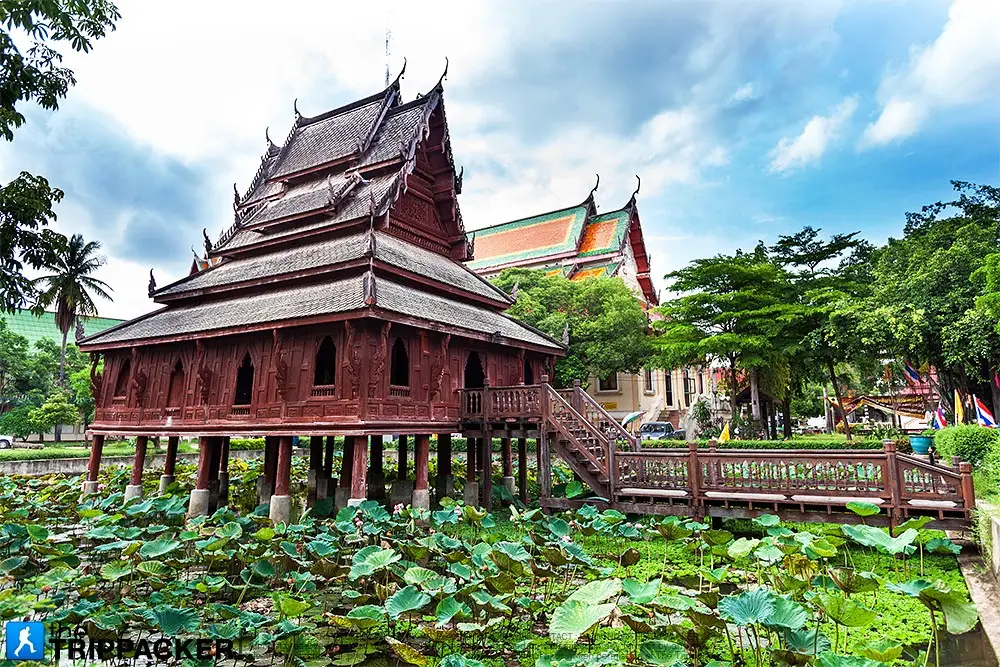
The most famous structure at Wat Thung Si Mueang is the Ho Trai, or Buddhist scripture hall, built over water. This wooden hall stands in the middle of a pond and was designed to store palm-leaf manuscripts, Buddhist scriptures, folded books and important religious texts. Building the scripture hall over water was a clever method of preservation. The surrounding pond helped protect the manuscripts from termites, ants and other insects that could destroy them. In a hot and humid climate, this was a practical and intelligent solution. The hall therefore represents both architectural beauty and the protection of Buddhist knowledge.
The Ho Trai of Wat Thung Si Mueang is widely admired as one of the most beautiful scripture halls in Thailand. It is a raised wooden building with a traditional Thai plan, standing on stilts above the water. A wooden bridge leads from the temple courtyard to the hall. Its design blends Thai, Lao and Burmese-influenced elements. The structure has the character of a Thai wooden house, while the layered roof and certain decorative details reflect artistic influences that moved through Lan Xang and neighboring cultural regions. The gables and carved panels show Lao-style motifs, including plant forms and zodiac animals. This combination gives the building a rare visual identity.
The beauty of the Ho Trai lies not only in its carving or roofline, but also in its relationship with water. The wooden hall, the pond, the reflections, the bridge and the surrounding temple atmosphere create one of the most memorable views in Ubon Ratchathani. Many travelers come to the temple specifically to photograph this building, but its deeper meaning is equally important. The hall is a symbol of the protection of the Buddha’s teachings. It shows how communities in the past valued Buddhist manuscripts and designed architecture to preserve them for future generations.
Inside the Ho Trai, religious manuscript cabinets were traditionally kept. These cabinets were decorated with lacquer and gilding, reflecting the high value placed on Buddhist scriptures. In earlier times, scripture was not only a religious object for monks. It preserved language, ethics, local knowledge, Buddhist philosophy, ritual practice and community memory. A beautifully built scripture hall in the middle of a pond therefore expresses the belief that knowledge itself deserves protection. This is one of the reasons Wat Thung Si Mueang remains culturally powerful even for visitors who are not Buddhist.
Another important sacred image within the temple is Phra Chao Yai Si Mueang, the principal Buddha image in Wihan Si Mueang. This revered image is connected to the faith of the local community and the history of the city. It was once enshrined at Wat Nuea Tha before being brought to Wat Thung Si Mueang during the time of Phra Khru Wiroj Rattanobon. The image was later restored and gilded, becoming an important object of devotion. For many local worshippers, a visit to Wat Thung Si Mueang is not complete without paying respect to Phra Chao Yai Si Mueang.
Wat Thung Si Mueang has long played several roles at once. It has been a meditation place, a temple of worship, a centre of Buddhist learning, a storage place for sacred manuscripts and a part of the old urban landscape of Ubon Ratchathani. Its name is inseparable from Thung Si Mueang, the public field and civic heart of the city. Walking between Thung Si Mueang and the temple allows visitors to see how religion, governance, community and public life developed side by side in Ubon Ratchathani. The temple is therefore an essential stop for anyone studying the cultural geography of the old city.
Over time, the temple’s important buildings have been repaired and conserved several times. During the period of Phra Khru Wiroj Rattanobon, many monastic structures were built or restored. Later repairs were made to the Buddha Footprint Hall, including work on the roof ornaments, walls, floor and stairs. The Ho Trai was also repaired, including work to protect the wooden structure. The Fine Arts Department later carried out conservation work on the scripture hall. These layers of restoration show that Wat Thung Si Mueang is both an active temple and a heritage site that requires continuous care.
A good way to visit the temple is to begin at the Ho Trai in the pond. This gives visitors an immediate sense of the temple’s identity. From there, continue to the Buddha Footprint Hall and observe the architectural mixture of early Rattanakosin and Vientiane styles. Inside, take time to look at the murals without rushing. After that, pay respect to Phra Chao Yai Si Mueang in Wihan Si Mueang and walk quietly around the temple grounds. This route helps visitors understand the temple as a place of manuscripts, mural art, sacred footprint worship and living community faith.
The best times to visit are in the morning and late afternoon. Morning light gives the temple a quiet atmosphere and is good for photography. Late afternoon light is especially beautiful around the pond and the Ho Trai. The temple can be visited during the day, but Ubon Ratchathani can be hot, so travelers should dress appropriately and carry water. Visitors who want to see only the Ho Trai may spend 30 to 45 minutes, but anyone interested in the murals, Buddha Footprint Hall, Wihan Si Mueang and surrounding details should allow 1 to 2 hours.
During the Ubon Ratchathani Candle Festival season, Wat Thung Si Mueang becomes especially meaningful as part of a wider cultural route. The festival activities are centred around Thung Si Mueang and nearby old-town streets. Travelers can enjoy the candle floats, processions, performances and public celebrations, then visit Wat Thung Si Mueang to see the older religious and artistic foundation behind the city’s festival identity. The Candle Festival shows Ubon Ratchathani’s public craftsmanship in wax carving, while Wat Thung Si Mueang shows the quieter craftsmanship of wood carving, mural painting and manuscript preservation.
The temple is suitable for many types of travelers. History lovers will appreciate its connection with early Rattanakosin Buddhism and the growth of Ubon Ratchathani. Architecture enthusiasts will appreciate the water-based scripture hall and the mixed artistic forms. Photographers will find the Ho Trai one of the most distinctive views in the city. Families and students can use the temple as a learning site for Buddhist architecture, mural painting, manuscript preservation and local history. Foreign travelers interested in Isan culture will find that the temple explains the relationship between religion, art and urban identity in a very direct way.
Visitors should behave respectfully because Wat Thung Si Mueang is an active Buddhist temple and a historic site. Dress politely, remove shoes before entering religious buildings, avoid touching murals or historic objects, keep voices low and stay out of restricted areas. The Ho Trai is a popular photography spot, but visitors should remember that it is a heritage building, not a stage prop. Photography should not disturb monks, worshippers or temple activities. If visitors wish to photograph inside religious buildings, they should follow signs or ask temple staff first.
Admission to Wat Thung Si Mueang is free. The temple is open daily from 08.00 to 18.00. Since it remains an active temple, visitors should be mindful of Buddhist ceremonies, merit-making activities and monk routines. During major festivals or Buddhist holy days, the temple may be busier than usual. Groups should contact the temple in advance if they need special arrangements. Because the temple is in the city centre, access is convenient, but traffic around Thung Si Mueang can be heavy during the Candle Festival and major provincial events.
Getting There is easy because Wat Thung Si Mueang is located on Luang Road near Thung Si Mueang in central Ubon Ratchathani. Travelers can arrive by private car, taxi, local hired vehicle, songthaew or ride-hailing service. From Ubon Ratchathani International Airport, the temple is about 4 km away and usually takes around 10 to 15 minutes by car. From Ubon Ratchathani Railway Station in Warin Chamrap District, the distance is about 6 km and usually takes around 15 to 25 minutes depending on traffic. Once in the old city area, several nearby attractions can be combined in the same route.
A practical old-city route can begin at Ubon Ratchathani National Museum, continue to Wat Si Ubon Rattanaram, Thung Si Mueang, the Ubon Ratchathani City Pillar Shrine and Wat Thung Si Mueang, then end with local food around the city centre. Travelers with more time can continue to Wat Maha Wanaram, Wat Supattanaram Worawihan, Wat Phra That Nong Bua or Wat Nong Pah Pong. Wat Thung Si Mueang is therefore both a main attraction and a connecting point within the cultural route of Ubon Ratchathani.
For international visitors, Wat Thung Si Mueang is one of the clearest introductions to Isan Buddhist art. The temple includes a scripture hall built over water, a replica Buddha footprint linked with Wat Saket in Bangkok, buildings that combine Thai and Vientiane styles, old mural paintings and a revered Buddha image. The Ho Trai represents the protection of Buddhist knowledge. The pond reflects practical wisdom in protecting manuscripts from insects and moisture. The murals preserve Buddhist imagination and local visual culture. The temple should therefore be understood not only as a beautiful place, but as a cultural text written in wood, water, paint and faith.
Wat Thung Si Mueang is one of the most meaningful places in Ubon Ratchathani because it condenses the city’s religious, artistic and historical identity into one temple compound. Visitors can see the work of important monks, the replica Buddha footprint, murals from the reign of King Rama III, the famous water-based Ho Trai, Thai-Lao-Burmese artistic influences, Phra Chao Yai Si Mueang and the daily life of an active Buddhist temple. A visit here is not only a chance to take beautiful photographs. It is a chance to read the history of Ubon Ratchathani through sacred architecture, community faith and the craftsmanship of generations.
| Name | Wat Thung Si Mueang, Ubon Ratchathani |
| Location | Luang Road, Nai Mueang Subdistrict, Mueang Ubon Ratchathani District, Ubon Ratchathani Province, near Thung Si Mueang and the old city area |
| Address | 95 Luang Road, Nai Mueang, Mueang Ubon Ratchathani, Ubon Ratchathani 34000, Thailand |
| Coordinates | 15.230239, 104.860790 |
| Highlights | Water-Based Ho Trai, Buddha Footprint Hall, Replica Buddha Footprint From Wat Saket, King Rama III-Period Murals And Phra Chao Yai Si Mueang |
| History | Historic early Rattanakosin temple associated with Chao Khun Phra Ariyawongsachan Yanawimon Ubon Sangkhapamok (Sui). Official heritage information records the temple’s establishment around 1842 during the reign of King Rama III. |
| Name Origin | The name is connected with the Thung Si Mueang area, an important field and civic space in central Ubon Ratchathani where the temple developed from an early meditation retreat. |
| Distinctive Features | A historic temple combining early Rattanakosin, Vientiane, Lao-Lan Xang and Burmese-influenced artistic elements, especially in the Ho Trai and Buddha Footprint Hall |
| Travel Information | Accessible by private car, taxi, local hired vehicle, songthaew or ride-hailing service. The temple is about 4 km from Ubon Ratchathani International Airport and about 6 km from Ubon Ratchathani Railway Station. |
| Current Status | Open To Visitors And Still Used As An Active Buddhist Temple In Central Ubon Ratchathani |
| Open Days | Daily |
| Opening Hours | 08.00 – 18.00 |
| Fees | Free Admission |
| Facilities | Temple parking area, restrooms, worship areas, walkways around historic structures and photography spots around the water-based Ho Trai |
| Main Areas / Zones | Water-Based Ho Trai Buddha Footprint Hall / Old Ordination Hall Replica Buddha Footprint From Wat Saket King Rama III-Period Murals Wihan Si Mueang Phra Chao Yai Si Mueang Ho Trai Pond Nong Mak Saew Pond Assembly Hall And Merit-Making Areas |
| Caretaker | Wat Thung Si Mueang And Heritage Conservation Agencies Of The Fine Arts Department For Registered Historic Components |
| Main Contact Number | 045-244-761 |
| Nearby Tourist Attractions | 1. Thung Si Mueang, About 0.5 km 2. Ubon Ratchathani City Pillar Shrine, About 0.6 km 3. Wat Si Ubon Rattanaram, About 0.8 km 4. Ubon Ratchathani National Museum, About 0.9 km 5. Wat Maha Wanaram, About 1.4 km 6. Wat Supattanaram Worawihan, About 2 km |
| Nearby Restaurants | 1. Daily Dish Thung Si Mueang, About 0.6 km, Tel. 082-623-6942 2. PunThai Coffee Thung Si Mueang, About 0.7 km, Tel. 080-086-5527 3. Guay Jub Ubon, About 1 km, Tel. 087-074-0499 4. Jungle Cafe Thung Si Mueang Branch, About 1.1 km, Tel. 091-852-0095 5. View Mun, About 5 km, Tel. 094-538-3939 |
| Nearby Accommodations | 1. The Ratchathani Hotel, About 0.8 km, Tel. 045-244-388 2. Ubon Hotel, About 0.9 km, Tel. 045-241-045 3. YUU Hotel & Cafe, About 1.1 km, Tel. 085-614-1111 4. T3 House, About 1.4 km, Tel. 045-244-911 5. Laithong Hotel, About 1.5 km, Tel. 045-264-271-3 |
Frequently Asked Questions (FAQ)
Q: Where is Wat Thung Si Mueang located?
A: Wat Thung Si Mueang is located at 95 Luang Road, Nai Mueang Subdistrict, Mueang Ubon Ratchathani District, near Thung Si Mueang and the old city area of Ubon Ratchathani.
Q: What are the opening hours of Wat Thung Si Mueang?
A: The temple is open daily from 08.00 to 18.00.
Q: Is there an admission fee?
A: No. Admission to Wat Thung Si Mueang is free.
Q: What is Wat Thung Si Mueang famous for?
A: The temple is famous for its water-based Ho Trai, Buddha Footprint Hall, replica Buddha footprint from Wat Saket, King Rama III-period murals and Phra Chao Yai Si Mueang.
Q: Why is the Ho Trai at Wat Thung Si Mueang important?
A: The Ho Trai was built over water to preserve Buddhist scriptures and protect them from termites, ants and moisture. It is also one of the most beautiful examples of Thai-Lao-Burmese-influenced wooden religious architecture in northeastern Thailand.
Q: Who founded Wat Thung Si Mueang?
A: The temple is closely associated with Chao Khun Phra Ariyawongsachan Yanawimon Ubon Sangkhapamok, also known as Sui Lak Kham, an important ecclesiastical leader of Ubon Ratchathani.
Q: How long should visitors spend at Wat Thung Si Mueang?
A: Visitors should allow about 1 to 2 hours to see the Ho Trai, Buddha Footprint Hall, murals, Phra Chao Yai Si Mueang and the surrounding temple grounds.
Q: What nearby attractions can be visited after Wat Thung Si Mueang?
A: Nearby attractions include Thung Si Mueang, Ubon Ratchathani City Pillar Shrine, Wat Si Ubon Rattanaram, Ubon Ratchathani National Museum, Wat Maha Wanaram and Wat Supattanaram Worawihan.
 Category: ●Places of Worship
 Group: ●Temple
Last Update : 2 MonthAgo
 Last Update : 2 MonthAgo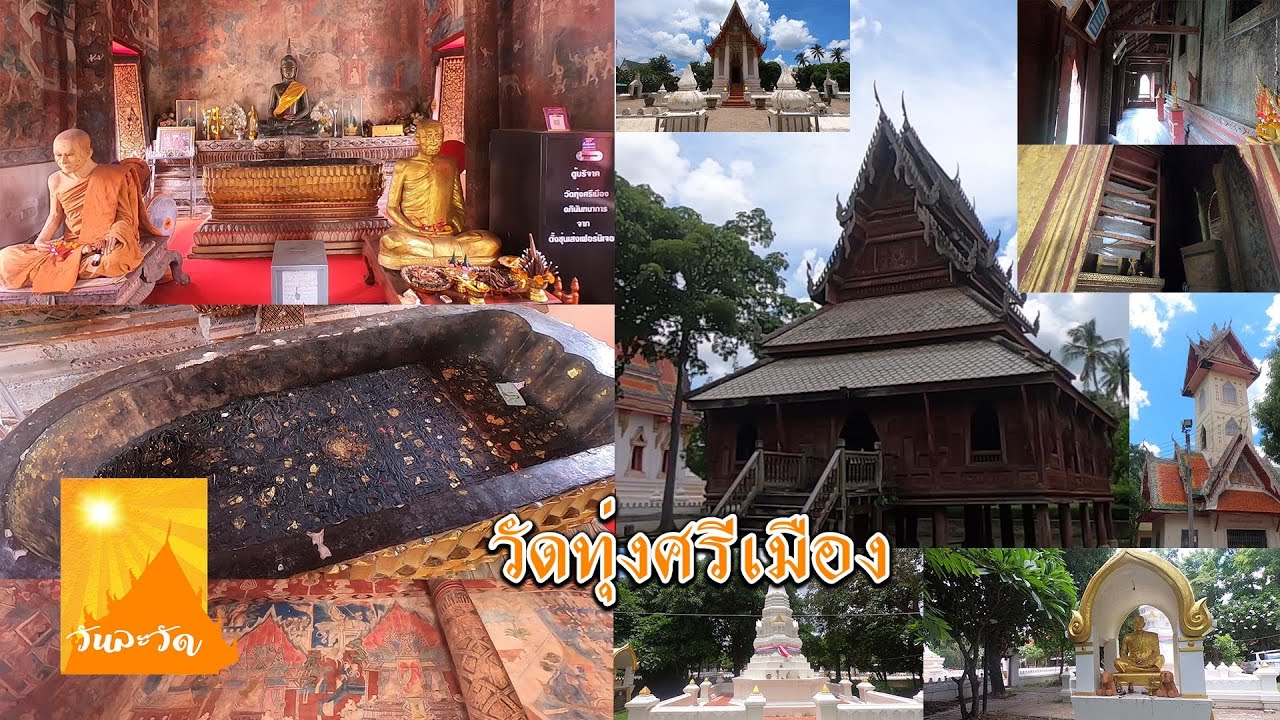
 Click to Access the Navigation Map GPS
Wat Thung Si Muang Map
Recommend

 Art, Culture and Heritage
 Historical Sites and Monuments(5)
 Landmarks and Memorials(2)
 Royal Palace(1)
 Art, Craft Centres, Tradition(7)
 Museums(3)
Temple(37)
Museums(3)
Temple(37)
 Other Sacred Sites(4)
 Research and Development
 Royal Project(2)
 Suburban Living
 Village, Community(2)
 Local Market(4)
 Nature and Wildlife
 National Parks and Marine Reserves(5)
 Mountain (Doi)(6)
 Dam, Reservoir, Lake(8)
 Waterfalls(12)
 Hot Springs(1)
 Caves(2)
 River, Canal(11)
 Bays and Beaches(8)
 Islands(2)
 Other natural attractions(6)
 Entertainment and Agricultural
 Zoos and Aquariums(1)
 Animal camps and shows(1)
 Farms, Parks and Ecotourism(1)


