
lovethailand home >Northeastern Travel Attractions >Ubon Ratchathani Travel Attractions >Muang Ubon Ratchathani >Nai Muang > Wat Nong Bua
TL;DR: Wat Nong Bua is located at Thamma Withi Road, Nai Mueang Subdistrict, Mueang Ubon Ratchathani District, Ubon Ratchathani Province, near Chayangkun Road and the, open Daily, hours 06.00 – 20.00.
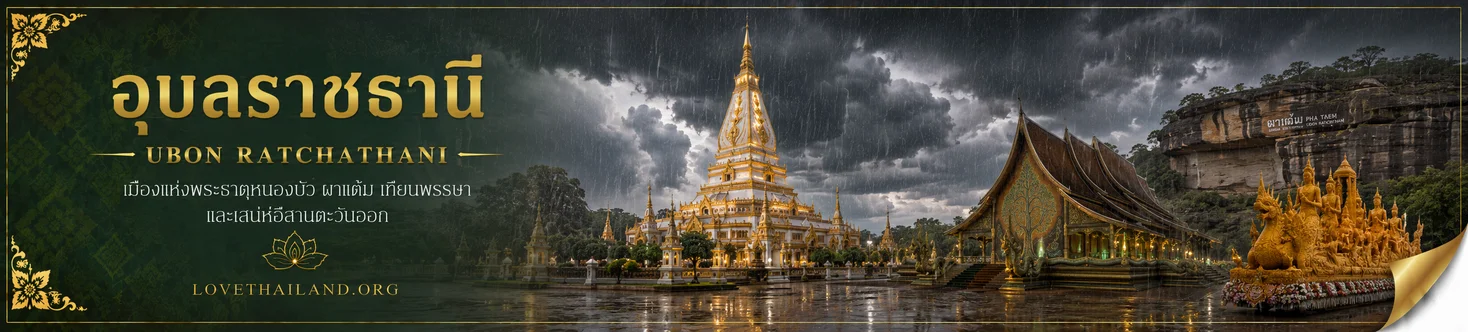
Wat Nong Bua
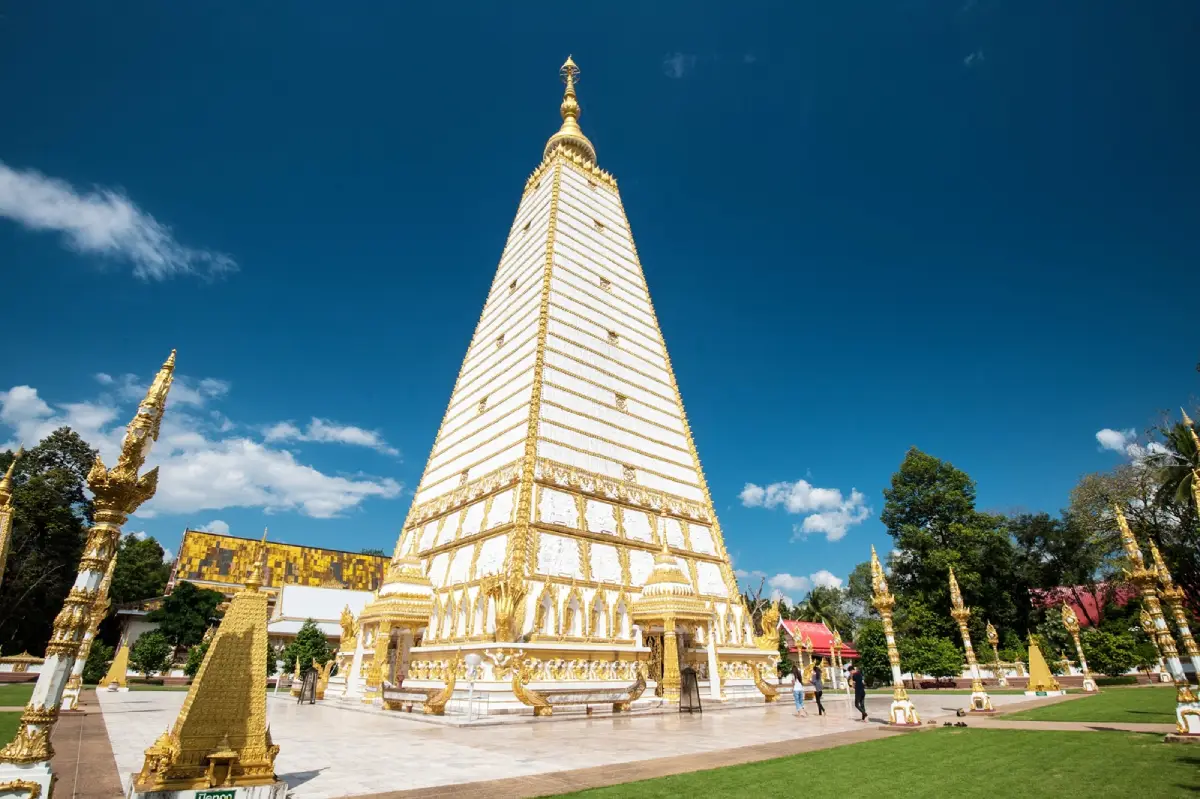
Open Days: Daily
Opening Hours: 06.00 – 20.00
Wat Phra That Nong Bua in Ubon Ratchathani is one of the most important Buddhist temples and cultural landmarks in the province. Located at 108 Thamma Withi Road in Nai Mueang Subdistrict, Mueang Ubon Ratchathani District, the temple is only a short distance from Chayangkun Road and the northern part of the city centre. Its most famous feature is the Phra That Chedi Si Maha Pho, a striking white-and-gold stupa inspired by the Mahabodhi Temple in Bodh Gaya, India, the place where the Buddha attained enlightenment. Built as a symbol of the 25th Buddhist Century in 1957, this chedi has become one of the clearest visual symbols of faith in Ubon Ratchathani and one of the most memorable temple sights in northeastern Thailand.
For foreign travelers, Wat Phra That Nong Bua is an excellent introduction to Buddhist art in Ubon Ratchathani because it is easy to understand visually and historically. Most Thai temples use bell-shaped stupas, Khmer-influenced prangs, or regional forms based on local traditions. Wat Phra That Nong Bua is different. Its main chedi follows the architectural idea of the Mahabodhi Temple in India, giving the temple a direct connection with the sacred geography of Buddhism. Visitors who know the story of Bodh Gaya immediately understand why the chedi looks different from other Thai temple structures. The temple therefore connects Ubon Ratchathani with the wider Buddhist world while still keeping a strong Isan identity through its setting, Naga sculptures, temple life, and local festivals.
The temple was established in 1955, and the Phra That Chedi Si Maha Pho was built in 1957 to commemorate 2,500 years of Buddhism. This was a highly meaningful period for Buddhist communities in Thailand. Building a major chedi in Ubon Ratchathani was not only an architectural project; it was a public expression of devotion and a statement that the city had an important role in preserving and honouring Buddhism. Over time, Wat Phra That Nong Bua became more than a local temple. It became a provincial spiritual landmark, a place where people come to pay respect, make merit, take photographs, join ceremonies, and understand the religious identity of Ubon Ratchathani.
The original chedi was much smaller, with a square base of about 5 metres on each side and a height of about 17 metres. Later, a larger chedi was built around the original structure, creating the grand monument that visitors see today. The present chedi has a square base measuring 17 metres on each side and rises to a height of 56 metres. Completed in 1969, it dominates the temple courtyard with its bright white surface, golden decorative lines, and tall tapering form. When sunlight touches the chedi, the combination of white and gold gives the structure a clean, luminous, and dignified appearance. The morning and late afternoon are especially beautiful times to see it.
The Phra That Chedi Si Maha Pho enshrines sacred relics of the Buddha, making it a deeply revered site for Buddhist devotees. Around the main chedi is a crystal-like enclosing wall, and at each of the four corners stands a smaller chedi. The main chedi has entrances on all four sides, allowing worshippers and visitors to approach it from different directions. This symmetrical layout gives the site a strong sense of order and sacred geometry. Walking around the chedi slowly allows visitors to appreciate the relationship between the main monument, the surrounding wall, the smaller corner chedis, the courtyard, and the devotional movement of people who come to pay respect.
The lower parts of the chedi and its decorative elements function almost like a visual Buddhist text. The reliefs and motifs refer to key moments in the life of the Buddha, including birth, enlightenment, first sermon, and passing into Parinirvana. These images are not only decorative. They help communicate Buddhist teachings through form, surface, and narrative. For travelers who do not read Thai, the images still provide a visual path into the story of Buddhism. The chedi therefore works as both a sacred monument and a teaching structure, allowing the temple to communicate faith through architecture.
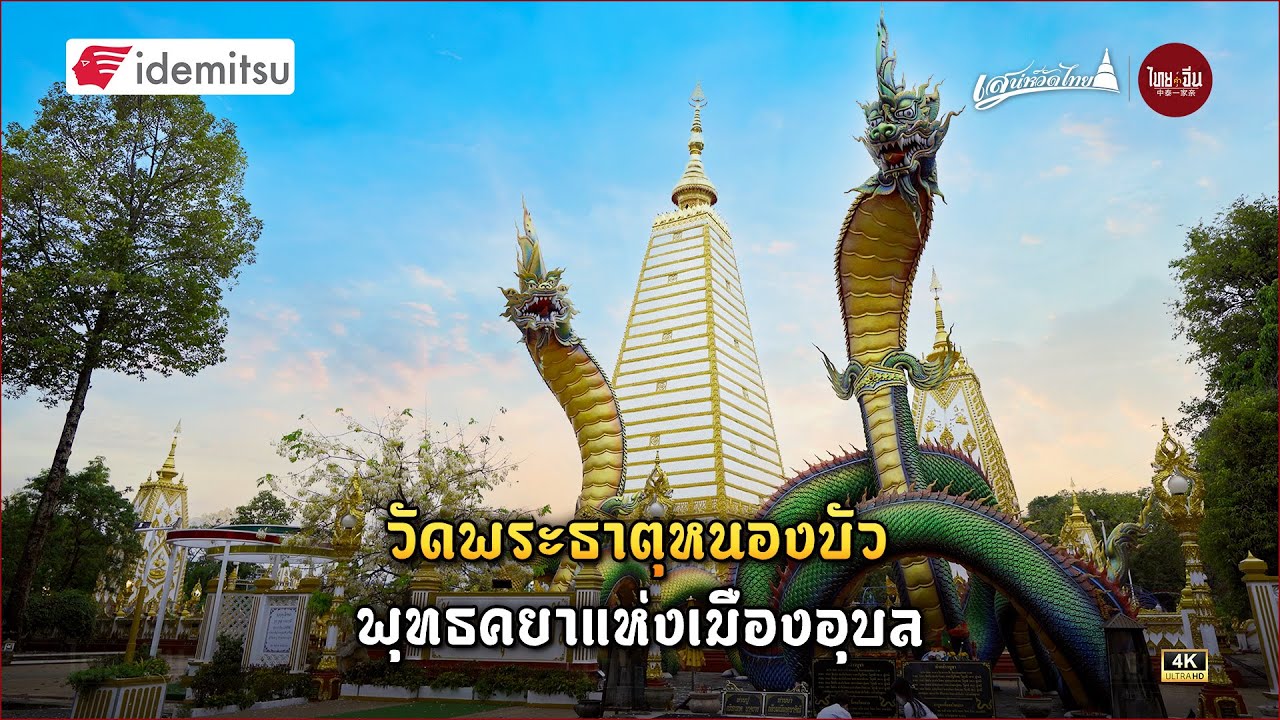
Another memorable feature of Wat Phra That Nong Bua is the Naga sculpture area in front of the chedi. The Naga is a powerful symbol in Isan and Mekong-region culture, associated with water, protection, fertility, spiritual energy, and Buddhist guardianship. The presence of the Naga beside the Mahabodhi-inspired chedi creates a meaningful combination: Indian Buddhist memory and northeastern Thai local belief meet in the same temple courtyard. This is one of the reasons the temple feels so distinctive. The Naga forms are also among the most popular photo spots in the temple, especially when framed with the white-and-gold chedi in the background.
Inside the temple grounds, visitors can pay respect at several Buddhist worship areas, walk around the chedi, observe the four entrances, view the smaller corner stupas, and see the temple buildings used for religious ceremonies. Behind the main chedi is the sermon and assembly area used for Buddhist rituals and community events. The temple also has monastic areas and quiet zones surrounded by greenery. Although the temple is located in the city, parts of the grounds still feel calm and shaded. This balance between accessibility and peacefulness makes Wat Phra That Nong Bua suitable for both short visits and more reflective travel.
Wat Phra That Nong Bua belongs to the Dhammayut tradition and continues to function as an active Buddhist temple. Phra Khru Amorn Thammasarot serves as the abbot and is closely involved with the temple’s religious and community activities. The temple is associated with annual ceremonies, merit-making events, and the cultural life of Ubon Ratchathani. During important Buddhist days and local festivals, the temple becomes a gathering place for monks, local residents, and visitors. This living role is important: Wat Phra That Nong Bua is not a monument separated from daily life, but a temple where devotion, community, and culture continue to operate.
The temple also has a strong connection with the Ubon Ratchathani Candle Festival, one of Thailand’s most important Buddhist cultural festivals. During the festival season, Ubon Ratchathani becomes a city of candle carving, processions, religious ceremonies, music, and local art. Wat Phra That Nong Bua is one of the temples associated with the city’s candle-making traditions and festival atmosphere. Travelers who visit during this period can see how temple life, Buddhist devotion, and public art come together in Ubon Ratchathani. Visiting the chedi during the Candle Festival adds another layer of meaning to the experience.
Architecturally, the chedi is especially valuable because it demonstrates how an international Buddhist model was adapted into a Thai-Isan context. The vertical stepped form, square base, white-and-gold colour scheme, surrounding wall, four corner chedis, and four entrances create a strong formal composition. At the same time, the temple courtyard, Naga sculptures, local worship practices, and festival connections give the site a distinctly Ubon Ratchathani character. Visitors should not view the chedi only as a photogenic building. It is a carefully organized religious space that moves the eye upward and invites reflection on enlightenment, devotion, and the presence of the Buddha’s relics.
For families and students, Wat Phra That Nong Bua is an accessible learning site. Children can learn about the Buddha’s life through reliefs and visual storytelling. Adults can explain the meaning of sacred relics, the importance of Bodh Gaya, and the reason the temple’s stupa looks different from other Thai temple structures. The site is also useful for understanding how Thai Buddhist communities use architecture to connect local devotion with the broader history of Buddhism. A visit can take as little as 45 minutes, but travelers who enjoy photography, architecture, and religious history should allow at least 1 to 1.5 hours.
The best times to visit are early morning and late afternoon. Morning offers a quiet atmosphere suitable for worship and reflection. Late afternoon gives the chedi a warm golden glow and is ideal for photography. The temple may also be beautiful after sunset when lighting gives the white-and-gold structure a luminous appearance. Visitors should photograph respectfully, especially around worshippers and religious ceremonies. The temple is an active sacred place, so the best approach is to move calmly, speak softly, and treat the space as a place of devotion rather than only as a photo location.
Admission to Wat Phra That Nong Bua is free. The temple is open daily from 06.00 to 20.00. Visitors should dress modestly, covering shoulders and knees, and remove shoes before entering religious buildings or sacred interior spaces. It is also important not to touch Buddha images, relic areas, or decorative elements unless permission is clearly given. During major Buddhist holidays, annual temple events, or the Candle Festival season, the temple can become busy, so visitors should allow extra time for parking and movement around the courtyard.
Getting There is simple from central Ubon Ratchathani. From the city centre, take Chayangkun Road northward in the direction of Amnat Charoen, then turn into Thamma Withi Road for about 500 metres. The temple is about 3 km from the city centre and can be reached by private car, taxi, local hired vehicle, songthaew, or ride-hailing service. From Ubon Ratchathani International Airport, the journey usually takes around 10 to 15 minutes depending on traffic. Because the temple is well known locally, drivers can easily recognize the destination as Wat Phra That Nong Bua or Wat Nong Bua.
Wat Phra That Nong Bua can be combined with several nearby attractions. Travelers can visit Nong Bua Public Park, Huai Muang Park, Ban Kan Lueang Archaeological Open Museum, Wat Sa Prasan Suk, Ubon Ratchathani Zoo, Thung Si Mueang, and Ubon Ratchathani National Museum. Those interested in temples can build a route around Wat Phra That Nong Bua, Wat Sa Prasan Suk, Wat Thung Si Mueang, Wat Si Ubon Rattanaram, and Wat Maha Wanaram. Those traveling with families can combine the temple with parks, shopping areas, and the zoo. This flexibility makes the temple an excellent anchor point for sightseeing in the city.
For international travelers, Wat Phra That Nong Bua is one of the most meaningful sites in Ubon Ratchathani because it presents Buddhism through a form that is both visually impressive and historically connected. The chedi links the city to Bodh Gaya, the Naga sculptures link the temple to Isan and Mekong cultural beliefs, and the active temple life links the monument to present-day Buddhist practice. A visit here is not only about seeing a beautiful white-and-gold stupa. It is about understanding how Ubon Ratchathani expresses faith through architecture, ritual, community, and memory.
In the broader identity of Ubon Ratchathani, Wat Phra That Nong Bua stands as a temple of devotion, craftsmanship, and cultural continuity. It enshrines sacred relics, honours the 25th Buddhist Century, preserves a Mahabodhi-inspired form rarely seen in northeastern Thailand, and remains an active place where people make merit and join religious ceremonies. Its location is easy to reach, its architecture is unforgettable, and its meaning is deep enough to reward slow observation. For anyone seeking the spiritual heart of Ubon Ratchathani, Wat Phra That Nong Bua is an essential place to visit.
| Name | Wat Phra That Nong Bua, Ubon Ratchathani |
| Location | Thamma Withi Road, Nai Mueang Subdistrict, Mueang Ubon Ratchathani District, Ubon Ratchathani Province, near Chayangkun Road and the northern part of the city centre |
| Address | 108 Thamma Withi Road, Nai Mueang, Mueang Ubon Ratchathani, Ubon Ratchathani 34000, Thailand |
| Coordinates | 15.263440, 104.839660 |
| Highlights | Phra That Chedi Si Maha Pho, a white-and-gold Mahabodhi-inspired chedi enshrining sacred relics of the Buddha and serving as one of the main spiritual landmarks of Ubon Ratchathani |
| History | The temple was established in 1955. The Phra That Chedi Si Maha Pho was built in 1957 to commemorate the 25th Buddhist Century. A larger chedi was later built around the original structure and completed in 1969. |
| Name Origin | The name Nong Bua refers to the old local area associated with lotus ponds, while Si Maha Pho connects the chedi with the sacred Bodhi tree and Bodh Gaya, where the Buddha attained enlightenment. |
| Distinctive Features | A square-based chedi measuring 17 metres on each side and 56 metres high, with four entrances, a surrounding wall, and four smaller chedis at the corners |
| Travel Information | From central Ubon Ratchathani, take Chayangkun Road toward Amnat Charoen and turn into Thamma Withi Road for about 500 metres. The temple is about 3 km from the city centre and is accessible by private car, taxi, songthaew, local hired vehicle, or ride-hailing service. |
| Current Status | Open To Visitors And Still Used As An Active Buddhist Temple In Ubon Ratchathani City |
| Open Days | Daily |
| Opening Hours | 06.00 – 20.00 |
| Fees | Free Admission |
| Facilities | Parking area, worship spaces, walkways around the chedi, photography areas, sermon hall, restrooms, and shaded areas within the temple grounds |
| Main Areas / Zones | Phra That Chedi Si Maha Pho Sacred Relic Worship Area Wall Around The Main Chedi Four Smaller Corner Chedis Four Entrances To The Main Chedi Naga Courtyard And Main Worship Plaza Sermon Hall Monastic And Meditation Areas Candle Festival Display Or Storage Area During Cultural Events |
| Caretaker | Wat Phra That Nong Bua, The Dhammayut Monastic Community, And Local Buddhist Supporters In Ubon Ratchathani |
| Abbot | Phra Khru Amorn Thammasarot |
| Main Contact Number | 083-125-8295 |
| Additional Tourist Information | Tourism Authority Of Thailand, Ubon Ratchathani Office: 045-243-770, 045-250-714 |
| Nearby Tourist Attractions | 1. Nong Bua Public Park, About 0.3 km 2. Huai Muang Park, About 1.8 km 3. Golden Jubilee Art And Cultural Centre, Ubon Ratchathani Rajabhat University, About 2 km 4. Ban Kan Lueang Archaeological Open Museum, About 2.4 km 5. Central Ubon, About 3.1 km 6. Wat Sa Prasan Suk / Wat Ban Na Muang, About 4 km 7. Ubon Ratchathani Zoo, About 4.5 km 8. Thung Si Mueang, About 4.8 km |
| Nearby Restaurants | 1. Ricco Caf, About 1 km, Tel. 086-868-7888 2. MK Restaurants Sunee Tower, About 1.3 km, Tel. 083-099-6348 3. The Bliss Restaurant, About 1.5 km, Tel. 045-281-919 4. Ninety Nine Bar & Restaurant Ubon Square, About 1.5 km, Tel. 089-649-6555, 086-650-9116 5. Matsu Sushi Ubon Ratchathani, About 2 km, Tel. 097-925-5544 6. Oishi Kitchen Central Ubon, About 3.1 km, Tel. 095-207-4736 |
| Nearby Accommodations | 1. My Home Hostel, About 0.7 km, Tel. 062-191-1757 2. Fun Dee Mansion, About 1 km, Tel. 081-988-5680 3. Sunee Grand Hotel & Convention Center, About 1.3 km, Tel. 045-352-900 4. The Bliss Ubon, About 1.5 km, Tel. 083-547-1919, 045-281-919, 094-307-0707 5. De Lit Ubon, About 2 km, Tel. 098-279-9476 6. The Regent Hotel Ubonratchathani, About 2.5 km, Tel. 086-478-8376 |
Frequently Asked Questions (FAQ)
Q: Where is Wat Phra That Nong Bua located?
A: Wat Phra That Nong Bua is located at 108 Thamma Withi Road, Nai Mueang Subdistrict, Mueang Ubon Ratchathani District, Ubon Ratchathani Province, about 3 km from the city centre.
Q: What are the opening hours of Wat Phra That Nong Bua?
A: The temple is open daily from 06.00 to 20.00.
Q: Is there an admission fee?
A: No. Admission to Wat Phra That Nong Bua is free.
Q: What is Wat Phra That Nong Bua famous for?
A: The temple is famous for Phra That Chedi Si Maha Pho, a 56-metre white-and-gold chedi inspired by the Mahabodhi Temple in Bodh Gaya, India, and enshrining sacred relics of the Buddha.
Q: When was Phra That Chedi Si Maha Pho built?
A: The chedi was built in 1957 to commemorate the 25th Buddhist Century. The larger present structure was later built around the original chedi and completed in 1969.
Q: Who is the abbot of Wat Phra That Nong Bua?
A: The abbot of Wat Phra That Nong Bua is Phra Khru Amorn Thammasarot.
Q: How do travelers get to Wat Phra That Nong Bua?
A: From central Ubon Ratchathani, take Chayangkun Road toward Amnat Charoen, then turn into Thamma Withi Road for about 500 metres. The temple can be reached by private car, taxi, songthaew, local hired vehicle, or ride-hailing service.
Q: What nearby attractions can be visited after Wat Phra That Nong Bua?
A: Nearby attractions include Nong Bua Public Park, Huai Muang Park, Ban Kan Lueang Archaeological Open Museum, Wat Sa Prasan Suk, Ubon Ratchathani Zoo, Thung Si Mueang, and Ubon Ratchathani National Museum.
 Category: ●Places of Worship
 Group: ●Temple
Last Update : 3 MonthAgo
 Last Update : 3 MonthAgo
 Click to Access the Navigation Map GPS
Wat Nong Bua Map
Recommend

 Art, Culture and Heritage
 Historical Sites and Monuments(5)
 Landmarks and Memorials(2)
 Royal Palace(1)
 Art, Craft Centres, Tradition(7)
 Museums(3)
Temple(37)
 Other Sacred Sites(4)
 Research and Development
 Royal Project(2)
 Suburban Living
 Village, Community(2)
 Local Market(4)
 Nature and Wildlife
 National Parks and Marine Reserves(5)
 Mountain (Doi)(6)
 Dam, Reservoir, Lake(8)
 Waterfalls(12)
 Hot Springs(1)
 Caves(2)
 River, Canal(11)
 Bays and Beaches(8)
 Islands(2)
 Other natural attractions(6)
 Entertainment and Agricultural
 Zoos and Aquariums(2)
 Animal camps and shows(1)
 Farms, Parks and Ecotourism(1)
 Waterpark(1)
 Travel Articles, Recipes
 Travel Review, Food Review(1)


