
lovethailand home >South Travel Attractions >Nakhon Si Thammarat Travel Attractions >Mueang NaKhon Si Thammarat >Nai Muang > Nakhon Si Thammarat City Wall
TL;DR: Nakhon Si Thammarat City Wall, Nakhon Si Thammarat attractions : Art, Culture and Heritage, Landmarks and Memorials.

Nakhon Si Thammarat City Wall
Open Days: Daily
Opening Hours: Open 24 Hours; Recommended Visiting Time Is 06.00 – 18.30 For Walking And Photography
Nakhon Si Thammarat City Wall is one of the most important historical landmarks in the old city of Nakhon Si Thammarat. It stands along Ratchadamnoen Road near Na Mueang Field, Khlong Na Mueang, and Nakhon Noi Bridge. The visible wall today preserves the memory of an old fortified city that once had a moat, gates, defensive walls, ramparts, and forts. The present structure is associated with major work during the reign of King Narai the Great in the Ayutthaya period and later restorations in the early Rattanakosin period and modern conservation works. It is an essential starting point for understanding the historic core of Nakhon Si Thammarat.
Nakhon Si Thammarat City Wall, also known as the Old City Wall of Nakhon Si Thammarat, is a major ancient monument in the heart of Nakhon Si Thammarat city. It is located along Ratchadamnoen Road in Nai Mueang Subdistrict, Mueang Nakhon Si Thammarat District, close to Na Mueang Field, Nakhon Noi Bridge, and the old northern moat of the city. For visitors, this is one of the easiest historical sites to reach because it is not outside the city. It stands directly within the urban landscape, allowing travelers to see how the old city and modern city continue to exist together.
The city wall is important because it helps explain Nakhon Si Thammarat as a fortified historic city. The province is widely known for Wat Phra Mahathat Woramahawihan and its deep Buddhist heritage, but the city wall shows another essential layer of its identity. It was also a strategic administrative and defensive center of southern Thailand. The wall, moat, gates, and forts reveal that this was not an ordinary settlement, but a well-organized city with clear boundaries, controlled access, and defensive planning.
The location of the wall is closely connected with the geography of the old city. Nakhon Si Thammarat developed on a long sand ridge running roughly north to south, bordered by lower wetland areas. Because of this geography, the old city had a long and narrow rectangular plan. The wall and moat followed that urban form. When visitors stand at the northern wall near Na Mueang Field, they can still understand the relationship between the wall, the moat, the road, and the civic open space outside the city boundary.
According to the Fine Arts Department, the present city wall was built during the reign of King Narai the Great of Ayutthaya, around 1686. The king ordered Monsieur de La Mare, a French engineer, to prepare plans for the forts and city wall. This major work reflects the influence of Western-style military engineering that entered Siam during the late Ayutthaya period. The wall of Nakhon Si Thammarat is therefore valuable not only as a local monument, but also as evidence of the wider history of military architecture in Thailand.
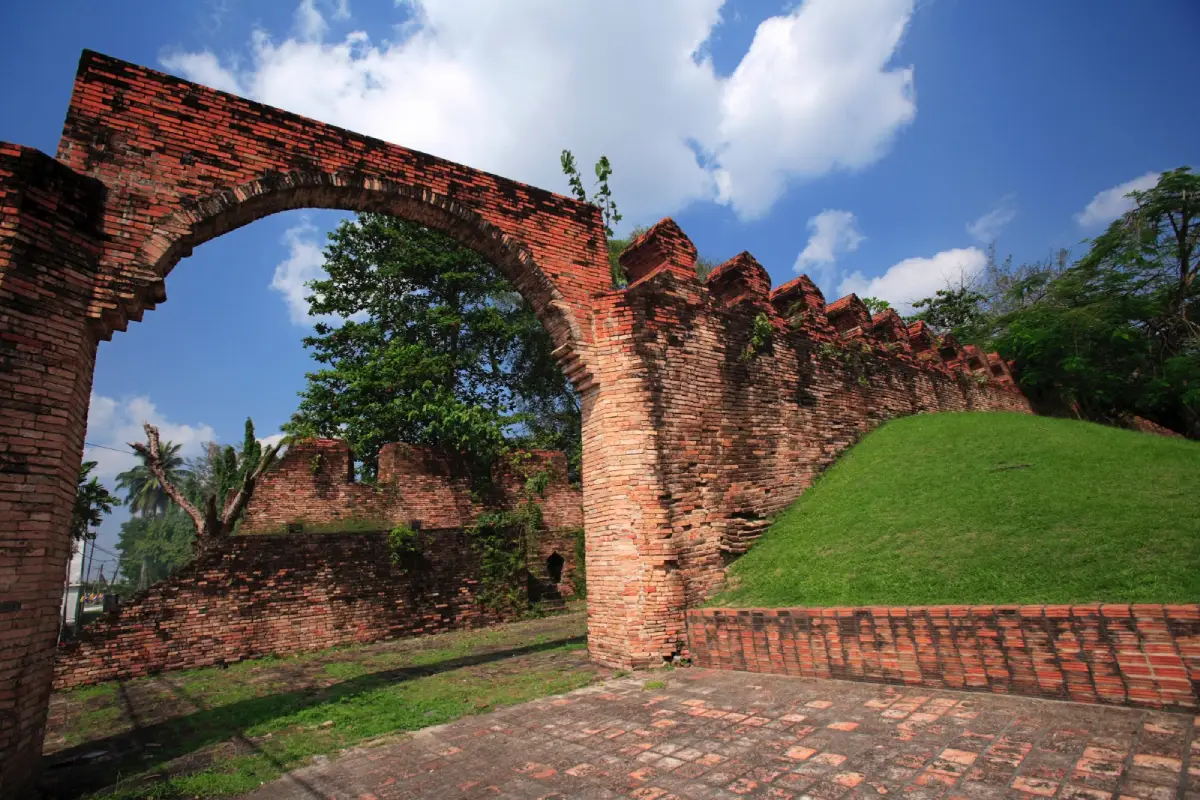
Although earlier defensive works may have existed before the Narai-period reconstruction, the wall visible today is strongly linked with that major improvement. The wall is made of brick and lime mortar and stands on an earthen rampart. The top of the wall has merlon-like forms, and there is a fort near the city gate close to Nakhon Noi Bridge. These elements show that the city wall was part of a complete defensive system, not just a simple boundary line. It included a wall, moat, gate, fort, rampart, and open approach area.
The old city had a rectangular plan. Its east–west width was about 500 meters, while its north–south length was about 2,239 meters. The front of the city was on the northern side. This long and narrow plan matched the natural form of the sand ridge. Because of the surrounding geography, the eastern and western parts of the wall were later altered and became roads during the development of the modern city. The best-preserved visible section today is the northern wall, especially the eastern side, which is about 100 meters long.
The Fine Arts Department officially registered Nakhon Si Thammarat City Wall as an ancient monument on 27 September 1936. This registration confirmed the wall as a national cultural heritage site. Later, the Fine Arts Department carried out excavation, clearing, and restoration work in several phases, including 1989–1992, 2004–2005, and 2009–2011. These works helped preserve the surviving remains and made the site more suitable for public learning.
Local tourism information also records major modern restoration work. In 1990, the wall was restored along the moat from the northern Chai Gate, or Pratu Chai Sak, toward the east for about 100 meters. In 2005, additional restoration created a parallel section along the western side of the moat for about 150 meters. These restored sections help visitors read the old city layout and understand how conservation work has preserved the form of the historic wall for modern public use.
The city wall is closely connected with Na Mueang Field, which lies outside the old northern wall. This field has long been an important civic space for ceremonies, official events, traditional festivals, and public gatherings. Around this area are several key historic sites, including the City Pillar Shrine, Ho Phra Sung, Sala Pradu Hok, Nakhon Noi Bridge, and the old moat. Together, these places form one of the most important historical walking areas in the city.
Standing near the wall, visitors can see several layers of the old city at once. The brick wall represents defense and authority. Khlong Na Mueang represents the moat and water boundary. Na Mueang Field represents civic activity outside the city wall. Ratchadamnoen Road represents the modern road axis that continues to connect important sites. This combination makes the wall more than a single monument. It is part of a living urban landscape where history remains visible.
The most striking visual features are the red brick surface, the rampart, the merlon forms, and the alignment beside the moat. The beauty of the wall is not ornamental in a palace sense. It comes from its age, mass, material, and relationship with the city landscape. The weathered brick, grassy embankment, moat, and nearby field create a strong sense of historical depth. It is one of the most photogenic points in old Nakhon Si Thammarat.
Visitors should walk slowly along the wall instead of treating it only as a quick photo stop. A good route begins near Nakhon Noi Bridge, where the relationship between wall and moat can be seen clearly. From there, visitors can continue along the northern section, observing the brickwork, the height of the embankment, the shape of the battlements, and the position of the old gate area. This approach helps visitors understand the wall as part of a defensive and urban system.
Historically, the wall reflects the strategic importance of Nakhon Si Thammarat. The city was a major center of religion, administration, trade, and regional power in the south. A fortified city required clear boundaries and protective structures. The wall and moat show that Nakhon Si Thammarat had a high urban status and played an important role in regional history. It was not just a religious city, but also a political and defensive center.
The wall also links different historical periods. It is associated with the Ayutthaya period, particularly the reign of King Narai, and with later repairs in the early Rattanakosin period. Modern restoration has further preserved the structure for present-day visitors. This continuity shows that later generations recognized the importance of the city wall and worked to maintain the old urban identity of Nakhon Si Thammarat.
For travelers interested in architecture, the wall is worth careful observation. Its brick-and-mortar construction, earthen rampart, merlon-like top, gate area, and fort position all reveal practical defensive design. The wall was not built for decoration alone. It was part of a military and administrative system. By reading its material and form, visitors can understand how the city protected itself and controlled movement in earlier periods.
For general travelers, the city wall is a practical starting point for exploring old Nakhon Si Thammarat. Nearby places include Na Mueang Field, the City Pillar Shrine, Ho Phra Sung, Sala Pradu Hok, Ho Phra Isuan, Ho Phra Narai, and Wat Phra Mahathat Woramahawihan. A walking or short driving route from the wall allows visitors to understand the old city in sequence, moving from the defensive northern boundary into the religious and civic heart of the city.
The best times to visit are early morning and late afternoon. Soft light gives the brick wall, battlements, moat, and grassy embankment more depth. Midday visits are possible, but visitors should prepare for heat because the site is outdoors. At night, the wall remains accessible as a roadside landmark, but detailed historical observation and photography are better during daylight.
Photography at the city wall is especially rewarding when the wall, moat, and Na Mueang Field appear together in one frame. The angle facing the red brick wall over the green embankment is one of the strongest visual images of the old city. Wide shots are useful for showing the urban landscape, while close-up images reveal the age and texture of the brickwork. Respectful photography is encouraged, but visitors should not climb on the wall or damage the monument.
Visitors should treat the site as protected heritage. They should not climb, scratch, write on, remove bricks, or leave waste around the wall. Because the monument stands beside active roads and public spaces, visitors should also be careful with traffic and park only in permitted areas. Conservation of a city-center monument depends on both official care and responsible public use.
Getting There is simple from central Nakhon Si Thammarat. From Tha Wang intersection, travel toward Na Mueang Field. Pass Nakhon Si Thammarat City Municipality and the provincial police station, then continue past Na Mueang Field and Nakhon Noi Bridge. The wall can be seen extending along both sides of the moat. The site is close enough to the City Pillar Shrine and Na Mueang Field for visitors to walk between them easily.
Travelers arriving by train can continue from Nakhon Si Thammarat Railway Station by local transport, taxi, or songthaew into the old city area. Travelers arriving by air can take a taxi or rental car from Nakhon Si Thammarat Airport into the city center. Because the wall is located on Ratchadamnoen Road, it is easy to combine with other attractions in the old town on the same day.
A strong half-day itinerary can begin at the city wall, continue to Na Mueang Field and the City Pillar Shrine, then proceed to Ho Phra Sung, Sala Pradu Hok, Ho Phra Isuan, Ho Phra Narai, and Wat Phra Mahathat Woramahawihan. This route helps visitors understand the city’s defensive, civic, Brahmanical, and Buddhist layers in one continuous journey.
There is no admission fee for Nakhon Si Thammarat City Wall. It is an open-air ancient monument along a public road and moat. Visitors can walk, take photographs, and learn from the site without paying an entrance charge. If visitors continue to museums or other indoor attractions nearby, they should check the separate opening hours and admission conditions of those places.
The site is suitable for Thai and foreign visitors. Thai travelers can appreciate it as a symbol of the city’s long history, while international visitors can understand the structure as part of Southeast Asian urban defense and city planning. The wall is easy to access, visually clear, and closely connected to other major landmarks, making it one of the best entry points into the historical identity of Nakhon Si Thammarat.
Another charm of the city wall is that it remains part of everyday life. It is not isolated inside a closed archaeological park. It stands beside roads, public spaces, shops, hotels, government buildings, and local movement. This makes the monument feel alive. Visitors can see how old heritage continues to exist within a functioning modern city.
In conclusion, Nakhon Si Thammarat City Wall is a compact but highly meaningful historical landmark. It preserves evidence of the city’s defensive system, moat, gate, rampart, and old urban planning. It connects Ayutthaya-period military architecture with early Rattanakosin repair and modern conservation. A visit may not require much time, but it gives visitors a deep understanding of why Nakhon Si Thammarat has long been one of southern Thailand’s most important historic cities.
| Name | Nakhon Si Thammarat City Wall / Old City Wall Of Nakhon Si Thammarat |
| Location | Along Ratchadamnoen Road, near Na Mueang Field, Khlong Na Mueang, and Nakhon Noi Bridge, Nai Mueang Subdistrict, Mueang Nakhon Si Thammarat District |
| Address | Ratchadamnoen Road, Nai Mueang Subdistrict, Mueang Nakhon Si Thammarat District, Nakhon Si Thammarat 80000, Thailand |
| Highlights | Historic red-brick city wall beside the old northern moat, with a fort, gate area, battlements, earthen rampart, and views toward Na Mueang Field and Khlong Na Mueang |
| History | The present wall is associated with construction and major improvement during the reign of King Narai the Great around 1686, later repairs in the early Rattanakosin period, and several modern conservation phases |
| Registration | Registered by the Fine Arts Department as an ancient monument on 27 September 1936 |
| Major Restorations | Restoration in 1990 created a section parallel to the moat from the northern Chai Gate toward the east for about 100 meters; additional restoration in 2005 created a western parallel section about 150 meters long; further excavation, clearing, and restoration were conducted by the Fine Arts Department in several periods |
| Distinctive Features | Brick-and-lime wall standing on an earthen rampart, with merlon-like forms on top, a fort near the gate area, and alignment along the northern moat |
| Key Evidence | Northern city wall section, Pratu Chai Nuea or Pratu Chai Sak, Khlong Na Mueang, earthen rampart, battlements, and the rectangular plan of the old city |
| Name Origin | Named after its original function as the defensive wall of Nakhon Si Thammarat; it is also called the Old City Wall because it is a surviving part of the historic fortified city |
| Travel Information | From Tha Wang intersection, travel toward Na Mueang Field, pass the municipality office and provincial police station, continue past Na Mueang Field and Nakhon Noi Bridge, and the city wall will be visible along the moat |
| Current Status | Open as an outdoor ancient monument and historical attraction in central Nakhon Si Thammarat |
| Open Days | Daily |
| Opening Hours | Open 24 hours; recommended visiting time is 06.00–18.30 for walking, photography, and reading the site details |
| Fees | No Admission Fee |
| Facilities | Roadside walking area, photo spots, nearby Na Mueang Field, walkway along the moat, and permitted parking areas around Na Mueang Field or nearby streets |
| Main Areas / Zones | Northern city wall section Pratu Chai Nuea or Pratu Chai Sak area Eastern restored section of about 100 meters Western restored section of about 150 meters Northern moat or Khlong Na Mueang Nakhon Noi Bridge Na Mueang Field and connected old-city area |
| Caretaker / Related Offices | The 12th Regional Office Of The Fine Arts Department, Nakhon Si Thammarat, and Nakhon Si Thammarat City Municipality |
| Main Contact Number | Nakhon Si Thammarat City Municipality, Tel. 075-809-571 |
| Nearby Tourist Attractions | 1. Na Mueang Field, about 100 meters 2. Nakhon Si Thammarat City Pillar Shrine, about 300 meters 3. Ho Phra Sung, about 400 meters 4. Sala Pradu Hok, about 500 meters 5. Ho Phra Isuan, about 1 km 6. Ho Phra Narai, about 1.2 km 7. Wat Phra Mahathat Woramahawihan, about 2.5 km 8. Nakhon Si Thammarat National Museum, about 3.5 km |
| Nearby Restaurants | 1. Kai Tod Na Rongrian Kluk Fun, Na Mueang Field, about 200 meters, Tel. 097-285-5401 2. Kopi Beside City Hall, about 600 meters, Tel. 089-431-9999 3. Khanom Chin Mueang Khon Sen Sot, about 2 km, Tel. 086-475-7641, 088-764-8430, 084-293-2456 4. Khanom Chin Sen Sot Mae Add, about 3 km, Tel. 075-345-327 5. Tang Kia Tae Tiam, about 3.5 km, Tel. 075-432-119 6. Krua Nai Nang, about 6 km, Tel. 081-728-5088, 075-346-006 |
| Nearby Accommodations | 1. Thai Hotel Nakhon Si Thammarat, about 1 km, Tel. 075-341-509 2. Muang Thong Hotel Tha Wang, about 1.2 km, Tel. 075-343-026, 075-314-326 3. Grand Park Hotel Nakhon Si Thammarat, about 2 km, Tel. 075-317-666-73 4. Chawlada Hotel, about 2.5 km, Tel. 075-466-178-9, 095-256-3212 5. Navakitel Design Hotel, about 2.5 km, Tel. 080-393-9339 6. The Original Orange Hotel, about 4 km, Tel. 075-774-675 |
Frequently Asked Questions (FAQ)
Q: Where Is Nakhon Si Thammarat City Wall Located?
A: It is located along Ratchadamnoen Road near Na Mueang Field, Khlong Na Mueang, and Nakhon Noi Bridge in Nai Mueang Subdistrict, Mueang Nakhon Si Thammarat District.
Q: What Are The Opening Days And Hours Of Nakhon Si Thammarat City Wall?
A: It is open daily and can be accessed 24 hours, but the recommended visiting time is 06.00–18.30 for walking, photography, and historical observation.
Q: Is There An Admission Fee For Nakhon Si Thammarat City Wall?
A: There is no admission fee. Visitors can walk around and take photographs without paying an entrance charge.
Q: Why Is Nakhon Si Thammarat City Wall Important?
A: It preserves evidence of the old city’s defensive system, including the wall, moat, gate, fort, rampart, and urban plan, showing the historical importance of Nakhon Si Thammarat as a major southern city.
Q: When Was The Present City Wall Built?
A: The present wall is associated with construction and improvement during the reign of King Narai the Great around 1686, with later repairs in the early Rattanakosin period and modern restorations.
Q: What Should Visitors See Around The City Wall?
A: Visitors should see the northern wall, Pratu Chai Nuea or Pratu Chai Sak, Khlong Na Mueang, Nakhon Noi Bridge, and Na Mueang Field.
Q: How Can Travelers Get To Nakhon Si Thammarat City Wall?
A: From Tha Wang intersection, travel toward Na Mueang Field, pass the municipality office and provincial police station, continue past Na Mueang Field and Nakhon Noi Bridge, and the wall will be visible along the moat.
Q: What Nearby Places Can Be Visited After The City Wall?
A: Nearby places include Na Mueang Field, the City Pillar Shrine, Ho Phra Sung, Sala Pradu Hok, Ho Phra Isuan, Ho Phra Narai, Wat Phra Mahathat Woramahawihan, and Nakhon Si Thammarat National Museum.
 Category: ●Art, Culture and Heritage
 Group: ●Landmarks and Memorials
Last Update : 2 MonthAgo
 Last Update : 2 MonthAgo

 Click to Access the Navigation Map GPS
Nakhon Si Thammarat City Wall Map
Recommend

 Historical Sites and Monuments(9)
Landmarks and Memorials(9)
 Royal Palace(1)
 Art, Craft Centres, Tradition(12)
 Museums(5)
 Educational Places
 Educational Gardens, Farm(2)
 Places of Worship
 Temple(44)
 Mosque(2)
 Other Sacred Sites(17)
 Research and Development
 Royal Project(2)
 Suburban Living
 Village, Community(8)
 Local Market(1)
 Floating Market(1)
 Nature and Wildlife
 National Parks and Marine Reserves(6)
 Mountain (Doi)(11)
 Dam, Reservoir, Lake(10)
 Waterfalls(43)
 Hot Springs(1)
 Caves(13)
 River, Canal(3)
 Bays and Beaches(29)
 Islands(2)
 Other natural attractions(3)
 Entertainment and Agricultural
 Farms, Parks and Ecotourism(3)
 Outdoor and Adventure Activities(4)
 Travel Articles, Recipes
 Travel Review, Food Review(5)
 Southern Food Menu, Southern Food Recipes(18)


