
lovethailand home >North Travel Attractions >Sukhothai Travel Attractions >Muang Sukhothai >Muang Kao > Wat Si Chum
TL;DR: Wat Si Chum is located at Northern Zone of Sukhothai Historical Park, Mueang Kao Subdistrict, Mueang Sukhothai District, Sukhothai Province, open Daily, hours 06.30 – 19.30.
Wat Si Chum
Open Days: Daily
Opening Hours: 06.30 – 19.30
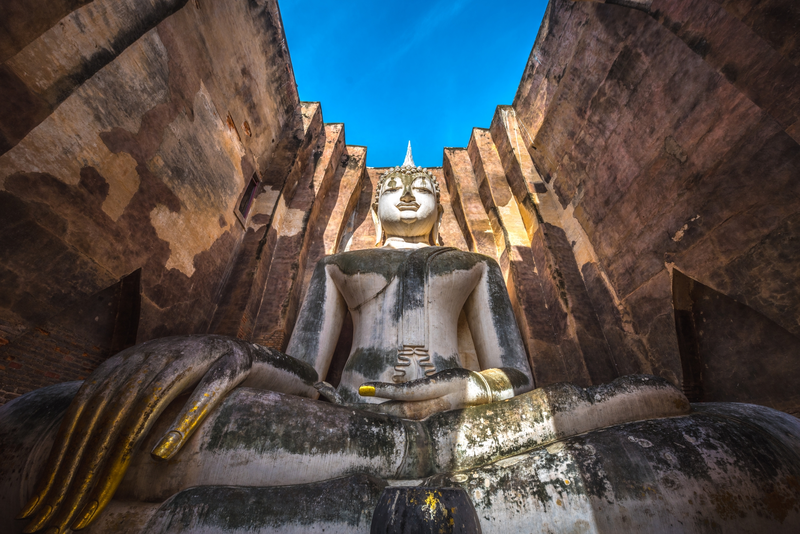
Wat Si Chum in Sukhothai Province is one of the most memorable ancient monuments in Sukhothai Historical Park. It is best known for the immense seated Buddha image known as Phra Achana, housed within a massive square mondop. The Buddha image measures approximately 11.30 meters across the lap and about 15 meters in height. For many travelers, the first sight of Phra Achana through the tall opening of the mondop is one of the most powerful visual experiences in Sukhothai. The image is calm, monumental, and deeply dignified, making Wat Si Chum far more than a popular photo stop. It is a place where Buddhist faith, Sukhothai art, architecture, history, and legend come together in a single unforgettable setting.
Wat Si Chum is located outside the old city wall on the northwestern side of ancient Sukhothai, in Mueang Kao Subdistrict, Mueang Sukhothai District, Sukhothai Province. The temple forms part of the broader historic landscape of Sukhothai Historical Park, which belongs to the Historic Town of Sukhothai and Associated Historic Towns, a UNESCO World Heritage property. This status reflects the importance of Sukhothai as a major early Thai capital and as a center where Thai art, Buddhism, language, urban planning, and political culture developed in a distinctive and influential way.
What makes Wat Si Chum especially different from many other ancient temples in Sukhothai is its architectural focus. Instead of placing a chedi at the center of the temple plan, Wat Si Chum is dominated by a large square mondop that enshrines Phra Achana. The thick walls, high vertical mass, and narrow frontal opening create a dramatic visual effect. As visitors approach the structure, the Buddha image gradually appears within the architectural frame, giving the impression of a sacred presence emerging from stillness and shadow.
Phra Achana is a stucco Buddha image built over a core of brick and laterite. It is seated in the maravijaya posture, with the right hand touching the earth, representing the moment when the Buddha overcame Mara before attaining enlightenment. The face of Phra Achana is serene and composed. The lowered eyes, gentle mouth, and stable seated form express the ideal of inner stillness. The present image was restored during the years 1953–1956, allowing visitors today to appreciate the scale and elegance of Sukhothai Buddhist sculpture.
The name Phra Achana is traditionally understood as meaning “the one who is unwavering.” This meaning is important because it gives the image a symbolic role beyond its artistic value. Phra Achana represents firmness of faith, mental stability, and spiritual endurance. Standing before the image, visitors can sense why this Buddha has become one of the most recognizable icons of Sukhothai.
Wat Si Chum is generally associated with the early Sukhothai period, around the 19th Buddhist century, and is often connected with the era of King Ramkhamhaeng the Great. Its historical importance is strengthened by the discovery of the Wat Si Chum Inscription, also known as Sukhothai Inscription No. 2, within the tunnel of the temple. This inscription is a major historical source for understanding the Phra Ruang dynasty, the Pha Mueang lineage, the establishment of Sukhothai, and the development of early Thai writing.
The Wat Si Chum Inscription was found in 1887 inside the tunnel of the temple. Written in Sukhothai Thai script, it records historical, religious, and cultural information of great importance. Today, the inscription is preserved at the National Museum Bangkok. For scholars and visitors interested in Thai history, the inscription connects Wat Si Chum not only with art and architecture, but also with the written memory of the Sukhothai kingdom.
Inside the mondop, Wat Si Chum once contained a narrow internal passage and staircase built within the thick wall. The interior walls were associated with ancient murals depicting Jataka stories. These paintings, although aged and fragile, are among the important artistic traces of early religious storytelling in Thailand. They show that temples in Sukhothai were not only places of worship, but also spaces for moral teaching, visual learning, and the transmission of Buddhist values.
Wat Si Chum is also associated with carved slate panels showing Jataka scenes, human figures, buildings, and walking Buddha images. These works help reveal the artistic skills and religious imagination of Sukhothai craftsmen. Through sculpture, painting, and inscription, the temple communicates ideas of merit, discipline, faith, and spiritual progress. This combination of art forms makes Wat Si Chum one of the most valuable learning sites in Sukhothai Historical Park.
One of the best-known legends connected with Wat Si Chum is the story of the “speaking Buddha.” The tale is linked with the time of King Naresuan the Great, when he gathered troops in the area before moving toward Si Satchanalai. According to the legend, a soldier spoke from behind or within the structure near Phra Achana, and the voice echoed outward as though the Buddha image itself were speaking. This dramatic effect was said to have strengthened the morale of the soldiers. Whether understood as legend, memory, or architectural ingenuity, the story has become an inseparable part of Wat Si Chum’s identity.
The legend of the speaking Buddha gives Wat Si Chum a living presence in Thai historical imagination. It transforms the monument from a silent ruin into a place filled with memory, faith, and human emotion. When travelers stand inside the mondop today, the massive walls and quiet atmosphere still make it easy to understand how such a story could become powerful and enduring.
Architecturally, the mondop of Wat Si Chum is designed to shape both sight and feeling. The massive structure makes the Buddha appear even more monumental, while the front opening frames the image with precision. The visitor does not simply see Phra Achana; the visitor encounters it gradually. This controlled visual experience is one of the reasons Wat Si Chum remains one of the most photographed and emotionally memorable monuments in Sukhothai.
Wat Si Chum is also an important study site for archaeologists, art historians, students, and cultural travelers. It brings together a large Buddha image, a monumental mondop, mural traces, carved slate panels, an internal passage, and a major inscription. These elements show that Sukhothai was not merely a city of beautiful ruins, but a sophisticated cultural center where religion, art, language, politics, and social memory were closely connected.
The surrounding area of Wat Si Chum is open, quiet, and suitable for slow exploration. Travelers should allow enough time to observe the Buddha image, the scale of the mondop, and the atmosphere around the monument. Early morning and late afternoon are especially pleasant times to visit, as the softer light reveals the texture of the walls and the calm expression of Phra Achana more clearly.
Wat Si Chum is an ancient monument managed by Sukhothai Historical Park under the Fine Arts Department of Thailand. It is not an active community temple with a resident abbot in the modern sense. The main caretaker is therefore Sukhothai Historical Park, which oversees preservation, visitor management, and the protection of the monument as part of Thailand’s national cultural heritage.
Visitors should dress respectfully, avoid climbing on ancient structures, avoid touching stucco surfaces or archaeological elements, and help preserve the calm atmosphere of the site. Wat Si Chum is both a historical monument and a sacred cultural place. Respectful behavior is part of protecting the monument for future generations.
Getting There is straightforward by private car, rental car, local transport, or bicycle from the old town area. From modern Sukhothai town, the journey to Mueang Kao is about 12 kilometers. From the central zone of Sukhothai Historical Park, visitors can continue toward the northern zone, where Wat Si Chum is located near Wat Phra Phai Luang. A practical route for a cultural day trip includes Wat Mahathat, Ramkhamhaeng National Museum, Wat Phra Phai Luang, and Wat Si Chum.
Travelers arriving by bus can reach Sukhothai town and then continue by local transport, rental vehicle, or hired car to Mueang Kao. Those staying in the old town area often rent bicycles or motorcycles to explore the historical park. Cycling is a good way to experience the old city atmosphere, but visitors should bring water, sun protection, and plan their route according to the weather.
Wat Si Chum is suitable for many types of travelers: history lovers, art enthusiasts, photographers, students, cultural researchers, and international visitors who want to understand the foundations of Thai civilization. In one place, it presents several essential aspects of Sukhothai: Buddhist sculpture, monumental architecture, inscriptions, sacred legends, and the atmosphere of an ancient capital.
Compared with other monuments in Sukhothai Historical Park, Wat Si Chum has a very distinctive personality. Wat Mahathat represents the heart of the ancient city and royal Buddhist devotion. Wat Saphan Hin connects religion with a hilltop landscape. Wat Si Chum, by contrast, gathers faith into the enclosed stillness of a monumental mondop. For this reason, it should be considered one of the essential stops on any visit to Sukhothai, not merely a brief photo opportunity.
As a cultural learning site, Wat Si Chum shows how Sukhothai used different forms of communication to preserve and transmit meaning. Inscriptions recorded history in written form. Murals and carved panels taught Buddhist stories visually. Phra Achana communicated serenity and firmness through form and scale. Together, these elements make Wat Si Chum a complete cultural experience, combining history, religion, art, and atmosphere.
First-time visitors should allow at least 30–45 minutes for Wat Si Chum. Those who want a deeper understanding of Sukhothai should also visit Ramkhamhaeng National Museum before or after the temple. The museum provides useful historical and artistic context that helps visitors better understand the monuments, inscriptions, and Buddhist images of the ancient city.
Wat Si Chum is therefore much more than the home of a large Buddha image. It is a place where the meaning of Sukhothai can be felt through silence, scale, art, history, and legend. To visit Wat Si Chum is to stand before one of Thailand’s most powerful images of calm endurance, a sacred presence that has carried the memory of Sukhothai across centuries.
| Name | Wat Si Chum |
| Location | Northern Zone of Sukhothai Historical Park, Mueang Kao Subdistrict, Mueang Sukhothai District, Sukhothai Province |
| Address | Mueang Kao Subdistrict, Mueang Sukhothai District, Sukhothai 64210, Thailand |
| Coordinates | Approximately 17.0284, 99.6972 |
| Highlights | Phra Achana, a large seated Buddha image inside a monumental square mondop, and the legend of the speaking Buddha |
| History | An ancient monument from the Sukhothai period, around the 19th Buddhist century, associated with Sukhothai inscriptions and Buddhist art |
| Name Origin | The name Phra Achana means the one who is unwavering, symbolizing firmness, calmness, and Buddhist faith |
| Distinctive Features | Large square mondop, thick walls, internal passage, Jataka mural traces, carved slate panels, and a monumental Buddha image framed by the front opening |
| Travel Information | About 12 km from modern Sukhothai town to Mueang Kao. Accessible by private car, rental car, local transport, motorcycle, or bicycle from the old town area |
| Current Status | Open to visitors as an ancient monument within Sukhothai Historical Park |
| Open Days | Daily |
| Opening Hours | 06.30 – 19.30 |
| Fees | Northern Zone: Thai visitors 20 THB, foreign visitors 120 THB; all-zone ticket: Thai visitors 40 THB, foreign visitors 400 THB |
| Facilities | Nearby parking area, ticketing services within the historical park, walking paths, and visitor information from Sukhothai Historical Park |
| Main Areas / Zones | Phra Achana Mondop, vihara base, ancient wall area, internal passage, and surrounding archaeological zone |
| Caretaker | Sukhothai Historical Park, Fine Arts Department, Ministry of Culture |
| Main Contact Number | 055-697-527 |
| Official Website / Official Page | Sukhothai Historical Park, Fine Arts Department |
| Nearby Tourist Attractions | 1. Wat Phra Phai Luang, about 1 km 2. Wat Mahathat, about 2 km 3. Ramkhamhaeng National Museum, about 2 km 4. King Ramkhamhaeng Monument, about 2 km 5. Wat Traphang Thong, about 3 km 6. Wat Saphan Hin, about 5 km |
| Nearby Restaurants | 1. Chanda’s Historical Garden Restaurant, about 1 km, Tel. 092-993-3408 2. Chorphaka Sukhothai, about 3 km, Tel. 088-885-5188 3. Phum Phor Coffee Restaurant, about 3 km, Tel. 064-626-3639, 055-010-356 4. Sinvana Restaurant, about 3 km, Tel. 091-840-4546 5. Krua Krung Kao, about 2 km |
| Nearby Accommodations | 1. Sukhothai Garden, about 2 km, Tel. 084-751-1533 2. Thai Thai Sukhothai Resort, about 3 km, Tel. 084-932-1006 3. Scent of Sukhothai Resort, about 3 km, Tel. 083-211-8898 4. Legendha Sukhothai Resort, about 3 km, Tel. 055-697-214, 082-450-0177 5. Sukhothai City Resort, about 1 km |
Frequently Asked Questions (FAQ)
Q: Where is Wat Si Chum located?
A: Wat Si Chum is located in the northern zone of Sukhothai Historical Park, Mueang Kao Subdistrict, Mueang Sukhothai District, Sukhothai Province.
Q: What is Wat Si Chum famous for?
A: Wat Si Chum is famous for Phra Achana, a large seated Buddha image housed inside a massive square mondop, and for the legend of the speaking Buddha.
Q: What does Phra Achana mean?
A: Phra Achana means the one who is unwavering, symbolizing calmness, firmness, and deep Buddhist faith.
Q: Why is Wat Si Chum called the temple of the speaking Buddha?
A: A well-known legend says that a voice once echoed from behind or within the structure near Phra Achana, making it seem as though the Buddha image was speaking. The story is linked with morale-building in a historical military context.
Q: What are the opening hours of Wat Si Chum?
A: Wat Si Chum is open daily from 06.30 to 19.30 as part of Sukhothai Historical Park.
Q: How much is the entrance fee for Wat Si Chum?
A: Wat Si Chum is in the northern zone of Sukhothai Historical Park. The entrance fee for this zone is 20 THB for Thai visitors and 120 THB for foreign visitors. All-zone tickets are also available.
Q: Does Wat Si Chum have an abbot?
A: Wat Si Chum is an ancient monument within Sukhothai Historical Park, not an active community temple with a resident abbot. It is managed by Sukhothai Historical Park under the Fine Arts Department.
Q: What nearby attractions can be visited with Wat Si Chum?
A: Nearby attractions include Wat Phra Phai Luang, Wat Mahathat, Ramkhamhaeng National Museum, King Ramkhamhaeng Monument, Wat Traphang Thong, and Wat Saphan Hin.
 Category: ●Places of Worship
 Group: ●Temple
Last Update : 4 MonthAgo
 Last Update : 4 MonthAgo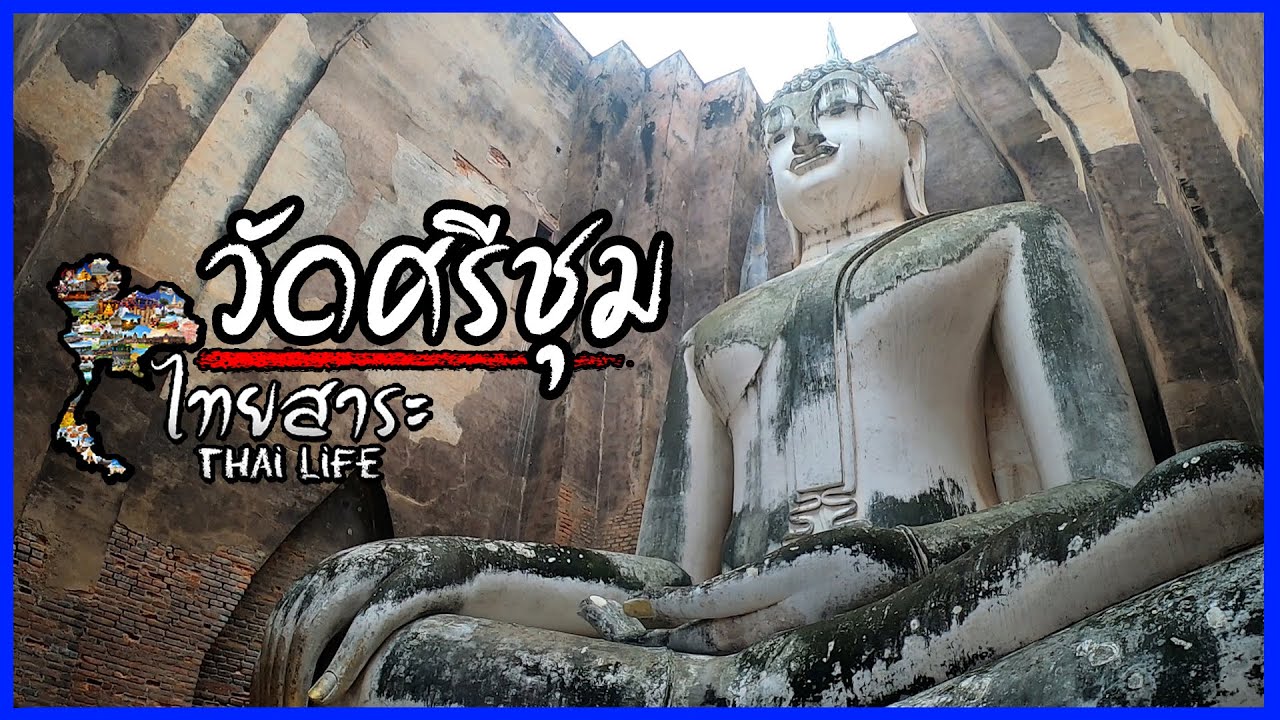
 Click to Access the Navigation Map GPS
Wat Si Chum Map
Recommend

 Art, Culture and Heritage
 Historical Sites and Monuments(4)
 Landmarks and Memorials(5)
 Art, Craft Centres, Tradition(11)
 Museums(5)
Temple(40)
Museums(5)
Temple(40)
 Other Sacred Sites(10)
 Suburban Living
 Village, Community(3)
 Nature and Wildlife
 National Parks and Marine Reserves(3)
 Mountain (Doi)(2)
 Dam, Reservoir, Lake(4)
 Waterfalls(8)
 Caves(4)
 River, Canal(2)
 Entertainment and Agricultural
 Farms, Parks and Ecotourism(3)


