
 Home
Home North(
 Chiang Mai(


Wat Molilokayaram
Rating: 3/5 (12 votes)
 Search By
  Map
Map 
 Have Map
  No Map
Bangkok attractions
Attractions in Thailand
Open Days: Daily
Opening Hours: 08.00 – 16.00
Wat Molilokayaram is an old temple on the Thonburi side of Bangkok that can tell the story of the Thonburi and Rattanakosin periods in one place, through faith, royal connections, and the everyday role of a community temple that still genuinely “works” for local life. The temple is believed to date back to the Ayutthaya era, yet there is no conclusive evidence of exactly who built it or the precise year of its founding. In earlier times, people commonly called it “Wat Thai Talat” because it stood beyond the old Thonburi market area. When King Taksin established Thonburi as the capital, the monastic precincts of Wat Chaeng (today Wat Arun Ratchawararam) and Wat Thai Talat were incorporated into the royal palace zone, and during that reign the temple did not have resident monks in the usual way, reflecting its special status within the royal compound.
After the capital moved to the Bangkok side under King Rama I, monks were invited to reside again at both Wat Chaeng and Wat Thai Talat. According to the historical narrative you provided, Phra Maha Sri from Wat Ratchasittharam was appointed as Phra Thep Moli, later elevated in rank, and subsequently became abbot of Wat Thai Talat. From that point onward, the temple regained a full monastic life and gradually accumulated importance until it became a royal temple with a continuous place in the history of the Thonburi side of Bangkok.
Another period that sharpened the temple’s profile was the time of King Rama II, when he was still Prince Isarasunthorn. He ordered major repairs and the construction of the ordination hall, and a new royal name was bestowed, as preserved in the tradition you shared. In that era, the meaning of a temple went beyond buildings. A great deal of basic learning for princes and commoners alike took place in temple schools, and the renowned monastic academy of Somdet Phra Phutthakhosachan (Khun) was especially respected among the royal family, reinforcing the idea that “the temple was a school” in a very literal sense.
Later, in the reign of King Rama III, the temple was renovated on a large scale across the entire compound, and the royal name “Wat Molilokasudharam” was granted, which later became widely known as “Wat Molilokayaram.” In the same reign, Somdet Phra Phutthakhosachan passed away, and a life-size seated bronze statue was cast and enshrined within the temple for veneration. The story you provided also links this devotion to the tradition of royal Kathin offerings, in which the act of paying homage to Somdet Phra Phutthakhosachan became intertwined with state-level merit-making and ceremonial memory, giving the temple a lasting identity as a place connected to royal ritual.
For visitors who enjoy reading a temple through both sacred objects and craftsmanship, Wat Molilokayaram offers clear highlights. Key devotional objects include the principal Buddha image in the ordination hall, described as a cast Buddha in the subduing Mara posture, and the statue of Somdet Phra Phutthakhosachan (Khun) with an inscribed base that carries a distinct “state voice” and a formal intention that disciples should venerate it across generations. Architecturally, the ordination hall reflects early Rattanakosin Thai design, with roof details, chofa and bai raka, woodwork, and traditional decorative techniques, while the gable is associated in your narrative with later restoration in the reign of King Rama IV. The temple also has a viharn with a Thai–Chinese blended character and the well-known tradition of the “salt warehouse viharn,” a reminder that in certain periods religious space could be used for practical state reasons as well as ritual purposes.
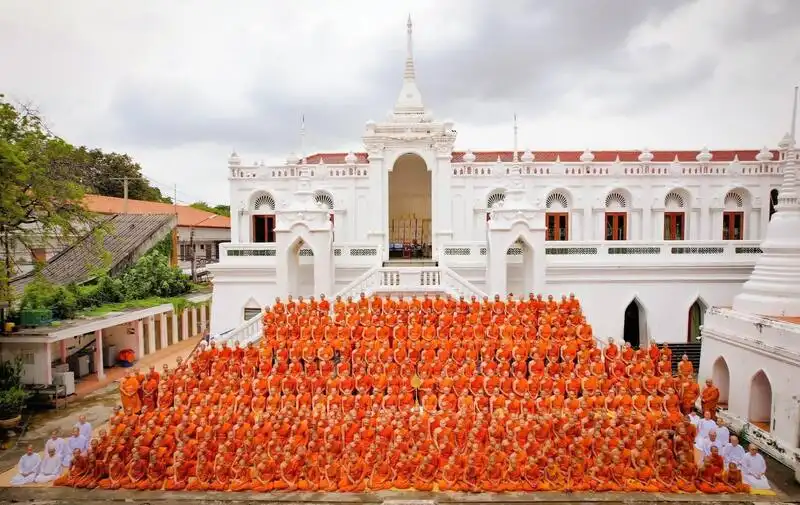
What makes Wat Molilokayaram especially compelling today is that it remains a temple that actively functions, as a place for daily merit-making, as an educational center for monastic studies, and as a social anchor for the surrounding community. Based on the information you provided, the temple has a large number of resident monks and novices, and it operates a Pali and Dhamma study school from introductory levels up to advanced examinations. In other words, the old Bangkok idea that “a temple is a school” has not disappeared here. It continues as a living structure that supports both community life and the monastic order.
Getting There If you want the most flexible approach, you can connect via the Tha Tien–Wat Arun area and then continue on the Thonburi side according to traffic conditions, or travel by river boat and take a short taxi/ride-hire connection to suit your schedule. If you come by car or taxi, simply pin the temple name and choose a route that approaches the former Thonburi palace area conveniently. Public-transport travelers can reach the Wat Arun–Arun Ammarin zone first and then take a short local connection into the temple area depending on where they start.
| Name | Wat Molilokayaram |
| Address | 248 Arun Ammarin Road, Wat Arun Subdistrict, Bangkok Yai District, Bangkok 10600 |
| Area | Thonburi side (Bangkok Yai) – near Wang Derm/Wat Arun – Tha Tien |
| Summary | An old temple believed to date to the Ayutthaya era, formerly known as Wat Thai Talat. It was associated with the Thonburi royal-palace zone, later restored across multiple reigns, with key devotional highlights including the main Buddha image in the ordination hall and the statue of Somdet Phra Phutthakhosachan (Khun). The temple also retains a strong role in monastic education through its Pali and Dhamma study programs. |
| Key Tradition | Veneration of Somdet Phra Phutthakhosachan (Khun) and the narrative of royal Kathin offerings that tie the temple to state-level merit-making and ceremonial memory. |
| Highlights | Main Buddha image in the ordination hall (cast, subduing Mara posture), statue of Somdet Phra Phutthakhosachan (Khun) with an inscribed base. |
| Architecture | Early Rattanakosin-style ordination hall (roof details, chofa & bai raka, traditional decorative work), a Thai–Chinese blended viharn and the tradition of the “salt warehouse viharn,” plus key structures such as the Somdet Hall, Tripitaka Hall, and sermon hall. |
| Getting There | Connect via Tha Tien–Wat Arun and continue on the Thonburi side / Taxi by pinning the temple name / Public transport to the Wat Arun–Arun Ammarin zone and then a short local connection as needed. |
| Current Status | Open for worship and visits |
| Contact Number | 02-891-0288 |
| Latest Abbot | Phra Phrom Wachirodom (Suthat Warathassi) |
| Nearby Attractions (Approx. Road Distance) | Wat Arun Ratchawararam Ratchaworamahawihan (approx. 1.2 km) Wichai Prasit Fort / Wang Derm area (approx. 1.5 km) Wat Kalayanamitr Woramahawihan (approx. 2.6 km) Museum Siam (approx. 3.4 km) The Grand Palace (approx. 4.2 km) |
| Popular Restaurants Nearby (Approx. Road Distance) + Phone | Supanniga Eating Room (Tha Tien) (approx. 3.2 km) Tel. 092-253-9251 Eat Sight Story Deck (approx. 3.4 km) Tel. 02-622-2163 The Deck by Arun Residence (approx. 3.5 km) Tel. 02-221-9158 Sala Arun Restaurant (approx. 3.5 km) Tel. 02-622-2932 Above Riva Rooftop Bar & Restaurant (approx. 3.6 km) Tel. 02-221-1188 |
| Popular Accommodations Nearby (Approx. Road Distance) + Phone | Arun Residence (approx. 3.5 km) Tel. 02-221-9158 Riva Arun Bangkok (approx. 3.6 km) Tel. 02-221-1188 Sala Rattanakosin Bangkok (approx. 3.8 km) Tel. 02-622-1388 Theatre Residence (approx. 4.8 km) Tel. 02-848-9488 Riva Surya Bangkok (approx. 5.8 km) Tel. 02-633-5000 |
Frequently Asked Questions (FAQ)
Q: What was Wat Molilokayaram originally called?
A: According to the historical narrative provided, the temple was formerly known as “Wat Thai Talat” because it was located beyond the old Thonburi market area, before later receiving royal names and becoming widely known as Wat Molilokayaram.
Q: What are the main devotional highlights at Wat Molilokayaram?
A: It is recommended to pay respect to the principal Buddha image in the ordination hall and to venerate the statue of Somdet Phra Phutthakhosachan (Khun), which carries strong historical meaning for the temple.
Q: How is the temple connected to the Thonburi period?
A: The information provided states that during Thonburi as the capital, Wat Thai Talat was incorporated into the royal-palace zone together with Wat Chaeng, and for a period it did not have resident monks, before monastic life was restored in the early Rattanakosin era.
Q: Does the temple have an educational role today?
A: Yes. The information provided notes that the temple operates monastic education, including Pali and Dhamma studies, continuing the long-standing tradition of “the temple as a school.”
Q: Who is the latest abbot and what is the temple’s phone number?
A: The latest abbot is Phra Phrom Wachirodom (Suthat Warathassi), and the temple’s phone number is 02-891-0288.
 Wat Molilokayaram Map
 Category:
  Group:
  Tag: ●Wat Molilokayaram●wat molilokayaram ●wat molilokasudharam ●wat thai talat ●thonburi temple ●bangkok yai temple ●temple near wat arun ●temple near wang derm ●somdet phra phutthakhosachan khun ●salt warehouse viharn ●monastic education bangkok Last Update: 2 MonthAgo
Comment
 Nearby Attractions
| Keyword (Advance) |
 Facebook Fanpage
 Region
 Art, Culture and Heritage
 Historical Sites and Monuments(
 Landmarks and Memorials(
 Royal Palace(
 Art, Craft Centres, Tradition(
 Museums(
 Historical Houses and The Ancient City(
 Art Gallery(
 Educational Places
 Museum for Study(
 Library(
 University
 Church(
 Mosque(
 Other religious and spiritural sites(
 Research and Development
 Royal Project(
 Suburban Living
 Village, Community(
 Local Market(
 Floating Market(
 Nature and Wildlife
 River, Canal(
 Bays and Beaches(
 Other natural attractions(
 Entertainment and Agricultural
 Zoos and Aquariums(
 Animal camps and shows(
 Stadium(
 Farm, Parks, Gardens and Ecotourism(
 Amusement Park(
 Waterpark(
 Theater(
 Cinema(
 Shopping
 Shopping and Night Market(
 Department Store(
 Spas and Wellness
 Spas and Wellness(
 Restaurant
 Michelin Star(
 Accommodation
 Hotel(
 Call Customer Service in Tourism
 Call Customer Service in Tourism(
 Travel Articles, Recipes
 Travel Review, Food Review(
 Royal Thai Desserts, Traditional Dessert, Thai Dessert Recipes(
 Copyright 2012,