

 Home
Home Chiang Mai(















National Stadium (National Sports Complex)
Rating: 3.7/5 (10 votes)
 Search By
  Map
Map 
 Have Map
  No Map
Bangkok attractions
Attractions in Thailand
Open Days: Daily (some buildings/activities may have different closure days)
Opening Hours: Varies by building and usage/competition schedule (recommended to check before visiting)
National Stadium (National Sports Complex) is one of those places that makes Bangkok feel “alive and in motion” because it is not just a single stadium. It is a sports-and-recreation complex that brings together outdoor fields, indoor arenas, a competition-standard swimming pool, and activity plazas within one area. If you know the Siam–National Stadium neighborhood, you already know how convenient it is in the inner city. But once you step inside, you enter another world—one filled with the rhythm of training, the rhythm of cheering, and the rhythm of city people who choose to take care of themselves by “being in a sports space” rather than sitting still.
The fun of visiting the National Stadium is that you can choose different modes in a single day. If you enjoy history, you can walk through and read the names of venues tied to important figures in Thai physical education. If you prefer urban wandering, you can take in the stadium structures and the everyday life of people using the space. And if you come to actually use the facilities, you will find both outdoor and indoor zones where you can pick activities that match your style. The key is to be clear about one thing first: “What am I here for today?” because each building has different opening patterns, scheduling systems, and usage rules. During certain periods, competitions or events may also change access to some areas.
If we explain it with a clear centerpiece, Supachalasai Stadium is the name most people recognize because it is the main stadium of the complex and the public’s strongest image of the “National Stadium.” In reality, however, this area includes many other venues and buildings that support a wide range of sports. That is why the National Stadium is more than a football or athletics venue—it is an ecosystem of sport in the inner city that is still moving and evolving.
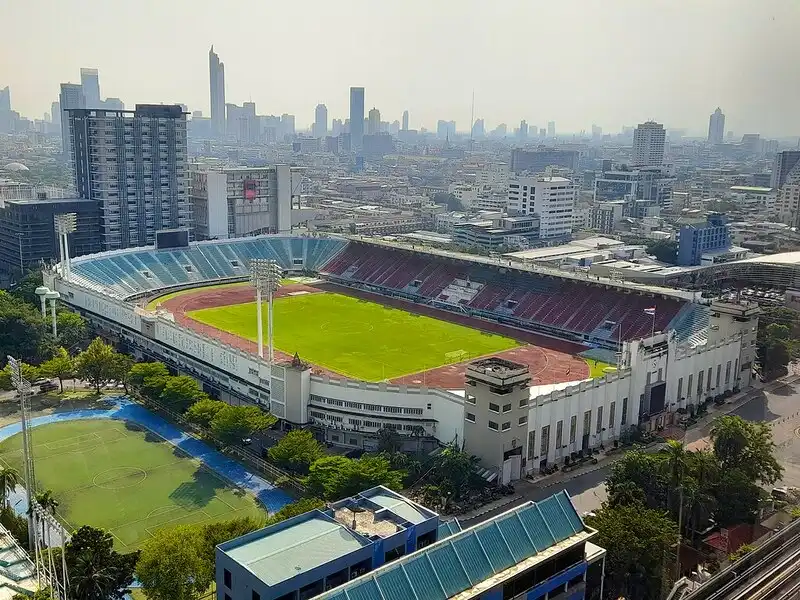
Supachalasai Stadium is the main stadium of the National Sports Complex. It has a synthetic athletics track for track-and-field competitions and is used for major sporting events. The stadium features a roof on one side and surrounding grandstands. Its current spectator capacity is 19,793 seats. Its former name was the National Stadium athletics ground, and later, on 4 May 1941, the Department of Physical Education changed it to its current name as a memorial to Lt. Cmdr. Luang Supachalasai (Royal Thai Navy), the first Director-General of the Department of Physical Education.
For visitors, what makes Supachalasai Stadium interesting is not only its capacity or its status as the main venue, but the feeling of standing in a place that has hosted many important matches and reflects several eras of sports spectatorship in Bangkok. On days without major events, you can feel the “scale” of the field and stands—and that alone makes it easy to imagine the roar of a full crowd without needing to force it.
Thephasadin Stadium is an outdoor venue with a running track for athletics. It is used for competitions and general sports training. Its total capacity is 6,378 seats. It was built in 1965 and was originally called the Hockey Stadium because it served as the hockey competition venue at the 5th Asian Games. Later, in 1983, the Department of Physical Education changed the name to the current one as a memorial to Maha Sewaek Ek Chao Phraya Thammasakmontri (Sanan Thephasadin na Ayutthaya), regarded as a founding figure of football in Thailand, and Mr. Nak Thephasadin na Ayutthaya, former acting Director-General of the Department of Physical Education. Today it serves as the home ground of BEC Tero Sasana Football Club.
If you prefer a venue that feels more “day-to-day functional” than “ceremonial,” Thephasadin Stadium gives that kind of atmosphere. It is closely tied to both training and competitions across levels. Knowing where the name comes from also turns a simple walk-by into something closer to reading a chapter of sports history within the same city—and it helps explain how some venues were built to support major sporting festivals before gradually becoming regular spaces for the sporting community over time.
Jindarak Stadium is currently the National Beach Sports Demonstration and Training Center. In the past, it was an outdoor stadium used for secondary-level competitions and general training. Its former name was Ton Pho Stadium, built after the Greater East Asia War. Later, in 1983, the Department of Physical Education changed it to its current name as a memorial to Maha Sewaek Tho Phraya Jindarak (Chamlong Sawasdee-chuto), a former Director-General of the Department of Physical Education.
What is particularly interesting about Jindarak Stadium is the “shift in role” from a general outdoor field to a specialized training center. It shows that the National Stadium has not remained static—it adapts to changing eras and the sports people become more interested in. From a visitor’s perspective, this is part of the charm of sports spaces: they prioritize “human activity” over pure aesthetics, and that change itself tells a strong story.
Wisuttaram Swimming Pool is a competition-standard pool equipped with diving platforms and related facilities, along with two sets of spectator stands on both sides. It is used for competitions and aquatic sports training. It was built in 1961 under the initiative of Mr. Kong Wisuttaram, who was Director-General of the Department of Physical Education at the time. The Department later changed the former name “Olympic Swimming Pool” to the current name as a memorial to the initiator who proposed its construction.
If you want to use the space in a way that “benefits your body immediately,” the swimming zone is an obvious answer because it is a standard pool with a long-standing training context. On regular days, you may see both athletes training as part of routine practice and everyday users swimming for health. The atmosphere suggests that the city still has room for people to “train,” not only to “perform.”
Nimibutr Stadium is an indoor sports venue for competitions and training. It was built in 1963 so that the Amateur Boxing Association of Thailand could use it as a competition venue, including the 1st Asian Amateur Boxing Championships. Its former name was Gymnasium Building 1. Later, on 27 April 1985, the Department of Physical Education changed it to its current name as a memorial to Lieutenant General Phechin Nimibutr, a former Director-General of the Department of Physical Education.
Chanthana-Yingyong Building is an indoor sports venue for competitions and training, as well as physical exercise practice. It was built in 1965 for the 5th Asian Games. Its former name was Gymnasium Building 2, and in the following year (1966), the Department of Physical Education changed it to its current name as a memorial to Luang Prawet Wutthasueksa (Prawet Chanthana-Yingyong), a former Director-General of the Department of Physical Education.
If you are into “indoor sports,” having both Nimibutr and Chanthana-Yingyong gives this complex a completely different dimension from the outdoor venues. Indoor sports often come with dense training and competition schedules, and these buildings are also places many people remember from watching boxing, watching competitions, or attending major sporting events in the past. Walking past them feels like a reminder that Thai sports history is not only in books—it sits physically in building forms and in the names engraved on them.
Other venues: The 200-meter warm-up track is a small training track located between Supachalasai Stadium and Thephasadin Stadium. It was built in 1978 as a warm-up facility for athletes competing in the 8th Asian Games, following international athletics competition standards.
The Recreation Park Plaza is a space for various recreational activities, built in 2006.
The Multi-purpose Sports Plaza is an area for exercise and various activities, located in front of Nimibutr Stadium.
These three components complete the picture of the National Stadium immediately because they show that “sport does not happen only during competition.” It starts from warm-ups and training, and continues into lighter activity spaces that the general public can access. That is why, on some days, you might not come to watch any match at all—yet simply walking through this place can still inspire you to take better care of yourself afterward.
Getting There The easiest way to reach the National Stadium is BTS National Stadium Station, because you can get off and walk straight into the complex without battling traffic too much. If you come by taxi or ride-hailing app, pin “National Stadium” or specify the exact building/field you want, since the area is large and has multiple drop-off points. If you drive, it helps to think like an inner-city local: park around the Siam–MBK zone and walk over, which is often easier to manage—especially on big-event days or during evenings when traffic becomes heavy.
If you ask what time is best to visit, mornings are usually more comfortable and less crowded for people who want to walk and take in the atmosphere. Evenings feel more energetic with more people exercising, but you should allow extra time and be patient with the higher volume of users. Small habits also help shared use go smoothly: walk to the side, do not block training areas, and respect each zone’s schedule because this is a place many people come to use with real intention.
| Place Summary | National Stadium (National Sports Complex), a central Bangkok sports complex that includes key venues such as Supachalasai Stadium, Thephasadin Stadium, Jindarak Stadium, Wisuttaram Swimming Pool, Nimibutr Stadium, Chanthana-Yingyong Building, and various activity plazas within one area. |
| Highlights | Extremely convenient access via BTS National Stadium Station. Offers both outdoor fields and indoor arenas, covering competition, training, and recreation. Suitable for sports fans, urban walkers, and visitors who want to actually use facilities for exercise. |
| Location | 154 National Stadium, Rama I Road, Wang Mai, Pathum Wan, Bangkok 10330 |
| Contact | Department of Physical Education Tel. 0-2214-0127 |
| Nearby Attractions (Approx. Road Distance) | BTS National Stadium Station (0.3 km) MBK Center (0.4 km) Bangkok Art and Culture Centre (0.5 km) Jim Thompson House (0.7 km) Siam Paragon (1.2 km) |
| Popular Restaurants Nearby (Approx. Road Distance + Phone) | Jim Thompson, A Thai Restaurant (0.8 km) Tel. 061-421-8951 Restaurants at Pathumwan Princess Hotel (0.6 km) Tel. 0-2216-3700 Siam@Siam Design Hotel Bangkok (0.7 km) Tel. 0-2217-3000 Mercure Bangkok Siam (1.0 km) Tel. 0-2659-2888 Madame Tussauds Bangkok (1.1 km) Tel. 0-2842-2000 |
| Popular Accommodations Nearby (Approx. Road Distance + Phone) | Pathumwan Princess Hotel (0.6 km) Tel. 0-2216-3700 Siam@Siam Design Hotel Bangkok (0.7 km) Tel. 0-2217-3000 Holiday Inn Express Bangkok Siam (1.0 km) Tel. 0-2217-7555 Mercure Bangkok Siam (1.0 km) Tel. 0-2659-2888 LiT BANGKOK Hotel (1.4 km) Tel. 0-2612-3456 |
Frequently Asked Questions (FAQ)
Q: What is inside the National Stadium (National Sports Complex)?
A: It includes Supachalasai Stadium, Thephasadin Stadium, Jindarak Stadium, Wisuttaram Swimming Pool, Nimibutr Stadium, Chanthana-Yingyong Building, and other activity areas such as the 200-meter warm-up track, the Recreation Park Plaza, and the Multi-purpose Sports Plaza.
Q: How many spectators can Supachalasai Stadium hold?
A: Approximately 19,793 seats.
Q: What time is best if I want to walk around and enjoy the atmosphere?
A: Mornings are cooler and less crowded. Evenings are livelier with more people exercising, but you should allow extra travel time because traffic around Siam–Rama I can be heavy.
Q: What is the easiest way to get to the National Stadium?
A: BTS National Stadium Station is the easiest and most direct option—get off and walk straight into the complex.
Q: What should I check before I go?
A: Check whether the building or zone you plan to visit is open on that day and at what time, and whether any competitions/events affect access, because each building can have different schedules.
 Tel: 022140120
 National Stadium (National Sports Complex) Map
 Category:
  Group:
  Tag: ●National Stadium (National Sports Complex)●national stadium bangkok ●national sports complex bangkok ●supachalasai stadium ●thephasadin stadium ●nimibutr stadium ●chanthana-yingyong building ●wisuttaram swimming pool ●sports facilities near siam ●bts national stadium station ●things to do near national stadium Last Update: 1 MonthAgo
Comment
 Nearby Attractions
| Keyword (Advance) |
 Facebook Fanpage
 Region
 Art, Culture and Heritage
 Historical Sites and Monuments(
 Landmarks and Memorials(
 Royal Palace(
 Art, Craft Centres, Tradition(
 Museums(
 Historical Houses and The Ancient City(
 Art Gallery(
 Educational Places
 Museum for Study(
 Library(
 University
 Places of Worship
 Temple(
 Church(
 Mosque(
 Other religious and spiritural sites(
 Research and Development
 Royal Project(
 Suburban Living
 Village, Community(
 Local Market(
 Floating Market(
 Nature and Wildlife
 River, Canal(
 Bays and Beaches(
 Other natural attractions(
 Zoos and Aquariums(
 Animal camps and shows(
 Farm, Parks, Gardens and Ecotourism(
 Amusement Park(
 Waterpark(
 Theater(
 Cinema(
 Shopping
 Shopping and Night Market(
 Department Store(
 Spas and Wellness
 Spas and Wellness(
 Restaurant
 Michelin Star(
 Accommodation
 Hotel(
 Call Customer Service in Tourism
 Call Customer Service in Tourism(
 Travel Articles, Recipes
 Travel Review, Food Review(
 Royal Thai Desserts, Traditional Dessert, Thai Dessert Recipes(
 Copyright 2012,