
lovethailand home >Central Travel Attractions >Bangkok Travel Attractions >Bang Rak >Si Phraya > Wat Hua Lampong
TL;DR: Wat Hua Lampong is located at 728 Rama IV Road, Si Phraya Subdistrict, Bang Rak District, Bangkok, open Daily, hours Open 24 hours (temple grounds) – Merit-making/coffin donation available 24.
Wat Hua Lampong
Open Days: Daily
Opening Hours: Open 24 hours (temple grounds) – Merit-making/coffin donation available 24 hours (Ruamkatanyu Foundation)
Wat Hua Lamphong is a well-known temple in central Bangkok, located at 728 Rama IV Road, Si Phraya Subdistrict, Bang Rak District. It has long been woven into everyday city life because it sits in a highly convenient area with many bus routes and easy access to the MRT. Even in the middle of a busy business zone, the temple still feels like a traditional place of refuge where people can stop by to pay respects, make merit, and slow down for a moment. Wat Hua Lamphong is also widely recognized for its strong public-charity role, especially the long-running practice of supporting funerals for those in need through coffin donations. This makes the temple’s idea of “making merit” more than a ritual — it becomes a direct act of compassion that reaches real people and real situations.
Looking back at its earlier identity, Wat Hua Lamphong was once known as “Wat Wua Lamphong.” This reflects a common Thai tradition in which a temple’s name often echoes the name of the local community, making it easy to remember and emphasizing a shared sense of belonging between the temple and the people around it. The founder and the exact date of construction are not clearly recorded, but it is commonly estimated that the temple likely originated in the early Rattanakosin period, roughly during the reigns of King Rama I to Rama III. This assumption is drawn from architectural observation — particularly the form of the old ordination hall and the stupa behind it, which were built as a pair. In Thai temple history, these structural details often function as “traces of time,” helping us read an era even when complete construction documents no longer remain.
Local tradition also connects the area’s early settlement to the final fall of Ayutthaya in 2310 BE (1767 CE). After the city was devastated, many people were left in hardship and uncertainty. Some groups could no longer remain where they had lived and moved south with their families. They eventually settled around what is now the Wat Hua Lamphong area, believing it was a suitable location — open land with no clear private ownership at the time and canals that made travel and transport convenient. As the community became established and more stable over the years, people joined together to build a temple in the spirit of Thai Buddhist ancestors, creating a shared spiritual center for religious life and collective ceremonies. In the Thai worldview, a temple is not only a ritual space — it is also a social structure that helps hold a community together.
Another key chapter unfolded during the reign of King Rama V, a period when Thailand began modernizing rapidly. In 2433 BE (1890 CE), railway development began, and Bangkok’s first major station emerged — later known by the public as “Hua Lamphong Station,” located about 2 kilometers from the old temple site. The arrival of the railway and modern transport networks gradually turned this part of the city into an important hub for travel and commerce. Later, around the Kathina season in 2447 BE (1904 CE), oral accounts and local records describe King Rama V traveling to present royal Kathina robes to several temples in a single day, including Wat Wua Lamphong. On that occasion, it is said that the King graciously bestowed a new name upon the temple: “Wat Hua Lamphong,” a royal name that has remained a fortunate and auspicious identity ever since.
In the broader context of Thai temple history, receiving a “royally bestowed name” is more than a simple change of signage. It reflects recognition of the temple’s standing within the city and the royal support given to Buddhism in that era. Over time, Wat Hua Lamphong continued to be maintained and improved, with restorations of older structures and additions of new permanent buildings to suit its role as a major inner-city temple. On 18 July 2545 BE (2002 CE), Wat Hua Lamphong was elevated to the status of a third-class royal temple (ordinary type), further affirming its importance as a Bangkok religious institution that serves both spiritual and social functions side by side.
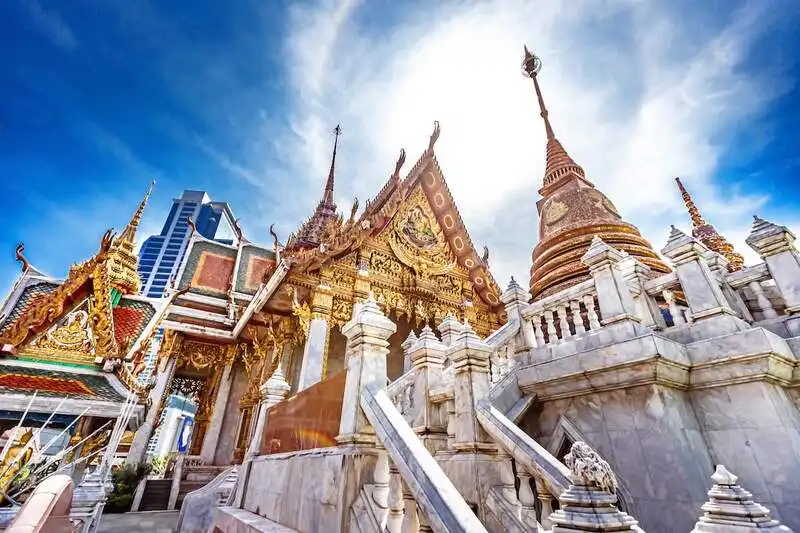
Architecturally, people often mention the old ordination hall and the paired stupa behind it, which serve as key visual evidence when discussing the temple’s estimated era. What makes an inner-city temple like Wat Hua Lamphong particularly interesting is its need to “support real life” — welcoming large numbers of visitors and donors every day. The space therefore tends to be arranged for smooth flow, clear entry and exit, and practical areas for merit-making and ceremonies in many circumstances. On weekdays, the temple feels calm without becoming lonely; on Buddhist holy days and during festivals, its activities reflect the living energy of faith shared by local residents and visitors from many parts of the city.
One of the reasons Wat Hua Lamphong stands out for many Bangkok residents is that its merit-making feels tangible and socially meaningful. The temple is a place where people contribute to supporting funerals for those in need through coffin donations and related charitable merit practices. This aligns with Thai Buddhist values of compassion and ensuring that those who pass away — even without family or financial support — receive appropriate care and dignity. For many donors, this is a form of merit that connects personal faith with social responsibility, allowing Wat Hua Lamphong to remain “alive” in a modern, practical sense — not merely a place to visit, pay respects, and leave.
Getting There is flexible, with several convenient options. If you travel by MRT, get off at Sam Yan Station and walk or connect onward easily to the temple. Many bus routes also pass through the area, including 4, 21, 25, 34, 40, 46, 67, 73, 109, 113, and air-conditioned routes Por Or 4, Por Or 17, Por Or 29, Por Or 67. If you arrive by BTS in the Siam area, you can transfer by bus or connect via the rail system to the MRT for a fast route toward Rama IV Road. For those driving, the temple can be reached via Rama IV Road and nearby main routes, though it is best to allow extra time during rush hours since this is a busy commercial district.
Another charm of visiting Wat Hua Lamphong is how easily you can “continue your city route” afterward. The surrounding Sam Yan–Si Phraya–Silom area is full of places to eat, explore, shop, and visit museums or art spaces. If you plan a relaxed half-day, you can begin by paying respects and making merit at the temple, then move on to nearby attractions without complicated planning. This convenience makes Wat Hua Lamphong feel like a quiet pause within everyday Bangkok life — and a destination that visitors from outside the area can reach with ease.
| Name | Wat Hua Lamphong |
| Location | 728 Rama IV Road, Si Phraya Subdistrict, Bang Rak District, Bangkok |
| Type | Third-Class Royal Temple (Ordinary Type) (elevated in 2002) |
| Former Name | Wat Wua Lamphong |
| Estimated Period | Early Rattanakosin (estimated King Rama I–III), inferred from the form of the old ordination hall and the paired stupa behind it |
| Royal Name | Wat Hua Lamphong (renamed by royal bestowal during King Rama V, based on local accounts and records) |
| Current Abbot | Phra Thammasuthi (Narin Narinto) |
| Contact | 02-233-8109, 02-233-9228 |
| Travel | MRT Sam Yan; buses 4, 21, 25, 34, 40, 46, 67, 73, 109, 113 and Por Or 4, Por Or 17, Por Or 29, Por Or 67 |
| Current Status | Open for worship and merit-making |
| Nearby Attractions (Approx. Route Distance) | Samyan Mitrtown – 0.8 km – 02-033-8900 Chamchuri Square – 0.8 km – 02-160-5666 Lumphini Park – 2.0 km – 02-252-7006 Bangkok Art and Culture Centre (BACC) – 2.6 km – 02-214-6630 Wat Traimit Withayaram (Wat Sam Chin) – 3.3 km – 02-623-5055 |
| Nearby Restaurants (Approx. Route Distance) | Jay Oh Khao Tom Ped – 1.6 km – 081-682-8816 Jay Oh Khao Tom Ped – 1.6 km – 064-118-5888 Somboon Seafood (Surawong Branch) – 2.2 km – 02-233-3104 Somboon Seafood (Surawong Branch) – 2.2 km – 02-234-4499 (Extra option in the same area) Samyan Mitrtown Dining/Food Area – 0.8 km – 02-033-8900 |
| Nearby Accommodations (Approx. Route Distance) | Triple Y Hotel – 0.3 km – 02-219-1611 Mandarin Hotel Bangkok (Managed by Centre Point) – 0.5 km – 02-238-0230 dusitD2 Samyan, Bangkok – 0.7 km – 02-211-3333 Mercure Bangkok Surawong – 0.7 km – 02-352-4999 (Same-area option) Samyan Serene Hotel – 3.0 km – 02-233-4657 |
Frequently Asked Questions (FAQ)
Q: Which station is closest to Wat Hua Lamphong?
A: The closest is MRT Sam Yan. From there, you can walk or connect onward easily, making it ideal for a quick temple stop while exploring the Rama IV–Silom area.
Q: Is Wat Hua Lamphong open every day, and can I visit late at night?
A: The temple generally welcomes visitors daily. Some public-charity merit activities can also be done 24 hours, depending on the related foundation’s service format.
Q: How do I make a coffin donation at Wat Hua Lamphong?
A: Go to the designated donation/merit area within the temple grounds. Staff will guide you through the steps, including donation options, registration, and proper procedures.
Q: What was the temple’s former name, and why was it changed?
A: It was formerly called Wat Wua Lamphong. Local accounts state that during King Rama V’s reign, the temple was given the royally bestowed name “Wat Hua Lamphong,” which became an auspicious identity and linked to the transport context of that era.
Q: Where should I go after visiting Wat Hua Lamphong?
A: Good nearby options include Samyan Mitrtown, Chamchuri Square, Lumphini Park, the Bangkok Art and Culture Centre, or heading toward Yaowarat for more temples and food.
Tel : 022338109
 Tel : 022338109
 Category: ●Places of Worship
 Group: ●Temple
Last Update : 10 MonthAgo
 Last Update : 10 MonthAgo
 Click to Access the Navigation Map GPS
Wat Hua Lampong Map
Recommend

 Art, Culture and Heritage
 Historical Sites and Monuments(3)
 Landmarks and Memorials(23)
 Royal Palace(13)
 Art, Craft Centres, Tradition(35)
 Museums(59)
 Historic Homes and Cities(3)
 Art Gallery(16)
 Educational Places
 Museum for Study(6)
 Library(4)
 University
 Public university(7)
 Autonomous Universities(7)
 Rajamangala University of Technology(6)
 Rajabhat University(6)
 Private University(19)
Temple(72)
Private University(19)
Temple(72)
 Church(2)
 Mosque(67)
 Other Sacred Sites(8)
 Research and Development
 Royal Project(1)
 Suburban Living
 Village, Community(5)
 Local Market(9)
 Floating Market(2)
 Nature and Wildlife
 River, Canal(3)
 Bays and Beaches(1)
 Other natural attractions(1)
 Entertainment and Agricultural
 Zoos and Aquariums(5)
 Animal camps and shows(5)
 Stadium(9)
 Farms, Parks and Ecotourism(20)
 Amusement Park(1)
 Waterpark(4)
 Theater(7)
 Cinema(1)
 Shopping
 Shopping and Night Market(20)
 Department Store(7)
 Spas and Wellness
 Spas and Wellness(1)
 Restaurant
 Michelin Star(5)
 Accommodation
 Hotel(3)
 Call Customer Service in Tourism
 Call Customer Service in Tourism(1)
 Travel Articles, Recipes
 Travel Review, Food Review(42)
 Royal Thai Desserts and Recipes(56)


