

 Home
Home Chiang Mai(














Soil Museum
Rating: 4.5/5 (4 votes)
 Search By
  Map
Map 
 Have Map
  No Map
Bangkok attractions
Attractions in Thailand
Open Days: Monday – Friday (Closed on Saturday – Sunday and public holidays) (Recommended to call and confirm before visiting)
Opening Hours: 09:00 – 16:00 (Recommended visit time: at least 45 – 90 minutes)
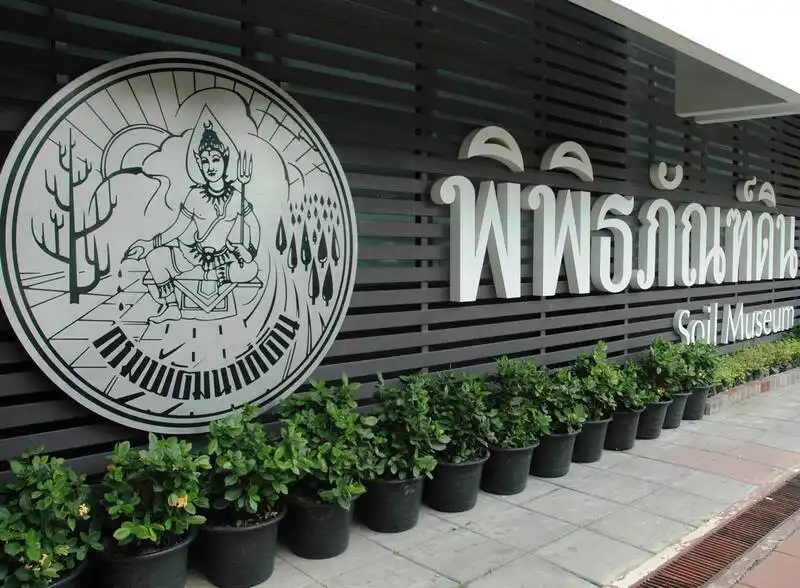
Soil Museum, Land Development Department is a knowledge-focused Bangkok attraction that turns “soil” — something many people think is distant or uninteresting — into a lens for understanding Thailand as a whole. Soil is not only the ground we walk on or the land we plant on; it is the foundation of food, water, ecosystems, cities, and sustainable land-use planning. This museum is located on the 1st floor of Building 6 within the Land Development Department on Phahonyothin Road in the Chatuchak area, and it is recognized as Thailand’s first soil museum, designed with a modern and comprehensive exhibition approach for general visitors.
As you enter, you’ll notice the museum tells its story in a clear sequence — from the origins of the Land Development Department to early soil-survey tools and equipment, and then into the sources of soil-forming materials and the process of soil formation itself. This core section helps visitors understand that soil doesn’t appear out of nowhere; it forms through rock weathering, deposition, chemical and biological changes, and environmental conditions that vary across different landscapes. That is why “soil from different places” produces different outcomes for agriculture, water retention, and erosion risk.
A highlight that makes the visit genuinely engaging is the display of “soil profiles” and many soil sets, which allow you to see soil as distinct layers in a tangible way — far more vivid than reading descriptions in a book. The idea of a soil profile invites you to read soil like a “biography of a place”: how much organic matter is in the topsoil, what soil color suggests about drainage, and how soil structure relates to water-holding capacity and root growth. The less you’ve paid attention to soil before, the more surprising it can be — because what’s in front of you is not abstract theory, but visible evidence.
Inside, the museum is divided into 8 sections that guide you from the “roots of the organization” to the “bigger picture of the country.” It begins with the history of the Land Development Department, followed by soil profiles and soil sets that explain Thailand’s soil diversity. From there, it expands into land-use planning and soil-and-water conservation, which are at the heart of real-world resource management. Knowing what soil exists where is not enough — if land is used incorrectly or erosion is left unmanaged, knowledge alone cannot improve the land. The museum therefore emphasizes that “data” must be used to support appropriate decisions.
For visitors who enjoy data and systems, one of the most interesting parts is the section on “soil survey and classification” and soil taxonomy. This is a standardized language for communicating about soils, similar to naming systems in biology. With clear classification, the country can build soil maps, plan land use, and assess land potential more accurately. The museum also explains soil analysis, helping the public see that soil testing is not distant or overly technical, but a practical tool that makes soil improvement less about guessing and more about informed decisions — often reducing long-term costs.
Another dimension that adds a strong human angle is the section on volunteer soil doctors, reflecting how community networks help share knowledge and support local land development. The section on the development of the Thung Kula Rong Hai area also offers a national-scale example showing that land improvement requires ongoing understanding of soil, water, and land management — not one-time fixes. In this way, the museum doesn’t stop at “look and remember”; it helps you see how soil links to quality of life, the economy, and national food security.
A section worth reading carefully highlights royal initiative projects related to soil, such as the “Klaeng Din (Soil-Acidification) Project,” which supports understanding and restoring severely acidic soils in certain areas, and the use of vetiver grass to help bind topsoil, reduce erosion, and strengthen slopes or vulnerable land. This part often leaves visitors feeling that soil is not merely technical knowledge, but knowledge translated into real solutions for the country.
Another modern feature is the geographic information system (GIS) installed for searching soil information and soil maps across different regions of Thailand. This is particularly appealing for visitors who want to see how soil knowledge is applied at a spatial level. Even if you are not here with an academic purpose, trying the search system helps you understand that “soil data” is one of the country’s essential datasets, enabling land-use planning to be grounded in evidence and reason.
Getting There You can reach the Soil Museum via several bus routes, such as 24, 26, 34, 39, 59, 104, 129, 177, 185, 206, 503, 528, and 543. It’s recommended to allow extra travel time depending on weekday traffic on Phahonyothin Road. For additional convenience, you can take the BTS/MRT and then transfer by taxi or a short local ride. Using the search term “Soil Museum, Land Development Department” on maps will help you arrive at the most accurate location.
In short, if you are looking for a Bangkok attraction that offers real learning and a fresh perspective without taking an entire day, the Soil Museum is a worthwhile choice. It shows that something as ordinary as “soil” is actually the foundation of everything — from the food on your plate to the country’s development. If you plan to visit, it’s still best to call and confirm opening details beforehand so your trip goes smoothly.
| Place Name | Soil Museum, Land Development Department |
| Location | 1st Floor, Building 6, Land Development Department, 2003/61 Phahonyothin Road, Lat Yao, Chatuchak, Bangkok 10900 |
| Zone | Chatuchak – Lat Yao (Upper Phahonyothin Zone) |
| Key Characteristics | A specialized soil museum featuring the department’s history, soil formation, soil profiles, soil survey and classification, Thailand’s soil issues, soil-related projects, and a soil information search system (GIS) |
| Open Days & Hours | Monday – Friday 09:00 – 16:00 (Closed Sat – Sun and public holidays) |
| Fees | Free admission |
| Current Status | Open during official hours (recommended to call and confirm before visiting) |
| Contact Number | 02 941 1968 |
| Facilities | Indoor exhibition area (good for hot/rainy days), reading/exhibition points, soil information search system (GIS) |
| Nearby Attractions (Approx. Driving Distance) | 1) Chatuchak Park – 4.3 km – Tel. 02 272 4575 2) MOCA BANGKOK (Museum of Contemporary Art) – 2.0 km – Tel. 02 016 5666 3) Central Ladprao – 3.0 km – Tel. 02 793 6000 4) Union Mall – 3.5 km – Tel. 02 512 5000 5) Or Tor Kor Market – 6.0 km – Tel. 02 279 2080 |
| Nearby Restaurants / Food Spots (Approx. Driving Distance) | 1) Dining Zone – Central Ladprao – 3.0 km – Tel. 02 793 6000 2) Dining Zone – Union Mall – 3.5 km – Tel. 02 512 5000 3) Or Tor Kor Market (ready-to-eat foods) – 6.0 km – Tel. 02 279 2080 4) Cafe/Restaurant Area at MOCA BANGKOK – 2.0 km – Tel. 02 016 5666 5) Food/Shop Area within Chatuchak Park – 4.3 km – Tel. 02 272 4575 |
| Nearby Accommodations (Approx. Driving Distance) | 1) Centara Grand at Central Plaza Ladprao Bangkok – 3.0 km – Tel. 02 541 1234 2) The Quarter Ladprao by UHG – 3.5 km – Tel. 02 056 2999 3) Best Western Chatuchak – 6.0 km – Tel. 02 666 4695 4) C U INN Bangkok – 6.0 km – Tel. 02 617 9550 5) Nature Boutique Hotel Ratchayothin – 6.0 km – Tel. 081 104 8000 |
Frequently Asked Questions (FAQ)
Q: What days and hours is the Soil Museum open?
A: Generally, it is open Monday – Friday from 09:00 – 16:00 and closed on Saturdays, Sundays, and public holidays. It is recommended to call and confirm before visiting.
Q: Is there an admission fee?
A: Published information states that admission is free, but to be safe, it’s recommended to confirm by phone before your visit.
Q: How much time should I plan for a worthwhile visit?
A: For a general walk-through, plan at least 45 – 90 minutes. If you want to read details carefully or explore the soil information search system, allow extra time.
Q: Is it suitable for children or families?
A: Yes, especially for primary-school-age children and up who are interested in nature, science, and geography. Parents can explore gradually and focus on highlights such as soil profiles and the Thailand soil issues section.
Q: What is the easiest way to get there?
A: You can take several bus routes along Phahonyothin Road, or use the BTS/MRT and transfer by taxi or a short local ride. Searching “Soil Museum, Land Development Department” on maps will help you reach the correct destination.
 Tel: 025625138
 Fax: 029412227
 Soil Museum Map
 Category:
  Group:
  Tag: ●Soil Museum●soil museum bangkok ●land development department soil museum ●things to do in chatuchak ●educational museum bangkok ●soil profile exhibit ●thailand soil types ●soil survey and classification ●gis soil map thailand ●free museum bangkok ●science centre bangkok Last Update: 2 MonthAgo
Comment
 Nearby Attractions
| Keyword (Advance) |
 Facebook Fanpage
 Region
 Art, Culture and Heritage
 Historical Sites and Monuments(
 Landmarks and Memorials(
 Royal Palace(
 Art, Craft Centres, Tradition(
 Museums(
 Historical Houses and The Ancient City(
 Art Gallery(
 Library(
 University
 Places of Worship
 Temple(
 Church(
 Mosque(
 Other religious and spiritural sites(
 Research and Development
 Royal Project(
 Suburban Living
 Village, Community(
 Local Market(
 Floating Market(
 Nature and Wildlife
 River, Canal(
 Bays and Beaches(
 Other natural attractions(
 Entertainment and Agricultural
 Zoos and Aquariums(
 Animal camps and shows(
 Stadium(
 Farm, Parks, Gardens and Ecotourism(
 Amusement Park(
 Waterpark(
 Theater(
 Cinema(
 Shopping
 Shopping and Night Market(
 Department Store(
 Spas and Wellness
 Spas and Wellness(
 Restaurant
 Michelin Star(
 Accommodation
 Hotel(
 Call Customer Service in Tourism
 Call Customer Service in Tourism(
 Travel Articles, Recipes
 Travel Review, Food Review(
 Royal Thai Desserts, Traditional Dessert, Thai Dessert Recipes(
 Copyright 2012,