
 Home
Home North(
 Chiang Mai(


Emaratuddeen Mosque (Khlong Lat Phrao)
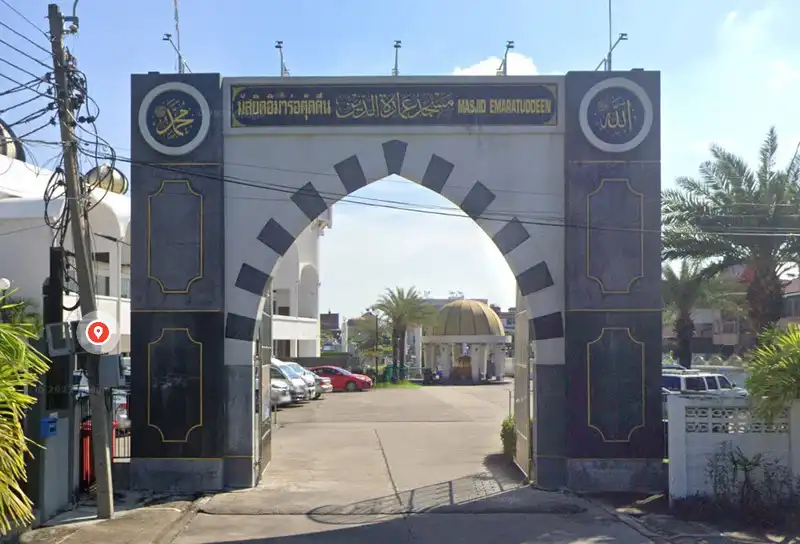
Rating: 3.3/5 (8 votes)
 Search By
  Map
Map 
 Have Map
  No Map
Bangkok attractions
Attractions in Thailand
Open Days: Please contact the mosque to confirm (usage periods may vary according to religious activities and community events).
Opening Hours: Please contact the mosque to confirm.
Emaratuddeen Mosque (Khlong Lat Phrao) is one of Bangkok’s long-established community mosques, shaped by the “canal-side way of life” long before the city expanded into today’s dense residential and business districts. Its charm does not come from the kind of buzz found at mainstream tourist spots, but from being a living space of faith—used by the community in real ways, passed on in real continuity, and still serving as a daily anchor for worship, learning, and the relationships of people who have shared this neighborhood across generations.
According to community accounts, the mosque’s beginnings trace back to around 1887, when approximately nine Muslim families who had migrated to settle along Khlong Lat Phrao agreed to build a shared place for religious practice on roughly one rai of canal-front land. The first structure was a wooden building, about 10 meters wide and 12 meters long. That early wooden building captures the heart of many community mosques: they rarely begin with grandeur, but with necessity—and with a collective intention to create a space of faith that is close to home, close to everyday life, and close to the bonds of family and neighbors.
Later, in 1927, Tok Piam Chimhirun donated one traditional Thai house to be used for religious activities and as a balai for Qur’an lessons for the community’s children, with local teachers remembered through community storytelling. This made “education” not a secondary role, but a central pillar that grew alongside worship from the early stages. In a deeper sense, this is where the mosque became more than a place for prayer—it became a space that helps “build people” and sustain the continuity of the community from one generation to the next.
Another important milestone came in 1935, when there was an official directive for surau in that era to be recognized as mosques and to adopt an Arabic name as part of their formal identity. From that point onward, the community used the mosque’s official name, along with defined religious roles—such as imam, khatib, and bilal—collectively supported by the community. As time passed, the city expanded and the area became more diverse. The fact that the mosque has continued to stand and function suggests that the community’s “system of cooperation” has remained real—through faith, volunteer effort, and ongoing care of shared space so it remains ready for use in every era.
As Bangkok entered periods of rapid development, the older mosque structure became significantly worn. Around 1966, the community resolved to build a new mosque building with support from waqf (endowed) land and donations from multiple benefactors, as described in the history you provided. The newer building was constructed with reinforced concrete, featuring front and side porches, and increased in size to accommodate worshippers and community activities. In later years, access roads were improved and the religious school space was further developed, giving young people a more structured place for learning—both in day-return formats and in pondok-style boarding—along with educational pathways the community takes pride in.
Another noteworthy point is that this mosque is often described as being situated within the context of a “business district” in Huai Khwang. For that reason, facilities such as restrooms and ablution (wudu) areas were improved to better support those who come to perform religious duties. This is a clear example of how a mosque in a large city adapts: it preserves the core of faith and the etiquette of the space, while responding flexibly to the rhythms of the city and the practical needs of real users—without diminishing the place’s sanctity or shared rules.
For visitors who come with genuine learning intentions, the most important thing is to “read the rhythm of the space.” A mosque is a place of worship, not a tourist site where people enter and exit at will. Visitors should dress modestly, keep their voices down, avoid prayer times or major activities, and request permission before taking photos or asking in-depth questions. A helpful way to frame it is to remember you are entering a living space of faith for the community. When you begin with respect, learning becomes more natural, and conversations with local community members often become “deeper” than a brief stop-by visit.
Getting There It is recommended to pin the mosque’s name in your navigation app and travel by private car or ride-hailing services, as the area includes many lanes and connecting roads. If you prefer public transportation, it is often most convenient to plan your route to a major transfer zone around Ratchada–Huai Khwang (or other nearby hubs) and then continue into the neighborhood based on real traffic conditions. This helps avoid getting lost on smaller roads, and it is wise to allow extra time—especially during weekday rush hours.
| Place Name | Emaratuddeen Mosque (Khlong Lat Phrao) |
| Location | Soi Suwan Mani, Samsen Nok, Huai Khwang, Bangkok 10310 (referenced from the mosque directory) |
| Current Status | Actively used as a community mosque and religious space (recommended to contact in advance to confirm a suitable time for visiting). |
| Open Days | Please contact the mosque to confirm |
| Opening Hours | Please contact the mosque to confirm |
| Mosque Highlights | A long-established community mosque in the Khlong Lat Phrao area with a continuous narrative dating back to around 1887, beginning as a wooden canal-side structure before being developed into a reinforced-concrete building suited to worship in a major city. It also plays an educational role through its religious school and reflects the community’s long-term cooperative strength in maintaining a living shared space of faith across generations. |
| Mosque Administrator | Imam Mr. Somnuek Aminsen |
| Contact Phone | 02-530-1729 |
| Nearby Attractions (Approx. Distance) | Central Rama 9 – approx. 6 km – 02-021-9999 The Street Ratchada – approx. 6 km – 02-232-1906 Ratchada Train Night Market – approx. 6 km – 080-078-0918 JODD FAIRS Rama 9 – approx. 6 km – 092-713-5599 Wachirabenchathat Park (Rot Fai Park) – approx. 10 km – 02-537-9221 |
| Nearby Restaurants (Approx. Distance) | Halal Roasted Duck – approx. 5 km – 081-803-2637 Mariam Islamic Made-to-Order Food – approx. 5 km – 02-248-5416 Tam Nua Op-pa (Islamic) Ratchada Soi 7 – approx. 6 km – 02-010-1204 Nuruddin Halal Rice Porridge – approx. 5 km – 086-105-0610 Zamozar Style Thai – approx. 5 km – 095-830-4003 |
| Nearby Accommodations (Approx. Distance) | Swissotel Bangkok Ratchada – approx. 6 km – 02-694-2222 The Emerald Hotel – approx. 6 km – 02-276-4567 Grand Mercure Bangkok Atrium – approx. 6 km – 02-718-2000 Avani Ratchada Bangkok – approx. 6 km – 02-641-1500 |
Frequently Asked Questions (FAQ)
Q: Which district of Bangkok is Emaratuddeen Mosque (Khlong Lat Phrao) located in?
A: It is located in Huai Khwang District, Samsen Nok Subdistrict, near the Khlong Lat Phrao community area—where older canal-side community life meets the modern city.
Q: Around when does the community story place the mosque’s beginning?
A: The community narrative traces it to around 1887, when local Muslim families settled along Khlong Lat Phrao and agreed to build a shared religious space, beginning with a wooden canal-side building.
Q: Why is “education” frequently associated with this mosque?
A: Because the space was used as a balai for Qur’an teaching and later developed into a religious school, making it both a worship center and a continuous learning space for the community’s youth.
Q: Can non-Muslims visit the mosque for educational purposes?
A: In principle, yes. Visitors should dress modestly, keep noise low, respect prayer times, avoid disrupting activities, and request permission before taking photos or asking in-depth questions.
Q: What is the best time to visit, and should I call ahead?
A: It is recommended to contact the mosque in advance to confirm a suitable time that does not overlap with prayers or community activities, as usage schedules may shift depending on the mosque’s context.
Q: Are there halal restaurants nearby?
A: Yes. There are several options in the Din Daeng–Ratchada area, such as halal roasted duck, made-to-order Islamic food, and other halal eateries. It is recommended to check distances on a map and call to confirm opening hours before you go.
 Tel: 025301729
 Emaratuddeen Mosque (Khlong Lat Phrao) Map
 Category:
  Group:
  Tag: ●Emaratuddeen Mosque (Khlong Lat Phrao)●masjid emaratuddeen ●imarotuddin mosque ●khlong lat phrao mosque ●huai khwang mosque ●samsen nok mosque ●bangkok mosque travel ●halal food ratchada ●islamic school bangkok ●muslim community bangkok ●things to do huai khwang Last Update: 2 MonthAgo
Comment
 Nearby Attractions
| Keyword (Advance) |
 Facebook Fanpage
 Region
 Art, Culture and Heritage
 Historical Sites and Monuments(
 Landmarks and Memorials(
 Royal Palace(
 Art, Craft Centres, Tradition(
 Museums(
 Historical Houses and The Ancient City(
 Art Gallery(
 Educational Places
 Museum for Study(
 Library(
 University
 Temple(
 Church(
 Other religious and spiritural sites(
 Research and Development
 Royal Project(
 Suburban Living
 Village, Community(
 Local Market(
 Floating Market(
 Nature and Wildlife
 River, Canal(
 Bays and Beaches(
 Other natural attractions(
 Entertainment and Agricultural
 Zoos and Aquariums(
 Animal camps and shows(
 Stadium(
 Farm, Parks, Gardens and Ecotourism(
 Amusement Park(
 Waterpark(
 Theater(
 Cinema(
 Shopping
 Shopping and Night Market(
 Department Store(
 Spas and Wellness
 Spas and Wellness(
 Restaurant
 Michelin Star(
 Accommodation
 Hotel(
 Call Customer Service in Tourism
 Call Customer Service in Tourism(
 Travel Articles, Recipes
 Travel Review, Food Review(
 Royal Thai Desserts, Traditional Dessert, Thai Dessert Recipes(
 Copyright 2012,