
 Home
Home North(
 Chiang Mai(


Nurul Mubin Mosque (Bansomdej Mosque)
Rating: 3.4/5 (7 votes)
 Search By
  Map
Map 
 Have Map
  No Map
Bangkok attractions
Attractions in Thailand
Open Days: Every day
Opening Hours: 08:00–17:00 (recommended hours for visiting and sightseeing)
Nurul Mubin Mosque (Bansomdej Mosque) is one of the mosques in Bangkok that clearly reflects the history, politics, trade, and way of life of the Muslim community. It is located in Soi Itsaraphap 15 in the Bansomdej area on the Thonburi side, surrounded by old houses, local markets, and Bansomdejchaopraya Rajabhat University. This makes it not only a place of worship, but also a destination for those who want to experience the deeper layers of Bangkok and learn the stories of Thai Muslims of Malay–Persian descent whose roots have been firmly planted here for generations.
If we trace back to the roots of the community, we find the name of Somdet Chao Phraya Borom Maha Sri Suriyawong (Chuang Bunnag), the son of Somdet Chao Phraya Borom Maha Prayurawong (Dit Bunnag) and Thao Puying Chan. The Bunnag family is descended from Sheikh Ahmad Qomi (Sheikh Ahmad), an Iranian trader who came to Ayutthaya in the reign of King Naresuan the Great and gradually became one of Siam’s most important noble families, bridging trade between the Middle East, South Asia, and East Asia.
Somdet Chao Phraya first entered royal service as a page during the reign of King Rama II and later rose to the highest rank as Regent of the Kingdom during the reign of King Rama V. His role was not only that of a statesman, but also of someone who recognized the potential of people of diverse ethnicities within the Siamese realm, especially Malay Muslims who possessed outstanding skills in craftsmanship and construction.
In 1861 (B.E. 2404), King Mongkut (Rama IV) commanded Somdet Chao Phraya, together with H.R.H. Prince Wisunratchakij (commonly called Krom Luang Wisanu Rat or Wisanu Rattaniphathorn in contemporary documents), to travel to Singapore to study urban development and bring back ideas to improve Bangkok. Upon seeing Malay Muslim communities in the Malay Peninsula who were highly skilled in craftsmanship, he invited Muslim leaders and the descendants of rulers from Pattani and Satun to come and work in Siam, granting them land to settle behind his residence (khuen khachuan).
The land granted by Somdet Chao Phraya became the origin of a Muslim community known as “Kok Somdet,” or “Bansomdej Muslims,” and is also the source of the name Bansomdej, which later became the site of Bansomdejchaopraya Rajabhat University today. The community is also called “Ban Khaek,” reflecting the coexistence of Malay Muslim and Siamese people in this old urban neighborhood.
On this piece of royal-granted land, Somdet Chao Phraya allocated part of the area as a kubor, or Muslim cemetery, and another part for building the first surau by the canal, in the lane opposite Wat Noi — today’s Hiranyaram Temple. The building was a single-story wooden structure locally called a “bale” and was used for prayer and Quranic teaching. The surau originally faced the kubor, with a pond in front for ablution and daily use. The atmosphere at that time was that of a small canal-side community and a center of faith at the same time.
In the early days, Bansomdej Muslims included those who served in Somdet Chao Phraya’s residence and those who made their living catching shrimp and fish in the canals and the Chao Phraya River. The abundance of aquatic life allowed families to live modest, self-sufficient lives without excessive hardship. Many men entered government service and were granted noble titles and surnames as an honor to their families.
When the wooden surau began to deteriorate over time, the community consulted with Somdet Chao Phraya and agreed that a new building should be constructed, larger and more permanent than the old wooden structure. Around 1907 (B.E. 2450), the project to build a permanent mosque began. The old wooden surau was demolished and a new building was erected on the same site, about 5 wa wide and 10 wa long.
The new structure used brick walls plastered on all four sides, with timber supporting the roof. The roof was covered with kite-shaped terracotta tiles, and the floor was tiled with patterned ceramics. There were two entrance doors and a mihrab projecting from the central bay of the building. Construction started with driving piles made from coral tree and areca palm along the wall line, then pouring concrete beams over the piles. As there was no cement factory in Thailand at that time, cement had to be imported from overseas, while the plaster was made using slaked lime mixed with cane sugar, left to ferment overnight to achieve the right consistency for plastering.
At that time, Thai craftsmen were not yet highly experienced in masonry work, so a Hainanese Chinese master mason named “Yong Heng” was hired to supervise the plastering work. The carpentry, however, was the specialty of Muslim craftsmen in the community, who contributed their skills wholeheartedly. Even so, the masonry took many years because it was funded by donations from the community: whenever enough money was collected, construction would continue.
Once the masonry was completed, it was time for the carpenters to raise the roof structure. The building was topped with a hip roof, with tiles laid from the eaves on all four sides up to meet at the ridge. A distinctive feature was the carved wooden fretwork running along the length of the building, making the mosque visible from afar. Inside, the ceiling was made of wooden panels about 2 meters wide on each side, forming an inverted hull shape, a highly intricate form of craftsmanship that is now rare.
After many years of shared labor and faith, the permanent mosque building at Bansomdej was completed in 1914 (B.E. 2457). A grand celebration lasting five days and five nights was held to mark the occasion. Later, another building was added in front of the hipped-roof structure, set perpendicular to the original, to serve as a venue for important ceremonies, religious lectures, and Islamic education for the youth of the community.
Not long afterwards, World War I and later the Greater East Asia War broke out. The Bansomdej community, located not far from the center of Bangkok, suffered significantly in terms of both economy and security. Many Muslim residents had to evacuate, leaving only a handful of houses holding on around the mosque. When peace returned, people gradually came back, rebuilding their family lives and social fabric. It took many years before things returned to a stable state.
In 1954 (B.E. 2497), the mosque committee and the imam at that time resolved to demolish the heavily deteriorated front building and construct a new reinforced concrete structure of the same size. The new building had a reinforced concrete flat roof at the same height as the main mosque roof and featured a two-story octagonal minaret (saobang) reminiscent of the original call-to-prayer tower. The design and construction proceeded in a “build-as-you-can-pay” manner and took about two years, with the structural work completed around mid-1957 (B.E. 2500).
In its early days, the mosque had several names, but the community was most familiar with the name “Bansomdej Surau.” Once the mosque complex was fully completed, Imam Manit Kiattrarai consulted Ustaz Ahmad Sihabuddin bin Saleh, better known as Khru Sawat, himself a son of the Bansomdej community, to choose an official name. He bestowed the name “Nurul Mubin Mosque” in 1958 (B.E. 2501).
By 1962 (B.E. 2505), the mosque building had become worn again, especially the kite tiles that had been in use for over 50 years and were difficult to replace. The mosque committee therefore resolved to change the roof to corrugated tiles, renovate the ceiling and minaret, and extend the side wings of the building about 2 meters on each side to align with the front structure. Two separate buildings were thus merged into a single large mosque, accommodating the growing Muslim population, with a basement storeroom added under the right wing.
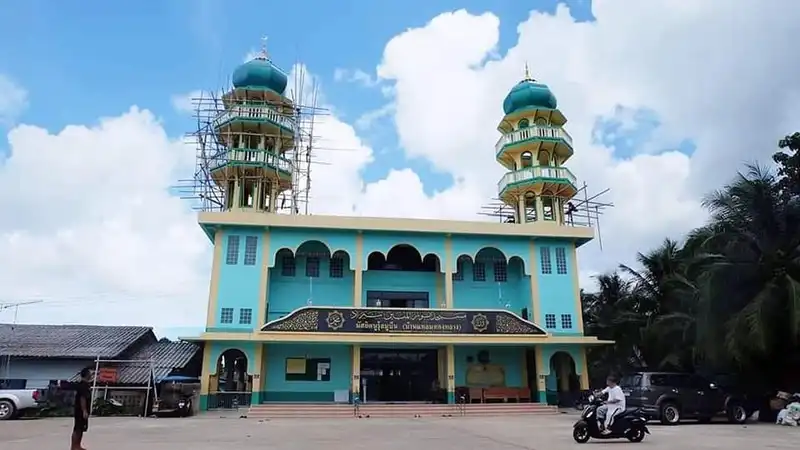
Seen with the naked eye today, the mosque appears as a structure that blends modern reinforced concrete forms with the architectural details of the old surau. The prominent hipped roof that once dominated the skyline has been altered several times, but the core idea of being a “house of the community” remains clear. In front of the building is a wide courtyard used for large congregational prayers and community events, while above stands a tall minaret that continues to call the faithful to gather at the mosque.
Architecturally, one of the most interesting features is the series of arches around the building, echoing Middle Eastern and colonial influences. Carved wooden fretwork decorates the verandas and gable lines, while some curves reflect Chinese artistic influence. Combined with the colors of the building and the mosque’s silhouette, Nurul Mubin Mosque has become a favorite photo spot for locals and visitors who love vintage Thonburi atmospheres.
As for the religious life inside the mosque, Imam Rosidee Onwan currently serves as the resident imam, working together with the mosque committee to oversee religious affairs and community activities. The mosque holds congregational prayers five times a day (salat al-jama’ah), Friday prayers (Jumu’ah), as well as Eid al-Fitr and Eid al-Adha prayers. There are also Quranic classes for children and youth, religious lectures, and various community-based Islamic activities throughout the year.
During Ramadan, Nurul Mubin Mosque and its surrounding community become especially lively. A Ramadan market springs up, filled with halal food and traditional sweets — Thai dishes, Malay dishes, and old-style desserts such as khanom bodin and khanom kari, along with a wide variety of street food. Every evening before iftar (breaking the fast), the area in front of the mosque is crowded with both locals and visitors coming specifically to buy delicious food, making it one of the best times to visit the Bansomdej neighborhood.
The area around the mosque is also famous for its variety of halal eateries lining Soi Itsaraphap 15 and nearby streets, from fried chicken and chicken biryani to beef noodles and desserts. Examples include Moolina Fried Chicken, Khao Mok Kai Na Rong Che, Musa Grilled Chicken in Milk, Mariam Coffee, Nifa Beef and Chicken Bitter Melon Noodles, and many more halal snack and fried food vendors. Food lovers seeking high-quality halal food in Bangkok often make Bansomdej Mosque area one of their must-visit spots.
As a Bangkok travel spot with a local flavor, Nurul Mubin Mosque offers an experience quite different from Buddhist temples and shopping malls. Visitors can walk from Bansomdejchaopraya Rajabhat University through narrow alleys lined with old wooden houses, small grocery shops, and family-run eateries before arriving at the mosque courtyard. You can admire the architecture, take photos, and, if you come before or after prayer times, have friendly conversations with community members to better understand the life of Thai Muslims.
Non-Muslim visitors are welcome, but should dress modestly. Women are advised to wear long-sleeved tops, long skirts or trousers, and cover their hair with a scarf or hijab. Men should avoid shorts above the knee. Shoes must usually be removed before entering the prayer hall, and visitors should avoid loud noise or walking directly in front of those who are praying.
The mosque is also connected to many important attractions on the Thonburi side, such as nearby Hiranyaram Temple (Wat Hirunruji), Prayurawongsawas Waraviharn, and Kalayanamit Woramahawihan along the Chao Phraya River, as well as ICONSIAM and Phra Phuttha Yodfa Bridge. Across the river are the Yaowarat and Sampeng districts. Choosing to stay in this area allows you to plan a culturally rich Bangkok trip that covers Muslim, Buddhist, and Chinese heritage within just a few kilometers.
Getting There: Nurul Mubin Mosque is located in Soi Itsaraphap 15 on Itsaraphap Road in Thonburi district. Parking in the soi is quite limited, so public transport is generally more convenient. The easiest way is to take the MRT Blue Line to Itsaraphap Station, then continue by taxi or motorcycle taxi to Soi Itsaraphap 15, which takes only a few minutes. Alternatively, you can take buses along Itsaraphap Road or cross-river ferries on the Chao Phraya River to piers such as Wat Kalayanamit Pier and then continue by local transport to Bansomdej junction, before walking into the soi following signs for “Bansomdej Mosque” to reach the mosque courtyard.
For those staying in hotels around Khlong San or ICONSIAM, such as riverside hotels or boutique hotels, it is easy to take a taxi via Somdet Phra Chao Taksin Bridge or Krung Thon Bridge towards Bansomdej–Itsaraphap. The route is fairly direct and not far from major tourist areas in Bangkok.
Looking at the overall picture, Nurul Mubin Mosque is not only a place of worship for Bansomdej Muslims, but also an important testament to the relationship between the Siamese court and the Bunnag family, the migration of Malay Muslims from the south, the flourishing of Islamic religious architecture on the Thonburi side, and the living halal food culture that continues from morning to night. For anyone wishing to see a softer, more hidden side of Bangkok, a walk into Soi Itsaraphap 15 to visit Nurul Mubin Mosque may become one of the most memorable experiences, no less impressive than visits to the city’s more famous landmarks.
| Name | Nurul Mubin Mosque (Bansomdej Mosque) |
| Location | Soi Itsaraphap 15, Itsaraphap Road, Hiranyaruji Subdistrict, Thonburi District, Bangkok 10600, near Bansomdejchaopraya Rajabhat University and Bansomdej junction |
| General Characteristics | An old mosque of the Bansomdej Muslim community serving as a center of religion, education, and daily life for Muslims on the Thonburi side, combining the role of a religious institution with that of a halal food hub and cultural learning site. |
| Period of Construction | Originally a wooden surau built around the reigns of King Rama IV–V; a permanent masonry building was erected around 1907 (B.E. 2450) and has been renovated and expanded between 1954–1962 (B.E. 2497–2505) up to the present. |
| Key Features / Elements | Permanent mosque building with a hipped roof, two-story octagonal minaret (saobang), carved wooden fretwork along the structure, an inverted-hull-style wooden ceiling (from the original building), and the kubor (cemetery) of the Bansomdej Muslim community. |
| Origin of the Name | Originally called “Bansomdej Surau” after the Bansomdej community. Later, Ustaz Ahmad Sihabuddin bin Saleh (Khru Sawat), a native of the community, gave the official name “Nurul Mubin Mosque” around 1958 (B.E. 2501), though locals still commonly refer to it as “Bansomdej Mosque.” |
| Highlights of the Mosque | Combines the historical legacy of the Bunnag family and the Malay Muslim community with Islamic religious architecture on the Thonburi side. It functions as a religious center, cultural learning space, and a renowned halal food neighborhood, especially during Ramadan. |
| Mosque Management | Imam Rosidee Onwan and the Nurul Mubin Mosque committee (details may change over time and should be reconfirmed for official contact or ceremonial matters). |
| Public Transportation | Take the MRT Blue Line to Itsaraphap Station, then continue by taxi or motorcycle taxi to Bansomdej junction and Soi Itsaraphap 15. Alternatively, take buses along Itsaraphap Road and cross-river ferries on the Chao Phraya River, then continue by local transport into the Bansomdej community. |
| Current Status | An active mosque serving the Bansomdej Muslim community, used regularly for worship and open to modestly dressed visitors who wish to observe the architecture and learn about Muslim life on the Thonburi side. |
| Facilities | Main prayer hall, open courtyard in front of the mosque, restrooms and ablution facilities (wudu). Limited parking may be available in front of the mosque and along the soi; facilities may change over time. |
| Entrance Fee | No entrance fee is charged to visit the mosque, but visitors should dress modestly, respect community rules, and may make donations to support the mosque according to their means. |
| Nearby Attractions (Approx. Distance) | Hiranyaram Temple (Wat Hirunruji) – approx. 0.3 km Prayurawongsawas Waraviharn Temple – approx. 1.2 km Kalayanamit Woramahawihan Temple – approx. 1.5 km Bansomdejchaopraya Rajabhat University – approx. 0.2 km ICONSIAM – approx. 3 km |
| Nearby Halal Restaurants + Distance + Phone | Moolina Fried Chicken – approx. 0.1 km, Tel. 083-558-7213 Khao Mok Kai Na Rong Che (Chicken Biryani Stall) – approx. 0.1 km, Tel. 080-249-5696 Musa Grilled Chicken in Milk – approx. 0.1 km, Tel. 081-452-6483 Mariam Coffee – approx. 0.1 km, Tel. 091-006-8424 Nifa Beef & Chicken Bitter Melon Noodles – approx. 0.2 km, Tel. 086-909-5998 |
| Nearby Accommodation + Distance + Phone | Aim House Bangkok Hotel (Khlong San) – approx. 2.5 km, Tel. 02-861-1128, 02-438-3188 The Pattern Boutique Hotel (Krung Thon Buri Road) – approx. 2.8 km, Tel. 082-424-2989 Amanah Bangkok Hotel (Somdet Phra Chao Taksin 4 Alley) – approx. 3.5 km, Tel. 02-466-6598, 02-466-6599 Away Bangkok Riverside Kene (Charoen Nakhon 35) – approx. 5 km, Tel. 02-437-2168 ASAI Bangkok Chinatown (Yaowarat) – approx. 4 km, Tel. 02-220-8999 |
Frequently Asked Questions (FAQ)
Q: Can non-Muslims visit Nurul Mubin Mosque?
A: Yes, non-Muslims are welcome to visit, but they should dress modestly with shoulders and knees covered. Women are advised to bring a headscarf or hijab, and visitors should follow the guidance of the imam or mosque staff. If you wish to take photos inside, it is best to ask for permission first.
Q: How should I dress when visiting Nurul Mubin Mosque?
A: It is recommended to wear long-sleeved tops or at least clothing that covers the shoulders, along with long trousers or skirts that cover the knees, and shoes that are easy to remove. Women should bring a headscarf or hijab. If you do not have one, you may ask at the mosque whether a covering is available to borrow, as a sign of respect for the place and its worshippers.
Q: What is the best time of day to visit Nurul Mubin Mosque?
A: Late morning to early afternoon (around 09:00–15:00) is generally the best time to walk around the building and its surroundings, as it is not too hot and less likely to disturb prayer times. During Ramadan, the area becomes especially lively in the late afternoon and evening due to the Ramadan market and numerous halal food stalls.
Q: Is there a Ramadan market or regular food stalls around the mosque?
A: There are halal eateries around Nurul Mubin Mosque all year round, serving breakfast dishes, chicken biryani, fried chicken, noodle soups, and desserts. During Ramadan, the area becomes even more vibrant, with a full Ramadan market offering a wide range of halal foods and snacks, making it an ideal time to experience local Muslim food culture.
Q: What should I keep in mind when taking photos inside and outside the mosque?
A: You are generally free to take photos outside the building, but try to avoid clearly capturing the faces of people who are praying. Inside the mosque, always ask the imam or staff for permission before taking pictures, and avoid using flash or loud shutter sounds that might disturb worship.
Q: How should I prepare if I want to join Friday prayers or Eid prayers at the mosque?
A: Muslims who wish to attend Friday or Eid prayers should arrive early to find parking and prepare themselves. Bring your own prayer mat if needed and follow the guidance of the imam and mosque committee. Non-Muslim visitors who wish to observe should ask for permission beforehand to ensure they do not disturb the worship of others.
 Nurul Mubin Mosque (Bansomdej Mosque) Map
 Category:
  Group:
  Tag: ●Nurul Mubin Mosque (Bansomdej Mosque)●nurul mubin mosque ●bansomdej mosque bangkok ●bangkok muslim community ●halal food bangkok ●ramadan market bangkok ●thonburi cultural attractions ●itsaraphap road travel ●islamic architecture bangkok ●local experiences bangkok ●bangkok halal street food Last Update: 2 MonthAgo
Comment
 Nearby Attractions
| Keyword (Advance) |
 Facebook Fanpage
 Region
 Art, Culture and Heritage
 Historical Sites and Monuments(
 Landmarks and Memorials(
 Royal Palace(
 Art, Craft Centres, Tradition(
 Museums(
 Historical Houses and The Ancient City(
 Art Gallery(
 Educational Places
 Museum for Study(
 Library(
 University
 Temple(
 Church(
 Other religious and spiritural sites(
 Research and Development
 Royal Project(
 Suburban Living
 Village, Community(
 Local Market(
 Floating Market(
 Nature and Wildlife
 River, Canal(
 Bays and Beaches(
 Other natural attractions(
 Entertainment and Agricultural
 Zoos and Aquariums(
 Animal camps and shows(
 Stadium(
 Farm, Parks, Gardens and Ecotourism(
 Amusement Park(
 Waterpark(
 Theater(
 Cinema(
 Shopping
 Shopping and Night Market(
 Department Store(
 Spas and Wellness
 Spas and Wellness(
 Restaurant
 Michelin Star(
 Accommodation
 Hotel(
 Call Customer Service in Tourism
 Call Customer Service in Tourism(
 Travel Articles, Recipes
 Travel Review, Food Review(
 Royal Thai Desserts, Traditional Dessert, Thai Dessert Recipes(
 Copyright 2012,